 By
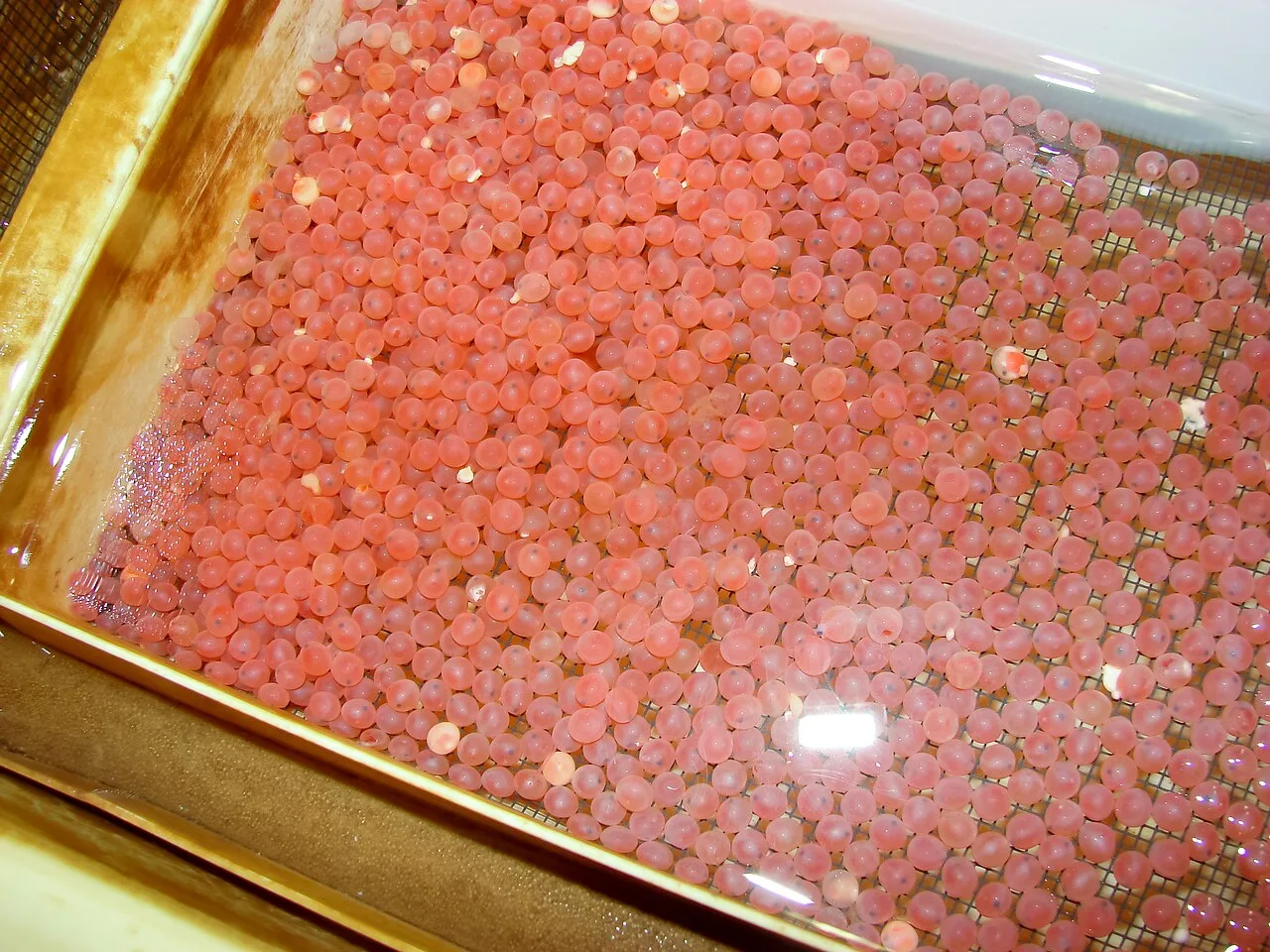
Salmon eggs are one of the best baits you can drift for trout, steelhead and salmon. For trout, buy a jar and fish one egg at a time. If you keep a female salmon, dust her eggs with borax, let them stand 12 to 36 hours, and you’ve got bait for the rest of the run.
A salmon in a river has quit eating. It’ll still hit an egg, and often so softly that your line just stops.
What are salmon eggs good bait for?
Trout, steelhead and every salmon that runs a river. New York calls eggs “one of the top producers” for its king and coho salmon in the creeks. In the West they also take mountain whitefish in winter, and California’s sturgeon anglers use roe too.
The reason is the calendar. A salmon that’s come in from the lake or the sea has stopped feeding. It still strikes, partly out of aggression and partly because eggs draw it in. Trout don’t need a reason at all. Every spawn, loose eggs tumble down the river past them.
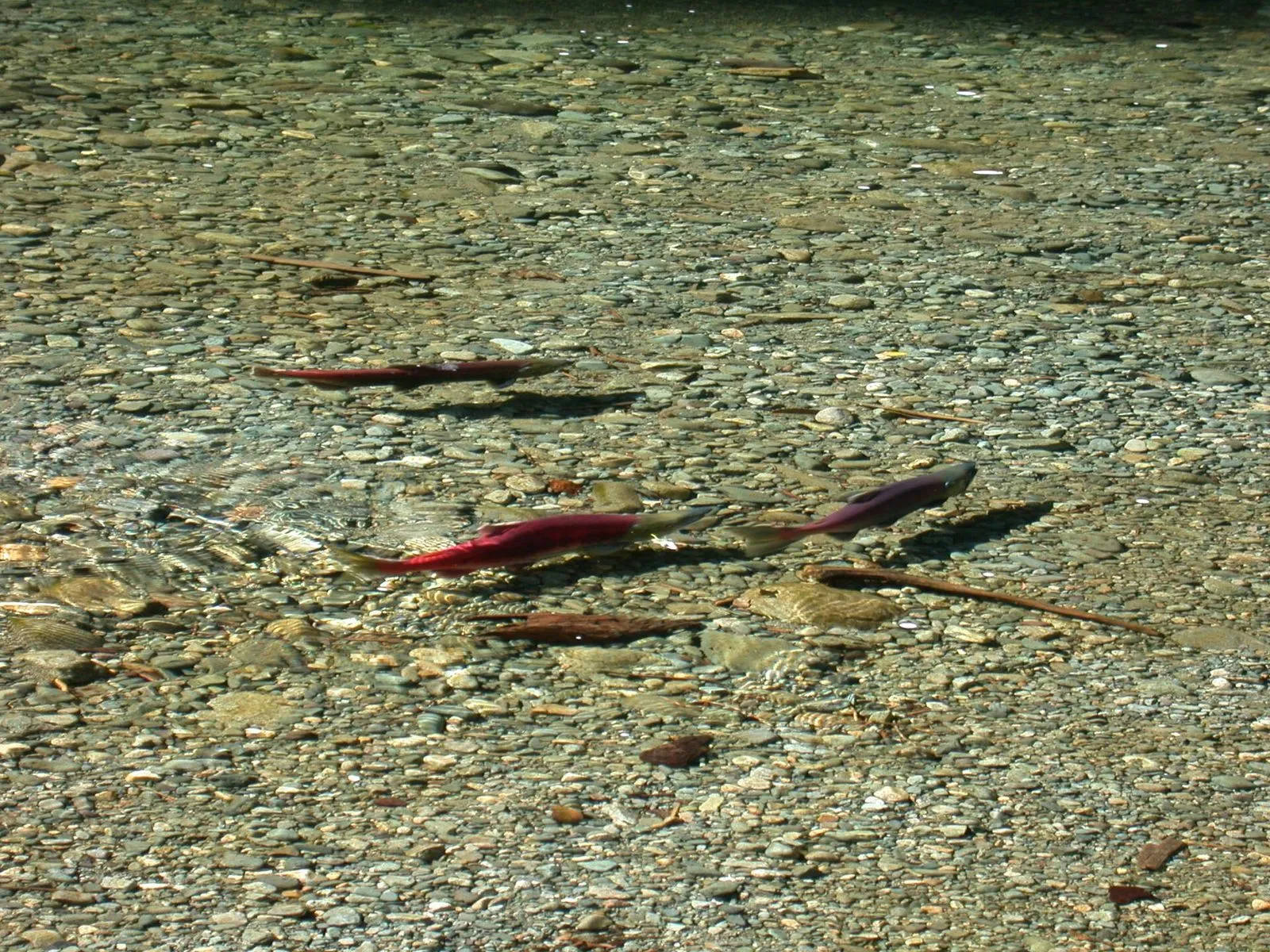
Sockeye on the gravel where they spawn. Every egg that drifts loose from here is a free meal downstream. Photo: Roger Hoffman for the National Park Service, Olympic National Park (public domain).
You’ll hear three words for the same thing. Roe and spawn both just mean fish eggs. A skein is a whole cluster still held in its membrane. On the hook, eggs come three ways:
- Single eggs. Cured, sold in small jars, one per hook. This is the trout bait.
- Clusters. A chunk of cured skein, tied on with an egg loop. This is the salmon bait.
- Spawn sacks. Loose eggs tied in a square of mesh. These are the steelhead and Great Lakes bait.
Should you buy salmon eggs or cure your own?
Buy them for trout. One small jar and a box of egg hooks is the whole kit. Pautzke’s smallest egg, the Tyee, is made for small streams and low, clear water, and the maker says it’s most effective on 2-pound line and a single egg hook. Run the point shallow through the side of the egg and push the hook up inside it, because a soft egg flies off on a hard cast. The right hook size for trout here is a #10 to #14.
Cure your own when you’ve kept a salmon. Nothing else gives you a skein that fresh, and one Great Lakes guide puts the work at about ten minutes a batch. Store-bought cured skein is the fallback when you don’t have a fish to cut.
Free PDF · Water temperature chart When do salmon bite?
One reading, and the 16-page chart shows which of 26 fish are spawning, feeding hard or slowing down; for bass, crappie, bluegill and walleye, where they sit and what to throw. Every number sourced.
No card, nothing to buy, and the PDF is yours to keep. Confirm with one click and it's on its way. Then a few short emails and one a week on what's biting. Unsubscribe anytime. Privacy.
How do you cure salmon eggs?
Start with plain borax. It has no sulfites, Oregon suggests it for home cures, and you only need the one powder. Borax toughens the eggs, keeps their looks and stops bacteria, so a cluster stays on the hook longer than a fresh one will.
- Bleed the fish right away. Cut the gills as soon as you decide to keep it, and keep the blood off the eggs.
- Keep the skeins dry and cold. Slide them into a plastic bag and pack it in ice. Keep water off them from here on.
- Cure within 24 hours. Sooner is better. A skein sealed in the fridge will hold up to a week if you have to wait.
- Get the blood off. Lay the skeins on paper towels or cardboard for an hour. Give a bloody one a quick rinse in cold water at most. Never soak it.
- Cut bait-size pieces. Use sharp scissors or pull them apart along the natural seams. Cut them to the size you’ll fish.
- Dust and wait. Spread a thin layer of borax on a big sheet of paper. Set the clusters on it, dust them well, and leave them 12 to 36 hours somewhere cool and dry.
- Jar them up. When they’re as firm as you like, pack them in wide-mouth jars with airtight lids.
Softer clusters stay on the hook better tied in a piece of nylon stocking, Oregon State’s guide says. That’s a spawn sack you already own.
Six cures, side by side
Everybody has a recipe. These six are written down with real amounts, so you can compare them before you buy anything.
| Cure | Amount and time | What you get |
|---|---|---|
| Plain borax | Dust clusters, 12–36 hours cool and dry | Tough clusters, no sulfites, the simple start |
| Equal parts salt, sugar, borax | Layer in a container, overnight in the fridge or until firm, then roll in borax | No drying step. Don’t overdo it: the eggs won’t take the juice back |
| Borax-salt-sugar brine | 1 cup each in a quart of water, 1–1.5 hours, air dry until tacky | Tough eggs, and food coloring goes right in the mix |
| Fire Cure, dry | 4–6 heaping tablespoons per pound, 6–8 hours on the counter, then 24–48 in the fridge | Deep red, milks a heavy scent trail. Contains sulfite |
| BorX O’ Fire, dry | 24 hours at room temperature, tumbled every 15 minutes for the first 2–3 hours | Drier and gummier, milks less. No sulfites in the cure, though Inglin stirs a tablespoon into his own mix |
| Red Fire Brine, frozen block | Whole bottle plus 1/2 cup Red Fire Cure, at least 24 hours | Frozen eggs cured as they thaw. For firmer eggs, dry 4–6 hours with a fan, 8 without |
Which one fits depends on the skein. Loose skeins, where the eggs come away easily, go in BorX O’ Fire. Tight skeins get Fire Cure, says Northwest radio host Duane Inglin. Color is the other choice: pink in clear water, red when it’s murky. Wear rubber gloves with anything dyed.
Does it matter which cure you use?
It matters to the fish you’re hoping to catch in a few years. Oregon’s fish and wildlife department warns that sodium sulfite, in some egg cures, “can be toxic when consumed by juvenile salmon and steelhead.”
In Oregon’s feeding tests, about 13 of every 100 young fish died on eggs from one sulfite cure. Take the sulfite out of that same cure and none did. Nobody knows how many eggs wild fish really eat, so nobody can say what it does to a whole run. It’s still an easy thing to get right:
- Buy eggs and cures labeled “meets Oregon guidelines.” Amerman’s, Pautzke, Pro-Cure and TNT all have products on Oregon’s list.
- Making your own? Use borax instead of sodium sulfite.
- Don’t add extra sulfite to eggs that are already cured.
- Don’t dump leftover eggs in the river. Little fish eat them.
- Think about tying your eggs in net. It makes them harder for young fish to eat.
How do you tie a spawn sack?
A sack is just eggs in a square of mesh, and you can tie a dozen at the kitchen table. New York’s creek anglers tie them the size of a dime or a nickel.
- Lay out squares of spawn netting, 3 or 4 inches across, and spoon eggs into the middle of each.
- Count your eggs. A dime-size sack holds 4 king eggs or 7 to 8 steelhead eggs. A quarter-size sack holds about 20.
- Gather the four corners, twist, and pinch the mesh tight against the eggs.
- Wrap thread around the neck 10 times and pull it tight.
- Trim the mesh with scissors, but not too close to the knot.
- Hook it through the netting on the side away from the knot.
Tie all three sizes before you go. Start with the biggest, and step down after a couple of drifts without a bite. Use white or peach netting in clear water, and pink or chartreuse when it’s dirty.
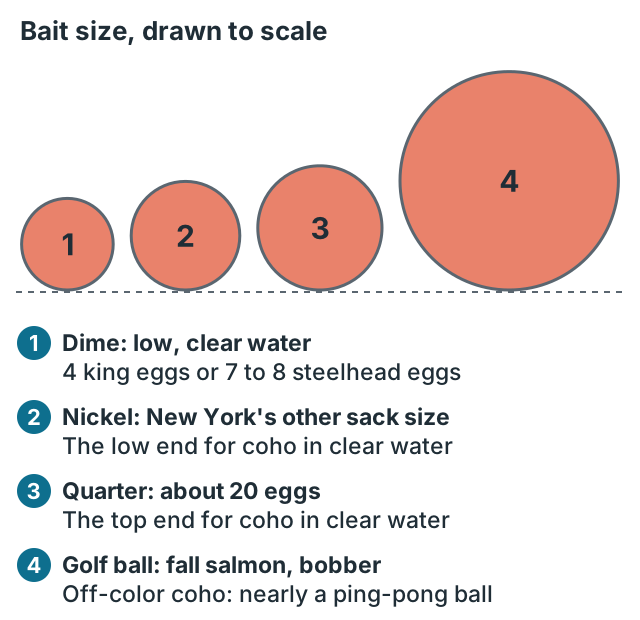
How big your bait should be, drawn to scale. Drawing: fishing.info.
How do you fish salmon eggs?
Start under a bobber. It’s the easy way in, and Oregon’s own advice on drift fishing is that “you can lose a lot of gear.” A float suits slow water, and rods of 10 to 12 feet are not unusual for it, Washington says.
Whatever the rig, your eggs need to pass at the fish’s eye level, just off the bottom. That’s the whole job.
| Fish and water | Bait | Rig |
|---|---|---|
| Trout, small clear stream | One jarred egg | #10–#14 egg hook, split shot or a float near inlets |
| Steelhead, Great Lakes creeks | Sack, dime to quarter | Float, 8 lb mono, 4–6 lb fluoro leader |
| Coho, low clear water | Nickel to quarter cluster | Float, size 2 to 2/0 octopus hook, egg loop, 18–36 in of 20 lb fluoro |
| Coho, off-color or glacial water | Nearly a ping-pong ball | Same rig |
| Fall salmon under a bobber | Golf-ball cluster | 2/0 hook, egg loop, 2 ft of 25 lb leader, 1–3 oz lead |
| Salmon, drift fishing | Cluster with corky and yarn | Single hook, egg loop, 12–48 in leader, 20–25 lb line for kings |
The egg loop goes on an octopus hook. It’s a snell with a loop left in it that pinches the cluster against the shank.
Under a bobber. Set the stop so the weight rides about a foot off the bottom. Use one ounce in slow, shallow water and two to three in deep, fast water. In low, clear water, go lighter still.
On a drift. Cast upstream and let the bait bounce along the bottom at about the speed of the current. Reel in and do it again. Washington’s standard rig is an 8 1/2- or 9-foot rod rated for 15 to 30 pound line. Its standard setup puts a corky, a small drift bobber, on the line above the hook and a piece of yarn on the hook.
What a bite feels like
It rarely feels like much. Salmon seldom smash a bait. Your line will “simply stop, hesitate, or dart forward slightly,” New York says. Under a float, reel up the slack first, and when you feel weight, set the hook.
How do you store cured salmon eggs?
Plan on a few weeks in the fridge in an airtight jar, and freeze what you won’t fish by then. Anglers report longer than that, up to a couple of months in the fridge and a year or two frozen.
Don’t freeze eggs in water. Air ruins them in the freezer too, so double-wrap the batch or seal it to keep the air out. Thaw at room temperature. Skeins frozen raw can still be cured later, though they milk out faster because ice pokes holes in the skin of each egg.
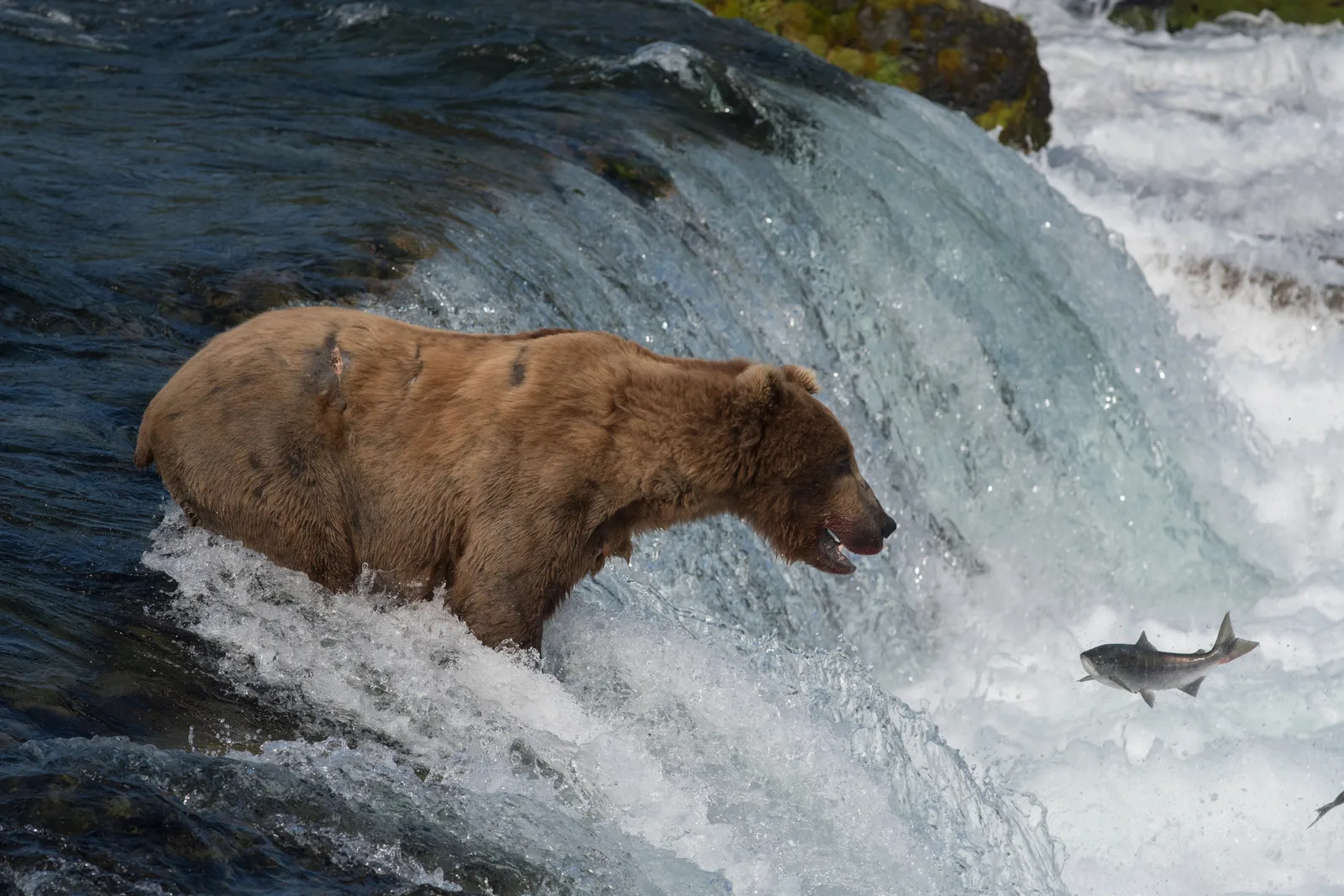
A brown bear fishing for sockeye at Brooks Falls, Katmai National Park, Alaska. Photo: EEI_Tony / Depositphotos.
Where are salmon eggs not allowed?
Anywhere bait is banned. Washington’s selective-gear rules, for one, limit you to artificial flies or lures with single-point barbless hooks and say “bait is prohibited.” Read your state’s rules for the exact stretch you’re fishing, including whether a barbless hook is required. Where bait’s banned, a bead or an egg fly may still be legal.
The Great Lakes add a disease rule. Wisconsin’s rules against VHS, a fish virus, let you use Lake Superior spawn on Superior waters fresh, refrigerated or frozen. Lake Michigan spawn can only go on Lake Superior if it’s first preserved by a method that needs no refrigeration or freezing. The Wisconsin DNR suggests “not using Lake Michigan spawn at all when fishing Lake Superior or its tributaries.” Michigan dropped its restriction on roe in the exclusion zones in 2016, because fish eggs haven’t been documented moving VHS. Check this year’s guide before you trust either rule.
Mistakes that cost you the batch
- Letting water touch fresh skeins. Keep them dry from the fish to the cure.
- Over-curing. A skein left too long in salt, sugar and borax won’t plump back up.
- Waiting. Cure within a day of the fish if you can.
- Fishing them too high. Your bait has to reach the fish’s eye level. Add lead until it does.
- Going big in low, clear water. Tie the dime or the nickel and save the golf ball for dirty water.
Can you eat salmon eggs?
Yes, salted fresh salmon eggs are ikura. Oregon State’s recipe uses eggs under 24 hours old, 1/2 cup of salt in 2 cups of cold water, and 30 minutes. Never eat eggs cured for bait. The same guide says it in capitals: eggs processed into fish bait “are NOT edible.”
When the next question is what to do with the fish itself, start at the salmon hub and pick your species.

Free PDF · 16 pages
Stop guessing. Know what's biting before your first cast
A whole Saturday on the water with nothing to show for it. One reading tells you who's feeding.
The Water Temperature Fishing Chart. Take one water temperature reading, find it on the chart, and see which of 26 freshwater fish are spawning, feeding hard or slowing down.
- Where bass, crappie, bluegill and walleye sit, and what to throw. Trout: the reading where you stop.
- Why a 3 ft drop beats a cold front, and what to throw each day of the front
- The three thermometer mistakes that make a reading lie
The chart's numbers come from state fish and wildlife agencies and fisheries research: 61 sources, each listed on the site.
No card, nothing to buy. Confirm with one click and the PDF is on its way, one version for your phone and one to print, yours to keep. Then a few short emails and one a week on what's biting, with an unsubscribe link in every one. Privacy.
Related
Section guide
Types of Salmon: The Five Pacific Species and the Atlantic, Told ApartThe six types of salmon a North American angler meets: chinook, coho, sockeye, pink, chum and Atlantic, by gum line, tail spots, size and record.
 Atlantic Salmon: Where You Can Still Fish for One, and How to ID It
Atlantic salmon: the sea-run fish is off limits in the US, but landlocked salmon bite in Maine and Michigan. How to ID one, catch one and buy one.
 King Salmon (Chinook): Black Gums, Size, Runs and the 97-Pound Record
King salmon, or chinook: the black gums that mark a king, how big they get from Alaska to the Great Lakes, when each run starts, and the 97 lb 4 oz record.
 Kokanee Salmon: The Landlocked Sockeye, Season by Season
Kokanee salmon are sockeye that never reach the sea. How to tell one, the 50 °F depth they hold at each season, how to troll for them, and the record.
 Pink Salmon: Odd-Year Runs, How to Tell a Humpy, Size and Records
Pink salmon live two years, so Puget Sound gets humpies only in odd years. When they run, how to tell one from a king, how to catch it and the record.
 Sockeye Salmon: How to Tell a Red, Where They Run, and the Record
Sockeye salmon: a 4–15 lb red salmon that needs a lake. Tell it from a chum, find the runs from Bristol Bay to Lake Washington, hook one, and the record.
 Coho Salmon: How to Tell a Silver From a King, Catch One and Eat It
Coho salmon: the white gum line that tells a silver from a king, when they run from Alaska to the Great Lakes, how to catch them, the record, the taste.
Sources (25)
- Oregon Department of Fish and Wildlife, Fishing with Cured Eggs
- Clements, Chitwood and Schreck (2011), Effect of commercially available egg cures on the survival of juvenile salmonids, PLoS ONE
- Oregon State University Seafood Network, Fish Eggs For Caviar And Bait
- New York DEC, Pacific salmon fishing
- Washington Department of Fish and Wildlife, Freshwater salmon fishing
Show all 25 sourcesShow fewer sources
- Oregon Department of Fish and Wildlife, 10 tips to catch more winter steelhead
- Wisconsin DNR, How VHS rules affect anglers
- Michigan DNR bulletin, New bait regulations protect against fish disease, invasive species (April 19, 2016)
- Washington Statewide Freshwater Regulations
- Pennsylvania Fish and Boat Commission, intro to PA steelhead fishing reference guide
- Idaho Fish and Game, mountain whitefish in winter
- California Department of Fish and Wildlife, White Sturgeon (fishing)
- Pautzke Bait Co., Balls O' Fire salmon eggs, Tyee
- Todd Daniels, Try This Super Easy Egg Cure for Northwest Salmon (Pautzke)
- Duane Inglin, Which Cure Should You Use For Salmon: FireCure or BorX O Fire? (Pautzke)
- Troy Whitaker, How to Cure Frozen Eggs (Pautzke)
- Kyle Deavers, Learn the Simplest Great Lakes Salmon Cure (Pautzke)
- James Swearingen, From the Bait Lab: Spring Spawn Sack 101 (Pautzke)
- James Swearingen, Spawn Sac Season is Back: Quick Refresher on How to Tie Sacs (Pautzke)
- Terry J. Wiest, Learn To Rig A Bobber & Eggs For Fall Salmon (Pautzke)
- JD Richey, Float and Egg Fishing for Silvers (Fish Alaska)
- Luigi De Rose, Curing Trout and Salmon Eggs Made Easy (MidWest Outdoors)
- Steelheader.net, Curing roe
- Outdoor Life (Joe Cermele), How to fish salmon eggs for trout
- Washington Administrative Code, WAC 220-300-160, Definitions: Personal-use fishing