 By
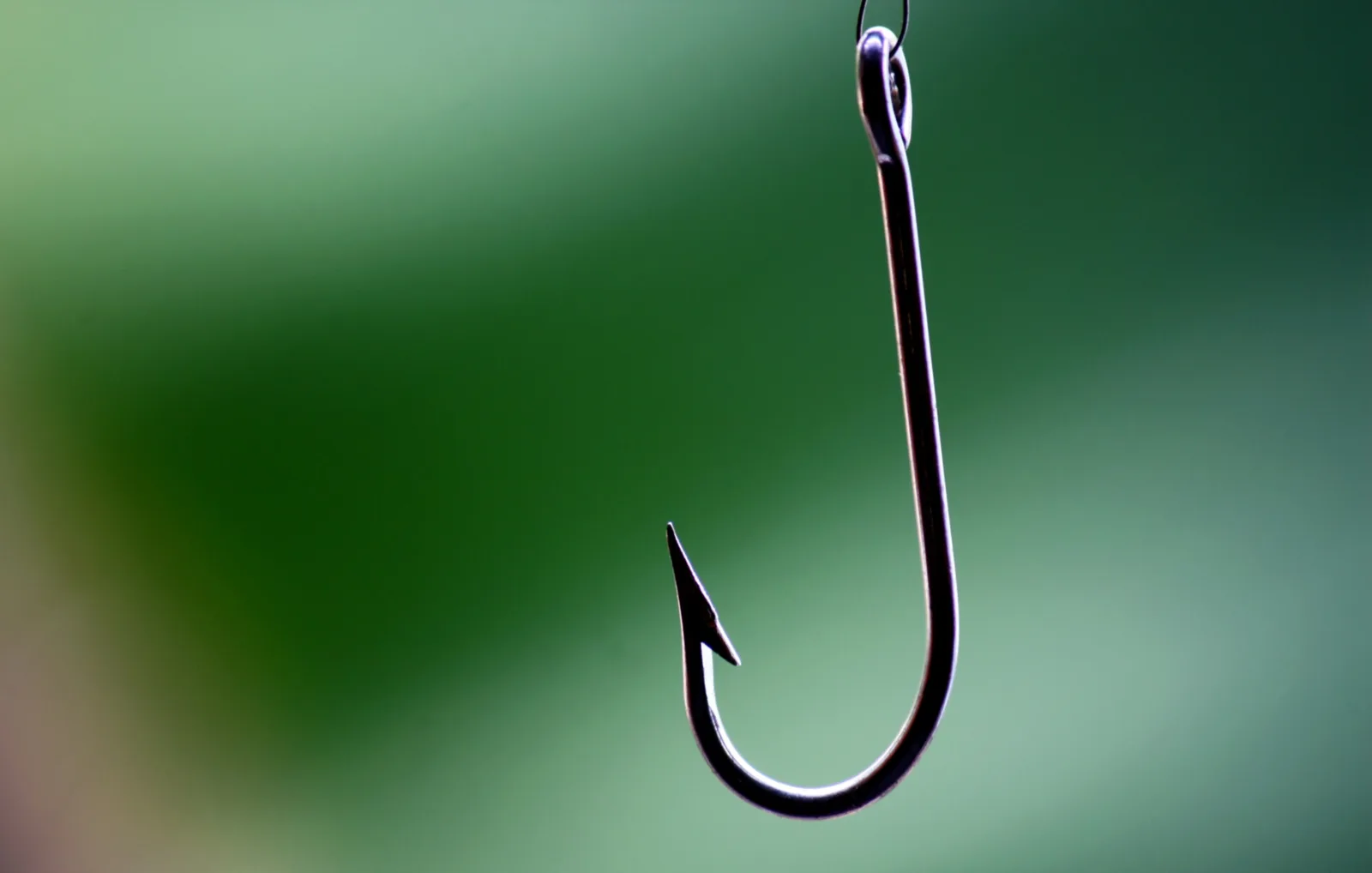
A J hook is the classic fishing hook shaped like the letter J: a straight shank, a round bend and a point that runs parallel to the shank. Because the point faces back up toward the eye, it bites into whatever the pull drives it against, so you set it the moment you feel the fish. That makes it the hook for bait you watch and set on, from a worm under a bobber to a minnow for walleye, and for plastics and lures you work. It is the wrong hook for a bait left in a rod holder for a catfish, which is the circle hook’s job.
In a study of 618 bluegill, light and moderate hook-sets landed 1.58 and 1.70 times the odds of a heavy, abrupt one. A hard snap of the rod loses panfish.
What is a J hook used for?
Nearly all bait fishing that is not done with a circle hook, and the single hooks on soft plastics and many lures. Academy’s hook chart sums the type up as “general purpose; used with live bait and lures”. What every use shares is the job: a J hook is for the fish you strike while the bait is still in its mouth. Think of bluegill and crappie on a worm or a minnow, trout on a nightcrawler, walleye on a leech, or bass on a live shiner you watch. It also suits a bait you work, because the strike comes while the line is tight and you are holding the rod.
Which hooks are J hooks?
“J hook” is not a maker’s category but the shape, and most of the bait hooks on a tackle rack share it. New York’s DEC calls the Aberdeen “the classic j-shaped hook”, with a “long shank that makes it easy to remove the hook” from a panfish. The patterns below are all J hooks; they differ in shank, wire and eye.
| Pattern | How you recognize it | What it is for |
|---|---|---|
| Aberdeen | Long shank, light wire | Minnows and worms for panfish and trout; the light wire is “less likely to kill the bait” (Academy) |
| Baitholder | “Two barbs on the shank to help prevent bait from sliding down to the bend” (NY DEC) | Worms, the classic nightcrawler hook |
| O’Shaughnessy | Long shank, forged wire | Salt water: Mustad’s 3407 is for “long natural baits, such as whole fish heads/tails, squid or crabs”, slow trolled or still |
| Octopus | Short, curved shank, up-turned eye | Leeches, minnows and other small live baits |
| Offset worm hook | A Z-bend under the eye that pins the plastic | Texas-rigged and Carolina-rigged soft plastics |
| Inline single | Eye turned in line with the shank | Replaces a treble on a plug |
Sproat and Kirby are not types: Sproat is a bend and Kirby a point bent sideways, old names still printed on the packet; the types of hooks page explains them and sets the J beside the circle, Kahle and treble.
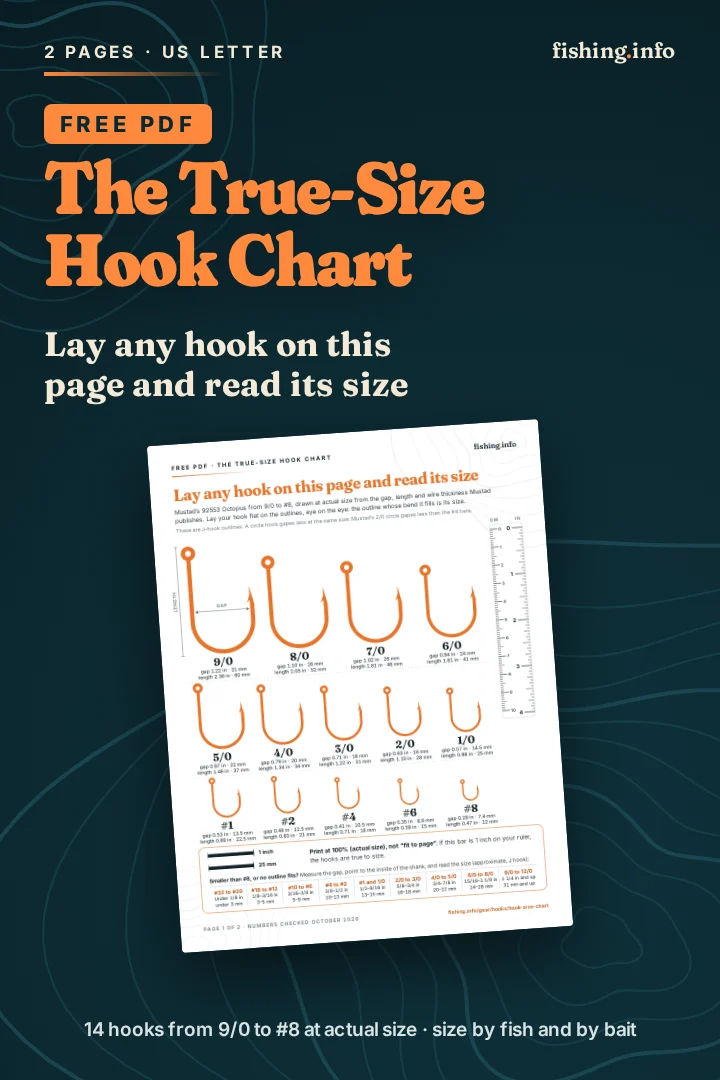
Free PDF · Hook size chart What size is that hook? Lay it on the chart.
Print the free chart, lay any hook on it and read its size: 14 hooks from 9/0 to #8 at actual size, a gap ladder from #32 to 12/0, and the size for 17 fish and 16 baits on the back.
No card, nothing to buy, and the PDF is yours to keep. Confirm with one click and it's on its way. Then a few short emails and one a week on what's biting. Unsubscribe anytime. Privacy.
Can you put a J hook on a lure or a soft plastic?
Yes, and on a Texas rig you already do. Owner’s wide-bend worm hook is sold simply as the J Hook, and Tackle Warehouse pitches it for “Carolina- and Texas-rigging lizards” and other big plastics, with a “Z-Lock shoulder bend” that keeps the bait in place. The hook-set works as it does with bait. NY DEC’s rule for a plastic worm is to wait for a tap or some resistance, then set.
On hard lures, a J hook is the single that replaces a treble hook. For re-rigging plugs, Hogy Lures recommends an inline hook, whose eye is turned in line with the shank. A plain J hook on a split ring hangs sideways unless you add a second ring. Rig the belly hook point down and the tail hook point up, the common practice Hogy describes, and a strike from any side meets a point. The payoff is in the release: Hogy finds J hooks “easier to unhook fish, reducing handling time and potential harm”.
Why does a J hook need a hook-set?
The point does not turn. On a J hook it faces up the shank, so a pull on the line drives it straight into the first thing it touches: lip, jaw or, if the fish has swallowed the bait, the throat. NY DEC’s beginners’ guide gives the move: “raising your rod in a fast upward motion, which causes the hook point to penetrate the fish’s mouth”. A circle hook works the other way: its point faces the shank, slides out of the throat and turns into the corner of the jaw on a steady pull, so you reel instead of striking.
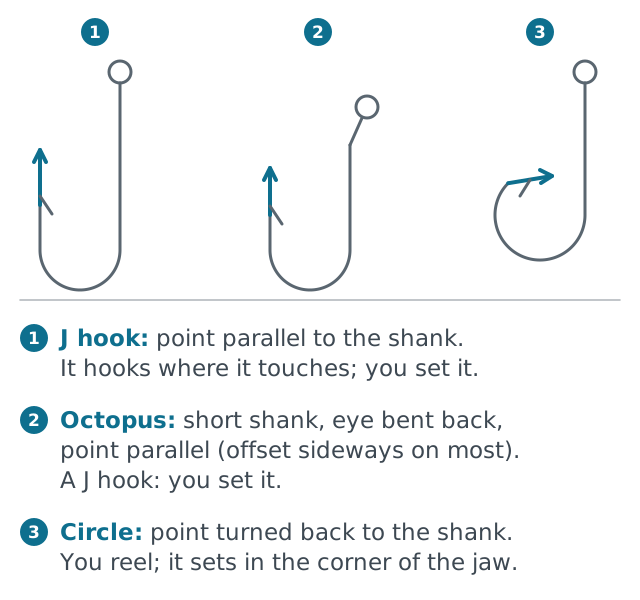
Timing matters more than force. Missouri’s conservation department puts the rule in one line: “You can usually avoid having fish swallow the bait by setting the hook the moment you feel or see a strike.” A J hook set at the first pull hooks a fish in the mouth. Set late, it is in the gullet.
How hard should you set a J hook?
Less hard than “set it hard” suggests. Robert Lennox and colleagues caught 618 bluegill in Lake Opinicon, Ontario, with live bait on J and circle hooks. Each fish was hooked with one of four hook-set styles: no set at all under a bobber, or a light, moderate or heavy set. The heavy, abrupt set did worst. Its odds of landing the fish were 0.70 of the no-set bobber’s, and the light and moderate sets landed 1.58 and 1.70 times the heavy set’s odds.
The moderate set is the one to copy. The study describes it as “a moderate, sweeping hook-setting action, drawing the rod tip steadily backward”. Leaving the bobber to do the work had its own cost: with no set, the fish swallowed the bait and deep hooking was highest. The lesson for a panfish angler is a firm sweep at the first pull, not a wait and not a snap.
When does a J hook catch more fish?
On fish that nibble and on bait you watch, it out-catches a circle hook. On fish that take a bait and run, it does not. Three studies measured it directly, and a 2004 review of 43 studies draws the same line.
| Study | Fish and method | J hook | Circle hook | What it means |
|---|---|---|---|---|
| Lennox et al. 2015 | 618 bluegill, Ontario; live bait | Capture odds 1.27 times the circle’s; deep-hooking odds 2.36 times | Fewer landed, fewer deep-hooked | Panfish: the J catches more and hooks deeper |
| Ostrand, Siepker and Cooke 2006 | Juvenile muskellunge; live baitfish fished actively | 41% capture efficiency | 21% | Worked bait: the J wins; no deaths on either hook |
| Willey, Barker and Sampson 2016 | Sharks off Maryland, charter trips 2012–2014 | 75% of strikes hooked, 68% landed; 6% of hooked fish deep | 91% hooked, 88% landed; 3% deep | A fish that runs with the bait: the circle wins |
| Cooke and Suski 2004, review | 43 studies, 25 species | — | Capture efficiency “remains high” for tuna, billfish and striped bass | For largemouth bass, circles reduced the catch for “minimal conservation benefit” |
The pattern is the angler’s choice. Pick the J hook when you hold the rod, watch the line or bobber and set at the bite: panfish, trout, walleye, bass on live bait. Pick the circle when the rod sits in a holder and the fish swims off with the bait: catfish, sharks, striped bass on chunks. Hooking location and release mortality are where the J hook loses: in the billfish studies Florida’s FWC summarizes, J-hooked fish were 21 times more likely to bleed. That half of the research is on the circle hook vs J hook page.
Where do saltwater captains still pick a J hook?
Where the mouth is small, where the bait has to lie straight, and where the fish chops the bait in half. Steve Waters asked charter captains in New Jersey, Florida and California for Sport Fishing Magazine, and their answers make a table.
| Fish | Bait or method | J hook used | Why the J |
|---|---|---|---|
| Tautog (blackfish) | Crab, legs and claws cut off | 3/0–4/0 J or octopus | The wide gap hooks a crab; the tautog’s crushers usually keep the hook out of the gut |
| Winter flounder | Sand or blood worms threaded on | 2/0–3/0 long-shank J or baitholder | A very small mouth; the long shank gives leverage to unhook and release |
| Tuna, mahi | Rigged ballyhoo, trolled | 6/0–8/0 J, by bait size | A J lies flat in the bait; “it’s next to impossible to thread a bait on a circle hook” |
| Kingfish (king mackerel) | Live bait, where no sailfish are around | J | Kings bite off the tail or cut the bait in half, then eat the chunk, and the J’s hookup ratio is higher; 5–10 lb kings are harder to hook on a circle |
| Yellowtail, yellowfin tuna | 3–4 in (8–10 cm) live sardine, collar-hooked | #4 and #2, up to 1/0 or 2/0 | “A J hook hurts the bait less”, so it swims well |
| Striped bass | Swimming plugs | Inline J in place of the trebles | Easier to remove from a striper’s mouth |
The tautog, flounder, trolling and striper rows are Capt. John Luchka’s, of Point Pleasant, New Jersey; the kingfish row is Fort Lauderdale’s Tony DiGiulian and the yellowtail row San Diego’s Jamie Thinnes. The same captains switch when the fish changes. Thinnes uses circle hooks for bluefin tuna, which roll and spit a J hook, and DiGiulian runs circles for the mahi he means to release. And on the Atlantic coast a striper fished with bait, not a plug, needs a circle by law.
How do you fish a J hook?
- Size the hook to the bait, not the fish. For panfish, NY DEC says size 6 to 8 Aberdeen hooks “work best”. A #6–#8 baitholder takes a whole nightcrawler for trout, and #4 to 1/0 suits walleye, bass and bullheads on a whole crawler or a minnow. The hook size chart has every bait.
- Leave the point covered or nearly so. Thread a worm over the bend for bluegill so they cannot strip it.
- Keep a tight line. Slack between you and the bobber is the time the fish has to swallow the bait.
- Set at the first real pull. A bobber that goes under or a line that moves off is the signal; for panfish, do not wait for a second tap.
- Sweep, do not snap. Draw the rod tip steadily back and up, the moderate set from the bluegill study.
- Reel with the rod bent. The barb holds only while the line stays tight.
- If it is swallowed, cut the line. A fish that is gut-hooked lives more often with the hook left in than torn out.
What size J hook for each fish?
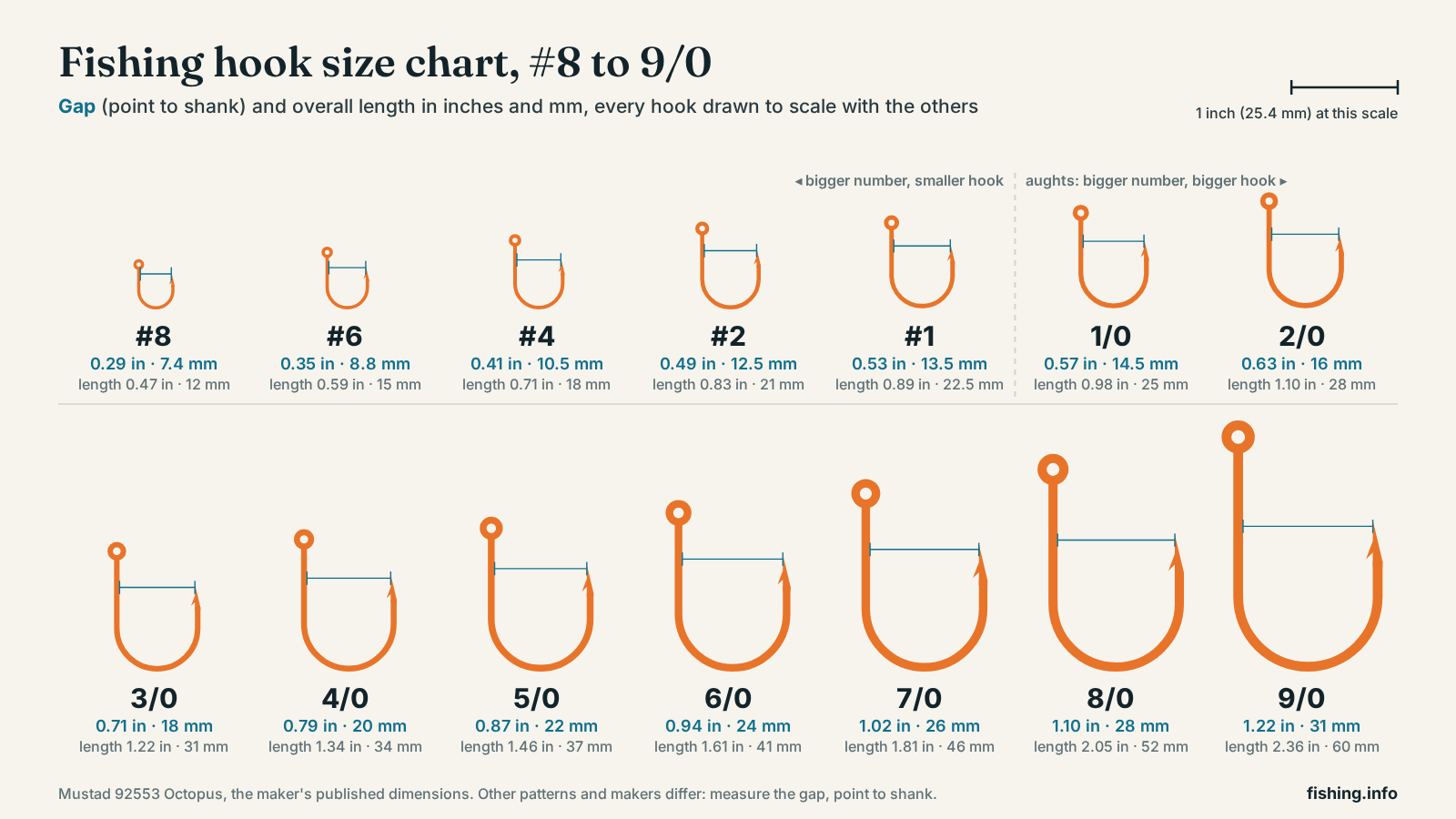
Sizes run two ways. From #1 down, the bigger the number the smaller the hook, so a #10 is smaller than a #6. From 1/0 (“one aught”) up, the number grows with the hook, so a 4/0 is bigger than a 1/0. A #1 and a 1/0 sit side by side in the middle. Academy’s chart puts most J hooks between #10 and #1, and these are its J-shaped picks by fish.
| Fish | J pattern | Size | Fishing |
|---|---|---|---|
| Bluegill, sunfish | Aberdeen | #8–#12 | Light tackle, float |
| Perch | Aberdeen | #6–#10 | Light tackle, float |
| Trout | Single hook | #10–#14 | Spinning |
| Walleye | J hook | #4 to 1/0 | Live bait, jigging |
| Lake whitefish | J hook | #6–#10 | Light tackle, jigging |
| Smallmouth bass | Worm hook | 2/0–3/0 | Live bait, small soft plastics |
| Largemouth bass | Worm hook | 3/0–5/0 | Live bait, large soft plastics |
| Flounder | J hook | 1/0–3/0 | Bottom fishing |
| Pompano | J hook | #2–#4 | Surf |
| Yellowtail | J hook | 2/0–4/0 | Live bait, jigging |
So how big is a #4? On Mustad’s octopus hook, a #4 gapes 0.41 in (10.5 mm) and runs 0.71 in (18 mm) long; a #6 gapes 0.35 in (8.8 mm) and a 1/0 about 0.57 in (14.5 mm). The hook size chart has the gap, length and wire for every size from #8 to 9/0, and sizes by bait.
Are J hooks illegal anywhere?
Only with bait, in a handful of saltwater fisheries and on the Atlantic coast for stripers. Federal law defines a circle hook as one whose point is “turned perpendicularly back to the shank to form a generally circular, or oval, shape”, and these rules require one:
- Gulf reef fish in federal waters. “Non-stainless steel circle hooks are required when fishing with natural baits”, plus a dehooking device on board (50 CFR 622.30).
- South Atlantic snapper and grouper in federal waters. Non-offset, non-stainless circle hooks with natural bait north of 28° N; south of that line, any hook with natural bait must be non-stainless. In force since July 15, 2020 (50 CFR 622.188).
- Atlantic striped bass, Maine to North Carolina. Inline circle hooks with bait, since January 1, 2021; the circle hook page has the rule by state.
- Atlantic sharks. Holders of a federal permit with a shark endorsement must use non-offset, corrodible circle hooks for sharks, except with flies or artificial lures (50 CFR 635.21).
- Atlantic billfish tournaments. Permit holders fishing a tournament with points or prizes for billfish “may not deploy a J-hook or an offset circle hook” with natural bait or a bait-and-lure combination (50 CFR 635.21). An artificial lure alone is outside the rule.
So are J hooks legal in Florida? For most fishing, yes. Not with natural bait for reef fish in federal Gulf waters or north of 28° N on the Atlantic, and not for sharks under a federal permit; Florida’s own reef-fish hook rule is in the circle-hook page’s table. Stainless J hooks are what these rules shut out: a stainless hook left in a released fish does not rust away.
Which mistakes cost fish on a J hook?
- Waiting. A second and a third tap is a fish swallowing the bait. Set at the first pull.
- Snapping the rod. The bluegill study’s heavy set landed the fewest fish; sweep.
- A hook too big for the mouth. A 1/0 under a bobber for bluegill gets stripped bare; drop to a #6 or #8.
- Burying a heavy hook in a soft bait. The point has to get through the bait and into the fish; leave the point near the surface of a worm or minnow.
- Using a J hook in a rod holder. No one is there to set it, and the fish swallows it. That is a circle hook’s job.
The next question is usually the hook’s family: the octopus hook is a short J hook for live bait, and the hooks hub has all ten types.

Free PDF · 2 pages
Stop guessing hook sizes. Lay any hook on this page and read it
A jar of loose hooks and no packet in sight. Guess wrong and you find out with a fish on.
The True-Size Hook Chart. Print it at actual size, lay a hook on the outlines, and the one its bend fills is its size. One sheet, front and back, for the tackle box.
- 14 hooks from 9/0 to #8 at true size, plus a ladder from #32 to 12/0
- The size for 17 fish and 16 baits, from bluegill to tuna
- A 2/0 circle that gapes less than a #4: why a 2/0 is not always a 2/0
Every outline drawn from Mustad's published dimensions; every size from the 25 sources on the page, Maryland DNR and Idaho Fish and Game among them.
No card, nothing to buy. Confirm with one click and the PDF is on its way, one version for your phone and one to print, yours to keep. Then a few short emails and one a week on what's biting, with an unsubscribe link in every one. Privacy.
Related
Section guide
Fishing Hooks: How to Choose the Right Hook, Set It and Sharpen ItHow to choose fishing hooks: fit the gap to the bait and the mouth, the hooks to buy first, wire and finish, when to set or reel, sharpening and hook laws.
 Barbless Hooks: What the Studies Say, and How to Fish Them
A barbless hook loses about one trout in eight (76 vs 63 percent landed) but backs out in seconds: seven studies, where barbless is the law, four to buy.
 Types of Hooks: The Ten Fishing Hook Styles and What Each One Is For
Ten types of fishing hooks, drawn and explained: J, circle, octopus, Aberdeen, Kahle, siwash, worm, jig, drop-shot and treble, and what each is for.
 Treble Hook Size Chart, When to Change Trebles, and Single-Hook Rules
A treble hook size chart from #14 to 5/0 with gap and length, the size for each lure and fish, when to change trebles, and if one counts as one hook.
 Circle Hooks: How They Work, Circle vs J Hook, Sizes, and the Law
A circle hook turns its point back toward the shank and sets itself in the jaw of a fish as you reel. How it works, circle vs J hook, a size chart, the law.
 Fishing Hook Size Chart and Guide: Actual Sizes, by Species
Fishing hook size chart and guide: #8 to 9/0 measured in inches and mm, why a #4 is bigger than a #6, an Aberdeen chart, and sizes by species and bait.
Sources (20)
- Lennox, R. et al. (2015), Influence of angler hook-set behaviour relative to hook type on capture success and incidences of deep hooking and injury in a teleost fish, Fisheries Research 164:201–205
- Ostrand, K. G., Siepker, M. J. and Cooke, S. J. (2006), Capture efficiencies of two hook types and associated injury and mortality of juvenile muskellunge angled with live baitfish, North American Journal of Fisheries Management
- Willey, A. L., Barker, L. S. and Sampson, M. (2016), A comparison of circle hook and J hook performance in the recreational shark fishery off Maryland, Fishery Bulletin 114:370–372
- Cooke, S. J. and Suski, C. D. (2004), Are circle hooks an effective tool for conserving marine and freshwater recreational catch-and-release fisheries? Aquatic Conservation 14:299–326
- NY DEC, Beginners' Guide to Freshwater Fishing: basic fishing tackle and techniques
Show all 20 sourcesShow fewer sources
- Missouri Department of Conservation, Live bait basics (Missouri Conservationist, May 2009)
- eCFR, 50 CFR 622.30, required fishing gear for Gulf reef fish (read October 17, 2026)
- eCFR, 50 CFR 622.188, required gear for South Atlantic snapper-grouper (read October 17, 2026)
- Federal Register, 85 FR 36166, Snapper-Grouper Regulatory Amendment 29 (effective July 15, 2020)
- eCFR, 50 CFR 635.21, gear for Atlantic highly migratory species (billfish tournaments and the shark circle-hook rule)
- eCFR, 50 CFR 622.2, definitions (circle hook)
- ASMFC, Atlantic striped bass management (Addendum VI)
- NC DEQ, circle hooks required for ocean striped bass from 1 January 2021
- Mustad, Octopus Hook 92553: size chart with gap, length and wire diameter
- Mustad, 3407 O'Shaughnessy Hook
- Steve Waters, When to Use Circle Hooks or J Hooks, Sport Fishing Magazine (updated June 27, 2024)
- Hogy Lures, Hook Types: J Hooks vs. Treble Hooks
- Tackle Warehouse, Owner J Hooks
- Academy Sports + Outdoors, Fishing Hook Size Chart
- FWC, The Difference Between Circle and "J" Hooks (archive.org copy, January 15, 2026)