 By
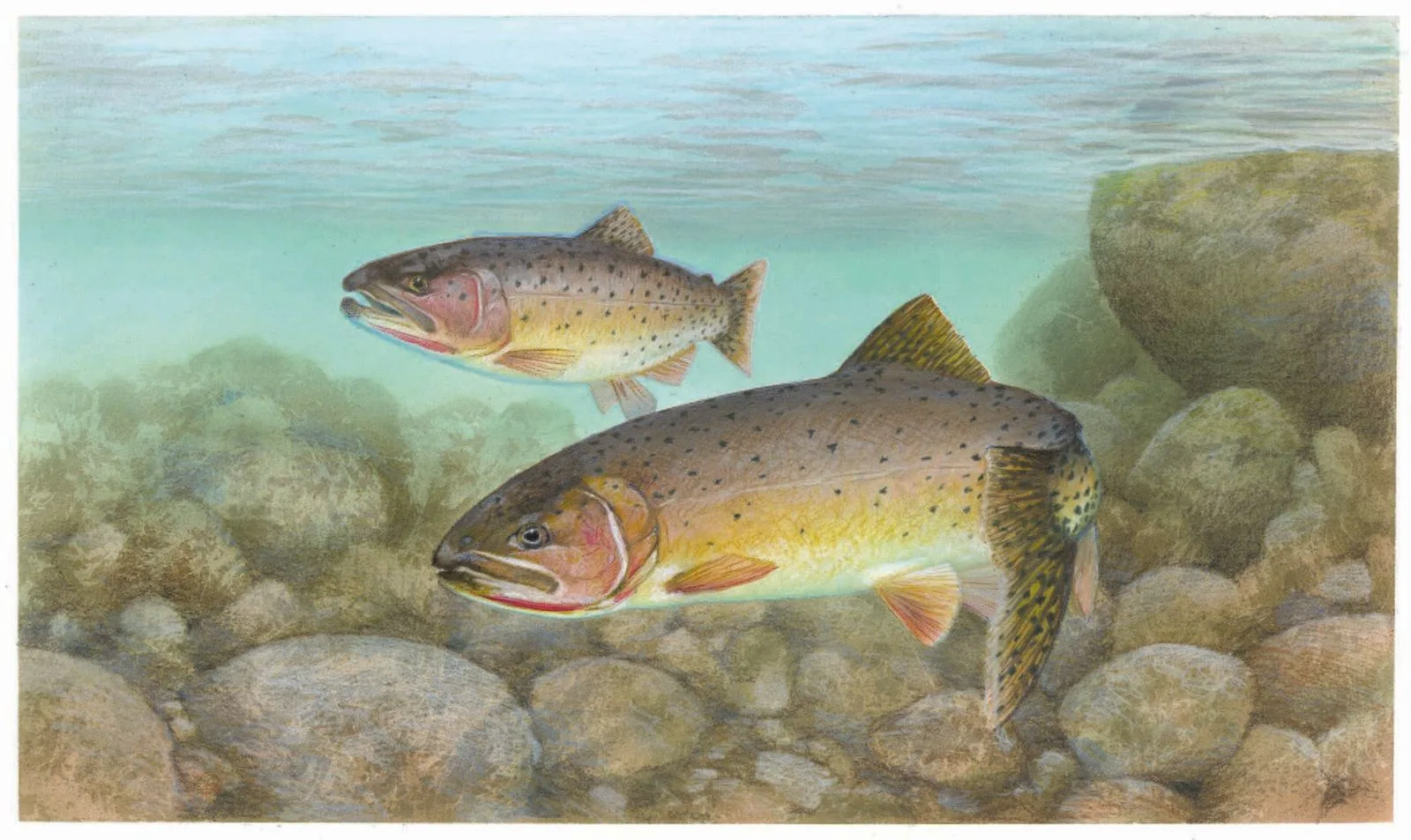
The cutthroat trout is the native trout of the American West, named for the red-orange slash under each side of its lower jaw. It comes in more than a dozen forms, from creek fish that average 6 to 16 in to the 41 lb Lahontan that still holds the world record. It is the state fish of Idaho, Montana and Wyoming. On a lot of the best cutthroat water, the fish you catch goes back.
Feel the base of the tongue. A cutthroat has teeth there and a rainbow does not, which is the check to make when the slash under the jaw has faded.
How do you tell a cutthroat from a rainbow or a cutbow?
The slash is the first mark: a red, pink or orange line in the folds under each side of the lower jaw. It is not proof on its own, because some coastal rainbows and Columbia River redband trout show a reddish throat too. The surer marks are in the mouth. A cutthroat generally has basibranchial teeth at the base of the tongue, and its upper jaw reaches past the rear edge of the eye.
The trouble is the rainbow. Cutthroat and rainbow trout interbreed naturally, and the offspring, the cutbow, is a fertile hybrid. Only the coastal and westslope cutthroat share natural range with rainbows. Lahontan and Rocky Mountain cutbows come from stocked rainbows.
| Check | Cutthroat | Rainbow | Cutbow |
|---|---|---|---|
| Under the jaw | Red, pink or orange slash on each side | Usually none; some coastal rainbows and redbands show red | Slash usually there, but fainter |
| Base of the tongue | Teeth | No teeth | In coastal crosses, throat teeth and slash strength are clues |
| Body | Back golden, gray or green; spots vary by form | Pinkish red stripe along the side | In Yellowstone fish, a white leading edge on the anal or dorsal fin suggests rainbow genes |
By looks alone a cutbow is hard to call, so treat a field ID as a best guess.
Which cutthroat is it? Read the colors and spots
Once you know it is a cutthroat, the spots narrow down which one. The Western Native Trout Initiative describes them like this:
| Cutthroat | Colors and spots |
|---|---|
| Coastal | A dense pattern of spots across the body, completely covering the tail |
| Westslope | Silvery or greenish; more small spots near the tail, none by the pectoral fin |
| Yellowstone | Gray, gold and copper hues; relatively large black spots clustered toward the tail |
| Snake River fine-spotted | A dense spread of small spots over the flanks |
| Bonneville | Less vivid colors; large, evenly spread spots |
| Greenback | The largest spots of any cutthroat; the back is not especially green |
| Paiute | Almost no spots on the body (Hatch Magazine) |
Seasoned anglers hedge too. The fly-fishing writer John Gierach admits that he cannot always tell a pure greenback from a pure Colorado River cutthroat, and that “neither can most of the fishermen I know.” Where you caught the fish, checked against the range table below, is often the better clue.
Which cutthroat lives where, and which are protected?
Cutthroat live in cold water from Prince William Sound in Alaska to the Rio Grande drainage of New Mexico; the other types of trout sit beside them on one page. Federal status in the table is the U.S. Fish and Wildlife Service’s; “not warranted” means the Service reviewed the fish for listing and declined. The second column is the species each form belongs to since the 2023 split.
| Cutthroat | 2023 species | Native range | Federal status |
|---|---|---|---|
| Coastal | Coastal | Prince William Sound, Alaska, to the Eel River, California | Not listed |
| Westslope | Westslope | Upper Columbia and upper Missouri basins: Idaho, Montana, Wyoming; pockets in Washington and Oregon | Not warranted, 2003 |
| Yellowstone | Rocky Mountain | Yellowstone Lake and River, upper Snake River above Shoshone Falls | Not warranted, 2006 |
| Snake River fine-spotted | Rocky Mountain | Snake River drainage, beside the Yellowstone | Managed as a Yellowstone |
| Bonneville | Rocky Mountain | Bonneville Basin: mainly Utah, parts of Wyoming, Idaho and Nevada; Utah’s state fish | Not warranted, 2008 |
| Colorado River | Rocky Mountain | Colorado and Green river basins: Colorado, Wyoming, Utah, once also Arizona and New Mexico | Not warranted, 2007 |
| Rio Grande | Rocky Mountain | Northern New Mexico and southern Colorado; New Mexico’s state fish | Not warranted, 2024 |
| Greenback | Rocky Mountain | South Platte basin, Colorado; Colorado’s state fish | Threatened |
| Yellowfin | Rocky Mountain | Twin Lakes, Arkansas River drainage, Colorado | Extinct |
| Lahontan | Lahontan | Lahontan Basin: Nevada, California, Oregon; Nevada’s state fish | Threatened since 1975 |
| Paiute | Lahontan | Silver King Creek, California | Threatened |
| Alvord | Lahontan | Tributaries of Alvord Lake, Oregon | Extinct |
“Not warranted” is not the same as healthy. The Western Native Trout Initiative counts westslope cutthroat in about 59 percent of their historic habitat, and Yellowstone cutthroat in 43 percent of their historic streams. Colorado River cutthroat trout conservation populations hold 11 percent of their historic range, Rio Grande cutthroat about 12 percent, and Lahontans about 10.5 percent.
The causes repeat from basin to basin. Stocked rainbows interbreed with them, nonnative trout compete with them or eat them, dams and diversions took their habitat, and overharvest took the fish. In Colorado, Gierach writes, early stocking of brown, rainbow and brook trout destroyed many already depleted native cutthroat fisheries altogether. Cutthroat were also stocked far outside the West. USGS lists nonnative records in 26 states, and Newaygo County, Michigan, received 105,000 fish between 1895 and 1940.

Free PDF · Water temperature chart When do trout bite?
One reading, and the 16-page chart shows which of 26 fish are spawning, feeding hard or slowing down; for bass, crappie, bluegill and walleye, where they sit and what to throw. Every number sourced.
No card, nothing to buy, and the PDF is yours to keep. Confirm with one click and it's on its way. Then a few short emails and one a week on what's biting. Unsubscribe anytime. Privacy.
How big do cutthroat trout get, and where do you catch each one?
Most cutthroat are small fish. At maturity they range from 6 to 40 in (15–102 cm), depending on the population, its habitat and its food. Fly Fisherman puts stream fish at 8 to 15 in and under 2 lb, and larger river and lake fish at 20 in or more and 3 to 5 lb.
| Cutthroat | Typical size | Where to look for it |
|---|---|---|
| Coastal | Adults average 1–4 lb (0.5–1.8 kg) and can reach 20 in (51 cm) | Puget Sound, the Washington coast and lower Columbia tributaries; hatchery sea-runs on the Cowlitz River |
| Westslope | 6–16 in (15–41 cm) on average | Streams of Idaho and Montana inside the native range |
| Yellowstone | 6–20 in (15–51 cm) at maturity | Yellowstone National Park; the Snake and Gros Ventre rivers near Jackson, Wyoming, for the fine-spotted form |
| Bonneville | Bear Lake fish averaged over 17 in (43 cm) and 1.5 lb (0.7 kg) in a 2021 survey | Bear Lake on the Utah–Idaho line; Strawberry Reservoir |
| Colorado River | Around 8 in (20 cm) on average; lake fish grow much larger | Headwater streams such as those of Utah’s Uinta Mountains |
| Rio Grande | Adults up to 12–13 in (30–33 cm) | About 700 miles of streams in New Mexico |
| Greenback | Up to 18 in (46 cm) | A few catch-and-release waters in Colorado |
| Lahontan | 7–33 in (18–84 cm), 1–25 lb (0.5–11 kg) | Pyramid Lake; Nevada streams in Elko, Humboldt and Nye counties |
| Paiute | Up to 10 in (25 cm) and 1 lb (0.45 kg) | A recovery fish: pure fish went back into Silver King Creek in 2019 |
In Colorado, a Gunnison outfitter puts most of the state’s cutthroat at 8 to 14 in, with fish over 24 in caught every year. Fly Fisherman gives cutthroat 6 to 10 years in favorable conditions; Nevada gives the Lahontan 5 to 14.
How do you catch cutthroat trout?
Gink and Gasoline calls cutthroat “one of the best trout species for introducing and teaching beginners the sport of fly fishing.” The tackle is ordinary trout fishing tackle. Where you fish matters more: a creek cutthroat, a Pyramid Lake Lahontan and a sea-run on a Puget Sound beach are three different games.
On streams: dry flies, nymphs and small spinners
On small streams, Fly Fisherman recommends a 3 to 5 weight rod with a floating line. Its dry flies are the Adams, Elk Hair Caddis and Stimulator, plus terrestrials such as ants and hoppers. Under the surface it names Hare’s Ear, Pheasant Tail and Prince nymphs.
On spinning gear, small spinners, spoons and jigs cover the same water, and Field & Stream adds a dry fly fished behind a casting bubble. Where bait is legal, its picks are a nightcrawler or a live grasshopper.
Check the rule before you bait a hook, because a lot of cutthroat water bans it. Yellowstone National Park allows only lead-free artificial lures and flies, so carry weights made of tungsten or another lead-free metal. Pyramid Lake allows no bait of any kind. In Oregon, bait is generally not allowed on coastal streams above tidewater, where resident cutthroat may not grow past 8 or 9 in.
In alpine lakes
Stocking mountain lakes has expanded the lakes holding Yellowstone cutthroat from 61 to more than 230. Colorado’s cutthroat lakes sit at or above treeline. A Gunnison outfitter’s rule is that the farther you are willing to walk to an alpine lake, the better the fishing can be. In lakes and larger rivers, Fly Fisherman steps up to a 5 or 6 weight with Woolly Buggers, Muddler Minnows and sculpin patterns.
In the big desert lakes
The Lahontan is a lake fish at heart and grows large where it has forage fish to eat. At Pyramid Lake, Fly Fisherman’s advice is large baitfish imitations on sinking lines. The lake’s trademark is the stepladder. Anglers haul ladders as far out on the shallow flats as they can, to reach fish cruising in deeper water, and some add chairs on top. Field & Stream says they blind-cast relatively heavy 7 to 9 weight rods in cold, windy weather, and that fish up to and beyond 10 lb are fairly common.
The lake lies on the Pyramid Lake Paiute Tribe’s reservation, so you need the tribe’s permit, not a Nevada license, and the trout season runs Oct. 1 to June 30. Hooks must be barbless, and no bait, worms, eggs, scent or PowerBait may go on them. The tribe’s keepers for the Lahontan cutthroat are 17 to 20 in or over 24 in: two of the smaller size, or one of each.
Fly fishing a summer river. Photo: fotovincek / Depositphotos.
In salt water: sea-run cutthroat
Coastal cutthroat are the only cutthroat that go to sea to feed. Sea-runs are born in rivers, go out to salt water, and come back to spawn in their home stream; after spawning, the adults head back out to the beaches. Oregon’s sea-runs spend a few months of the year in the estuaries, grow up to an inch a month there, and return to fresh water in July and August.
The season depends on the water. In southern Puget Sound there are cutthroat around 12 months of the year, and Washington’s Department of Fish and Wildlife calls winter a productive time on its beaches, bays, estuaries and inlets. Guide Keith Robbins rates winter and spring best in the south Sound, and summer and fall farther north. Every sea-run in Puget Sound goes back: the fishery has been catch-and-release only since the mid-1990s.
The agency’s beach advice is specific. Fish often hold close to shore on soft incoming or outgoing tides or at slack water, when baitfish gather. Look for rocky beaches with larger gravel in 15 to 20 ft (4.6–6.1 m) of water, and avoid strong tidal exchanges that scatter the fish.
Fly anglers use marabou Clouser Minnows and Muddlers. For hardware, small spoons and size 2 or 3 spinners are common, dark in clear or bright conditions and brighter when the water is cloudy. Barbless hooks are required in all Puget Sound marine fisheries.
Mind the water temperature
Keep Fish Wet’s review of release studies puts the threshold for rainbow, brook and cutthroat trout at about 61 °F (16 °C). Above it, the share of released fish that die starts to climb fast. Carry a thermometer in late summer and check the trout water temperature chart before you go.
When do cutthroat trout spawn?
Cutthroat spawn in spring, as early as February in coastal rivers and as late as July in high mountain lakes and streams. Spawning starts when the water reaches 43 to 46 °F (6–8 °C). In Colorado it runs mostly March through June, earlier in lower rivers than in alpine lakes, and the greenback spawns from late May to mid-July at high elevation.
Rule of thumb: Cutthroat start spawning when the water reaches 43 to 46 °F (6–8 °C). Step around the gravel redds and leave spawning fish alone.
Lake fish need a stream to spawn in. The Lahontans of the big lakes spawned in tributary streams, and at Pyramid Lake, Derby Dam on the Truckee River interfered with those runs by 1905. The Lahontan spawns February to July, set by flow, elevation and water temperature, and Nevada says more than 60 percent of spawning adults die after their first spawn. The coastal cutthroat, by contrast, can spawn more than once.
The female picks the site and digs the redd, a nest in the gravel. Step around those patches, and leave spawning fish alone.
What do cutthroat trout eat?
Cutthroat are opportunistic feeders. Stream fish live mostly on aquatic insects: mayflies, caddisflies, stoneflies and midges, plus ants, beetles and grasshoppers that fall in. Larger fish add small fish, sculpins and minnows, along with fish eggs and crustaceans.
Sea-runs in Puget Sound eat herring, candlefish, sculpins and salmon fry, plus crabs, sand shrimp, worms and zooplankton, WDFW says, so match the baitfish on the beach. Lake Lahontans grew large on baitfish such as tui chub and suckers, some up to 16 in long. The predator a cutthroat cannot handle is the lake trout, which can eat a cutthroat up to one-third its own size.
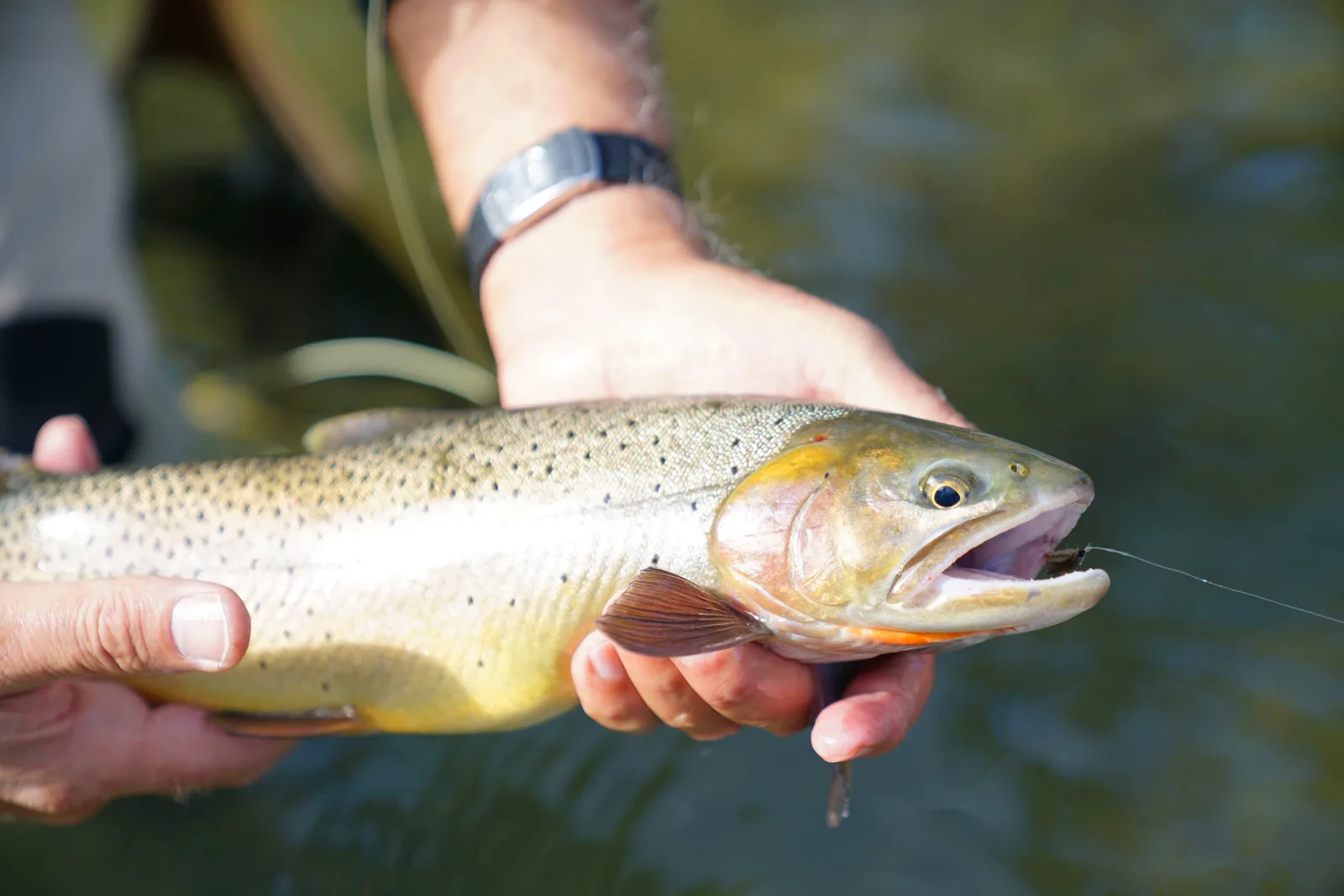
A cutthroat trout, about to be released. Photo: Goodluz / Depositphotos.
Can you keep and eat a cutthroat?
Yes, where the rules allow it, but on a lot of cutthroat water they do not. In Yellowstone National Park every native fish, cutthroat included, must be released unharmed, and hooks must be barbless or have the barbs pinched down. Every lake trout caught in Yellowstone Lake must be killed. Colorado requires greenbacks to go back immediately.
Lahontan cutthroat, although threatened, can be harvested under a special federal rule, the 4(d) rule, that lets the states permit angling. At Pyramid Lake you keep only fish inside the tribe’s slot limit. Check the state or tribal regulations for the water before you keep one.
On the plate a cutthroat is a trout like any other, and the flesh is often pink. In 1937 a Yellowstone ranger naturalist wrote that the pink flesh of cutthroat caught at Fishing Bridge “gives rise to many inquiries” and leaves many visitors thinking of them as “salmon trout.”
If you release it, the Utah Cutthroat Slam’s handling guide is blunt: cutthroat are “particularly sensitive to air exposure.” Wet your hands first, because dry hands strip the slime coat that guards a trout against infection, and keep the fish in the water. How to hold a trout and catch and release set out the grip and the steps.
What is the biggest cutthroat trout ever caught?
The all-tackle world record is a Lahontan of 41 lb (18.6 kg), caught by John Skimmerhorn at Pyramid Lake, Nevada, on Dec. 1, 1925. Nothing else is known about the catch. Outdoor Life names Adam Garcia’s 35 in, 19 lb (8.6 kg) Pyramid Lake fish of Nov. 5, 2016, taken on a woolly bugger, as the biggest cutthroat ever taken with fly tackle. The IGFA also keeps length records, both from Pyramid Lake: Garcia’s 85 cm (33.5 in) fish of Nov. 11, 2018, on any tackle, and Bob Gaines’s 83 cm (32.7 in) fish of March 18, 2026, on fly.
The number: The all-tackle cutthroat record is a 41 lb (18.6 kg) Lahontan from Pyramid Lake, Nevada, caught in 1925.
The cutbow has its own record: 34 lb 11 oz (15.7 kg) and 41.13 in, caught by Mark J. Adams at American Falls Reservoir, Idaho, on July 25, 2011. Both records sit beside the other species on the trout hub.
Why are cutthroat trout in trouble, and which came back?
Three stories show what happened to the cutthroat and what it takes to bring one back.
Yellowstone Lake. Yellowstone Lake and the Yellowstone River together hold the world’s largest inland population of Yellowstone cutthroat trout. A 17 in lake trout caught in the lake in 1994 showed the problem. Since then more than 5.1 million lake trout have been removed, 289,900 in 2025 alone. The Park Service says the effort has cut the lake trout spawning population by 87 percent since 2012. In one overnight net set in 2007, 21 lake trout held the remains of at least 47 cutthroats.
The greenback. Colorado’s state fish was presumed extinct by 1937. A 2007 study showed that populations thought to be greenbacks were really cutthroats transplanted from Colorado’s Western Slope. A 2012 study of museum specimens up to about 150 years old then found that the true greenback cutthroat survived in one small stream, Bear Creek, not far from Colorado Springs. Fish from that line were documented breeding on their own in Herman Gulch in 2022.
The Pyramid Lake Lahontan. The strain that produced the 1925 record was gone from Pyramid Lake by 1943. In 1977, stream surveys in the Pilot Peak range of Utah, near the Nevada line, found trout that were later identified as the Pyramid strain. That strain has been stocked in Pyramid since 2006, and Orvis says catches over 20 lb have become “relatively common.”
Fishing a forest river. Photo: FedBul / Depositphotos.
Can you catch a cutthroat slam?
Two states turn the subspecies into a challenge. Wyoming’s Cutt-Slam asks for its four cutthroat, each caught in its native range in Wyoming: Bonneville, Colorado River, Snake River and Yellowstone. You send a clear photo of each fish with the date and place. The first submission earns a personalized certificate, a Wyoming Trout Unlimited medallion and a vehicle decal.
Utah’s Cutthroat Slam, run by the Utah Division of Wildlife Resources and Utah Trout Unlimited since 2016, asks for Bonneville, Colorado River, Bear River and Yellowstone cutthroat in their native ranges. By October 2025 it had 2,019 completions and had raised more than $126,580 for native cutthroat conservation.
Is the cutthroat one species or four?
The common name came from the outdoor writer Charles Hallock, in an 1884 article in The American Angler. The scientific name clarkii honors William Clark of the Lewis and Clark Expedition. Clark’s journals first described the fish, from specimens taken on the Missouri River near Great Falls, Montana, most likely westslope cutthroat.
The cutthroat is a Pacific trout: in 1989 it and the rainbow were moved out of Salmo into Oncorhynchus, the genus of the Pacific salmon. The species question is newer. In November 2023 the joint committee of the American Fisheries Society and the American Society of Ichthyologists and Herpetologists split the cutthroat into four species without any named subspecies:
- Coastal cutthroat, Oncorhynchus clarkii: the Pacific coast, the only one that feeds at sea.
- Westslope cutthroat, O. lewisi: the northern Rockies.
- Lahontan cutthroat, O. henshawi: the Great Basin of Nevada, California and Oregon.
- Rocky Mountain cutthroat, O. virginalis: Yellowstone, Bonneville, Colorado River, Rio Grande, greenback and their kin.
Not everyone agrees. A 2026 paper in Evolutionary Applications, built on full mitochondrial genomes, does not find the coastal, westslope or Lahontan cutthroat substantially more different than the lineages inside the Yellowstone complex. It keeps one species, O. clarkii, with eleven subspecies-level groups.
The Endangered Species Act still lists the protected fish under their old subspecies names, and most state regulations still say “cutthroat”. For the angler, the names that matter are the regional ones in the tables; they are what the rulebook and the stocking reports use. Beside the cutthroat, the West’s other native trout include the golden trout and the Apache trout and Gila trout of the Southwest.

Free PDF · 16 pages
Stop guessing. Know what's biting before your first cast
A whole Saturday on the water with nothing to show for it. One reading tells you who's feeding.
The Water Temperature Fishing Chart. Take one water temperature reading, find it on the chart, and see which of 26 freshwater fish are spawning, feeding hard or slowing down.
- Where bass, crappie, bluegill and walleye sit, and what to throw. Trout: the reading where you stop.
- Why a 3 ft drop beats a cold front, and what to throw each day of the front
- The three thermometer mistakes that make a reading lie
The chart's numbers come from state fish and wildlife agencies and fisheries research: 61 sources, each listed on the site.
No card, nothing to buy. Confirm with one click and the PDF is on its way, one version for your phone and one to print, yours to keep. Then a few short emails and one a week on what's biting, with an unsubscribe link in every one. Privacy.
Related
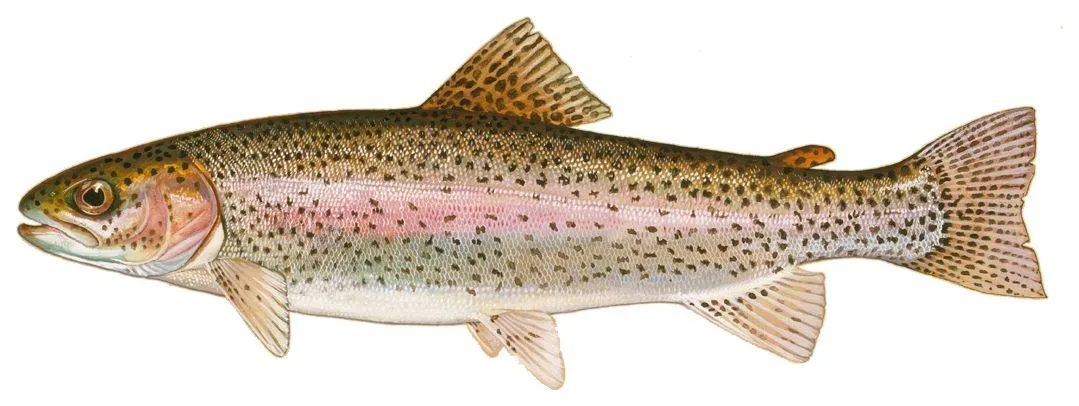
Section guide
Trout: The Fish, Where They Live, When They Bite and How to Catch ThemTrout are cold-water fish of the salmon family. The five you'll catch, the 68 °F line, when each spawns and how to catch them; every type on its own page.
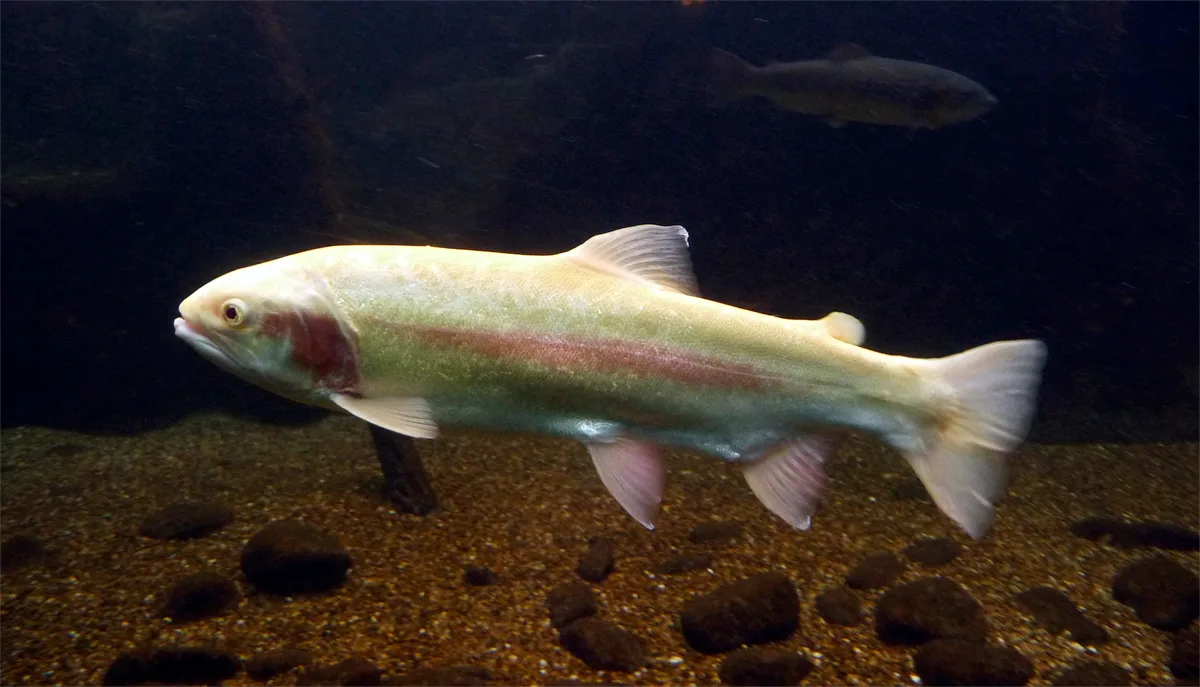 Palomino Trout: The Golden Rainbow, Where It Came From
Palomino trout are golden rainbows from one West Virginia fingerling found in 1955: the name, where they are stocked and how to catch one.
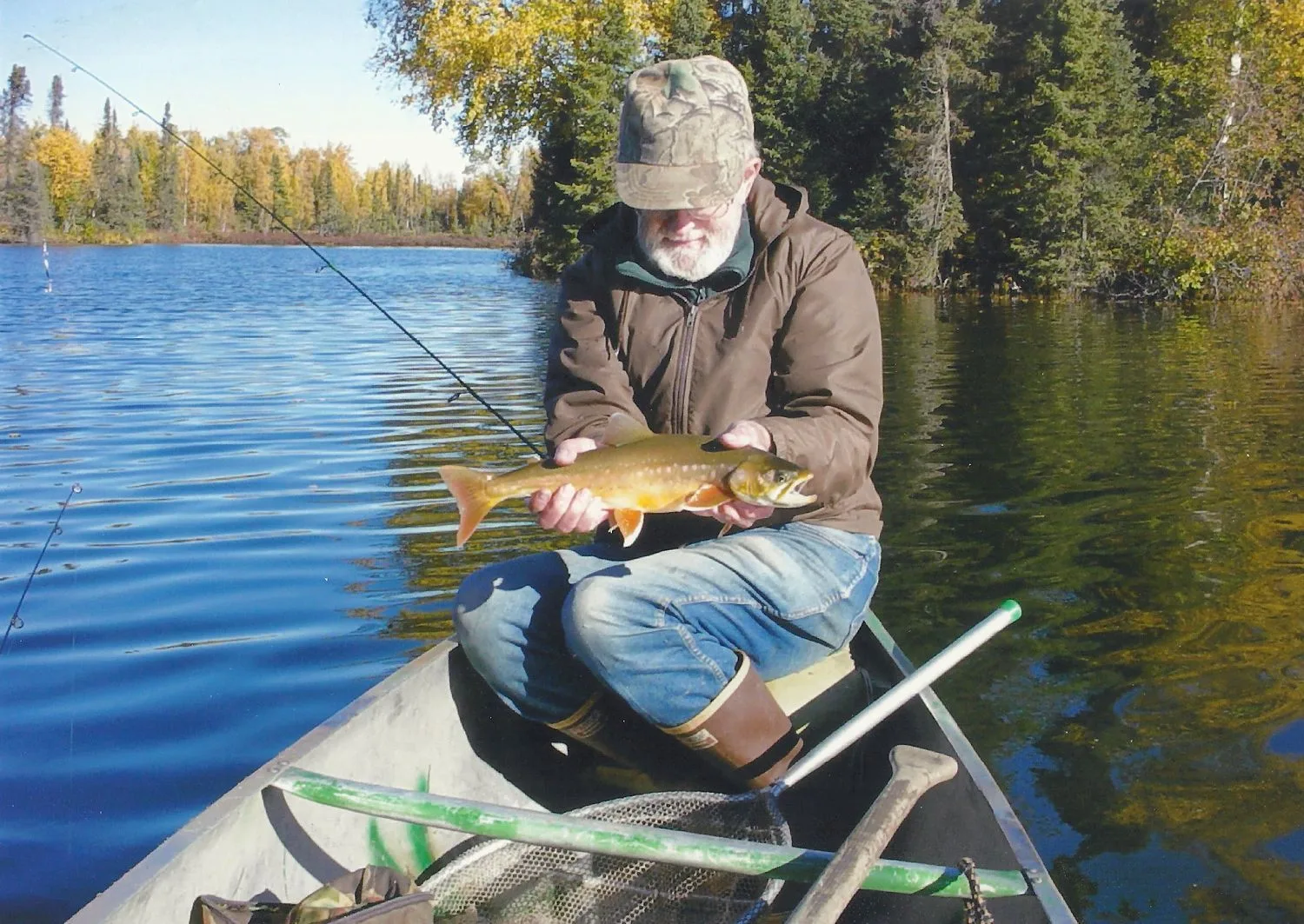 Arctic Char: How to Identify, Where to Catch and Is It Good to Eat
Arctic char, the most northerly freshwater fish: how to tell it from a Dolly Varden, where US anglers catch it, the record, and how it eats.
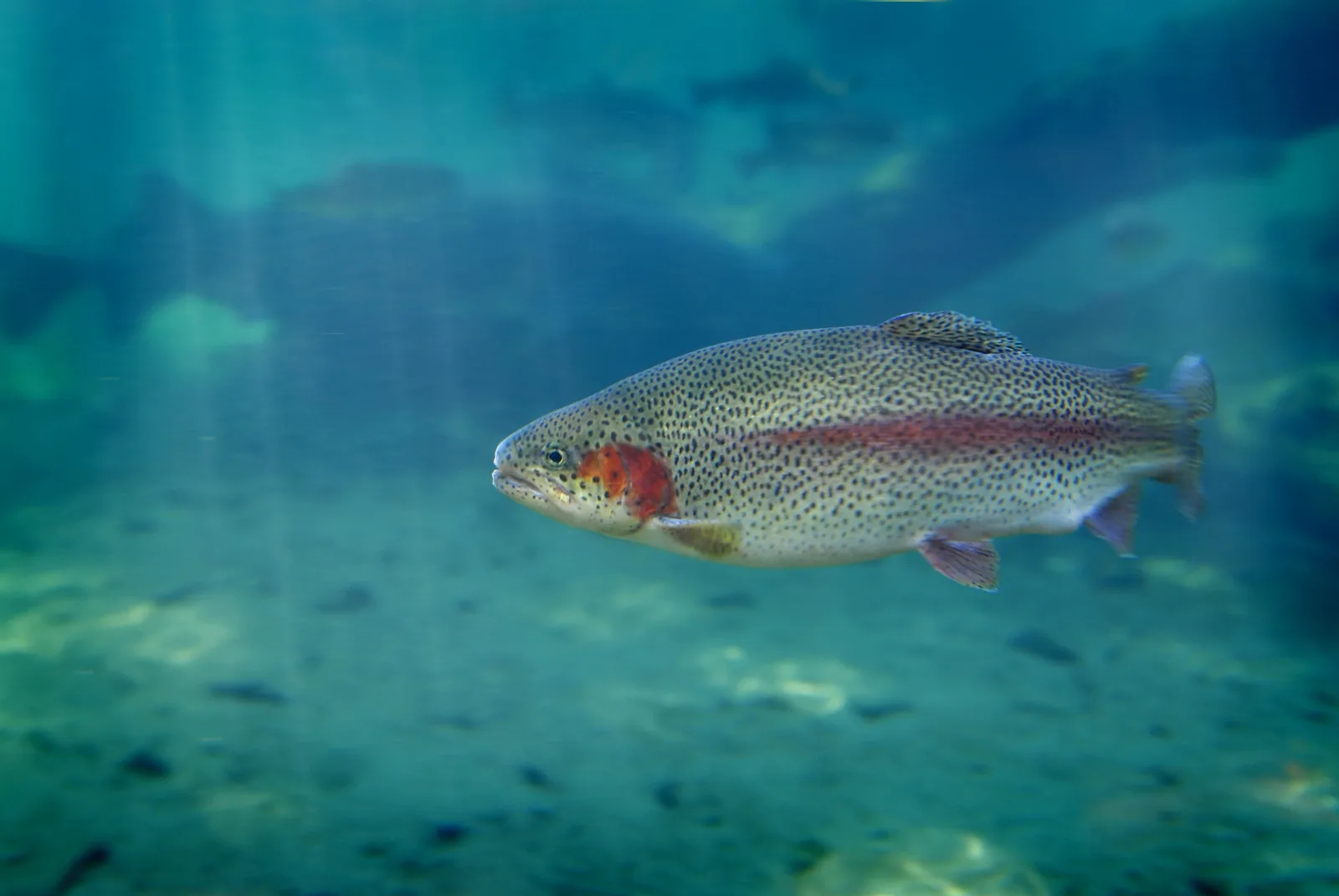 Trout Magnet: How to Rig and Fish the 1/64 oz Jig and Float
Trout Magnet rigging step by step: the 1/64 oz jig under the E-Z float, how deep to set it, the twitch, 2 lb line, colors, and what a rigged lure costs.
 Dolly Varden: Alaska's Sea-Run Char and How to Catch One
The Dolly Varden is a char, not a trout: how to tell it from Arctic char and bull trout, where it runs, when to fish for it and the 20 lb record.
 Bull Trout: How to ID the Threatened Char, and Where to Fish
Bull trout are a threatened char: how to tell one from a brook trout, lake trout or Dolly Varden, the few waters where you may fish, and the 32 lb record.
 Golden Trout: California's State Fish and Where to Catch One
The California golden trout: native to two Kern Plateau creeks, stocked in high lakes from Wyoming to Washington, and the 1948 record Wyoming now doubts.
Sources (55)
- Colorado Parks and Wildlife, statewide bag and possession limits (greenback cutthroat: catch and release)
- Wikipedia, Cutthroat trout (naming, taxonomy, basibranchial teeth, throat marks, size range, spawning, diet, state fish)
- Van Orden et al. 2026, Phylogeny of Cutthroat Trout (Oncorhynchus clarkii) Based on Full Mitochondrial Genomes With Comments on Species Delimitation and Taxonomy (Evolutionary Applications 19(7): e70304, PMC)
- Page, Bemis, Dowling et al. 2023, Common and Scientific Names of Fishes From the United States, Canada, and Mexico, 8th edition (American Fisheries Society Special Publication 37)
- Smith and Stearley (1989), The classification and scientific names of rainbow and cutthroat trouts, Fisheries 14(1): 4–10
Show all 55 sourcesShow fewer sources
- U.S. Fish & Wildlife Service, Spiciest trout in the West
- Wikipedia, Cutbow (field marks of the hybrid, natural range overlap)
- Hatch Magazine, Spencer Durrant, Cutthroat 101 (subspecies, native ranges, where to fish)
- USGS Nonindigenous Aquatic Species, cutthroat trout profile
- USFWS, westslope cutthroat trout should not be listed (2003)
- USFWS, Yellowstone cutthroat trout does not warrant ESA protection (2006)
- USFWS, Colorado River cutthroat trout will not be listed (2007)
- USFWS, Bonneville cutthroat trout does not warrant protection (2008)
- USFWS, ESA protections not warranted for Rio Grande cutthroat trout (2024)
- Western Native Trout Initiative, Lahontan cutthroat trout (range, 10.5 percent, 4(d) rule)
- Western Native Trout Initiative, westslope cutthroat trout (size, spots, 59 percent of historic habitat)
- Western Native Trout Initiative, Yellowstone cutthroat trout (size, spots, fine-spotted form, 43 percent, mountain lakes)
- Western Native Trout Initiative, coastal cutthroat trout (size, spots, marine migrations, repeat spawning)
- Western Native Trout Initiative, Bonneville cutthroat trout (spots)
- Western Native Trout Initiative, greenback cutthroat trout (maximum size, spots)
- Western Native Trout Initiative, Colorado River cutthroat trout (11 percent of historic range)
- Western Native Trout Initiative, Rio Grande cutthroat trout (adult size)
- Western Native Trout Initiative, Paiute cutthroat trout (size, Silver King Creek)
- Nevada Department of Wildlife, Lahontan cutthroat trout (size, spawning, where found)
- Wikipedia, Lahontan cutthroat trout (Derby Dam)
- Peacock et al. 2017, Return of a giant: DNA from archival museum samples helps to identify a unique cutthroat trout lineage formerly thought to be extinct (Royal Society Open Science, PMC)
- Hickman and Duff (1978), Current status of cutthroat trout subspecies in the western Bonneville Basin, Great Basin Naturalist 38(2)
- U.S. Fish & Wildlife Service, From Peak to Pyramid (2019)
- IGFA world records, cutthroat trout (all-tackle, all-tackle length, all-tackle length fly)
- Orvis News, Fish facts: Lahontan cutthroat
- Pyramid Lake Paiute Tribe, fishing at Pyramid Lake
- Center for Biological Diversity, Colorado River cutthroat trout natural history (size)
- Utah Division of Wildlife Resources via Sportfishing Report, Bear Lake cutthroat survey (Nov. 2, 2021)
- Fly Fisherman, All about cutthroat trout (size, life span, diet, rods and flies)
- Gunnison Fly Fishing Outfitters, Colorado's native cutthroat trout (sizes, spawning, alpine lakes)
- Gink and Gasoline, Why can't we have cutthroat trout everywhere (2011)
- Field & Stream, Mark Taylor, Cutthroat trout fishing: a beginner's guide (2026)
- Oregon Department of Fish and Wildlife, cutthroat trout (sea-run timing, bait rule on coastal streams)
- Washington Department of Fish and Wildlife, The 411 on sea-run cutthroats (2022)
- Leland Fly Fishing, What is a cutthroat trout: John Gierach, Cutthroats (chapter 5 of In Praise of Wild Trout, 1998)
- KIRO 7 via Yahoo News, From cutthroat trout to squid jigging (WDFW's December 2025 fishing roundup)
- Washington Department of Fish and Wildlife, cutthroat trout
- Southflyfisher (2024), Chasing trout in warming rivers: why 61 °F/16 °C is the new 68 °F/20 °C (quoting Jamie Madden's review for Keep Fish Wet)
- Utah Cutthroat Slam, Helpful reminders for proper trout handling
- National Park Service, suppressing non-native lake trout in Yellowstone Lake (Yellowstone Science 25(1))
- National Park Service, fishing in Yellowstone
- National Park Service, Yellowstone fish management
- Ranger Naturalist Harry Woodward, Flesh colors in fishes, Yellowstone Nature Notes 14(9–10), September–October 1937
- University of Colorado Boulder, new study clarifies diversity of cutthroat trout in Colorado (2012)
- Colorado Parks and Wildlife, greenback cutthroat trout species profile
- Trout Unlimited, Colorado greenbacks are back (2022)
- Wyoming Game and Fish Department, Cutt-Slam
- TownLift, Utah's native trout slam hits new record with over 2,000 completions (October 2025)
- Animal Diversity Web, Oncorhynchus mykiss (the rainbow's side stripe, no teeth at the base of the tongue)
- Outdoor Life, the biggest trout ever caught (IGFA records)