 By
A Nile perch can grow to about 2 m (6 ft 7 in) and 200 kg (440 lb). The IGFA world record weighs 230 lb. It’s an African fish, from the Nile, the big West African rivers and the Rift Valley lakes. You won’t find one in any US water, and you can’t bring a live one into the country. If you want one, you’re going to Egypt’s Lake Nasser, to Uganda or to Lake Victoria.
Texas stocked Nile perch in its reservoirs from 1978 to 1985. The last one on record turned up in Smithers Reservoir in January 1990: a 60 lb fish, thought to have died of the cold.
How big do Nile perch get?
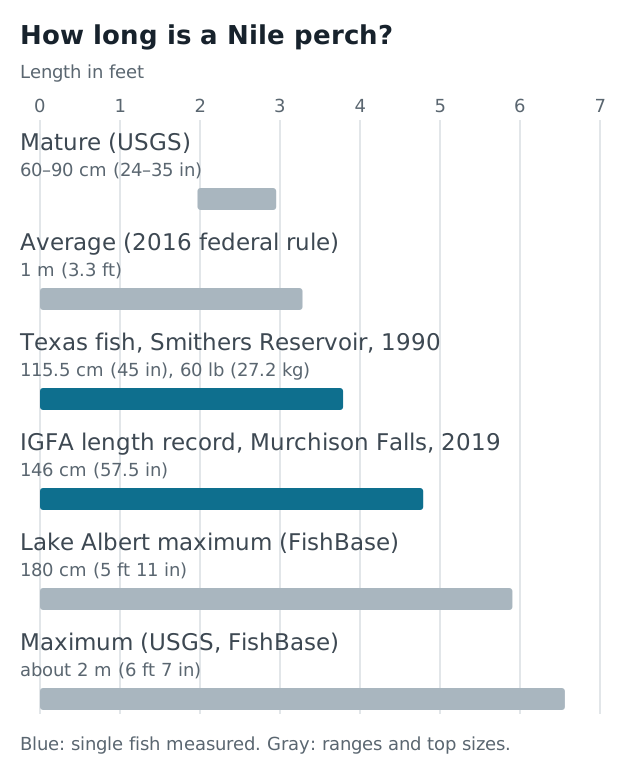
Up to about 2 m (6 ft 7 in) and 200 kg (440 lb). That’s the top size the U.S. Geological Survey and FishBase both give. The fish you’d hook is smaller: the 2016 federal rule that banned imports puts the average at 1 m (3.3 ft).
Nile perch mature at 60 to 90 cm (24 to 35 in), says the USGS. Males can spawn at one to two years old, females at one to four. The biggest fish measured in one lake are a good check on the 2 m figure. FishBase gives a top length of 180 cm (5 ft 11 in) for Lake Albert, with a heaviest fish there of 164 kg (362 lb).
| Measure | Length | Weight | From |
|---|---|---|---|
| Top size | About 2 m (6 ft 7 in) | 200 kg (440 lb) | USGS, FishBase |
| Lake Albert top size | 180 cm (5 ft 11 in) | 164 kg (362 lb) | FishBase |
| Average | 1 m (3.3 ft) | — | 2016 federal rule |
| Mature | 60–90 cm (24–35 in) | — | USGS |
| IGFA all-tackle record | — | 104.32 kg (230 lb) | IGFA |
| IGFA length record | 146 cm (57.5 in) | — | IGFA |
On a trip, expect smaller again. African Angler, an outfitter on Lake Nasser, says most of its anglers can count on at least one fish of 50 lb or more. With a fly rod, it puts your usual fish at 10 to 40 lb.
What is the Nile perch world record?
The IGFA all-tackle record is 230 lb (104.32 kg), caught by William Toth on Lake Nasser, Egypt, on December 20, 2000. The same fish holds the 30 lb line-class record. The heaviest one on a fly weighed 110 lb 3 oz (50 kg). Wayne Haselau caught it on 16 lb tippet at Rubondo Island, Lake Victoria, in 1994.
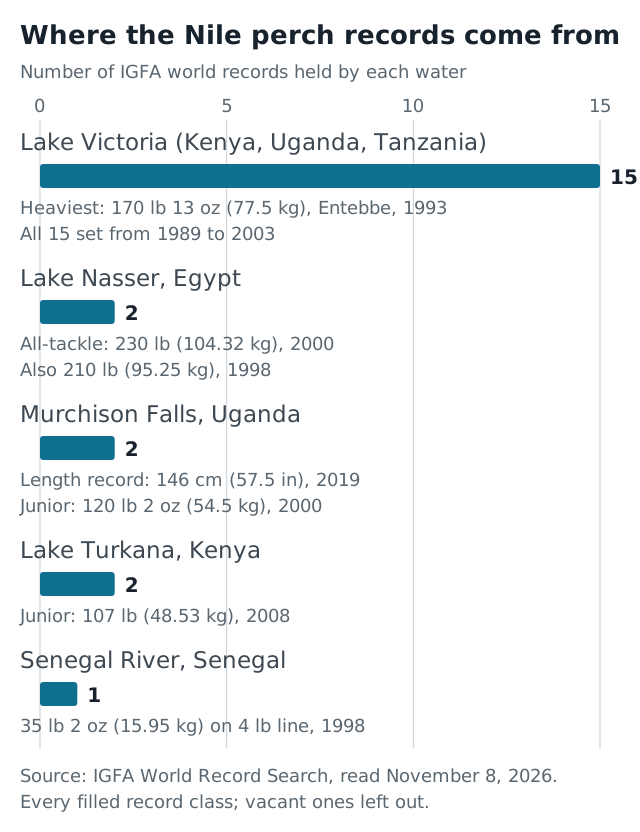
The length record is newer. Christopher S.G. Tan’s fish from Murchison Falls, Uganda, measured 146 cm (57.5 in) on August 7, 2019. The IGFA has 22 different Nile perch records on its books, and the chart up top counts where they came from.
Lake Victoria holds 15 of them, all set between 1989 and 2003. Lake Nasser holds the two heaviest: the 230 lb fish and a 210 lb (95.25 kg) one from 1998. The best junior fish is Alexander Wipfler’s 120 lb 2 oz (54.5 kg) from Murchison Falls in 2000.
Big as it is, the Nile perch isn’t the largest freshwater fish in the record book. The arapaima record is heavier, at 339 lb 8 oz (154 kg). So is the wels catfish record, 297 lb 9 oz (134.97 kg). A Mekong giant catfish netted in Thailand in 2005 weighed 646 lb, close to three times the Nile perch record.
Free PDF · Water temperature chart Which fish are biting at today's water temperature?
One reading, and the 16-page chart shows which of 26 fish are spawning, feeding hard or slowing down; for bass, crappie, bluegill and walleye, where they sit and what to throw. Every number sourced.
No card, nothing to buy, and the PDF is yours to keep. Confirm with one click and it's on its way. Then a few short emails and one a week on what's biting. Unsubscribe anytime. Privacy.
Where can you go Nile perch fishing?
Go to Lake Nasser if you want the biggest fish on record. Go to Murchison Falls if you’d rather fish a river in a national park. The table shows what the record book and the sources say. Rules change, so ask your lodge for the current permit before you book.
| Where | Records there | What to know |
|---|---|---|
| Lake Nasser, Egypt | All-tackle 230 lb (2000) and 210 lb (1998) | Outfitter says at least one 50 lb-plus fish is likely, and fishing runs every day of the year |
| Murchison Falls, Uganda | Length record, 146 cm (2019) | Inside a national park. The Uganda Wildlife Authority sport-fishing permit is US$50 a day or US$150 for four days (2024–2026 tariff), park entrance extra |
| Lake Victoria (Kenya, Uganda, Tanzania) | 15 records, 1989–2003 | Home of most fly and light-line records, at Rubondo Island and Rusinga Island |
| Lake Turkana, Kenya | Two junior records, 2008 | Northern Kenya, where Texas got its first Nile perch in 1975 |
| Senegal River, Senegal | 35 lb 2 oz on 4 lb line (1998) | West Africa’s record water |
On Ade Kiddell’s Lake Nasser trip, written up for Angling Direct in 2020, the main method was trolling lures behind the boat. Multiplier reels with 50 lb braid went to a 100 lb mono leader. Big deep-diving crankbaits worked the deep water, and Shad Raps and smaller countdowns the shallow spots.
He changed every hook for a stronger one and took the middle treble hook off three-hook lures. The fish he describes ran around 20 lb. African Angler also lets you cast lures from shore on Lake Nasser. It says its boats broke “the last 3 (IGFA approved) Nile perch all tackle world records”.
What does a Nile perch look like?
A big, deep-bodied fish with a dark grayish-blue back and silver sides. The tail is rounded. The USGS notes spines on the bones around the eye and a large one on the edge of the gill cover. Mind that spine when you handle one. Discover Wildlife describes dark eyes ringed in bright yellow. Young fish look different: brownish, with lighter marbling.
If it reminds you of a snook, you’re right. The IGFA says the top of the head is “strongly depressed, as in the barramundi and its relative across the sea, the snook”. It has two dorsal fins, a spiny one in front and a soft one behind.
Is a Nile perch a perch?
No. It’s a lates, in the same genus as the barramundi, and not related to the yellow perch. The IGFA and Texas still file it with the snooks (Centropomidae), and FishBase gives the lates their own family, Latidae. Our page on what counts as a perch sorts out the whole family of borrowed names. On a US seafood label, the FDA’s Seafood List requires Lates niloticus to be sold as “Nile perch”, not plain “perch”.
Nile perch vs barramundi: same genus, different continents. The barramundi’s IGFA record is 98 lb 6 oz (44.64 kg), from Lake Monduran, Queensland, Australia, in 2010. The Nile perch record is more than twice that.
You’ll hear it called many things on a trip:
| Name | Where you’ll hear it |
|---|---|
| African snook, Victoria perch | English names in the 2016 federal rule |
| Giant perch, Niger perch | English names in the IGFA record book |
| Capitaine | French-speaking Africa |
| Sangara | Tanzania |
| Mbuta, mputa | Luo, spoken in western Kenya |
| Empuuta | Central Uganda |
In ancient Egypt the fish was sacred, Discover Wildlife notes. Some were mummified, and the city of Esna was once named Latopolis after it.
Where do Nile perch live?
Across much of tropical Africa. FishBase lists the Senegal, Niger, Volta, Chad and Nile basins, the Congo basin, and lakes Albert, Turkana and Tana. In the Nile, the USGS puts it below Murchison Falls. It also lives in brackish Lake Mariout, near Alexandria.
You’ll find adults deep, at 10 to 60 m (33 to 197 ft), and the young shallow, FishBase says. The federal rule gives 28 °C (82 °F) as the best water temperature and 38 °C (100 °F) as the top limit. Cold kills them sooner: the USGS cites lower limits of 12 to 15 °C (54 to 59 °F). Cold water is the likely end of the Texas fish. Nile perch also need well-oxygenated water, which mostly keeps them out of swamps.
They eat what’s there. Fish under 5 cm eat zooplankton, young fish eat insects and shrimp, and adults eat mostly fish. Where small fish are plentiful, the USGS notes, they start eating them at just 4 cm (1.6 in) long.
What happened when Nile perch reached Lake Victoria?
It took over the lake. Drop a big predator into a lake of small fish and you get the textbook invasive species. The USGS says the introduction “caused the extinction of at least 200 species of endemic fishes”. The federal rule tells it step by step:
- 1954: Nile perch from Lake Albert are put into Lake Victoria on the Ugandan side.
- 1954–1955: they go into Lake Kyoga, as a test of what they would do to Lake Victoria. No one knew they were already in Victoria.
- 1962: a breeding population exists in Lake Victoria.
- 1962–1963: more are stocked in Kenyan and Ugandan waters to start a commercial fishery.
- 1979: the boom shows in Kenyan waters, two to three years later in Uganda and four to five in Tanzania.
- 1980s: the Nile perch becomes the lake’s dominant fish.
- Today: more than 90 percent of the fish weight near the bottom is Nile perch.
Here’s the lake before and after, in the numbers the federal rule and the USGS give:
| Lake Victoria | Before the Nile perch | After |
|---|---|---|
| Native cichlid species | At least 400 | At least 200 gone |
| Nile perch share of fish weight near the bottom | None | More than 90 percent |
| Eggs per spawn | Cichlids: 13 to 33 | Nile perch: 3 to 15 million |
| Water | Short spells of low oxygen in deep water | Low oxygen more often, and in shallower water |
That egg count is how it spread so fast. A Nile perch spawns all year, more in the rainy season. Without the cichlids, algae bloomed and used up oxygen. The species is on the list of the world’s 100 worst invaders.
The same fish built an industry. The USGS says the fishery brought electricity and money to fishing villages that had lived on subsistence fishing. Now the pressure runs the other way: mesh-size limits on gill nets were brought in to protect the stock. Discover Wildlife writes that overfishing has since driven the lake’s Nile perch “to the brink”. Globally the species is rated Least Concern (IUCN, 2019), unlike the fish on our endangered freshwater fish list.
Are there Nile perch in the United States?
No. Texas tried, and the fish died out. Since 2016 you can’t bring a live Nile perch into the country without a federal permit, and only zoos, schools and labs get one. A fish farm can’t import either.
What happened in Texas, from the USGS and the federal rule:
- 1975: Nile perch from Lake Turkana, Kenya, go to the Heart of the Hills Research Station in Ingram, Texas.
- 1978–1984: almost 70,000 young Lates go into Victor Braunig, Coleto Creek and Fairfield reservoirs. The hope was sport fishing, and fewer carp, gizzard shad and buffalo.
- 1985: six Nile perch go into Smithers Reservoir, with two other Lates species.
- January 1990: one fish of 115.5 cm and 60 lb (27.2 kg) is collected from Smithers. It probably died of cold water.
- Today: “All populations are probably extirpated,” the USGS says.
| Where | The rule | From |
|---|---|---|
| Whole US | No import of live Nile perch, eggs or hybrids since October 31, 2016 | 50 CFR 16.13 |
| Texas | Every species of Lates is a prohibited exotic | Texas Parks and Wildlife |
| Arizona, Mississippi | Regulate the Nile perch in some way | 2016 federal rule |
| Dead fish and fillets | Not covered by the federal ban | 2016 federal rule |
The worry is the warm states. The federal rule found a high climate match for Florida and the Gulf Coast, California, Hawaii, Puerto Rico and the U.S. Virgin Islands. Imports were small even before the ban. From 2011 to 2015 there were 25 import events for Nile perch and three other listed species together, worth $5,789 in all.
The ban makes the Nile perch an injurious species under the Lacey Act, the same status as the wels catfish. The Texas line names the whole genus, so it covers the barramundi too.
Is Nile perch good to eat?
Yes, and eating it is why Nile perch went into Lake Victoria. In a US store, the FDA’s Seafood List has it sold as “Nile perch”. The federal ban covers live fish only, so fillets can still come in.
Pick a fresh fillet by color and smell, says a Kenyan food column in The Standard. You want deep pink flesh and no fishy smell at all. Cooked, it turns white, with a sweet, savory flavor and a flaky texture. It’s a fatty fish. Around Lake Victoria it’s smoked rather than sun-dried, which added to the demand for firewood in a region already short of trees.
Why did the Nile perch spread so fast?
Three things made the Nile perch so hard to stop. It spawns all year and lays millions of eggs. It starts eating fish at a tiny size. And it can mature in one to four years. In Lake Victoria, full of small cichlids, that was enough.
The cold is the one limit it hasn’t beaten, which is why the Texas fish never made it. For the other odd ones out, from the air-breathing arapaima to the alligator gar, see the other freshwater fish hub.

Free PDF · 16 pages
Stop guessing. Know what's biting before your first cast
A whole Saturday on the water with nothing to show for it. One reading tells you who's feeding.
The Water Temperature Fishing Chart. Take one water temperature reading, find it on the chart, and see which of 26 freshwater fish are spawning, feeding hard or slowing down.
- Where bass, crappie, bluegill and walleye sit, and what to throw. Trout: the reading where you stop.
- Why a 3 ft drop beats a cold front, and what to throw each day of the front
- The three thermometer mistakes that make a reading lie
The chart's numbers come from state fish and wildlife agencies and fisheries research: 61 sources, each listed on the site.
No card, nothing to buy. Confirm with one click and the PDF is on its way, one version for your phone and one to print, yours to keep. Then a few short emails and one a week on what's biting, with an unsubscribe link in every one. Privacy.
Related
Section guide
Freshwater Fish Species Outside the Big Families: Sturgeon, Gar, Bowfin, BurbotThe freshwater fish species outside the bass, trout, catfish and pike families: sturgeon, gar, bowfin, burbot, drum, eel and paddlefish, with records.
 Beluga Sturgeon: How Big It Gets, Where It Lives and the Caviar Ban
The beluga sturgeon reaches 26 ft on the books and lives only in the Caspian and Black Sea basins. Its size, record, status and the US caviar rules.
 Goliath Tigerfish: How Big They Get, Teeth, and the Crocodile Stories
Goliath tigerfish facts that hold up: the 97 lb IGFA record, real size, the teeth, the attack and crocodile stories, and where anglers go.
 Buffalo Fish: Not a Carp, and How to Catch and Eat One
Buffalo fish are native suckers, not carp. How to tell bigmouth from smallmouth buffalo, the bait that catches them, and how to cook around the bones.
 Lamprey: What It Is, and What to Do If You Catch One
A lamprey is a jawless, eel-like fish that feeds on blood. How to tell a sea lamprey from a native one, what to do if you catch one, and the rules.
 Piranha: Are They Dangerous, and Are They Illegal in the US?
Piranhas bite swimmers, but it's unclear one has ever killed a living person. Their real size, the pacu look-alike, how to catch one, and US state law.
 Arapaima: How Big They Really Get, and Where You Can Catch One
The arapaima breathes air, tops out near 10 ft and 440 lb, and is legal to catch in only a few places. Its real size, the record, and where to fish.
Sources (17)
- IGFA World Record Search: Perch, Nile, Lates niloticus (all-tackle, all-tackle length, line-class, fly and junior records; read November 8, 2026)
- U.S. Geological Survey, Nonindigenous Aquatic Species Database, Lates niloticus (Nile perch) fact sheet (P.J. Schofield, revised 2011)
- National Geographic, Grizzly bear-size catfish caught in Thailand (June 2005)
- IGFA World Record Search: Barramundi, Lates calcarifer (all-tackle, Denis Harrold, 44.64 kg, Lake Monduran, Queensland, December 21, 2010)
- FishBase, Lates niloticus, Nile perch summary
Show all 17 sourcesShow fewer sources
- U.S. Fish and Wildlife Service, Injurious wildlife species; listing 10 freshwater fish and 1 crayfish, final rule, 81 FR 67862 (September 30, 2016)
- Electronic Code of Federal Regulations, 50 CFR 16.13, importation of live or dead fish
- Texas Parks and Wildlife Department, Prohibited/Controlled Exotic Species (fish)
- U.S. Food and Drug Administration, The Seafood List
- Discover Wildlife (Kevin Parr), Nile perch (August 6, 2026)
- African Angler, Nile Perch Fishing (Lake Nasser)
- African Angler, Fly Fishing for Nile Perch
- Angling Direct (Ade Kiddell), Fishing for Perch on the River Nile in Egypt, Part 1 (April 30, 2020)
- Uganda Wildlife Authority, Conservation Tariff July 2024 to June 2026 (sport fishing permit, p. 14)
- Wikipedia, Nile perch (local names)
- Wikipedia, Types of fish in Uganda (empuuta)
- The Standard, Kenya (Wambui Kuria), Ingredient of the week: Nile perch fish (November 17, 2019)