 By
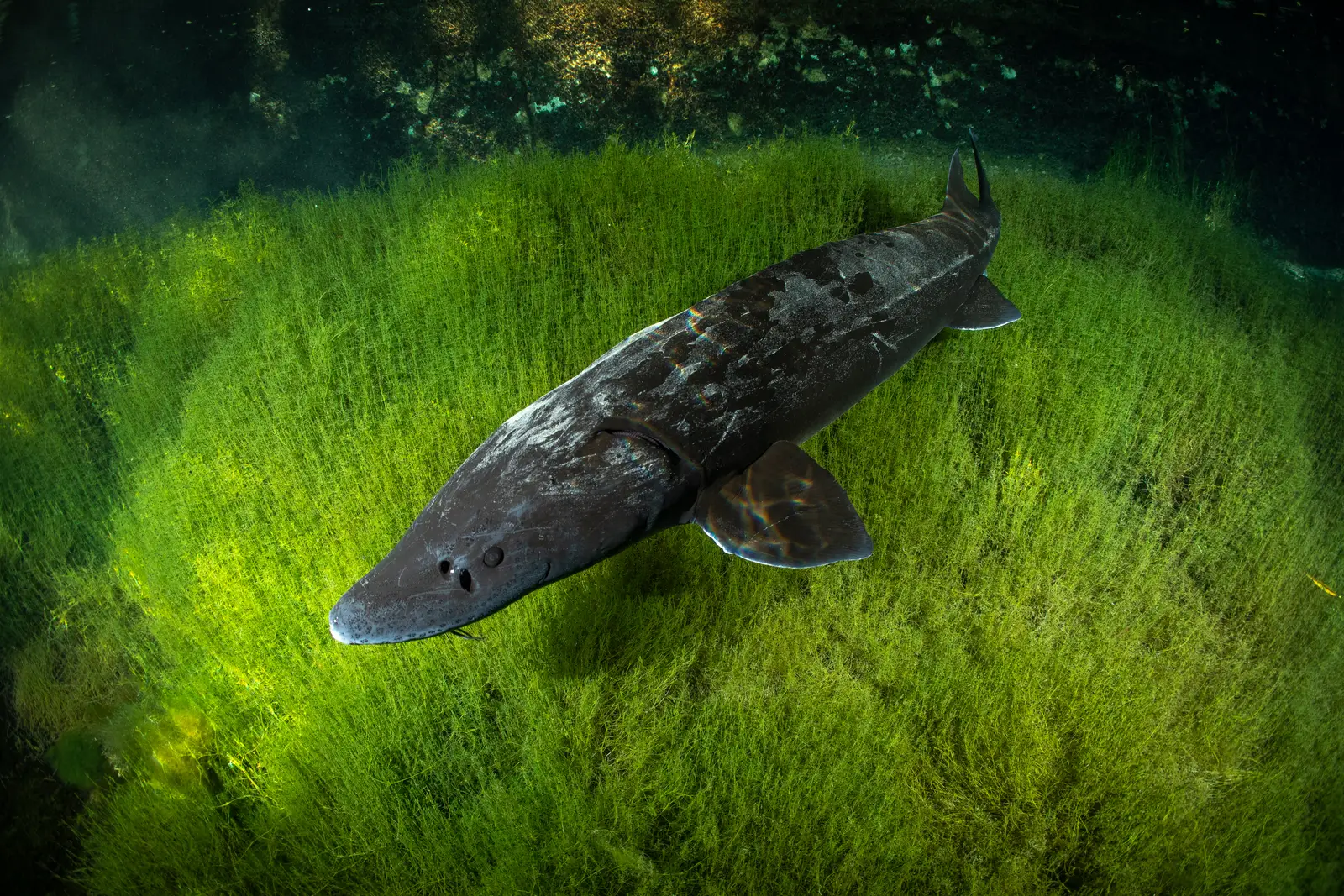
The white sturgeon is the largest freshwater fish in North America, with historical records of fish 20 ft (6.1 m) long. You’ll find it in the big rivers and bays of the Pacific coast. Think the Sacramento–San Joaquin Delta, the Columbia and Willamette, Idaho’s Snake and the Fraser in British Columbia. You can fish for one in California, Oregon, Washington and Idaho. Keeping one is another matter. That’s allowed only on a few stretches of the Columbia system, inside a size slot, and mostly on the few days a year the states open for keeping.
Idaho Fish and Game says anglers once caught white sturgeon up to 1,500 pounds. The world record on the books is 468 lb, from 1983, because the biggest whites caught today never leave the water.
How do you identify a white sturgeon?
A white sturgeon is gray with a pale belly and no stripes. Look under the long snout: the four whiskers, the barbels, sit closer to the tip of the snout than to the mouth. Instead of scales it has rows of bony plates called scutes, and skin Oregon’s agency calls “rough, scale-less skin, similar to a shark.” The mouth has no teeth. It slides out like a vacuum hose and sucks food off the bottom.
The only fish you’ll confuse it with is the green sturgeon, which lives in the same West Coast rivers and bays. That matters. California, Oregon and Washington don’t let you fish for a green at all. One you hook by accident goes back at once, unharmed. Check the belly first, then the snout.
| Check | White sturgeon | Green sturgeon |
|---|---|---|
| Color | Gray, pale belly, no stripes | Olive green, dark stripes on sides and belly |
| Barbels | Closer to the tip of the snout | Closer to the mouth |
| Side plates (scutes) | 37 or more, dull | 33 or fewer, sharp |
| Behind the vent | No plates | Plates |
| Vent | Behind the pelvic fins | Between the pelvic fins |
That table is California’s. The U.S. Fish and Wildlife Service adds one more check: a white has a blunter snout than the pointed snout of a green. The plates can be sharp on young sturgeon, so wear gloves when you handle one.
The lake sturgeon is the other big American sturgeon, but you’ll never find the two together. The lake sturgeon lives in the Great Lakes and the Mississippi and Hudson Bay basins. For all nine sturgeons in US waters, see the sturgeon species guide.
Where do white sturgeon live?
From Ensenada, Mexico, to Alaska along the coast, but mostly in big rivers and the bays at their mouths. Three main spawning populations still reach the sea: the Fraser, the Columbia and the Sacramento–San Joaquin. Whites can move between salt and fresh water, but they don’t have to. Washington’s agency says most of them spend most of their time in fresh water.
- The Columbia and Willamette. The lower Columbia and Willamette hold “the most productive white sturgeon population in the world,” Oregon’s Department of Fish and Wildlife says. Fish move back and forth between the two rivers. The pools above Bonneville Dam are where the keeper seasons are.
- San Francisco Bay and the Delta. The Sacramento–San Joaquin fish are the species’ southernmost spawning population. They spawn mainly over a short reach of the middle Sacramento River, with some spawning in the San Joaquin.
- The Snake River in Idaho. Idaho’s healthiest populations are in the free-flowing Snake between Bliss Dam and the top of C.J. Strike Reservoir, and from Lewiston up to Hells Canyon Dam. Idaho also has whites in the lower Salmon and the Kootenai, but the Kootenai is closed to sturgeon fishing.
- Washington’s coast and Puget Sound. Willapa Bay, Grays Harbor and Puget Sound have catch-and-release fisheries. The ones on the Chehalis, Skagit and Stillaguamish rivers have a small, loyal following.
- Land-locked fish. Some populations never reach the sea. On the Snake, Idaho says, dams cut the fish into isolated groups. The Kootenai River fish of Idaho, Montana and British Columbia are one of 18 land-locked populations in western North America.
Season moves them within a river. In winter, Oregon says, sturgeon hold deeper and are less active. As the water warms they move shallower to feed. On the lower Columbia, Oregon points to “a relatively productive fishery from June to July around Astoria.”
If you can pick one place, pick the lower Columbia. Oregon calls its fish, with the Willamette’s, the most productive white sturgeon population in the world. It’s catch and release only there, so go for the fight, not the freezer.

Free PDF · Water temperature chart Which fish are biting at today's water temperature?
One reading, and the 16-page chart shows which of 26 fish are spawning, feeding hard or slowing down; for bass, crappie, bluegill and walleye, where they sit and what to throw. Every number sourced.
No card, nothing to buy, and the PDF is yours to keep. Confirm with one click and it's on its way. Then a few short emails and one a week on what's biting. Unsubscribe anytime. Privacy.
How big do white sturgeon get?
Big, but not as big as the stories. A 20 ft fish is history. What you’ll hook today is far smaller, and it depends on the river.
| How big | Length or weight | Who says so |
|---|---|---|
| Historical records | 20 ft (6.1 m) | California |
| Caught by Idaho anglers, historically | Up to 1,500 lb (680 kg) | Idaho Fish and Game |
| Large by today’s standards | 10–12 ft (3–3.7 m) | U.S. Fish and Wildlife Service |
| Most whites | Rarely over 10 ft (3 m) | Oregon |
| Rare in California today | Over 6.5 ft (2 m) | California |
| Average Delta fish | About 3.6 ft (1.1 m) | California |
Washington puts the weight of a big one at “hundreds of pounds.” They live a long time too. The oldest white on record was 103 years old when it was caught, California reports. Most fish you’ll catch in the Delta today are thought to be under 20.
What is the world record white sturgeon?
The IGFA all-tackle record is 468 lb (212.28 kg), caught by Joey Pallotta III at Benicia, California, on July 9, 1983. It’s also the white sturgeon line on our list of the largest freshwater fish.
Why hasn’t a bigger fish beaten it in more than 40 years? Because the rules changed under it. A weight record needs the fish on a scale, and the giants now stay in the water. California won’t let a white over 60 in fork length out of the water. Washington draws the line at 55 in and Oregon at 54 in. Idaho keeps every sturgeon in the water. So the biggest fish are measured, photographed and let go, and their weights stay estimates. On the world stage the white is not the biggest sturgeon either: the beluga sturgeon of the Caspian and Black Sea outgrows it.
Can you keep a white sturgeon?
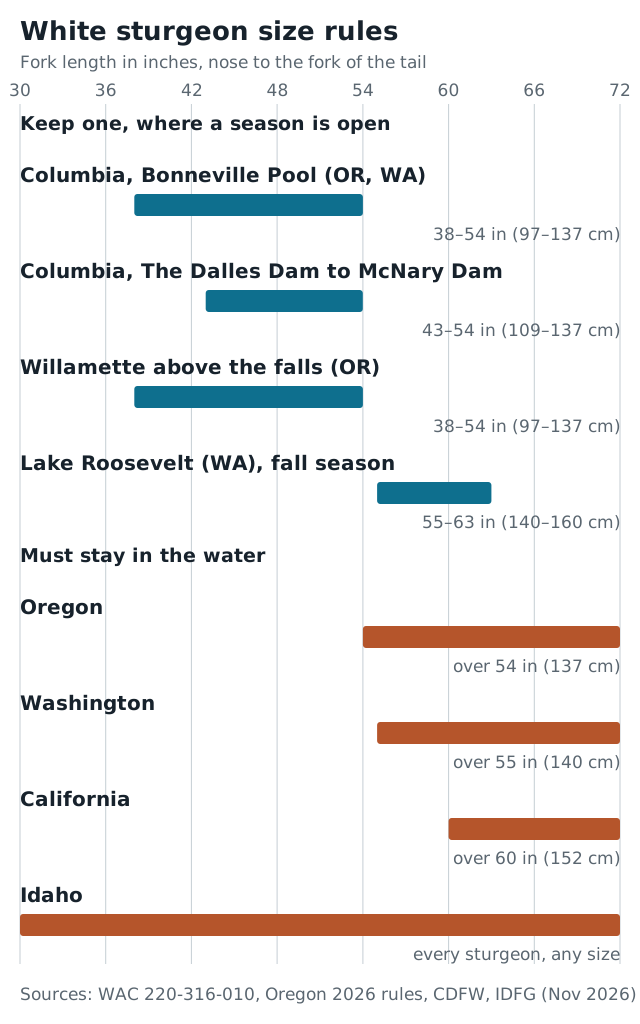
In California and Idaho, no. In Oregon and Washington, yes, on a few waters and only when a retention season, the days you may keep one, is open. You get one fish a day and two a year, inside a slot measured in fork length. That is the length from the tip of the nose to the fork of the tail, with the fish on its side. The table puts every white sturgeon water in the four states side by side, from each state’s own rules as of November 2026.
| Water | Keep one? | Size rule, fork length | When |
|---|---|---|---|
| California, all waters | No: catch and release only, bag limit zero | Over 60 in (152 cm) stays in the water | October 1 to June 30 in most waters |
| Columbia, mouth to Bonneville Dam (OR, WA) | No: catch and release only | Over 54 in (137 cm) in Oregon, 55 in (140 cm) in Washington stays in the water | Year-round, with some May 1 to August 31 closures to protect spawning fish |
| Columbia, Bonneville Pool (OR, WA) | Yes, 1 a day, 2 a year | Keep 38–54 in (97–137 cm) | Short seasons, dates announced each year |
| Columbia, The Dalles Dam to McNary Dam (OR, WA) | Yes, 1 a day, 2 a year | Keep 43–54 in (109–137 cm) | Short seasons, dates announced each year. The Dalles Pool had four days in 2026 |
| Willamette above the falls (OR) | Yes, 1 a day, 2 a year | Keep 38–54 in (97–137 cm) | Year-round, to the mouth of the Coast Fork |
| Lake Roosevelt (WA) | Yes, 1 a day, 2 a year | Keep 55–63 in (140–160 cm) | September 16 to November 30 |
| Washington coast and Puget Sound | No: catch and release only | Over 55 in (140 cm) stays in the water | Marine areas year-round; Snohomish to the Highway 9 Bridge year-round |
| Idaho, Snake and Salmon | No: catch and release only since 1970 | Every sturgeon stays in the water | Where the river is open |
Two warnings before you plan a trip around that table. The Columbia keeping days are set each year, and the quotas are small. Washington’s standing rule says January 1 to April 30. But in 2026 The Dalles Pool, from The Dalles Dam to John Day Dam, was open for keeping on four days: February 16, 22 and 26 and March 3. “Starting in 2026, sturgeon anglers should not expect the traditional New Years Day opener in all sections of the Columbia upstream of Bonneville,” Oregon writes. And the lower Columbia stays closed to keeping fish for now. Oregon puts the drop in sturgeon below Bonneville at nearly 80 percent since 2010, and says fishing did not cause it. Check Oregon’s and Washington’s sturgeon pages the week you go.
One row looks odd. Washington says no sturgeon over 55 in may leave the water, yet its Lake Roosevelt slot runs from 55 to 63 in fork length. The rule sets that fall season for Lake Roosevelt alone and says no more, so read it before you go.
You need the right paperwork too, even when you only plan to release. California asks for a Sturgeon Fishing Report Card while you fish for white sturgeon. Oregon wants a fishing license and a Combined Angling Tag, plus the Columbia River Basin Endorsement on the Columbia and Willamette. Washington has a statewide night closure for white sturgeon.
A small stream in autumn. Photo: sliper84 / Depositphotos.
How do you catch a white sturgeon?
With bait on the bottom and heavy gear. Whites “typically don’t take lures,” California says, so bait is the game.
- Rod and line. California’s anglers use medium-heavy to heavy rods with soft tips, to see the bite, and 50 to 100 lb braided line or mono.
- Weight. Pyramid sinkers of 4 to 16 oz (113 to 454 g), heavy enough to hold in the current. On a sliding-sinker rig, like a big fish-finder rig, the sinker slides on the line. Idaho requires one.
- Hook. One single-point barbless hook. That’s the law in California, Oregon and Washington, and Idaho requires barbless hooks too.
- Bait. In California: ghost, mud or grass shrimp, lamprey (“eel”) and salmon roe, then pile worms, nightcrawlers, shad or herring. On the Columbia and Willamette: sand shrimp, nightcrawlers, smelt, pickled herring, squid and anchovy. In Idaho: cut bait, squid, herring and shrimp, fished on the bottom of deep holes.
Match your bait to what the fish are eating. Columbia anglers dip the spring smelt run for bait. Sturgeon there also feed on the shad run and even on full-grown salmon coming upriver to spawn. In Idaho the old giants grew big on runs of salmon, steelhead and Pacific lamprey, and on freshwater mussels.
Watch out: Use one single-point barbless hook. It’s the law for white sturgeon in California, Oregon and Washington.
Then watch your rod. For a fish this big the bite is tiny. California says to keep the line tight and look for “very gentle taps and pumps” on the rod tip. Once it’s on, land it fast, because a long fight can stress a sturgeon so much it doesn’t recover. From a boat, Oregon’s advice is to “release from the anchor and follow the fish.” The rig step by step, the best months and the release are in our sturgeon fishing guide.
How do you release a white sturgeon?
Keep it in the water if it’s over your state’s line, and keep it level if it’s under. A sturgeon has no strong bony skeleton to carry its own weight out of the water, so lifting a big one can hurt it inside. For a fish under 60 in, California says to use two hands and gloves. Put one hand under the head and front fins and one just ahead of the tail. Never hang one by the gills, the mouth or the tail alone, and never use a lip gripper or a gaff. To revive it, hold it under water facing into the current until it struggles or swims off. More habits that keep a released fish alive are in catch and release.
Is white sturgeon good to eat?
Yes, where you may keep one. Oregon calls sturgeon meat “excellent when smoked or prepared any number of other ways for the table.” So many anglers want one that the Columbia quotas fill fast. California allows no harvest at all, and poaching for meat and eggs is one of the threats it lists for its fish. Those eggs are caviar, and the caviar story is in our sturgeon guide. Oregon also advises releasing any sturgeon caught from Bonneville Dam to Ruckel Creek, about a mile upstream, because of high PCB levels. Before you eat a kept fish from anywhere else, check your state’s fish advisory.
Why are white sturgeon so protected?
Because they start late and a lost fish takes decades to replace. On the lower Columbia a white matures at about 6 ft, or around 25 years old, Washington says. Females then spawn every four to six years. In California the first spawn comes at about 10 to 19, males earlier than females, and females spawn every two to four years. A stressed female may skip a spawn, reabsorb her eggs and wait three to five years, Oregon adds. When she does spawn, it’s a lot of eggs: a 60 in fish averages over 200,000.
The number: A white sturgeon on the lower Columbia matures at about 6 ft, or around 25 years old.
The history shows how fast it can go wrong. California shut its commercial white sturgeon fishery in 1901 after the numbers crashed. Anglers could keep fish there from 1954 through 2024. Then the state made the white a candidate for its endangered species list, and the fishery went to catch and release only. In 2022 an algae bloom killed at least 691 sturgeon in San Francisco Bay. In July 2026 the U.S. Fish and Wildlife Service found a federal listing of the San Francisco Bay fish “warranted but precluded.” That makes them a federal candidate too.
The Kootenai River fish are already federally endangered, since 1994. That population fell from about 7,000 fish in the late 1970s to 760 in 2000. On average only about 10 young sturgeon are born in the river each year. Idaho went catch and release only for all its sturgeon in 1970, after dams and poorly regulated harvest cut the Snake River fish down.
The good news is in the Columbia: Oregon says the Columbia and Willamette populations are still well above conservation thresholds. Want the other big fish outside the bass, trout and catfish families, from gar to burbot? Browse other freshwater fish. Every protected species is in the endangered freshwater fish guide.

Free PDF · 16 pages
Stop guessing. Know what's biting before your first cast
A whole Saturday on the water with nothing to show for it. One reading tells you who's feeding.
The Water Temperature Fishing Chart. Take one water temperature reading, find it on the chart, and see which of 26 freshwater fish are spawning, feeding hard or slowing down.
- Where bass, crappie, bluegill and walleye sit, and what to throw. Trout: the reading where you stop.
- Why a 3 ft drop beats a cold front, and what to throw each day of the front
- The three thermometer mistakes that make a reading lie
The chart's numbers come from state fish and wildlife agencies and fisheries research: 61 sources, each listed on the site.
No card, nothing to buy. Confirm with one click and the PDF is on its way, one version for your phone and one to print, yours to keep. Then a few short emails and one a week on what's biting, with an unsubscribe link in every one. Privacy.
Related
Section guide
Freshwater Fish Species Outside the Big Families: Sturgeon, Gar, Bowfin, BurbotThe freshwater fish species outside the bass, trout, catfish and pike families: sturgeon, gar, bowfin, burbot, drum, eel and paddlefish, with records.
 American Eel: How to Catch One at Night, and the Rules
The American eel grows to 4 ft and 9 lb. The night bait and hook that catch one, where to cast, the limits state by state, and how to skin it.
 Pacu Fish: Human-Like Teeth, and How to Tell One From a Piranha
A pacu fish is a piranha cousin with flat teeth like human molars. How to tell it from a piranha, how big it gets, and what to do if you catch one.
 Mooneye and Goldeye: How to Tell Them Apart and Catch Them
A mooneye is a silvery, big-eyed river fish with teeth on its tongue. How to tell it from a goldeye, where both live, how to catch them, and how they eat.
 Round Goby: How to Identify It, Why It Matters, and the Bait Rules
The round goby is a small invasive bottom fish of the Great Lakes. How to ID one, what each state says about goby bait, and why smallmouth love them.
 Alewife: How to Identify It, Where It Runs and Why Anglers Care
The alewife is a small silver herring: sea-run on the Atlantic, landlocked in the Great Lakes. How to ID one, where it runs, and where you can keep it.
 Candiru: The Amazon's Vampire Catfish and the Urethra Myth
The candiru is a tiny see-through Amazon catfish that drinks blood from fish gills. What it really does, its size, and the urethra story checked.
Sources (18)
- California Department of Fish and Wildlife, White Sturgeon
- California Department of Fish and Wildlife, White Sturgeon (fishing, regulations T14 CCR §5.80)
- Washington Department of Fish and Wildlife, White sturgeon
- Washington Administrative Code 220-316-010, Sturgeon—Areas, seasons, limits and unlawful acts
- Oregon Department of Fish and Wildlife, White sturgeon
Show all 18 sourcesShow fewer sources
- Oregon Department of Fish and Wildlife, Sturgeon fishing in Oregon
- Idaho Fish and Game, Sturgeon
- Idaho Fish and Game, Idaho Fishing Seasons and Rules 2025–2027
- 2026 Oregon Sport Fishing Regulations, General Statewide Regulations
- 2026 Oregon Sport Fishing Regulations, Columbia River Zone
- 2026 Oregon Sport Fishing Regulations, Willamette Zone
- Oregon Department of Fish and Wildlife, Green sturgeon
- Oregon Department of Fish and Wildlife, Two sturgeon retention days added in The Dalles Pool (February 19, 2026, updated February 26)
- U.S. Fish & Wildlife Service, Sturgeon Snoots and Scutes
- U.S. Fish & Wildlife Service, White Sturgeon (Acipenser transmontanus)
- U.S. Fish & Wildlife Service ECOS, species listing status (white sturgeon)
- Federal Register, 12-Month Finding for the San Francisco Estuary Distinct Population Segment of White Sturgeon (July 21, 2026)
- IGFA World Record Search: Sturgeon, white