 By
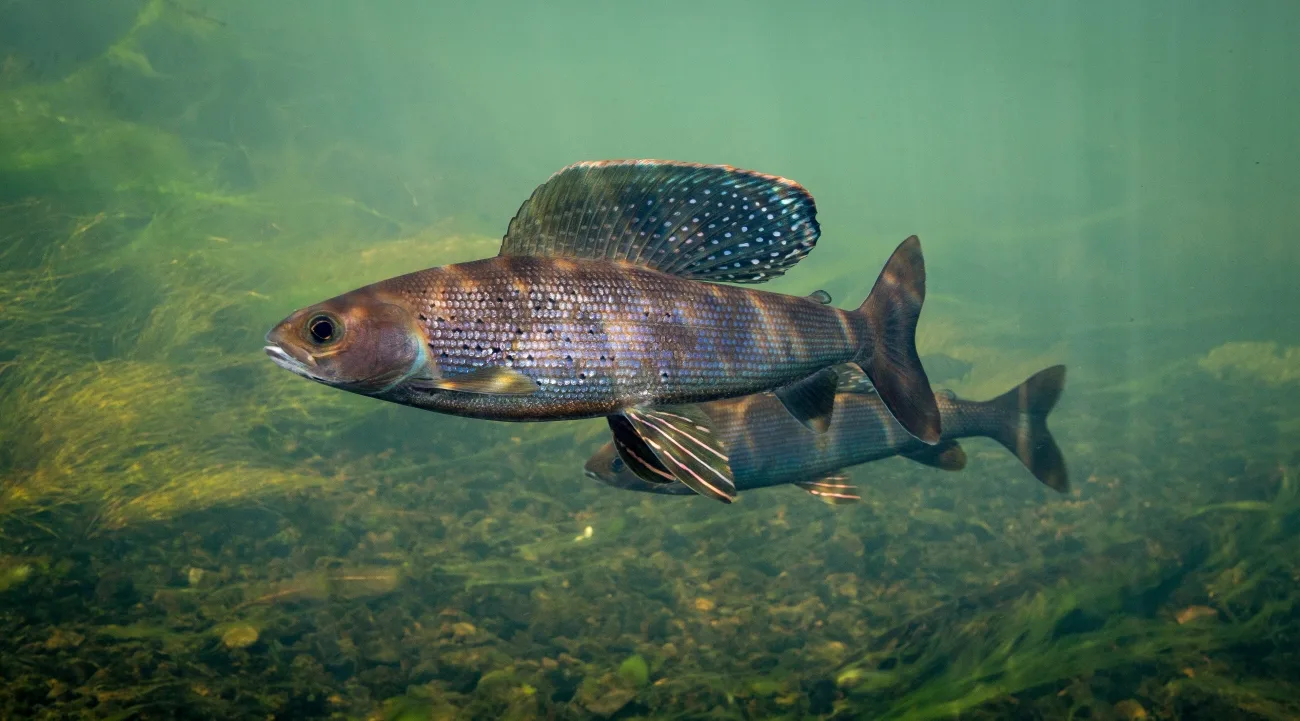
The Arctic grayling is the trout-family fish with the sail on its back. In the US you catch one in Alaska, in Montana, or in a high mountain lake out West. It’s small: the Fish and Wildlife Service puts the common length at 13.5 inches. And it eats bugs off the surface. So the whole game is a small dry fly or a tiny spinner in cold, clear water. In Alaska it’s everywhere. In the lower 48 it takes a hike.
Alaska’s fish and game department once opened up a grayling with seven shrews in its stomach. Another had eaten 65 young salmon.
What is an Arctic grayling?
It’s a cold-water cousin of the trout and the whitefish, and you’ll know it the second it comes out of the water. The dorsal fin on its back is huge, like a sail, edged in red and dotted with iridescent red, aqua or purple spots. The US Fish and Wildlife Service calls it the only member of the trout and salmon family with a fin like that. It’s also the only one of the six grayling species that lives in North America, Alaska says. It belongs to the same family as trout, salmon and the lake whitefish. Its home range runs from Russia’s Ural Mountains across Siberia, Alaska and Canada to the western shore of Hudson Bay.
Tip: You’ll usually need small flies or lures. A grayling’s mouth is tiny.
Three more marks settle it. The mouth is tiny. Colorado’s wildlife agency says that’s why you usually need small flies or lures. Look for a black slash on each side of the lower jaw. The back is dark and the sides silver, sometimes gold or blue, with big scales and a scatter of black spots on the front half. Like a trout it has an adipose fin, the small fleshy fin on the back near the tail.
Where to catch Arctic grayling in the US
Go to Alaska if you can. Alaska’s fish and game department says grayling have the largest natural range of any sport fish in the state, nearly all of it. The exceptions are Southeast Alaska, Kodiak Island and the Aleutians. The biggest fisheries are along the road system in the Interior, such as the Chena River through Fairbanks. The bigger fish come from waters that see fewer anglers. In the far north they share the cold water with the Arctic char.
In the lower 48 it’s a different story. Grayling were native only to Michigan and the upper Missouri country: Montana, and the Madison and Gibbon headwaters in Yellowstone. Michigan’s were gone by 1936. Montana’s river fish now hang on in the upper Big Hole River and the upper Ruby River near Alder. Most of the rest south of Canada are stocked fish, mostly in lakes. Some of those lakes have kept their grayling going on their own for decades.
| State | Native or stocked | Where to look | State record |
|---|---|---|---|
| Alaska | Native, statewide | Interior road system (Chena River, Delta Clearwater River); Bristol Bay’s Ugashik system and the Nome area for trophies | 5 lb 1 oz (2.3 kg), 23 in (58 cm), Seward Peninsula |
| Montana | Native (Big Hole River); lakes stocked | Upper Big Hole River near Wisdom; 30 or more lakes in the western half of the state | 3.63 lb (1.65 kg), 20 in (51 cm), Washtub Lake, 2003 |
| Wyoming | Native in the Madison and Gibbon headwaters; stocked | Select cold, clear lakes and streams, a handful of them self-sustaining | 2.36 lb (1.07 kg), 19.6 in (50 cm) |
| Colorado | Stocked since the 1890s | Joe Wright Reservoir, Pearl Lake, Lower Big Creek Lake, Silver Lake, Bonham Reservoir, Pomeroy Lake | 1 lb 10 oz (0.74 kg), 17.25 in (44 cm), Lower Big Creek Lake, 2002 |
| Utah | Stocked, now self-sustaining | High Uinta lakes: Weir, Blue, Marjorie, Trial, Wall, Fish, Round, Sand; Smith and Morehouse Reservoir | 1 lb 12 oz (0.79 kg), 17.25 in (44 cm), Big Dog Lake, 1998 |
| Michigan | Native until 1936; being restored | Penegor Lake (Houghton County), West Johns Lake (Alger County) and Pine Lake (Manistee County), stocked in November 2023, release-only; eggs in three rivers since 2025 | None |
The IGFA also lists transplanted grayling in Vermont, Arizona, Nevada and California. Call that state’s fish agency before you plan a trip around one.

Free PDF · Water temperature chart Which fish are biting at today's water temperature?
One reading, and the 16-page chart shows which of 26 fish are spawning, feeding hard or slowing down; for bass, crappie, bluegill and walleye, where they sit and what to throw. Every number sourced.
No card, nothing to buy, and the PDF is yours to keep. Confirm with one click and it's on its way. Then a few short emails and one a week on what's biting. Unsubscribe anytime. Privacy.
How to catch Arctic grayling
Grayling eat drifting bugs: black flies, mayflies, stoneflies and caddis, Alaska says. They rise readily to a dry fly, a fly that floats on the surface, Alaska says. That’s why fly anglers love them. Here’s what to tie on.
- On a fly rod, start with an Adams. Alaska names the Adams dry fly and the hare’s ear nymph as patterns that usually work. A 4 or 5-weight rod is all you need, the Fairbanks Daily News-Miner says. Its favorite flies are the Elk Hair Caddis, the Adams, mosquito patterns and black ants.
- On a spinning rod, go tiny. A light rod and a small Mepps or Blue Fox spinner will do it, the same paper says. In Utah’s Uinta lakes, Rooster Tails, Panther Martins and small Kastmaster spoons work too.
- Match the hatch when they get picky. Grayling can be finicky when one insect is coming off, Alaska warns. If they rise and refuse, go smaller or switch to what’s on the water.
- Fish the cold, clear stretch. In Alaska the bigger adults hold in the cooler upper reaches of a river. The young ones sit lower down, where the water’s warmer.
- Move with the season. In spring, grayling run upstream to spawn, then spread out to summer feeding water, sometimes 100 miles (160 km) away. In early fall they drift back down to lakes and deep, slow pools for the winter.
- In a mountain lake, think about the inlet. Montana’s lake grayling live in small, cold, clear lakes with creeks where they can spawn. At Colorado’s Joe Wright Reservoir they run up the creek near the end of June and spend the other 11 months in the lake. Check the rules before you fish any inlet in spawning time.
Bait works too, Alaska says, but you can’t use it on a lot of grayling water. On the Delta Clearwater River, from January through August, you may fish only one unbaited, single-hook lure or fly. On the Chatanika, bait is allowed only on hooks with a gap wider than ¾ inch.
Pinch the barb if you’ll let them go. A barbless hook makes the release quicker. For the photo, Alaska’s trophy program says to hold the fish at the water’s surface and release it into the current. The rest of the catch-and-release basics apply here too.
When is the best time to fish for grayling?
Summer. Alaska calls grayling voracious feeders during the brief northern summer: they’ll eat almost anything that moves. Here’s how their year runs in an Alaska river, and what it means for you.
| When | Where the grayling are | What you do |
|---|---|---|
| Spring | Running upstream to spawn | Check the rules: some water is release-only now |
| Right after spawning | Moving to summer feeding water, up to 100 mi (160 km) away | Follow them up to the cooler upper river |
| Summer | Feeding hard on drifting insects | Your best weeks: dry flies and small spinners |
| Early fall | Drifting back downstream | Fish lower down, toward the wintering pools |
| Winter | Lakes and deep, slow pools, barely feeding | Your slowest season |
Source: Alaska Department of Fish and Game species profile.
In winter they sit in lakes or in deep, slow pools of rivers such as the Chena, Gulkana, Tanana and Yukon. They can handle the low oxygen under the ice that many other fish can’t.
In the West the spawning run comes late. Colorado’s Joe Wright fish run up their creek near the end of June. Below the Chena River dam marker, Alaska makes grayling release-only from April 1 through May 31. So if you’re planning one trip, you’ll do best from midsummer on.
You may have the fish to yourself, too. “You can spend the whole day on the upper Chena and not see anybody,” Audra Brase of Alaska’s fish and game department told the News-Miner.
How big do Arctic grayling get?
Not big, outside Alaska and northern Canada. Colorado says they’re usually less than 12 inches, and a really big one there is around 16. In Wyoming they usually weigh 1 to 2 pounds, and 16 inches is a great fish. Montana calls 20 inches and 3 pounds exceptional. In Alaska a trophy is more than 3 pounds. Most of those come from the Ugashik Lake and river system and the Nome area.
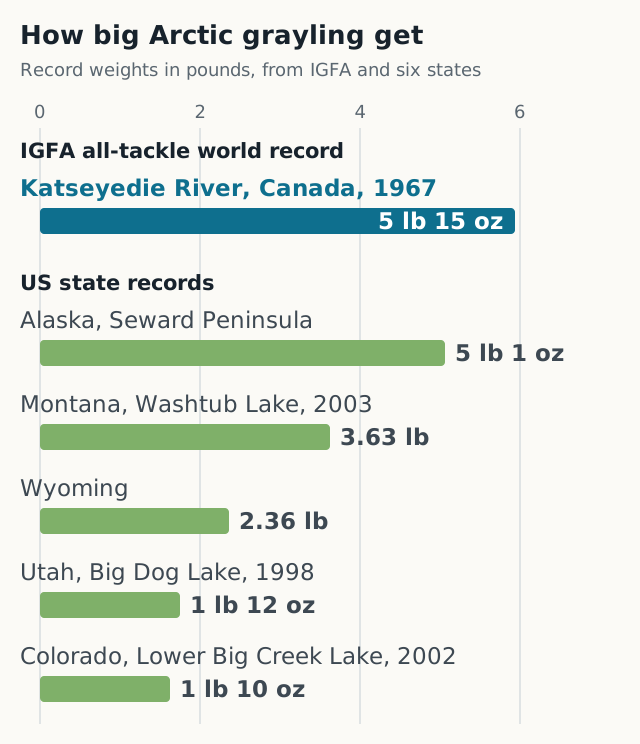
The IGFA all-tackle record is 5 lb 15 oz (2.69 kg), caught by Jeanne Branson in the Katseyedie River, Canada, on August 16, 1967. It has stood for nearly 60 years. The longest on IGFA’s length list is 48 cm (about 19 in), from Great Bear Lake in 2025.
Great Bear Lake, in Canada’s Northwest Territories, is the name to remember. It holds that length record and five more IGFA grayling records. The US records on IGFA’s list are all from Alaska. Fly angler Peter Cockwill holds three men’s tippet records from the Seward Peninsula, the best 5 lb 1 oz (2.3 kg) in 2008.
A big grayling can be old. Alaska’s live up to 32 years. In Montana’s Big Hole River they grow fast and rarely live past 5.
When do Arctic grayling spawn?
In spring, in moving water over gravel. The males move into the creeks first and claim a spot before the females arrive, the Fish and Wildlife Service says. The fish scatter the eggs over the gravel, and the eggs sink in between the pebbles. In Alaska the fry hatch about three weeks later. A female carries 1,500 to 30,000 eggs, depending on her size.
Alaska’s grayling first spawn at 4 to 7 years old and 10 to 12 inches (25–30 cm). Montana’s Big Hole fish are nearly full grown by age 3. Alaska says some fish return to the very same spawning and feeding spots every year.
Grayling rules: when you have to let them go
The rules swing from 5 a day to none, so read the book for the exact water. A few examples:
| Water | What you may keep | Source |
|---|---|---|
| Tanana River area, Alaska (general) | 5 a day, no size limit | ADF&G 2026 |
| Delta Clearwater River, Alaska | 1 a day, 12 in (30 cm) or shorter | ADF&G 2026 |
| Chena River, above the marker 300 ft (91 m) below the dam | Catch-and-release only | ADF&G 2026 |
| Chena River, below that marker | Release April 1–May 31; then 1 a day | ADF&G 2026 |
| Montana, Central District rivers and streams | All grayling released | Montana FWP 2026 |
| Michigan lakes stocked in 2023 | Catch-and-release | Michigan DNR 2023 |
In Utah you can often keep four trout and grayling combined, KSL.com reported in 2018. Check the current guidebook, because every state changes its book.
Montana’s river grayling aren’t listed under the Endangered Species Act. The Fish and Wildlife Service said in 2020 that federal protection for the upper Missouri River grayling was not warranted. In August 2024 a federal judge threw out that finding and ordered a new one, the Daily Montanan reported. The new finding is now due by February 2027, E&E News reported. For now, the release rules are the protection, so follow them.
Are Arctic grayling good to eat?
Yes. Colorado’s wildlife agency says they have tasty white meat. In Alaska, villages harvest grayling for food. Some take only a few, and others count on them to meet the year’s needs.
Keep one only where the rules allow it, and pick a common fish from a busy water. A big, old grayling from a remote lake took a long time to grow. If you came for a photo of that sail, a quick release is the better trade.
Why grayling vanished from most of the lower 48
They bite too easily. Montana’s field guide calls grayling gullible to the angler’s lures and easily out-competed by other trout and salmon. That probably explains much of their loss from their native range. Montana says they don’t live well alongside other fish, except the cutthroat trout and others they evolved with. Michigan’s disappeared through habitat destruction, unregulated timber harvest and pressure from non-native fish. The city of Grayling, Michigan, on the Au Sable River, is named after them.
In Montana, grayling once ran the upper Missouri River drainage as far down as Great Falls. Lewis and Clark wrote about a “new kind of white or silvery trout” in 1805. Today the river form survives in the Big Hole. Montana’s Fish, Wildlife and Parks is putting grayling back into many southwestern Montana rivers, and it asks anglers to report any they catch.
Michigan is bringing them back. In 2016 Michigan DNR and the Little River Band of Ottawa Indians launched the Michigan Arctic Grayling Initiative, now more than 50 partners. On May 12, 2025, the DNR handed about 400,000 eggs to three tribes for streamside incubators on the Manistee, Maple and Boardman-Ottaway rivers. The eggs came from Alaska’s Chena River. The DNR calls the return a yearslong process. For the list of fish that are in trouble nationwide, see endangered freshwater fish.
In a Uinta lake, the fish next to your grayling is often a brook trout, KSL.com notes. In Montana, the cutthroat trout is one of the few fish grayling get along with. The rest of the odd ones are on the other freshwater fish page.

Free PDF · 16 pages
Stop guessing. Know what's biting before your first cast
A whole Saturday on the water with nothing to show for it. One reading tells you who's feeding.
The Water Temperature Fishing Chart. Take one water temperature reading, find it on the chart, and see which of 26 freshwater fish are spawning, feeding hard or slowing down.
- Where bass, crappie, bluegill and walleye sit, and what to throw. Trout: the reading where you stop.
- Why a 3 ft drop beats a cold front, and what to throw each day of the front
- The three thermometer mistakes that make a reading lie
The chart's numbers come from state fish and wildlife agencies and fisheries research: 64 sources, each listed on the site.
No card, nothing to buy. Confirm with one click and the PDF is on its way, one version for your phone and one to print, yours to keep. Then a few short emails and one a week on what's biting, with an unsubscribe link in every one. Privacy.
Related
Section guide
Freshwater Fish Species Outside the Big Families: Sturgeon, Gar, Bowfin, BurbotThe freshwater fish species outside the bass, trout, catfish and pike families: sturgeon, gar, bowfin, burbot, drum, eel and paddlefish, with records.
 White Sturgeon: Size, Age, Where They Live and the Rules by State
The white sturgeon is North America's largest freshwater fish. The 468 lb record, how to tell it from a green, and where you may keep one, state by state.
 American Eel: How to Catch One at Night, and the Rules
The American eel grows to 4 ft and 9 lb. The night bait and hook that catch one, where to cast, the limits state by state, and how to skin it.
 Pacu Fish: Human-Like Teeth, and How to Tell One From a Piranha
A pacu fish is a piranha cousin with flat teeth like human molars. How to tell it from a piranha, how big it gets, and what to do if you catch one.
 Mooneye and Goldeye: How to Tell Them Apart and Catch Them
A mooneye is a silvery, big-eyed river fish with teeth on its tongue. How to tell it from a goldeye, where both live, how to catch them, and how they eat.
 Round Goby: How to Identify It, Why It Matters, and the Bait Rules
The round goby is a small invasive bottom fish of the Great Lakes. How to ID one, what each state says about goby bait, and why smallmouth love them.
 Alewife: How to Identify It, Where It Runs and Why Anglers Care
The alewife is a small silver herring: sea-run on the Atlantic, landlocked in the Great Lakes. How to ID one, where it runs, and where you can keep it.
Sources (23)
- Alaska Department of Fish and Game, Arctic Grayling Species Profile
- IGFA World Record Search, Grayling, Arctic
- U.S. Fish and Wildlife Service, Arctic Grayling (Thymallus arcticus)
- U.S. Fish and Wildlife Service (2020), Listing Arctic grayling not warranted
- Montana Fish, Wildlife and Parks, Arctic Grayling Management
Show all 23 sourcesShow fewer sources
- Montana Field Guide, Arctic Grayling
- Montana Fish, Wildlife and Parks, Montana state record fish (2022)
- Montana Fish, Wildlife and Parks, 2026 Montana Fishing Regulations
- Wyoming Game and Fish Department, Arctic Grayling
- Colorado Parks and Wildlife, Grayling (Arctic)
- Colorado Outdoors (2021), The Arctic Grayling Spawn at Joe Wright Reservoir
- Utah Division of Wildlife Resources, Utah state fish records
- Brad Kerr, KSL.com (2018), Is the exotic Arctic grayling on your Utah fishing bucket list?
- Michigan DNR (2025), Save the date! Arctic grayling reintroduction begins with May 12 ceremony at Oden State Fish Hatchery
- WCMU Public Media (2025), Ceremony kicks off the Arctic grayling's return to the Lower Peninsula
- Michigan DNR (2023), Milestone reached in continuing Arctic grayling reintroduction effort
- Kelly House, Bridge Michigan (2023), Gone nearly a century, Michigan anglers can again catch Arctic grayling
- Michigan Arctic Grayling Initiative
- Alaska Department of Fish and Game, 2026 Northern Alaska Sport Fishing Regulations Summary, Tanana River Area
- Alaska Department of Fish and Game, Angler Recognition and Trophy Fish Program
- Daily Montanan (2024), Judge orders Fish and Wildlife Service to make new finding on Arctic grayling protections
- E&E News (2025), A shrinking FWS gains more time to assess Arctic grayling for ESA
- Tim Mowry, Fairbanks Daily News-Miner, Arctic grayling rise to the top for Interior Alaska fishermen