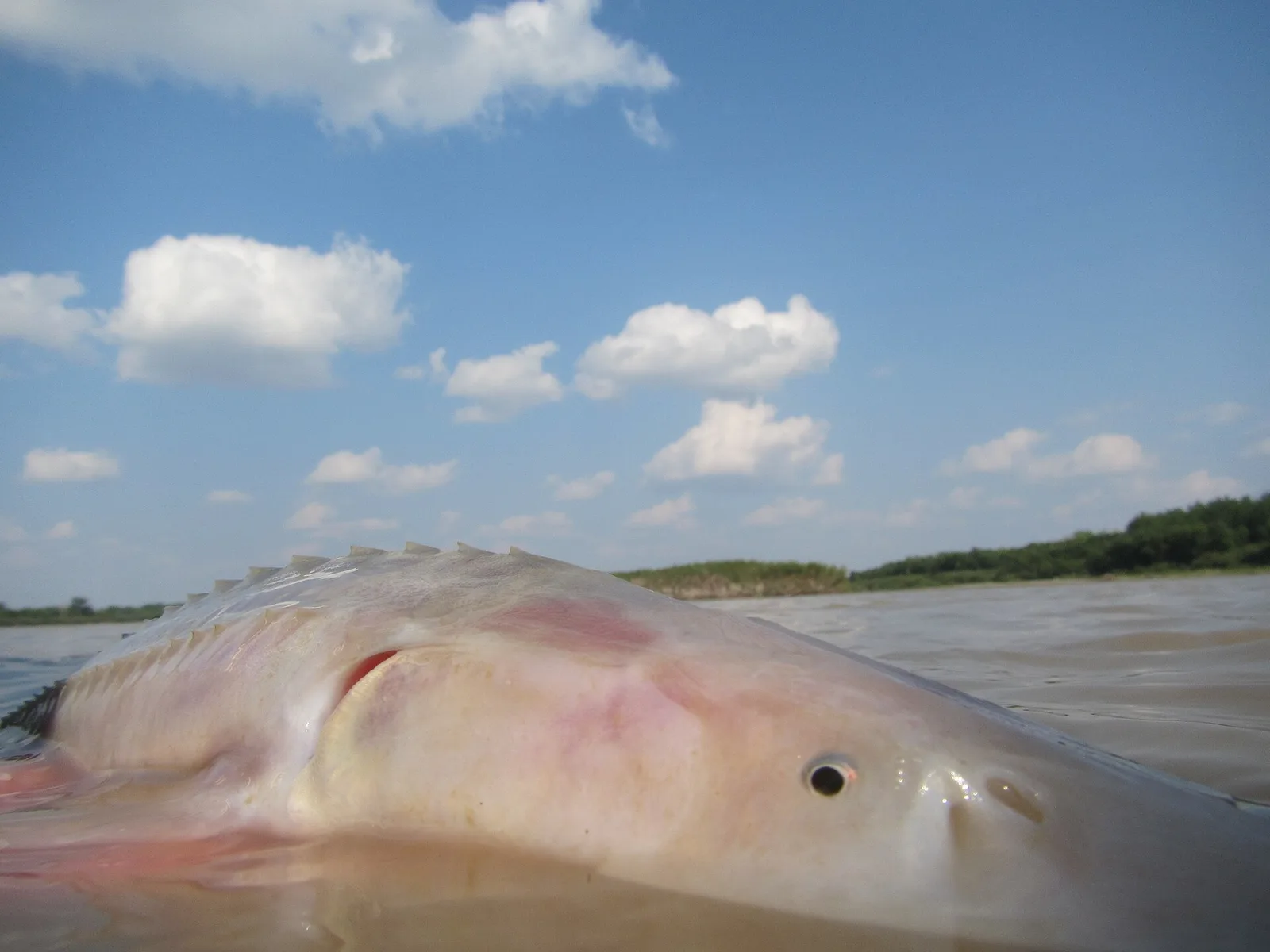
The federal endangered species list carries 167 listings for fish in the United States: 90 endangered and 77 threatened (USFWS ECOS, October 2026). That makes fish the largest group of animals on the list, ahead of mammals, clams and birds, and nearly all of them live in fresh water or run up rivers from the sea to spawn. A handful are fish an angler can actually hook: sturgeon in the Missouri and the Atlantic rivers, bull trout in the Northwest, native trout in the Rockies and the Southwest, the big minnows of the Colorado.
The rarest fish in the country, the Devils Hole pupfish, lives on one rock shelf of 215 square feet in a Nevada cavern. In spring 2025, after two earthquakes shook the water, divers counted 38 of them.
How many fish are endangered in the United States?
The count comes from the Fish and Wildlife Service’s ECOS database, which tracks every species protected under the Endangered Species Act (ESA). One species can appear more than once. Steelhead are listed eleven times, as eleven separate runs from Southern California to Puget Sound, and Atlantic sturgeon five times. Thirteen of them are fish you might actually meet.
In January 2025 the IUCN published the first full assessment of the world’s freshwater animals in Nature: at least 4,294 of the 23,496 species assessed are at high risk of extinction, and freshwater fish came in at 26 percent threatened, worse than dragonflies (16 percent) and behind only crabs, crayfish and shrimp (30 percent). One in four freshwater fish on the planet is in trouble; the American list is the local edition.
| Animal group | Endangered (US) | Threatened (US) | Listings (US) |
|---|---|---|---|
| Fishes | 90 | 77 | 167 |
| Mammals | 69 | 30 | 99 |
| Clams | 75 | 21 | 96 |
| Birds | 65 | 25 | 90 |
| Reptiles | 20 | 31 | 51 |
| Amphibians | 25 | 18 | 43 |
Source: USFWS ECOS listed species summary, read October 2026.
The listed fish an angler might hook
Most of the 167 are fish you will never see on a hook: 1-inch pupfish in desert springs, darters under riffle stones, cavefish, blind catfish. The ones below take bait and lures, share water with fish you may keep, and some look like their legal cousins. Status and listing year are from ECOS.
| Fish | Status (listed) | Where you might meet it | If you hook one |
|---|---|---|---|
| Pallid sturgeon | Endangered (1990) | Missouri, lower Yellowstone, Mississippi below the Missouri | Keep it wet, unhook or cut the line, release. If you don’t know, let it go |
| Shortnose sturgeon | Endangered (1967) | Atlantic rivers and estuaries, Canada to Florida | Illegal to fish for or keep. Release with care, report stranded or dead fish |
| Atlantic sturgeon | Endangered, 4 runs; threatened, Gulf of Maine (2012) | Coastal rivers, Maine to Florida | Same as shortnose: no targeting, no possession, careful release |
| Gulf sturgeon | Threatened (1991) | Gulf Coast rivers, Louisiana to Florida | Same NOAA rule: never kept, released at once |
| Bull trout | Threatened (1998) | Northwest rivers and lakes, Montana to the Oregon coast | Release promptly; a live bull trout may not be possessed. Montana allows targeted fishing on three waters only, with a free catch card |
| Lahontan cutthroat | Threatened (1970; downlisted 1975) | Pyramid Lake, Tahoe, Nevada and California streams | Legal where the state or tribe allows; Pyramid Lake runs a slot and a tribal permit |
| Greenback cutthroat | Threatened (1967; downlisted 1978) | Colorado Front Range streams and lakes | Illegal to keep anywhere in Colorado; some waters open to catch-and-release |
| Gila trout | Threatened (1967; downlisted 2006) | Southwest New Mexico, two Arizona lakes | Legal with a license and a free Gila trout permit; limits from catch-and-release to 5 |
| Humpback chub | Threatened (1967; downlisted 2021) | Colorado River canyons, Little Colorado, Westwater | Release at once; the 2021 rule lets states open catch-and-release water |
| Razorback sucker | Threatened (1991; downlisted 2026) | Colorado, Green and San Juan rivers, Lake Mead | Release at once; no possession |
| Colorado pikeminnow | Endangered (1967) | Green, upper Colorado and San Juan rivers | Release at once; no possession. Adults have been found with catfish lodged in their mouths by the spines (FWS) |
| Steelhead, 11 runs | 10 threatened, 1 endangered (1998–2007) | West Coast rivers, California to Washington | Rules are per river; hatchery fish with a clipped adipose fin are the ones a state may let you keep |
| Apache trout | Delisted September 4, 2024 | White Mountains, Arizona | Legal on state water and, with a tribal permit, on the Fort Apache Reservation |
Two fish deserve a second look because of their look-alikes. The pallid sturgeon shares the Missouri with the shovelnose sturgeon, legal in several states, and the two are told apart by the barbels under the snout: on a pallid the inner pair is clearly shorter than the outer pair, on a shovelnose all four are about the same length and sit in a straight line (Montana FWP). Young hatchery pallids look so much like shovelnose that since 2010 the shovelnose has carried its own ESA listing, for “similarity of appearance”, wherever the two overlap. Montana’s phrase is the one to remember: if you don’t know, let it go.
The bull trout’s problem is the brook trout. Both are char with light spots on a dark body. The brook trout has worm-like markings on its back, solid black marks on its dorsal fin and a black line behind the white edge of its lower fins; the bull trout has a dorsal fin with no black marks and no black line. In Montana the fish may be targeted only on Hungry Horse Reservoir, part of the South Fork Flathead and Lake Koocanusa (catch-and-release only), with a free catch card for whichever one of the three waters you choose; everywhere else it goes back the moment you recognize it, and a live bull trout may not be possessed for any reason.
What to do when you hook an endangered fish
The Endangered Species Act forbids the “take” of a listed animal, and defines take as to harass, harm, pursue, hunt, shoot, wound, kill, trap, capture or collect (16 U.S.C. § 1532). Hooking a protected fish by accident while fishing legally for something else is not a crime. Keeping it is, and so is fishing for it on purpose where no rule allows it. The penalties in § 1540 are a civil fine of up to $25,000 per violation and, for a knowing violation, a criminal fine of up to $50,000, up to a year in prison, or both. The fish is forfeited, and so can be the rod, the net, the truck and the boat used to take it.
What the agencies ask is simple:
- Leave the fish in the water. Do not lift a sturgeon onto the bank or into the boat; a 6 ft (1.8 m) fish is hurt by its own weight in air.
- Back the hook out if it is in the lip. If it is deep, cut the line as close to the hook as you can, the same advice as on the catch-and-release page.
- Hold it upright, head into the current, until it swims off on its own.
- Take no fish out of the water for a photograph. A picture in the water, taken while it recovers, costs it nothing.
- Report it when the agency asks. NOAA wants to hear about any stranded, injured or dead sturgeon on the Atlantic coast at (978) 281-9328, in the Southeast at (844) STURG-911. A tagged fish of any species is worth a call to the state agency with the tag number, place and date.
Seeing someone keep one is a different matter. The Fish and Wildlife Service takes wildlife crime tips at 1-844-397-8477 (1-844-FWS-TIPS), NOAA’s enforcement hotline is (800) 853-1964 around the clock, and the ESA pays rewards from the fines it collects to the person whose tip led to the conviction (§ 1540(d)). Your state’s warden line is on the first page of the regulations booklet; the terms on that page are defined under fishing terms.
The rarest fish in the United States
The Devils Hole pupfish is 1 to 1.5 in (2.5 to 4 cm) long, iridescent blue in the males and olive in the females, and the whole species lives in one water-filled limestone cavern in the Mojave Desert, a detached piece of Death Valley National Park in Nevada. Every fish feeds and spawns on a shallow rock shelf of about 215 sq ft (20 m²) at the mouth of the cavern. It has been on the federal list since the first list was written in 1967.
Divers from the Park Service, the Fish and Wildlife Service and Nevada’s wildlife department count it twice a year, and the count reads like a heart monitor. From 1972 into the mid-1990s the spring count averaged around 200 and the fall count around 425. It fell to 35 in spring 2013 and climbed back to 191 in spring 2024. Then two earthquakes, in December 2024 and February 2025, sent waves through the still water that swept the algae, the organic matter and the eggs off the shelf. The official spring 2025 count was 38; a March 2025 dive had found only about 20. For the first time, biologists added captive-raised pupfish to the wild population, 19 of them. The spring 2026 count found 77, twice the official 2025 count, and fish spawning again on the shelf.
No angler will ever hook one. The story is here because it shows the margin: a shelf the size of a parking space, and, less visibly, a trout stream of four miles or a sucker that breeds in one lake.
Why freshwater fish are in the most trouble
A river is a line: everything upstream flows down it, which is the short answer to why the freshwater list is so long. The IUCN found pollution, mostly from agriculture and forestry, behind more than half of the threatened freshwater species, with dams and water withdrawal the next named causes.
The Colorado pikeminnow was the top predator of the Colorado basin, a minnow that reached 6 ft (1.8 m) and 88 lb (40 kg) and ran the river from Wyoming to Mexico. The dams of the twentieth century cut its migrations and changed the flows it spawned on; it is now found in three sub-basins, the longest fish taken in recent years is about 4 ft (1.2 m), and the San Juan population exists because a hatchery put it there (USFWS). The pallid sturgeon was listed in 1990 for the same reasons: altered rivers, no sign of natural reproduction, and commercial harvest. A female pallid takes 15 to 20 years to mature, so its recovery is measured in decades, not seasons. The humpback chub lives in canyons that dams turned cold and clear, where non-native fish eat its young.
None of these fish was fished out. They were engineered out, by water taken for farms and cities, by dams that blocked and chilled rivers, and by the fish stocked on top of them. The angler’s part is small but real: the one fish you release is a fish the program did not have to raise.
State lists are longer than the federal one
Every state keeps its own list under its own law, usually longer than the federal one for that state. New York lists 19 fish as endangered or threatened, from the shortnose and lake sturgeon down to the pugnose shiner and the mud sunfish. Texas lists 34, of which only 11 carry a federal status; the other 23, among them the paddlefish, the shovelnose sturgeon and the blue sucker, are protected by Texas alone. A state listing forbids possession inside that state whatever the federal list says.
The practical rule is the one for any fish you cannot name: let it go, and look it up afterward, starting from the species hub.
The comebacks
The list is not a one-way door. The Apache trout was removed from it on September 4, 2024, the first sportfish ever delisted because it recovered: 14 populations in 1979, 30 today in 175 miles of White Mountain stream. The Gila trout moved from endangered to threatened on August 17, 2006, with a special rule that let New Mexico and Arizona open angling. New Mexico opened its first Gila trout water on July 1, 2007, for the first time since the 1960s; a license and a free permit now put you on it.
The greenback cutthroat, down to four miles of Bear Creek near Colorado Springs when genetics found it in 2012, was confirmed breeding on its own in Herman Gulch in 2022. The Lahontan cutthroat of Pyramid Lake, gone from the lake by 1943, was rediscovered in a Utah creek in 1977 and is back, where it may be kept within a slot. The humpback chub went from endangered to threatened in October 2021 with more than 11,000 fish in the Little Colorado and over 3,300 in Westwater Canyon (USFWS species page), and the rule that moved it lets states open catch-and-release water. The razorback sucker followed in July 2026. On the next edition of the list, a few more will have moved.
Related
Section guide
Fish Species: Identification, Habitat and How to Catch Each OneThe fish species anglers chase, from largemouth bass to catfish: how to tell each one apart, where it lives, when it bites and what to throw at it.
Sources
- U.S. Fish & Wildlife Service, ECOS listed species summary (boxscore)
- U.S. Fish & Wildlife Service, ECOS FWS-listed U.S. species by taxonomic group: fishes
- IUCN, One quarter of freshwater animals at risk of extinction (press release, January 8, 2025)
- 16 U.S. Code § 1532, Endangered Species Act definitions (the meaning of 'take')
- 16 U.S. Code § 1540, Endangered Species Act penalties and enforcement
- NOAA Fisheries, Atlantic sturgeon
- NOAA Fisheries, Shortnose sturgeon
- U.S. Fish & Wildlife Service, Pallid sturgeon (Scaphirhynchus albus)
- Montana FWP via KPAX, Anglers asked to watch for pallid sturgeons in Montana
- Montana Fish, Wildlife & Parks, Bull trout fishing regulations
- National Park Service, Death Valley: Devils Hole pupfish spring count (April 15, 2025)
- U.S. Fish & Wildlife Service, Inside Devils Hole: mysterious depths, an endangered fish, and an unwavering partnership
- U.S. Fish & Wildlife Service, Humpback chub reclassified from endangered to threatened (October 2021)
- U.S. Fish & Wildlife Service, Humpback chub (Gila cypha)
- U.S. Fish & Wildlife Service, Colorado pikeminnow (Ptychocheilus lucius)
- KKCO, Razorback sucker reclassified from endangered to threatened under federal law (July 17, 2026)
- U.S. Fish & Wildlife Service, Removal of Apache trout from the endangered species list (September 2024)
- NMDGF, Gila trout waters open July 1, 2007 (press release)
- New Mexico Department of Game and Fish, Gila trout recovery and angling (where to fish, updated Aug. 28, 2024)
- Arizona Game and Fish Commission Order 40, special regulations and seasons, eRegulations
- White Mountain Apache Tribe Game and Fish, fishing regulations
- USFWS, shovelnose sturgeon similarity-of-appearance rule, 75 FR 53598 (2010)
- Pyramid Lake Paiute Tribe, fishing at Pyramid Lake
- FISHBIO, Recovering lost leviathans: Pyramid Lake Lahontan cutthroat
- Wikipedia, Lahontan cutthroat trout
- Colorado Parks and Wildlife, greenback cutthroat trout species profile
- University of Colorado Boulder, new study clarifies diversity and distribution of cutthroat trout in Colorado (2012)
- Trout Unlimited, Colorado greenbacks are back (2022)
- Federal Register, Reclassification of the Gila trout from endangered to threatened with a special rule (71 FR 40657, July 2006)
- New York DEC, Endangered and threatened fishes
- Texas Parks & Wildlife, Federal and state listed fish species in Texas
- U.S. Fish & Wildlife Service, Office of Law Enforcement (wildlife crime tip line)