 By
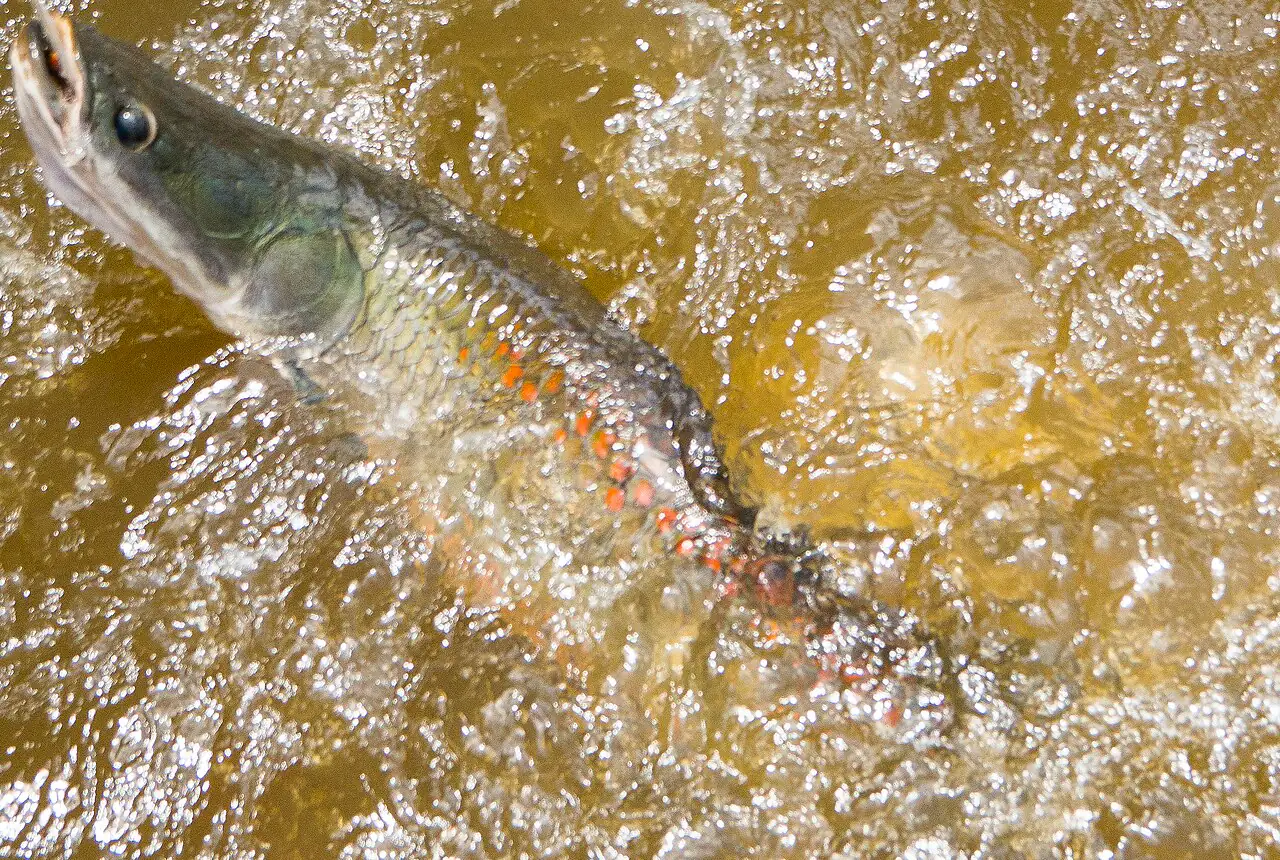
The arapaima is one of the largest freshwater fish on earth: scientists who measure them put the top size at about 3 m (10 ft) and 200 kg (440 lb). It breathes air and has to come up every few minutes, which is how fishers find it and how they count it. For an American angler it is a fish of travel: there is no wild population in the United States, and the legal places to catch one are few.
An arapaima must gulp air every 5 to 15 minutes. Amazon fishers count the fish at that moment, and in one Mamirauá population, fish over 1 m went from about 2,350 in 1999 to 20,650 in 2006.
How big do arapaima get?
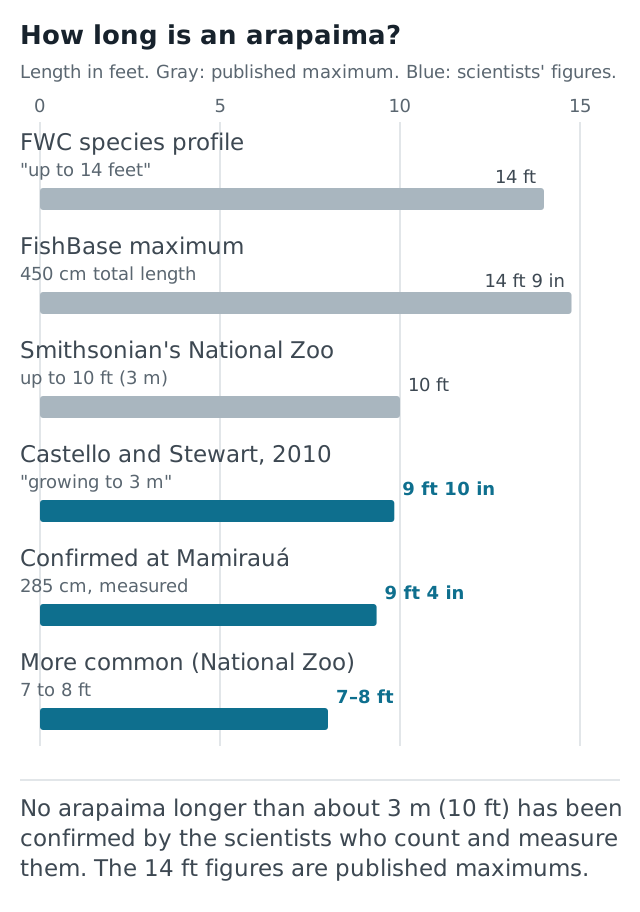
Smaller than most pages say, and still huge. The measured top is about 3 m (10 ft) and 200 kg (440 lb). Leandro Castello and Donald Stewart, who study the fish in Brazil and Guyana, write that the fish grow “to 3 m in length and 200 kg”. The longest fish confirmed at Brazil’s Mamirauá Reserve measured 285 cm (9 ft 4 in).
Is it the largest freshwater fish? Not by weight. João Campos-Silva and Carlos Peres, who study it on Brazil’s Juruá River, call it the “largest scaled freshwater fish”. Heavier fish have been weighed: a 646 lb (293 kg) Mekong giant catfish netted in Thailand in 2005, and a giant freshwater stingray of just under 300 kg (661 lb) caught in Cambodia in 2022.
The bigger numbers are published maximums. The Florida Fish and Wildlife Conservation Commission (FWC) profile gives “sizes up to 14 feet and 440 pounds”, and FishBase lists a maximum of 450 cm total length. The scientists who measure arapaima confirm nothing that long. Smithsonian’s National Zoo gives up to 10 ft (3 m) and 440 lb (200 kg), and says fish of 200 lb (90.7 kg) and 7 to 8 ft (2.2 to 2.4 m) are more common.
They get there fast. Castello and Stewart give 70–100 cm and about 10 kg in the first year, and about 160 cm and 45 kg in three to four years. FWC’s version for the angler: 3 feet and 20 pounds in the first year, five feet and 90 pounds by the fourth.
| Source | Length | Weight |
|---|---|---|
| FWC species profile | Up to 14 ft (4.3 m) | 440 lb (200 kg) |
| FishBase | 450 cm (14 ft 9 in) max; 200 cm (6 ft 7 in) common | 200 kg (440 lb) max |
| Smithsonian’s National Zoo | Up to 10 ft (3 m); 7–8 ft (2.2–2.4 m) common | Up to 440 lb (200 kg); 200 lb (90.7 kg) common |
| Castello and Stewart, 2010 | 3 m (9 ft 10 in); 285 cm (9 ft 4 in) confirmed | 200 kg (440 lb) |
| USGS fact sheet | 290 cm (9 ft 6 in) max | — |
What does an arapaima look like?
Merriam-Webster gives the name as ar-uh-PIE-muh. It is a long, torpedo-shaped fish with a flat, bony head and scales the size of a palm. FWC describes “a streamlined, oval shape with a large, flattened head” and “very large scales that are generally gray to gray green in color”, with red markings on many scales toward the tail. The National Zoo describes a copperish-green head, a black body and a red tail. The Brazilian name, pirarucu, is usually explained as “red fish”, for that red. In Peru it is paiche.
The zoo calls the tail “massive, yet stumpy in appearance”. The scales reach 4 in (10 cm) and are used for jewelry. National Geographic calls them “one of the toughest materials in nature”. They are not bulletproof, but they stop piranhas. A University of California, San Diego team pressed a piranha tooth into a scale, and NBC News reported that the tooth “failed to penetrate into two layers and broke when it was pulled out.”
Does an arapaima have teeth? Yes, and a bony tongue that does a lot of the work. The National Zoo says the tongue and “sharp, bony teeth”, together with teeth on the roof of the mouth, let the fish shred its prey. The arapaima belongs to the bonytongues, and the zoo notes the tongue “can also be used as a scraper”. How fish tongues differ from ours explains why a bony one makes sense for a fish that swallows prey whole.
Free PDF · Water temperature chart Which fish are biting at today's water temperature?
One reading, and the 16-page chart shows which of 26 fish are spawning, feeding hard or slowing down; for bass, crappie, bluegill and walleye, where they sit and what to throw. Every number sourced.
Enter your email, confirm it with one click, and the PDF is in your inbox. Plus one email a week on what's biting. Unsubscribe anytime. Privacy.
Why does an arapaima breathe air?
Because its water is often too low in dissolved oxygen to live on. The arapaima is an obligate air breather: its gills are too small, and it takes air into a modified swim bladder that opens into the mouth and acts as a lung. Kept from the surface, it would drown. That makes it the textbook exception on the page about whether fish can drown.
How often it comes up depends on who counted. Castello and Stewart give every 5 to 15 minutes; FWC gives every 10 to 20. FishBase notes the noisy, distinctive gulp “is reported to carry for long distances”. The breathing lets it hunt in stagnant floodplain pools where gill-breathing fish slow down, and it is also its weak point. Every rise shows a fisher where it is and roughly how big. How fish breathe covers the gill side; North America’s own air-gulpers are the bowfin and the gars.
Is the arapaima one species or five?
Probably five, though every law and record book still says Arapaima gigas. For about 145 years biologists treated the genus as a single species. In 1868 Albert Günther, of the British Museum, lumped the four species described in the 1800s into one, and his view held.
In 2013 Donald Stewart, a fisheries professor at SUNY ESF, published two papers in Copeia. The first re-described A. agassizii, known from an 1829 monograph; SUNY ESF reported that scientists “don’t know if it still exists in the wild”. He argued the other two old names were valid as well. The second paper described a new species, A. leptosoma, from one specimen collected in 2001 where the Solimões meets the Purus. The name refers to its slender body.
| Name | Status | Where |
|---|---|---|
| A. gigas | The name in every regulation and record book | Amazon basin |
| A. agassizii | Re-described in 2013; wild status unknown | Brazil |
| A. arapaima | Argued valid by Stewart | Guyana |
| A. mapae | Argued valid by Stewart | Northeastern Brazil, outside the Amazon basin |
| A. leptosoma | New species, 2013, one specimen | Solimões River, Amazonas |
Why it matters to an angler: the fish in Guyana may not be the fish in central Brazil. Stewart told National Geographic that his growth-ring work suggests fish in Guyana’s Essequibo may grow much heavier than those of central Brazil. If each area holds a different species, he said in 2013, “then results from one area should not be applied to manage populations in the next area.”
Where do arapaima live?
In the floodplains of the Amazon River basin and in Guyana’s Essequibo. The USGS fact sheet lists the Amazon system of Brazil, southern Colombia, Amazonian Ecuador and northeastern Peru, the Rio Tocantins basin, and the Essequibo River of Guyana. FishBase gives a water range of 25–29 °C (77–84 °F).
The fish follow the water. As rivers rise, they move out into the flooded forest; as the water drops, they return to lakes and channels. In the dry season they are confined to isolated lakes and channels, and National Geographic reports that this is when fishing is allowed in Brazil’s managed areas.
Outside the native range they live where people put them. Bolivia’s arapaima came from a translocation by Peruvian authorities, according to Castello and Stewart, and the USGS adds escapes from fish farms and a 2019 study of fish established in Indonesia’s Brantas River. Is it dangerous to people? FishBase rates its threat to humans as “Harmless”.
How do arapaima spawn?
In nests dug in sand, with both parents on guard. FishBase says the fish spawn in April and May, in nests about 15 cm deep and 50 cm wide, and guard the eggs and young. FWC gives the numbers an angler can picture:
- Spawning starts at 4 to 5 years old, at 45 in (114 cm) for males and 57 in (145 cm) for females.
- A female lays 10,000 to 20,000 eggs.
- The males protect the young for up to three months.
- Rising water triggers spawning in the wild; in ponds with stable water and plenty of food they spawn anyway.
The National Zoo describes the male taking the fry into his mouth and moving them when predators come close. In the Rupununi, folklore says the parents give their young “milk” from glands on the head. Castello and Stewart put female maturity at about 1.68 m (5 ft 6 in); Brazil’s minimum harvest length of 1.5 m (4 ft 11 in) sits just below it.
What is the arapaima world record?
The IGFA all-tackle record is 154 kg (339 lb 8 oz), caught by Jakub Vagner on February 18, 2010, at a place the IGFA lists as “Amazonia, Ecuador”. It is the only IGFA record for the species. There is no length record, no line-class record and no fly record.
Heavier arapaima have been reported from Thai fishing parks, and none of them is a record. Fishing World Records lists a fish of over 181.5 kg from Bung Sam Lan Lake in 2011 and one of over 163 kg in 2012. It files both as “questionable”, with the note “no measurements taken”. Those are stocked fish in pay-to-fish lakes, the same kind of Thai park where the rod-and-reel Mekong giant catfish record was set.
Where can you fish for arapaima?
In the wild, in South America; stocked, in Thailand; and in the US, at one fishing resort in Florida. The table gives the rules as the sources state them. Rules change, so ask the lodge or park for the current permit before you book.
| Where | Wild or stocked | Rules as published | Source |
|---|---|---|---|
| Rewa, North Rupununi, Guyana | Wild | Catch and release under the community management plan; a no-take ban for harvest | rupununi.org; DPI Guyana, 2017 |
| Managed reserves, Amazonas, Brazil | Wild | Harvest only by licensed communities under quotas; minimum 1.5 m; closed December–May | Castello and Stewart, 2010 |
| Brazil, Peru, Colombia lodges | Wild | Catch and release required in many regions | FishingBooker |
| Thai fishing parks | Stocked | Fishing parks with introduced fish; fishing all year | FishingBooker |
| Arcadia, Florida | Stocked | A fishing resort with a controlled fish population; reservations from $1,500 | WSVN, 2026 |
Guyana’s Rewa fishery is “estimated to be worth over US$ 1 million to Guyana”, according to rupununi.org. A 2017 statement from Guyana’s Department of Public Information said no catch-and-release licenses existed yet and that the regulations were still being finalized. FishingBooker puts prime season in Guyana at September to February. For Brazil and Peru it gives the dry season, roughly July to December in Brazil and June to November in Peru.
What it takes, according to FishingBooker’s guide: braid of at least 80 lb test with a 100–150 lb monofilament or fluorocarbon leader, and circle hooks of 5/0–10/0. For fly anglers it names a 9 ft rod of 10–12 weight and an 80 lb fluorocarbon leader. The guide says the fish “spook easily” and that “Many hooks have been lost to their bony jaws”. You find them the way the fishers count them: by watching for the surface disturbance when one comes up to breathe.
Can you catch or keep an arapaima in the US?
Catch one in Florida, yes; release it, no; keep one as a pet, no. There is no wild population anywhere in the country. The USGS lists nonnative records in three states: Texas in 1995, Louisiana in 2016 and Florida’s Caloosahatchee in 2020. It says such introductions are “likely the result of aquarium releases”.
Florida regulates arapaima as a Conditional species. Live fish are permitted only for research, commercial import and export, and public exhibition, and “Permits will not be issued for private exhibition or as personal pets”. FWC’s instruction to anglers is blunt: “If you catch an arapaima, do not release it!” It needs no special permit, only a valid freshwater fishing license. FWC asks that the fish be iced or humanely killed at once, and reported through the IveGot1 app or 1-888-IVE-GOT1.
FWC’s worry is what a loose arapaima would eat: native fish including largemouth bass, butterfly peacock and snook. Cold is the limit. Arapaima die if the water drops below 61 °F (16 °C), which would confine them to southeast Florida.
Texas lists Arapaima gigas as a prohibited exotic species: no one may possess one or put one in the water without a permit from the department. Other states have their own lists. Check yours before buying a juvenile for a tank: by FWC’s figures, it can reach 3 feet in its first year.
How did the arapaima come back?
Fishers counted them. Overfishing from the 1970s made the fish commercially extinct near the big Amazonian cities, the National Zoo says. Bans did not work: Castello and Stewart wrote in 2010 that most arapaima were “now probably caught and traded illegally”.
What worked was counting at the breath. In the Mamirauá Reserve, experienced fishers counted arapaima at the moment each one rose for air. Their counts were checked against mark-recapture and total catches, and they held up. “In the split second that an arapaima comes to the surface, an experienced fisherman can tell you the size, weight, and direction of its movement,” Castello told National Geographic. The counts set next year’s quota, and the fishers enforce it themselves.
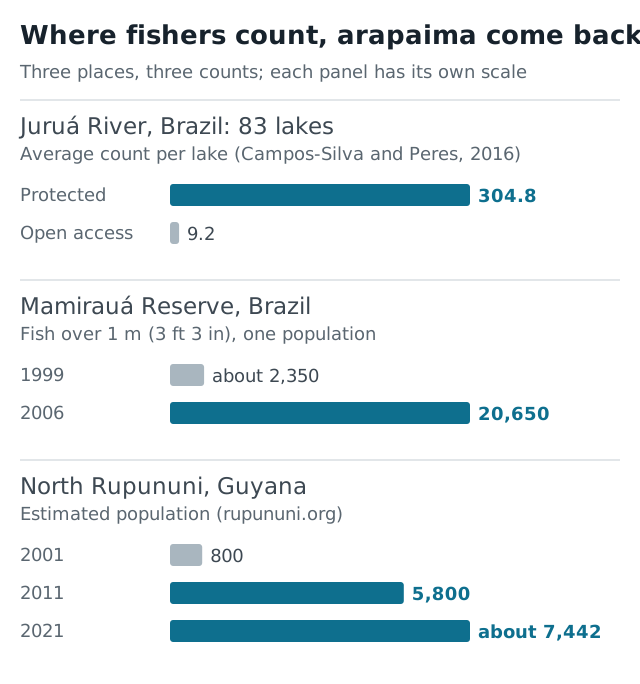
The numbers moved fast. In the managed lakes, Castello and Stewart report, “fishers’ profits more than doubled”. On the Juruá River, Campos-Silva and Peres counted 83 lakes: protected lakes averaged 304.8 arapaima, open-access lakes 9.2. National Geographic reports a rise of 425 percent in 11 years in managed areas and about 1,100 communities in the program by 2024.
The steps, in order:
- 1986: Brazil’s environment agency, IBAMA, sets a minimum catch length of 1.5 m.
- 1991: a closed season, December to May.
- 1996: the arapaima fishery is banned in the state of Amazonas, after Tocantins in 1990.
- 1999: four riverine communities manage their arapaima with the counting system developed at Mamirauá.
- 2002: Guyana’s North Rupununi District Development Board writes an Arapaima Management Plan; the government recognizes it in 2007.
- 2004: Amazonas exempts fishers who census their arapaima from the ban.
- 2008: the State of Acre adopts the same system.
- 2010: more than 100 communities in Amazonas use it, Castello and Stewart report.
- 2024: about 1,100 communities across the Amazon; harvest of up to 30 percent of counted adults in protected areas, none under five feet.
The arapaima is still listed as Data Deficient by the IUCN, from an assessment in 1996, and sits on CITES Appendix II, which monitors international trade. In 2010, Castello and Stewart noted it was the only South American freshwater fish on that list. It shares that kind of story with the fish on the endangered freshwater fish list, with one difference: here the people who catch it brought it back.
Can you eat arapaima?
Yes, and in Florida you are asked to. FWC calls it “good to eat and mild tasting” and asks anglers to “catch, keep, and eat” any they land. In the Rupununi, rupununi.org describes “high-yield, boneless meat”, long sold across the border to Brazil.
Why is it expensive? Wild supply is tight: in Brazil the fishery is closed from December to May and capped by a quota set from the counts. Farm-raised paiche from Peru reached the menus of several prominent US restaurants in 2011, the National Zoo notes. Aquaculture is growing: Florida lets certified farms raise arapaima only for food, and the zoo reports breeding in indoor ponds in Germany and artificial lakes in Peru. Stewart’s warning is that pond fish escape, and a species endangered at home may turn invasive elsewhere.
What else to know about the arapaima
The National Zoo gives its lifespan as up to 20 years, and says sexual maturity comes after about 4 or 5 years. It eats mostly fish, according to the zoo, but also fruits, seeds, insects, birds and mammals that land on the water. It feeds by “gulper” suction, opening its huge mouth to pull prey in. FWC adds crustaceans, and notes the fish “have been known to leap out of the water to capture prey”.
North America’s nearest match in sheer size and ancient look is the alligator gar, another air-breathing giant that is legal to catch at home. The wels catfish is Europe’s. The rest of the odd ones out are on the other freshwater fish hub.
Free PDF · 16 pages
Know what's biting before your first cast
The Water Temperature Fishing Chart. Take one water temperature reading, find it on the chart, and see which of 26 freshwater fish are spawning, feeding hard or slowing down. Six pages go deeper: bass, crappie, bluegill, walleye, catfish and trout. For your phone and the tackle box.
- Where they sit and what to throw at every band: bass, crappie, bluegill and walleye; catfish by species; trout: the 68 °F line where you stop, and where they hide
- A bass that drops 3 ft feels more pressure change than the biggest cold front: the front day by day, and what to throw on each
- The three thermometer mistakes that make a reading lie (the first one is the surface)
- The 26-fish chart: who's spawning, feeding hard or slowing down at your reading
The chart's numbers come from state fish and wildlife agencies and fisheries research: 61 sources, each listed on the site.
Enter your email, confirm it with one click, and the PDF is in your inbox. Plus one email a week on what's biting. Unsubscribe anytime. Privacy.
Related
Section guide
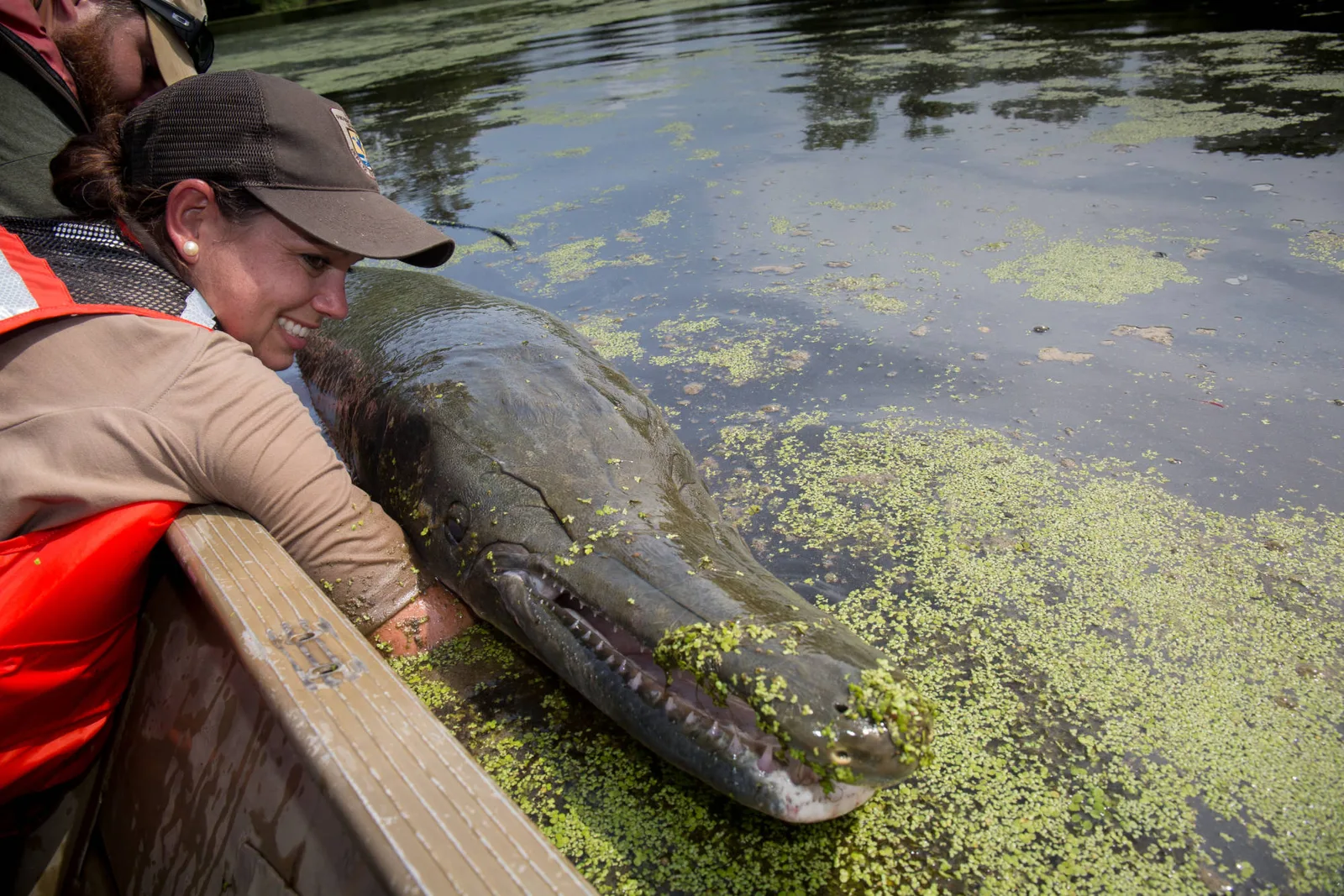
Freshwater Fish Species Outside the Big Families: Sturgeon, Gar, Bowfin, BurbotThe freshwater fish species outside the bass, trout, catfish and pike families: sturgeon, gar, bowfin, burbot, drum, eel and paddlefish, with records.
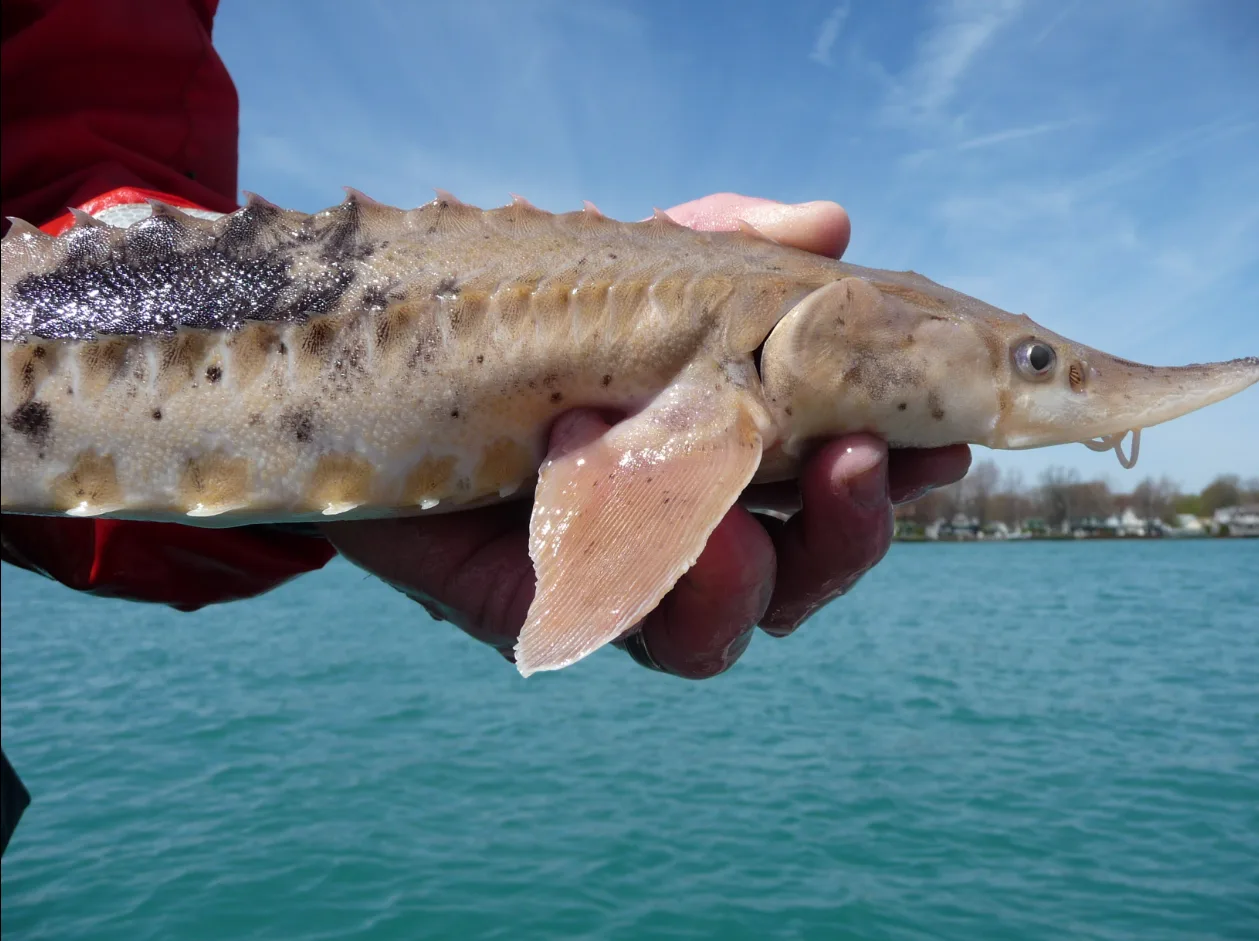 Lake Sturgeon: Size, Age, Where They Live and When You Can Fish
Lake sturgeon grow to 7 ft and may live centuries. How to identify one, where they live, the Winnebago spearing season and where you may keep one.
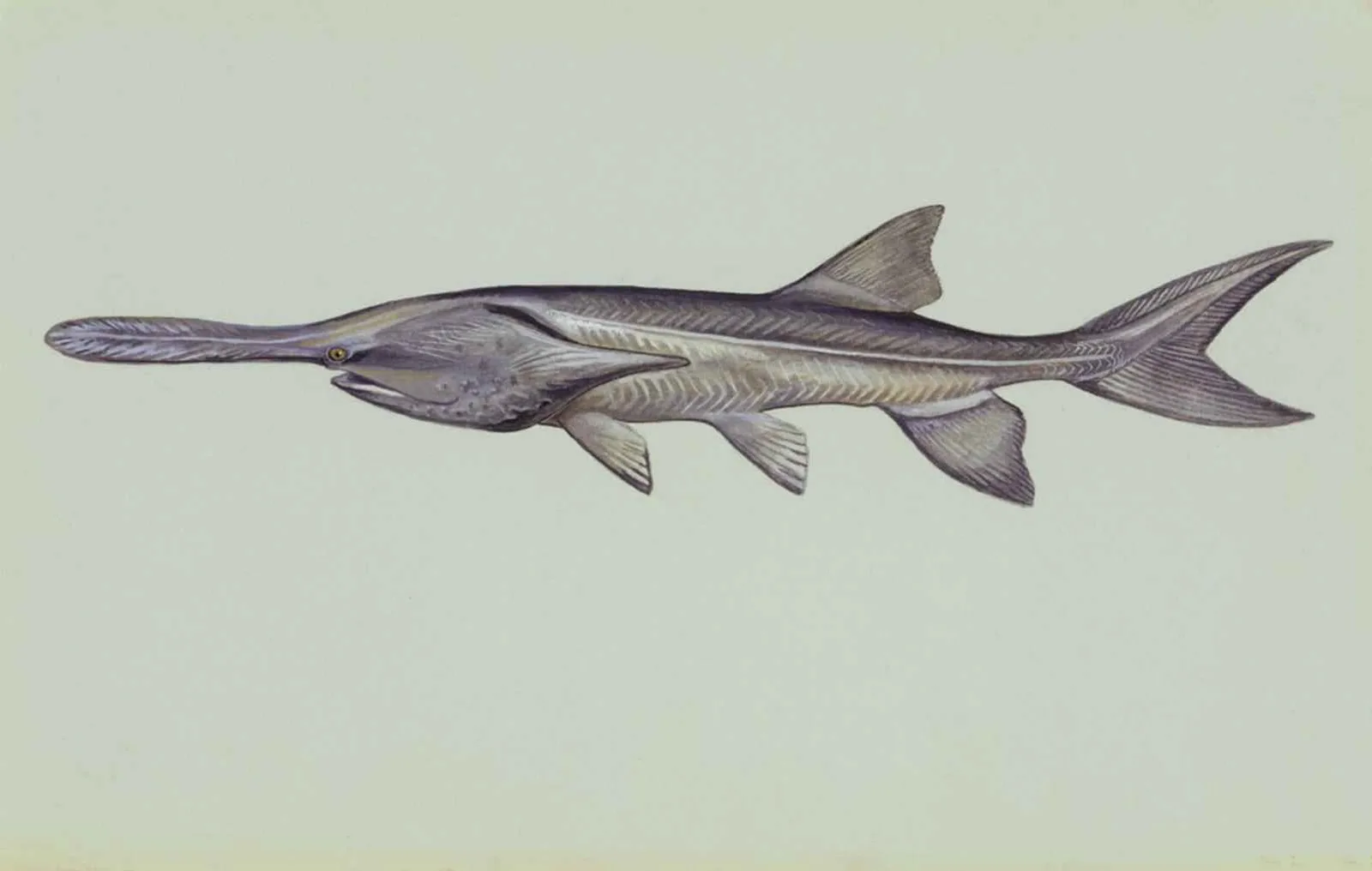 Paddlefish (Spoonbill): Facts, Snagging Seasons, Records and Rules
The paddlefish, or spoonbill, eats only plankton, so anglers snag it. Size, age, the 164 lb record and the snagging seasons state by state.
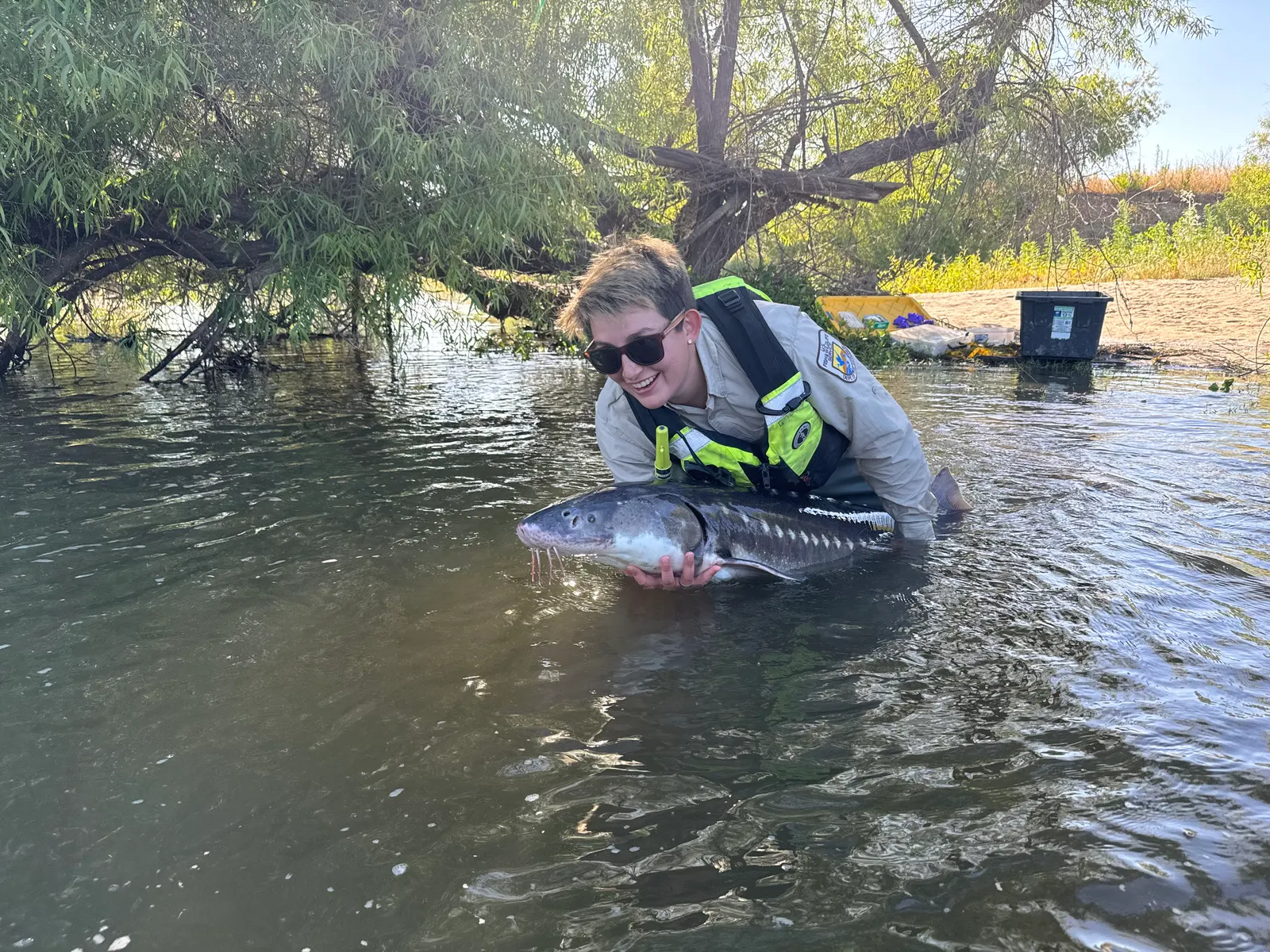 Sturgeon Fishing: Where to Go, the Rig, the Bait and the Rules by State
Sturgeon fishing for white and lake sturgeon: where it is open, when to go, the sliding-sinker rig, the best baits and the keep-it-in-the-water rules.
 Freshwater Drum: Sheepshead, Gaspergou and How to Catch Them
Freshwater drum, or sheepshead, mostly run 1 to 5 lb; the record is 54 lb 8 oz. How to tell one apart, the rig that catches it and how to cook it.
 Longnose Gar: Identification, Size, Records, and How to Catch One
Longnose gar commonly reach 3 ft and 5 to 6 lb; the IGFA record is 43 lb, yet four states certify bigger fish. How to ID, find and catch one.
 Bowfin: Identification, Bowfin Fishing, and the Snakehead Look-Alike
The bowfin is a native, air-breathing predator with a 21 lb 8 oz world record. How to identify one, tell it from a snakehead, and catch one.
Sources
- IGFA World Record Search: Arapaima, Arapaima gigas (all-tackle, Jakub Vagner, 154 kg, Amazonia, Ecuador, February 18, 2010)
- Florida Fish and Wildlife Conservation Commission, Arapaima (Arapaima gigas) species profile
- Florida Fish and Wildlife Conservation Commission, Conditional Nonnative Species List
- Texas Parks and Wildlife Department, Exotic Fish, Shellfish and Invasive Aquatic Plants (prohibited exotic species list)
- U.S. Geological Survey, Nonindigenous Aquatic Species Database, Arapaima sp. fact sheet (J. Procopio, revised 2022)
- FishBase, Arapaima gigas summary
- Smithsonian's National Zoo and Conservation Biology Institute, Arapaima
- Castello, L. and Stewart, D. J. (2010), Assessing CITES non-detriment findings procedures for Arapaima in Brazil, Journal of Applied Ichthyology 26: 49–56
- SUNY ESF, ESF Scientist Rediscovers Long-lost Giant Fish from Amazon (April 23, 2013)
- SUNY ESF, ESF Scientist Reports New Species of Giant Amazonian Fish (2013)
- Stewart, D. J. (2013), Re-description of Arapaima agassizii (Valenciennes), a rare fish from Brazil, Copeia 2013(1): 38–51
- Stewart, D. J. (2013), A new species of Arapaima from the Solimões River, Amazonas State, Brazil, Copeia 2013(3): 470–476
- Merriam-Webster, arapaima (pronunciation)
- Campos-Silva, J. V. and Peres, C. A. (2016), Community-based management induces rapid recovery of a high-value tropical freshwater fishery, Scientific Reports
- National Geographic (Stefan Lovgren), One of Earth's biggest freshwater fish is bouncing back, a rare 'win win' (June 14, 2024)
- Graham Watkins, Oma "Mother of All Fish": Arapaima and Rupununi Fisheries (rupununi.org, 2026)
- Department of Public Information, Guyana, Arapaima legislation being finalised (March 2, 2017)
- WSVN 7News (Sebastian Cuervo), Fishing resort on Florida's West Coast adds prehistoric arapaima to its controlled fish population (February 4, 2026)
- NBC News (Eric Niiler), Are piranha-proof fish the secret to better body armor? (February 15, 2012)
- Fishing World Records, Arapaima gigas (record list with questionable claims)
- FishingBooker (Jacqueline), How to Go Fishing for Arapaima: The Complete Guide for 2026