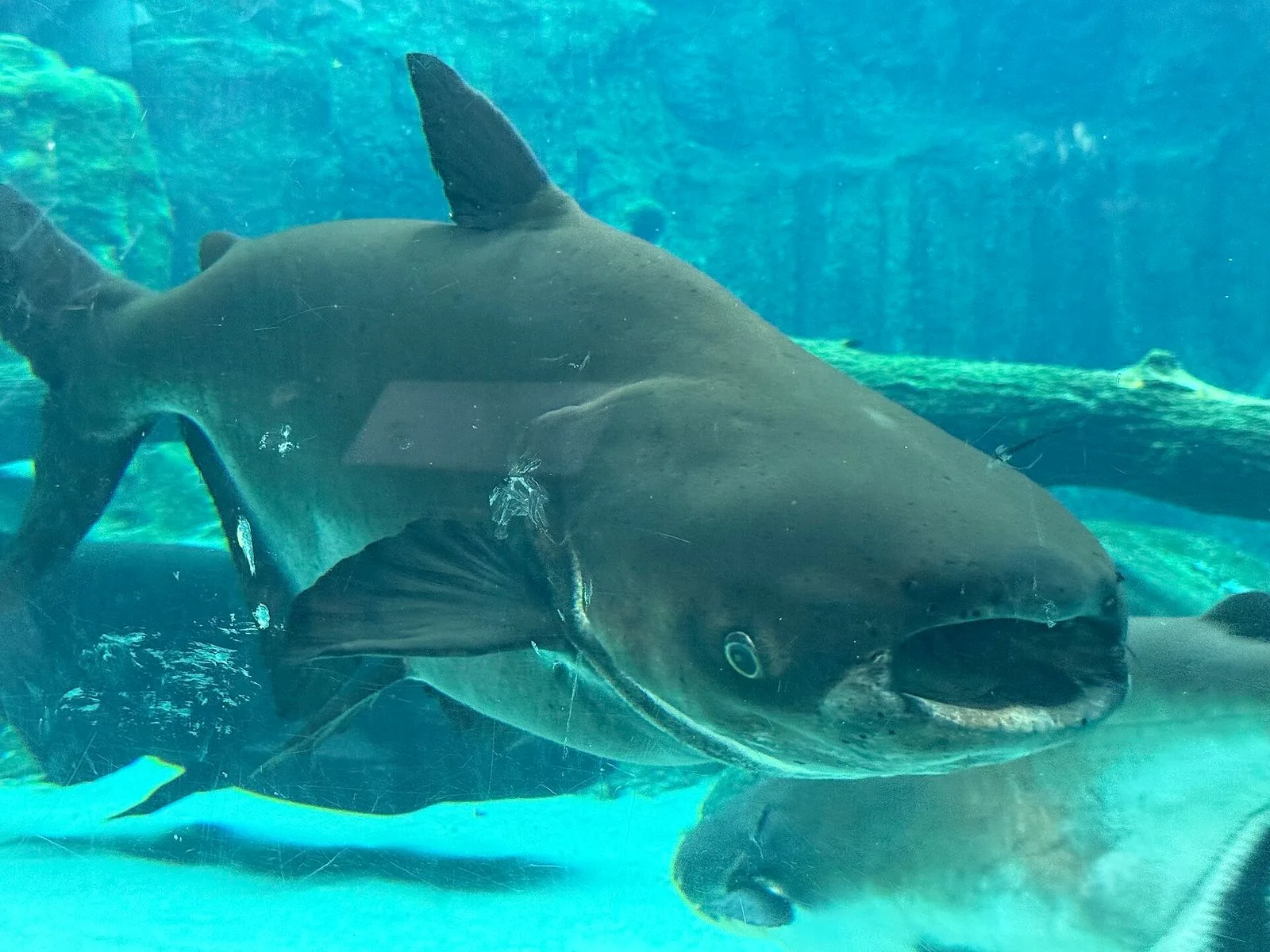
The Mekong giant catfish is one of the largest freshwater fish in the world: the heaviest ever weighed, a female netted in northern Thailand in 2005, came to 646 lb (293 kg). It is a critically endangered, toothless plant eater of one river system. For an angler there is exactly one legal way to catch one: a Thai fishing park stocked with farm-bred fish.
The 646 lb Mekong giant of 2005 held the freshwater weight record for 17 years, until a giant freshwater stingray of just under 300 kg (661 lb) was caught and released in Cambodia in June 2022.
What does a Mekong giant catfish look like?
It looks like a shark-shaped catfish that forgot its whiskers. FishBase separates it “from other large catfish in the Mekong by its lack of teeth and the almost complete absence of barbels”. The body is gray and unstriped, and the fins are gray, “never black”. In adults the eye sits low, below the corner of the mouth, which gives the big fish its sleepy look.
The young are different fish to look at. Juveniles have well-developed barbels on the upper and lower jaw, plus teeth and gill rakers. They lose the teeth at about 30–50 cm (12–20 in) of body length, and the chin barbels shrink to stubs. A small Mekong catfish with whiskers is not a hybrid or another species; it is a baby.
Next to the other two giant catfish an angler might know, the differences are plain:
| Mark | Mekong giant catfish | Wels catfish | Blue catfish |
|---|---|---|---|
| Barbels | Almost none in adults | Two long, four short | Eight |
| Anal-fin rays | About 35 | 83–95 | 30–35 |
| Adult food | Filamentous algae | Fish, crayfish, small mammals, waterfowl | Fish first; cut shad is the bait |
| Heaviest weighed | 646 lb (293 kg), netted | 297 lb 9 oz (134.97 kg), rod and reel | 143 lb (64.86 kg), rod and reel |
| Status | Critically Endangered | Least Concern in its native range | Native; widely fished |
Of the three, only the Mekong giant has given up teeth and whiskers as an adult. The wels catfish page tells Europe’s giant’s story, and the blue catfish page North America’s; both belong with the other species on the catfish hub.
Where does it live?
Only in the Mekong. The species once ranged through the whole basin, from the coast of Vietnam to northern Laos. Today it is limited to the Mekong and its tributaries in Thailand, Laos and Cambodia. Big fish spend the dry season in the deep pools of the lower river and migrate upstream to spawn. At least one spawning site is known, on the stretch between northern Thailand and Laos, according to Zeb Hogan’s 2011 assessment for the IUCN.
In Cambodia the fish move out of the flooded Tonle Sap Lake at the end of the rainy season, from October to December. That is where the good news of recent years has come from. In December 2024, Cambodian fishers caught six in five days, the first two on the Tonle Sap River near Phnom Penh. All were tagged and released.
Thailand has stocked farm-bred fish into reservoirs since the 1980s. Large ones are caught there, but the U.S. Fish and Wildlife Service’s summary of the research finds no self-sustaining population outside the river. There is none in the United States either. The same screening found no record of the fish in American waters or trade, and an overall climate match of zero for the lower 48 states; only the tip of Texas and southern Florida rate medium.
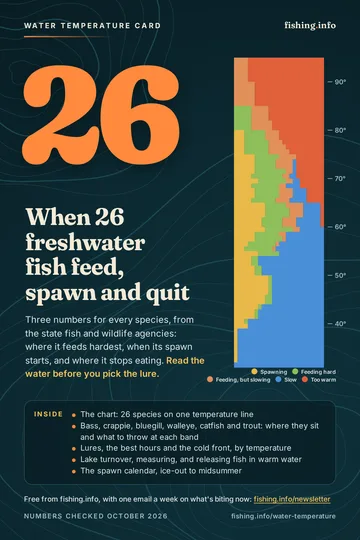
Free card: what 26 species do at your water temperature
Plus one email a week on what's biting now. No sales pitches. Privacy.
Where can you legally catch one?
Almost nowhere in the wild. The table follows the 2008 conservation strategy of the Mekong Giant Catfish Working Group and later reports.
| Place | Fish | Legal position | What it means for an angler |
|---|---|---|---|
| Thai Mekong | Wild | Capture needs written permission from the Director of the Department of Fisheries; broodstock permits stopped after 2005 | Not legal |
| Chiang Khong, Thailand | Wild | Fishers agreed on March 29, 2006 to stop, with compensation for their nets and a no-fishing zone | The famous annual catch is over |
| Cambodia | Wild | Listed as endangered under the Fisheries Law; a captured fish must be released | Release at once |
| Vietnam | Wild | Red Book species with special legal protection | Not legal |
| Laos | Wild | No specific legal protection as of 2008 | Unclear; check the current law |
| Thai reservoirs | Farm-bred releases | Released since the 1980s; no self-sustaining population | Local fishers catch and sell them |
| Thai fishing parks | Farm-bred | Captive-bred stock is “frequently used in game fishing ponds” | The legal way; the rod record came from one |
| International trade | Any | CITES Appendix I since July 1, 1975 | No commercial trade in wild fish |
The fishing parks are ponds and lakes stocked from farms. The best known is Bungsamran Lake, near Bangkok. Game & Fish writer Anietra Hamper wrote in 2015 about fishing it: fish of 40 to 80 lb on a dough ball “the size of a baseball”, fished from a wooden platform. Eddie Mounce, managing director of Fish Thailand, which runs the fishing there, told her: “At 100 pounds, a Mekong catfish will bend a 50 pound class boat and rod to the butt and strip line as if not even hooked.”
The bait follows the biology. Adults eat algae, so the parks fish dough balls and boilies, not the cut shad an American angler would use for blue cats on the best catfish bait list. The parks supply stout rods and reels: Hamper’s 2015 day rate of $236 for one angler included the guide, bait, lunch and tackle. Martin Kent, whose record fish is below, compared its fight to a big yellowfin tuna.
How big is the record?
The heaviest Mekong giant catfish ever weighed is the female netted on the Mekong at Chiang Khong on May 1, 2005, and reported that June. National Geographic gave its weight as 646 lb (293 kg) and its length as nearly 9 ft (2.7 m). Officials hoped to strip its eggs for the breeding program and release it, but it died, and the villagers ate it. It was the largest catch recorded in Thailand since record keeping began there in 1981. Hogan, quoted by National Geographic, called it “an astonishing find”.
It was one of the last legal wild fish. The special broodstock permits for Chiang Khong ran out after 2005, and the fishery closed by agreement the next March.
The angling record is smaller. Martin David Kent, a retired British Navy captain, landed a 260 lb (118 kg) fish on November 29, 2010 at Gillhams Fishing Resorts, a 9 acre stocked lake in Krabi, Thailand. Outdoor Life reports he took it on a boilie under a float after nine hours without a bite. The IGFA accepted the stocked lake as an eligible location and listed it as the all-tackle record. The world record catfish page sets it beside the blue, flathead and wels records.
FishBase’s maximum of 300 cm and 350 kg (10 ft, 772 lb) is a published maximum, not a weighed fish. “Measuring up to three meters in length and weighing in excess of 300 kg,” Hogan wrote for the IUCN, is the safe description.
How many Mekong giant catfish are left?
Nobody has counted them, and any single number is a guess. The best estimate is a model. In 2008 the Mekong Giant Catfish Working Group reconstructed the spawning stock from the catch records:
- About 250 spawning fish before 1983.
- “Just 50 spawners in 1995”, after the Chiang Khong fishing boom cut the stock by about 80 percent in ten years.
- About 145 spawners by 2006.
- More than 900 wild fish removed between 1980 and 2000, about half the population, partly for broodstock.
Basin-wide catches have never been documented above 150 fish a year, and the group put them at no more than 20 a year at the time. VOA reported in January 2025 that a joint program of Wonders of the Mekong and Cambodia’s Fisheries Administration had tagged and released about 100 fish in two decades.
The threats are overfishing, habitat loss and dams that block the spawning run. Hogan’s IUCN assessment adds “genetic introgression with cultured stocks”, which is why the working group asked that farm-bred fish not be released into the Mekong for now. The species has been listed as Critically Endangered by the IUCN since 2003.
Can you eat a Mekong giant catfish?
Not a wild one. It was “a high value food fish”; today, in Hogan’s words, it is “officially protected and intentional harvesting of the species is banned”. Some captive-bred fish supply the trade, so a farmed one is legal in Thailand. A fish netted in the river in Cambodia goes back.
The species in ten dates
- July 1, 1975: listed on CITES Appendix I, which bans commercial international trade in wild fish.
- 1983: captive breeding begins.
- 1980s: farm-bred fish released into Thai reservoirs.
- 1995: the working group’s model puts the spawning stock at about 50 fish.
- 2003: listed as Critically Endangered by the IUCN.
- May 1, 2005: the 646 lb female netted at Chiang Khong.
- March 29, 2006: the Chiang Khong fishers agree to stop.
- November 29, 2010: Martin David Kent’s 260 lb rod record in a Krabi fishing park.
- June 13, 2022: a giant freshwater stingray of just under 300 kg, caught and released at Koh Preah in Cambodia, takes the freshwater weight record.
- December 2024: six wild fish caught, tagged and released in Cambodia within five days, two of them 120 and 131 kg (265 and 289 lb).
What does a Mekong giant catfish eat, and how does it grow so big?
Fast. Fry eat zooplankton and each other; from about a year old the fish turn herbivorous. Adults graze filamentous algae, Cladophora, feeding in the dry season and probably fasting in the wet. FishBase, citing Rainboth’s 1996 field guide, calls its growth “one of the fastest growth rates of any fish in the world, reaching 150 to 200 kg in 6 years”. North America’s blue catfish live the other way round: past 8–13 in (20–33 cm) they eat mostly fish, so what catfish eat there, and the baits that copy it, look nothing like a dough ball.
How old a spawner is remains uncertain. A 2006 study by Sukumasavin estimated the wild fish netted at Chiang Khong in 1984–1990 at 6–12 years and 150–250 kg. Captive fish have spawned at 14–18 years and only 40–60 kg. The 2008 model put maturity at about 2.2 m (7 ft 3 in) and 16–20 years, and FishBase gives a maximum reported age of just 10 years. Those figures cannot all be right; the honest summary is a fast-growing fish whose age at maturity is still unknown.
Gear for catfish
Gear guide
Best Catfish Bait: What Channel, Blue and Flathead Catfish EatThe best catfish bait by species: cut shad for blues, punch and dip baits for channels, live bluegill for flatheads, and which prepared baits to buy.
Gear guide
Catfish Rods: Length, Power, the Soft Tip, and the Reviewers' PicksCatfish rods explained: 7–10 ft, medium-heavy, a soft glass tip on a strong butt, sinker ratings by species, and the reviewers' picks with maker specs.
Free download
The water temperature card
Read your water temperature and the card tells you who is spawning, who is feeding and what to throw. 26 species, 16 pages, for your phone and the tackle box.
Plus one email a week on what's biting now. No sales pitches. Privacy.
Related
Section guide
Catfish: Species Identification, Baits, Seasons and RecordsThe catfish species anglers catch most, channel, blue and flathead first: how to tell them apart by the anal fin, when they spawn, what bait each wants.
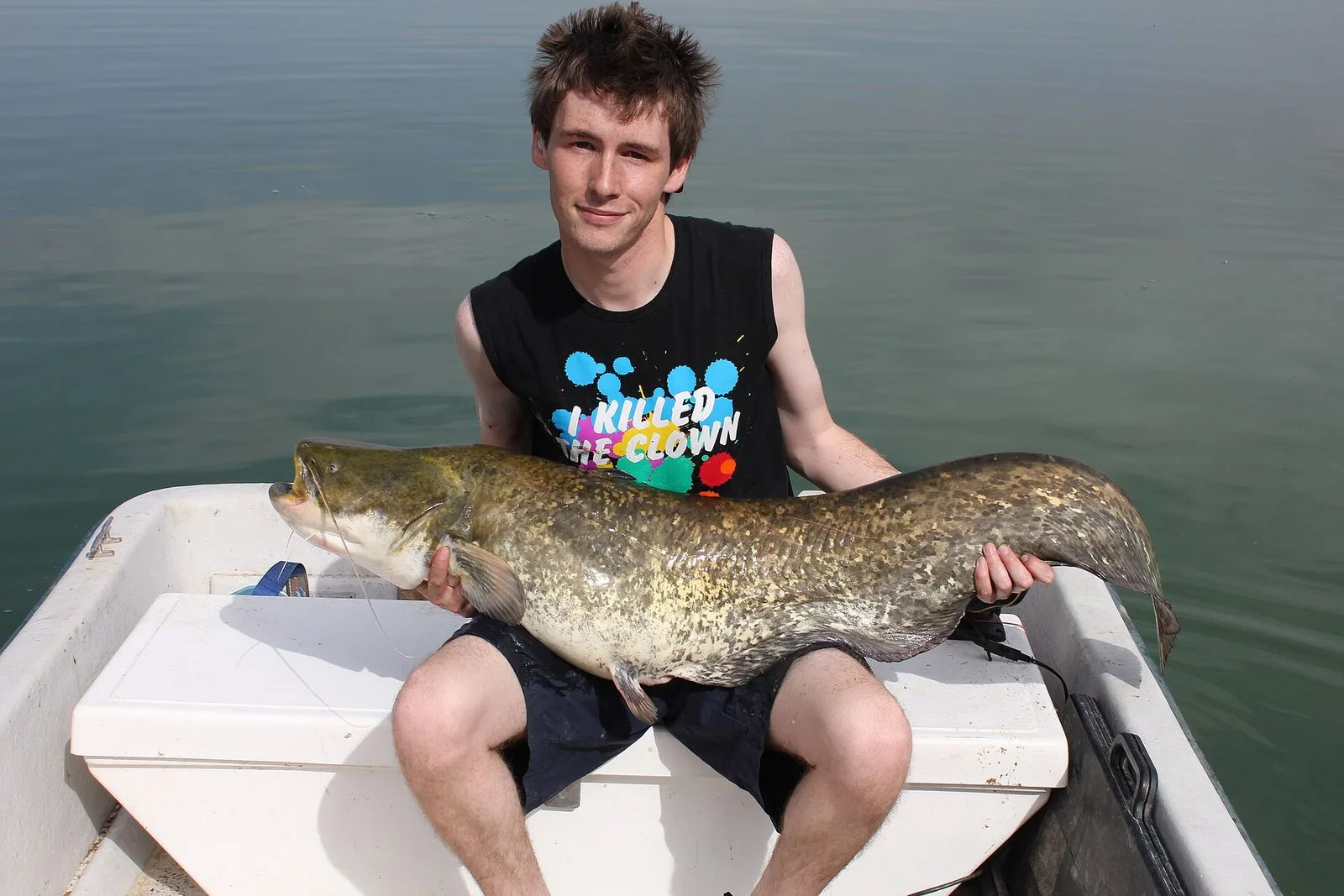 Wels Catfish: Europe's Giant, Its Records, and Why It Is Banned in the US
Wels catfish: Europe's giant, 297 lb 9 oz on record and banned from US import since 2016. How to recognize it, the Ebro record book, how anglers catch it.
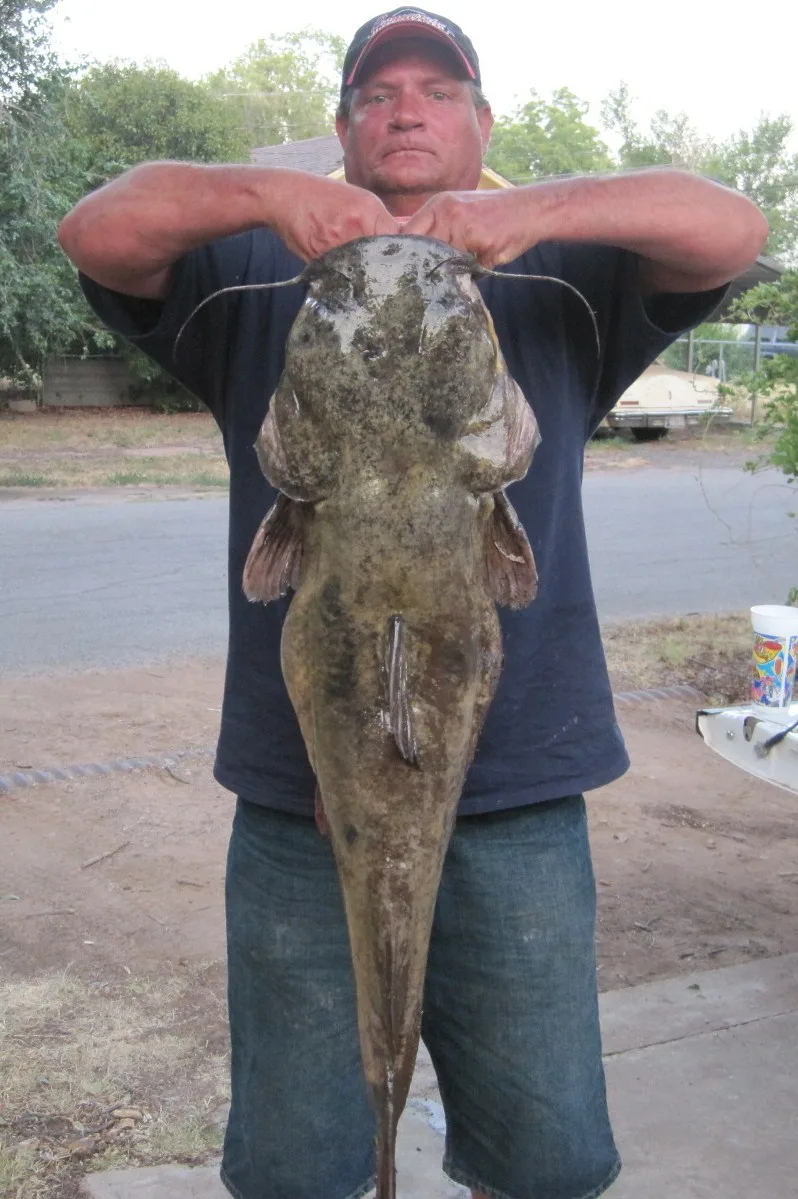 Noodling Catfish: How It Works, Where It Is Legal, Staying Safe
Noodling catfish means pulling a nest-guarding flathead from its hole by hand. How it is done, every state's season and rules, and what hurts people.
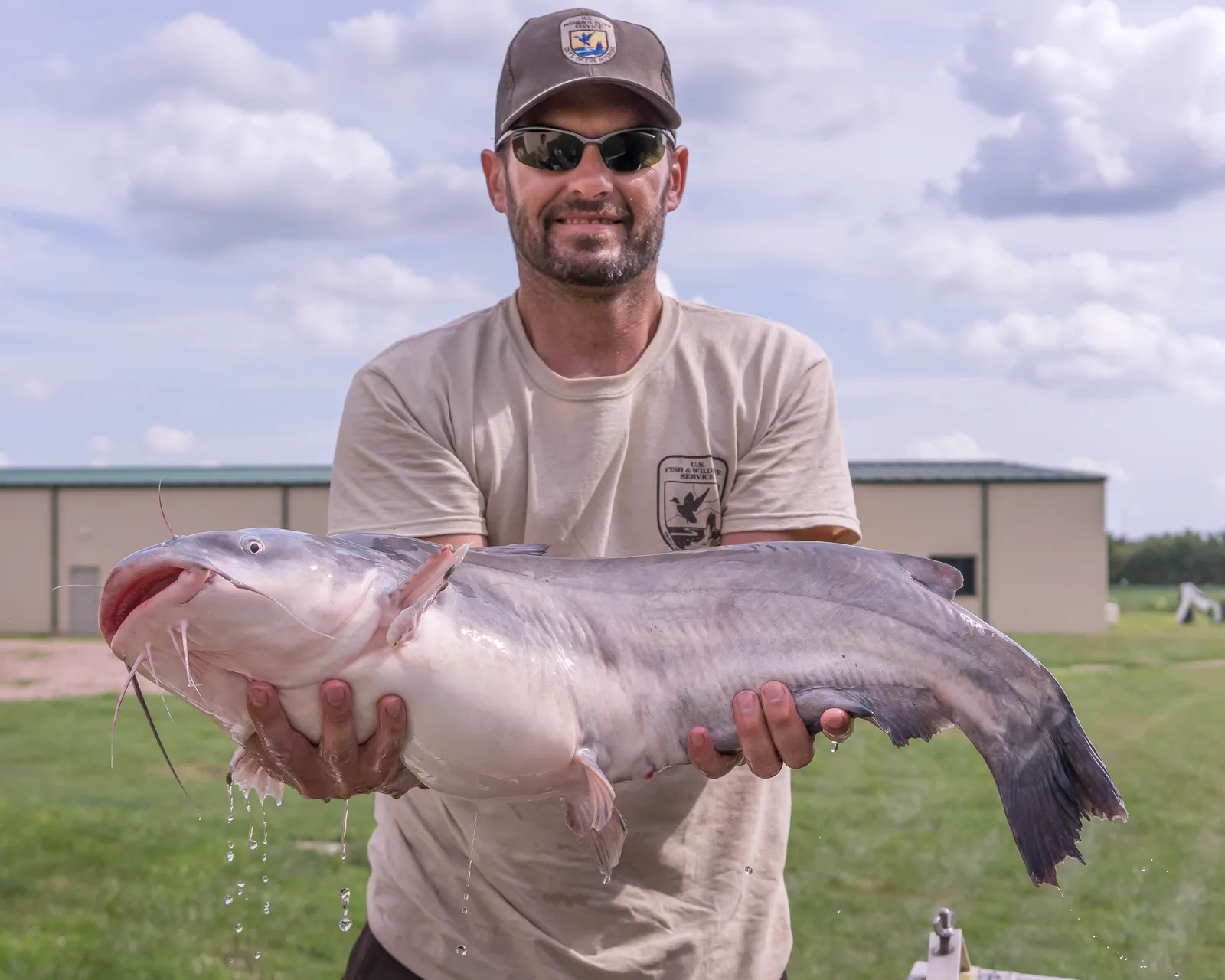 World Record Catfish: Blue, Flathead, Channel, Wels, Mekong Giant
Every world record catfish: the 143 lb blue, 123 lb flathead, 58 lb channel of 1964, 297 lb wels and 646 lb Mekong giant, and how a record is certified.
 How to Hold a Catfish Without Getting Stung, Small to Big
How to hold a catfish safely: where the three spines are, the grip behind the pectoral fins for small fish, the lip grip for big ones, and first aid for stings.
 Catfish Rigs: The Five That Matter and When to Use Each
The five catfish rigs the guides use, slip sinker, Santee Cooper, three-way, slip float and bottom rig, with sinker weights, hook sizes and when to use each.
- Best Catfish Bait: What Channel, Blue and Flathead Catfish Eat
The best catfish bait by species: cut shad for blues, punch and dip baits for channels, live bluegill for flatheads, and which prepared baits to buy.
Sources
- U.S. Fish and Wildlife Service, Giant Mekong catfish (Pangasianodon gigas) Ecological Risk Screening Summary (revised 2019, web version 2020)
- Mekong Giant Catfish Working Group, Conservation strategy for the Mekong giant catfish (MGCWG Report 5, 2008)
- Mekong Wetlands Biodiversity Programme, Historic end to the fishing of Mekong giant catfish in Thailand (April 2006)
- National Geographic, Grizzly bear-size catfish caught in Thailand (June 2005)
- Al Jazeera, World's largest freshwater fish caught in Cambodia (June 21, 2022)
- VOA, Huge and rare Mekong catfish spotted in Cambodia, raising conservation hopes (January 2025)
- Outdoor Life, Retired British Navy captain catches 260-pound world record Mekong giant catfish (June 2011)
- Game & Fish (Anietra Hamper), An angler's journey to Thailand: catching the Mekong giant catfish (April 2015)
- FishBase, Pangasianodon gigas summary
- CBS News (AP), 6 endangered Mekong giant catfish spotted in Cambodia (December 13, 2024)
- U.S. Fish and Wildlife Service, Injurious wildlife species; listing 10 freshwater fish and 1 crayfish, final rule, 81 FR 67862 (September 30, 2016)
- IUCN Red List, Silurus glanis (Freyhof and Kottelat 2008, Least Concern)
- FishBase, Silurus glanis summary (IUCN global status Least Concern, assessed May 29, 2022)
- Animal Diversity Web, Ictalurus furcatus
- Missouri Department of Conservation, blue catfish field guide