Do fish get cold? Yes, all the way through: a fish’s body is the same temperature as the water around it. When the pond drops to 40 °F (4 °C), the fish is 40 °F too. But it does not shiver, and it does not feel chilly the way you do on a January morning. Cold reaches a fish as slowness: its heart beats less often, its muscles pull more slowly, and its food takes longer to digest.
A bluefin tuna can hold its swimming muscle about 36 °F (20 °C) warmer than the sea around it. The opah goes one better: it is the first fish shown to warm its whole body, heart and brain included.
Are fish cold-blooded?
Yes. A fish has no warm inside the way you do. Scientists call fish ectotherms, which means “heat from outside.” A dog or a duck burns food to stay at one steady temperature, whatever the weather. A fish takes the temperature of the water and stays there. Part of the reason is the gills. Every drop of a fish’s blood passes through the gills to pick up oxygen, and the gills sit in the water. Any warmth the body makes leaks straight out into the lake.
A few big ocean fish have found a way around this. Bluefin tuna run their warm blood past their cold blood in a heat exchanger. That tight net of vessels hands the warmth back before it reaches the gills. Their red swimming muscle stays up to about 36 °F (20 °C) warmer than the water. The opah takes it further: Wegner and colleagues showed in 2015 that it warms its whole body, not only its muscle. A pumpkinseed in your local pond can do none of this. Its body is the pond.
What does cold feel like to a fish?
Nobody can ask a fish. But we can measure what cold does to it, and the answer is the same as for honey in a refrigerator: everything moves slower. Its muscles contract more slowly. Its stomach empties more slowly, so it wants less food. A fish at 40 °F (4 °C) is not suffering. It is running on a low idle.
It does notice, though. Fish move toward water that suits them when they can. The water temperature chart shows the band each species prefers, and the bass chart and trout chart put numbers on it.
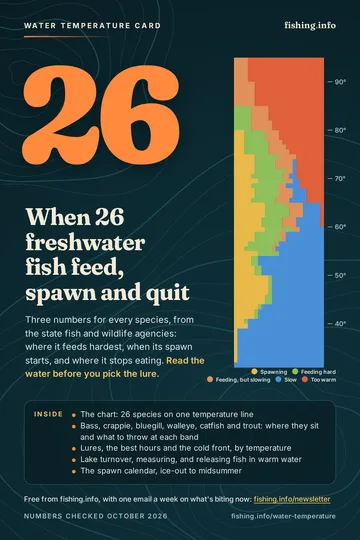
Free card: what 26 species do at your water temperature
Plus one email a week on what's biting now. No sales pitches. Privacy.
What do fish do in winter?
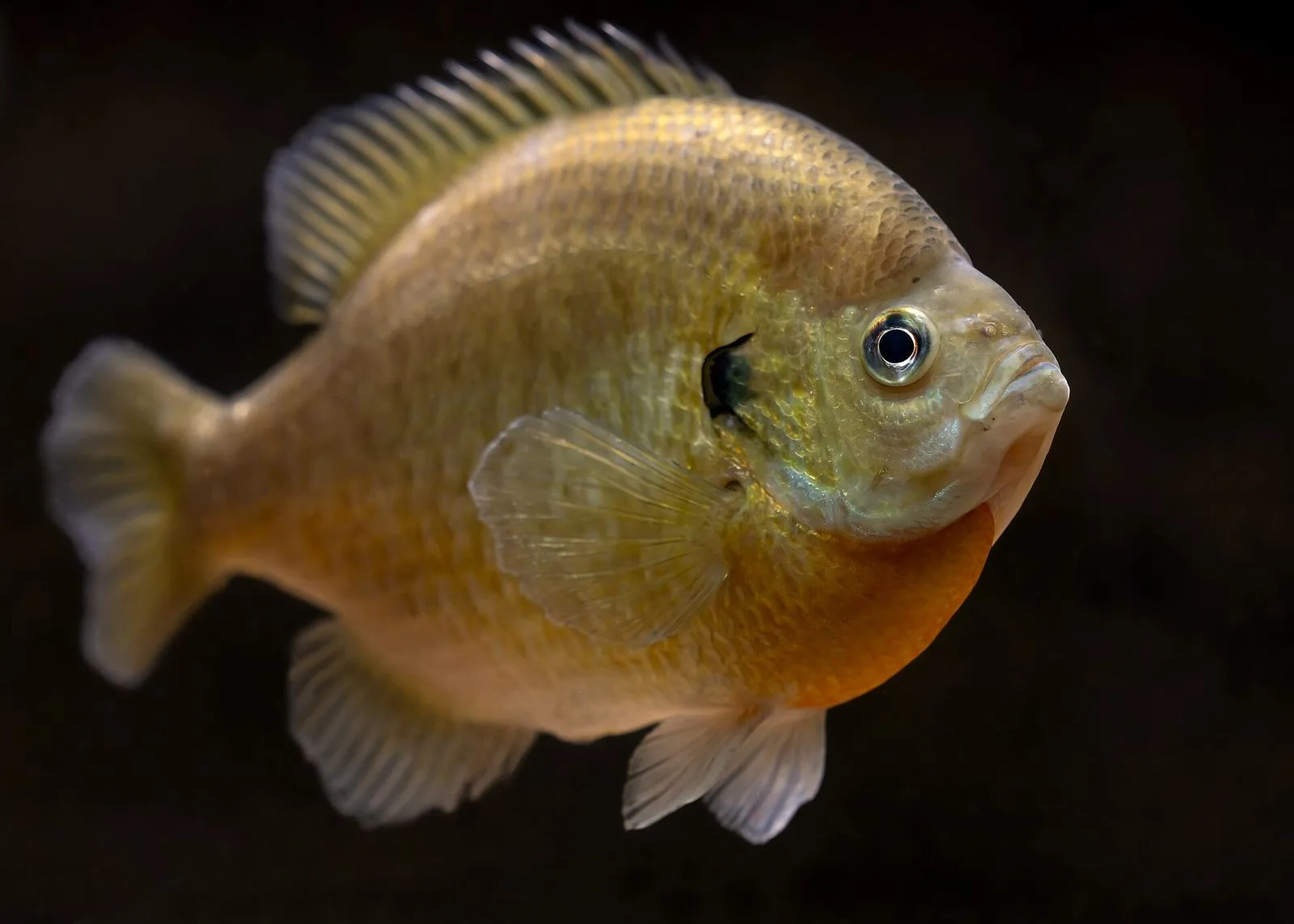
Most of them slow down and do very little. A 2022 review of how fish get through winter, by Reeve and colleagues, gives the numbers. The cunner, a small wrasse of the North Atlantic coast, stops moving when the water falls to 45 °F (7.1 °C) or below. The pumpkinseed, a common pond sunfish, stops at 46 °F (7.9 °C).
The savings come from two places, and neither is a special winter sleep. First, the fish stops swimming, so it stops paying for swimming. Second, its chemistry slows down by itself, because that is what cold does to chemistry. There is no hibernation switch like a bear’s. A fish holding still in cold water can look asleep, but sleep in fish has its own signs.
The champions live under the Antarctic ice. A 2008 study recorded the heart rate and movement of Notothenia, an Antarctic cod, through the year. In winter the fish swam 20 times less. Its metabolism dropped by a third and its heart rate halved.
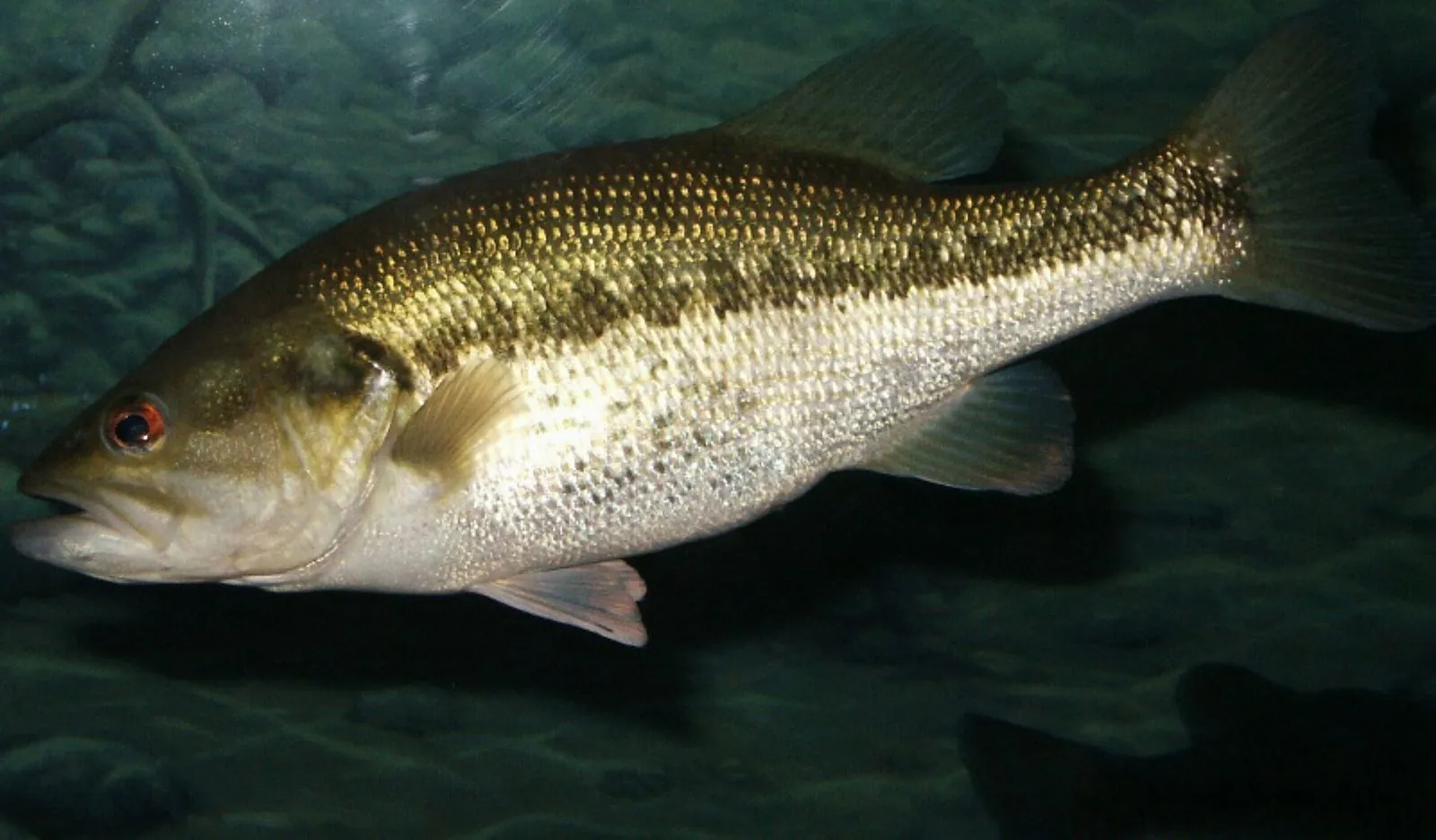
Largemouth bass never get close to that. A 2025 study tracked wild largemouth through fall and winter. Heart rate, activity and metabolism fell as the water cooled, and stayed low. Yet the fish kept swimming slowly and fed a little. A winter bass is a slow bass, not a switched-off one.
| Species | Stops moving at | Winter behavior | Source |
|---|---|---|---|
| Cunner (North Atlantic wrasse) | 45 °F (7.1 °C) or below | Sits still; savings from inactivity plus chemistry slowing on its own | Reeve et al. 2022 |
| Pumpkinseed sunfish | 46 °F (7.9 °C) or below | Sits still for the same two reasons; no special dormancy | Reeve et al. 2022 |
| Antarctic cod (Notothenia) | Never fully; swims 20 times less | Metabolism down a third, heart rate halved, all winter | Campbell et al. 2008 |
| Largemouth bass | Never fully; slows through fall | Heart rate and activity low and stay low; keeps slow-swimming and feeds a little | Brownscombe et al. 2025 |
| Antarctic notothenioids and Arctic cod | Never; keeps swimming in ice-cold seawater | Antifreeze glycoproteins in the blood stop ice crystals growing | Chen, DeVries and Cheng 1997 |
Do fish freeze?
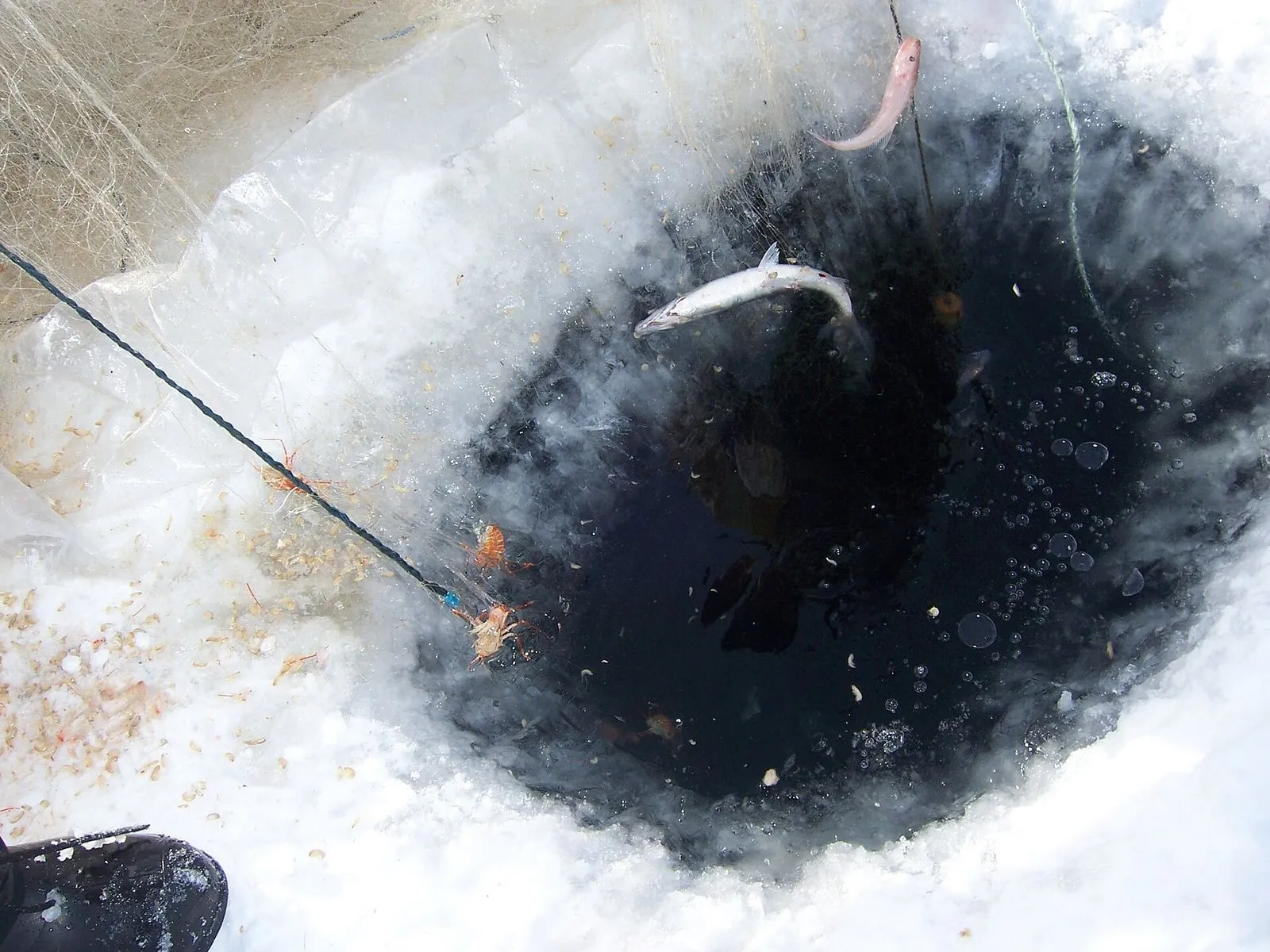
A pond fish does not, because it is never colder than the water it swims in. Fresh water turns to ice at 32 °F (0 °C), and under the ice the water stays liquid, so the fish does too.
The sea is a harder place. Salt water can be colder than 32 °F and still not freeze, and a normal fish in it would turn to ice from the inside. Polar fish carry a fix in their blood: antifreeze glycoproteins, molecules that stick to the tiniest ice crystals and stop them growing. Chen, DeVries and Cheng traced where the gene came from in 1997. In the Antarctic notothenioids it grew out of a gene for trypsinogen, a digestive enzyme. Arctic cod, at the other end of the planet, carry almost the same antifreeze but arrived at it by a different route. Nature invented fish antifreeze twice.
Can fish under ice run out of air?
Yes, but ice by itself is not the danger. The water under it holds oxygen, and a slowed-down fish needs less of it. The trouble is snow. When snow piles up on the ice it blocks the light, and the plants and algae below stop making oxygen. Nothing comes in from the air either, because the ice seals the surface. So the oxygen falls all winter, and it is lowest in late winter, just before the ice goes out. In a shallow, weedy pond, fish can suffocate. That is winterkill.
How should you fish cold water?
- Slow down, then slow down again. The fish’s nerves and muscles run at winter speed. A lure that races past is gone before the fish has decided. Move a bait a few inches, then hold it still.
- Fish small. A fish running on a fraction of its summer energy wants a meal that costs almost nothing to catch. Small jigs, single baits, thin line.
- Put it on the fish’s nose. Winter largemouth keep swimming slowly and feed a little. They take what arrives in front of them and will not chase.
- Expect late winter to be the hardest ice fishing. Oxygen is lowest then, and fish that are short of air eat least. Early ice, with the oxygen still high, is the easy part.
- Do not expect a fight. A cold fish’s muscles pull slowly and tire fast, so a bass in 40 °F (4 °C) water comes in like a wet sock. The fish gives up quickly; unhook it quickly too.
- Release in the water when the air is below freezing. The fish is at water temperature and its gills and eyes are wet. Freezing air is harder on them than on you. Keep the fish in the hole, wet your hands, take the hook out and let go.
- Watch the weather before the water. A cold front knocks the shallows down a few degrees in a night, and the fish slow with it. The day after a winter warm spell is the day to go.
More questions about how fish work are answered in the fish facts collection.
Free download
The water temperature card
Read your water temperature and the card tells you who is spawning, who is feeding and what to throw. 26 species, 16 pages, for your phone and the tackle box.
Plus one email a week on what's biting now. No sales pitches. Privacy.
Related
Section guide
Fish Facts: The Questions Kids Ask About Fish, Answered With the ScienceFish facts with a number and a source for each: how fish sleep, breathe, hear and feel, and what every answer means when you hook and release one.
 Do Fish Drink Water? Freshwater Fish, Saltwater Fish and Sharks
Do fish drink water? Freshwater fish barely do, saltwater fish drink all day, sharks cheat with urea. The numbers, and what it means for bait and livewells.
 Do Fish Drown? How Fish Suffocate, and How to Revive a Tired One
Do fish drown? Not by the dictionary, but they suffocate three ways: low oxygen, damaged gills, no water flow. How long a fish lasts in air, how to revive one.
 Do Fish Fart? Yes, Herring Do It on Purpose, and a Bloated Bass Needs Help
Do fish fart? Herring do, on purpose, and scientists won a prize for proving it. Which fish pass gas, where it goes, and what to do with a bloated bass.
 Do Fish Feel Pain? What the Studies Found, and What Decides Whether a Released Fish Lives
Do fish feel pain? They sense damage and react; whether they suffer is contested. The trout study, both camps, and what decides if a released fish lives.
 Do Fish Have Bones, Hearts and Blood? What Is Inside a Fish
Do fish have bones? Most do; sharks run on cartilage and 16 icefish have clear blood. How skeleton, heart and blood work, and what it means for your fillets.
 Do Fish Have Brains? Memory, Learning, and Why the 3-Second Myth Is Wrong
Do fish have brains? Yes: a full brain, no neocortex, a memory that lasts months. What goldfish, carp and pike learned, and what it means at the water.
Sources
- Reeve et al. (2022), Overwintering fishes: how fish get through the cold season (review)
- Campbell et al. (2008), Hibernation in an Antarctic fish: on ice for winter, PLOS ONE
- Chen, DeVries and Cheng (1997), Evolution of antifreeze glycoprotein gene from a trypsinogen gene in Antarctic notothenioid fish, PNAS
- Chen, DeVries and Cheng (1997), Convergent evolution of antifreeze glycoproteins in Antarctic notothenioid fish and Arctic cod, PNAS
- Wegner et al. (2015), Whole-body endothermy in a mesopelagic fish, the opah, Science
- Bluefin tuna endothermy and heat exchangers, Marine Biology (2020)
- Brownscombe et al. (2025), Winter behaviour and energetics of largemouth bass, Canadian Journal of Fisheries and Aquatic Sciences
- Forest Preserve District of DuPage County, Life under ice