 By
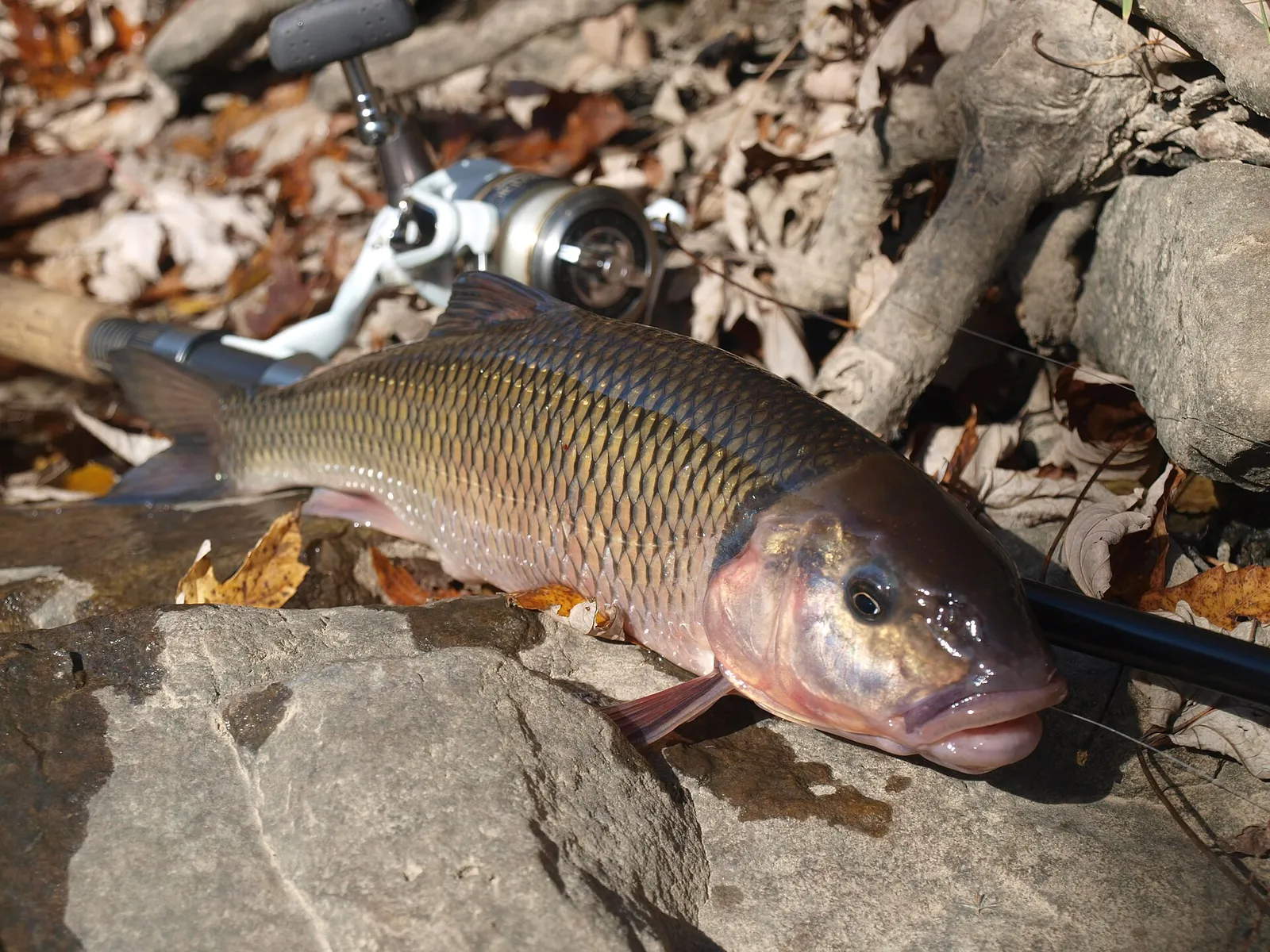
A fallfish is the biggest native minnow in the eastern US. In a Connecticut stream most run 4 to 9 in, but they can reach about 20 in. They live in clear gravel streams from Virginia north into Canada. Throw a small spinner or a worm on light tackle and you’ll likely catch one, often while you’re fishing for trout.
The heaviest fallfish in the IGFA book is 4 lb 1 oz, from the St. Lawrence River in New York in May 2025. Until March 2025 the record was 3 lb 9 oz, and it had stood since 2009.
How do you identify a fallfish?
Look at the scales and the back fin. A fallfish has big scales, fewer than 50 in the row along its side. It has no black spot at the base of its back fin. Then check for these:
- Dark edges on the front of many scales, mostly on adults.
- A dark gray back, silver sides and a white belly. The lower fins are often reddish on adults.
- A big mouth. The end of the jaw reaches at least to the front of the eye.
- A forked tail and a long, torpedo-shaped body.
- A dark stripe down the side on young fish only. Adults lose it.
In spring, breeding males turn very dark, with a brownish to reddish head covered in small hard bumps called breeding tubercles. Connecticut says few anglers name them right. Many call them “dace,” and now and then someone takes one for a trout.
Four fish get mixed up with it most:
- Creek chub: a black spot at the front base of the back fin, and a smaller eye.
- River chubs (river, bigmouth and bluehead chub): West Virginia says the fallfish’s bigger silvery scales, narrower body and bigger mouth set it apart.
- Common carp: whiskers (barbels) you can see at the mouth, and a back-fin ray turned into a spine. A fallfish has neither.
- Suckers: people mix them up “without looking at their mouths,” West Virginia says. A look at the mouth ends it.
Fallfish vs creek chub: how to tell them apart
Go by the spot. A creek chub has an easy-to-see dark spot at the front of its back fin, and a fallfish doesn’t. They’re close cousins in the same genus, and small ones are hard to tell apart.
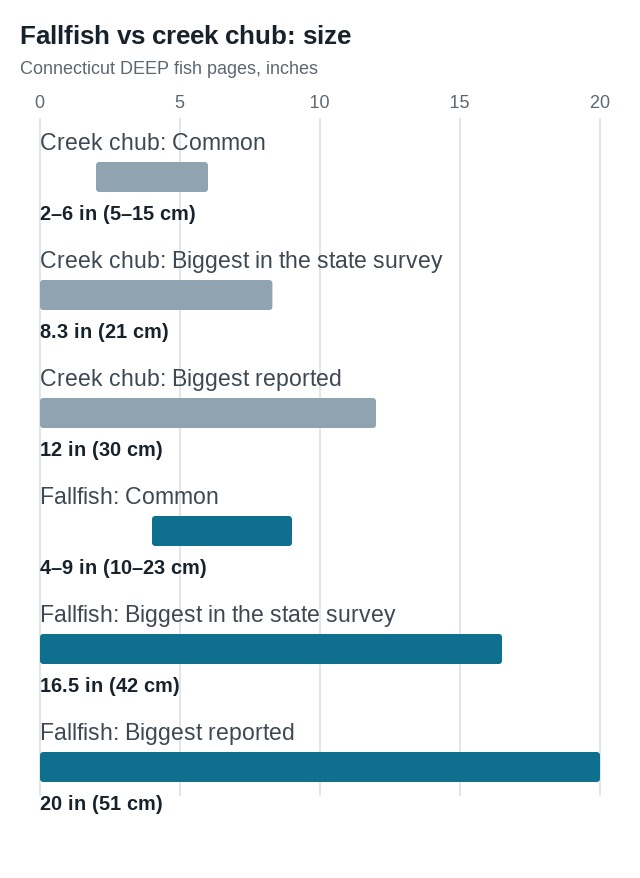
Chart: fishing.info, from Connecticut DEEP’s creek chub and fallfish pages (read November 25, 2026)
The rest backs it up. The fallfish’s scales are bigger and more sharply outlined, and its eye is larger. And size settles most cases. In Connecticut’s numbers, a creek chub tops out near 12 in, and a fallfish can reach 20. The nest gives a fallfish away too: the male piles small rocks into a mound 4 to 18 in tall.
Free PDF · Freshwater fish identification chart Which fish is that? Tell the look-alikes apart.
Print the free 4-page chart: 28 freshwater fish in 8 families, each with its picture and the two to four marks that tell it from the fish beside it.
No card, nothing to buy, and the PDF is yours to keep. It's in your inbox a minute later. Then a few short emails and one a week on what's biting. Unsubscribe anytime. Privacy.
Where do fallfish live?
Clear streams and rivers with a gravel or cobble bottom, from Virginia north. The native range runs up the Atlantic Slope from the James River in Virginia to New Brunswick. It reaches into the St. Lawrence drainage of New York, Quebec and Ontario too. Connecticut finds them in most of its streams, often in good numbers. In Virginia they live in the James, Potomac, Rappahannock and York drainages. In Maryland they’re common in the central and western parts of the state. In West Virginia they live only in the streams that flow east, in the Potomac watershed.
Look in pools first. Virginia says young and adult fish both like pools, and sometimes runs and faster water. Small to medium streams are the classic spot. In the North of their range they also live in lakes and ponds, while farther south they stay in warm-water rivers and streams.
Here’s why that matters in July. When warm water sends trout to springs and deep pools, fallfish often take over the river, says New England Fly Co., a Maine guide service. James Suleski, writing in Dark Skies Fly Fishing, says they handle water up to roughly 82 °F. That makes them a fly rod fish all year. To find the bigger ones, he goes downstream, into the stretches counted as warm water.
The number: Fallfish handle water up to roughly 82 °F, Suleski says. That keeps them feeding when the stream gets too warm for trout.
How do you catch fallfish?
Go light. Virginia says ultralight tackle or a fly rod gives you the best fight, and anything you’d use for panfish will work. Fallfish hit hard and fast, and usually jump once hooked. Connecticut calls them very easy to catch.
- First pick: a small spinner or jig. Virginia names spinners, jigs and small plugs. Maryland adds small spoons. Work it through the pools.
- Second pick: a worm. Connecticut says worms work well. Virginia even names “a big juicy worm.”
- On a fly rod: a streamer or a wet fly. Suleski says “any typical streamer or crayfish pattern will take fallfish.” He also swings soft-hackle wet flies during summer hatches.
- When they rise: a dry fly. Fallfish feed on top during hatches. New England Fly Co. says they take dry flies, nymphs and streamers, and are far less picky than trout.
- After dark: a big streamer. Suleski calls fallfish mostly night hunters. Some of his best fish came in the middle of the night, on big wet flies and streamers.
Bring a net. Fallfish have soft mouths, so Virginia says a net is the best way to land them. Maryland says they hit the small jigs, spoons and live bait meant for stocked trout and perch. You may catch them without trying. An ultralight rod with light line is all you need. The small spinners and spoons in our best trout lures guide fit fallfish too.
How big do fallfish get?
Expect 4 to 9 in in a Connecticut stream. New England Fly Co. says most anglers in Maine meet fish of 8 to 14 in. A fish over 18 in is exceptional, Maryland says. Here’s what each source puts on paper:
| Source | Common size | The biggest it gives |
|---|---|---|
| Connecticut DEEP | 4–9 in (10–23 cm) | 16.5 in (42 cm) in the state survey; 20 in (51 cm) reported |
| Maryland DNR | — | 15 in (38 cm) or more; exceptional fish over 18 in (46 cm) and 2 lb (0.9 kg) |
| Virginia DWR | — | 20 in (51 cm) |
| Ontario fish database | Adults 6.1–14.4 in (15.5–36.5 cm) | 21.3 in (54.0 cm) and 3 lb 12 oz (1.7 kg); Ontario record 18.5 in (47.0 cm) |
| New England Fly Co., Maine | 8–14 in (20–36 cm) | Bigger fish “regularly exceed 18 inches” |
Length doesn’t tell you the weight on its own. Both of Jerry Hall’s Virginia records ran just under 20 in long. One weighed 3 lb 5 oz, the other 3 lb 13.9 oz.
What is the world record fallfish?
The heaviest fallfish in the IGFA book is 4 lb 1 oz (1.84 kg). Alex Pidhorodeckyj caught it in the St. Lawrence River near Massena, New York, on May 13, 2025. It’s New York’s state record too. The IGFA lists one more all-tackle fish beside it: Jerry Hall’s 4 lb 0 oz from Virginia’s Cowpasture River, caught on March 21, 2025. A new record has to beat the old one by 2 oz, IGFA rules say, so the two share the book. For 16 years before Hall’s fish, the mark was Jonathan McNamara’s 3 lb 9 oz. He caught it in the Susquehanna River near Owego, New York, in April 2009.
Then the record started to fall. Virginia began counting fallfish as a trophy fish in 2020, Outdoor Life reports. Since fallfish joined Virginia’s state record list, DWR says, anglers have set new records every few years. Here’s how the books climbed:
| Year | Fish | Where, who, and which book |
|---|---|---|
| 2009 | 3 lb 9 oz | Susquehanna River, New York. Jonathan McNamara. IGFA all-tackle |
| 2020 | 2 lb 8 oz | Jackson River, Virginia. David Legg. Virginia record |
| 2021 | 3 lb 5 oz, 19 3/4 in | Cowpasture River, Virginia. Jerry Hall, on a Joe’s Fly. Virginia record |
| 2022 | 3 lb 9.5 oz | Cowpasture River, Virginia. Josh Dolin, on a Nungesser spoon, second cast. Virginia record; Dolin said it would tie the world record |
| 2025, March 21 | 4 lb 0 oz (1.81 kg) | Cowpasture River, Virginia. Jerry Hall. IGFA all-tackle |
| 2025, April 3 | 3 lb 13.9 oz, 19 7/8 in | Jackson River, Virginia. Jerry Hall. Virginia record (DWR’s record list dates it April 3; its blog says March 3) |
| 2025, May 13 | 4 lb 1 oz (1.84 kg) | St. Lawrence River, New York. Alex Pidhorodeckyj. IGFA all-tackle and New York record |
Virginia DWR adds one more: the 2022 fish was beaten again in 2024. Then, in spring 2025, Hall went back to his Cowpasture hole on the anniversary of his 2021 record. DWR says he caught one that went 4 lb on his own scale. It lost a few ounces on the way to the official one. The IGFA lists a 4 lb 0 oz Hall fish from the Cowpasture on March 21, 2025, the same date as his 2021 catch. About two weeks later he got Virginia’s record back on the Jackson. So when you land a big one, weigh it fast, on a certified scale.
Four of the last five fish in that table came from two Virginia rivers, the Cowpasture and the Jackson. The heaviest came from the St. Lawrence. Records move, so check the IGFA and your state’s list for the current ones.
Can you use fallfish as bait?
Yes, where your state allows it. Maine puts fallfish on its legal baitfish list, next to the creek chub and the golden shiner. Ontario’s fish database lists them as an occasional bait fish. A small one goes on the hook like any other bait minnow.
Check the rules before you keep any. Bait rules differ by state: Maine, for one, allows only the species on its list. Read your state’s baitfish rules, and never dump a bait bucket into other water. To catch your own, use a small hook and a worm. Connecticut says worms work well. Or set a minnow trap where traps are legal. Our live bait guide covers keeping them lively.
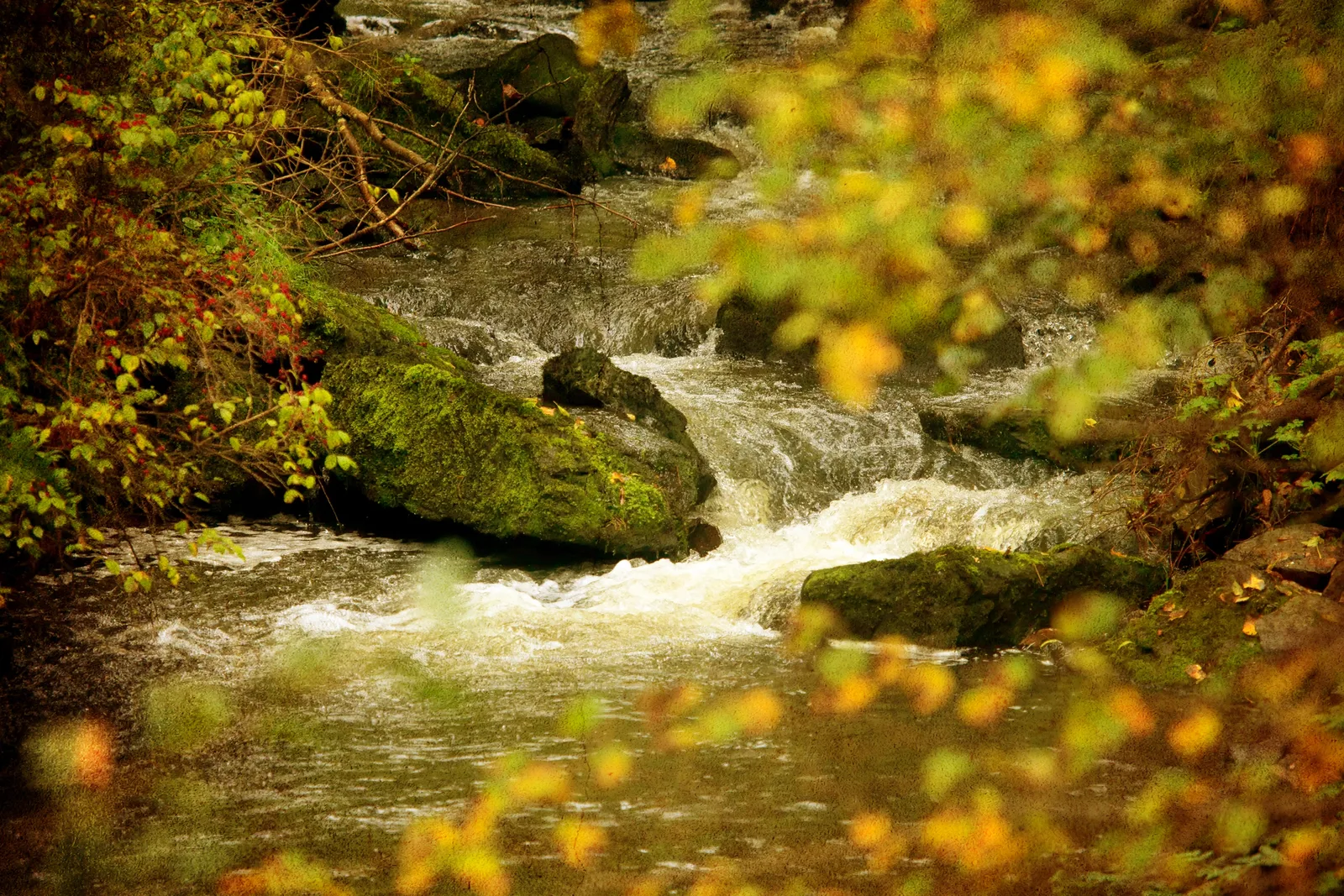
A small stream in autumn. Photo: sliper84 / Depositphotos.
Are fallfish good to eat?
Yes, you can eat one, but opinions split, and mind the bones. Virginia says the taste “is one of much debate.” People describe it as anything from “bland brown paper” to “sweet and delicate.” As a minnow, it has small, thin bones all through the meat, so eat with care. Virginia doesn’t list it as a game fish. If you keep one, check your state’s fish consumption advice for that water first.
The biology behind the fishing
Fallfish are predators. Young ones eat insects and some algae. Once they get bigger they add fish and crayfish, West Virginia says. Before people stocked smallmouth bass, brown trout and other sport fish, the fallfish was the top predator in many eastern streams.
The nest is the famous part. A male carries pebbles of 1 to 2 in in his mouth and piles them into a mound, over as many as four days. Connecticut puts the finished pile at 4 to 18 in tall, a pyramid of small rocks in the stream. Females pick a male by his work. Spawning is communal, Maryland says. West Virginia adds that other minnows use the same mounds later in the season.
Spawning runs in spring. West Virginia’s fish spawn in April. Ontario gives May and June, in water of about 57 to 66 °F (14 to 19 °C). Suleski puts the window at March to June. He asks anglers not to wade on the mounds, or the pits below them, in those months. A fallfish can live 6 to 10 years, Ontario’s database says. Males mature at 2 to 3 and females at 3 to 4.
The other freshwater fish hub has more of the fish you’ll meet on a trout stream. In Maine, fallfish often share a river with brook trout.

Free PDF · 4 pages
Bluegill or redear? Walleye or sauger? Tell them apart at the net
Color is a poor guide, and the limits differ by fish. Know which one is in your net before you keep it.
The Freshwater Fish Identification Chart. Print the four pages for the tackle box or the cabin wall. Each family starts with the one thing to check, and the look-alikes sit side by side.
- 28 freshwater fish in 8 families, each with a picture and the marks that tell it apart
- The one check to do first, family by family: the jaw, the ear flap, the spots, the tail
- A tick box beside every fish for the first time you catch one
Every mark from the species pages on fishing.info and the 168 sources behind them, state wildlife agencies among them. Pictures: U.S. Fish and Wildlife Service paintings by Duane Raver and Timothy Knepp, and USFWS photos.
No card, nothing to buy. The PDF is in your inbox a minute later, one version for your phone and one to print, yours to keep. Then a few short emails and one a week on what's biting, with an unsubscribe link in every one. Privacy.
Related
Section guide
Freshwater Fish Species Outside the Big Families: Sturgeon, Gar, Bowfin, BurbotThe freshwater fish species outside the bass, trout, catfish and pike families: sturgeon, gar, bowfin, burbot, drum, eel and paddlefish, with records.
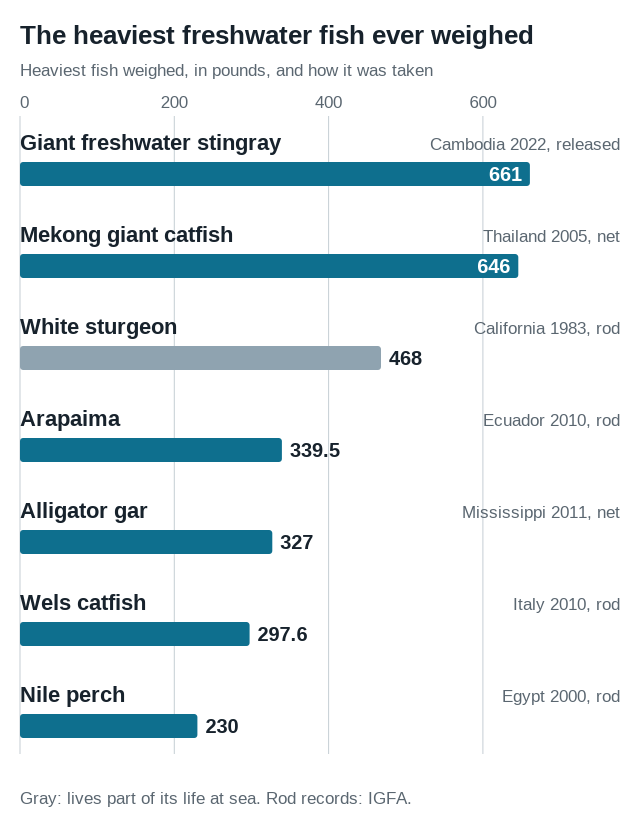 Largest Freshwater Fish: The 661 lb Stingray and the Giants Behind It
The largest freshwater fish is a 661 lb stingray from Cambodia. The giants ranked by weight, the rod records, and the biggest you can catch in the US.
 Cisco Fish (Lake Herring, Tullibee): ID and How to Catch Them
Cisco fish, also called lake herring or tullibee, run 12–15 inches in cold, deep lakes. Tell one from a whitefish, find them under the ice, plus limits.
 Arctic Grayling: Where to Catch One in the US, Best Flies, Size and Records
Arctic grayling in the US: Alaska, Montana and stocked lakes in Wyoming, Utah and Colorado. How to ID one, what to throw, the records and the rules.
 White Sturgeon: Size, Age, Where They Live and the Rules by State
The white sturgeon is North America's largest freshwater fish. The 468 lb record, how to tell it from a green, and where you may keep one, state by state.
 American Eel: How to Catch One at Night, and the Rules
The American eel grows to 4 ft and 9 lb. The night bait and hook that catch one, where to cast, the limits state by state, and how to skin it.
 Pacu Fish: Human-Like Teeth, and How to Tell One From a Piranha
A pacu fish is a piranha cousin with flat teeth like human molars. How to tell it from a piranha, how big it gets, and what to do if you catch one.
Sources (18)
- Connecticut DEEP, Fallfish (Freshwater Fishes of Connecticut)
- Mike Pinder, Fallfish: Little Tarpon of the Commonwealth, Virginia DWR
- Connecticut DEEP, Creek Chub (Semotilus atromaculatus) - Native
- Maryland DNR, Maryland Fish Facts: Fallfish
- West Virginia DNR, Fallfish
Show all 18 sourcesShow fewer sources
- USGS Nonindigenous Aquatic Species, Fallfish (Semotilus corporalis) species profile
- Ontario Freshwater Fishes Life History Database, Fallfish
- IGFA World Record Search, Fallfish (all-tackle, read 2026-11-25)
- IGFA, International Angling Rules (world record requirements)
- Virginia DWR, Virginia State Record Fish
- New York State DEC, Freshwater Fishing news bulletin: four new state records set in 2025
- Virginia DWR, New State Record Fallfish (press release, 2021)
- Molly Kirk, Jerry Hall Reclaims State Record Fallfish Title, Virginia DWR (June 4, 2025)
- Scott Einsmann, Virginia Angler Catches World-Record Fallfish in Two Casts, Outdoor Life
- James Suleski, Fallfish on the Fly: Discover A Native Super Predator, Dark Skies Fly Fishing (May 10, 2025)
- New England Fly Company, Maine's Native Fallfish
- Maine Department of Inland Fisheries and Wildlife, Baitfish and Smelt Information
- Alexander Y. Suvorov, Semotilus corporalis (photo, Wikimedia Commons)