 By
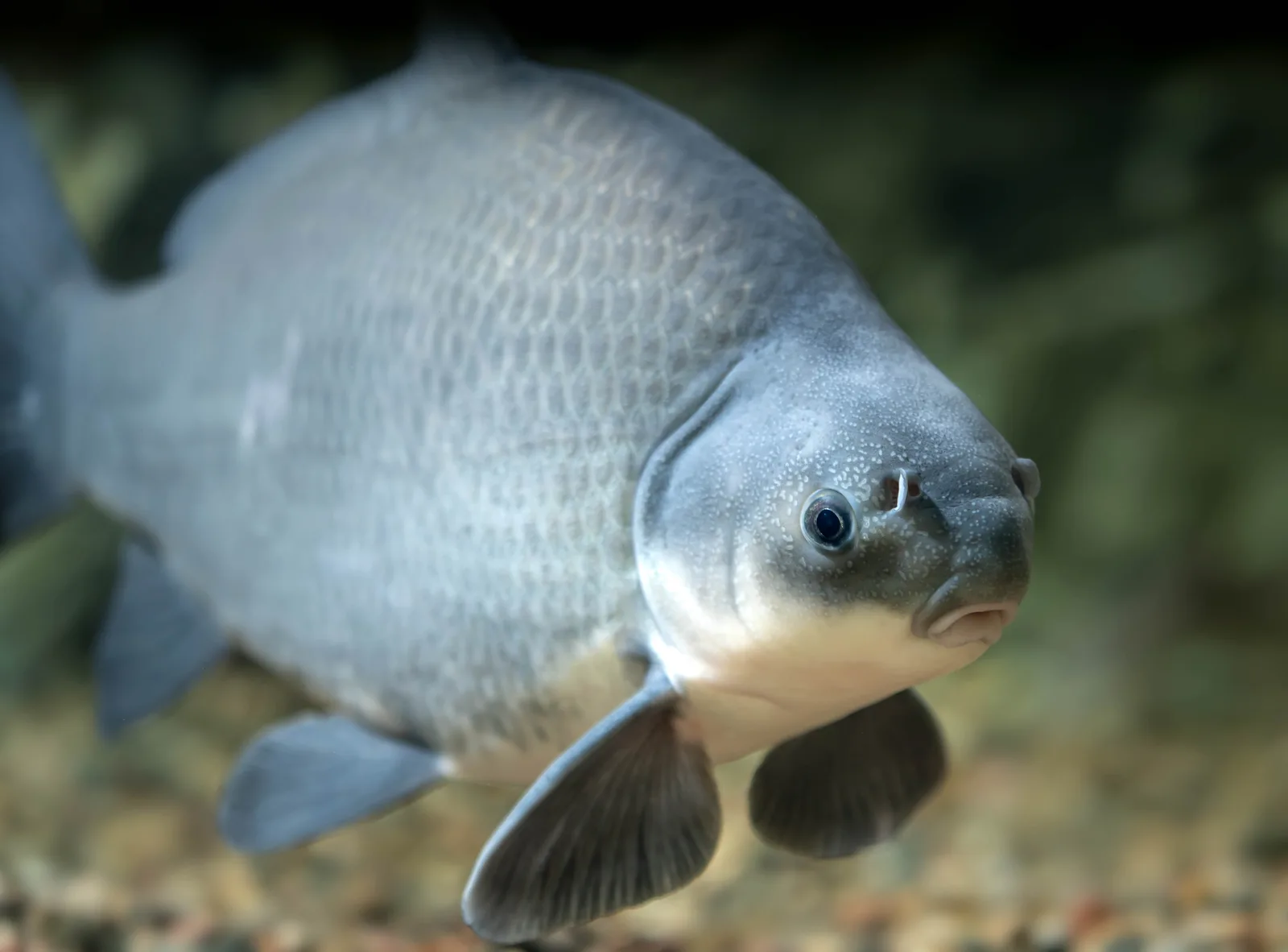
A buffalo fish is a big native sucker, not a carp. Three kinds live in the U.S.: the bigmouth, the smallmouth and the black. Most run 2 to 18 lb. They’ll take corn, dough or worms on the bottom, and they’re good eating once you know how to handle the bones.
One bigmouth buffalo was aged at 148 years. That fish hatched in the 1870s.
Is a buffalo fish a carp?
No. Buffalo are native to North America and belong to the sucker family. The common carp came from Asia and reached America as early as 1831, Missouri’s field guide says. Look at the mouth first. A common carp has two barbels, or whiskers, on each side of its upper jaw. A buffalo has none.
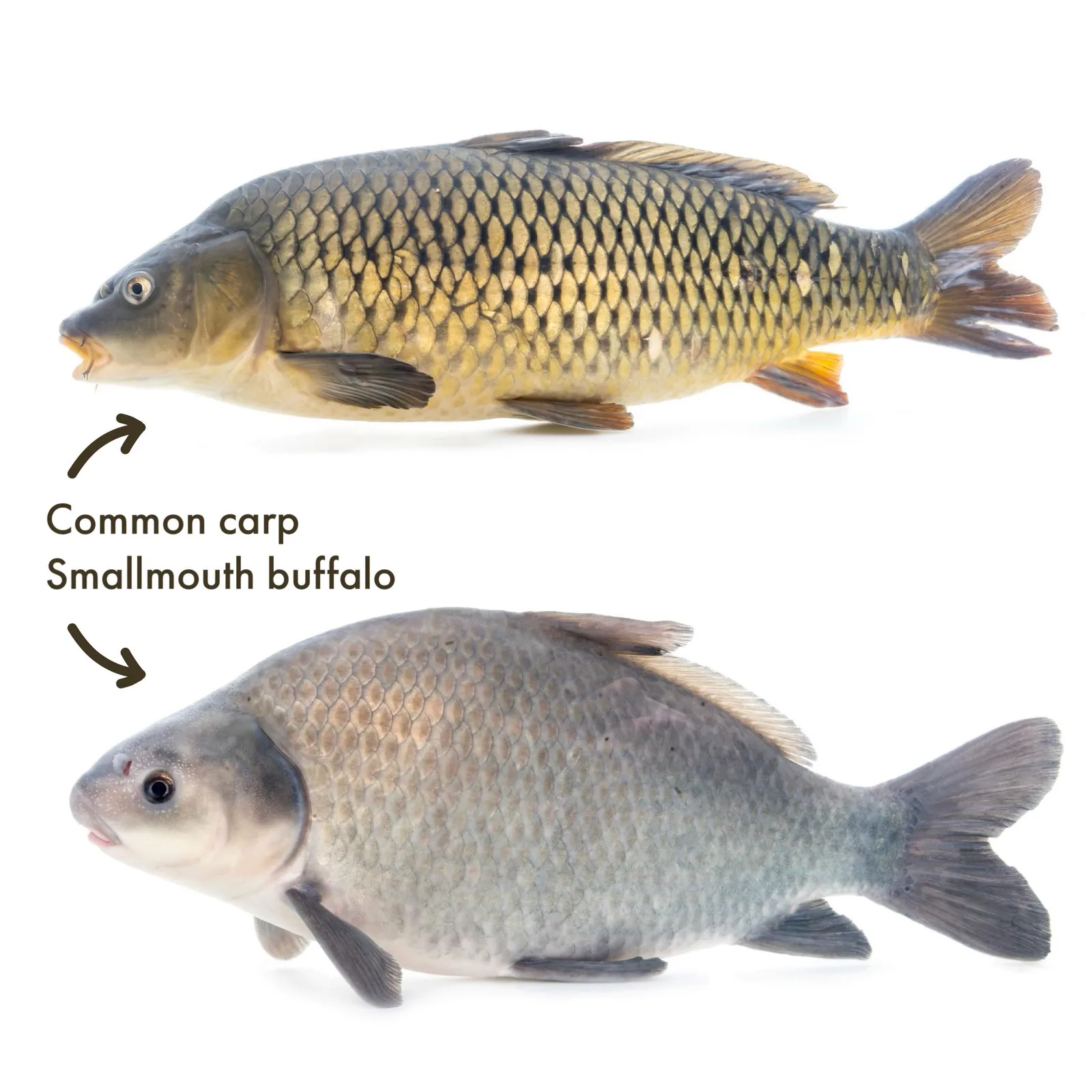
Common carp above, smallmouth buffalo below. Photo: Sam Stukel, U.S. Fish and Wildlife Service (public domain).
| Check this | Buffalo | Common carp |
|---|---|---|
| Barbels | None | Two on each side of the upper jaw |
| Back fin | Long and sickle-shaped | Long, with a stout, saw-toothed spine at the front |
| Color | Dark, often a striking blue-gray | Brassy olive with dark-edged scales, yellowish white belly |
| Family | Suckers | Carps (Cyprinidae) |
| Origin | Native | Brought from Asia |
One more tell: a buffalo out of the water turns a splotchy pink, says Missouri’s Gilbert Randolph. He also says people who can’t tell the two apart “waste an unfortunate amount of buffalo fish every year.”
The other look-alike is the river carpsucker. It has the same long back fin, but it’s silvery and the center of its lower lip has a small nipple-like point. It’s also smaller, usually 12 to 15 in. The carp hub sorts every carp-shaped fish in one key.
Calling one a “buffalo carp” is an old mistake. Meriwether Lewis wrote “Carp or buffaloe fish” in his journal in 1804.
Bigmouth, smallmouth or black buffalo?
Start with the mouth. A big, slanted mouth is a bigmouth, and you’re done. A small, flat mouth means you check the back: a sharp hump is a smallmouth, and a round back is a black.
| Buffalo | What to check | Where you’ll find it |
|---|---|---|
| Bigmouth | Big mouth that slants up, front of the upper lip about level with the bottom of the eye, thin lips, rounded back | Still water: deep pools of large streams, lowland lakes, reservoirs. Handles muddy water well |
| Smallmouth | Small, nearly flat mouth, thick grooved lips, upper lip well below the eye, sharply keeled back | Rivers, large streams, ditches and big reservoirs. Likes clearer water than the bigmouth |
| Black | Small, nearly flat mouth, thick lips, rounded or weakly keeled back, thicker-bodied than a smallmouth | Moving water, often below dams. The buffalo least likely to live in a reservoir |
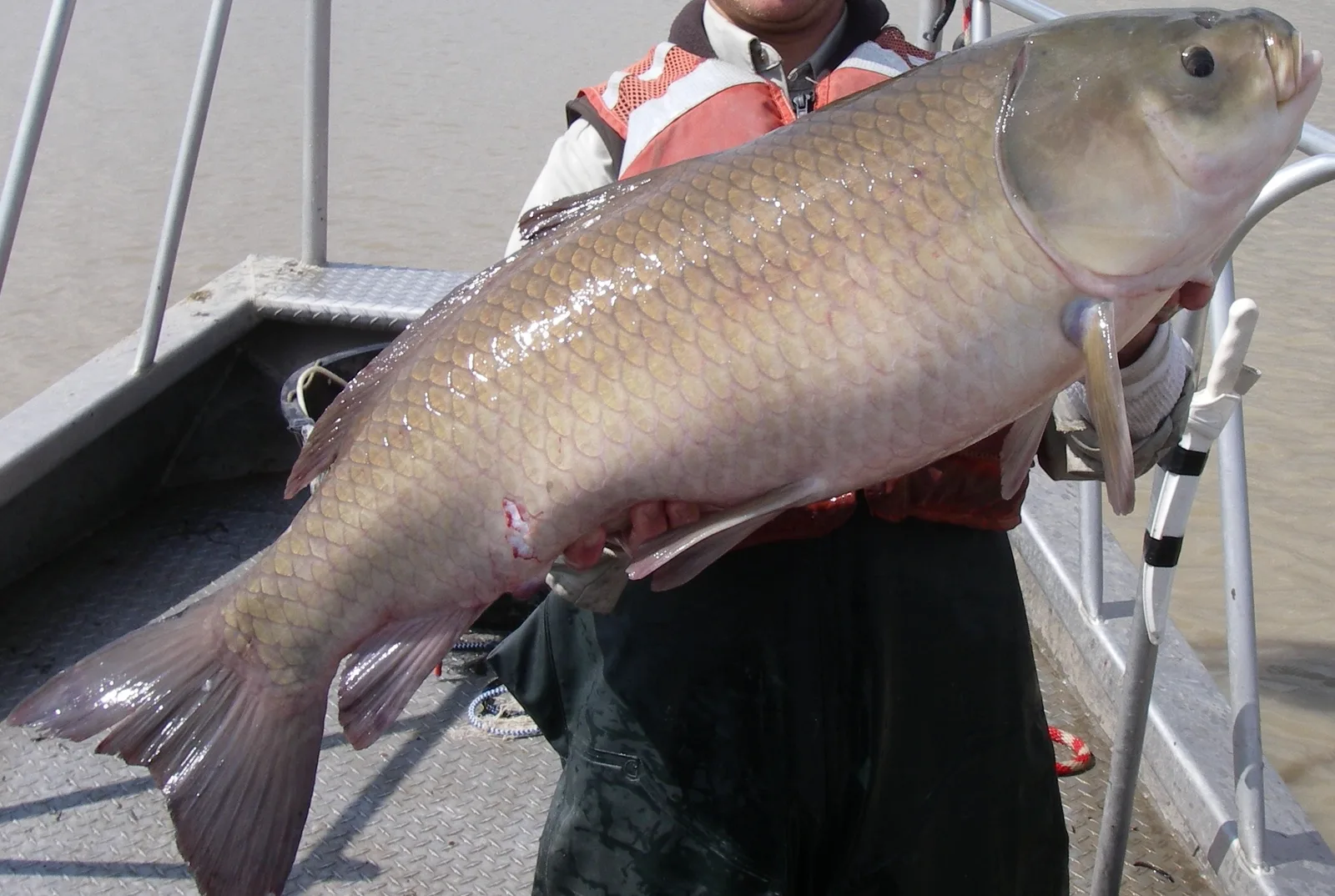
A bigmouth buffalo taken during Missouri River fish sampling. Note the mouth, angled up at the end of the snout. Photo: U.S. Fish and Wildlife Service, Missouri River Fish and Wildlife Conservation Office (public domain).
The names change by river. Missouri lists gourdhead and redmouth buffalo for the bigmouth, and roach-back, razor-backed buffalo, liner and blue pancake for the smallmouth. The black also goes by mongrel buffalo, round buffalo, blue rooter and current buffalo. So check the fish you’re holding and not the name.
Free PDF · Water temperature chart Which fish are biting at today's water temperature?
One reading, and the 16-page chart shows which of 26 fish are spawning, feeding hard or slowing down; for bass, crappie, bluegill and walleye, where they sit and what to throw. Every number sourced.
No card, nothing to buy, and the PDF is yours to keep. Confirm with one click and it's on its way. Then a few short emails and one a week on what's biting. Unsubscribe anytime. Privacy.
Where are buffalo, and when do they bite?
Their home water is the big river country of the middle of the continent. The bigmouth is native to the Mississippi and Red River of the North drainages. The smallmouth runs through the large Mississippi tributaries and the Gulf slope. The black is in the Mississippi, Missouri and Ohio basins. All three were also stocked in Arizona’s Roosevelt Lake in 1918.
| When | Where they are | What to do |
|---|---|---|
| Spring spawn | Shallows and flooded areas, and below dams. Smallmouth spawn at 60–65 °F (16–18 °C), in 4–10 ft (1.2–3 m) on Iowa’s rivers | Fish below dams and on shallow bars next to deep water. This is the easiest time |
| Late spring and summer | Deep pools and the shallows next to them | Keep your bait on the bottom at the edge of the deep water |
| Fall and winter | They still feed: Texas records came on Oct. 15, Oct. 28 and Dec. 18 | Stay with the same bottom baits and fish slowly |
Dams are the first place to try, since fish stack up below them in spring. On Arizona’s Apache Lake, bank anglers cast 30 to 330 ft (10–100 m) and fish 3 to 50 ft (1–15 m) down. Most often they fish 16 to 26 ft (5–8 m) deep.
How do you catch a buffalo fish?
Put corn or a dough ball on a small, stout hook and leave it on the bottom. Be ready to work for it, though. Missouri says both the bigmouth and the smallmouth are “seldom taken on a hook and line.” A bigmouth mostly strains tiny crustaceans out of the water, so it isn’t hunting your hook. Stick with it. Buffalo get written off as rough fish, but Texas says a hooked smallmouth provides “exceptional sport.”
- Pick the hook. Use a No. 6 or smaller, because buffalo have small mouths. Get a strong one. Missouri warns that “a big buffalo can straighten out a light wire hook.” Ben Cantrell caught his at Shelbyville Dam on a No. 10.
- Bait up. Start with canned corn. Next, a dough ball: Texas says smallmouth “will sometimes take doughballs made with cottonseed meal.” Nightcrawlers are third, and Missouri calls them excellent.
- Rig it plain. Slide a sinker onto the line above a swivel, then add a short leader and the hook. Skip the circle hook. Cantrell’s fish finder rig with one caught only common carp, and he figured it wasn’t the best way to catch buffalo.
- Bait the spot. Cantrell baited a concrete ledge with alfalfa pellets and canned corn, then lowered a kernel or two to fish he could see. Check your state’s rules on chumming first.
- Watch the line. Buffalo “bite very, very lightly,” says Michigan carp angler Brian Pearcy. They can mouth a bait for 10, 15 or even 30 minutes without running. When the line tightens and loosens two or three times in a short stretch, reel down and set the hook.
For rough fish under about 10 lb, a medium spinning combo with 8 lb line will do. For anything bigger, use your carp setup.
Want the big ones? Fish them the carp way. The Apache Lake crowd fishes from the bank for hours with a hair rig. That rig holds the bait on a short length of line below the hook. They use a tiny, micro-barbed hook about 3/8 to 3/4 in (1–2 cm) long. The bait is often a piece of fake corn, balanced so it neither sinks nor floats. Pack bait goes around the sinker: an oat and breadcrumb base with added corn, nuts and grubs. Then they wait on rod pods with bite alarms, because the bites are that soft.
Texas’s records tell the same story. The 71.625 lb smallmouth from Lady Bird Lake came on tiger nuts in 2024, and the state’s black buffalo record came on a boilie. Fly anglers have Texas records too, for both of those species. Good carp bait catches buffalo too.
How big do buffalo fish get?
Most buffalo you’ll see are 2 to 18 lb, but the top end is enormous. Missouri says a bigmouth sometimes reaches 30 lb.
| Buffalo | Typical size | Biggest on the books |
|---|---|---|
| Bigmouth | 15–27 in (38–69 cm), 2–14 lb (1–6 kg) | 70 lb 5 oz (31.89 kg), Bastrop, Louisiana, 1980 (IGFA). Wisconsin’s hook-and-line record is 76 lb 8 oz (34.7 kg), 2013 |
| Smallmouth | 15–30 in (38–76 cm), 2.2–17.6 lb (1–8 kg) | 82 lb 3 oz (37.29 kg), Athens Lake, Texas, 1993 (IGFA) |
| Black | 20–30 in (51–76 cm) | 63 lb 6 oz (28.74 kg), Mississippi River, Iowa, 1999 (IGFA) |
You’ll notice some of those numbers argue with Missouri’s field guide. It calls the smallmouth the smallest buffalo, at about 40 lb, and the IGFA’s smallmouth record is more than double that. It puts the black’s maximum at about 53 lb, and the IGFA’s black is 10 lb heavier. And Wisconsin’s bigmouth from Petenwell Flowage outweighs the IGFA’s all-tackle fish, since the state and the IGFA keep separate lists. The same flowage gave up a 94 lb 3.2 oz (42.7 kg) bigmouth in 2020, listed under Wisconsin’s alternate methods: spear, bow, crossbow and hand.
What are the rules on buffalo?
They vary by state, and they’re changing. In 2024 Minnesota renamed these fish “native rough fish” and let its DNR set limits. In February 2026 the DNR proposed a combined limit on bigmouth and smallmouth for inland waters. It’s five in a northern zone and 30 in a southern zone. If approved, it starts March 1, 2027. It wasn’t final in November 2026. Comments closed March 12, and the DNR was preparing for a hearing before an administrative law judge. When it proposed the limit, Minnesota had none on buffalo at all. Fish taken by bowfishing there “must not be returned to the water” and “may not be left on the banks of any water of the state.”
Pennsylvania’s code lists the bigmouth buffalo as endangered, and Canada lists its Saskatchewan-Nelson bigmouth as a species of special concern. Check your own state’s book before you keep one.
Are buffalo fish good to eat?
Yes, if you deal with the bones. “They do have a well-deserved reputation for being bony,” Randolph writes, but he calls them “fantastic table fare.” Andrew Zimmern called buffalo “the best tasting fish that no one eats.” Texas Parks and Wildlife calls the smallmouth “the number one species sold by commercial freshwater fishermen.” On the Mississippi and Missouri rivers, Missouri says, buffalo rank second in importance to carp in the commercial fishery.
The trouble is a row of big Y-bones in the main part of the fillet. You have three ways around them:
- Score it and fry it. Scoring means you slice across the bones so they end up in short bits. Driftwood Outdoors says people who gig suckers run fillets through a machine that cuts the bones “so small they dissolve when frying.” Missouri says many people like bigmouth deep fried.
- Smoke it. Randolph calls smoked buffalo excellent if you aren’t shy about bones. Pick the meat off and eat it plain or stir it into a fish dip. Don’t throw away the collars.
- Grind it. Randolph uses the meat for fish cakes, fish balls and boudin.
Don’t waste the ribs. A buffalo’s rib bones are “much heavier than any other fish,” says Missouri’s John Rittel, and fried buffalo ribs are a tradition in Louisiana. Dredge them in seasoned flour with a little cornmeal and fry them golden. On a big fish, you’ll also find a boneless strip of fillet on top of the ribs. Fold back the main fillet and let the rib bones guide your knife.
The FDA lists buffalofish as a “Good Choice.” For fish caught by family or friends, the agency says: “Check for fish and shellfish advisories to tell you how often you can safely eat those fish.” And: “If there is no advisory, eat only one serving and no other fish that week.” The FDA wrote that advice for people who might become or are pregnant or breastfeeding, and for children ages 1 to 11.
How long do buffalo fish live?
Longer than almost anything else in fresh water. All three U.S. species have been aged past 100 years from their ear stones.
| Buffalo | Oldest aged | Where |
|---|---|---|
| Bigmouth | 148 years | Qu’Appelle system, Saskatchewan |
| Black | 108 years | Apache Lake, Arizona |
| Smallmouth | 101 years | Apache Lake, Arizona |
That’s new knowledge. Missouri’s field guide still says a bigmouth may live 10 years, and until 2019 the known maximum was 26. Guinness still lists 112 years, for a female collected near Pelican Rapids, Minnesota. Only the lake sturgeon has been reported older, at 152, and that number comes from an anonymous brochure more than 70 years old. In the same Saskatchewan water, the oldest common carp checked was 53.
Here’s what it means for you. The old fish aren’t being replaced. In the Qu’Appelle, only one year’s hatch has shown up since 1949. At Minnesota’s Rice Lake, 389 of 390 bigmouth checked hatched before 1972. On Apache Lake, more than 90 percent of the buffalo caught are over 80, and some of the 1918 stockers are probably still swimming.
Those old fish wear their age. Black and orange spots build up as they get older. On Saskatchewan fish, black spots show up more often than not by about age 43. On Apache Lake, those spots let people recognize the same fish from one catch to the next. Think about that before you keep the big spotted one.
Why so few young? Water levels are part of it. At North Dakota’s Jamestown Reservoir, more young bigmouth made it in years when the water rose higher in spring. And when the water drops too fast after the spawn, the hatch can fail. In Minnesota the gap in young fish seems to go back to dams built in the 1930s. Missouri lists dams among the reasons the black buffalo is declining in some states.
What do buffalo eat?
It depends on the buffalo, and that’s why each one bites differently. The bigmouth’s large mouth and fine gill rakers strain small crustaceans out of the water near the bottom. The smallmouth roots along the bottom for insect larvae, algae and crustaceans. The black is more of a bottom feeder, and in some regions it eats a lot of clams. A bigmouth still takes a bait, though: of the 23 buffalo Apache Lake anglers handed over for aging, 18 were bigmouth.
They spawn in spring in the shallows. The bigmouth usually starts in late April or early May, and its eggs stick to dead plants and hatch in 9 or 10 days. A black buffalo spawn can draw several hundred adults into flooded ground for days.
If you’ve got a mystery fish from the same water, the other freshwater fish hub covers the gar, the freshwater drum, the bowfin and the rest.

Free PDF · 16 pages
Stop guessing. Know what's biting before your first cast
A whole Saturday on the water with nothing to show for it. One reading tells you who's feeding.
The Water Temperature Fishing Chart. Take one water temperature reading, find it on the chart, and see which of 26 freshwater fish are spawning, feeding hard or slowing down.
- Where bass, crappie, bluegill and walleye sit, and what to throw. Trout: the reading where you stop.
- Why a 3 ft drop beats a cold front, and what to throw each day of the front
- The three thermometer mistakes that make a reading lie
The chart's numbers come from state fish and wildlife agencies and fisheries research: 61 sources, each listed on the site.
No card, nothing to buy. Confirm with one click and the PDF is on its way, one version for your phone and one to print, yours to keep. Then a few short emails and one a week on what's biting, with an unsubscribe link in every one. Privacy.
Related
Section guide
Freshwater Fish Species Outside the Big Families: Sturgeon, Gar, Bowfin, BurbotThe freshwater fish species outside the bass, trout, catfish and pike families: sturgeon, gar, bowfin, burbot, drum, eel and paddlefish, with records.
 Lamprey: What It Is, and What to Do If You Catch One
A lamprey is a jawless, eel-like fish that feeds on blood. How to tell a sea lamprey from a native one, what to do if you catch one, and the rules.
 Piranha: Are They Dangerous, and Are They Illegal in the US?
Piranhas bite swimmers, but it's unclear one has ever killed a living person. Their real size, the pacu look-alike, how to catch one, and US state law.
 Arapaima: How Big They Really Get, and Where You Can Catch One
The arapaima breathes air, tops out near 10 ft and 440 lb, and is legal to catch in only a few places. Its real size, the record, and where to fish.
 Lake Sturgeon: Size, Age, Where They Live and When You Can Fish
Lake sturgeon grow to 7 ft and may live centuries. How to identify one, where they live, the Winnebago spearing season and where you may keep one.
 Paddlefish (Spoonbill): Facts, Snagging Seasons, Records and Rules
The paddlefish, or spoonbill, eats only plankton, so anglers snag it. Size, age, the 164 lb record and the snagging seasons state by state.
 Sturgeon Fishing: Where to Go, the Rig, the Bait and the Rules by State
Sturgeon fishing for white and lake sturgeon: where it is open, when to go, the sliding-sinker rig, the best baits and the keep-it-in-the-water rules.
Sources (34)
- Missouri Department of Conservation, Bigmouth buffalo (field guide)
- Missouri Department of Conservation, Smallmouth buffalo (field guide)
- Missouri Department of Conservation, Black buffalo (field guide)
- Missouri Department of Conservation, River carpsucker (field guide)
- Missouri Department of Conservation, Common carp (field guide)
Show all 34 sourcesShow fewer sources
- Gilbert Randolph, Taste What You're Missing, Missouri Conservationist (July 2025)
- Jim Low, Niche Fish, Missouri Conservationist (November 2016)
- Texas Parks and Wildlife, Smallmouth buffalo (Ictiobus bubalus)
- Texas Parks and Wildlife, Texas State Records: fresh water
- Iowa DNR, Fish Iowa: smallmouth buffalo
- Illinois River Biological Station, Illinois Natural History Survey, From the Field: Smallmouth buffalo (2020)
- U.S. Fish and Wildlife Service, Common carp vs smallmouth buffalo (Sam Stukel)
- U.S. FDA, Advice about eating fish
- Wisconsin DNR, Record fish: hook and line
- Wisconsin DNR, Record fish: alternate methods
- IGFA World Records search: all-tackle records for the carp, goldfish and buffalo
- Minnesota Statutes, section 97C.376 (bowfishing)
- Minnesota DNR, Fisheries rulemaking (status of the native rough fish limits)
- Minnesota DNR, Native Rough Fish Limits (proposed rule)
- St. Croix 360, Minnesota DNR proposes harvest limits for native rough fish (February 2026)
- St. Croix 360, Minnesota passes new law to manage misunderstood fish (May 2024)
- Lackmann, Sereda, Villeneuve, Foley, Pollock, Bryshun, McCallum, Englot, Zak, Rehbein, Bielak-Lackmann and Clark (2025), Within-Ecosystem Comparison of Bigmouth Buffalo Ictiobus cyprinellus and Common Carp Cyprinus carpio Reveals Diverging Population Trajectories, Declining Recruitment, and a Lifespan of 148 Years, Ecology and Evolution 15(11):e72483
- Lackmann, Black, Bielak-Lackmann and Lackmann (2023), Centenarian lifespans of three freshwater fish species in Arizona reveal the exceptional longevity of the buffalofishes (Ictiobus), Scientific Reports 13
- Lackmann, Seybold, Bielak-Lackmann, Ford, Butler and Clark (2024), Analysis of bigmouth buffalo Ictiobus cyprinellus spawning phenology in Minnesota reveals 50-year recruitment failure and conservation concern, Scientific Reports 14
- Lackmann, Andrews, Butler, Bielak-Lackmann and Clark (2019), Bigmouth Buffalo Ictiobus cyprinellus sets freshwater teleost record as improved age analysis reveals centenarian longevity, Communications Biology 2:197
- Guinness World Records, Oldest freshwater fish
- Jessica B. Harris, A Different Kind of Buffalo, 64 Parishes (Fall 2024)
- Driftwood Outdoors, Rough fish too often overlooked as table fare (2022)
- Ben Cantrell, Shelbyville Dam buffalo (June 29, 2015)
- Brian Pearcy, Tips for catching small mouth buffalo, Michigan Carp Fishing (2017)
- Sports Illustrated On SI, Hardest-fighting fish: rough fish guide
- Pennsylvania Code, 58 Pa. Code § 75.1 (endangered species)
- Wikipedia, Bigmouth buffalo (range and Canadian status)
- Wikipedia, Black buffalo (range)