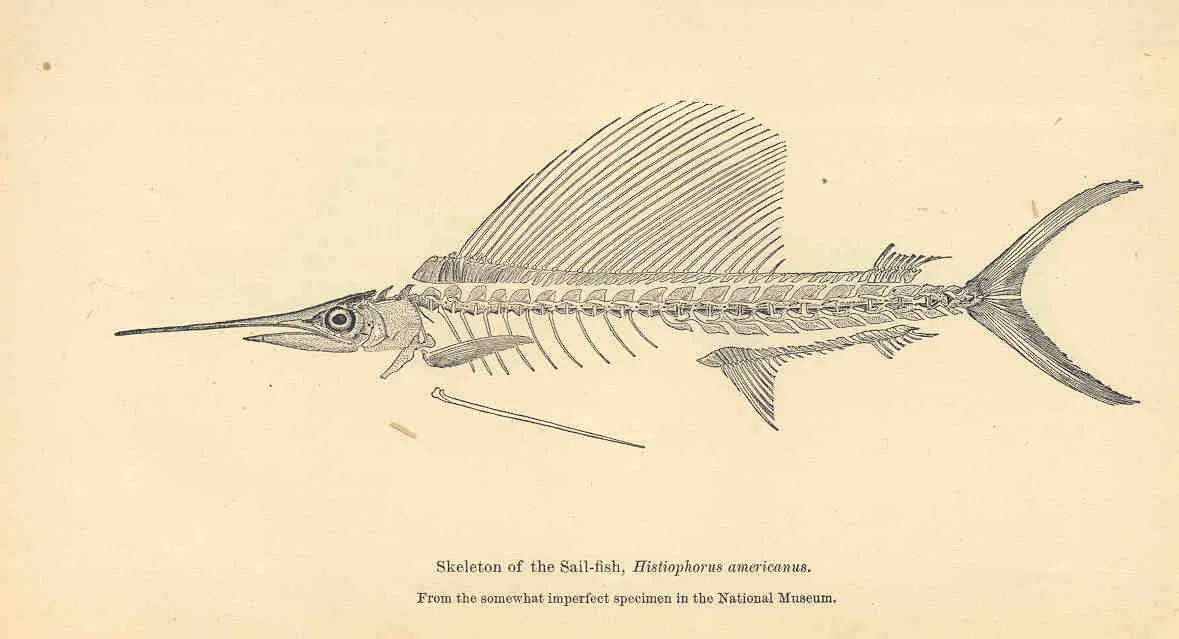
Most fish have bones. A bass, a catfish or a trout has a skull, a backbone, ribs and a row of small bones hidden in its muscle. Sharks, rays and chimaeras are built from cartilage instead, the bendy stuff in your ear and the tip of your nose. Two strange groups, hagfish and lampreys, have no jaws at all.
Sixteen kinds of Antarctic icefish have no red blood. They lost the genes for hemoglobin about 8.5 million years ago, and their plasma carries about a tenth of the oxygen a red-blooded cousin moves.
Which fish have bones, and which have cartilage?
Fish come in three groups. The bony fishes are the huge majority of the 37,772 species in Eschmeyer’s Catalog of Fishes: every bass, trout, perch, catfish and carp you will ever catch. Their skeleton is true bone, the same material as yours.
The cartilaginous fishes are the sharks, rays, skates and chimaeras, about 1,200 species, around 520 of them sharks. Their skeleton is cartilage from nose to tail, lighter and bendier than bone.
The jawless fishes are the odd ones out: hagfish and lampreys. A lamprey has a round sucker mouth with rasping teeth and no jaw.
| Bony fish | Cartilaginous fish | Jawless fish | |
|---|---|---|---|
| Skeleton | True bone: skull, backbone, ribs, fin supports and pin bones in the muscle | Cartilage throughout; the teeth and skin are hard, the frame is not | Cartilage; a flexible rod in place of a jointed backbone |
| Species | The great majority of 37,772 | About 1,200, of which about 520 sharks | A small group |
| Jaws | Yes | Yes | None; a round sucker mouth |
| Swim bladder | Most have one | None; an oil-filled liver does part of the job | — |
| Heart | Two chambers, one loop (heart, gills, body) | Two chambers, one loop | Two chambers, one loop |
| Blood | Red with hemoglobin, except 16 clear-blooded Antarctic icefish | Red with hemoglobin | Red with hemoglobin |
| Examples | Largemouth bass, channel catfish, rainbow trout, northern pike | Great white shark, stingray, skate, ghost shark | Sea lamprey, hagfish |
What is a fish skeleton made of?
A bass skeleton is bone in the full sense, the same hard tissue as a human skeleton, with one odd difference. In the more advanced bony fishes the bone has no living cells inside it. This acellular bone is found in zebrafish, billfishes and parts of the salmon and trout skeleton. Human bone is riddled with cells that keep rebuilding it; a sailfish’s is closer to a solid cast. The frame can be thin and light because the water carries the fish. The bones only brace the muscle and anchor the fins.
Holding depth is the job of the gas-filled swim bladder above the gut, not of the bones. The bladder is why a bass pulled up fast from 30 ft (9 m) comes to the surface bloated.
Sharks solve the same problem the other way round. They lack true bone, and a cartilage skeleton is much lighter. They have no swim bladder, so a large liver full of low-density oil offsets the weight, and some, the sand tiger among them, gulp air into the stomach for extra lift.
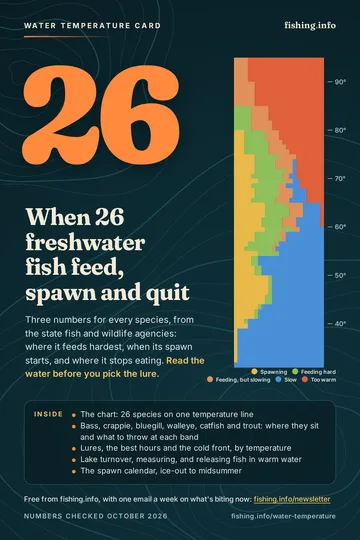
Free card: what 26 species do at your water temperature
Plus one email a week on what's biting now. No sales pitches. Privacy.
Why do fish have so many bones?
Skull, backbone, ribs and fin supports are only the start. Then come the ones every angler meets at the fillet board: the pin bones.
Pin bones are thin bones that sit inside the muscle. They are not part of the backbone and they are not ribs. Biologists call them intermuscular bones, because they form in the sheets of connective tissue between the muscle blocks. Run a fingertip along a trout fillet from the head end and you feel them as a row of tiny points. In a northern pike they are forked, so anglers call them Y-bones. That row runs along the upper half of the fillet, above the lateral line.
Why does a fish grow bones in its meat at all? They are stiffeners. A fish swims by bending its whole body, and the pin bones brace the muscle blocks so the push goes into the tail instead of into a wobble. They harden where the swimming load falls: from the head back in an eel, from the tail forward in a zebrafish.
That also explains which fish are bony. A count of the intermuscular bones in dozens of carp relatives found a tight link with the number of vertebrae: the longer the backbone, the more pin bones along it. By that rule a pike, an eel or a herring, all long fish, carries far more of them than a stubby bass. In the perch-like fishes, the group that holds bass, walleye and crappie, the same study found the bones have disappeared altogether in some lines.
Which fish are the boniest?
Counts from X-rays, dissections and CT scans, not from the kitchen; they vary from fish to fish, but the ranking holds.
| Fish | Bones in the meat | How many | Where they sit |
|---|---|---|---|
| Carp family (common carp, grass carp and relatives) | Intermuscular bones | 73 to 169 per fish; most carp relatives average 88 to 126 (Yang 2019) | Mostly the rear half of the body |
| Farmed Atlantic salmon | Pin bones | About 29 per fillet, 0.8 to 0.9 mm (about 1/32 in) thick (SINTEF 2012) | Front half of the fillet, above the ribs |
| Cod | Pin bones | About 13 per fillet (SINTEF 2012) | Front half of the fillet |
| Haddock, saithe | Pin bones | About 7 per fillet (SINTEF 2012) | Front half of the fillet |
| Northern pike | Y-bones (forked) | “No more bones than other fish,” only forked ones (Alaska Fish and Game) | Above the ribs from head to dorsal fin; none from the dorsal fin back |
| Bass, walleye, crappie, perch | None to speak of | Lost in some perch-like fishes (Yang 2019) | Ribs only |
The pike row is the one worth repeating. A pike does not have more bones than other fish, only forked ones, “giving them a multi-boned appearance,” as Alaska Fish and Game puts it.
How do you get a fillet without bones?
Species, size and the cut decide whether a fillet comes out clean.
Species first. A bass, crappie, walleye or perch fillet lifted off the ribs is done; there is no second row to find. A channel catfish fillet comes off the flank the same way, one reason it is the first fish so many kids eat. A trout, salmon, carp or pike fillet carries a row of bones the rib cut does not touch.
Size next. A 30-inch (76 cm) pike has the same bones as a 16-inch (41 cm) one, only larger. Big pin bones are easy to feel and pull, and a thick fillet leaves room to run the knife over the Y-bones. In a small fish the same bones are hair-thin with barely any meat around them, which is why small trout are cooked whole and eaten around the bones.
Then the cut. For salmon and trout, find the row with a fingertip and pull each bone toward the head with pliers. For pike, both methods are on are northern pike good to eat: the five-fillet cut that takes the fish apart around the Y-bones, and the strip cut that lifts the row out of a normal fillet. The northern pike page has the fish itself, jaw to tail.
How do the stones in a fish’s skull tell its age?
The bones that tell a fish’s story are ones you will never eat. Deep in the skull, every bony fish carries three pairs of otoliths, ear stones of calcium carbonate used for balance and hearing. Sharks and rays have none. How they work as ears is on do fish hear. To a biologist they are a calendar.
An otolith grows by adding layers. A wide, cloudy layer forms while the fish feeds hard in summer; a narrow, glassy layer forms in the lean months. The pair is one year, an annulus, and a fish with two annuli is two years old. The stone is sliced through its core and read under a microscope at 6 to 40 times, exactly like the rings of a tree stump. NOAA’s Alaska laboratory reads more than 30,000 otoliths a year and has collected over 1.1 million.
This is where slot limits come from. The record Lake Erie smallmouth, 10.15 lb (4.6 kg), was aged at 16 years from its otoliths, and the growth figures on the smallmouth bass page rest on stones like it. A fish worth photographing is often a decade old.
You may have found one without knowing it. The white, polished “lucky stones” picked up on beaches where drum live are freshwater drum otoliths. In drum they are larger and more pronounced than in other fish.
Do fish have hearts?
Yes. A fish heart has two chambers, one atrium that collects the blood and one ventricle that pumps it. It sits low in the body, just behind the gills, under the throat. Yours has four chambers, and the difference is in the plumbing. Your blood makes two loops, heart to lungs and back, then heart to body and back. A fish’s blood makes one loop: heart to gills, where it picks up oxygen, then on around the body. One push per trip. A resting fish slows that heart and its gill beats together, one sign of a sleeping fish (do fish sleep? has the rest).
That single loop is why a gill-hooked fish bleeds so hard. Every drop of blood in the fish crosses the gills right after the heart, spread through thin red filaments that sit against the water. A hook that tears those filaments opens the main line, and the heart keeps pumping through the tear. A fish bleeding freely from the gills rarely survives release. If it is legal to keep, that is the one for the cooler.
Do fish have blood?
Yes, and it is red for the same reason yours is: hemoglobin, the iron-rich protein that carries oxygen.
The exception is the family in the pull quote: sixteen species of Antarctic icefish with no hemoglobin at all. They survive because they live slowly in near-freezing water and grew bigger hearts and more blood to push the little oxygen they have around. It helps that cold water is rich in oxygen. Fresh water at 32 °F (0 °C) holds 14.6 mg of oxygen per liter, twice the 7.3 mg/L at 90 °F (32 °C).
How do you bleed a fish you keep?
Cooks and commercial fishermen bleed fish because blood left in the meat darkens the fillet and gives it a stronger taste. The single-loop heart does the work: open the gills and it pumps the blood out.
- Decide first. A bled fish is a kept fish. Check that it is in season and over the size limit before the knife comes out.
- Do it at once, while the heart is beating. The heart is the pump. Wait until the fish is dead and most of the blood stays in the meat.
- Lift the gill cover and cut the red gill arches. One clean cut across the arches on each side with the knife tip.
- Put the fish head-down in a bucket of water. The blood runs out instead of clotting in the gills. A few minutes is enough; the flow stops on its own.
- Straight onto ice. A cooler with ice or an ice-and-water slush, never the warm livewell.
- Fillet, then find the pin bones. Run a fingertip along the fillet and pull each bone with clean pliers, or cut the row out in one strip.
What else do kids ask?
Do sharks have bones? No. The Florida Museum’s answer is one word, then the explanation: a shark’s skeleton is cartilage, “strong enough to give support but softer than true bone.” Its hard parts are its teeth and its skin.
Do fish have teeth? Nearly all of them, some on the tongue and in the throat. Which fish you can hold by the lip and which need a leader is on do fish have teeth.
Do fish have brains? Yes, about one-fifteenth the weight of a bird’s or mammal’s brain at the same body size. Do fish have brains? covers memory and how a caught fish learns.
More questions with answers in the fish facts collection, and the build of each game fish, from jaw to tail, in the species guides.
Free download
The water temperature card
Read your water temperature and the card tells you who is spawning, who is feeding and what to throw. 26 species, 16 pages, for your phone and the tackle box.
Plus one email a week on what's biting now. No sales pitches. Privacy.
Related
Section guide
Fish Facts: The Questions Kids Ask About Fish, Answered With the ScienceFish facts with a number and a source for each: how fish sleep, breathe, hear and feel, and what every answer means when you hook and release one.
 Do Fish Drink Water? Freshwater Fish, Saltwater Fish and Sharks
Do fish drink water? Freshwater fish barely do, saltwater fish drink all day, sharks cheat with urea. The numbers, and what it means for bait and livewells.
 Do Fish Drown? How Fish Suffocate, and How to Revive a Tired One
Do fish drown? Not by the dictionary, but they suffocate three ways: low oxygen, damaged gills, no water flow. How long a fish lasts in air, how to revive one.
 Do Fish Fart? Yes, Herring Do It on Purpose, and a Bloated Bass Needs Help
Do fish fart? Herring do, on purpose, and scientists won a prize for proving it. Which fish pass gas, where it goes, and what to do with a bloated bass.
 Do Fish Feel Pain? What the Studies Found, and What Decides Whether a Released Fish Lives
Do fish feel pain? They sense damage and react; whether they suffer is contested. The trout study, both camps, and what decides if a released fish lives.
 Do Fish Get Cold? What Winter Does to a Fish, and the Ones With Antifreeze in Their Blood
Do fish get cold? Yes: a fish is as cold as its water and feels it as slowness. What fish do in winter, who carries antifreeze, and how to fish cold water.
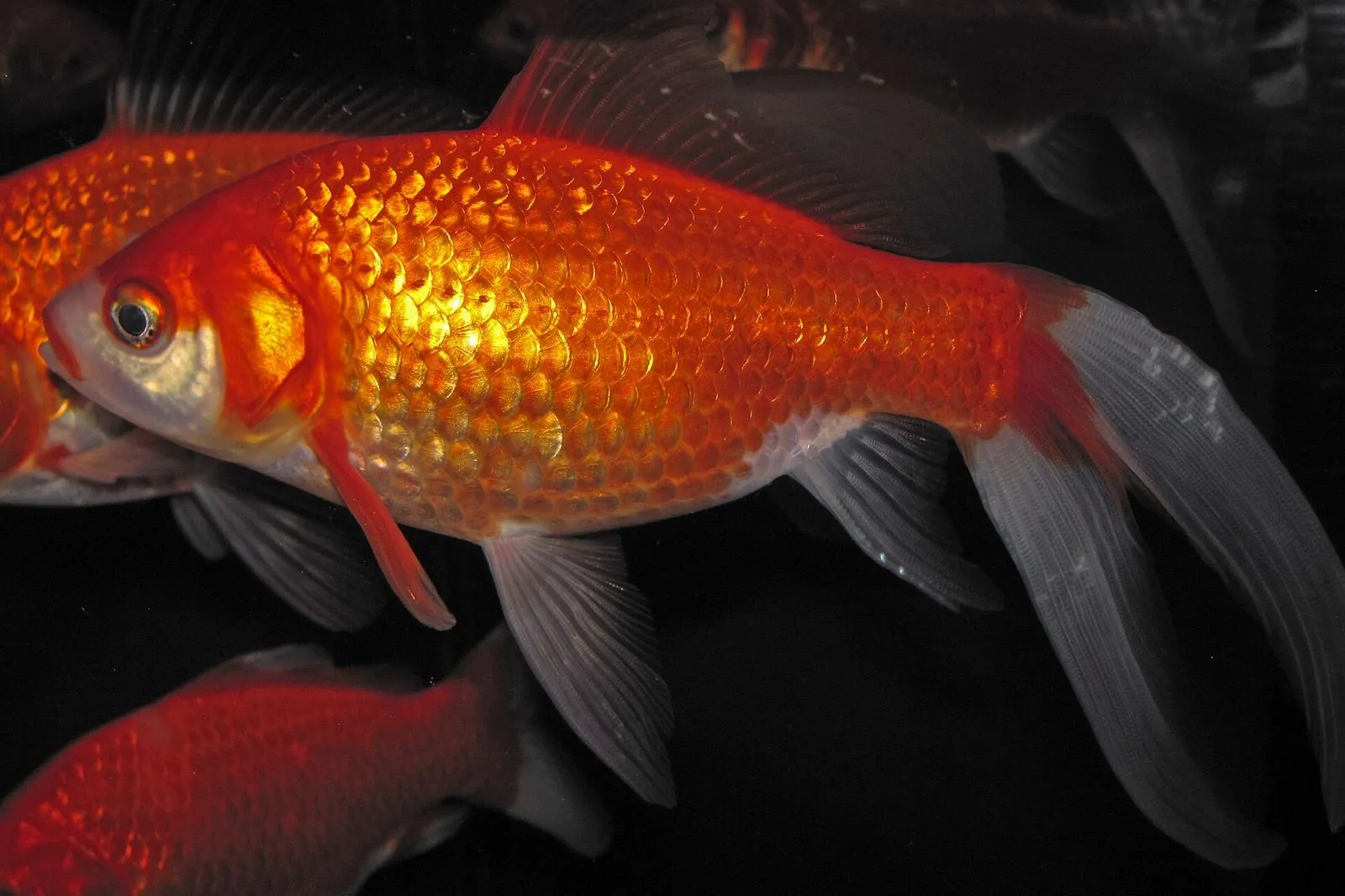 Do Fish Have Brains? Memory, Learning, and Why the 3-Second Myth Is Wrong
Do fish have brains? Yes: a full brain, no neocortex, a memory that lasts months. What goldfish, carp and pike learned, and what it means at the water.
Sources
- Australian Museum, Fish bones (citing Helfman, Collette and Facey 1997)
- Eschmeyer's Catalog of Fishes, California Academy of Sciences, species by family (online version, updated 21 September 2026): 37,772 valid species
- Florida Museum of Natural History, Sharks FAQ (about 520 shark species, about 1,200 cartilaginous fishes, no bones)
- Florida Museum of Natural History, Shark biology (cartilage skeleton, oily liver, no swim bladder, sand tigers gulping air)
- Yang et al. (2019), Evolution of the intermuscular bones in the Cyprinidae from a phylogenetic perspective, Ecology and Evolution 9(15)
- Yao et al. (2015), Different ossification patterns of intermuscular bones in fish with different swimming modes, Biology Open 4(12)
- Weigele and Franz-Odendaal (2016), Functional bone histology of zebrafish, Journal of Anatomy 229(1): cellular and acellular bone in teleosts
- Bakken, Schulerud and Thielemann (2012), Apricot anatomy: measures of pinbones in fish fillets using CT, SINTEF report A23581
- Alaska Department of Fish and Game, Northern pike handout (2013): the Y-bones and the five-fillet method
- NOAA Fisheries, Age and growth: how otoliths are read
- North Dakota Game and Fish, Freshwater drum (the 'lucky stones' are otoliths)
- OpenStax Biology 2e, Overview of the circulatory system (the two-chambered fish heart)
- Sidell and O'Brien (2006), When bad things happen to good fish: the loss of hemoglobin and myoglobin expression in Antarctic icefishes, Journal of Experimental Biology
- USGS Water Science School, Dissolved oxygen and water (oxygen by temperature)
- Relative brain size in fishes, Brain, Behavior and Evolution (2021)