 By
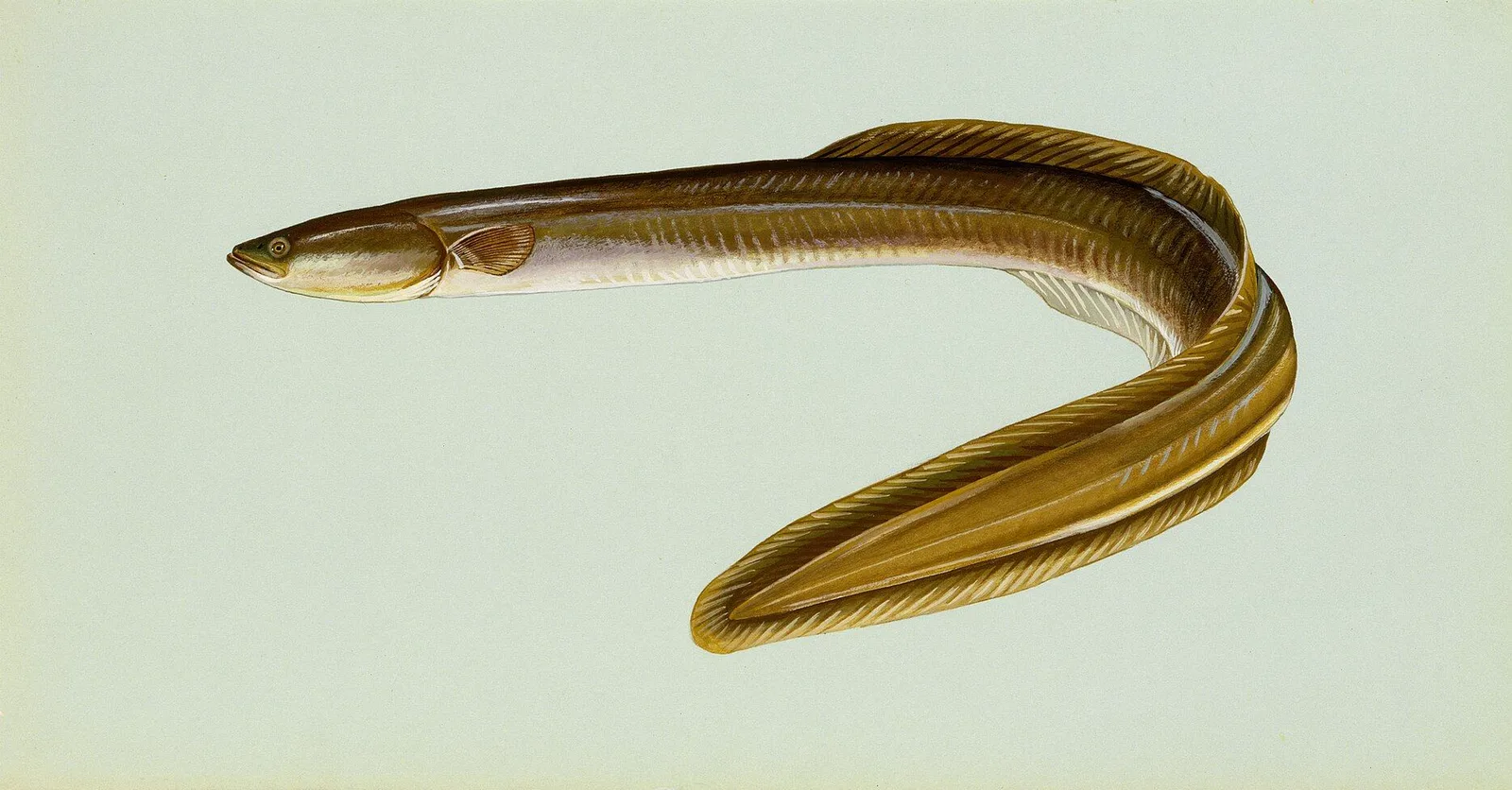
The American eel is the only freshwater eel in North America, a snake-shaped fish that can reach 9 lb and 4 ft (1.2 m). To catch one, fish after dark with a whole nightcrawler on a No. 4 hook, right on the bottom near deep, quiet water. Most East Coast states let you keep eels of 9 in (23 cm) or longer, up to 25 a day. A few waters are closed or bait-only, so check the table below before you keep one.
Every American eel you’ll ever hook was hatched in the Sargasso Sea, in the middle of the Atlantic. Nobody has ever watched one spawn.
What is an American eel, and is it a fish?
Yes, it’s a fish, with jaws, fins and gills, and it’s not a snake or a worm. Three things give it away.
- One long fin. It starts far down the back, wraps around the tail and runs back up the belly.
- Two small fins behind the head. Those are the pectoral fins, and they’re the only paired fins it has. There are no pelvic fins.
- A real jaw and slick skin. The scales are tiny and buried in slime, so the skin feels smooth.
Color runs olive-green to brown on top, fading to pale yellow or white underneath. If it’s over 2 ft, it’s a female. Males top out at about 1.5 to 2 ft (46–61 cm).
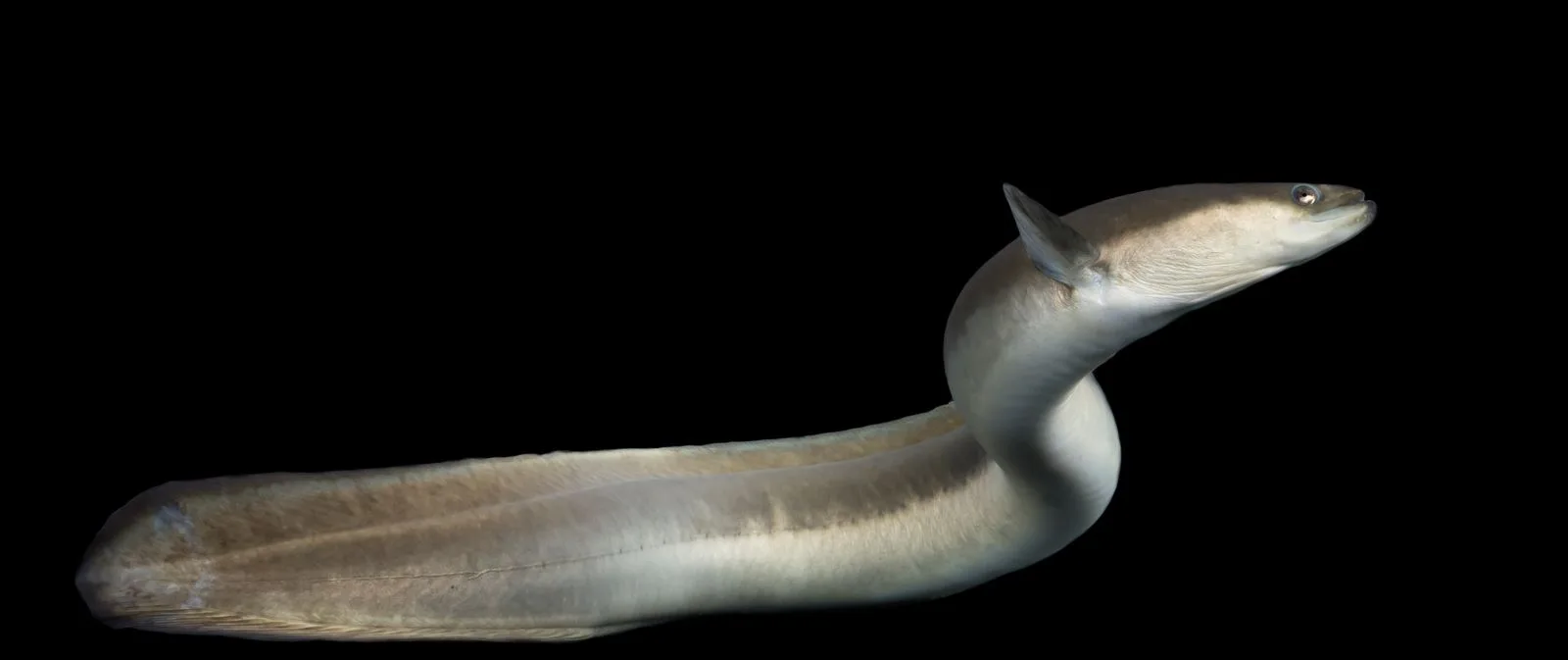
An adult American eel. Photo: Sam Stukel, U.S. Fish and Wildlife Service (public domain)
The fish it gets mixed up with are easy to rule out once you check the mouth.
| Fish | The giveaway | Where you’d meet it |
|---|---|---|
| American eel | Hinged jaw, pectoral fins, one fin wrapped around the tail | Rivers, lakes, ponds and estuaries |
| Sea lamprey | No jaw, a round sucker mouth, two back fins, no pectoral fins, seven gill holes a side | The Great Lakes and coastal rivers |
| Conger eel | Back fin starts close to the end of the pectoral fin, upper jaw sticks out past the lower | Salt water only |
| Burbot | One whisker on the chin, two back fins | Cold lakes and big cold rivers |
Minnesota anglers call the burbot an eelpout, but it’s a relative of the cod and no eel at all.
Where do you find American eels?
Almost anywhere water connects to the Atlantic or the Gulf, as long as a dam hasn’t cut the fish off. They live from Greenland to Venezuela, along the Gulf Coast, up the Mississippi and its tributaries, and in inland lakes such as Champlain and Ontario. Outdoor Life counts 36 U.S. states, mostly east of the Rockies.
Females travel far inland. Males mostly stay in brackish water near the coast. So the big eel in a river a long way from the ocean is a female.
Dams are the limit. Alabama finds fewer eels with each dam you move upstream, and its best numbers are in the Mobile Delta. Texas says dams have wiped eels out of most of the central and western parts of the state. In Missouri an eel is an uncommon catch that “probably occurs occasionally in every large stream in the state”, mostly in deep pools around logs and boulders.
By day eels hide: under rocks and logs, among snags, or down in the mud and silt. After dark they come out to eat. That one habit tells you where to put your bait.

Free PDF · Water temperature chart Which fish are biting at today's water temperature?
One reading, and the 16-page chart shows which of 26 fish are spawning, feeding hard or slowing down; for bass, crappie, bluegill and walleye, where they sit and what to throw. Every number sourced.
No card, nothing to buy, and the PDF is yours to keep. Confirm with one click and it's on its way. Then a few short emails and one a week on what's biting. Unsubscribe anytime. Privacy.
What do American eels eat?
Worms, insects, crayfish, crabs and small fish, mostly at night. Frogs too, and dead things when they turn up, though Vermont says carrion rarely shows up in their stomachs. That’s why a nightcrawler or a chunk of cut bait works: it’s food they find on the bottom every night, and you don’t need anything fancier.
Where to cast, by the water you’re on
| Water | Where the bait goes | When or what |
|---|---|---|
| Pond, lake or slough | A shallow flat right next to deep water | After dark |
| River | The riffle at the head of a deep hole, or a quiet backwater beside one | After dark |
| Big snags | Deep holes with fallen trees, off riverbanks and in lake coves | Hot, humid summer nights, for the biggest eels |
| Muddy river | Slow water | Daytime, when the river runs high and muddy |
| Below a dam | Where moving eels pile up against the dam | They feed on dead and injured baitfish there |
Fish from late spring to early fall. By autumn the adults that are ready to leave turn silver, head for the ocean and stop eating, so a worm won’t interest them.
How do you catch an American eel?
Fish the bottom at night with a stinky bait and a strong small hook. You probably own the tackle already.
- Rod and line. Use your catfish or panfish spinning rod, anywhere from 6 to 11 ft in medium power. Spool 10 lb mono that stands up to scrapes.
- Hook. Tie on a No. 4 or No. 2 long-shank or baitholder hook, the sizes two good guides agree on (the hook size chart shows them). Skip the light wire. In-Fisherman says even small eels can straighten an Aberdeen hook.
- Weight. A couple of split shot is enough in slow water. In current, use the same slip-sinker rig you’d use for catfish.
- Bait. Start with a whole nightcrawler. Eels hunt by smell, so your second choice is a chunk of herring or shiner, or chicken liver. Skipjack bait works too: that’s what Missouri’s state record took.
- Rod tip. Put a flashlight beam on it. Eels poke at a bait first, and you’ll see small taps.
- Set the hook. Guides split on this. FishingBooker says wait, or “they’ll drop the bait.” In-Fisherman says set it right away, because eels nibble and then swallow the hook fast. We’d go with In-Fisherman. An eel under 9 in has to go back, and a hook in its gut makes that a lot harder.
If you plan to let them all go, use a circle hook in size 2 to 1/0, which FishingBooker recommends to keep hooks out of the gut. The catch and release guide covers the rest.
Once it’s on the bank, an eel is hard to hold. Dip your hand in the water, then press your palm into dry sand. The grit gives you a grip through the slime.
Eels are also a bait themselves. Delaware’s agency says eels are mostly sold live for bait and exported as food. A live eel is a classic night bait for striped bass.
How big do American eels get?
Eels commonly run 30 to 40 in (76–102 cm), on Vermont’s numbers, and one that long is a female. The federal profile puts the top at 4 ft (1.2 m) and 9 lb, and Vermont has reports of 60 in (1.5 m). The IGFA world record is a shade over that weight, and the state records show how these fish really get caught: by people fishing for something else.
| Where | Record | Caught on |
|---|---|---|
| World (IGFA) | 9 lb 4 oz (4.21 kg), Cape May, New Jersey, 1995 | Not reported |
| Missouri | 6 lb 15 oz (3.1 kg), Current River, 2021 | Skipjack bait, fishing for catfish |
| New Jersey, fresh water | 6 lb 13 oz (3.1 kg), Round Valley Reservoir, 2005 | Live shiner, casting from shore for trout |
| Texas | 6.45 lb (2.9 kg), 42 in (1.07 m) | Not reported |
| Vermont | 6.2 lb (2.8 kg), about 45 in (1.14 m) | Not reported |
Missouri’s angler, Carlin Allison, “originally thought I was pulling in a catfish.” Texas says most eels there are caught by anglers after something else. New Jersey’s date is from the 2005 announcement, so check the current list if you’re chasing it.
Can you keep American eels? The rules by state
On most of the East Coast, yes, if it’s 9 in (23 cm) or longer and you’re at 25 a day or fewer. That’s the baseline the Atlantic States Marine Fisheries Commission set. The commission’s plan also allows a captain and crew 50 a day, and Virginia writes that in for charter boats and head boats. Your own state’s book is the one that counts, and it can change. Here’s what the agencies print:
| Where | The rule, in the agency’s words |
|---|---|
| New York, statewide | American Eel, All year, 9”, 25 |
| New York, tidal Hudson (Battery to Troy Dam and tributaries to the first barrier) | American Eel (for bait only), All year, Minimum Length-9”-14”, Daily Limit-25. (Note: No eels may be possessed for food) |
| New York, lower Niagara River, Lake Ontario, St. Lawrence River and tributaries | American Eel: Closed. Possession prohibited |
| Pennsylvania, inland waters | American eel: Open year-round, 9 inches, 25 |
| Maryland | “A person may not catch or possess eels for noncommercial purposes which are less than 9 inches total length.” “A person may not catch or possess more than 25 eels per day for noncommercial purposes.” “Except by spear or baited traps or pots, eels may not be taken between September 1 and December 31.” |
| Virginia | “It shall be unlawful for any individual to take, catch, possess, or land any eels less than nine inches in total length.” Recreational gear, including hook and line and rod and reel: unlawful “to possess more than 25 eels per day” |
| Connecticut, marine waters | Minimum length: 9 inches. Daily creel limit: 25 fish per angler. Open Season: Open Year Round |
| Vermont | “This species does not have a minimum length or daily limit.” |
Read Maryland’s line twice. The fall closure only excepts spears and baited traps or pots, and a rod and reel isn’t on that list. New York’s Hudson rule has a catch too. You can keep eels there for bait, and the length column reads 9 to 14 in. You can’t take one home to eat.
Young eels are off limits nearly everywhere. Only Maine and South Carolina have a fishery for glass eels, and it’s commercial and tightly controlled.
Are American eels good to eat?
Yes, if the water’s clean, and if you don’t mind the bones. Texas Parks and Wildlife calls eels “exceptionally good fish,” slime and all. Florida’s agency calls the eel bony by American standards but good smoked. It’s a prized fish in Asian markets and shows up in sushi.
Skin it first. Here’s In-Fisherman’s method:
- Wrap a stout cord around the neck, just behind the gills.
- Cut a ring through the skin just below the cord, without cutting deep into the meat.
- Grip the edge of the skin with pliers and peel it down to the tail.
- Cut off the head and fins, and take out the guts.
Then bake, fry or smoke it. Outdoor Life’s cook fried thick chunks in bacon grease in a cast-iron skillet and picked the meat off the thin bones.
Cook it all the way through. Eel blood is poisonous, and cooking destroys the toxin. Check your state’s fish advice before you eat one, too. On the tidal Hudson, New York won’t let you keep an eel for food at all.
American eel life cycle: born at sea, raised in your river
An eel is catadromous, which means it lives in fresh or brackish water and goes to the ocean to spawn. That’s the reverse of a salmon. Every eel from Venezuela to Greenland breeds in the same place, the Sargasso Sea, 2 million square miles of warm Atlantic between the West Indies and the Azores. Spawning happens in winter, it has never been observed, and the adults die afterward. A big female can carry millions of eggs.
| Stage | What it looks like, and where | What it means for you |
|---|---|---|
| Larva | Clear and leaf-shaped, 2.5–4 in (6–10 cm), drifting on ocean currents for up to a year | You’ll never see one |
| Glass eel | Clear, with fins, 2–3 in (5–8 cm), reaching the coast (January to May in Delaware) | A commercial fishery in Maine and South Carolina only |
| Elver | Brown, about 2.4 in (6 cm), swimming up rivers | Far too small to keep |
| Yellow eel | Yellow-brown, in fresh or brackish water for years, about 10 to 15 of them in Vermont | This is the eel you catch |
| Silver eel | Mature, heading to sea in autumn and done eating | Don’t count on bait |
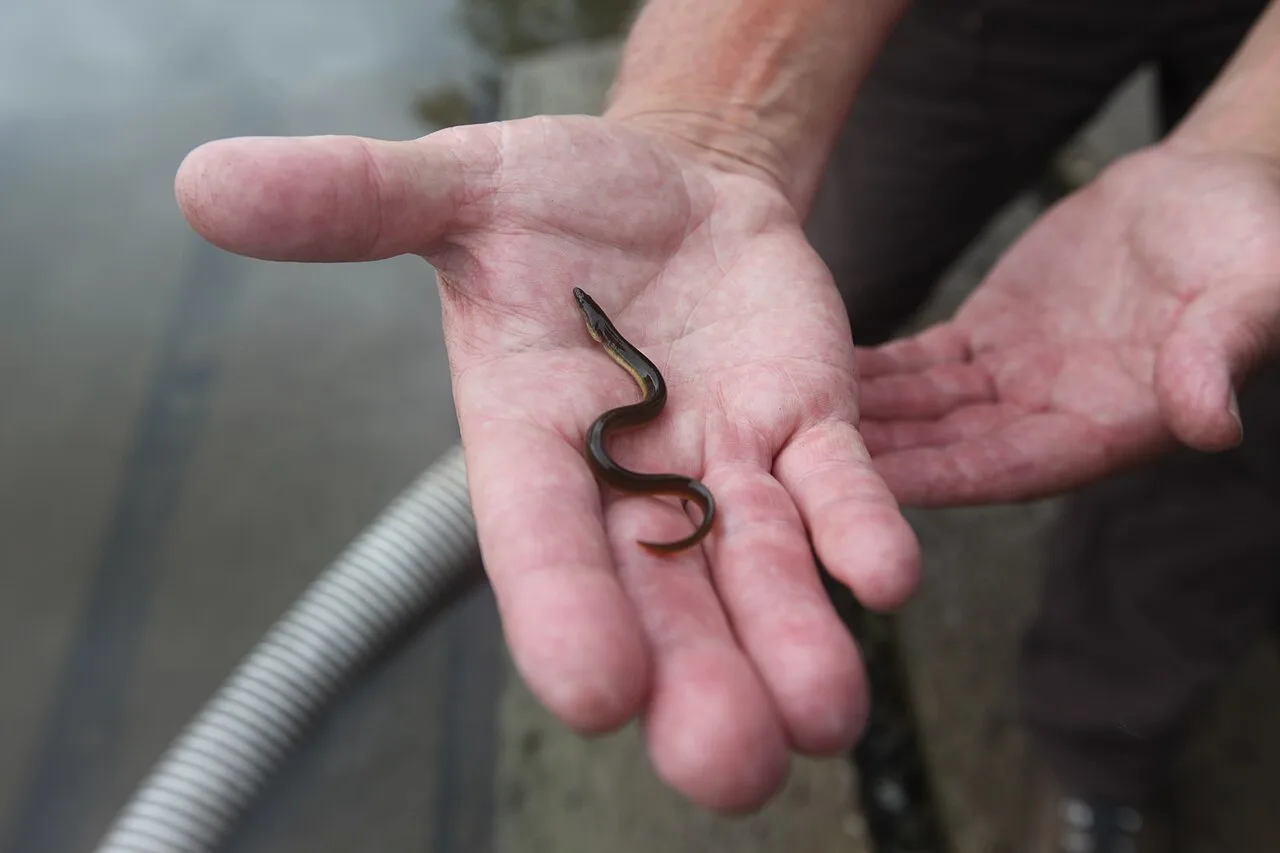
A juvenile American eel about to be released upstream of Conowingo Dam on the Susquehanna River. Photo: Greg Thompson, U.S. Fish and Wildlife Service (public domain)
An eel lives anywhere from 5 to more than 40 years, depending on whether it grows up in brackish or fresh water. On the way upstream it can “slide over rocks, dams, wet grass and other seemingly impassable blockages.” In-Fisherman says females will move overland around dams, and they climb fish ladders too.
Are American eels endangered?
They’re in trouble. The Atlantic States Marine Fisheries Commission puts it plainly: “The American eel population remains depleted in U.S. waters.” The IUCN lists the species as endangered. Canada looked at listing it and in December 2025 decided not to, citing stable numbers over the past two decades.
Dams are a big part of it, and hydro turbines kill young eels. It’s a long way down from the days when eels made up more than a quarter of the fish in many Atlantic coastal streams.
The baby eels are worth a fortune, and that draws crime. In 2019 glass eels fetched $3,000 a pound in Maine, up from $100 ten years earlier. A federal investigation called Operation Broken Glass, finished in 2014, led to more than 20 people being indicted along the East Coast for poaching them.
Keep what the rules allow and let the rest go. For the other strange fish outside the big families, try the other freshwater fish guide.

Free PDF · 16 pages
Stop guessing. Know what's biting before your first cast
A whole Saturday on the water with nothing to show for it. One reading tells you who's feeding.
The Water Temperature Fishing Chart. Take one water temperature reading, find it on the chart, and see which of 26 freshwater fish are spawning, feeding hard or slowing down.
- Where bass, crappie, bluegill and walleye sit, and what to throw. Trout: the reading where you stop.
- Why a 3 ft drop beats a cold front, and what to throw each day of the front
- The three thermometer mistakes that make a reading lie
The chart's numbers come from state fish and wildlife agencies and fisheries research: 61 sources, each listed on the site.
No card, nothing to buy. Confirm with one click and the PDF is on its way, one version for your phone and one to print, yours to keep. Then a few short emails and one a week on what's biting, with an unsubscribe link in every one. Privacy.
Related
Section guide
Freshwater Fish Species Outside the Big Families: Sturgeon, Gar, Bowfin, BurbotThe freshwater fish species outside the bass, trout, catfish and pike families: sturgeon, gar, bowfin, burbot, drum, eel and paddlefish, with records.
 Pacu Fish: Human-Like Teeth, and How to Tell One From a Piranha
A pacu fish is a piranha cousin with flat teeth like human molars. How to tell it from a piranha, how big it gets, and what to do if you catch one.
 Mooneye and Goldeye: How to Tell Them Apart and Catch Them
A mooneye is a silvery, big-eyed river fish with teeth on its tongue. How to tell it from a goldeye, where both live, how to catch them, and how they eat.
 Round Goby: How to Identify It, Why It Matters, and the Bait Rules
The round goby is a small invasive bottom fish of the Great Lakes. How to ID one, what each state says about goby bait, and why smallmouth love them.
 Alewife: How to Identify It, Where It Runs and Why Anglers Care
The alewife is a small silver herring: sea-run on the Atlantic, landlocked in the Great Lakes. How to ID one, where it runs, and where you can keep it.
 Candiru: The Amazon's Vampire Catfish and the Urethra Myth
The candiru is a tiny see-through Amazon catfish that drinks blood from fish gills. What it really does, its size, and the urethra story checked.
 Fathead Minnows: ID, Bait, Pond Stocking and Rosy Reds
Fathead minnows are tough 2 to 3 in baitfish. How to identify them, keep them alive in a bucket, stock a pond by the pound, and spot a rosy red.
Sources (30)
- U.S. Fish & Wildlife Service, American eel (Anguilla rostrata)
- International Game Fish Association, World record search: Eel, American, all-tackle (member-portal API, read 2026-11-09)
- In-Fisherman (2012), Catching and preparing American eels
- Nick Honachefsky, How to catch (and eat) eels, Outdoor Life (2017)
- FishingBooker, How to go eel fishing: the complete guide for 2026
Show all 30 sourcesShow fewer sources
- New York State DEC, Statewide seasons, sizes and catch limits (effective April 1, 2026)
- New York State DEC, Tidal Hudson River special regulations
- New York State DEC, Great Lakes and tributaries regulations
- 58 Pa. Code § 61.1, Commonwealth inland waters
- Code of Maryland Regulations 08.02.05.08, Eels
- Virginia Administrative Code 4VAC20-500-35, Minimum size limit
- Virginia Administrative Code 4VAC20-500-55, Possession limit
- Connecticut DEEP, Saltwater fishing guide: species regulations
- Vermont Fish and Wildlife, American eel
- Atlantic States Marine Fisheries Commission, American eel
- Atlantic States Marine Fisheries Commission, American Eel Board presentations (October 2025)
- Florida Fish and Wildlife Conservation Commission, American eel
- Missouri Department of Conservation (2021), Ripley County angler swipes rare state-record American eel
- New Jersey Division of Fish and Wildlife (2005), New state-record American eel
- Texas Parks and Wildlife Department, American eel
- Outdoor Alabama, Freshwater eel
- Chesapeake Bay Program, Field guide: American eel
- Delaware DNREC, American eel
- Connecticut DEEP, Freshwater eels
- Ontario, Sea lamprey
- Columbia River Inter-Tribal Fish Commission, Differences between a lamprey and an eel
- National Park Service, Lowell National Historical Park: American eel
- Maryland Sea Grant, American eels: population, fishery, and poaching
- Wikipedia, American eel (IUCN status, Canadian listing decision, egg counts)
- Wikipedia, Eel as food (toxin in the blood)