 By
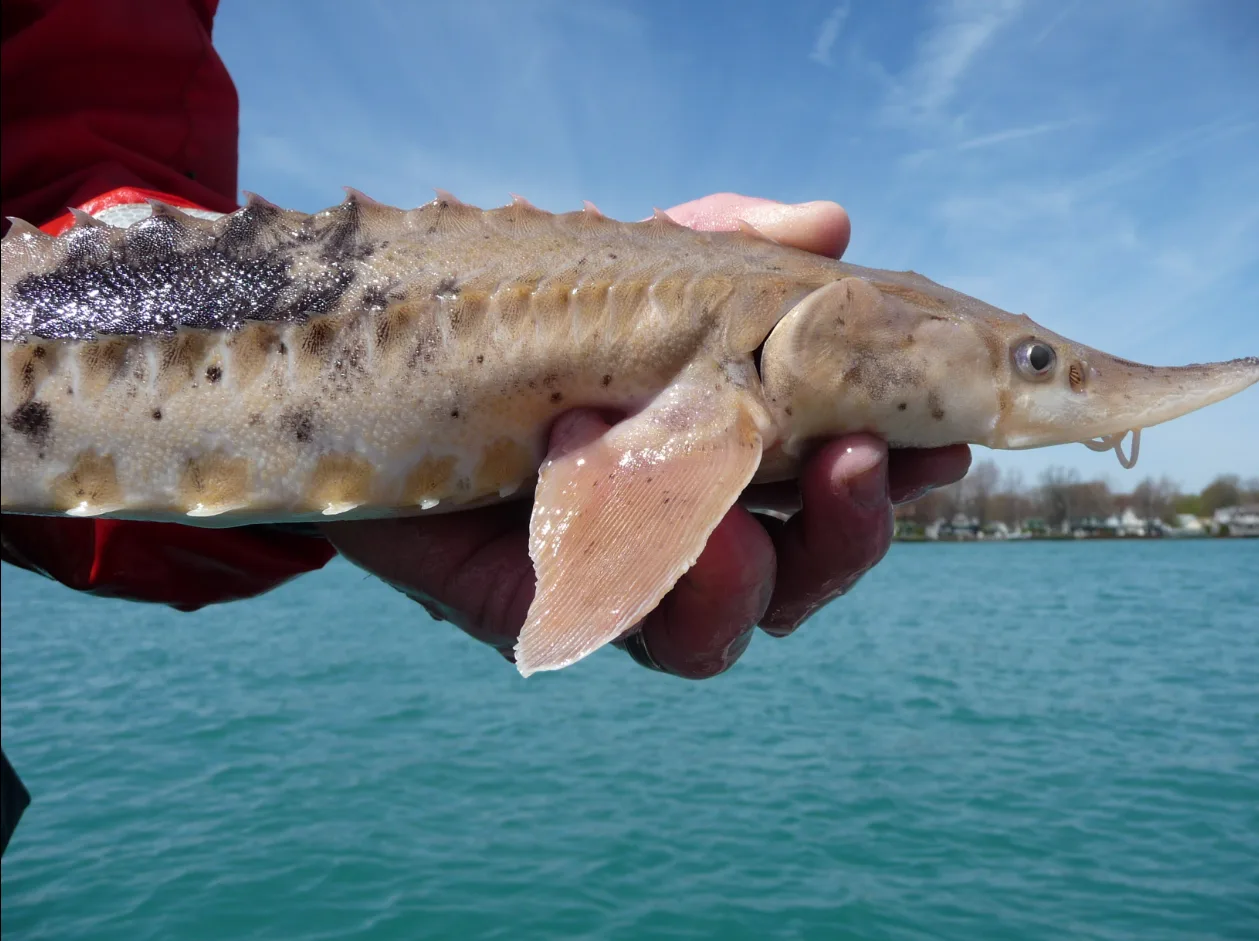
The lake sturgeon is one of the largest freshwater fish in North America, and an old one: the Fish and Wildlife Service traces its origins back at least 150 million years. Adults typically run 4 to 6 ft and 30 to 80 lb, and the biggest reach about 7 ft and 200 to 300 lb, according to the U.S. Fish and Wildlife Service. It lives in big lakes and rivers from Hudson Bay to the Mississippi basin, eats off the bottom with a toothless, vacuum mouth and grows for a century or more. Most states protect it, so for the angler the real questions are where you may fish for one and where you may keep one.
A 2026 study of 44 years of tag returns estimated that a 71 in (180 cm) female lake sturgeon could be 90 to 248 years old, depending on the population, and put the oldest male at 435. The oldest age ever counted on one is 152.
How do you identify a lake sturgeon?
Look at the snout first. Lake sturgeon “have short, rounded, conical snouts compared to the shovel-nosed look of our other sturgeon species,” the Missouri Department of Conservation writes, and the four barbels in front of the mouth are smooth, not fringed. The body carries five rows of bony plates called scutes, two on each side and one along the back, and they are sharp on young fish.
Color changes with age. Young lake sturgeon are mottled light and dark brown; adults turn a solid dark brown or slate gray with a white belly.
The look-alike that matters is the shovelnose sturgeon, which shares the Mississippi and Missouri rivers, and behind it the endangered pallid. Missouri’s field guides give the tests:
| Check | Lake sturgeon | Shovelnose sturgeon |
|---|---|---|
| Snout | Short, rounded, conical | Flat and shovel-shaped |
| Barbels | Smooth, not fringed | Fringed |
| Spiracle (small opening above and behind the eye) | Present | Absent |
| Lower lip | Two lobes | Four lobes |
A sturgeon on the Missouri or the Mississippi that you cannot name with confidence goes back; the sturgeon family page shows how to tell the shovelnose from the pallid. Among the other freshwater fish of the region, nothing else has the plates and the barbels together.
Where do lake sturgeon live?
In the Great Lakes and St. Lawrence, the Mississippi and the Hudson Bay basin, and in the Coosa River watershed of Alabama and Georgia. The Fish and Wildlife Service lists 24 states and five Canadian provinces, from Alberta to Quebec. “Contrary to its name, lake sturgeon can thrive in both lakes and rivers,” the agency notes, and in Missouri the fish is “almost always found in big rivers, not lakes.”
Two of the largest US populations are in Wisconsin and Minnesota. The Winnebago System, Lake Winnebago and the Upriver Lakes of Poygan, Winneconne and Butte des Morts, holds about 24,500 males and 16,200 adult females on the Wisconsin DNR’s five-year average. On the border with Ontario, the Rainy River “holds nearly 100,000 sturgeon 40 inches or longer,” Minnesota’s DNR writes. “Put head to tail, that is a string of fish more than 60 miles long.”
Lake sturgeon move a long way. Tagged fish have moved “300 miles or more” through connected waters. Stocking has brought them back to rivers they had vanished from. Among them are the Genesee in New York, the St. Louis between Minnesota and Wisconsin, the Red River of the North, the Middle Mississippi and the Coosa.
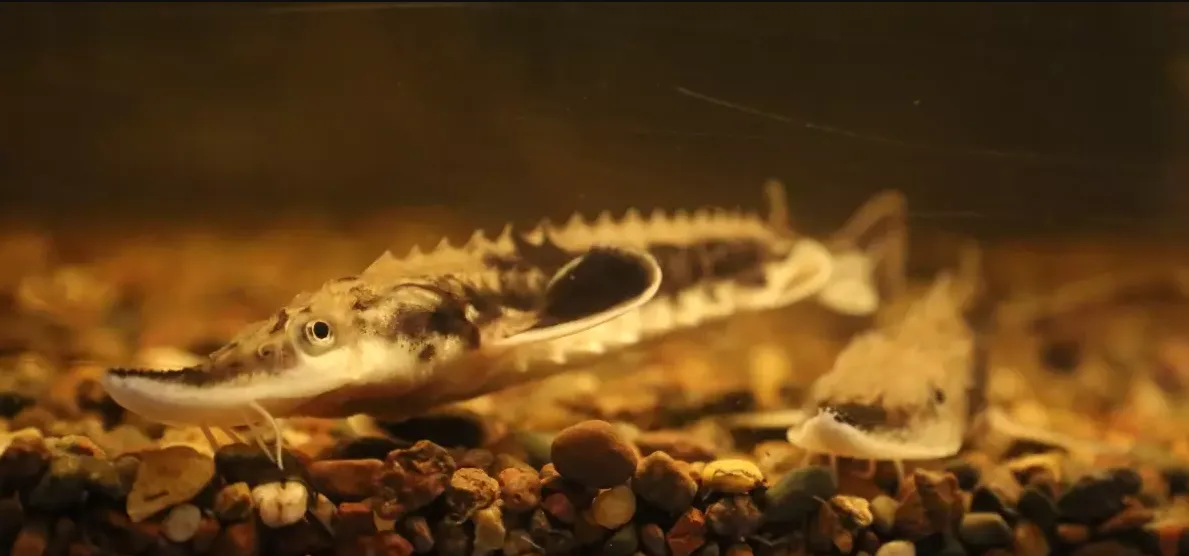
Young lake sturgeon in the aquarium at the Edenton National Fish Hatchery, North Carolina: mottled brown, with the sharp scutes of a small fish. Photo: Sonia L. Mumford, U.S. Fish and Wildlife Service (public domain)

Free PDF · Water temperature chart Which fish are biting at today's water temperature?
One reading, and the 16-page chart shows which of 26 fish are spawning, feeding hard or slowing down; for bass, crappie, bluegill and walleye, where they sit and what to throw. Every number sourced.
Enter your email, confirm it with one click, and the PDF is in your inbox. Plus one email a week on what's biting. Unsubscribe anytime. Privacy.
How big do lake sturgeon get?
Most adults run 4 to 6 ft and 30 to 80 lb. The largest reach about 7 ft and 200 to 300 lb. Missouri’s guide goes further: “to 8 feet” and “to 300 pounds.”
They grow slowly once they are adults. The Wisconsin DNR’s length-at-age figures:
| Age | Length |
|---|---|
| 1 year | 11 in (28 cm) |
| 5 years | 33 in (84 cm) |
| 10 years | 40 in (102 cm) |
| 15 years | 47 in (119 cm) |
| 20 years | 51 in (130 cm) |
| 25 years | 56 in (142 cm) |
By those figures a fish reaches the 36 in spearing minimum between 5 and 10 years old. One at the 60 in hook-and-line minimum is older than 25.
The spearing season gives a yearly check on real fish. In 2026 the average speared male on the Winnebago System was 54.9 in and the average female 60.6 in. The largest was a 148.9 lb, 75.4 in female from the Upriver Lakes.
The records show what the biggest ones weigh:
| Record | Weight | Length | Where and when |
|---|---|---|---|
| IGFA all-tackle | 168 lb (76.2 kg) | – | Georgian Bay, Ontario, May 29, 1982 (Edward Paszkowski) |
| Wisconsin, hook and line | 170 lb 10 oz (77.4 kg) | 79.0 in (201 cm) | Yellow Lake, Burnett County, September 22, 1979 |
| Wisconsin, other methods | 212 lb 3.2 oz (96.2 kg) | 84.25 in (214 cm) | Lake Winnebago, February 13, 2010 |
| Winnebago System, largest of 2026 | 148.9 lb (67.5 kg) | 75.4 in (192 cm) | Upriver Lakes, February 2026 |
Both Wisconsin state records outweigh the IGFA world record. Neither is in the IGFA’s books, which is why the world record still belongs to a Canadian fish of 1982. Wisconsin’s “other methods” list covers spear, bow, crossbow and hand.
How long do lake sturgeon live?
For a century or more. The Fish and Wildlife Service says the largest and oldest live to 150 years, while typical adults live 50 to 100. Minnesota’s DNR puts males at roughly 65 to 90 years and says females can live “over 150 years.” FishBase gives a maximum reported age of 152.
Those ages were counted from growth rings in a fin spine, and the rings become hard to read as a fish ages and its growth slows. A study published in the Journal of Fish Biology in 2026 tried another route. Edward Baker of the Michigan DNR and eight co-authors used 44 years of tag-and-recapture data from five Great Lakes populations to measure how slowly adults grow, then worked back to an age. Their estimate for a male of 160 cm (63 in) fork length ran from 87 to 215 years across the populations. For a female of 180 cm (71 in) it ran from 90 to 248 years. The oldest single estimate, a Black River male, came out at 435. The journal corrected the abstract’s age ranges in October 2026; these are the corrected figures. “Our data suggest Lake Sturgeon live much longer than currently believed,” the authors write.
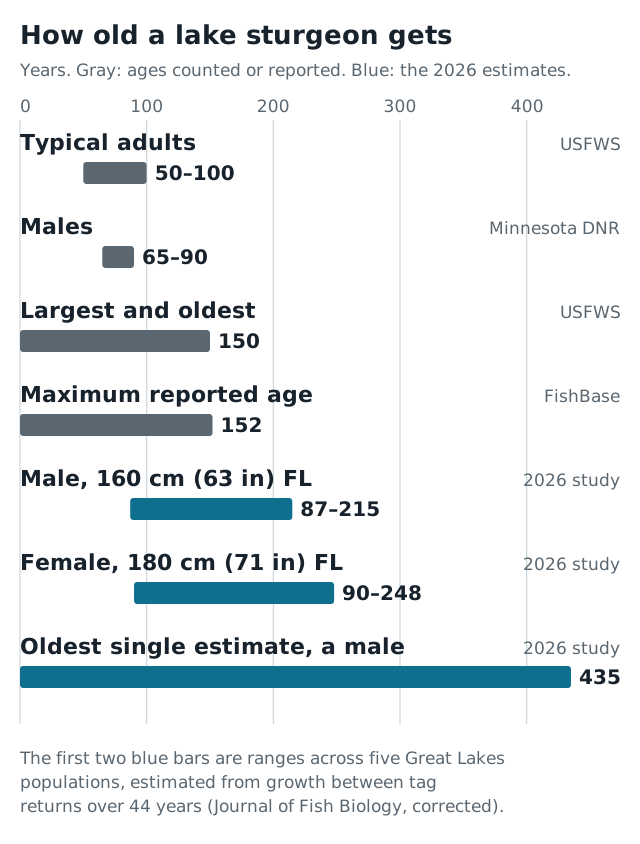
Treat the 435 as an estimate, not a counted age. Bridge Michigan, reporting on the study, notes that this Black River male “could be anywhere from 318 to 737 years old.” What the study and the old counts agree on is the part that shapes the rules: lake sturgeon start breeding late and live long.
Where can you fish for lake sturgeon, and can you keep one?
Only in a handful of waters, and at most one fish a year or a season. The Fish and Wildlife Service decided in April 2024 that the lake sturgeon does not need federal listing. But Minnesota’s DNR counts 19 of the 20 states where it historically lived that list it as threatened, endangered or of special concern. Wisconsin, Michigan and Minnesota run the seasons that remain:
| Where | Season | Size rule | Limit |
|---|---|---|---|
| Wisconsin: Winnebago System, spearing | From the second Saturday in February, up to 16 days or until a harvest cap is reached | 36 in (91 cm) minimum | One per season |
| Wisconsin: Chippewa, Flambeau, Yellow Lake system, Wisconsin River below Wisconsin Dells and other listed waters, hook and line | First Saturday in September to September 30 (September 5–30 in 2026) | 60 in (152 cm) minimum | One per season, with a harvest tag |
| Michigan: Lake St. Clair and St. Clair River | Harvest July 16–September 30; catch and immediate release July 16–March 15 | 42–50 in (107–127 cm) | One per year, statewide |
| Michigan: Otsego Lake | July 16–March 15 | 50 in (127 cm) minimum | One per year, statewide |
| Michigan: Black Lake | First Saturday in February through the following Monday, or until the quota set with the tribes is reached; 8 a.m. to 2 p.m. | – | One per year, statewide |
| Minnesota: Lake of the Woods and Rainy River | Harvest late April to early May and early July to late September; closed the second half of May through June | 45–50 in (114–127 cm), or over 75 in (191 cm) | One per calendar year, with a tag |
| Missouri | No season: every lake sturgeon goes back | – | None |
Can you keep a lake sturgeon in Michigan, then? Yes, one a year, but only on the waters in the table. The table is the frame, not the rulebook; dates and sizes change, so check the agency before the trip. The details that catch people out:
- Michigan prohibits fishing for lake sturgeon on all waters except those its fisheries order names, and a kept fish must be registered within 24 hours. The Detroit and St. Marys rivers, Portage and Torch lakes and the Ontonagon River are open for catch and immediate release only, July 16 to March 15.
- Wisconsin sells the hook-and-line harvest tag for $20 to residents and $50 to nonresidents, and a kept fish must be registered by 6 p.m. the day after it was caught. The Winnebago System is closed to hook-and-line sturgeon fishing all year; see the Wisconsin fishing guide for the rest of the state.
- Minnesota treats the lake sturgeon as a species of special concern. Between the harvest windows on the border waters, catch and release is allowed from early to mid-May and from early October to late April.
Everywhere else, a lake sturgeon hooked by accident, often on a catfish bait, should be released at once with the care described below.
The Winnebago spearing season
Every February the Winnebago System opens for sturgeon spearing through the ice, and the Wisconsin DNR runs it on numbers. Harvest caps for juvenile females, adult females and males are set from the population estimate, and the season closes early when a cap is reached.
The 2026 season, from the DNR’s report:
- 1,539 lake sturgeon speared, 1,261 on Lake Winnebago and 278 on the Upriver Lakes.
- 54 fish over 100 lb, 43 of them on Lake Winnebago, where the largest was a 138.1 lb female.
- 11,350 Lake Winnebago licenses sold, down from the year before, and 3,019 shanties counted on the lake.
- Lake Winnebago closed after 10 days, “the first time it closed early in over a decade,” after 779 fish were taken on the opening weekend with safe ice and clear water.
- The Upriver Lakes season lasted 3 days. Spearing there is by drawing, and in 2026 a tag took 9 preference points; spearers with one succeeded 57.4% of the time.
On Lake Winnebago itself the 2026 success rate was 11.1%, against an average of 8%. Every speared fish is registered, weighed and measured, and 20% of them carried a PIT tag.
How do you catch a lake sturgeon on hook and line?
On the bottom, with worms, in current. Minnesota’s DNR, writing for the Rainy River, gives a complete rig:
| Part | Minnesota DNR’s choice |
|---|---|
| Rod and reel | A stout muskellunge rod and a level-wind reel |
| Line | Braid in the 80 to 100 lb test range |
| Weight | A no-roll slip sinker of 1 to 5 oz (28 to 142 g), only enough to hold bottom |
| Swivel and leader | A barrel swivel below the sinker, then 12 to 18 in (30 to 46 cm) of leader |
| Hook | A 5/0 circle hook |
| Bait | One or more nightcrawlers, often with a minnow or two added |
Where to fish matters more than the rig. Boat anglers look for pools or deeper seams in the river bottom and anchor slightly upstream so the bait settles into them. Sturgeon “hole-up” in those spots, the DNR notes, and leave by swimming upstream from the head of the pool.
When a fish takes, do not strike. Tighten the slack and raise the rod so the circle hook sets, then expect a fight that can last “10 minutes or more.”
Handle it like the old fish it is, following the basics of catch and release. Support a sturgeon horizontally for a photo and never hold one vertically by the head, gills or tail. A wet towel over the head calms the fish while you measure, and gloves protect your hands from the sharp scutes of a small one. A soft tape for length and girth gives you the fish’s measurements without a scale. In Wisconsin, leave any tag on the fish and report its number to the DNR.
Is lake sturgeon good to eat?
Yes, where you may keep one. “The flesh of sturgeons has an excellent flavor, especially when smoked,” Missouri’s conservation department says. On the Winnebago System most speared fish are eaten by the spearer and the spearing group, fried or smoked, the DNR’s sturgeon biologist Ryan Koenigs wrote in 2019. “The meat is firm and contains plenty of fat that keeps the meat moist during the smoking process.”
Do lake sturgeon have caviar? The mature females do. Most speared fish are males or females not carrying ripe eggs, Koenigs explains, but each season some ripe females are taken, and their roe can be made into caviar.
Two rules come with it. In Wisconsin no part of a sturgeon may be sold or bartered, flesh or eggs; a spearer may only pay someone a fee to clean the fish or process the roe. And sturgeon are long-lived bottom feeders that can build up PCBs and mercury. In 2019 the DNR’s tests found contaminant levels in Winnebago fish, lake sturgeon included, “very low,” with no site-specific advisory; the state’s general fish-eating advice still applies, so check it for the water you fish.
When and where do lake sturgeon spawn?
In spring, on rocky river shallows. Lake sturgeon start moving to the spawning grounds when the water reaches 50 °F (10 °C) and spawn at 55 °F (13 °C), Minnesota’s DNR says. The Fish and Wildlife Service gives 52 to 59 °F (11 to 15 °C). The season runs “between April and early June” in Minnesota, while in Missouri “spawning peaks in April.” Wisconsin’s DNR puts the start at 53 °F (12 °C), between late April and early June. The water temperature guide shows how those numbers move through a northern spring.
They choose clean, hard bottom in current: gravel, cobble and boulders, in water 1 to 26 ft (0.3 to 8 m) deep. The current there runs at 0.5 to 1 m (1.6 to 3.3 ft) per second. A female, accompanied by two males, lays hundreds of thousands of eggs over a day or two. The eggs hatch in about 5 to 8 days. They hatch best at 59 to 64 °F (15 to 18 °C). After about 10 days the larvae have used up the yolk sac and drift off in the current, and the young stay in the river for about a year before moving out to the lakes.
Spawning is rare for each fish. In Minnesota’s figures, females mature at 24 to 26 and spawn every four to six years; males mature at 8 to 17 and spawn every two to three. A female caught at 20 has never spawned. Zebra mussels add a new threat: they “can cover rocks in one season leaving no space for sturgeon eggs.”
What do lake sturgeon eat, and what eats them?
Lake sturgeon eat snails, crayfish, mussels and aquatic insects, and sometimes small fish and eggs. The barbels feel the bottom for food, and the toothless mouth shoots out to suck it up. Minnesota’s DNR says they prefer fresh food and do not eat decomposing animals; Missouri’s guide says they can scavenge dead animal matter at times. Worms take them either way: nightcrawlers are the standard bait on the Rainy River, and Missouri notes that lake sturgeon are “often caught by catfish anglers using worms or cut bait.”
Do lake sturgeon bite? They cannot: the mouth has no teeth and feeds by suction. The hazard to an angler is the plates: small sturgeon have “razor-sharp projections called scutes,” Minnesota’s DNR warns. Do they jump? Yes. Lake sturgeon leap “completely out of the water until they appear to be standing on their tails,” the Wisconsin DNR writes.
Small sturgeon have plenty of enemies: crayfish and small fish eat the eggs, and herons take the fingerlings. After that the list is short. “By the time sturgeon reach 20 inches or more in length their primary predator is humans,” Minnesota’s DNR writes.
Why are lake sturgeon protected?
Because they were nearly wiped out once, and they recover slowly. In the 1800s sturgeon tore commercial nets and were treated as a nuisance: “stacked on the shorelines like logs,” Minnesota’s DNR writes, and burned as fuel in steamboats because the meat is oily. Then caviar made them valuable, and harvest for the eggs crashed the population in the early 1900s. Dams cut off spawning and nursery habitat on many rivers, and that threat remains across the range.
The Ojibwe called the fish Nahmay or Namé, “the king of fish.” In places it is coming back. On the Rainy River, “sturgeon fishing is the best it has been since the late 1800s,” Minnesota’s DNR writes. Missouri listed the lake sturgeon as state endangered in 1974, began stocking fingerlings in 1984 and confirmed the first spawning in the state in 2015. The endangered freshwater fish page covers the sturgeons that are federally listed, from the pallid to the Atlantic.
Free PDF · 16 pages
Know what's biting before your first cast
The Water Temperature Fishing Chart. Take one water temperature reading, find it on the chart, and see which of 26 freshwater fish are spawning, feeding hard or slowing down. Six pages go deeper: bass, crappie, bluegill, walleye, catfish and trout. For your phone and the tackle box.
- Where they sit and what to throw at every band: bass, crappie, bluegill and walleye; catfish by species; trout: the 68 °F line where you stop, and where they hide
- A bass that drops 3 ft feels more pressure change than the biggest cold front: the front day by day, and what to throw on each
- The three thermometer mistakes that make a reading lie (the first one is the surface)
- The 26-fish chart: who's spawning, feeding hard or slowing down at your reading
The chart's numbers come from state fish and wildlife agencies and fisheries research: 61 sources, each listed on the site.
Enter your email, confirm it with one click, and the PDF is in your inbox. Plus one email a week on what's biting. Unsubscribe anytime. Privacy.
Related
Section guide
Freshwater Fish Species Outside the Big Families: Sturgeon, Gar, Bowfin, BurbotThe freshwater fish species outside the bass, trout, catfish and pike families: sturgeon, gar, bowfin, burbot, drum, eel and paddlefish, with records.
 Arapaima: How Big They Really Get, and Where You Can Catch One
The arapaima breathes air, tops out near 10 ft and 440 lb, and is legal to catch in only a few places. Its real size, the record, and where to fish.
 Paddlefish (Spoonbill): Facts, Snagging Seasons, Records and Rules
The paddlefish, or spoonbill, eats only plankton, so anglers snag it. Size, age, the 164 lb record and the snagging seasons state by state.
 Sturgeon Fishing: Where to Go, the Rig, the Bait and the Rules by State
Sturgeon fishing for white and lake sturgeon: where it is open, when to go, the sliding-sinker rig, the best baits and the keep-it-in-the-water rules.
 Freshwater Drum: Sheepshead, Gaspergou and How to Catch Them
Freshwater drum, or sheepshead, mostly run 1 to 5 lb; the record is 54 lb 8 oz. How to tell one apart, the rig that catches it and how to cook it.
 Longnose Gar: Identification, Size, Records, and How to Catch One
Longnose gar commonly reach 3 ft and 5 to 6 lb; the IGFA record is 43 lb, yet four states certify bigger fish. How to ID, find and catch one.
 Bowfin: Identification, Bowfin Fishing, and the Snakehead Look-Alike
The bowfin is a native, air-breathing predator with a 21 lb 8 oz world record. How to identify one, tell it from a snakehead, and catch one.
Sources
- U.S. Fish & Wildlife Service, Lake Sturgeon (Acipenser fulvescens)
- U.S. Fish & Wildlife Service, Sturgeon Snoots and Scutes
- Minnesota DNR, Lake Sturgeon (MinnAqua species profile)
- Minnesota DNR, How to catch lake sturgeon
- Missouri Department of Conservation, Lake Sturgeon
- Missouri Department of Conservation, Shovelnose Sturgeon
- Baker, Colborne, Auer et al., Lake sturgeon (Acipenser fulvescens) growth and longevity estimated from adult capture–mark–recapture data, Journal of Fish Biology (2026)
- Journal of Fish Biology, Correction to 'Lake sturgeon (Acipenser fulvescens) growth and longevity estimated from adult capture–mark–recapture data' (October 13, 2026)
- Bridge Michigan, Think you're getting old? New study says Michigan sturgeon may live to 400 (August 11, 2026)
- FishBase, Acipenser fulvescens
- IGFA World Record Search: Sturgeon, lake
- Wisconsin DNR, 2026 Lake Sturgeon Spearing Season, Winnebago System (September 24, 2026)
- Wisconsin DNR, Lake sturgeon
- Wisconsin DNR, Lake sturgeon fishing seasons
- Wisconsin DNR, Lake sturgeon hook and line season
- Wisconsin DNR, Hook and line record fish
- Wisconsin DNR, Alternate methods record fish
- Wisconsin DNR, Ryan Koenigs, What do the spearers do with the fish? (February 23, 2019)
- Minnesota DNR, 2026 Minnesota Fishing Regulations
- Michigan DNR, Fisheries Order FO-240, Lake Sturgeon Fishing Regulations
- Federal Register, 12-Month Finding for Lake Sturgeon (April 23, 2024)