 By
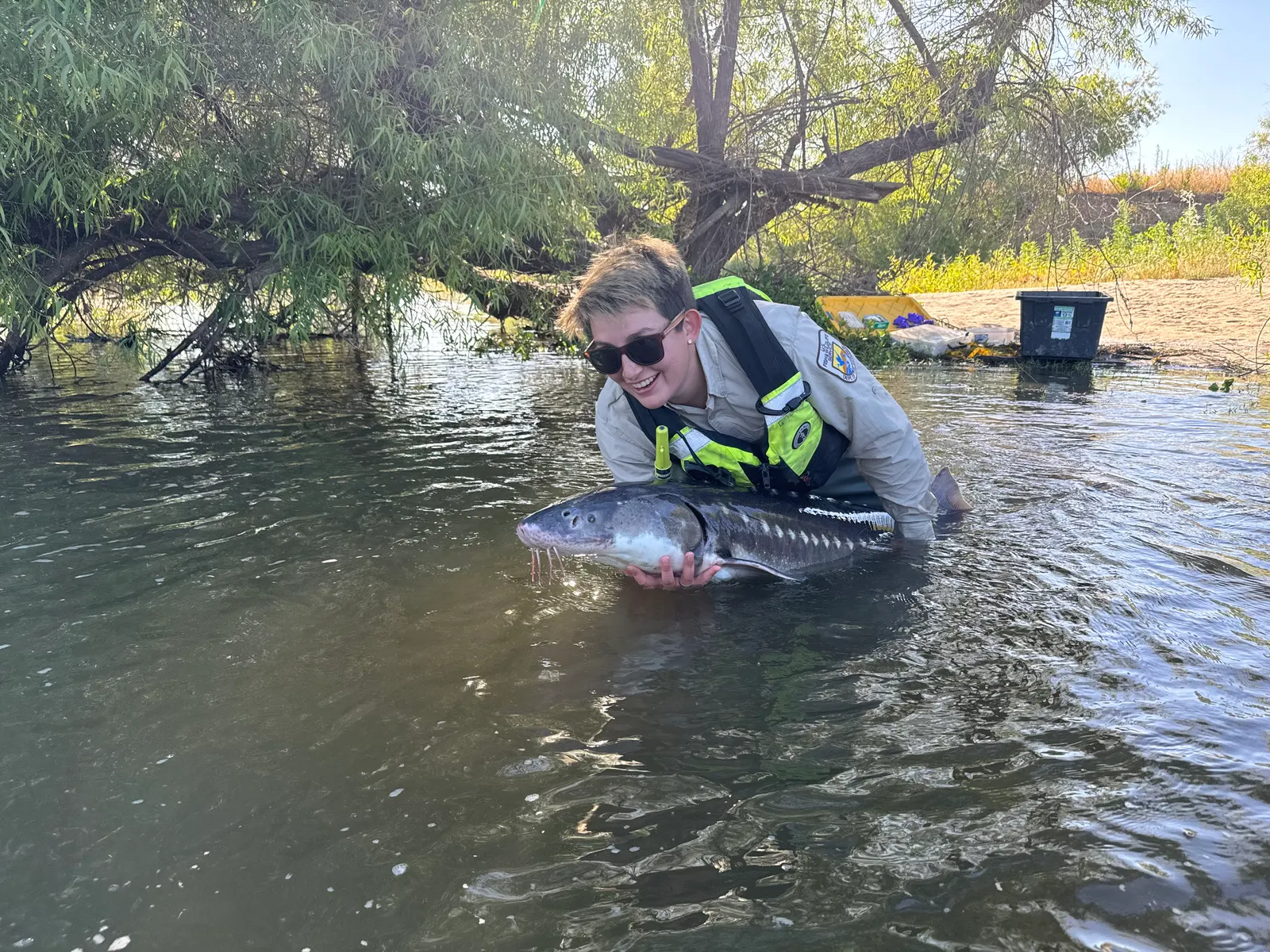
Sturgeon fishing means soaking bait on the bottom of a big river, bay or lake with heavy tackle, and in the United States it splits into two fisheries. White sturgeon are fished on the Pacific coast, in San Francisco Bay and the Sacramento–San Joaquin Delta, the Columbia and the Snake, with British Columbia’s Fraser River just north. Lake sturgeon are fished in the Upper Midwest: the Rainy River, Wisconsin’s rivers and Lake Winnebago, and a few Michigan waters. Most of it is catch and release, and the rules on how you land a fish are as much a part of the sport as the rig.
The Rainy River on the Minnesota–Ontario border holds nearly 100,000 lake sturgeon 40 inches or longer. “Put head to tail, that is a string of fish more than 60 miles long,” Minnesota’s DNR writes.
Where can you go sturgeon fishing?
Where a state still has a healthy run, an open season and a way to fish it from the bank or a boat. The table lists the main US fisheries and the Fraser, with the one question that decides the trip: may you keep a fish? For the nine sturgeon species, their size and which ones are protected, see the sturgeon species guide.
| Water | Sturgeon | Keep one? | When |
|---|---|---|---|
| San Francisco Bay and the Delta, California | White | No: catch and release only, bag limit zero | October 1 to June 30 in most waters |
| Columbia River below Bonneville Dam, Oregon and Washington | White | No: catch and release only | Year-round, apart from some May 1 to August 31 closures that protect spawning fish |
| Columbia River pools above Bonneville Dam | White | Yes, on short retention days inside a slot | Winter; the days are set each year |
| Willamette River, Oregon | White | Catch and release below Willamette Falls; retention year-round above the falls to the Coast Fork, 43 in minimum | All year |
| Lake Roosevelt, Washington | White | Yes, 55 to 63 in fork length | September 16 to November 30 |
| Snake River, Idaho | White | No: release, and keep it in the water | Where the river is open |
| Fraser River, British Columbia | White | No: catch and release since 1994 | Check BC’s closures |
| Rainy River and Lake of the Woods, Minnesota | Lake | One a year with a tag | Harvest in spring and summer windows; release most of the rest of the year |
| Listed Wisconsin rivers | Lake | One per season, 60 in minimum, harvest tag | September 5 to 30 (2026) |
| Lake Winnebago system, Wisconsin | Lake | One per season by spear, 36 in minimum | February, from the second Saturday |
| Lake St. Clair, St. Clair River and Black Lake, Michigan | Lake | One a year | July 16 to September 30 on the St. Clair waters; February at Black Lake |
| Missouri and Mississippi rivers | Shovelnose | Where the state allows it, as in Missouri | Check the state |
Which state is best for sturgeon fishing? For numbers, Oregon and Washington’s share of the lower Columbia. Oregon’s Department of Fish and Wildlife counted about 2,200 catch-and-release trips there from March to October 2024, and they “averaged 2-3 sturgeon released per trip.” The lower Willamette saw about 1,700 trips from March to June the same year, at the same 2 to 3 fish a trip. For a lake sturgeon you may keep, Minnesota’s border waters and Wisconsin’s September rivers are the main hook-and-line options.
Why is sturgeon fishing illegal in some places? Because six of the nine US sturgeons may not be kept. Pallid, Alabama, Atlantic, Gulf and shortnose sturgeon are federally endangered or threatened, and green sturgeon (its southern population federally threatened) may not be kept in California, Oregon or Washington. California makes it illegal even to fish for green sturgeon. Michigan bans fishing for lake sturgeon on all waters except those its fisheries order names. Wisconsin goes further: sturgeon “may only be targeted in waters with an open hook and line season, even if anglers intend to release their catch.” Missouri protects its lake sturgeon outright. Those rules come from the fish itself: a lake sturgeon female first spawns at about 24 to 26 and then only every four to six years, so a run that is fished down takes decades to come back.
When is the best time to go sturgeon fishing?
That depends on the water, because the seasons decide before the fish do. The calendar shows when eight of the main fisheries are open, by month, from the agency rules.
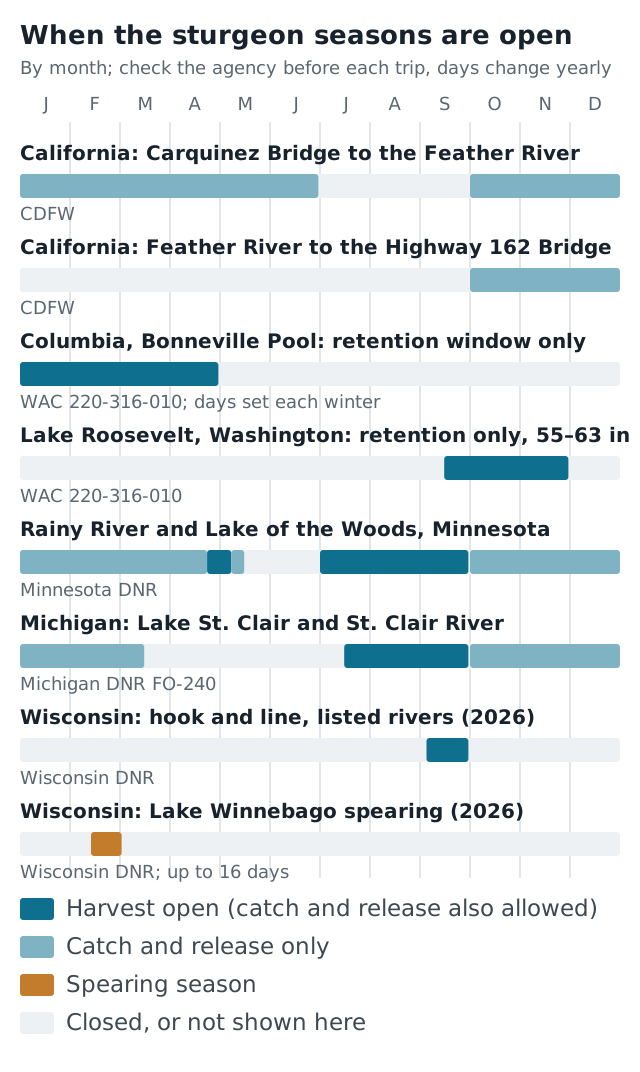
On the West Coast, the California season runs from fall to early summer. The Lost Anchovy, a San Francisco Bay kayak-fishing site, calls bay sturgeon “mainly considered a winter fishery.” In January and February, it writes, South Bay sturgeon gorge on herring and herring roe when the herring spawn arrives. On the lower Columbia, Oregon’s agency points to “a relatively productive fishery from June to July around Astoria.”
Water temperature moves the fish within a season. “During the winter, sturgeon seem to hold in deeper areas and are less active,” Oregon’s guide says; as the water warms they become more active and move shallower to feed.
In the bay and Delta the tide matters more than the hour. The Lost Anchovy rates the last two hours of an outgoing tide the best time and fast-moving tides the best tides, with “Full and new moons w/ a negative tide” on top. Strong tides lift food off the mud of the bay and Delta and spread it along the channels, and that sets the sturgeon feeding.
Lake sturgeon seasons are built around the spring spawning run. On the Rainy River and Lake of the Woods, Minnesota allows harvest from late April until early May and from early July until late September. Catch and release fills most of the rest of the year, and from the second half of May to the end of June you cannot fish for sturgeon at all. Wisconsin’s hook-and-line harvest season on its listed rivers is in September, with catch-and-release seasons on other rivers, and its spearing season is in February, through the ice.

Free PDF · Water temperature chart Which fish are biting at today's water temperature?
One reading, and the 16-page chart shows which of 26 fish are spawning, feeding hard or slowing down; for bass, crappie, bluegill and walleye, where they sit and what to throw. Every number sourced.
Enter your email, confirm it with one click, and the PDF is in your inbox. Plus one email a week on what's biting. Unsubscribe anytime. Privacy.
What gear do you need for sturgeon fishing?
Heavy gear, because the fish is big and the water is moving. “You need stout gear just to cast and manage your bait, let alone fight a fish bigger than you are,” Oregon’s guide puts it. The agencies give the numbers for the two fisheries.
| White sturgeon | Lake sturgeon | |
|---|---|---|
| Rod | Medium-heavy to heavy, with a soft tip for seeing the bite (California) | A stout muskie rod (Minnesota) |
| Reel and line | Braid or mono of 50–100 lb (California); at least 130 lb in BC’s guidelines | Level-wind reel, braided line of 80–100 lb |
| Sinker | Pyramid, 4–16 oz (113–454 g), by the current | No-roll slip sinker, 1–5 oz (28–142 g) |
| Hook | A single-point barbless hook: the law in CA, OR and WA; CA and WA allow only one | A 5/0 circle hook on a 12–18 in (30–46 cm) leader |
| Bait | Shrimp, lamprey, salmon roe | Nightcrawlers, often with a minnow |
A few extras matter as much as the rod. Minnesota’s DNR lists a wet towel for the fish’s head, a tape for length and girth, gloves and a pen to record tag numbers. California recommends a mesh sling or a large sturgeon-sized net as the safest way to lift a fish that is legal to take out. Kayak anglers on San Francisco Bay anchor up for the bite: The Lost Anchovy uses a 3 to 5 lb anchor on galvanized chain.
How do you rig for sturgeon?
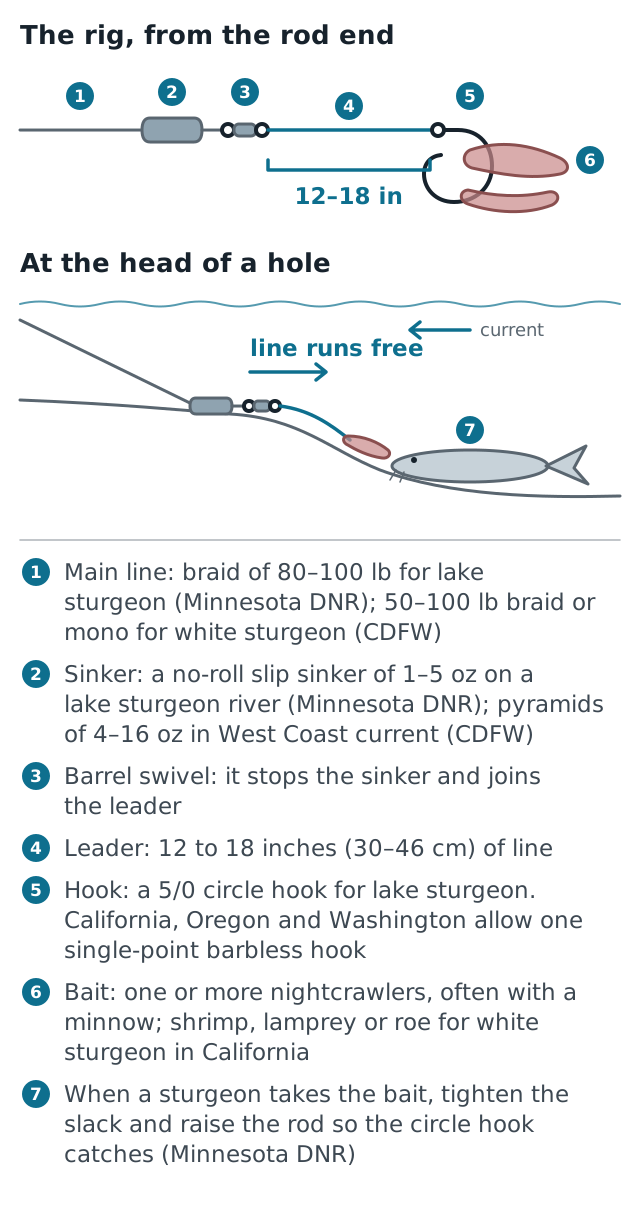
With a sliding-sinker rig: the weight rides on the main line, a swivel stops it, and a short leader carries the hook and bait. It is the same idea as the surf angler’s fish-finder rig, scaled up. Minnesota’s DNR gives the lake sturgeon version step by step.
- Thread the sinker on the main line. Minnesota anglers prefer a “no-roll” slip sinker of 1 to 5 oz. Use just enough weight to keep the bait on the bottom; in West Coast tidal current that means pyramids of 4 to 16 oz.
- Tie a strong barrel swivel to the end of the main line. It stops the sinker from sliding down to the hook.
- Add the leader. Tie about 12 to 18 inches of line to the other end of the swivel.
- Tie on the hook. A 5/0 circle hook for lake sturgeon. California, Oregon and Washington require single-point barbless hooks, and California and Washington allow only one. California also bans hooks with a gap wider than 1 inch inland of the Benicia-Martinez Bridge, and warns that some ocean sturgeon tackle exceeds that.
- Bait it. One or more nightcrawlers on the hook for lake sturgeon, often with a minnow or two. For white sturgeon, the bait the local fish are eating (next section).
- Cast and let it settle. On a river, anchor slightly above the hole and let the bait settle into it. Then keep the line taut so the rod tip shows every touch.
What is the best bait for sturgeon?
The best bait is whatever sturgeon on that water are eating, fished fresh on the bottom. “Sturgeon are bottom feeders and typically don’t take lures, so anglers almost exclusively target them with bait,” California’s wildlife department says.
- San Francisco Bay and the Delta. California’s most common baits are ghost, mud or grass shrimp, lamprey (“eel”) and salmon roe; some anglers also do well with pile worms, nightcrawlers, shad or herring. The Lost Anchovy adds that San Pablo Bay anglers prefer shrimp, while Delta anglers switch to roe when the salmon run through the river.
- The Columbia and Willamette. Oregon’s list is sand shrimp, nightcrawlers, smelt, pickled herring (rollmop), squid and anchovy. On the Columbia, anglers dipnet the spring smelt run for bait, and sturgeon feed on the shad run and even full-grown salmon, the U.S. Fish and Wildlife Service notes.
- Lake sturgeon. Nightcrawlers, often with a minnow or two added. Missouri’s conservation department notes lake sturgeon are “often caught by catfish anglers using worms or cut bait.”
When bait-stealing small fish are busy, or shrimp is scarce, The Lost Anchovy calls eel and worms together an excellent combination. The site’s rule of thumb holds for every water: “All the baits work, however, there are times when the sturgeon key in on a preferred bait.”
How do you find sturgeon in a river?
Look for the deep water next to the shallow water they feed on. Minnesota’s DNR says boat anglers look for “pools or deeper seams in the river bottom,” then anchor slightly above them and let the bait settle in. Sturgeon often “hole-up” in those spots.
In a bay or estuary the same idea becomes contours and channels. The Lost Anchovy names changes in contour, the edges of shipping channels and deep holes, plus the shallows of San Pablo Bay. On a fish finder, the site says, feeding sturgeon show as large red arches on the bottom; fish suspended mid-water during a tide change are passing, not feeding.
Season shifts the depth too. In winter, Oregon’s guide says, sturgeon hold deeper and are less active; as the water warms they move shallower in search of food. Oregon also warns that sturgeon are “often found in deep swirling waters,” so safety comes first: “When in doubt, go with a more experienced captain before you take your own boat out.”
How do you hook and fight a sturgeon?
Gently, then quickly. A white sturgeon is a big fish with a small bite. “White Sturgeon are extremely subtle when taking bait,” California’s guidance says. Keep the line taut and watch the rod tip for very gentle taps and pumps.
On a circle hook you do not swing hard. “Once you feel a bite simply tighten the slack from your line and raise the rod, thereby allowing the circle hook to catch,” Minnesota’s DNR writes. “Then hold on.” You may be fighting a fish for 10 minutes or more, it adds, and a stout rod with heavy line brings it in faster.
That speed is for the fish’s sake. California warns that “prolonged fights can be extremely stressful and the fish may not recover.” In strong current, follow the fish instead of holding it against the flow, so it is not fighting the current as well as the line. Oregon’s advice is the same: “release from the anchor and follow the fish.” British Columbia’s guidelines add a plan: when a sturgeon of 1.5 m (59 in) or longer is on, drop the anchor line and play the fish to a landing spot you picked in advance.
What do you do when you catch a sturgeon?
You release it in the water, quickly, and on most West Coast waters the law says how. Sturgeon have no strong bony skeleton to carry their weight out of the water, so the rules draw a size line above which the fish never leaves it.
| Where | Which fish stay in the water | Other rules | Source |
|---|---|---|---|
| California | White sturgeon over 60 in fork length, and every green sturgeon | No gaff, tail rope, snare or lip gripper; never held by the gills, mouth or tail alone | CDFW |
| Washington | Any sturgeon over 55 in fork length, wholly or partly | No gaff or other body-penetrating device | WAC 220-316-010 |
| Idaho | Every sturgeon | Released upon landing | Idaho Fish and Game |
| British Columbia | “Never lift a large sturgeon” of 1.5 m (59 in) or more | No ropes, tailers or nooses; never tow one to shore by the tail | BC guidelines |
| Oregon | Every green sturgeon caught by accident | Release at once and unharmed | ODFW |
Then work through the release the way the agencies describe it.
- Leave a big fish in the water. Bring it alongside the boat or to a shallow landing spot. Elevated docks are not suitable landing spots, BC’s guidelines say.
- Hold a smaller fish with two hands. For a white sturgeon under 60 in, California’s advice is one hand under the head and pectoral fins and one just in front of the tail, with gloves on. The bony plates along the body, the scutes, can be sharp on young fish.
- Never squeeze it. California warns that squeezing can harm the organs, and BC says never squeeze or hug a sturgeon.
- Cut a deep hook. If the fish is deeply hooked, bleeding or hooked near the gills, cut the hook or the line. “Studies have shown that sturgeon process and expel hooks and tackle well,” California notes.
- Photograph it level and fast. Minnesota’s DNR asks anglers to support the fish horizontally and never hold it vertically by the head, gills or tail. A wet towel over its head calms it while you measure.
- Note any tag. Leave a tag on the fish and write down the number, water and place to report it; Wisconsin’s DNR asks for exactly that.
- Revive it head-first into the current. Keep it submerged facing upstream until it struggles or swims off on its own, California’s guidance says. No tethering and no live well.
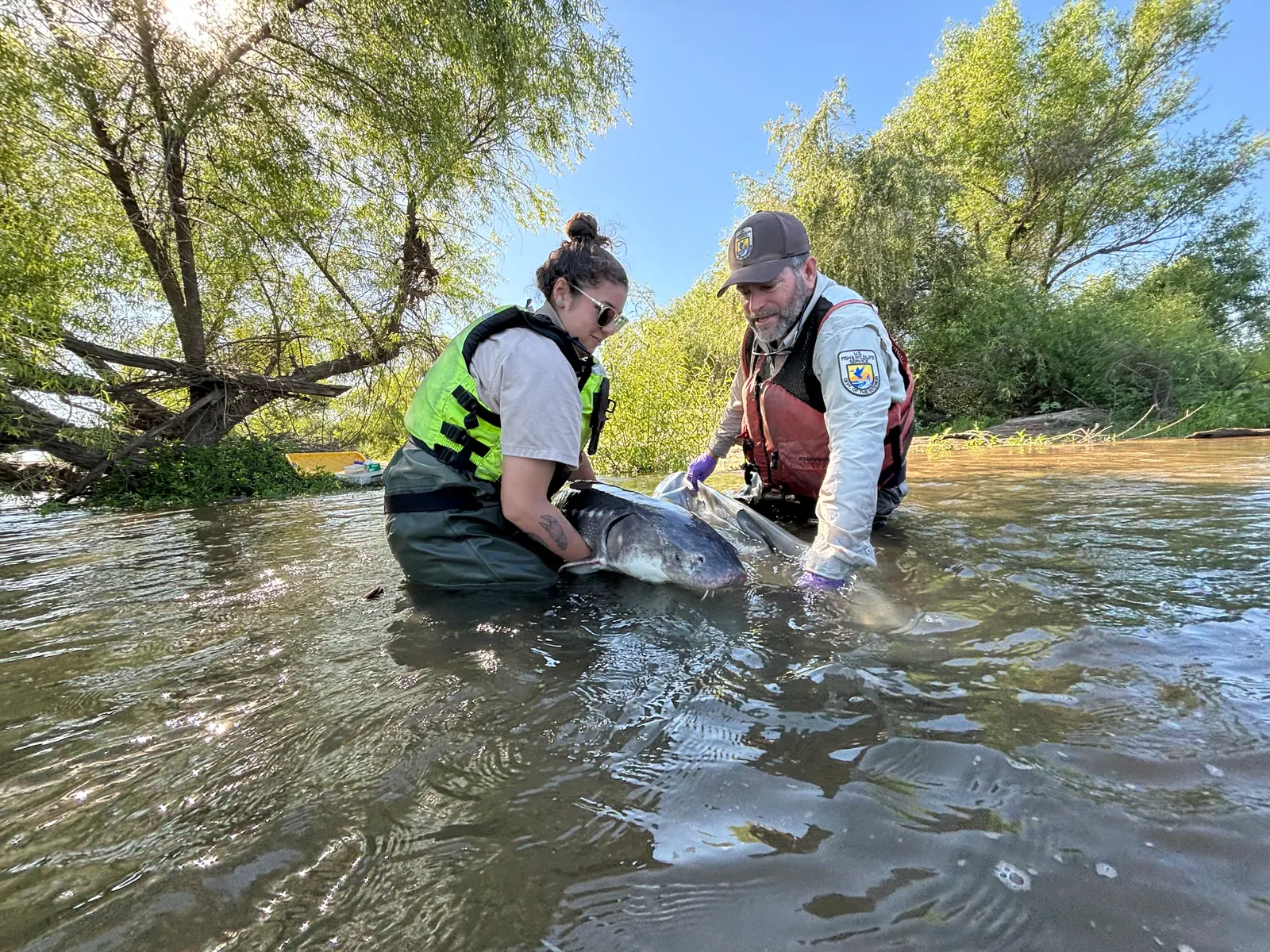
Photo: Geoff Steinhart, U.S. Fish and Wildlife Service (public domain)
For the general habits that keep any released fish alive, see catch and release.
Can you keep a sturgeon, and what license do you need?
On a few waters, one a year, and only with the right paperwork. Even catch and release needs more than a basic license in some states.
White sturgeon. California’s fishery is catch and release only, with a bag limit of zero. You still need a Sturgeon Fishing Report Card to fish for white sturgeon, and you record every fish you release. Return the card by July 31, after the June 30 season close. Two rods are allowed only inland of the Carquinez Bridge, with a two-rod stamp. Oregon requires a fishing license and a Combined Angling Tag, plus a Columbia River Basin Endorsement on the Columbia and Willamette. During Oregon’s retention seasons the limit is one fish a day and two a year, statewide. Washington’s limits match: one a day, two a year, a statewide night closure, and no fishing for green sturgeon. Slots are set in fork length: 38 to 54 in in the Bonneville Pool and a 43 in minimum in the other pools and the Willamette above the falls. The pools above Bonneville have small quotas, Oregon warns, “so seasons are very short.”
The Fraser River. British Columbia closed the harvest in 1994 and replaced it with catch and release. You need a BC freshwater fishing license, plus a white sturgeon conservation license to fish upstream of the tidal zone. Most other white sturgeon populations in BC are protected and closed to angling.
Lake sturgeon.
- Minnesota: one fish per calendar year with a tag on the border waters; no harvest from October 1 to April 23, though catch and release is allowed. In May 2026 the state certified an 80 in lake sturgeon from the Rainy River as its catch-and-release record, weight estimated at about 165 lb from length and girth.
- Wisconsin: a $20 resident or $50 nonresident harvest tag, a 60 in minimum and one fish per season on listed rivers. Register a kept fish at a station by 6 p.m. the day after; no tag is needed to release one.
- Michigan: one lake sturgeon a year on the named waters, registered within 24 hours. On Lake St. Clair and the St. Clair River the harvest slot is 42 to 50 in.
Shovelnose. Missouri lists it as a permitted sport fish but bans commercial harvest, because it closely resembles the endangered pallid sturgeon. On the Missouri or Mississippi, a sturgeon you cannot name with confidence goes back. The endangered freshwater fish guide covers the protected species.
What is lake sturgeon spearing on Lake Winnebago?
Wisconsin’s February fishery, in which spearers wait over a hole cut in the ice for a sturgeon to pass below. It is a form of spearing, and the Lake Winnebago system holds one of the largest lake sturgeon populations in North America. The season opens on the second Saturday in February for up to 16 days, with one sturgeon per season at a 36 in minimum. It can close early, because the harvest is capped separately for juvenile females, adult females and males.
The 2026 season shows the scale. The Wisconsin DNR counted 1,539 fish speared, 54 of them over 100 lb, under 11,350 Lake Winnebago licenses. The biggest was a 148.9 lb, 75.4 in female from the Upriver Lakes. Lake Winnebago closed after 10 days, the first time it had closed early in over a decade, and the Upriver Lakes season lasted three. Spearing on the Upriver Lakes is by drawing; in 2026 a tag took 9 preference points.
Quick answers about sturgeon fishing
Is sturgeon fishing hard? Finding a spot is not: “It is not difficult to find good bait and a spot open to catch and release,” Oregon’s guide says. The hard parts are seeing a bite that can be no more than a tap, and fighting a big fish quickly enough that it survives.
How much is a sturgeon worth? To an angler, nothing in money. California’s Fish and Game Code (Section 7121) says fish caught on a sport fishing license “may not be bought, sold, traded or bartered.” Washington makes it unlawful to have sturgeon eggs in the field without the carcass they came from. The federal Lacey Act makes it a crime to sell or move across state lines any fish taken against a state’s law.
Does sturgeon taste good? Missouri’s conservation department calls the flesh excellent, “especially when smoked.” Where you may keep one, check the water first. Oregon advises releasing any sturgeon from Bonneville Dam to Ruckel Creek, about a mile upstream, because of PCBs.
How old is a 1,000 lb sturgeon? No agency puts an age on a fish that size. The oldest white sturgeon on record was 103 years old, California’s wildlife department reports. The heaviest in the record book is far smaller: the IGFA all-tackle white sturgeon weighed 468 lb, caught at Benicia, California, in 1983. Today’s giants stay in the water and are never weighed.
Is sturgeon fishing legal in Canada? On some waters. The lower and middle Fraser River populations are designated endangered, but BC considers them “healthy enough to support a catch and release sport fishery.”
Mistakes to avoid
- Fishing a closed water “just for release.” In Wisconsin, Michigan and for green sturgeon on the West Coast, targeting the fish where no season is open is itself the violation.
- Using too light a sinker. If the bait rolls downstream, it is not where the fish are. Add weight until it holds, and no more.
- Setting the hook like a bass angler. A circle hook is not jerked; tighten the slack and lift the rod instead.
- Holding the anchor in a big current. Release it and follow the fish, so the fight stays short.
- Lifting a big fish for the photo. Over the legal size it is against the law in California, Washington and Idaho, and it can injure the fish anywhere.
If you want the fish itself, its size, age and the rules for the nine US species, the sturgeon guide has them. The rest of the big freshwater fish outside the bass, trout and catfish families, from gar to burbot, are in other freshwater fish.
Free PDF · 16 pages
Know what's biting before your first cast
The Water Temperature Fishing Chart. Take one water temperature reading, find it on the chart, and see which of 26 freshwater fish are spawning, feeding hard or slowing down. Six pages go deeper: bass, crappie, bluegill, walleye, catfish and trout. For your phone and the tackle box.
- Where they sit and what to throw at every band: bass, crappie, bluegill and walleye; catfish by species; trout: the 68 °F line where you stop, and where they hide
- A bass that drops 3 ft feels more pressure change than the biggest cold front: the front day by day, and what to throw on each
- The three thermometer mistakes that make a reading lie (the first one is the surface)
- The 26-fish chart: who's spawning, feeding hard or slowing down at your reading
The chart's numbers come from state fish and wildlife agencies and fisheries research: 61 sources, each listed on the site.
Enter your email, confirm it with one click, and the PDF is in your inbox. Plus one email a week on what's biting. Unsubscribe anytime. Privacy.
Related
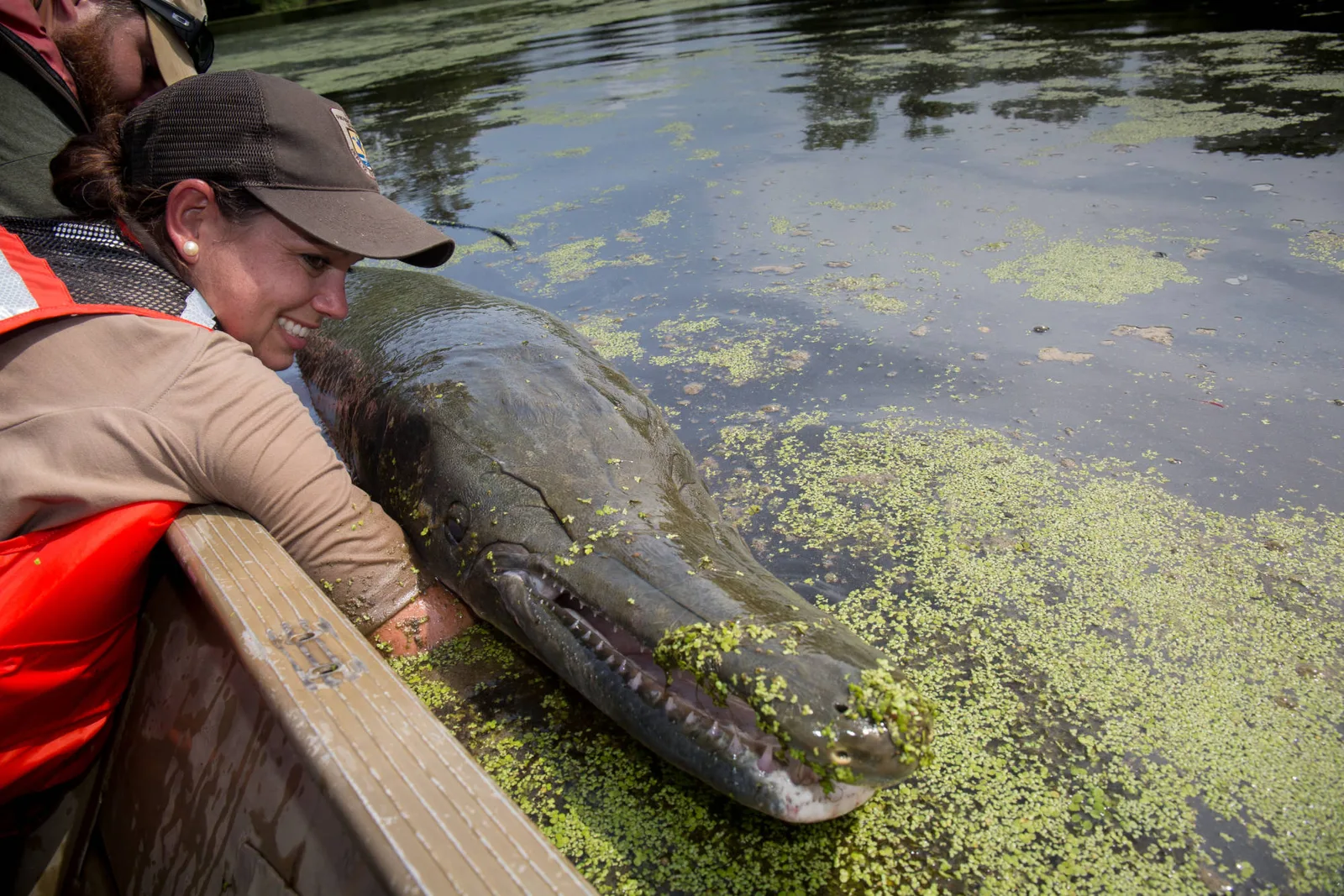
Section guide
Freshwater Fish Species Outside the Big Families: Sturgeon, Gar, Bowfin, BurbotThe freshwater fish species outside the bass, trout, catfish and pike families: sturgeon, gar, bowfin, burbot, drum, eel and paddlefish, with records.
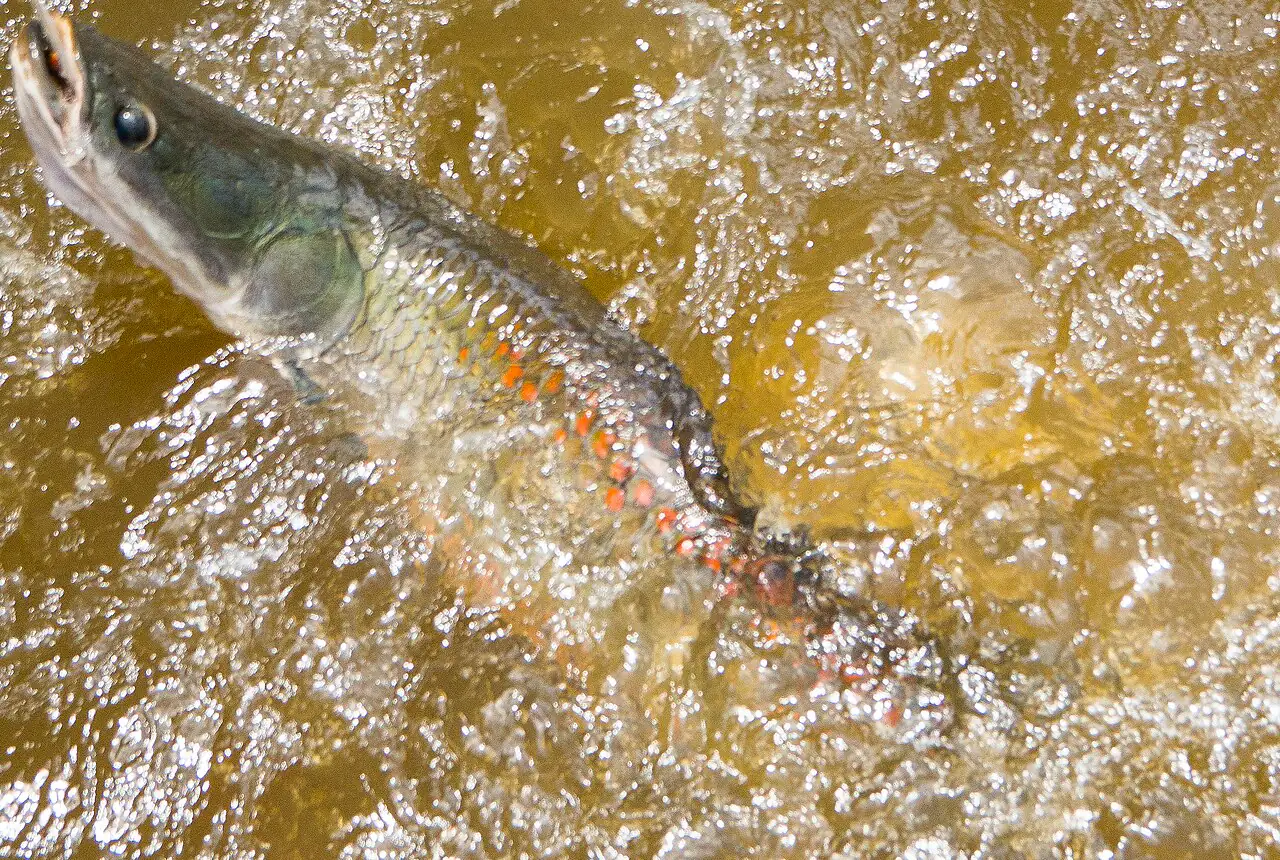 Arapaima: How Big They Really Get, and Where You Can Catch One
The arapaima breathes air, tops out near 10 ft and 440 lb, and is legal to catch in only a few places. Its real size, the record, and where to fish.
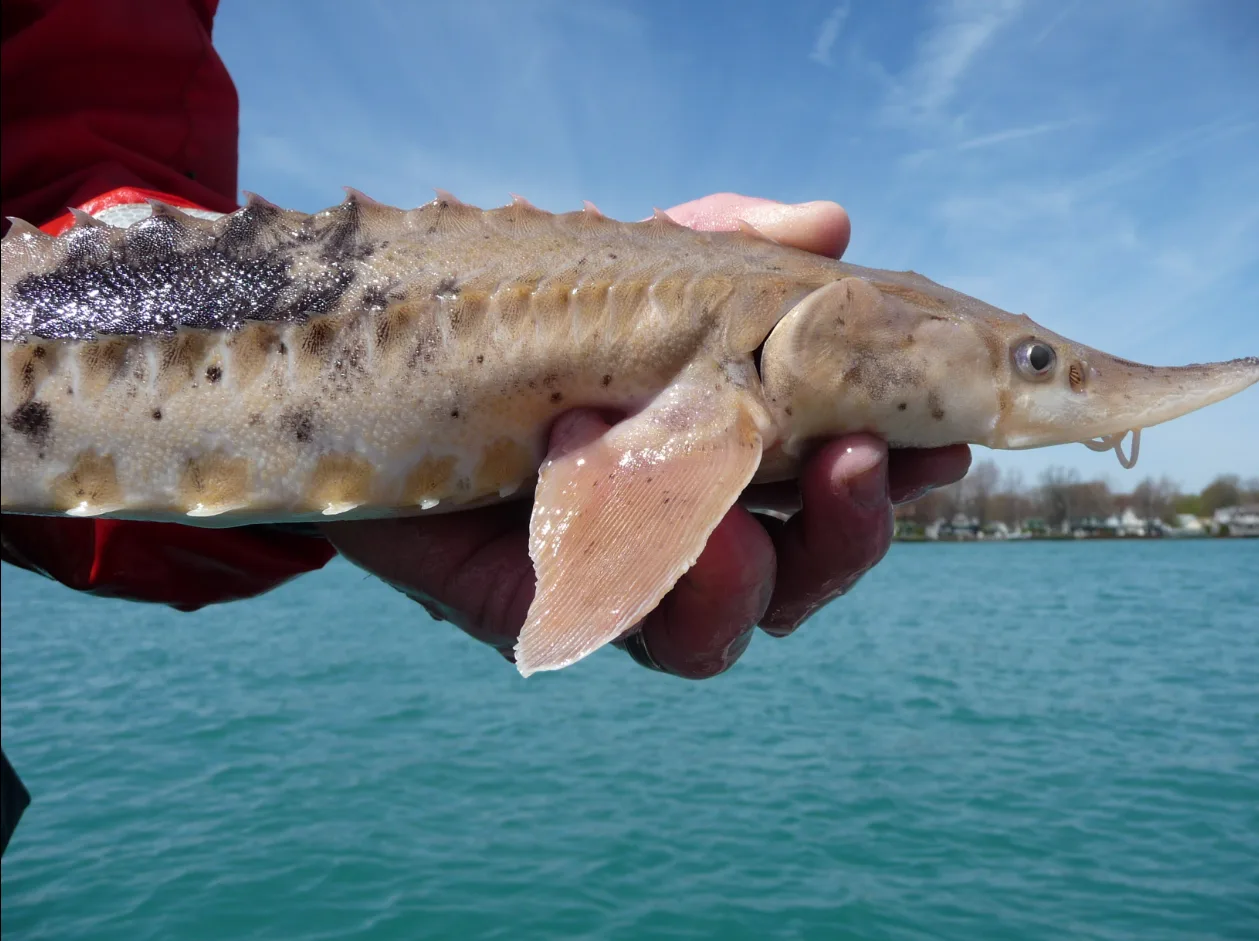 Lake Sturgeon: Size, Age, Where They Live and When You Can Fish
Lake sturgeon grow to 7 ft and may live centuries. How to identify one, where they live, the Winnebago spearing season and where you may keep one.
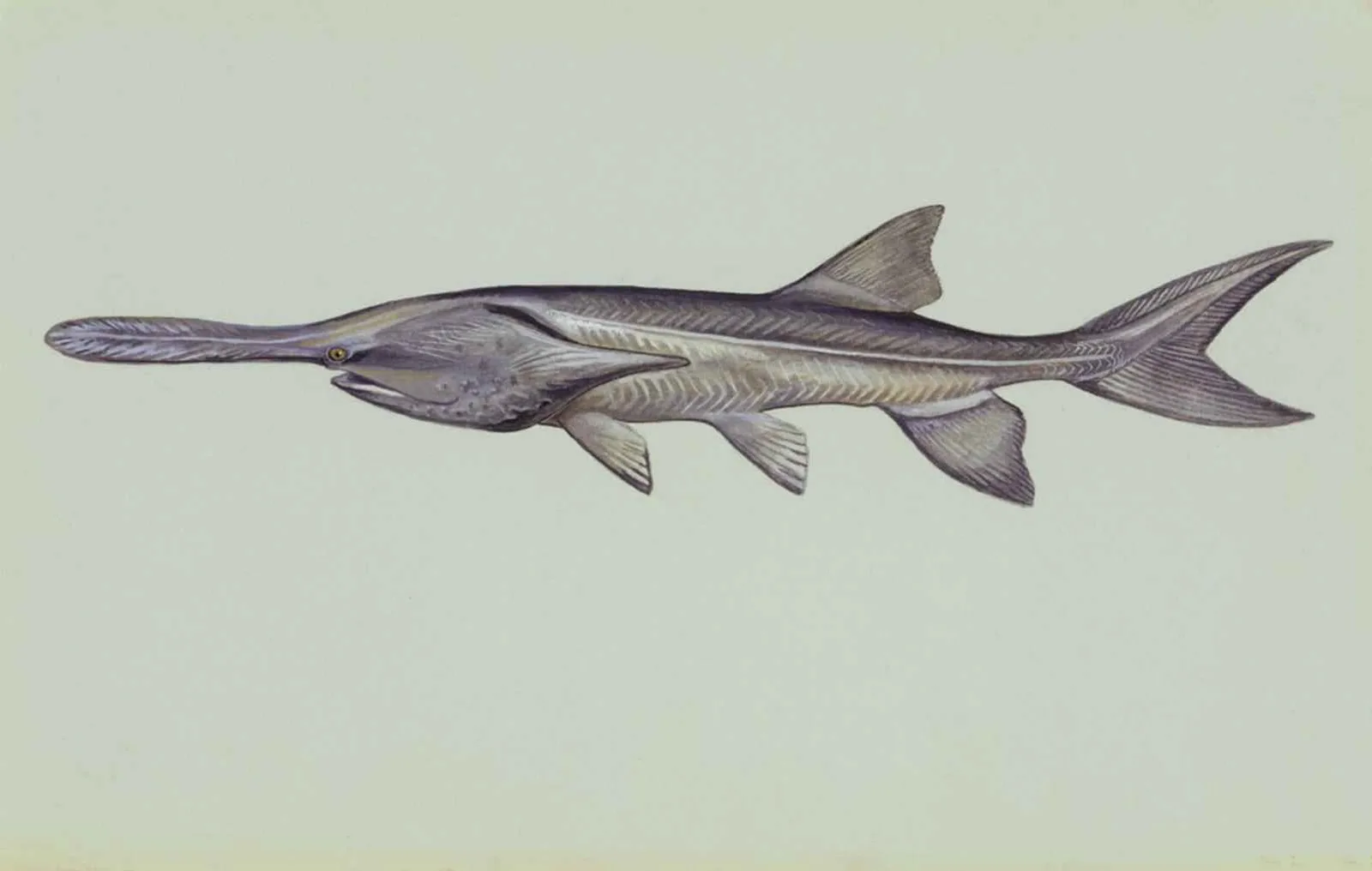 Paddlefish (Spoonbill): Facts, Snagging Seasons, Records and Rules
The paddlefish, or spoonbill, eats only plankton, so anglers snag it. Size, age, the 164 lb record and the snagging seasons state by state.
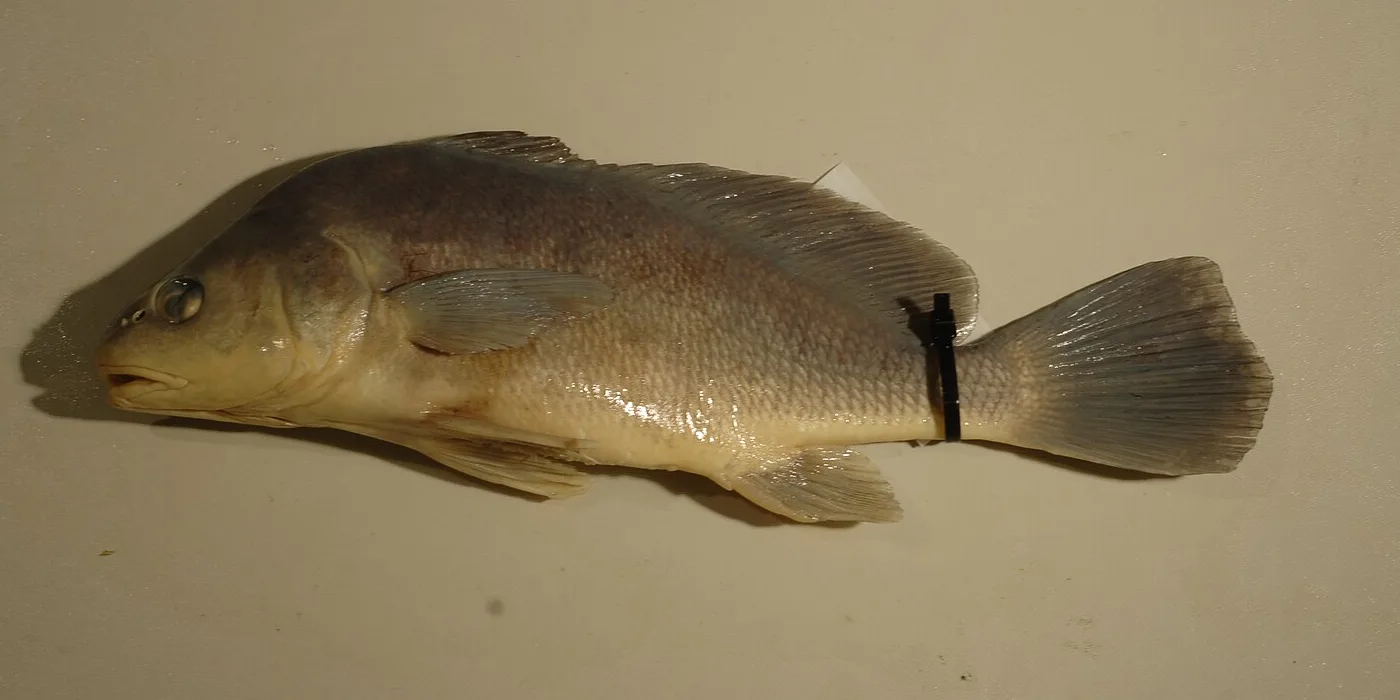 Freshwater Drum: Sheepshead, Gaspergou and How to Catch Them
Freshwater drum, or sheepshead, mostly run 1 to 5 lb; the record is 54 lb 8 oz. How to tell one apart, the rig that catches it and how to cook it.
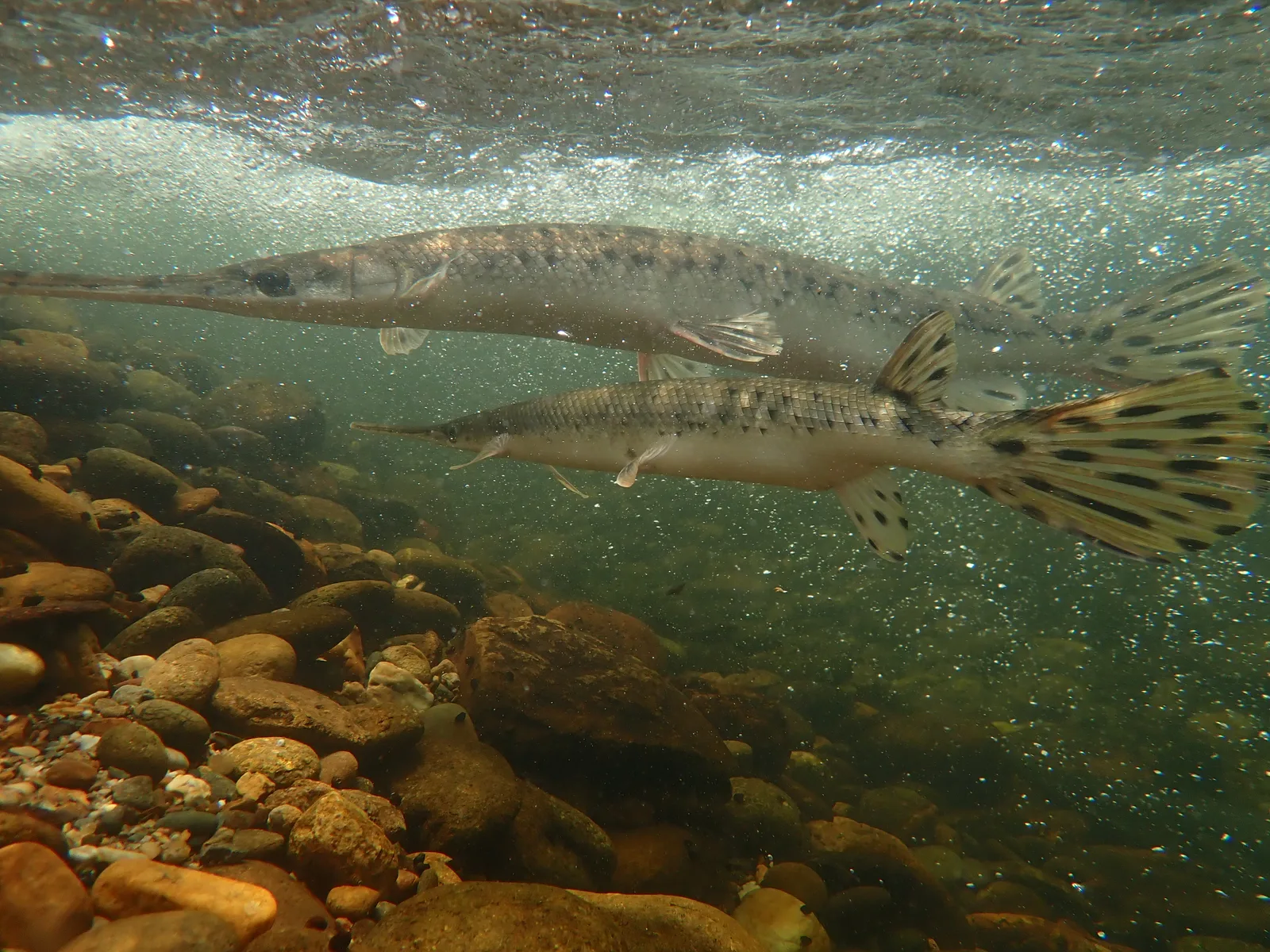 Longnose Gar: Identification, Size, Records, and How to Catch One
Longnose gar commonly reach 3 ft and 5 to 6 lb; the IGFA record is 43 lb, yet four states certify bigger fish. How to ID, find and catch one.
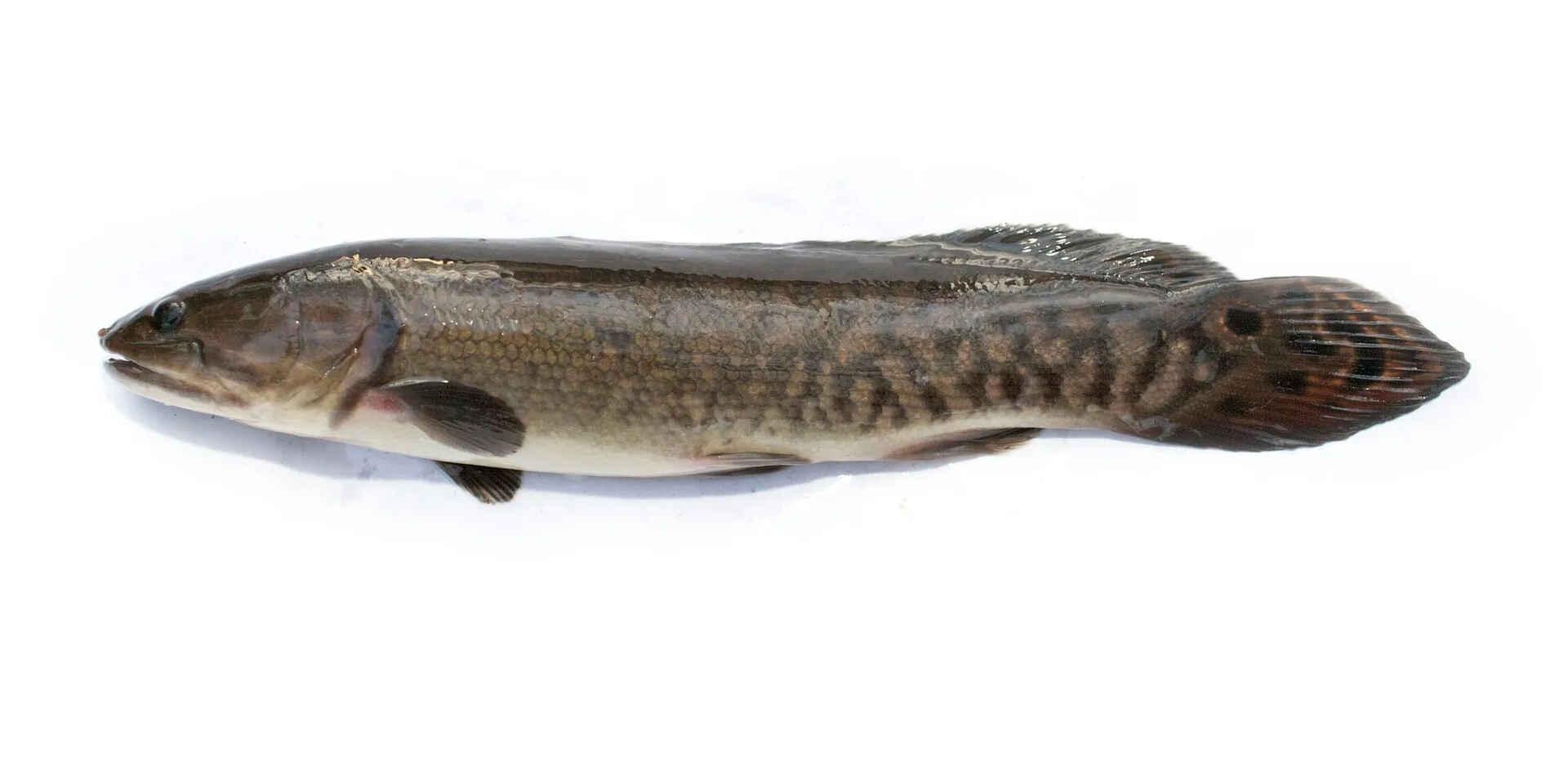 Bowfin: Identification, Bowfin Fishing, and the Snakehead Look-Alike
The bowfin is a native, air-breathing predator with a 21 lb 8 oz world record. How to identify one, tell it from a snakehead, and catch one.
Sources
- California Department of Fish and Wildlife, White Sturgeon (fishing)
- California Department of Fish and Wildlife, White Sturgeon
- Oregon Department of Fish and Wildlife, Sturgeon fishing in Oregon
- Oregon Department of Fish and Wildlife, Green Sturgeon
- Washington Administrative Code 220-316-010, Sturgeon—Areas, seasons, limits and unlawful acts
- Idaho Fish and Game, Sturgeon
- Idaho Fish and Game, Snake River, CJ Strike Reservoir to Bliss Dam (fishing planner)
- Province of British Columbia, Guidelines for Angling White Sturgeon in BC
- Province of British Columbia, B.C. Fraser River White Sturgeon Plan
- Minnesota DNR, How to catch lake sturgeon
- Minnesota DNR, Lake of the Woods winter regulations (2025–2026)
- Minnesota DNR, Minnesota DNR certifies 'fish of a lifetime' lake sturgeon as new catch-and-release state record (May 4, 2026)
- Wisconsin DNR, Lake sturgeon hook and line season
- Wisconsin DNR, The 2026 Hook And Line Sturgeon Season Opens Sept. 5
- Wisconsin DNR, Lake sturgeon fishing seasons
- Wisconsin DNR, 2026 Lake Sturgeon Spearing Season report
- Wisconsin DNR, 2026 Sturgeon Spearing Season Opens Feb. 14
- Michigan DNR, Fisheries Order FO-240, Lake Sturgeon Fishing Regulations
- Missouri Department of Conservation, Lake Sturgeon
- Missouri Department of Conservation, Shovelnose Sturgeon
- U.S. Fish & Wildlife Service, Sturgeon Snoots and Scutes
- The Lost Anchovy, Sturgeon Fishing Tutorial
- 16 U.S.C. § 3372, Lacey Act prohibited acts (LII)
- IGFA World Record Search: Sturgeon, white
- U.S. Fish & Wildlife Service ECOS, species listing status (sturgeon)
- NOAA Fisheries, Green Sturgeon
- California Department of Fish and Wildlife, Can I sell sport-caught fish? (FAQ)