 By
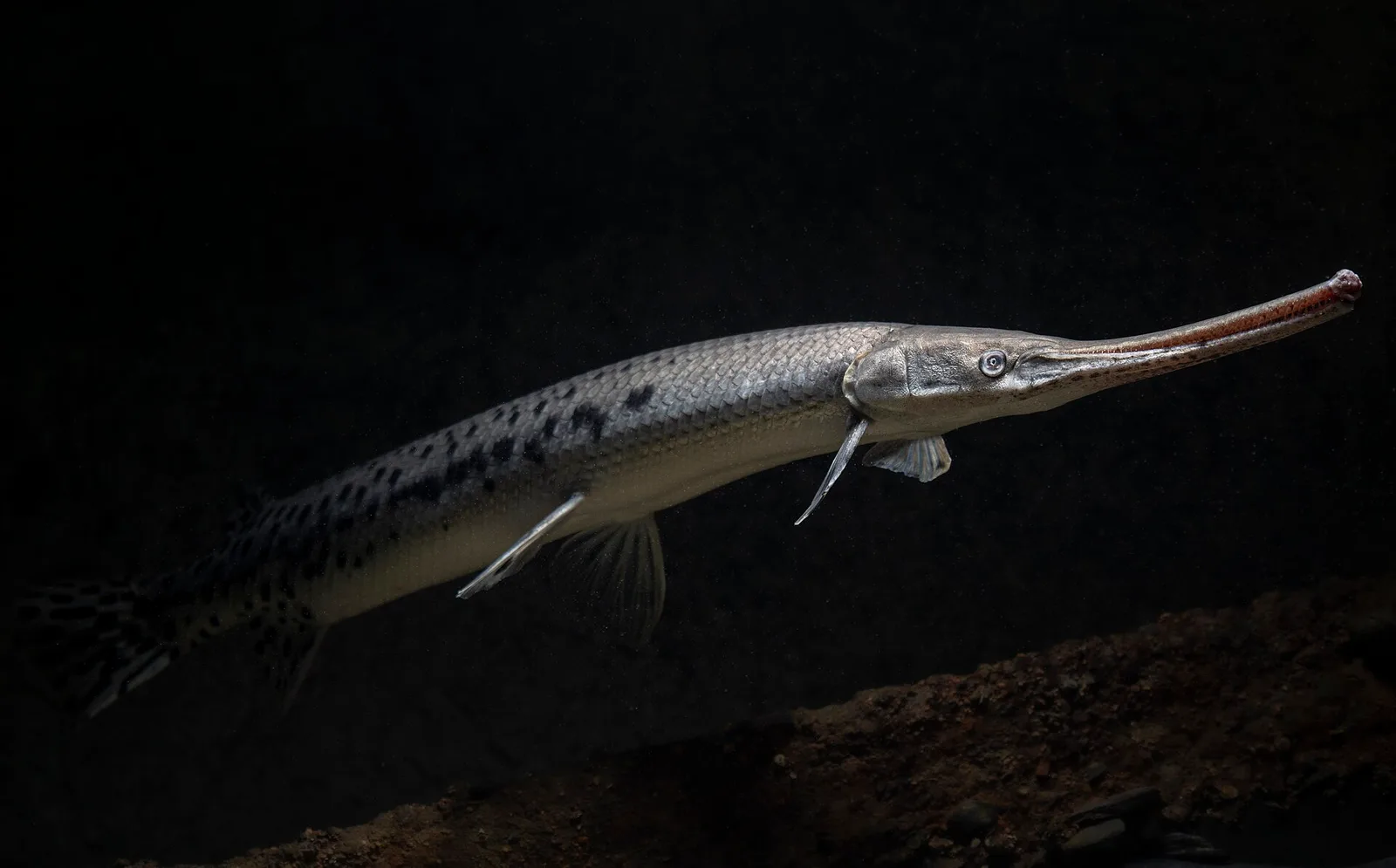
Gar fishing comes down to one problem: a gar’s beak is bone lined with teeth, and a hook point has almost nothing to grip. So gar anglers either tangle those teeth in frayed nylon rope, let the fish swallow a live or cut bait before setting, or shoot them with a bow. The best days are hot, clear and sunny in July and August, when gar lie at the surface where you can see them.
A gar’s teeth are not built to cut. In the Missouri Department of Conservation’s words, they “simply make escape impossible.” That is why a hookless tuft of rope catches them.
Which gar are you fishing for?
The United States has five gars, and they are not the same fishery. Four of them, the longnose, shortnose, spotted and Florida gar, are fish of a few feet and a few pounds that eat mostly small fish; the rope lure and light live-bait rigs below are built for them. The fifth, the alligator gar, grows to 8 ft and more than 300 lb and is fished with heavy cut-bait tackle instead.
What each one eats is your best bait clue, and where it lives tells you where to look:
| Gar | Usual size | Where to look | What it eats |
|---|---|---|---|
| Longnose | Commonly 3 ft (0.9 m), 5–6 lb (2.3–2.7 kg) in Missouri | Sluggish pools, backwaters and oxbows of moderately clear rivers; reservoirs | Almost only fish: minnows when young, mostly gizzard shad later |
| Shortnose | Usually to 28 in (71 cm), 4½ lb (2 kg) | Quiet pools, backwaters and oxbows of big rivers; handles muddy water best | Fish, plus insects and crayfish |
| Spotted | To about 36 in (91 cm), 8 lb (3.6 kg) in Missouri | Quiet, clear water with weed or standing timber | Adults in one swamp study: 90% gizzard shad, plus shrimp, crayfish, insects |
| Florida | Typically 13–34 in (33–86 cm) | Florida streams, canals and lakes with weed over mud or sand | Fish, shrimp and crayfish |
| Alligator | Up to 8 ft (2.4 m), 300+ lb (136 kg) | Big, slow rivers, bayous and reservoirs of the Gulf coast and lower Mississippi | Mostly rough fish: common carp, gizzard shad, buffalo, freshwater drum |
The longnose is the one you are most likely to meet: the IGFA calls it “the most common and widely distributed of all the gars,” and Missouri’s field guide finds it in probably every major stream in the state. Its beak is the giveaway, 15 to 20 times as long as its narrowest width. The shortnose and spotted gars have short snouts, and the spotted carries round black spots on the top of its head and paired fins. The other freshwater fish hub shows the gars beside the bowfin, sturgeon and burbot.
Where and when do gar bite?
Gar like it hot. In In-Fisherman’s gar story, John Gaulke names July and August as his top months, and “the best days are hot, clear, and sunny.” He finds more gar breaking the surface once the water rises into the 70s °F. Terry Smith, who guides on Alabama’s Coosa River, sees “a lot of surface activity” when it reaches the 80s and low 90s °F. Cloud cover can slow or stop the bite, because gar seem to see lures better in sunlight.
Time of day follows the same logic. In the waters Gaulke fishes, the peak summer feed usually runs from 1 to 4 p.m., after a slow morning. Keith Sutton, writing in Game & Fish, finds gar rolling near the surface at dawn, at dusk and at night. Both can be right: watch your own water and fish when the fish are up. Our best time of day guide covers the light and temperature logic that runs most fish.
Where to look:
- Rivers: just below dams, around weedy bends and in backwaters (Gaulke); lock-and-dam tailwaters, outside bends, sandbars along the channel and the mouths of incoming creeks (Sutton).
- Lakes: big weedy flats next to deep water; without deep water nearby, heavy cover (Gaulke). Sutton adds shallow water at the edges of wood and weeds.
- The classic gar water: oxbow lakes, bayous and sluggish delta rivers, in Sutton’s list of the best fishing.
- Warm-water discharges: power-plant outflows are often gar hot spots (Gaulke).
Gar are easy to find once you know the look. They bask just under the surface in warm, still water and rise now and then to snap a gulp of air into a swim bladder that works much like a lung, Missouri’s field guide explains. That makes gar fishing mostly sight fishing, and Gaulke calls polarized glasses “a must.”

Free PDF · Water temperature chart Which fish are biting at today's water temperature?
One water temperature reading, and the 16-page chart tells you who's spawning, who's feeding hard, where they sit and what to throw. 26 fish, every number sourced.
Enter your email, confirm it with one click, and the PDF is in your inbox. Plus one email a week on what's biting. Unsubscribe anytime. Privacy.
What tackle do you need for gar?
For the four smaller gars, a mid-weight outfit does it. Gaulke fishes rope flies on a 7 ft medium-heavy spinning rod with 14 lb monofilament or heavier braid and a 30 lb wire leader. Sutton’s range for the smaller, more common gars is 15 to 25 lb line, and 30 to 80 lb with a stout rod and a reel with an excellent drag for big ones.
A wire leader is the one piece nobody skips: Sutton writes that most serious gar anglers use several feet of steel as insurance against the teeth. The rest of the box is short:
- Rope lures, bought or made (below), and a few split shot or rubber-core sinkers.
- For live bait: a large treble hook and a big, bright bobber you can see at a distance.
- For landing: a fish-handling glove, a jaw spreader and a long hook-removal tool, as the guides in In-Fisherman’s story advise. For alligator gar, TPWD suggests a large landing net, a cradle or a rope lasso.
Alligator gar need far heavier gear; that rig is on the alligator gar page.
How do you make and fish a rope lure?
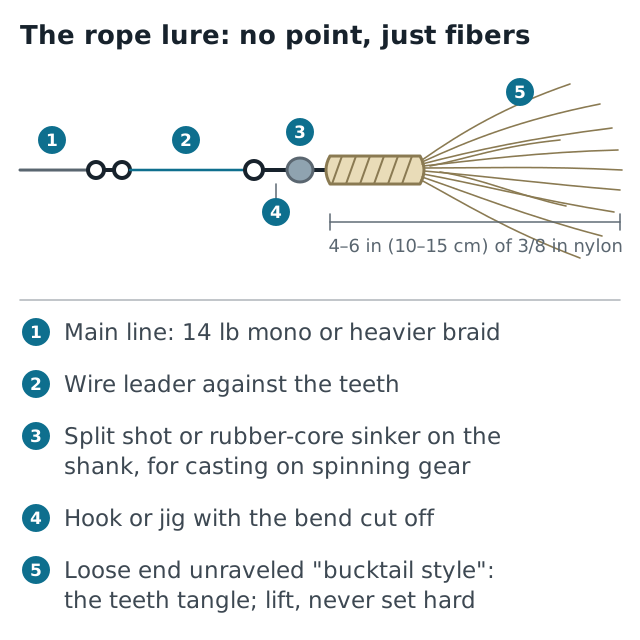
A rope lure has no hook point at all. The gar strikes it, its fine teeth snag in the loose nylon fibers, and the tangle holds the fish. Texas Parks and Wildlife lists entangling the teeth in nylon threads as one of the two ways longnose gar are caught; Florida’s wildlife agency names frayed nylon cord for the Florida gar.
Drawing: fishing.info, from the rigs in In-Fisherman and Game & Fish
- Cut the rope. Sutton’s version is a 4 to 6 in (10 to 15 cm) length of 3/8 in nylon rope. In-Fisherman’s gar story recommends twisted rather than braided rope, because it is easier to comb out.
- Fray it. Unravel the loose end for several inches, “bucktail style,” in Sutton’s words. Mississippi guide Mark Beason, in Bobby Cleveland’s Mississippi Sportsman story, turns each 12 in strand into a 6 in lure on a barrel swivel and frays it with a wire brush.
- Rig it. Sutton attaches the rope to a wire leader. Gaulke ties rope strands to a jig or hook and cuts the hook off at the bend, so there is a shank but no point.
- Weight it for your water. A rubber-core sinker or split shot on the hook shank adds casting weight for spinning gear (Gaulke). Terry Smith fishes his lure weightless or with a 1/4 to 1/2 oz bullet sinker, depending on how deep he is fishing.
- Cast close. Gaulke and Smith believe longnose gar do not see well, so they put the lure very close to the fish. A weighted lure lets you cast from farther off without spooking it.
- Vary the retrieve. Smith finds the retrieve changes with the fish’s mood: “Sometimes they like a lure worked quickly across the surface; other times a slow, steady pumping action is best.” Try both on the first fish that follows.
- Do not set the hook. When a gar hits, wait a second or two and let it turn, then simply lift the rod tip. Gaulke calls a hookset with a rope fly counterproductive, and Beason is blunter: “whatever you do don’t set the hook.”
The fight is the reward. Once the teeth are tangled, the Mississippi Sportsman story says, the gar “can’t get loose,” so keep steady pressure and let it jump.
How do you catch gar on live bait?
Live bait catches gar too, but it asks for patience at the strike. The reason is in how a gar eats. Missouri’s field guide describes a gar drifting toward its prey like a stick, lunging, and grabbing the fish sideways in its jaws. It holds it until the prey stops struggling, then turns it and swallows it headfirst. Set the hook during that first sideways grab and you pull the bait out of a bony beak.
The rig Sutton reports from Dean Peace of Jonesboro, Arkansas: a 4 to 6 in shiner on a 5/0 to 6/0 treble hook, 6 in below a bright orange bobber 4 in across. Cast upstream and drift it through gar feeding at the surface; the big float is easy to see at night. When the bobber goes under, wait for the fish to stop, swallow the bait and begin a second run, then set. Florida’s wildlife agency lists minnows for Florida gar, and the diet table above points the same way: small shad and minnows for the longnose and spotted gar. The shortnose’s taste for crayfish makes a crayfish worth a try.
Gaulke does not recommend hooks for longnose gar at all. If you do use one, he writes, a fish hooked in the small fleshy area in the back corner of the mouth has a good chance of being landed.
Topwater plugs, the wire noose and fly fishing
Three more methods have a following, and each suits a certain kind of angler.
The topwater plug. Sutton calls it “the ultimate form of gar fishing fun,” and the hardest on your patience. Cast a baitfish-imitation plug a few feet in front of a gar and leave it still but for an occasional twitch. Do not move it at all when the gar swims toward it. If the lure stays still, the gar comes forward until the plug is beside its head, and then you set with several hard upward sweeps of the rod.
The wire noose. An old rig Sutton describes: a baitfish run onto a 2 ft piece of thin, strong wire shaped into a loop that closes when the line is pulled. The gar pushes its bill through the loop or grabs the wire going for the bait, and a quick yank snares it by the bill.
Fly fishing. Jack Barnett, who guides for longnose gar on Georgia’s Lake Lanier, uses a 9- to 10-weight rod, a weight-forward floating line and a 20 lb mono leader 4 to 5 ft long. In shallow water he often puts a small float 8 to 10 ft up the line to keep a sinking fly off the bottom. The fly itself is a rope fly: Gaulke’s recipe starts with five or six strands of nylon rope cut to 5 to 6 in. Fly tackle can land big gar. The IGFA lists a 26 lb longnose gar on 4 lb tippet from Lake Livingston, Texas, in 2006. Its heaviest fly-caught alligator gar weighed 85 lb 8 oz, on 20 lb tippet from the Trinity River in 2024.
How do you match the method to the gar?
The short version, every rig as the source gives it:
| Method | Best for | Rig | When to set |
|---|---|---|---|
| Rope lure | Longnose, spotted, shortnose and Florida gar | 4–6 in (10–15 cm) of 3/8 in nylon, frayed, on a wire leader | No hard set: wait a second or two, let it turn, lift |
| Live bait under a float | Gar feeding at the surface | 4–6 in shiner, 5/0–6/0 treble, 6 in below a 4 in bobber | After the fish stops, swallows and starts a second run |
| Topwater plug | One gar you can see | Baitfish-imitation plug, still with an occasional twitch | Several hard upward sweeps once it is beside the head |
| Cut bait | Alligator gar | Cut carp on a 3/0 bronze treble or J-hook, steel leader | After the run; a set right after the pickup hooks about half |
| Bow and arrow | Gar basking at the surface | Bowfishing bow, barbed arrow on a line | None: in Texas a shot fish cannot be released |
When nothing bites, change the light before you change the lure. On a cloudy or cool day the gar may simply not be up; Gaulke’s afternoon window and Sutton’s dusk and night bite are the second chances worth trying.
How do you catch alligator gar?
The alligator gar is the one gar the rope lure does not suit. It has two rows of teeth in the upper jaw where every other gar has one. Mississippi Sportsman calls it “the only one that the rope lure will not catch effectively,” because alligator gar “are reluctant to hit artificial lures.”
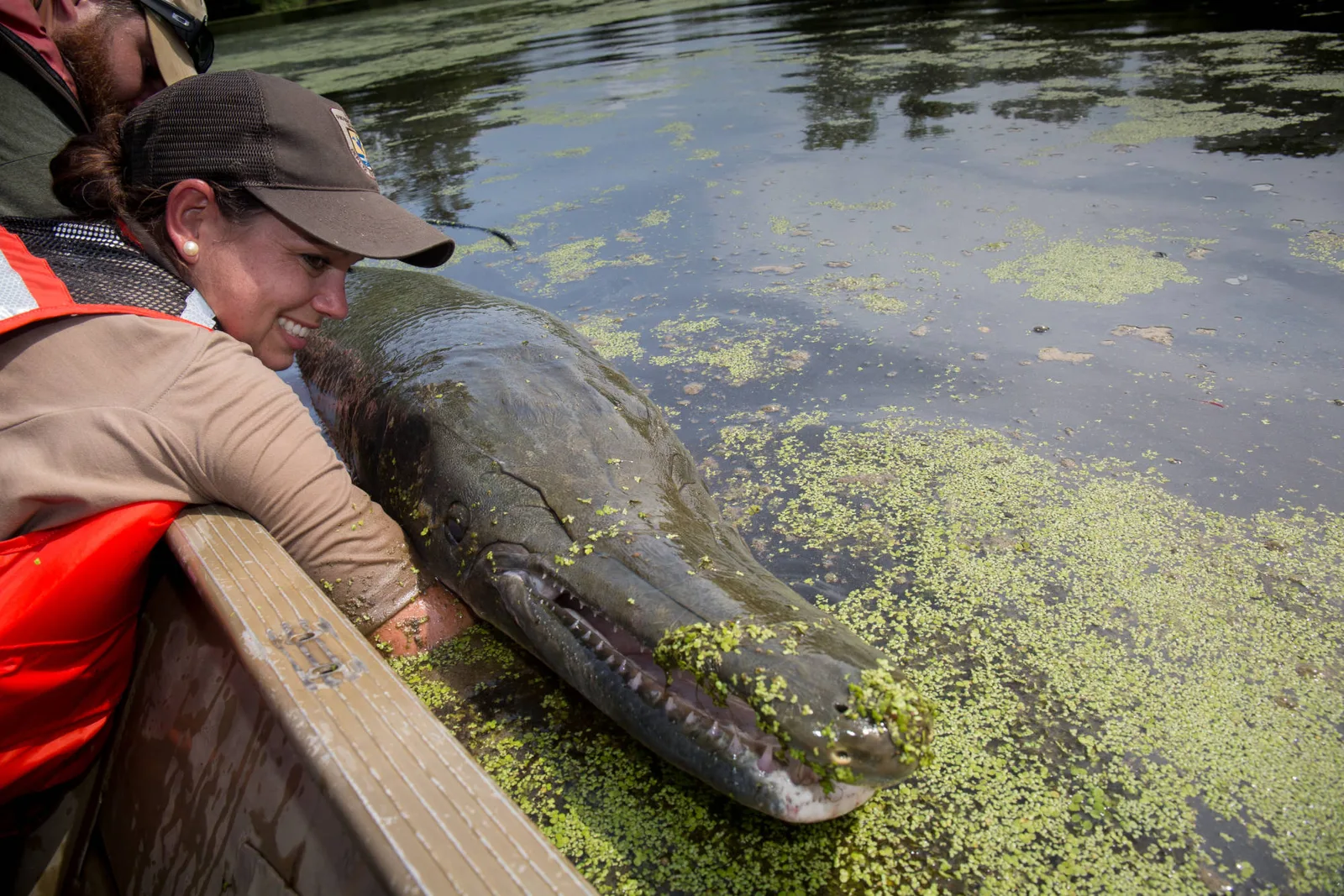
The Texas Parks and Wildlife Department (TPWD) describes the standard rig: cut carp on a 3/0 treble or J-hook, on a steel leader and strong braid, fished suspended or on the bottom. The agency asks for bronze (Aberdeen) hooks no larger than 3/0, because bronze breaks down in the fish while stainless lasts for years. An alligator gar picks up the bait and swims a good distance before it swallows, so many anglers wait, then cut the leader and release the fish with the hook in. Setting before the fish has swallowed works only about half the time, TPWD says. The 283 lb IGFA record took nearly three hours on 6 lb line. The largest ever documented, 327 lb, was netted in Mississippi in 2011.
The rules differ by state, and several states protect the species entirely. Catching gar is legal in Texas: TPWD sets a bag limit of one alligator gar a day statewide, with special rules on some waters, and no bag or size limits on longnose, shortnose or spotted gar. Everything on rigs, rules and records is on the alligator gar page.
How big do gar get on rod and reel?
The IGFA’s all-tackle records show how far apart the five gars are. The alligator gar record is more than six times the longnose record.
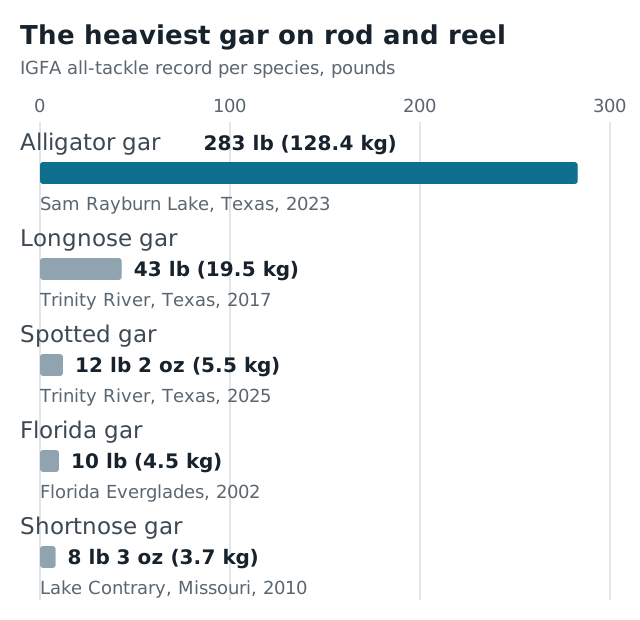
Chart: fishing.info, from the IGFA World Record Search (read November 1, 2026)
Texas dominates the list: three of the five records come from the Trinity River or Sam Rayburn Lake. One angler, Arthur Weston, caught the 283 lb alligator gar on Sam Rayburn on September 2, 2023. Five days later, on the same lake, he caught the longnose gar that holds the IGFA’s all-tackle length record at 148 cm (58 in). Missouri’s field guide gives a sense of everyday size: its biggest longnose gars run about 60 in (152 cm) and 30 lb (14 kg), and its biggest shortnose about 32 in (81 cm).
How do you land and release a gar?
The teeth are the hazard, not the fish. TPWD’s rule for alligator gar is a good one for any gar: “Never stick your hands in the fish’s mouth and stay clear of the powerful tail.” TPWD biologist Dan Daugherty has said there are no documented cases of any gar attacking a person.
- Grip the snout with a glove. The guides In-Fisherman spoke to recommend fish-handling gloves for grabbing a gar by the snout, plus a jaw spreader and a long hook remover.
- Clear every fiber. “Remove all the thread from the fish’s mouth before releasing it,” Terry Smith tells In-Fisherman. “Gar released with their mouth clamped shut with fibers likely die.” This is the step that makes rope fishing a fair catch and release method.
- Land big fish low. For alligator gar, TPWD asks anglers to use a rope lasso, a large net or a cradle, land the fish on shore rather than lifting it over the gunwale, leave a hook that sits beyond the mouth, and release the fish head first.
Bowfishing for gar
Gar are a classic bowfishing target for the same reason they are a sight-fishing target. Missouri’s field guide notes that because gars often bask near the surface, they “provide a ready target for the bow hunter,” and TPWD lists bowfishing beside the nylon-thread method for longnose gar. It is a harvest method, not catch and release: in Texas an arrow counts as lethal, and a shot fish cannot be released. Missouri lists the longnose, shortnose and spotted gars as nongame species, while the alligator gar is protected there. Read your state’s bowfishing rules for each gar before you shoot.
Are gar good to eat?
Some anglers do, though fewer than you might think: in a 2018 TPWD survey of people interested in alligator gar, only about 40% said they actually harvest gar to eat. Missouri’s field guide says gars “are seldom taken on hook and line and are rarely used for food.” Texas biologists describe alligator gar flesh as white, firm and mild, and add that it takes some work to clean and fillet a gar.
Check the consumption advisories for your water first: Texas advises against eating gar from Lake Livingston and the Trinity River. And one rule has no exceptions: never eat the eggs. Gar roe is highly toxic to warm-blooded animals, people included, Missouri’s field guide warns. TPWD says the same of alligator gar: “the eggs are toxic!”
Mistakes to avoid
- Setting the hook on a rope lure. Gaulke calls it counterproductive. Wait a second or two, let the gar turn, then lift.
- Striking at the first grab on live bait. The gar is still holding the bait sideways. Wait for the second run.
- Fishing a cool, cloudy morning and giving up. Gaulke’s best bite comes on hot, bright afternoons; come back when the sun is high and the fish are at the surface.
- Skipping the wire. Sutton’s serious gar anglers use several feet of steel leader as insurance against the teeth.
- Releasing a gar with fibers in its mouth. Pick out every strand: Smith warns that a gar released with its jaws clamped shut by fibers likely dies.
Start with a longnose on a hot July afternoon; for the giant of the family, read the alligator gar guide next.
Free PDF · 16 pages
Know what's biting before your first cast
The Water Temperature Fishing Chart. Take one water temperature reading, find it on the chart, and you know which of 26 freshwater fish are feeding today, where they are and what to throw. For your phone and the tackle box.
- Where they sit and what to throw at every band: bass, crappie, bluegill and walleye; catfish by species; trout: when to stop and where they hide
- The best hours at your reading, the cold front day by day, and the spawn calendar from ice-out to midsummer
- The three thermometer mistakes that make a reading lie (the first one is the surface)
- The 26-fish chart: who's spawning, feeding hard or shut down at your reading
Every number from state fish and wildlife agencies and fisheries research: 61 sources, all on the site.
Enter your email, confirm it with one click, and the PDF is in your inbox. Plus one email a week on what's biting. Unsubscribe anytime. Privacy.
Related
Section guide
Freshwater Fish Species Outside the Big Families: Sturgeon, Gar, Bowfin, BurbotThe freshwater fish species outside the bass, trout, catfish and pike families: sturgeon, gar, bowfin, burbot, drum, eel and paddlefish, with records.
 Freshwater Drum: Sheepshead, Gaspergou and How to Catch Them
Freshwater drum, or sheepshead, mostly run 1 to 5 lb; the record is 54 lb 8 oz. How to tell one apart, the rig that catches it and how to cook it.
 Longnose Gar: Identification, Size, Records, and How to Catch One
Longnose gar commonly reach 3 ft and 5 to 6 lb; the IGFA record is 43 lb, yet four states certify bigger fish. How to ID, find and catch one.
 Bowfin: Identification, Bowfin Fishing, and the Snakehead Look-Alike
The bowfin is a native, air-breathing predator with a 21 lb 8 oz world record. How to identify one, tell it from a snakehead, and catch one.
 Sturgeon: The Nine US Sturgeons, How Big and Old They Get, and the Rules
Nine sturgeons live in US waters and six may never be kept. How to tell them apart, how big and old they get, the records and where you can fish.
- Alligator Gar: Size, Teeth, Records, and How to Catch One
Alligator gar reach 8 ft and 300 lb and can live past 90 years. How to tell them from other gars, how to catch one, the records and the rules by state.
 Burbot: The Freshwater Cod That Spawns Under the Ice
Burbot, the only freshwater cod: one chin barbel, 15–28 in, 1.5–5 lb. When and where they bite through the ice, the glow jig that works, and the rules.
Sources
- In-Fisherman, John Gaulke, Best Summer Gar Fishing Strategies
- Game & Fish, Keith 'Catfish' Sutton, 4 Best Ways to Catch Gar Fish
- Mississippi Sportsman, Bobby Cleveland (2016), Frayed: How to catch hard-fighting gar
- Missouri Department of Conservation, Longnose Gar
- Missouri Department of Conservation, Shortnose Gar
- Missouri Department of Conservation, Spotted Gar
- Texas Parks and Wildlife Department, Longnose Gar (Lepisosteus osseus)
- Florida Fish and Wildlife Conservation Commission, Florida Gar
- Florida Museum of Natural History, Florida Gar – Discover Fishes
- Texas Parks and Wildlife Department, Alligator Gar Fishing Tips and Tactics
- Texas Parks and Wildlife Department, Alligator Gar - Not A Threat to Humans
- Texas Parks and Wildlife Department, Are Alligator Gar Safe to Eat?
- Texas Parks and Wildlife Department, Who Fishes for Alligator Gar?
- Texas Parks and Wildlife Department, Alligator Gar (Atractosteus spatula)
- TPWD: News Roundup: Alligator Gar (fast facts: records, other gars, eggs)
- Missouri Department of Conservation, Alligator Gar
- KUT / Texas Standard (2018), 'A Face Only A Mother Could Love': How Changing Gar's Bad Rap Could Save A Species
- Outdoor Life, Nearly 300-Pound Alligator Gar Should Break World Record
- IGFA World Record Search: Gar, alligator; Gar, longnose; Gar, spotted; Gar, Florida; Gar, shortnose (read 2026-11-01)