 By
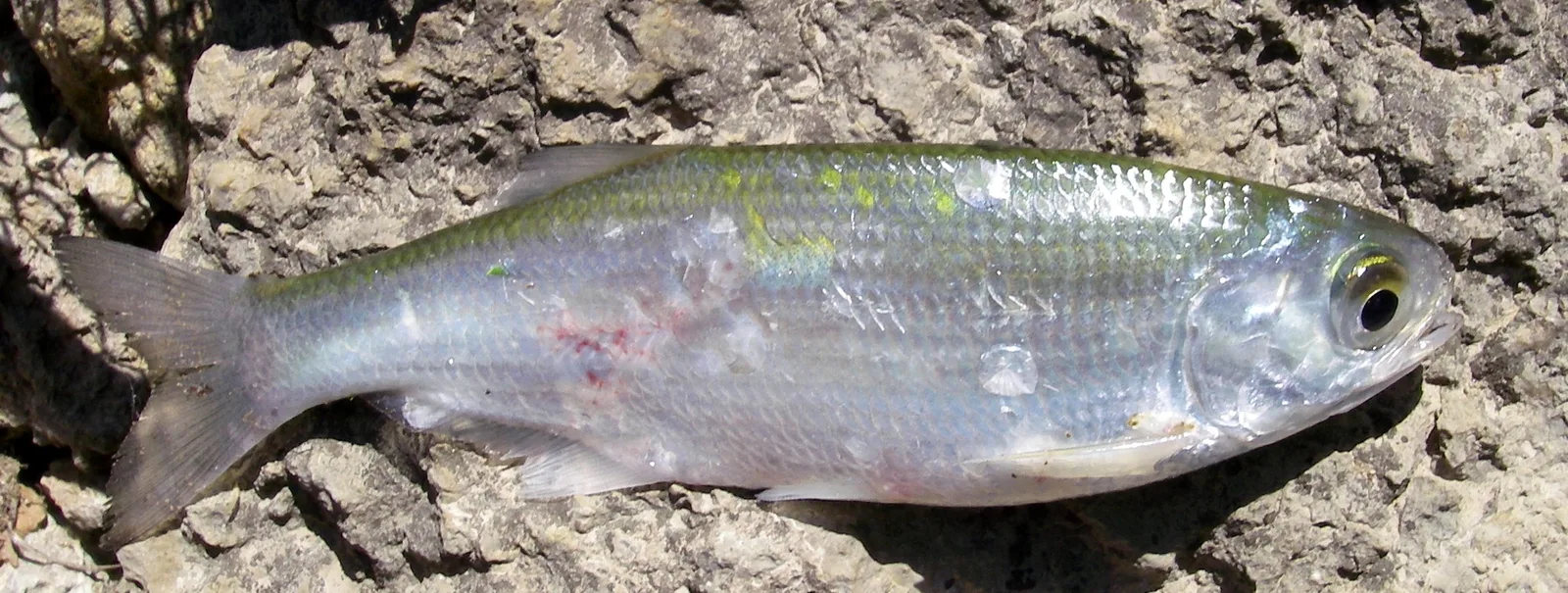
A mooneye is a silvery, flat-sided river fish of 9 to 11 inches with a huge eye and teeth on its tongue. It has one close relative, the goldeye, and the two get mixed up all the time. Look at the eye first: all gold means goldeye, mostly silver means mooneye. Both bite small spinners, flies and worms near the surface, best at low light.
In Winnipeg, goldeye are gutted, lightly brined, dyed orange-red and smoked over oak fires. Fresh off the hook, the same fish is called poor eating.
What is a mooneye fish?
It’s one of only two fish left in the mooneye family. The other is the goldeye, and both live only in North America. They look like a shad or a herring, but they’re not in that family. Missouri calls both “toothed herring” for the teeth on the jaws, the roof of the mouth and the tongue. A real herring has no teeth like that.
The name comes from the eye. It’s big, with a metallic silver or gold shine. Missouri thinks the big eye helps the fish hunt by sight in low light, at night or near dusk. That’s your first fishing tip: fish them early and late.
Here’s what you’ll see in your hand:
- A silver, flat body. The back is greenish or steel blue, the sides and belly silvery white.
- A huge eye with a silvery iris and only a trace of gold.
- A fleshy ridge along the belly, called a keel, but no row of sharp, saw-edged scales like a gizzard shad or an alewife has.
- Teeth on the jaws, the roof of the mouth and the tongue.
Missouri adds a fun detail. The mooneye family used to be grouped with the bony-tongue fish, the same order as the arowanas you see in aquarium shops.
Mooneye vs goldeye: how do you tell them apart?
Look at the eye. A goldeye’s iris is gold. A mooneye’s is silvery, with only a trace of gold. Manitoba calls that “the most obvious difference.” A mooneye’s eye can still show some gold, mostly along the top. Outdoor Canada puts it at gold on the top half and silver on the bottom. So when the eye looks in between, go to the fins.
Check the fins too, in case the light is bad. Find the back fin (the dorsal) and the long fin under the belly near the tail (the anal fin). On a mooneye, the back fin starts ahead of the front of the anal fin. On a goldeye, it starts slightly behind it. If you don’t know your fins, the fish-parts diagram shows where each fin sits.
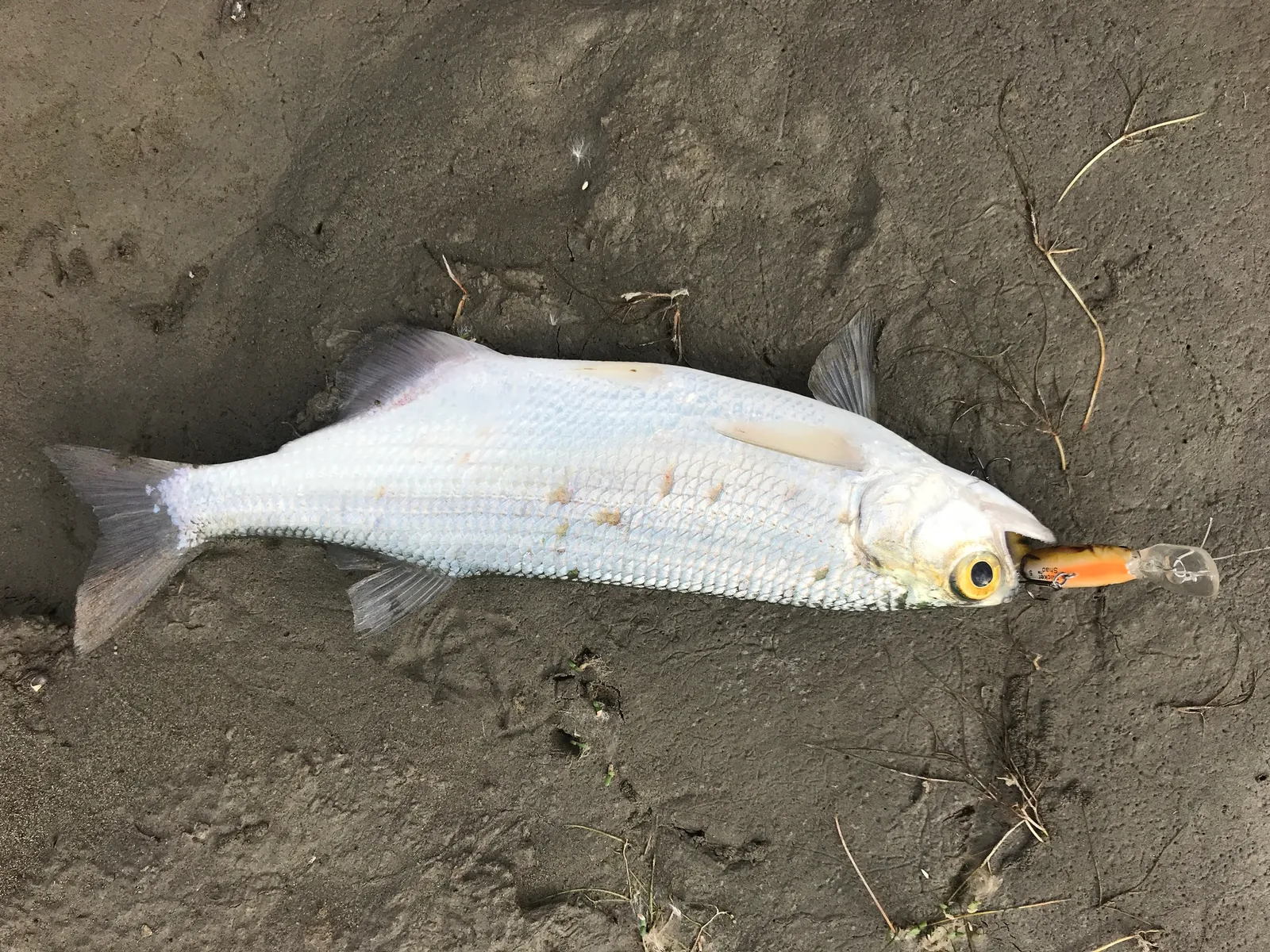
A goldeye from Chouteau County, Montana. Note the gold iris. Photo: Konshau Duman, iNaturalist (CC BY 4.0).
Here’s the full check, with the fish people mistake them for. Iowa says anglers often take a mooneye for a gizzard shad. Some river anglers call goldeye “skipjack,” which is another fish, the skipjack herring.
| Check | Mooneye | Goldeye | Gizzard shad and herrings |
|---|---|---|---|
| Eye color | Silvery, a trace of gold | Gold | Not the test |
| Back fin starts | Ahead of the anal fin | Slightly behind the anal fin | Far forward of the anal fin (herrings) |
| Belly | Fleshy keel, stops at the pelvic fins | Fleshy keel, runs nearly to the pectoral fins | Row of spiny, saw-edged scales |
| Teeth | Jaws, mouth roof, tongue | Jaws, mouth roof, tongue | No prominent teeth |
| Body | Deeper | Slimmer | Gizzard shad: very long last ray on the back fin |
| Common size (Missouri) | 9–11 in (23–28 cm) | 14–16 in (36–41 cm) | Gizzard shad 8–12 in (20–30 cm), Illinois |
The keel is the tiebreaker. Run a finger along the belly from the vent (the opening just ahead of the anal fin) toward the head. On a mooneye the ridge stops at the pelvic fins, the pair on the belly. On a goldeye it keeps going nearly to the pectoral fins behind the gills.
Free PDF · Water temperature chart Which fish are biting at today's water temperature?
One reading, and the 16-page chart shows which of 26 fish are spawning, feeding hard or slowing down; for bass, crappie, bluegill and walleye, where they sit and what to throw. Every number sourced.
No card, nothing to buy, and the PDF is yours to keep. Confirm with one click and it's on its way. Then a few short emails and one a week on what's biting. Unsubscribe anytime. Privacy.
Where do mooneye and goldeye live?
Mooneye like clear water. New York puts their range from the Hudson Bay basin south through the Great Lakes (except Lake Superior), the St. Lawrence River and Lake Champlain. In Iowa they’re in the big rivers, the Cedar, Des Moines and Upper Iowa, and most of all the Mississippi. Illinois calls them common. In Missouri they’re rarer than goldeye, except in the large streams of the southeastern Ozarks, where only mooneye live.
Goldeye take muddier water. Missouri says they’re “rather common” in the Missouri River and the big prairie streams. In the Mississippi they’re more common below the mouth of the Missouri than above. In Canada they range from western Ontario to the Rocky Mountains.
Inside a river, the two pick different spots:
- Mooneye hang in backwaters and quiet spots, but feed in fast current over a firm bottom. Iowa names dam outflows. On Manitoba’s Winnipeg River, Don Lamont finds them in big schools off current breaks and back eddies, and in mud-bottom bays next to heavy current.
- Goldeye sit in open water of large rivers, both in strong current and in quiet pools. Outdoor Canada’s tip: fish the mouths of tributaries to big rivers in late spring. Where you know a good spring walleye run, the goldeye are likely close by.
When do mooneye and goldeye bite?
Both feed at or near the surface, and both eat mostly insects and small fish. Missouri says much of a goldeye’s feeding is done in late evening or at night. That doesn’t mean you can’t catch them at noon. Outdoor Canada says goldeye can be caught during the day all open-water season.
| Time of year | Mooneye | Goldeye | What to do |
|---|---|---|---|
| Late winter to spring | Spawning fish in March (Missouri); into rivers to spawn, March to May (New York) | Females full of eggs in late February at 32 °F (0 °C) in the Missouri River; runs upstream at 50–54 °F (10–12 °C), May and June (Canada) | Fish tributary mouths and the spring walleye spots |
| Summer | Popular in August and September (Manitoba) | Popular in July, August and September (Manitoba) | Low light, near the surface |
| Mid-August to mid-September | Prime time on the Winnipeg River, often on a caddis hatch | Still popular through September (Manitoba) | Look for swirls on the surface and cast to them |
How do you catch mooneye and goldeye?
Go light and stay near the surface. Iowa’s tip is the simplest: mooneye eat minnows, so fish for them like you would for white bass or crappie. Start with one of these three.
First pick: a small spinner on ultralight. Outdoor Canada suggests an ultralight spinning rod with 4- to 6-pound mono. Tie on a Mepps Aglia or a Panther Martin. Both are easy to see in murky water. That’s a classic inline spinner. Keep it high in the water. “The trick is to keep your fly, lure or bait near the surface, where goldeye feed,” Outdoor Canada says.
Second pick: a worm under a bobber. For goldeye, Outdoor Canada’s rig is a plastic bobber, a short leader and a bait hook. Set the bobber so the worm hangs no more than a foot (30 cm) under the surface. On a school of feeding mooneye, Lamont drifts a slip float with a small hook, a split shot and a piece of nightcrawler. He keeps the boat back so the school doesn’t scatter. For goldeye, Missouri adds grasshoppers, crickets and small minnows.
Third pick: a small jig. Lamont also uses a small jig with a 1-inch grub.
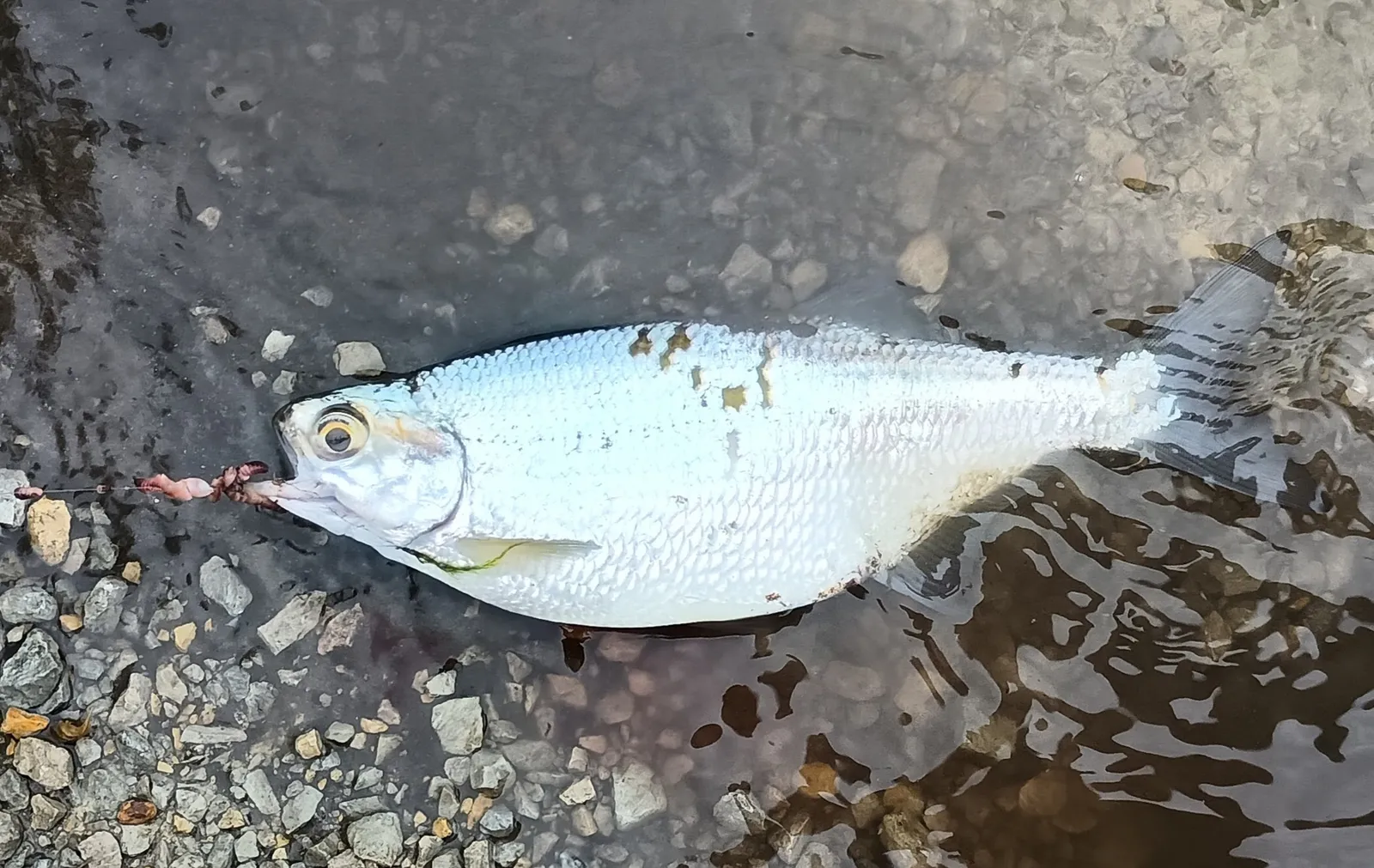
A mooneye from Fillmore County, Minnesota, caught on a worm. Photo: moxostoma, iNaturalist (CC BY 4.0).
Can you catch them on a fly?
Yes. Missouri calls flies or fly-and-spinner combos the most effective lures for goldeye. Outdoor Canada calls goldeye a perfect fly angler’s fish, because they take dry flies, wet flies, streamers and nymphs.
- Rod: a 4-weight, 9-foot rod with a floating line and a 9-foot tapered leader (Outdoor Canada, for goldeye).
- Dry fly: a Chernobyl Ant with a light-colored bottom. Cast across and let it float with the current. If nothing hits, twitch it back across the surface.
- When mooneye are on a caddis hatch: an Elk Hair Caddis. Hooked Magazine describes hundreds of mooneye rising to caddis on the Winnipeg River in August.
- When they’re deeper: a sink-tip line and a black micro leech (Hooked Magazine). Lamont brings two reels, one with a floating line and one with a sink tip.
- Streamers for goldeye: an earth-colored Woolly Bugger on a floating line, since the fish sit near the surface or out in mid-stream (Outdoor Canada).
No fly rod? Outdoor Canada has a trick. Tie a clear torpedo float to your spinning line, then a 10-foot (3 m), 4- to 6-pound mono leader, then the fly. You fish the fly like a fly angler, and you can usually cast farther.
What’s the fight like?
Short and flashy. Missouri says a goldeye makes a short, swift run or jumps a few times, then lets itself be reeled in. It lacks stamina. Lamont calls mooneye “an incredibly fun fish to catch on light tackle or a fly rod.”
How do you release a mooneye?
Keep it in the water. Hooked Magazine calls mooneye “an extremely fragile fish” that often dies after handling. If you’re not keeping it, reach in with pliers, pop the hook out and don’t touch the fish. Lamont says leaving it in the water means a lot fewer of them die. Our catch-and-release guide has the rest.
In some states you have no choice. Michigan lists the mooneye as endangered and New York as threatened, and New York says it “will continue to protect the mooneye from harvest.” North Carolina lists it as a species of special concern, and Missouri says it’s gone from Maryland. The causes Missouri names are silt, muddy and dirty water, and dams that block the fish’s runs. Check your own state’s rules before you keep one.
How big do mooneye and goldeye get?
A typical mooneye is 9 to 11 inches, and the biggest Missouri has recorded was about 13 inches and ¾ pound. New York sees bigger fish: 11 to 15 inches and 1 to 2 pounds. Goldeye run larger, commonly 14 to 16 inches, up to about 18 inches and 3 pounds in Missouri.
| Record | Fish | Size | Where and when |
|---|---|---|---|
| Iowa state record | Mooneye | 1.52 lb (0.69 kg), 15.6 in (39.6 cm) | Mississippi River Pool 9, October 23, 2016 |
| IGFA all-tackle world record | Mooneye | 1 lb 8 oz (0.7 kg) | Lake of the Woods, Minnesota, June 13, 2001 |
| Manitoba Master Angler record | Mooneye | 20 in (50.8 cm), by length | No water given |
| Manitoba Master Angler record | Goldeye | 20.75 in (52.7 cm), by length | No water given |
| IGFA all-tackle world record | Goldeye | 3 lb 13 oz (1.72 kg) | Pierre, South Dakota, August 9, 1987 |
| North Dakota state record | Goldeye | 4 lb 3 oz (1.9 kg), 21 in (53 cm) | Lake Audubon, July 25, 2014 |
That North Dakota fish is heavier than the IGFA all-tackle world record for goldeye. That one is still 3 pounds 13 ounces, caught by Gary Heuer at Pierre, South Dakota, in 1987. Manitoba says its mooneye rivers regularly produce fish over 16 inches, and goldeye at the peak of the bite often top 16 inches too.
Are mooneye and goldeye good to eat?
Fresh, not really. Missouri calls the flesh “soft, bony” and “little valued as food.” The Canadian Encyclopedia says freshly caught goldeye has a poor taste.
Smoked is another story. Missouri says smoked goldeye is “considered a delicacy in Manitoba and Ontario.” As early as 1890, the Canadian Encyclopedia says, smoking was found to improve the taste a lot. Today the commercial fish are processed almost all in Winnipeg and sold whole as “Winnipeg goldeye,” a gourmet item. Lamont says mooneye are “spectacular fare to eat when smoked” too.
So if you keep one, plan to smoke it. And only keep one where it’s legal: the mooneye is endangered in Michigan and threatened in New York. Check your state’s fish consumption advisory before you keep any river fish.
Are they good catfish bait?
Goldeye are. Most big-river anglers after big blue catfish rank gizzard shad, goldeye and, best of all, skipjack herring as the top baits, Missouri’s Conservationist magazine says. Some catch their goldeye on small crappie jigs, and the bait gets cut into pieces. Leave the mooneye out of the bait bucket where it’s protected, and check your state’s bait rules first.
The biology behind the fishing
The big eye. Both fish hunt near the surface. The Canadian Encyclopedia says the goldeye’s large yellow eyes are built for low light and muddy water, which makes it “essentially nocturnal.” That’s a good reason to fish at dusk.
Floating eggs. Both lay eggs that float, which is rare for a freshwater fish and more common in saltwater fish. Missouri says newly hatched goldeye float at the surface for a while, head up. Mooneye in New York spawn over rocks in fast water, March through May, and a female drops about 10,000 to 20,000 eggs.
Growth. In Lake Champlain a mooneye is about 12 inches by age eight. Males live about 7 years and females about 9, Missouri says.
Why clear water matters. Mooneye don’t handle muddy water or steep, fast streams, Iowa says. They’ve been declining in Lake Michigan and Lake Erie, and pulling back into bigger rivers. Goldeye take murky water much better, and they’re the common one in the Missouri River.
A mussel’s ride. The spectaclecase, an endangered freshwater mussel, uses mooneye and goldeye as the main hosts for its young. The tiny larvae ride on the fish for a while and don’t hurt it.
More river fish that live outside the big families, from gar to sturgeon, are on our other freshwater species page.

Free PDF · 16 pages
Stop guessing. Know what's biting before your first cast
A whole Saturday on the water with nothing to show for it. One reading tells you who's feeding.
The Water Temperature Fishing Chart. Take one water temperature reading, find it on the chart, and see which of 26 freshwater fish are spawning, feeding hard or slowing down.
- Where bass, crappie, bluegill and walleye sit, and what to throw. Trout: the reading where you stop.
- Why a 3 ft drop beats a cold front, and what to throw each day of the front
- The three thermometer mistakes that make a reading lie
The chart's numbers come from state fish and wildlife agencies and fisheries research: 61 sources, each listed on the site.
No card, nothing to buy. Confirm with one click and the PDF is on its way, one version for your phone and one to print, yours to keep. Then a few short emails and one a week on what's biting, with an unsubscribe link in every one. Privacy.
Related
Section guide
Freshwater Fish Species Outside the Big Families: Sturgeon, Gar, Bowfin, BurbotThe freshwater fish species outside the bass, trout, catfish and pike families: sturgeon, gar, bowfin, burbot, drum, eel and paddlefish, with records.
 Pacu Fish: Human-Like Teeth, and How to Tell One From a Piranha
A pacu fish is a piranha cousin with flat teeth like human molars. How to tell it from a piranha, how big it gets, and what to do if you catch one.
 Round Goby: How to Identify It, Why It Matters, and the Bait Rules
The round goby is a small invasive bottom fish of the Great Lakes. How to ID one, what each state says about goby bait, and why smallmouth love them.
 Alewife: How to Identify It, Where It Runs and Why Anglers Care
The alewife is a small silver herring: sea-run on the Atlantic, landlocked in the Great Lakes. How to ID one, where it runs, and where you can keep it.
 Candiru: The Amazon's Vampire Catfish and the Urethra Myth
The candiru is a tiny see-through Amazon catfish that drinks blood from fish gills. What it really does, its size, and the urethra story checked.
 Fathead Minnows: ID, Bait, Pond Stocking and Rosy Reds
Fathead minnows are tough 2 to 3 in baitfish. How to identify them, keep them alive in a bucket, stock a pond by the pound, and spot a rosy red.
 Golden Shiner: How to ID, Catch and Fish This Trophy Bait
Golden shiners are deep-bodied minnows and Florida's top live bait for big bass. How to tell one from a rudd, catch your own, and hook it right.
Sources (21)
- Missouri Department of Conservation, Field Guide: Mooneye
- Missouri Department of Conservation, Field Guide: Goldeye
- Illinois DNR, Wild About Illinois Fishes: mooneye
- Illinois DNR, Wild About Illinois Fishes: goldeye
- Illinois DNR, Wild About Illinois Fishes: gizzard shad
Show all 21 sourcesShow fewer sources
- Iowa DNR, Fish Iowa: Mooneye
- New York State Department of Environmental Conservation, Mooneye
- Outdoor Alabama (ADCNR), Mooneye
- Hunt Fish Manitoba (Travel Manitoba), Mooneye
- Hunt Fish Manitoba (Travel Manitoba), Goldeye
- Hooked Magazine, Don Lamont: Fall time is mooneye time! (2016)
- Hooked Magazine, Mooneyes on the Fly! A time-honoured tradition
- Outdoor Canada, Duane Radford: Why you've got to try fishing for goldeye this spring (2016)
- The Canadian Encyclopedia, Goldeye
- North Dakota Game and Fish Department, North Dakota Record Fish (list of November 13, 2026)
- International Game Fish Association, World record search: goldeye and mooneye, all-tackle (member-portal API, read 2026-11-14)
- Michigan Administrative Code, R 299.1023: endangered and threatened fish species
- Michigan DNR, Threatened and endangered species list
- North Carolina Administrative Code, 15A NCAC 10I .0105: special concern species listed
- Danny Brown, Catching Big River Blues (Missouri Conservationist, June 2006)
- Big Muddy Fishing, That Is A Goldeye! Not a Mooney. Not a Skipjack.