 By
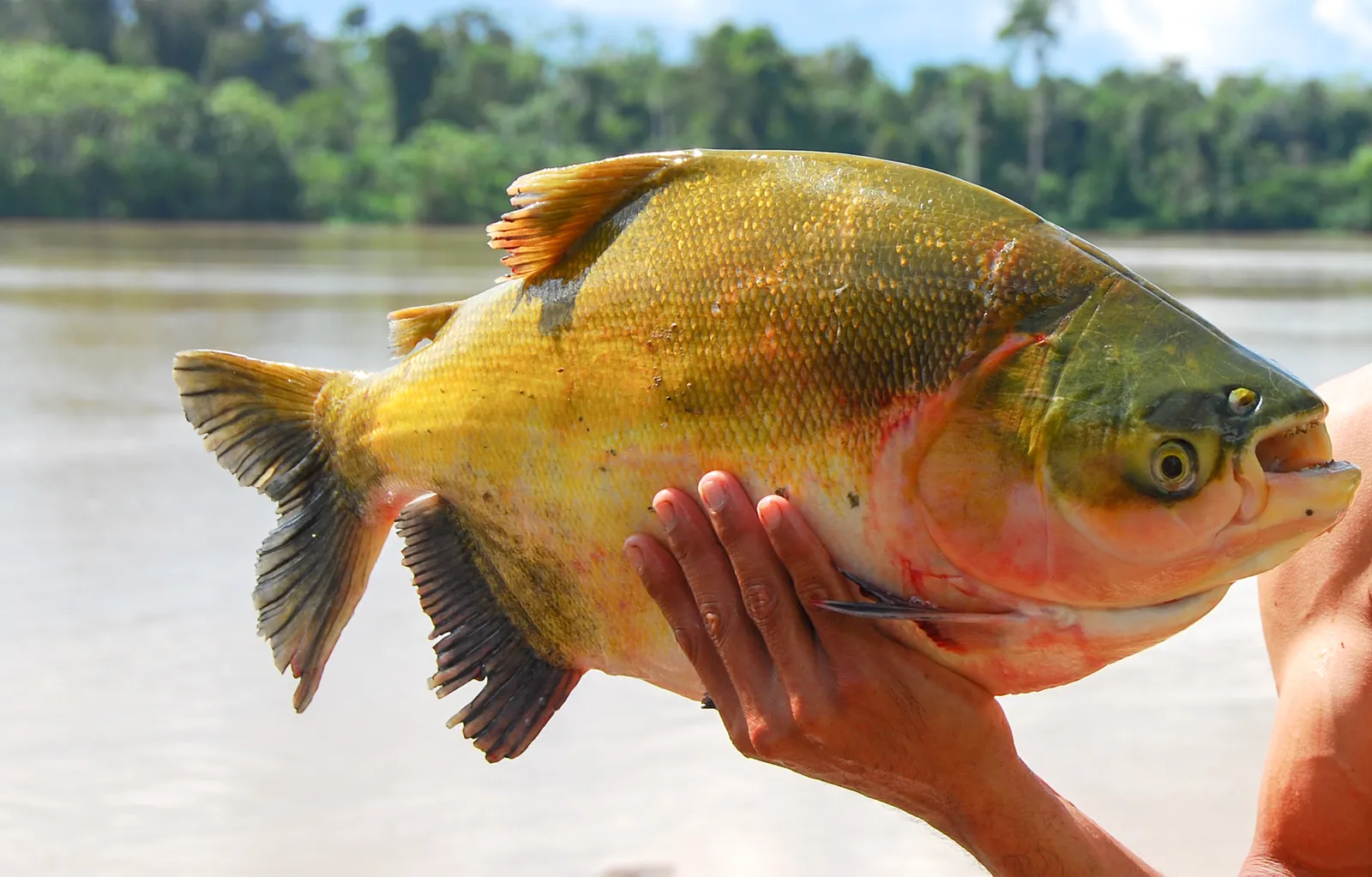
A pacu fish is a South American cousin of the piranha with flat, square teeth that look a lot like your own molars. It eats mostly fruit, nuts and seeds. It also grows far bigger than any piranha: the tambaqui, or black pacu, reaches 30 kg (66 lb). In a US lake, a pacu is most likely a pet someone dumped, and that happens more often than you’d think.
Red-bellied pacu have turned up in more than 40 US states. In not one of them has anybody found one spawning.
Pacu or piranha: how do you tell them apart?
Look in the mouth, and open it with pliers. Two rows of flat, blocky teeth means pacu. One row of sharp, pointed teeth means piranha. USGS calls the teeth the main mark: “single row of serrated incisor-like teeth in piranhas vs. two rows of molariform teeth in pacus.” Molariform just means shaped like a molar.
You can see the bite before you touch the fish. “A piranha has an underbite whereas the pacu has almost more of an overbite,” Utah’s wildlife agency said. That was after a 13-inch pacu came out of Utah Lake.
Don’t go by color. A young pacu has a red belly and a silver back, just like a red-bellied piranha. FishBase says young red-bellied pacu copy the piranha’s look. A Copenhagen aquarium curator explains why: small pacu hide in piranha schools for safety.
| What to check | Pacu | Piranha |
|---|---|---|
| Teeth | Two rows, flat and square, like molars | One row, sharp, pointed, serrated |
| Jaw | Close to an overbite | Underbite |
| Biggest size | 30 kg (66 lb), tambaqui (USGS) | 3.9 kg (8.6 lb), red-bellied (FishBase) |
| Main food | Fruit, nuts, seeds | Fish, insects, worms |
| Owning a live one in Texas | Not on the prohibited list | Prohibited, every genus named |
Even newspapers get it wrong. USGS says many pacu caught in US waters “have been misidentified and reported as the red piranha.” A Pennsylvania paper’s piranha from the Lehigh River was “most likely a pacu based on the reported fish size.” A Florida “piranha” from 1987 turned out to be a pacu too. So if your fish weighs a few pounds, think pacu first.
Why do pacu have human-like teeth?
To crack nuts. In the Amazon, pacu spend the flood season in drowned forest, eating the fruit and nuts that fall from the trees. “They have very powerful jaws that they use to crack the nuts,” says Lars Skou Olsen, a curator at the Blue Planet Aquarium in Copenhagen. A tooth built for that job ends up looking a lot like yours.
Our page on fish teeth covers the other odd mouths, from the piranha to the sheepshead. The tambaqui eats two ways. Its molars crush nuts and seeds, and long gill rakers strain tiny animals out of the water.
Can a pacu bite you?
Yes, and it hurts. FishBase says the red-bellied pacu has “powerful dentition that can cause serious bites.” It lists both big pacus as fish that can wound you. Treat the mouth the way you’d treat a piranha’s.
Big ones are strong, too. Olsen says that when his staff net a large pacu, “they will drag you around in the tank until you get them up.” Hold it by the body. Keep your hands away from the mouth, and use pliers or a lip gripper on the hook.
Free PDF · Water temperature chart Which fish are biting at today's water temperature?
One reading, and the 16-page chart shows which of 26 fish are spawning, feeding hard or slowing down; for bass, crappie, bluegill and walleye, where they sit and what to throw. Every number sourced.
No card, nothing to buy, and the PDF is yours to keep. Confirm with one click and it's on its way. Then a few short emails and one a week on what's biting. Unsubscribe anytime. Privacy.
Do pacu really bite men’s testicles?
Probably not. National Geographic called the fear “overblown,” and the famous version is a joke that got away. In August 2013, fisherman Einar Lindgreen netted a pacu in the Øresund, the strait between Sweden and Denmark. The Natural History Museum of Denmark announced the catch, and Danish experts added a warning. Anyone swimming there had “best keep their swimsuits well tied.”
The museum’s fish expert, Henrik Carl, added fuel. He told The Local that “human testicles are just a natural target,” NPR reported. He also said you’re more likely to drown than to be bitten by a pacu.
Then the museum walked it back. “All we said last week (with a smile) was that male swimmers should keep their pants on,” Peter Rask Møller told National Geographic. Olsen was blunter: “I think it’s just a rumor.”
So where did the idea come from? NPR points to Papua New Guinea. There, in 2011, a pacu was “purportedly blamed” for attacking two men. The fish is “reportedly nicknamed ‘the ball cutter’” there. Purportedly and reportedly carry the weight in those lines, and neither NPR nor National Geographic had more to show.
Which pacu did you catch?
Three big pacus turn up in US water, and you need a close look to tell them apart. The red-bellied pacu is the one you’re most likely to hook. USGS says some, perhaps all, of the US fish logged as small-scaled pacu “may actually have been” red-bellied pacu. Hybrids from fish farms muddy it further.
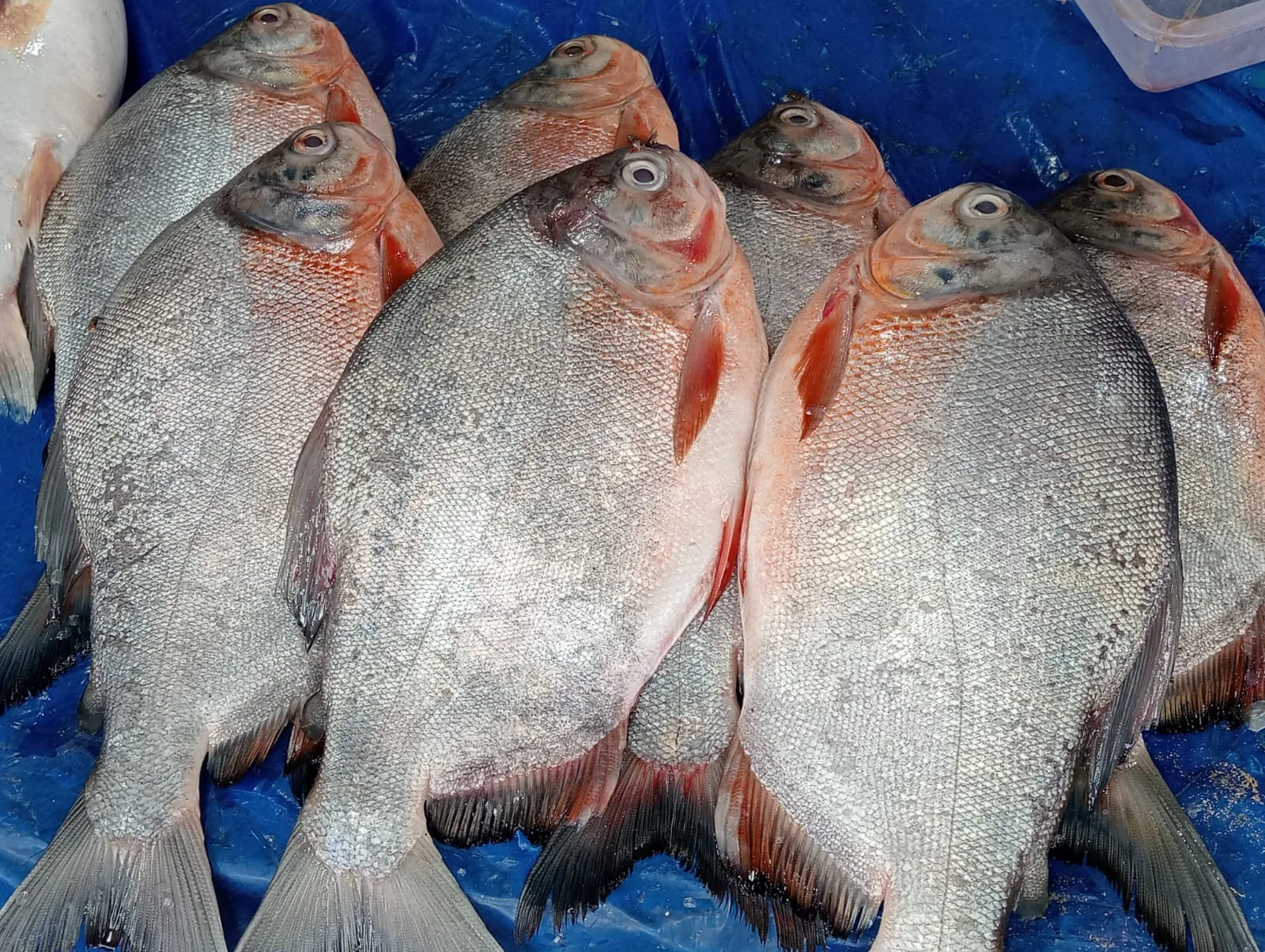 Red-bellied pacu at a market. The red belly doesn’t make it a piranha, so check the mouth. Photo: Sannidhishetty, Wikimedia Commons (CC0).
Standard length runs from the snout to the base of the tail, without the tail fin.
| Pacu | Also called | Biggest size (USGS) | Home water | Found in the US |
|---|---|---|---|---|
| Red-bellied pacu | Pirapitinga, cachama blanca | 85 cm (33 in) standard length, 20 kg (44 lb) | Amazon basin | Reported from 43 states, breeding in none |
| Tambaqui | Black pacu, cachama, gamitana | 90 cm (35 in) standard length, 30 kg (66 lb) | Amazon and Orinoco basins | Failed in six states, possibly established in Puerto Rico |
| Small-scaled pacu | Pacu caranha (IGFA) | About 85 cm (33 in) standard length, 20 kg (44 lb) | La Plata basin (Paraguay and Paraná rivers) | Single fish in Florida and Oregon, plus a 1995 Texas report |
To split the two main ones, check the small fin on the back between the dorsal fin and the tail. That’s the adipose fin. On a tambaqui it has rays. On a red-bellied pacu it doesn’t, USGS says. Inside the mouth, the red-bellied pacu has a triangular gap between its rows of upper teeth. The tambaqui has none.
Why are pacu showing up in US lakes?
People let their pets go. A pacu is sold as a cute little fish in a pet store, and it doesn’t stay little. Utah’s agency said the Utah Lake fish probably started as a 3-inch pet on its way to a full-grown 30 inches. The owner didn’t know what to do next. “They can’t kill them – they don’t have the heart,” said Utah outreach manager Scott Root. “So they do something even worse and put them in some water somewhere.”
USGS’s state table lists red-bellied pacu from 45 states, from Maine to Hawaii. That’s two more than the 43 in its own summary. Texas leads by far, with fish from 30 drainages. Every Texas fish was caught by an angler and later named by Texas Parks and Wildlife. Florida (13 drainages) and Georgia (12) come next. A few Florida and Georgia fish may be fish-farm escapes, USGS says. Most were likely aquarium releases.
You’ll find real cases all over. Arizona Game and Fish confirmed a pacu from a lake in Tucson’s Christopher Columbus Park. South Carolina’s DNR says pacu are occasionally caught in Lake Hartwell, a local TV station reported. In 2017 one was found dead on the shore of a lake in Cedar City, Utah.
Cold water is the likely reason they never take hold. At home a pacu lives in 72 to 82 °F (22 to 28 °C) water. Utah’s agency said the Cedar City fish “didn’t survive long in the cold water.” Most US reports are of one fish, or a few. The count is likely low, too. USGS says “many additional captures probably have gone unreported.”
Watch out: a pacu’s teeth can hurt you. Open the mouth with pliers, never a finger.
Caught a pacu? Here’s what to do
- Keep it. Don’t put it back. South Carolina’s DNR says it’s illegal to release one. Utah calls releasing aquarium fish “ILLEGAL and potentially highly damaging to the lake environment.”
- Take photos of the mouth and the side. The teeth tell pacu from piranha, and the adipose fin helps tell which pacu.
- Call your state fish and wildlife agency. Utah’s agency took in the Utah Lake fish and named it.
- Report it to USGS. Its sighting report form is how pacu end up on the national map.
- Have a pacu at home you can’t keep? Don’t dump it. Florida law makes it “unlawful … to release within this state, any species of the animal kingdom not native to Florida” without the state’s say-so. The state’s Exotic Pet Amnesty Program finds new homes for nonnative pets.
That’s the same drill as for a snakehead, the other invasive fish you might hook by surprise. The difference: no pacu has been found breeding in any US state. The one question mark is Puerto Rico, where USGS lists the tambaqui as “possibly established.”
How do you catch a pacu?
Fish fruit or a nut, keep it still, and put wire in front of the hook. That’s the advice from the guides and fly anglers who chase them in South America, and it follows from the teeth.
Acute Angling, an outfitter that runs Amazon trips, says to “present fruit baits or cut chunks of native nuts.” Then “keep bait stationary and let the fish find it rather than retrieve.” Its tackle list for bait fishing:
- A medium-heavy spinning or baitcasting rod
- 30–50 lb braid
- A 60–80 lb mono or fluorocarbon leader
- 2/0–5/0 circle hooks
Oliver White, writing in Fly Fisherman, put 8 inches of 40-pound single-strand wire at the end of his leader. “Pacus will easily bite through monofilament,” he wrote. Keep your wire leader short like his.
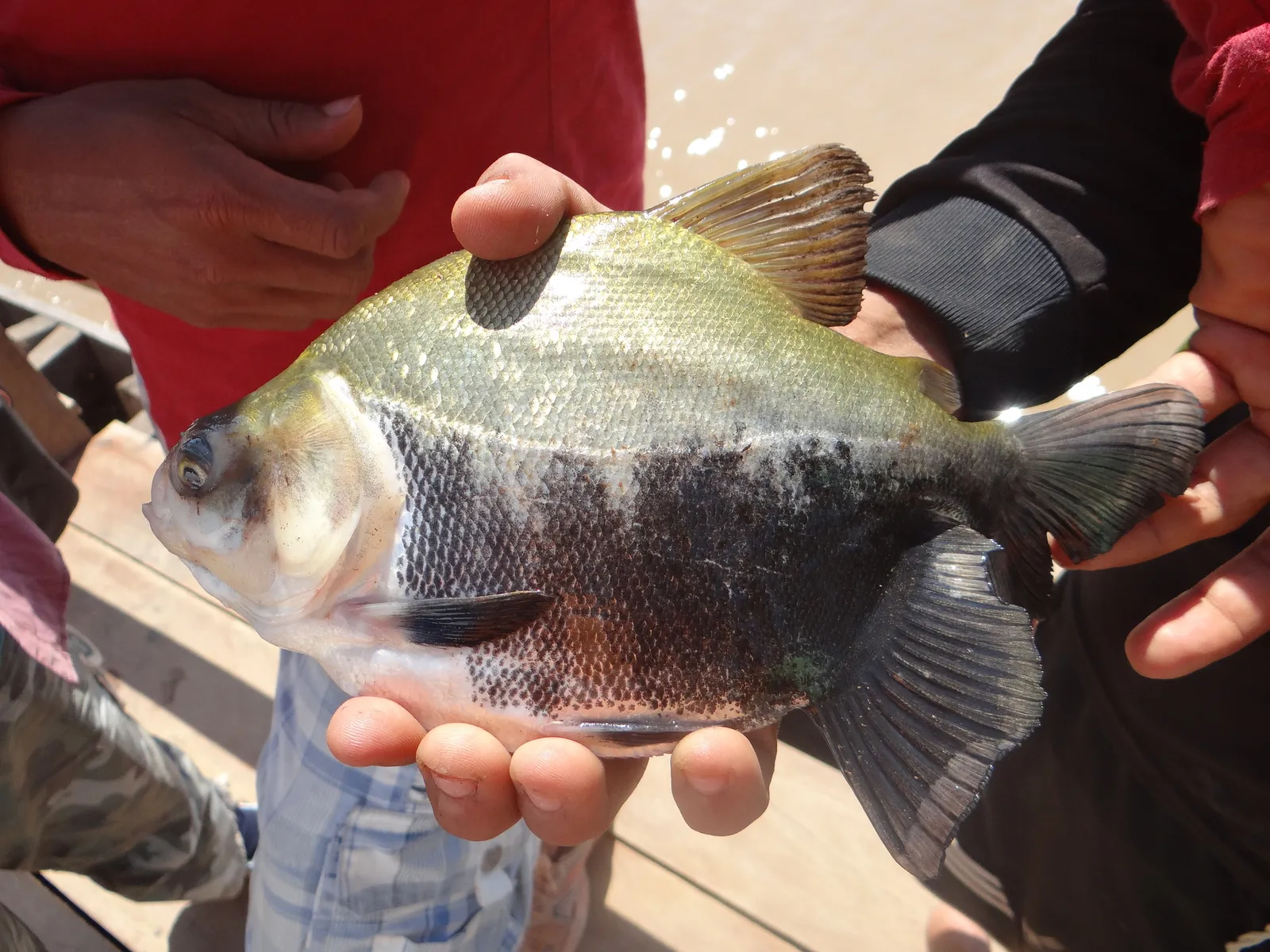 A tambaqui, the black pacu, in Bolivia. Photo: Vincent A. Vos, via iNaturalist and Wikimedia Commons (CC BY 4.0).
Look for pacu tight to the bank under trees that hang over the water. In Argentina, White wrote, they “loved sitting tight to the bank, always under overhanging trees.” Once hooked, they ran for the nearest logjam. On Bolivia’s Sécure River he found them in slow, clear pools, at 15 to 25 pounds.
On the fly, his best move was a small weighted streamer. He dropped it with an open loop so it “plopped downward in the pool to mimic a falling nut or fruit.” Done right, the pacu ate the fly as it started to sink. Fly Fisherman calls them “incredibly skittish,” and White had to lengthen his leader to 12 feet.
Tambaqui are easier to reach in the dry season. In low-water months they “may congregate in deeper pools and lagoons,” Acute Angling says. Use fruit, seeds or dough balls near forested backwaters.
How big do pacu get, and what’s the record?
The tambaqui is the giant. USGS calls it the second largest scaled fish in the Amazon basin. FishBase gives a bigger top size than USGS does, so here are both.
| Fish | Biggest size | Rod-and-reel record |
|---|---|---|
| Tambaqui (black pacu) | 90 cm (35 in) standard length, 30 kg (66 lb), USGS; 108 cm (42.5 in) total length, 40 kg (88 lb), FishBase | 32.4 kg (71 lb 7 oz), IGFA all-tackle |
| Red-bellied pacu | 85 cm (33 in) standard length, 20 kg (44 lb), USGS; 88 cm (34.6 in) total length, 25 kg (55 lb), FishBase | No IGFA record found |
| Small-scaled pacu | About 85 cm (33 in) standard length, 20 kg (44 lb), USGS | 10.21 kg (22 lb 8 oz), IGFA all-tackle |
The tambaqui record was caught by Jorge Masullo de Aguiar at Lago Grande, Amazonas, Brazil, on August 25, 2007. IGFA lists the small-scaled pacu as “pacu, caranha.” Alejandro Linares caught that record in the Rio Tarija, Bolivia, on September 28, 2008.
How fast they grow matters if you ever see one for sale. Olsen’s aquarium buys them at 5 to 10 cm (2 to 4 inches). It “takes them five to six years before they’re around 20 kilos (44 pounds) and about a meter (3 feet) long.” The arapaima, from the same flooded forests, grows far bigger still.
Are pacu good to eat?
Yes. In South America they’re a top food fish. USGS calls the red-bellied pacu “a prized food fish in South America.” Tambaqui are farmed there and sold fresh and frozen.
NPR says pacu has “a mild, slightly sweet flavor.” It cites a 1997 US taste test that found it “comparable to that of hybrid striped bass, tilapia, and rainbow trout, but superior to catfish.”
A dumped pacu from a US lake ate whatever was in that lake. Check your state’s fish consumption advisory for that water before you keep one for the table.
The biology behind the fishing
Pacu live by the flood. When the rivers rise, they move into the flooded forest and eat what falls from the trees. FishBase says adult tambaqui stay there for the first five months of the flood, eating “fruits and grains.” USGS calls red-bellied pacu “major seed dispersers.” That’s why you fish the bank under a fruiting tree.
They spawn on the move. Red-bellied pacu leave the lagoons as the flood starts and swim upstream to spawn in the headwaters, USGS says. The newly hatched young drift back down to the flooded forests and grasslands to feed on plankton. As small fish, they hide among piranha schools.
They live long and need warm water. FishBase gives the red-bellied pacu a top reported age of 28 years, and Olsen’s aquarium has kept some for nearly 20. Both big pacus want water of about 72 to 82 °F (22 to 28 °C). That’s the likely reason a pacu in your lake stays a one-off and never becomes a population.
For the other strange fish of these rivers, from the piranha to the candiru, start at our other freshwater species page.

Free PDF · 16 pages
Stop guessing. Know what's biting before your first cast
A whole Saturday on the water with nothing to show for it. One reading tells you who's feeding.
The Water Temperature Fishing Chart. Take one water temperature reading, find it on the chart, and see which of 26 freshwater fish are spawning, feeding hard or slowing down.
- Where bass, crappie, bluegill and walleye sit, and what to throw. Trout: the reading where you stop.
- Why a 3 ft drop beats a cold front, and what to throw each day of the front
- The three thermometer mistakes that make a reading lie
The chart's numbers come from state fish and wildlife agencies and fisheries research: 61 sources, each listed on the site.
No card, nothing to buy. Confirm with one click and the PDF is on its way, one version for your phone and one to print, yours to keep. Then a few short emails and one a week on what's biting, with an unsubscribe link in every one. Privacy.
Related
Section guide
Freshwater Fish Species Outside the Big Families: Sturgeon, Gar, Bowfin, BurbotThe freshwater fish species outside the bass, trout, catfish and pike families: sturgeon, gar, bowfin, burbot, drum, eel and paddlefish, with records.
 Mooneye and Goldeye: How to Tell Them Apart and Catch Them
A mooneye is a silvery, big-eyed river fish with teeth on its tongue. How to tell it from a goldeye, where both live, how to catch them, and how they eat.
 Round Goby: How to Identify It, Why It Matters, and the Bait Rules
The round goby is a small invasive bottom fish of the Great Lakes. How to ID one, what each state says about goby bait, and why smallmouth love them.
 Alewife: How to Identify It, Where It Runs and Why Anglers Care
The alewife is a small silver herring: sea-run on the Atlantic, landlocked in the Great Lakes. How to ID one, where it runs, and where you can keep it.
 Candiru: The Amazon's Vampire Catfish and the Urethra Myth
The candiru is a tiny see-through Amazon catfish that drinks blood from fish gills. What it really does, its size, and the urethra story checked.
 Fathead Minnows: ID, Bait, Pond Stocking and Rosy Reds
Fathead minnows are tough 2 to 3 in baitfish. How to identify them, keep them alive in a bucket, stock a pond by the pound, and spot a rosy red.
 Golden Shiner: How to ID, Catch and Fish This Trophy Bait
Golden shiners are deep-bodied minnows and Florida's top live bait for big bass. How to tell one from a rudd, catch your own, and hook it right.
Sources (22)
- U.S. Geological Survey, Nonindigenous Aquatic Species Database, Piaractus brachypomus (pirapitinga, red-bellied pacu) fact sheet
- U.S. Geological Survey, Nonindigenous Aquatic Species Database, Colossoma macropomum (tambaqui) fact sheet
- U.S. Geological Survey, Nonindigenous Aquatic Species Database, Piaractus mesopotamicus (small-scaled pacu) fact sheet
- U.S. Geological Survey, Nonindigenous Aquatic Species Database, Colossoma or Piaractus sp. (unidentified pacu) fact sheet
- U.S. Geological Survey, Nonindigenous Aquatic Species Database, Sighting Report Form
Show all 22 sourcesShow fewer sources
- FishBase, Colossoma macropomum, Cachama (tambaqui)
- FishBase, Piaractus brachypomus, Pirapitinga
- FishBase, Pygocentrus nattereri, Red piranha
- IGFA World Record Search: Tambaqui, Colossoma macropomum (all-tackle, Jorge Masullo de Aguiar, 32.4 kg, Lago Grande, Amazonas, Brazil, August 25, 2007); Pacu, caranha, Piaractus mesopotamicus (all-tackle, Alejandro Linares, 10.21 kg, Rio Tarija, Bolivia, September 28, 2008)
- NPR, The Two-Way, Beware The Pacu, Experts Tell Men Who Skinny-Dip In Scandinavia (August 13, 2013)
- National Geographic, Fears of 'Testicle-Eating' Fish Overblown (2013)
- KSL.com (Associated Press), Piranha-like Fish Caught in Utah Lake Was a Pacu
- Cedar City News, Big pacu found at city pond; ditching fish creates problems (March 23, 2017)
- Tucson News Now (KOLD), Fish with human-like teeth caught in Tucson lake
- Fox News, South Carolina teen catches invasive piranha-like fish, sparks reminders that it's illegal to release: report (April 10, 2023)
- Florida Statutes, section 379.231, Regulation of nonnative animals
- Florida Fish and Wildlife Conservation Commission, Regulations for Nonnative Fish and Wildlife
- Florida Fish and Wildlife Conservation Commission, Exotic Pet Amnesty Program
- Texas Parks and Wildlife Department, Exotic Fish, Shellfish and Invasive Aquatic Plants (prohibited exotic species list)
- Fly Fisherman (Oliver White), Pacu Fishing on the Sécure River (first printed as Freshwater Permit, February-March 2017 issue)
- Acute Angling, Pacu Species Guide
- Acute Angling, Tambaqui Species Guide