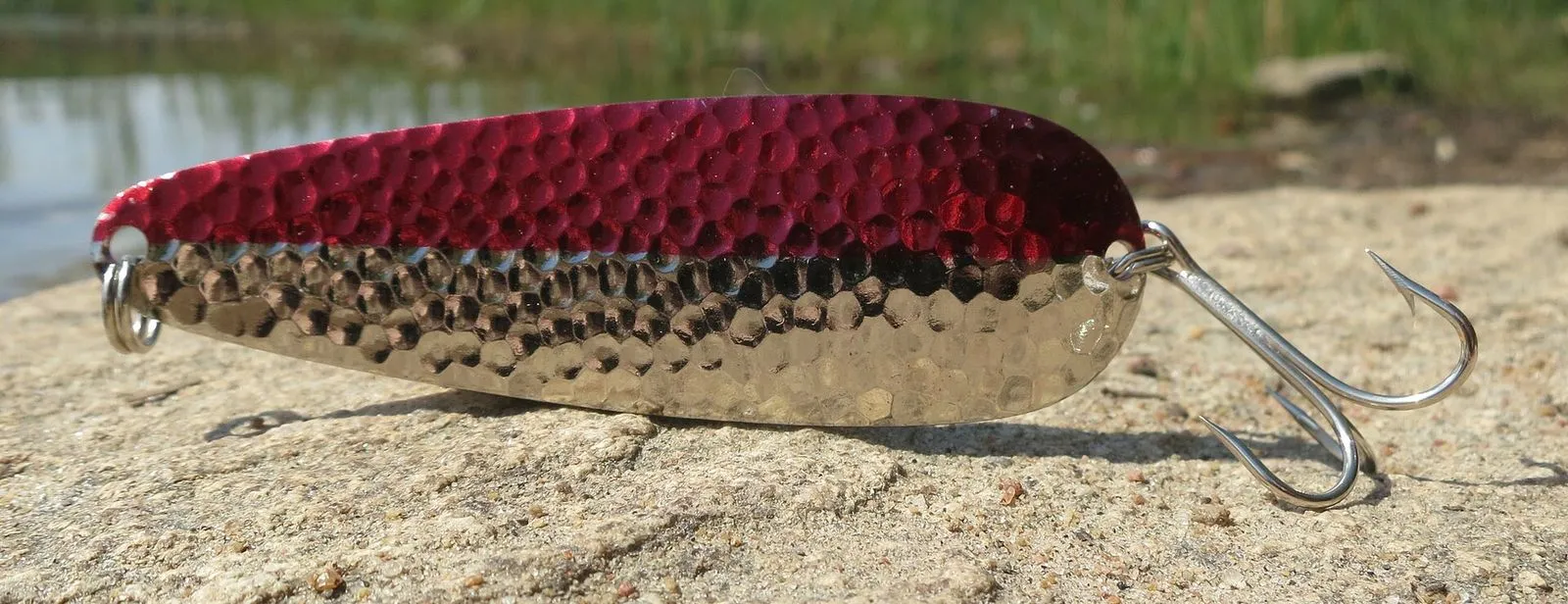
The best northern pike lure, on the evidence, is a spoon of about 1 oz: it is the one lure that every state agency and every magazine list behind these picks names. After it come in-line spinners and spinnerbaits, then plugs, topwaters and swimbaits. Which of them catches fish on a given day depends on water temperature and weeds, so the six picks above are sorted by when to throw each. They were chosen on who recommends them (five state agencies, In-Fisherman’s guides, Wired2Fish, Outdoor Life) and on sizes checked on the makers’ own pages. None was tested for this page.
Lou Eppinger fished his first hammered spoon alone in the Ontario bush in 1906. The Dardevle that came of it is still the first pike lure on nearly every list, and the maker says it fills orders for over a million lures a year.
How the picks were chosen
A lure made the list when independent sources named it or its class for pike. Agencies came first, because they have nothing to sell. Minnesota DNR says pike “will readily attack all manner of lures, especially larger plugs and spoons”. Wisconsin DNR lists “a full complement of spoon-type lures”. Michigan DNR names plugs, spoons and spinners; Maine’s fisheries agency “large spoons, spinner baits, and stick baits”; Alaska’s “large, bright spinners, spoons, diving plugs, and surface plugs”.
The models come from the magazines and from named guides. Wired2Fish’s list supplied the Dardevle, the Silver Minnow and the Reed-Runner. Outdoor Life’s fishing editor Joe Cermele supplied the plug and the topwater. In-Fisherman’s guides (Jeff Gustafson, Billy Rosner, biologist Dr. Bruce Carlson) supplied the when and the how. Sizes and weights were then read on each maker’s page, except the Silver Minnow’s, which are as Wired2Fish gives them.
The agreement thins as the list goes on. Spoons have everyone behind them. Swimbaits and bladed jigs rest on one or two writers and no agency, which is why neither has a box above.
When to throw what
| Lure | When | Size | Retrieve | Who says so |
|---|---|---|---|---|
| Casting spoon | Ice-out to early summer; again in fall. Cold water | ¾–1 oz (21–28 g) | Steady wobble, or lift and let it flutter back | Wired2Fish; Doug Stange, In-Fisherman |
| Weedless spoon | Any time pike are inside thick weeds | 1⅛ oz, 4 in (10 cm), with a grub | Slow and steady through the cover | Wired2Fish |
| Spinnerbait | Spring into summer; windy days on cabbage | ¾–1 oz (21–28 g) | Slow-roll in cold water, faster as it warms | Jeff Gustafson, In-Fisherman; Wired2Fish |
| In-line spinner | Summer, over weed tops in warm water | #5, about ½ oz (14 g) | Steady and quick; it cannot be paused | Outdoor Life; Mepps |
| Minnow plug | Over weed tops; trolled deep in summer above 65 °F (18 °C) | 5–8 in (13–20 cm) | Twitch and pause; troll 1–1.5 mph calm, 4–5 mph in wind | Outdoor Life; Bruce Carlson, In-Fisherman |
| Topwater | Summer, over weed flats 1–8 ft (0.3–2.4 m) deep | 5 in (13 cm) | Vary the speed; wait for the fish to turn before striking | Billy Rosner, In-Fisherman; Alaska DF&G |
The table follows the fish. At ice-out, Maine’s agency puts large pike in “shallow weedy areas” where they spawn, and In-Fisherman notes that some big fish linger in those bays while the water stays in the low 60s °F. That is spoon and spinnerbait water: shallow, cold, with little weed growth to foul a hook.
Summer splits the population. In a Minnesota telemetry study, pike over 28 in (71 cm) chose water of 61–70 °F (16–21 °C) in August, even with 82 °F (28 °C) water available. Small pike stayed in warm, shallow lily pads. Wired2Fish puts the move at 65 °F (18 °C) and switches to trolled plugs. Carlson tells In-Fisherman readers to start looking where the water is 55–60 °F (13–16 °C), over structure in 35 ft (11 m) or more.
So a summer day offers two choices. Spinners, spinnerbaits and topwaters over the weeds catch numbers of small and medium pike. Plugs trolled deep along the cool band are for the big one. In fall, Maine’s agency notes, “shallower water areas again offer productive fishing”, and the spoons come back out.
The picks in detail
Eppinger Dardevle, 1 oz
The original is 3⅝ in long and 1¼ in wide, thick enough to cast into a wind and sink quickly. Wired2Fish suggests ¾ or 1 oz for casting and the 1½ oz Troll Devle for trolling, in red and white, black and white, the yellow and red “Five of Diamonds”, or plain hammered brass. Outdoor Life’s Joe Cermele makes the case for the class: metal spoons “have been hammering pike across the globe for more than 100 years”, and pike teeth cannot damage them.
Guide Billy Rosner tells In-Fisherman that spoons are undervalued by most pike anglers today. His trick is to swap the treble for a single 1/0 or 2/0 hook and add a 4 in white grub. Doug Stange’s is a lift and fall: retrieve with the rod at ten o’clock, snap it to twelve, and let the spoon drop back into the face of a following fish. A heavy-bottomed spoon like the Dardevle “shines” for that, he says.
Johnson Silver Minnow, 1⅛ oz
A single fixed hook behind a wire guard lets this spoon slide through cover that stops everything else. Wired2Fish’s writer fishes the 1⅛ oz, 4 in model in silver or gold, tipped with a white or chartreuse curly-tail grub, through cabbage, bulrushes and openings in lily pads. It also trolls without collecting weeds.
Mepps Dressed Aglia, #5
“Northern pike and giant tackle busting musky will inhale a dressed #5 Mepps spinner,” says the maker, and the dressed #5 weighs ½ oz. Wired2Fish’s advice on size is the useful part: big muskie bucktails catch big pike on trophy waters, but “in most waters, medium-sized offerings will do best”.
Outdoor Life adds the limit. A spinner needs a constant retrieve to keep the blade turning, so it “tends to shine in warmer water” and is a poor choice when pike will not chase. For bigger water, Mepps points to its Musky Killer (¾ oz) and Giant Killer. The best muskie lures page covers that class.
Northland Reed-Runner Magnum, ¾ oz
Larger bass spinnerbaits are pike lures already; Wired2Fish points to all the pike caught by accident on them. This one adds what pike demand: a 4/0 hook on the ¾ oz size (6/0 on the 1 oz), a trailing stinger hook for short strikers, and a closed twist-bend eye that holds a leader clip. Wired2Fish finds willow blades out-catch Colorado and Indiana blades for pike.
Jeff Gustafson, the Ontario guide, tells In-Fisherman that when wind rolls through cabbage a ¾ to 1 oz spinnerbait “can be as good as it gets”. Colors named by the sources: black and orange, green and yellow, perch; white or silver where ciscoes and whitefish are the forage. The spinnerbait hub explains blades.
Rapala Original Floating, F18
Outdoor Life’s Cermele puts pike plugs at 5 to 8 in and names the Original Floating Minnow first. The F18 is the 7 in balsa model: 11/16 oz, three No. 2 trebles, with a listed running depth of 6–11 ft (1.8–3.4 m). Cermele’s rule for depth: most pike action is in 10 ft of water or less, so plugs that run 1 to 3 ft over the weed tops catch the most. He favors metallic finishes and fire tiger.
For the deep summer fish, the same makers build heavier tools. Wired2Fish trolls the Rapala X-Rap Magnum, which Rapala rates to dive 10 to 40 ft (3–12 m) by model. Carlson trolls Storm ThunderSticks and Bucher DepthRaiders on a three-way rig with a bell sinker. The jerkbaits page covers the twitch-and-pause retrieve.
River2Sea Whopper Plopper 130
A hard body with a soft tail that spins and plops on a straight retrieve, designed by Larry Dahlberg, whose 7½ in Whopper Plopper 190 was built for muskies. The 130 is 5 in long and 1⅜ oz, with two 4X-strong trebles. Outdoor Life rates it a top producer for pike. In-Fisherman’s Billy Rosner fishes the same style, in Bucher’s 7 in TopRaider, over cabbage and wild rice on flats 1 to 8 ft deep. His advice on the strike: “Let the fish turn with the bait before you set.” The Whopper Plopper page has the full size ladder.
Swimbaits, the seventh lure
Two writers, no agency: that is the support for swimbaits, and the reason there is no box for one. The two are specific, though. Gustafson casts a 5 to 6 in paddletail on a ½ oz jighead when the wind drops and pike slide past 8 ft. Colorado guide Nate Zelinsky casts and trolls 8 and 10 in swimbaits along the weed lines of high-country reservoirs that hold 40 in fish. Wired2Fish adds the jointed Berkley Magic Swimmer. The swimbaits page explains heads and hooks.
Leader, line and color
Leader first. Minnesota DNR: without a steel leader “you will likely lose your lure as those sharp teeth will easily cut through your mono-filament line”. Alaska’s agency calls wire “a must”. No controlled test of wire against fluorocarbon turned up in the research for this page. What exists is practice: Rosner uses a 12 in, 50 lb titanium leader; MeatEater’s Jack Ballard ties on about a foot of 50 lb fluorocarbon for flies; North Dakota Game and Fish biologist Paul Bailey uses 100 lb fluorocarbon for big pike on dead bait. Wire is the only material no source reports a pike cutting. The leader guide has the knots.
Is 20 lb line enough? With a leader, yes, on spinning tackle. Rosner spools 20 lb braid on his spinning rods and 40 to 60 lb on casting rods. Wisconsin DNR asks only for “medium-weight line with a wire leader”. The leader stops the teeth; the main line only has to land the fish.
Color. “Yellow, chartreuse, white and red are great starters,” writes Ballard, “though getting the lure in front of the fish is far more important than its color.” Rosner goes natural, perch and black shiner, and adds: dark baits on dark days, light ones in bright sun.
Time of day. Wisconsin DNR says pike “bite best during the daylight hours”, and Minnesota calls the pike “a daytime feeder”. There is no need to be out before dawn.
Keep it moving. Wisconsin’s leaflet again: “keep the bait moving”, and expect a pike to “strike a lure repeatedly, or follow a lure right to the boat before charging”. Alaska’s agency says to try a fast retrieve. Wisconsin puts the average at about eight hours of fishing per pike hooked, so a follow is worth a second cast.
Related
The pike family hub sorts the four North American species. The northern pike page has size by age and the summer temperature study in full, and how to catch northern pike takes the seasons step by step. For the bigger cousin, see muskie. A measured fish goes into the fish weight calculator.
Sources
- Wisconsin DNR, Northern Pike (Esox lucius), PUBL-FM-707 (2008): tackle, keep the bait moving, summer slump, hours per fish
- Minnesota DNR, MinnAqua species profile: northern pike (larger plugs and spoons, steel leader, daytime feeder)
- Alaska Department of Fish and Game, Northern Pike in Southcentral: spinners, spoons, plugs, buzzbaits, fast retrieve, steel leader
- Maine Department of Inland Fisheries and Wildlife, Northern Pike Assessment: large spoons, spinner baits and stick baits; seasons
- Michigan DNR, Northern pike species page: plugs, spoons and spinners
- Pierce and others (2013), Depths and thermal habitat used by large versus small northern pike in three Minnesota lakes, Transactions of the American Fisheries Society 142(6)
- Dan Johnson, Big Pike Don't Disappear in Summer. They Move Here, In-Fisherman (2026): Bruce Carlson, Billy Rosner, Doug Stange
- Cory Schmidt, Pike Patterns Spring-To-Summer, In-Fisherman (2016): Jeff Gustafson, Steve Ryan, Nate Zelinsky
- Doug Stange, Fluorocarbon Secrets for Pike, In-Fisherman (2017)
- Wired2Fish, The Best Pike Lures of All Time (2025)
- Joe Cermele, The Best Pike Lures, Outdoor Life (2025)
- Jack Ballard, Northern Pike Fishing Part Two: Hook Up and Hold On, MeatEater (2019): leaders and lure colors
- Eppinger Manufacturing, Our Tradition: the Dardevle from 1906 (maker's own account)
- Eppinger Manufacturing, Dardevle 1 oz: weight and length
- Mepps, How and Why Mepps Spinners Catch Fish: the dressed #5 for pike (maker's own account)
- Northland Fishing Tackle, Reed-Runner Magnum Spinnerbait: weights and hooks
- Rapala, Original Floating: F18 length, weight and running depth
- River2Sea, Whopper Plopper 130 and 90: length, weight, hooks