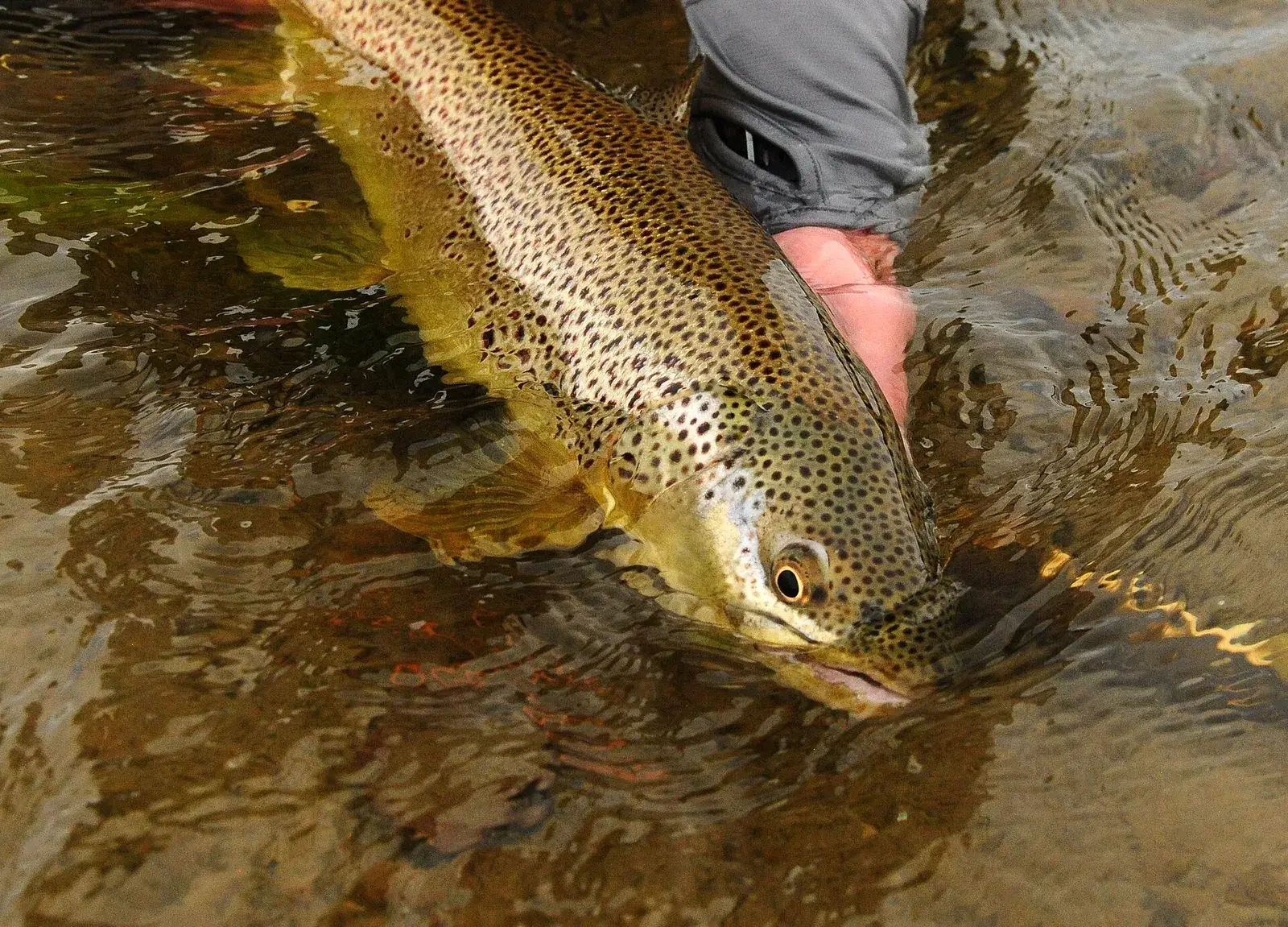
To hold a trout, cradle it: one wet hand under the chest just behind the gill plates, the other around the wrist of the tail, and no squeezing. That grip protects the three things anglers damage most. The throat, where the heart and liver sit; the jaw, which breaks if you lip a trout like a bass; and the slime coat, which dry hands wipe off. Out of the water, seconds count, and the bigger the fish and the warmer the water, the fewer it has.
In a lab, rainbow trout chased to exhaustion and then held in the air for 60 seconds: only 28% were alive 12 hours later. In Idaho rivers, 928 trout caught on rod and line and held out for 0, 30 or 60 seconds survived equally well. The difference is the fight, the fish’s size and the water temperature.
How do you hold a trout?
Can you grab a trout by the mouth? No. A bass has a tough jaw built for it; a trout does not. The Utah Cutthroat Slam warns that lipping “often damages or breaks their jaws and can ultimately kill the fish by affecting its ability to eat.” A lip grip clamp does the same damage if the fish hangs from it.
Small trout. Do not hold it at all if you can help it. Slide a wet hand under the fish in the net or the shallows, pin it gently against your palm, and back the hook out. Barbless hooks make that a matter of seconds; the barbless hooks page has the numbers on what the barb costs and buys.
Any trout you have to lift. Two hands. The front hand goes under the fish from below, not over the top. The palm sits under the chest just behind the gill plates, fingers open, taking the weight. The rear hand closes around the wrist of the tail, the narrow part just in front of the tail fin. Domenick Swentosky of Troutbitten calls the tail wrist “one place you can squeeze a trout without scaring or hurting it.” Everywhere else his rule holds: “Never squeeze… It does no good.” A trout that feels supported kicks less than one that feels pinned.
A trout that will not settle. Swentosky’s advice is to roll a thrashing trout belly-up in your hands, in the water, to unhook it: “turning trout upside down usually relaxes them.” Nobody has published a study on why. Turn it upright again before you let go.
Big trout. Everything above, with more care. In a 2022 brook trout study, fish over 13 in (328 mm) showed impaired reflexes after just 10 seconds of air, a third of the time smaller fish could take. Keep a big fish in the net in the water until the camera is ready. Support its full length with both hands, level, never hanging. Hold it low over the water, so a slip lands it in the river and not on the rocks.
Can you unhook it without lifting it?
The best hold is no hold. Most trout can be unhooked while they are still in the water, in a rubber net or against your wet palm.
- Forceps, not fingers, on a small fly: grip the bend and back the hook out the way it went in.
- Keep the fish’s head upstream while you work, so water keeps running over its gills.
- A hook deep in the throat stays there. Cut the line close and let the fish go; digging for the hook does more harm. The catch and release page has the survival numbers by hook, bait and hook position.
If the fish has been in the net a while, let it rest there in the current before you lift it for anything.
Free card: what 26 species do at your water temperature
Plus one email a week on what's biting now. No sales pitches. Privacy.
How do you hold a trout for a photo?
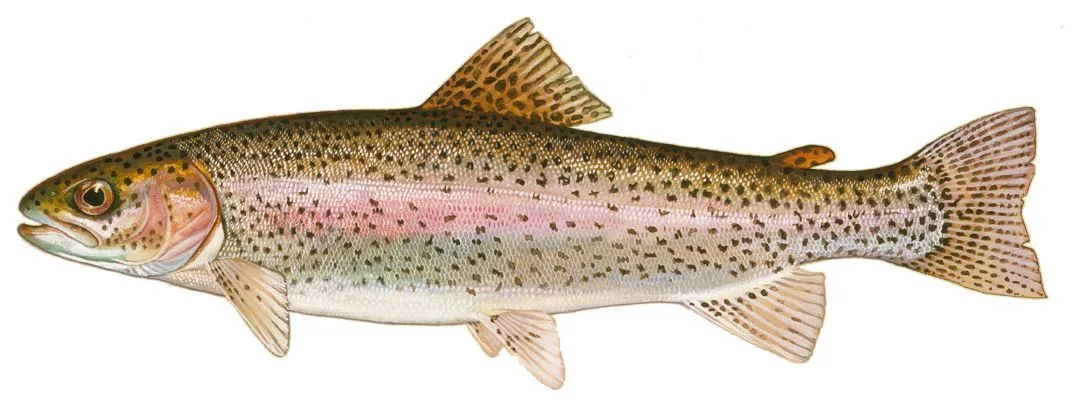
Photo: Tom Koerner, U.S. Fish and Wildlife Service (public domain)
- Get the camera ready first, with the fish still in the net in the water. Tell your partner what you want before the fish comes up.
- Wet both hands, and the net if it is dry.
- Slide the front hand under the chest behind the gill plates, palm up, fingers open; close the rear hand around the tail wrist.
- Lift it just clear of the water, level and close to the surface. The Wild Trout Trust’s rule: support the fish at the vent and the pectoral fins, ideally for less than 10 seconds. Swentosky allows himself “about five seconds. No more.”
- Take the shot and put it back at once. If you want another, let the fish breathe in the water a minute or two between shots, as the Wild Trout Trust advises.
- Release it nose into the current and hold it upright, loosely, until it swims out of your hand. In still water, hold it upright until it swims off on its own.
What should you never do?
| Do | Don’t | Why |
|---|---|---|
| Wet your hands before you touch it | Handle it with dry or hot hands | Dry skin strips the slime coat that protects against infection |
| Net it in rubber, and unhook it in the net in the water | Use knotted mesh, or lift the net onto the bank | Rubber spares the slime coat; the bank adds air and dry surfaces |
| Cradle the chest behind the gills, lightly | Squeeze behind the head | That is where the heart and liver are; squeezing can kill a fish that swims off |
| Hold the wrist of the tail firmly | Grab it by the jaw like a bass | Lipping “often damages or breaks” the jaw and can kill a trout by stopping it eating (Utah Cutthroat Slam) |
| Hold it level, belly supported | Hang a big trout by the jaw or tail | Holding a big fish vertically puts pressure on its organs |
| Keep fingers on the outside | Touch or hook a finger in the gills | Gills are delicate and easily damaged |
| Photo in under 10 seconds | Hold it up while the camera is found | “If water stops dripping off the fish, it’s too long” (Wild Trout Trust) |
Why wet hands? A trout’s skin is covered in slime, its first defense against infection. Dry hands, a dry net or a warm rock pull that coat off in patches, and the bare skin is where infection gets in. Dip your hands in the river before the fish comes in, and keep them wet. The same logic is behind fine rubber mesh nets over knotted nylon: the knots scrape, the rubber slides. A catfish is the opposite problem: how to hold a catfish is about spines rather than slime.
How long can a trout be out of the water?
Most handling advice quotes one number: the 28% from a 1992 lab study. It is real, but it is the worst case. Read the four studies side by side and a clearer rule appears.
| Study | Fish and place | What was done | Result |
|---|---|---|---|
| Ferguson and Tufts, 1992 | Rainbow trout, lab tanks | Chased to exhaustion, then 0, 30 or 60 seconds of air | Alive after 12 hours: 88%, 62%, 28% |
| Roth et al., 2018 | 328 Yellowstone cutthroat, 278 bull trout, 322 rainbow trout; Idaho rivers, summer | Caught on rod and line, then 0, 30 or 60 seconds of air | No difference in survival for any of the three species |
| Brownscombe et al., 2022 | 337 brook trout, Kenauk Nature, Quebec | Angled or put through a simulated fight; air, size and water temperature scored | Reflexes impaired after more than 30 s of air; after 10 s in fish over 13 in (328 mm); worse above 67 °F (19.5 °C); 6% of 141 angled fish died within 24 hours |
| Keep Fish Wet review (Jamie Madden) | 24 mortality and 9 sublethal studies | Water temperature against release deaths | Under 61 °F (16 °C) for rainbow, steelhead, brook and cutthroat, temperature deaths stay under 5–10% |
Why do the first two disagree? Ferguson and Tufts drove their trout to total exhaustion before the air exposure, harder than most fights on a rod. Roth’s fish were fought normally and released into their own rivers. The Idaho team concluded that air exposure of 60 seconds or less “is not likely a population-level concern.”
The Idaho team also watched anglers at work. Most landed their fish in a minute or less and held them out of the water for 30 seconds or less; very few went past 60. Idaho Fish and Game’s own summary of the work tells anglers not to feel bad about a brief lift for a photo.
The brook trout study adds the fine print. Big fish and warm water are where the margin runs out. Reflex impairment is the early-warning score researchers use: a trout that cannot keep upright or react has not recovered yet. In that study, balance was already worse in water above 56 °F (13.5 °C).
So the rule at the water is simple. Keep the fight short, keep the air short, and take more care the bigger the fish and the warmer the water. A small trout on a cold morning tolerates a quick photo. A 20-inch fish in August water does not. For why air hurts at all, the do fish drown page explains what happens to gills out of water.
When is the water too warm, or too cold?
Heat changes the rules. The common stop line among trout anglers is 68 °F (20 °C); the Wild Trout Trust puts it as “if it is at or around 20C, it is better not to fish.” Keep Fish Wet’s review sets the bar lower. Above about 61 °F (16 °C) for rainbow, steelhead, brook and cutthroat trout, the fishing itself starts to kill a share of released fish. That figure rests on 24 mortality and 9 sublethal studies.
For brown trout the same review suggests 66 °F (19 °C), and calls it a best guess. It rests on only 4 mortality studies and 1 sublethal study.
Between 61 and 68 °F, fish smarter rather than stop. Use heavier tippet so the fight is short, unhook in the water, skip the photo, and fish the early morning. A fishing thermometer settles the question in a minute. The trout water temperature chart gives the numbers species by species and shows where trout go in summer.
Cold is the other extreme. Lilleys’ Landing warns that in extreme cold the gills can freeze in the air within seconds and kill the fish outright. On a below-freezing winter day, unhook every trout in the water.
Native trout deserve the most care. Apache, Gila and cutthroat trout live in small populations where every fish counts; the Apache trout and Gila trout pages cover where they live and why.
For the rest of the fish in your hands, start at the trout hub.
Free download
The water temperature card
Read your water temperature and the card tells you who is spawning, who is feeding and what to throw. 26 species, 16 pages, for your phone and the tackle box.
Plus one email a week on what's biting now. No sales pitches. Privacy.
Related
Section guide
Trout: The Types of Trout and How to Tell Them ApartThe types of trout anglers catch, from rainbow and brown to brook and lake trout (two are chars): the marks that identify each, spawn seasons, records.
 Splake: The Brook Trout and Lake Trout Hybrid
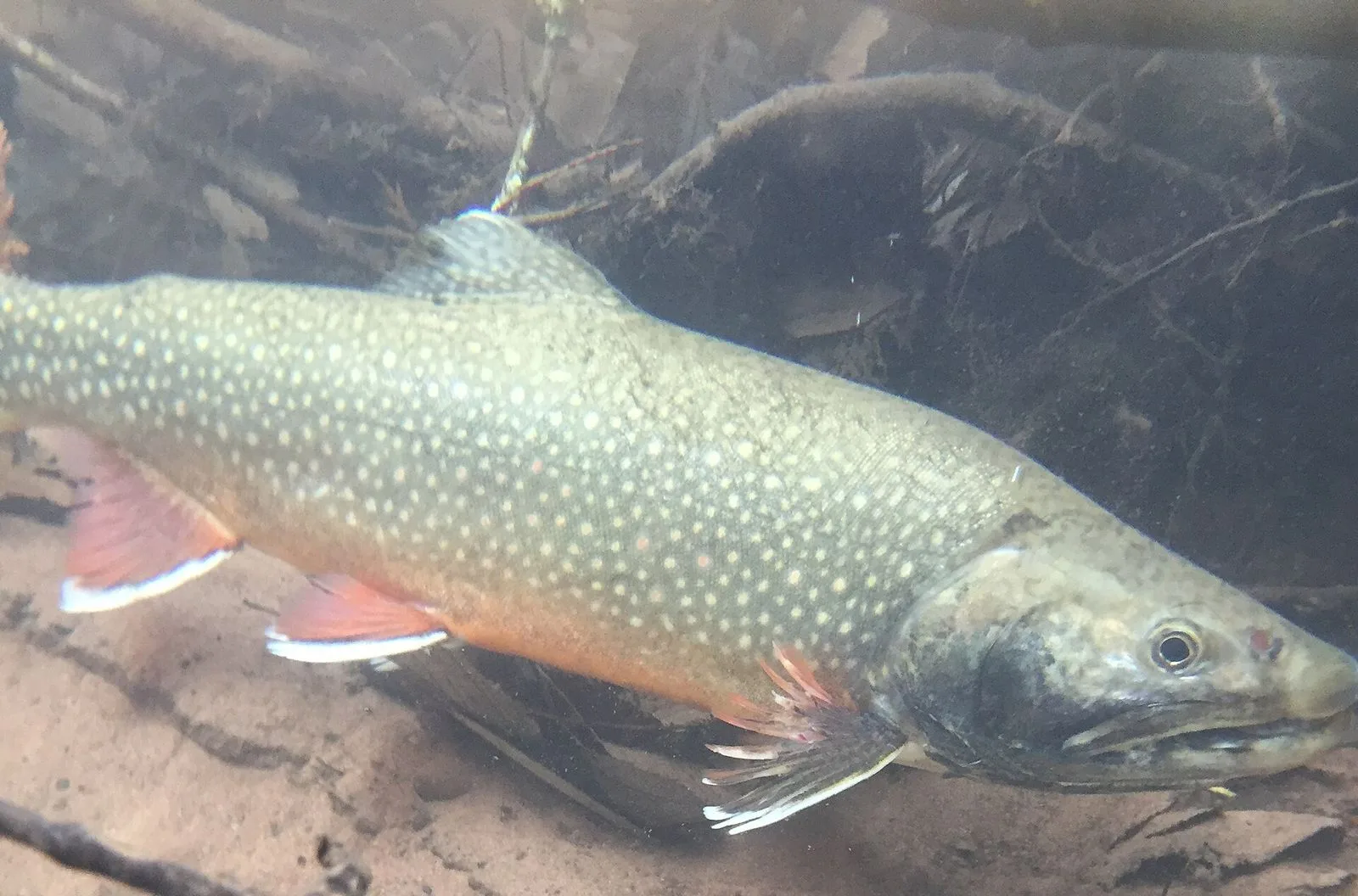
Splake are a hatchery cross of lake trout and brook trout. How to tell them apart, whether they can reproduce, the 20 lb record and how to catch them.
Sources
- Ferguson, R. A. and Tufts, B. L. (1992), Physiological effects of brief air exposure in exhaustively exercised rainbow trout: implications for catch and release fisheries, Canadian Journal of Fisheries and Aquatic Sciences 49:1157–1162
- Roth, C. J., Schill, D. J., Quist, M. C. and High, B. (2018), Effects of summer air exposure on the survival of caught-and-released salmonids, North American Journal of Fisheries Management 38(4)
- Idaho Fish and Game (2019), F&G fisheries staff recognized for catch-and-release research
- Brownscombe, J. W. et al. (2022), Identifying thresholds in air exposure, water temperature and fish size that determine reflex impairment in brook trout exposed to catch-and-release angling, Conservation Physiology 10: coac070
- Southflyfisher, 61 °F (16 °C) is the new 68 °F (20 °C) (quoting Jamie Madden's review for Keep Fish Wet)
- Wild Trout Trust, Catch and release
- Utah Cutthroat Slam, Helpful reminders for proper trout handling
- Troutbitten (Domenick Swentosky), How to hold a trout
- Lilleys' Landing, How to hold a trout