 By
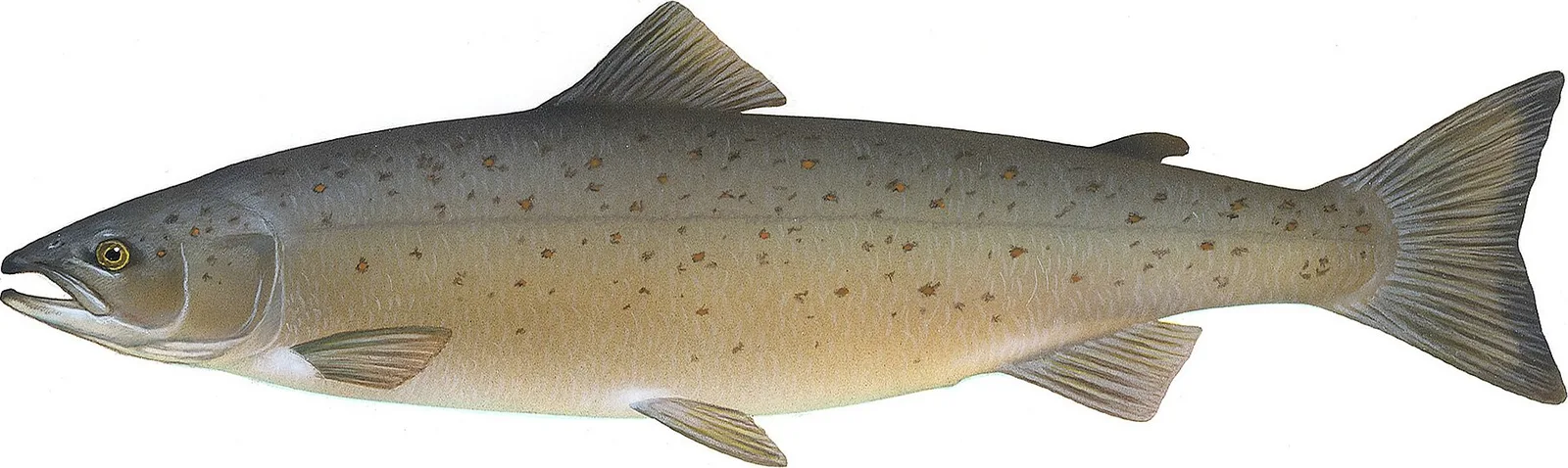
An Atlantic salmon is a silver, black-spotted fish of 8 to 12 lb, and in the United States you can’t fish for the sea-run kind. You can catch the same fish in fresh water: the landlocked salmon of Maine, Lake Champlain and Michigan. Use a smelt-colored streamer or a silver lure. The Atlantic salmon at your grocery store is farmed. Wild ones aren’t for sale.
In 2025, 643 Atlantic salmon climbed the fish lift at Milford Dam on Maine’s Penobscot River, down from 1,557 in 2023. It’s the biggest run counted in the country, and every one of those fish is off limits.
Can you fish for Atlantic salmon?
Not the sea-run fish. NOAA’s rule is short: “Commercial and recreational fishing for Atlantic salmon is prohibited.” It adds: “It is illegal to fish for, catch, or keep fish from the Gulf of Maine Atlantic salmon DPS.” That DPS, a distinct population segment, is the wild salmon of Maine’s rivers. It “is listed as endangered under the Endangered Species Act,” first listed in 2000.
Maine’s own rule, current as of March 19, 2025, reads: “It is unlawful to angle, take or possess any Atlantic salmon from all Maine waters (including coastal waters). Any salmon incidentally caught, must be released immediately, alive, and uninjured. At no time should the Atlantic salmon be removed from the water.”
So if one grabs your fly on a Maine river by accident, it never comes out of the water. Get the hook out and let it go.
What you can fish for is the landlocked form and the stocked Great Lakes fish. Those are the same species, living in fresh water under different rules. Here’s where that leaves you.
| Water | What’s there | The rule that decides |
|---|---|---|
| Maine rivers and coast, sea-run | Penobscot, Kennebec and other rivers; 643 salmon at Milford Dam in 2025 | “unlawful to angle, take or possess” |
| Maine lakes and streams, landlocked | A fishery in over 300 lakes and about 320 miles of rivers and streams | Open; read the rules for your water |
| Lake Champlain rivers, New York | Boquet, Saranac and Ausable; spring run mid-April to late May, main run in fall | “Lake Champlain and Tributaries Special Fishing Regulations Apply”; fall rules restrict weighted baits, lures and flies |
| St. Marys River, Michigan | Michigan’s main fishery; fall returns mostly October to December | Michigan Fishing Guide |
| Torch Lake and Lake Huron, Michigan | Stocked in Torch Lake; experimental spring stocking at Lexington Harbor, Thunder Bay River and Au Sable River | Michigan Fishing Guide |
| Canada’s Gulf region: New Brunswick, Prince Edward Island, Nova Scotia | Sea-run rivers, the Miramichi and Restigouche among them | Barbless fly only, and “anglers are required to release all Atlantic salmon” (2026) |
| Southeast Alaska salt water | Non-native fish, raised along the West Coast outside Alaska | “Alaska sport fishing regulations do not limit harvest of Atlantic salmon” |
If you want a sea-run Atlantic salmon on the line, Canada is where you go, and you’ll put it back. For 2026, the Gulf region’s notice says “a barbless artificial fly must be used to fish for Atlantic salmon.” In New Brunswick the spring fishery runs April 15 to May 15, with “a catch and release limit of 5 salmon per day.” After that it’s “a catch and release limit of 2 salmon per day on the Miramichi and Restigouche Rivers and 4 on other open rivers.”
Four rivers (Miramichi, Restigouche, Nepisiguit and Margaree) have warm-water protocols, so fishing can be restricted when the water heats up. Check the closure notices and the province’s guide before you book. Rules differ outside the Gulf region.
Alaska is the odd one out. Atlantic salmon aren’t native to the Pacific. Alaska’s Department of Fish and Game calls their presence in Southeast Alaska waters “biologically undesirable.” If you catch one there, it asks you to bring the entire fish to the nearest office.
How do you tell an Atlantic salmon from a brown trout or a Pacific salmon?
Look at the gill cover first. Black spots there set it apart from all the Pacific species. Then check the base of the tail, which looks slender or “pinched.” Count the rays in the anal fin, the one on the belly near the tail: an Atlantic has fewer than 13. Alaska’s card says 8 to 12, and Michigan counts nine or 10.
A chinook has 13 to 19, so that fin rules one out. A steelhead also has 8 to 12, and that’s where the gill cover settles it. The salmon hub sets all six North American salmon side by side.
In Maine lakes and the Great Lakes, the fish you’ll mix it up with is a brown trout. Maine’s fish and wildlife department gives these marks:
| Mark | Atlantic or landlocked salmon | Brown trout |
|---|---|---|
| Tail | Slightly forked | Square, almost no fork |
| Wrist of the tail | Thin | Thick |
| Upper jaw | Typically not much past the eye | Often slightly past the eye |
| Adipose fin (the small fin behind the back fin) | Usually dark; spots hard to see | Larger, often orange-tinted, obvious spots |
| Spots | Smaller, less defined; X-shaped on the back and upper sides | More of them, a few reddish |
| Roof of the mouth | A single row of small teeth on the shaft | Zig-zag row, plus well-developed teeth on the head of the bone |
No single mark is a sure thing. Both fish can lose those teeth with age. A post-spawn male landlocked salmon can be dark and golden and look a lot like a brown trout. Maine’s advice when you can’t decide: “it’s always safe to release the fish.”
Color tells you where the fish is in its year. Sea-run adults come in from the ocean very bright silver and darken to bronze in the river before they spawn. Males grow a kype, the hooked lower jaw. Landlocked adults are generally silvery, with small X-shaped marks on the back and upper sides.
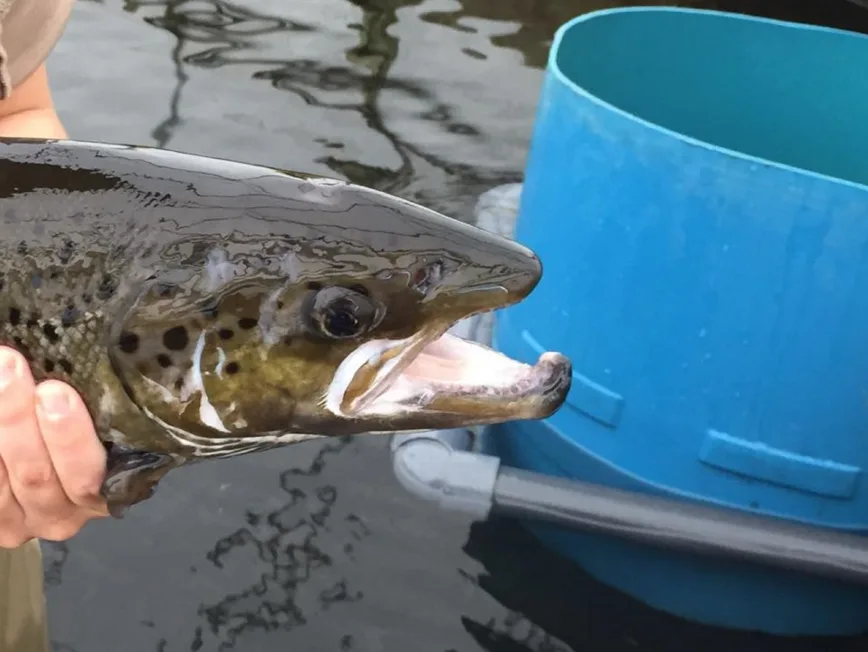 An adult male Atlantic salmon at Nashua National Fish Hatchery, New Hampshire. Note the black spots on the gill cover. Photo: Katelyn Marony, U.S. Fish and Wildlife Service (public domain)
Free PDF · Water temperature chart When do salmon bite?
One reading, and the 16-page chart shows which of 26 fish are spawning, feeding hard or slowing down; for bass, crappie, bluegill and walleye, where they sit and what to throw. Every number sourced.
No card, nothing to buy, and the PDF is yours to keep. Confirm with one click and it's on its way. Then a few short emails and one a week on what's biting. Unsubscribe anytime. Privacy.
How do you catch a landlocked Atlantic salmon?
Bring a streamer or a lure that looks like a smelt. Rainbow smelt are what these salmon mainly eat in Maine lakes, so that’s what you’re copying. Fish it near the top in spring and fall, and go deep in summer. They like water under 65 °F (18 °C), which is why they move. How a lake layers through the year is on the lake water temperature page.
- Spring and fall: stay near the surface and close to shore. Cast or troll a streamer or a smelt-style lure. This is your best shot from the bank.
- June through August: go down 30 to 60 ft (9–18 m). Troll with lead core line or a downrigger, and run a copper, gold or silver lure. Maine calls that the best method once the fish are deep.
- In rivers: fly-cast. Fly casting is the preferred method. Dry flies, nymphs and streamers all work. On Lake Champlain’s rivers, New York names the Gray Ghost, Black Ghost, Nine-Three, Golden Witch and other smelt imitations.
- Through the ice: stay within 15 ft (4.6 m) of the ice. Fish smelts or other bait, dead or alive, or a jig.
- On a fall run: expect a strike out of spite. Salmon on the spawning run don’t feed, but they’ll often hit out of aggression. In Michigan, anglers troll with downriggers. Some drift below the rapids instead and cast streamers or soft-plastic jerkbaits. In Lake Champlain’s rivers, worms work best early in the fall and fade as it goes on.
Keep a hand near the drag. The nickname is the “leaping landlocked,” and jumps and deep, strong dives are the rule.
What is a landlocked salmon?
It’s an Atlantic salmon that lives its whole life in fresh water, the Atlantic’s answer to the kokanee. Maine calls it a freshwater form of the sea-run fish. You’ll also hear Sebago salmon and ouananiche, and they all mean this fish.
Before 1868 landlocked salmon lived in just four river basins in Maine: the St. Croix, the Union, the Penobscot and the Presumpscot, which holds Sebago Lake. Now you can fish for them in over 300 Maine lakes and about 320 miles of rivers and streams.
So you have plenty of water to pick from. Before you drive, read the rules for the one you choose.
How big do Atlantic salmon get, and what’s the record?
A sea-run fish that has spent two years at sea averages 28 to 30 in and 8 to 12 lb. A Maine landlocked salmon runs much smaller.
| Fish | Typical size | Note |
|---|---|---|
| Sea-run, one winter at sea | 23 in (58 cm) average | A grilse, a mature one-winter salmon, is this fish |
| Sea-run, two winters at sea | 28–30 in (71–76 cm), 8–12 lb (3.6–5.4 kg) | May reach 30 lb (13.6 kg) |
| Sea-run, rare | 35 in (89 cm) | After 2 or 3 years in the ocean |
| Landlocked, Maine | 16–18 in (41–46 cm), 1–1½ lb (0.45–0.7 kg) | 3–5 lb (1.4–2.3 kg) “not uncommon” |
| Great Lakes, Michigan | 3–6 lb (1.4–2.7 kg) after one year | Around 6 lb (2.7 kg) after an extra year or more |
The IGFA all-tackle world record is 79 lb 2 oz (35.89 kg), caught by Henrik Henriksen in Norway’s Tana River in 1928. FishBase lists a top weight of 46.8 kg (103 lb). The landlocked world record is Tom Aufiero’s 26 lb 12 oz (12.13 kg) fish, fly-caught in Torch Lake, Michigan, in October 2010. The IGFA certified it in 2011.
Michigan’s state record is bigger: 32.62 lb (14.8 kg), from Lake Michigan in 1981.
Why can’t you buy wild-caught Atlantic salmon?
Because the only Atlantic salmon you can buy in the US is farmed. NOAA says it plainly: “Wild-caught Atlantic salmon is not available. Farm-raised Atlantic salmon is available year-round.” Commercial fishing for it is banned, and most of what’s sold here is imported from other countries. Norway grows over half the world’s supply, with Chile, Canada and the UK among the other big producers.
So a fillet labeled “Atlantic salmon” tells you the species and nothing about the sea. It’s a farm fish. If you want wild salmon at the counter, you want a Pacific species: sockeye, coho or pink.
Is Atlantic salmon healthy, and which salmon is best?
Yes, it’s healthy. NOAA says farmed Atlantic is low in sodium and high in omega-3 fatty acids and vitamin B12, and the FDA counts salmon among its “Best Choices.” NOAA calls the taste “buttery, rich.”
Here’s how the numbers line up, per raw 100 g (3.5 oz):
| Salmon | Calories | Fat | Source |
|---|---|---|---|
| Atlantic, farmed | 208 | 13.4 g | USDA |
| Atlantic, wild | 142 | 6.34 g | USDA |
| Sockeye, wild | 168 | 8.56 g | NOAA |
| Pink, wild | 116 | 3.45 g | NOAA |
One trap if you look this up yourself: NOAA’s farmed Atlantic page prints 142 calories and 6.34 g of fat. Those are USDA’s numbers for the wild fish. USDA’s own entry for farmed Atlantic salmon says 208 calories and 13.4 g, about twice the fat.
Protein barely moves, 19.8 to 21.3 g across all four. So is Alaskan or Atlantic better? It depends what you’re after. Farmed Atlantic is the richer, fattier bite. Wild sockeye and pink carry less fat, and sockeye has the reddest meat of the wild salmon. The FDA doesn’t split them, so pick by taste and price.
If you keep a landlocked salmon from Maine, mind the mercury. Maine CDC’s guideline for “Pregnant and nursing women, women who may get pregnant, and children under age 8” is “DO NOT EAT any freshwater fish from Maine’s inland waters. The only exception to this ‘do not eat’ guideline is for brook trout and landlocked salmon, which should be limited to 1 meal per month.” For “All other adults and children older than 8,” it says: “For brook trout and landlocked salmon, the limit is 1 meal per week.”
Why are wild Atlantic salmon so rare?
Dams are the first thing NOAA names. More than 90 percent of Maine’s rivers and streams are affected by them. Returns to Gulf of Maine rivers have averaged less than 1,200 a year since 2015. Hatchery stocking and cleaner water had rebuilt the run to nearly 5,000 adults by 1985. It didn’t hold. Wild fish are also at risk from breeding with fish that escape from farms.
Here’s the Penobscot, where the country’s biggest run is counted at Milford Dam:
| Year | Atlantic salmon counted |
|---|---|
| 2015 | 725 |
| 2016 | 502 |
| 2017 | 840 |
| 2018 | 757 |
| 2019 | 1,152 |
| 2020 | 1,414 |
| 2021 | 553 |
| 2022 | 1,310 |
| 2023 | 1,557 |
| 2024 | 1,358 |
| 2025 | 643 |
The Kennebec, the next river down the list, counted 60 at Lockwood Dam in 2025.
The trouble isn’t only in Maine. About 400,000 adults came home across North America in 2024, the Atlantic Salmon Federation says. That’s the fewest since the count began in 1971, down from 850,000 in 2021. For the other fish on the federal list, see the endangered freshwater fish page.
Atlantic salmon vs Pacific salmon: what’s the difference?
Three things matter to you. An Atlantic can spawn more than once, and a Pacific salmon spawns once and dies. The Atlantic is one species, native to one ocean, and NOAA calls it the only salmon native to the Atlantic. The Pacific side has five species in North America, and those are the wild salmon you can buy and, in season, keep.
On the table, the difference is farm against wild. In the water, it’s the gill-cover spots and the fin count above.
How long do Atlantic salmon live, and do they die after spawning?
They live 4 to 6 years, by NOAA’s count, and no, they don’t have to die after spawning. In practice most still don’t make it back: fewer than 5 of every 100 spawners return to spawn again. A spent fish on its way back down the river is called a kelt.
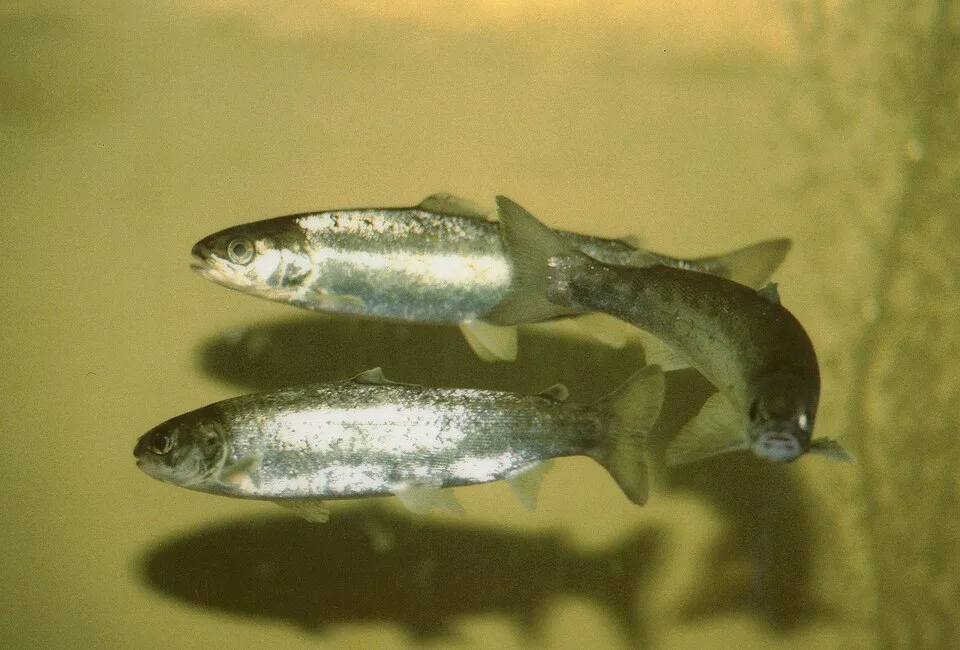 Atlantic salmon smolts, silver and ready for the sea. Photo: E. Peter Steenstra, U.S. Fish and Wildlife Service (public domain)
The life starts in fall, on river gravel. A female digs a redd, a gravel nest, and lays an average of 7,500 eggs, buried under about a foot of gravel. The young eat insects and stay in or near their home stream for two to three years. Then, at about 6 in (15 cm), they turn silver and head out as smolts.
Sea-run fish can cover over 6,000 miles. Maine fish spend their first winter south of Greenland and their second growing season off West Greenland, sometimes East Greenland. Larger adults hunt herring, alewife and smelt. After 1 to 3 years they come home, between May and October, to the river where they hatched, which is what anadromous means.
The landlocked form runs a shorter loop. It spawns in lake inlets and outlets from mid-October to late November. The young spend one to four years in a stream before dropping to the lake. In the Great Lakes, Atlantic salmon were native only to Lake Ontario and were gone before 1900. Michigan first stocked them successfully in 1972, about 20,000 young fish in the Boyne and Au Sable rivers.

Free PDF · 16 pages
Stop guessing. Know what's biting before your first cast
A whole Saturday on the water with nothing to show for it. One reading tells you who's feeding.
The Water Temperature Fishing Chart. Take one water temperature reading, find it on the chart, and see which of 26 freshwater fish are spawning, feeding hard or slowing down.
- Where bass, crappie, bluegill and walleye sit, and what to throw. Trout: the reading where you stop.
- Why a 3 ft drop beats a cold front, and what to throw each day of the front
- The three thermometer mistakes that make a reading lie
The chart's numbers come from state fish and wildlife agencies and fisheries research: 61 sources, each listed on the site.
No card, nothing to buy. Confirm with one click and the PDF is on its way, one version for your phone and one to print, yours to keep. Then a few short emails and one a week on what's biting, with an unsubscribe link in every one. Privacy.
Related
Section guide
Types of Salmon: The Five Pacific Species and the Atlantic, Told ApartThe six types of salmon a North American angler meets: chinook, coho, sockeye, pink, chum and Atlantic, by gum line, tail spots, size and record.
 King Salmon (Chinook): Black Gums, Size, Runs and the 97-Pound Record
King salmon, or chinook: the black gums that mark a king, how big they get from Alaska to the Great Lakes, when each run starts, and the 97 lb 4 oz record.
 Kokanee Salmon: The Landlocked Sockeye, Season by Season
Kokanee salmon are sockeye that never reach the sea. How to tell one, the 50 °F depth they hold at each season, how to troll for them, and the record.
 Pink Salmon: Odd-Year Runs, How to Tell a Humpy, Size and Records
Pink salmon live two years, so Puget Sound gets humpies only in odd years. When they run, how to tell one from a king, how to catch it and the record.
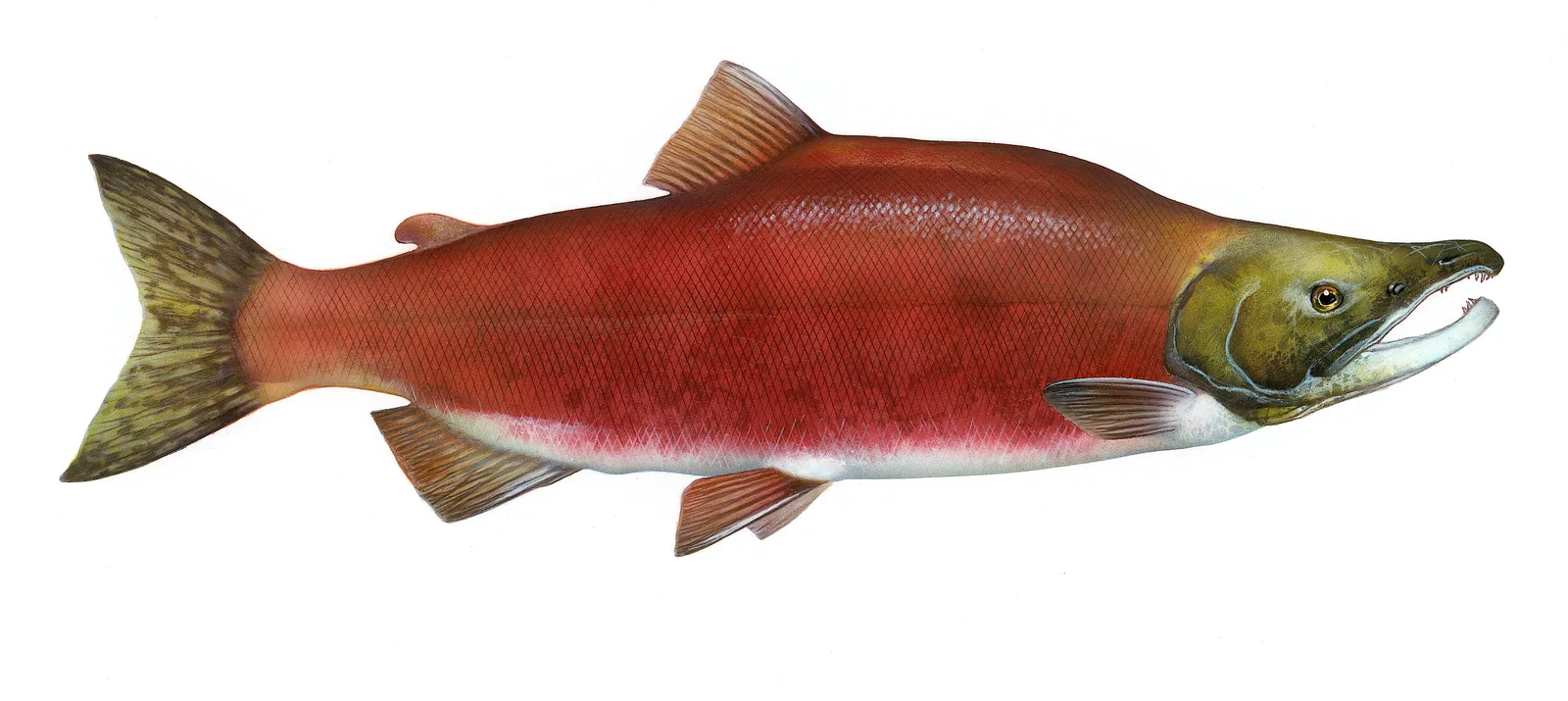 Sockeye Salmon: How to Tell a Red, Where They Run, and the Record
Sockeye salmon: a 4–15 lb red salmon that needs a lake. Tell it from a chum, find the runs from Bristol Bay to Lake Washington, hook one, and the record.
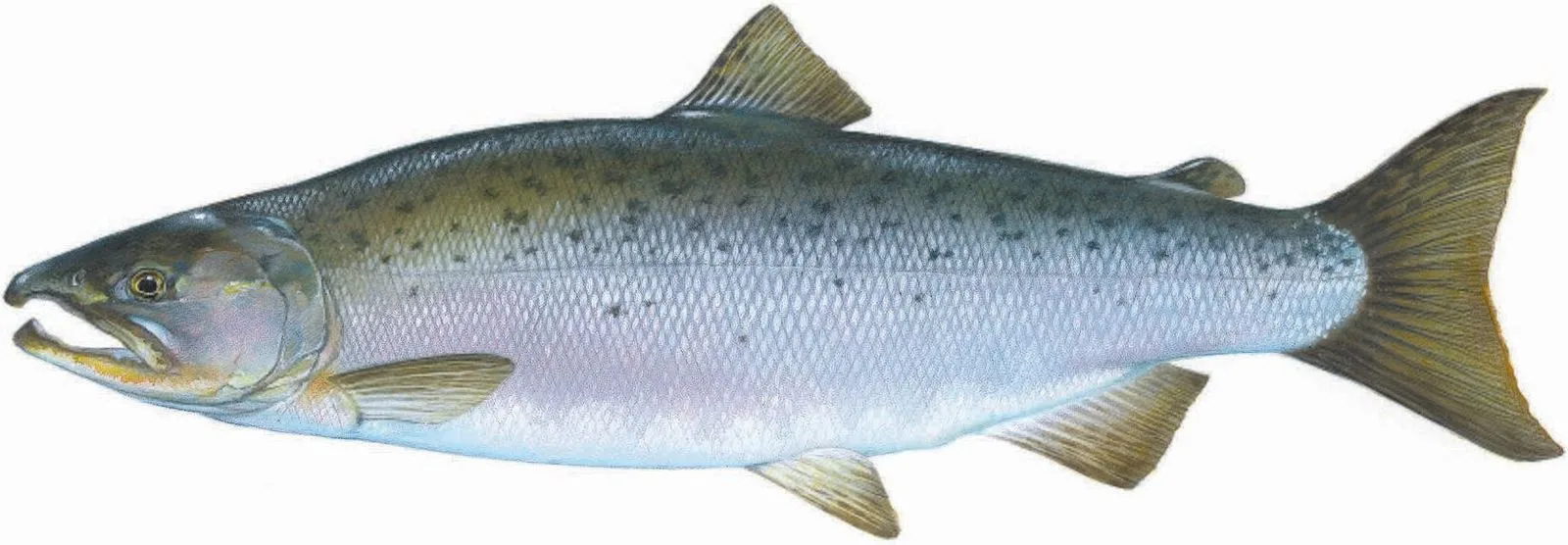 Coho Salmon: How to Tell a Silver From a King, Catch One and Eat It
Coho salmon: the white gum line that tells a silver from a king, when they run from Alaska to the Great Lakes, how to catch them, the record, the taste.
Sources (24)
- NOAA Fisheries, Atlantic salmon: fishing prohibition, listing, size, life history, seafood
- U.S. Fish & Wildlife Service, Atlantic salmon (Salmo salar): size at sea age, migration, listing
- Maine Department of Marine Resources, Sea run fish recreational fishing regulations (current as of March 19, 2025)
- Maine Department of Marine Resources, Historical trap counts through 2025
- Maine Department of Inland Fisheries and Wildlife, Landlocked salmon
Show all 24 sourcesShow fewer sources
- Maine Department of Inland Fisheries and Wildlife, Landlocked salmon and brown trout: tips for identifying your catch
- Maine CDC, Freshwater fish safe eating guidelines
- Michigan DNR, Atlantic salmon: identification, where to fish, stocking history
- Michigan DNR, State record fish
- New York State DEC, Lake Champlain tributaries salmon fishing
- Fisheries and Oceans Canada, Gulf Region, Atlantic salmon recreational fishing in 2026 (notice of April 9, 2026)
- Alaska Department of Fish and Game, Alert for Atlantic salmon, 2023 Southeast sport fishing regulations
- IGFA world records, Salmon, Atlantic
- MidCurrent (2011), IGFA certifies 26-pound landlocked salmon record
- FishBase, Salmo salar summary
- FishBase glossary, grilse
- FishBase glossary, kelt
- USDA FoodData Central, Fish, salmon, Atlantic, farmed, raw (FDC 175167)
- USDA FoodData Central, Fish, salmon, Atlantic, wild, raw (FDC 173686)
- NOAA Fisheries, Sockeye salmon: seafood profile and nutrition facts
- NOAA Fisheries, Pink salmon: seafood profile and nutrition facts
- U.S. Food and Drug Administration, Advice about eating fish
- Wikipedia, Atlantic salmon: farming
- Atlantic Salmon Federation, Impact Report 2025