 By
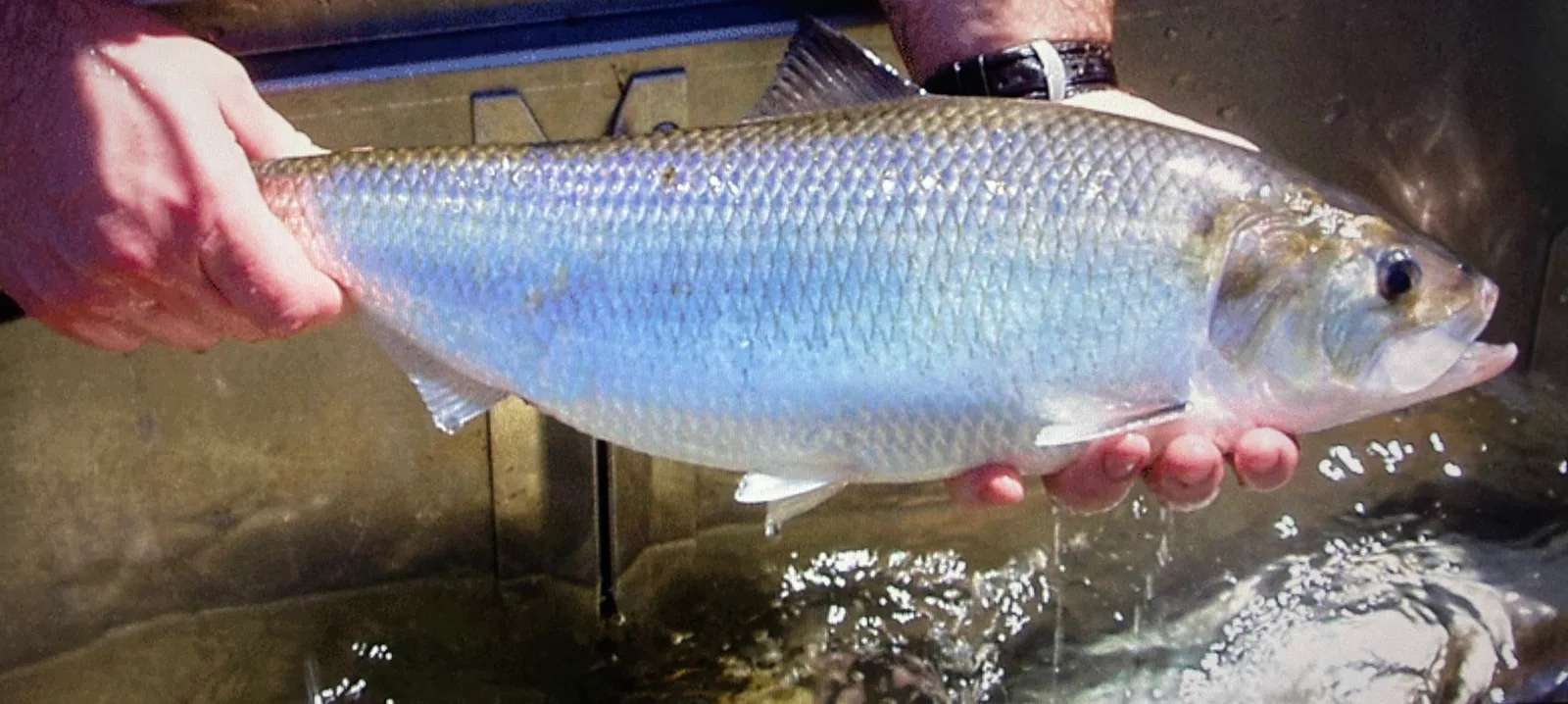
Shad fishing takes one setup: a light spinning rod, 4 to 8 lb line and a small shad dart. Swing it across the current near the bottom, in the weeks the spring run is in your river. American and hickory shad come in from the ocean to spawn, and they fight well above their weight on light tackle. Go when your river warms into the 50s °F. Then look up the rule before you keep one, because it changes from river to river.
Shad stop eating once they’re in the river. They still hit a dart, so the whole game is putting it right in front of them.
How do you fish for shad?
Cast across the current and let the lure swing past the fish, close to the bottom. You can do this from the bank. North Carolina’s wildlife agency says to cast upstream and reel as the lure sinks and drifts back down, along the breaks in the current. A shad won’t chase it far, so where you put the lure matters more than anything on it.
- Find moving water. Shad don’t sit in still water. Look for eddies, the seams along fast current, the outside of bends, creek mouths, bridge pilings and any place the river narrows.
- Tie on a dart. Use 1/32 to 1/8 oz (1 to 4 g), heavier in deep or fast water. Virginia’s Department of Wildlife Resources gives that range for its rivers.
- Cast slightly upstream. Throw across the run, a little up current. The lure sinks as it comes back toward you.
- Count it down. Start with a 3- to 5-second sink. Try a 10-count next, then a 15-count, until you find the depth they’re holding at.
- Reel slow and steady. Let the lure sweep in an arc across the run. On a tidal river, try three turns, a pause, then two or three more. Keep it slow enough that it stays down.
- Stay near the bottom. Shad travel low. If you get no bites, you’re probably fishing over their heads. Add a split shot a few feet up the line.
- Change the depth before the color. A heavier weight or a bigger dart does more for a slow bite than a new color.
Pick your hours too. Shad don’t like bright light, so dawn, dusk and cloudy or rainy days are best. In bright, clear water they hug the bottom. On a tidal river, fish a moving tide. An incoming tide pushes shad upstream, and an outgoing tide can stall them.
What gear do you need for shad?
Less than you think. A light or medium-light spinning rod you already own for crappie or trout will do the job on most East Coast rivers. The Columbia is bigger water and calls for a little more rod.
| Fishing | Rod | Line |
|---|---|---|
| East Coast rivers, spinning | 6 to 7 1/2 ft (1.8 to 2.3 m), light action | 4 to 8 lb (1.8 to 3.6 kg) |
| Columbia River, bank or boat | A light steelhead rod | At least 12 lb (5.4 kg) main line |
| Fly fishing | 8 to 9 ft (2.4 to 2.7 m) for a 5- to 7-weight line | 4 to 8 lb (1.8 to 3.6 kg) tippet |
Go with monofilament first. It handles a shad’s sudden bursts of speed, and a shad’s mouth is thin and tears easily. Light-wire hooks tear it less, too. If you’d rather fish braid, add a long mono leader. Fill the reel with about 150 yards, since a shad can run. Keep lures small: most top out around 1 1/2 in (4 cm).
Free PDF · Water temperature chart Which fish are biting at today's water temperature?
One reading, and the 16-page chart shows which of 26 fish are spawning, feeding hard or slowing down; for bass, crappie, bluegill and walleye, where they sit and what to throw. Every number sourced.
No card, nothing to buy, and the PDF is yours to keep. Confirm with one click and it's on its way. Then a few short emails and one a week on what's biting. Unsubscribe anytime. Privacy.
American or hickory: which shad are you catching?
The jaw tells you, and on some rivers the jaw decides whether the fish goes in the cooler. Look at it before anything else.
| American shad | Hickory shad | |
|---|---|---|
| Lower jaw | Meets the upper jaw evenly | Sticks out past the upper jaw |
| Cheek patch | Deeper than it is long | Longer than it is deep |
| Usual weight | 3 to 8 lb (1.4 to 3.6 kg) | 1 to 3 lb (0.5 to 1.4 kg) |
| Spawns at | About 65 °F (18 °C) | About 61 °F (16 °C) |
| In Virginia’s rivers | Peak mid-April through May | Late February through April |
Expect a hickory to jump and twist in the air. Most American shad go 15 to 24 in (38 to 61 cm), and the world record is 11.3 lb (5.1 kg), Connecticut’s agency reports.
Gizzard shad and threadfin shad are another story. They’re the bait fish of lakes and rivers, not the fish on this page. The “shad spawn” bass anglers talk about happens on lakes, with those bait fish.
When is shad season?
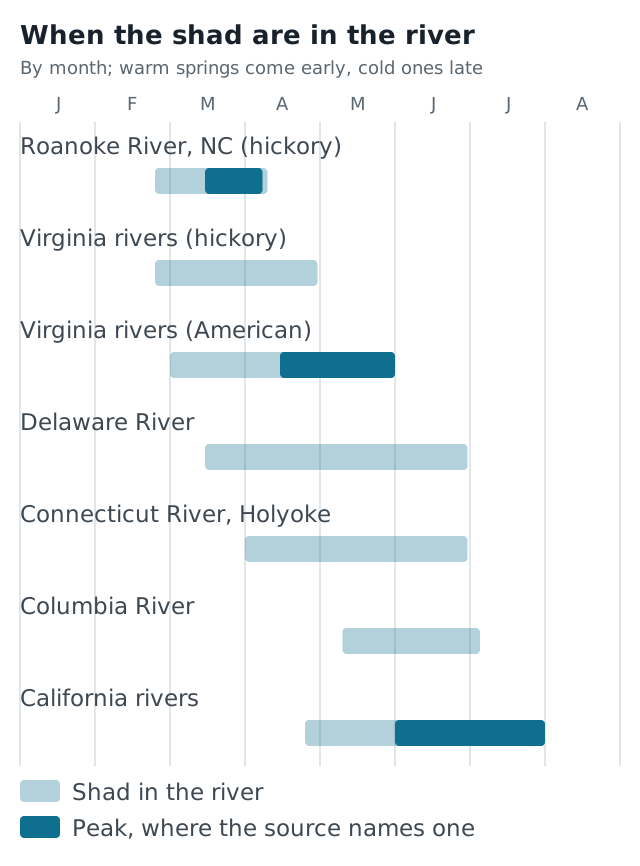
It starts in the South and works north as rivers warm. On the East Coast, the fishing starts when the water reaches the 50s °F. In Virginia, hickory shad show up once the water passes 46 °F (8 °C), usually in late February. American shad peak from mid-April through May.
Drawing: fishing.info
The numbers on the big rivers are worth knowing. In 2026, the first American shad went up the Holyoke fish lifts on the Connecticut River on April 15, by the count of Holyoke Gas & Electric, which runs them. On May 5 alone, 42,407 went up, and the year’s count came to 470,407. On the Delaware, the first fish come in sometime in March, and you can follow them upriver through June.
Out West the run comes later. Oregon’s agency says shad show up “sometime around Mother’s Day” and the run usually fades by early July. More than seven million shad passed above Bonneville Dam by late August in 2019. California’s rivers start in late April and peak in June and July.
Where are the best shad rivers?
Start below a dam or wherever the river narrows. Those choke points are where the run gets squeezed. The table names the places the agencies and local anglers point to.
| River | Where to start | Fish |
|---|---|---|
| Roanoke, North Carolina | Near Weldon | Hickory |
| Cape Fear, North Carolina | Locks and dams near Tarheel, Elizabethtown and Riegelwood | American |
| Tar, North Carolina | Battle Park in Rocky Mount, Bell’s Bridge north of Tarboro | American |
| Rappahannock and Potomac | City Dock on the Rappahannock, Fletcher’s Cove on the Potomac | Both |
| Delaware | From around Trenton up past the Delaware Water Gap, and Hancock, New York | American |
| Connecticut | Below the Holyoke Dam, Massachusetts, where the fish lifts are | American |
| Columbia | The bank below Bonneville Dam, in Washington below the Second Powerhouse and the Hamilton Island boat ramp | American |
| Willamette and Umpqua, Oregon | Moving water, casting or plunking from the bank | American |
| Sacramento, Feather, Yuba and American, California | The Sacramento holds California’s largest run | American |
Washington’s agency is blunt about the Columbia: “if you’re fishing from shore, the only sure-fire location is below Bonneville Dam.”
What’s the best lure for shad?
A shad dart first, a small weighted jig with a bright body. If you only bring one thing, bring darts in two weights. A flutter spoon is the second pick, and it’s the one for an anchored boat.
| Water | Throw | Color |
|---|---|---|
| High, stained or early | A bigger, bright dart | Chartreuse body, green or red head |
| Low, clear or late | A small but still bright dart | Chartreuse body, green or red head |
| Current behind an anchored boat | A flutter spoon | Silver or gold |
| Fly rod | A small Clouser or Crazy Charlie, size 4 to 8 | Chartreuse or orange |
Grubs work too. Oregon anglers fish “tiny rubber grubs on tiny little jig heads a fraction of an ounce.” On tidal Virginia water, DWR writer Mark Fike’s go-to is a crappie jig on an 1/8 oz hot pink jig head. He pinches a split shot on at least 12 in (30 cm) above it.
How do you rig for shad?
Fish the simplest one that gets you to the bottom. Tie the lure on with an improved clinch knot or whatever you trust.
- Bank, normal current. A dart alone, with a split shot a few feet up if you need more depth. This is the one to start with.
- Deeper current. Put a 1/4 oz (7 g) inline sinker ahead of the dart.
- Two lures at once. Tie an 18- to 24-in (46 to 61 cm) leader to the bend of a spoon’s hook and put a dart on the end.
- Columbia River. A sinker of 1 to 3 oz (28 to 85 g), a three-way swivel and a leader to the dart or small spoon. Cast and retrieve or plunk it in fast current.
- Anchored boat. Run spoons behind a small diving planer, or behind a diving crankbait with its hooks taken off.
How do you land a shad?
Keep the drag light and the fight short. A hooked shad usually heads downstream first, and a tight drag pulls the hook right out of that thin mouth. You don’t need heavy gear to enjoy it.
If it’s going back, follow Pennsylvania’s advice: reel in quickly and don’t fight it to exhaustion. Land it in a net instead of dragging it onto shore. Unhook it with pliers, then slide it back into the water from the net. The rest of the good habits are in our catch and release guide.
Can you keep shad?
Sometimes. It depends on the river and on which shad you’ve got, and the rules don’t match across a state line. These are the agencies’ own words. They change, so read the current rule before you keep one.
| Where | Fish | The rule |
|---|---|---|
| Connecticut River, Connecticut | American and hickory | “Open year-round.” “No minimum length.” “6 in aggregate with Hickory Shad.” American shad: “Harvest of American shad allowed only in the Connecticut River system.” |
| Massachusetts | American | Merrimack and Connecticut rivers: “Year Round,” “3 fish.” Other waters: “Prohibited. Catch and release only.” |
| Hudson River, New York | American | “Recreational and commercial fishing for American shad is prohibited in the Hudson River and the Marine District of New York” |
| Delaware River and Estuary, Pennsylvania | American | “Open year-round, no minimum size and a daily limit of 2 fish.” |
| Delaware River mainstem, New Jersey | American | “Open year-round,” daily limit 2 (2026 guide) |
| Susquehanna River, Pennsylvania | American | “CLOSED YEAR-ROUND in Susquehanna River and tributaries, including the Conowingo Reservoir up to Holtwood Dam.” |
| Pennsylvania, the Delaware included | Hickory | “CLOSED YEAR-ROUND in all Commonwealth Inland Waters, Susquehanna River and tributaries (including the Conowingo Reservoir) and Delaware River and Estuary Waters.” |
| Nontidal waters, Maryland | American and hickory | “CLOSED.” “Catch and Release is permitted at all times.” |
| Virginia | American | “all American shad must be released as possession is unlawful” |
| Roanoke and Neuse, North Carolina | Both | “10 Hickory Shad and American Shad in combination,” “only one of which can be an American (white) Shad” |
| Cape Fear, North Carolina | Both | “10 Hickory Shad and American Shad in combination, only five of which may be an American (white) shad” |
| Tar River, North Carolina | Both | “10 Hickory Shad and American Shad (white), in combination” |
| Atlantic Ocean, North Carolina | American | “Unlawful to take or possess American shad from the Atlantic Ocean.” |
| Georgia | Both | “The maximum recreational daily creel and possession limit shall be eight (8) for any one or a combination of American shad or hickory shad.” |
| Columbia River, Washington | American | “No min. size. No daily limit. No possession limit. Open only during open game fish or salmon seasons except Apr. 1-May 15: closed in the mainstem Columbia River downstream of Bonneville Dam.” |
| Oregon | American | “the shad does not have size or bag limits” |
| California | American | “Open season: All year, except for closures listed under special regulations.” “Limit: Twenty-five.” |
The West Coast is generous for one reason: shad aren’t from there. They were brought to West Coast rivers in the late 1800s. On the Columbia they’re now the most common fish that runs in from the sea. On the East Coast, where they belong, the rules are tighter.
Virginia’s hickory rule depends on the water. DWR wrote in 2024 that there were “no regulations on hickory shad caught above and below the fall line” in its coastal Chesapeake Bay rivers. On those rivers, state code says the limits are the ones the Marine Resources Commission sets for tidal rivers. The Meherrin below Emporia Dam, the Nottoway, the Blackwater and a few other named waters have a limit of “10 per day.” In May 2024 the commission proposed a possession limit for hickory shad, then took the item off that month’s agenda. Its shad rule still names only American shad, so check with the commission before you keep a hickory.
Two more things to look at. A hook rule applies from April 1 to June 30 in the inland waters of the Roanoke, upstream of the U.S. Highway 258 bridge. The rule: “only a single barbless hook or lure with a single barbless hook (or hook with barb bent down) may be used.” And Florida’s St. Johns River and South Carolina’s rivers have their own shad rules, so check with those states before you go. Pennsylvania spells out what closed means: “no kill.”
Are shad good to eat?
Yes, where you’re allowed to keep one. Oregon’s agency calls the shad “certainly edible” and “a delicacy in its native east coast range.” Most Oregon anglers don’t eat them, though. Many keep them for bait, thanks to their oily, herring-like flesh. On the lower Columbia, sturgeon love to feed on the shad run.
Quick answers about shad fishing
What’s the best bait for shad? Skip the bait. Adult shad generally don’t feed on the run, so throw a dart, a small spoon or a fly.
How big do shad get? In their native range they reach 30 in (76 cm) and 12 lb (5.4 kg), Washington’s agency says. Most go up to 20 in (51 cm) and 2 to 4 lb. Washington’s state record is only 3.85 lb, from the Columbia in 2005.
What time of day is best? First light and the last hour before dark, plus any cloudy day. Don’t write off midday on a dark, rainy one.
Mistakes to avoid
- Fishing too high. Most slow days are a depth problem. Add a split shot and count the lure down longer.
- Changing colors first. Change the weight first. Then change the color.
- Fishing still water. Shad want current. Move to a seam or the head of a run.
- Cranking the drag tight. A thin mouth tears. Loosen it and let the fish run.
- Keeping the wrong shad. Check the jaw. In Virginia you can keep a hickory but never an American. On Pennsylvania’s side of the Delaware it’s the other way around.
Shad also matter to anglers who never throw a dart. If you came here for bait fish and the fish that chase them, go to striped bass or what to use for catfish bait. The fish that don’t fit a big family are all in other freshwater fish.

Free PDF · 16 pages
Stop guessing. Know what's biting before your first cast
A whole Saturday on the water with nothing to show for it. One reading tells you who's feeding.
The Water Temperature Fishing Chart. Take one water temperature reading, find it on the chart, and see which of 26 freshwater fish are spawning, feeding hard or slowing down.
- Where bass, crappie, bluegill and walleye sit, and what to throw. Trout: the reading where you stop.
- Why a 3 ft drop beats a cold front, and what to throw each day of the front
- The three thermometer mistakes that make a reading lie
The chart's numbers come from state fish and wildlife agencies and fisheries research: 61 sources, each listed on the site.
No card, nothing to buy. Confirm with one click and the PDF is on its way, one version for your phone and one to print, yours to keep. Then a few short emails and one a week on what's biting, with an unsubscribe link in every one. Privacy.
Related
Section guide
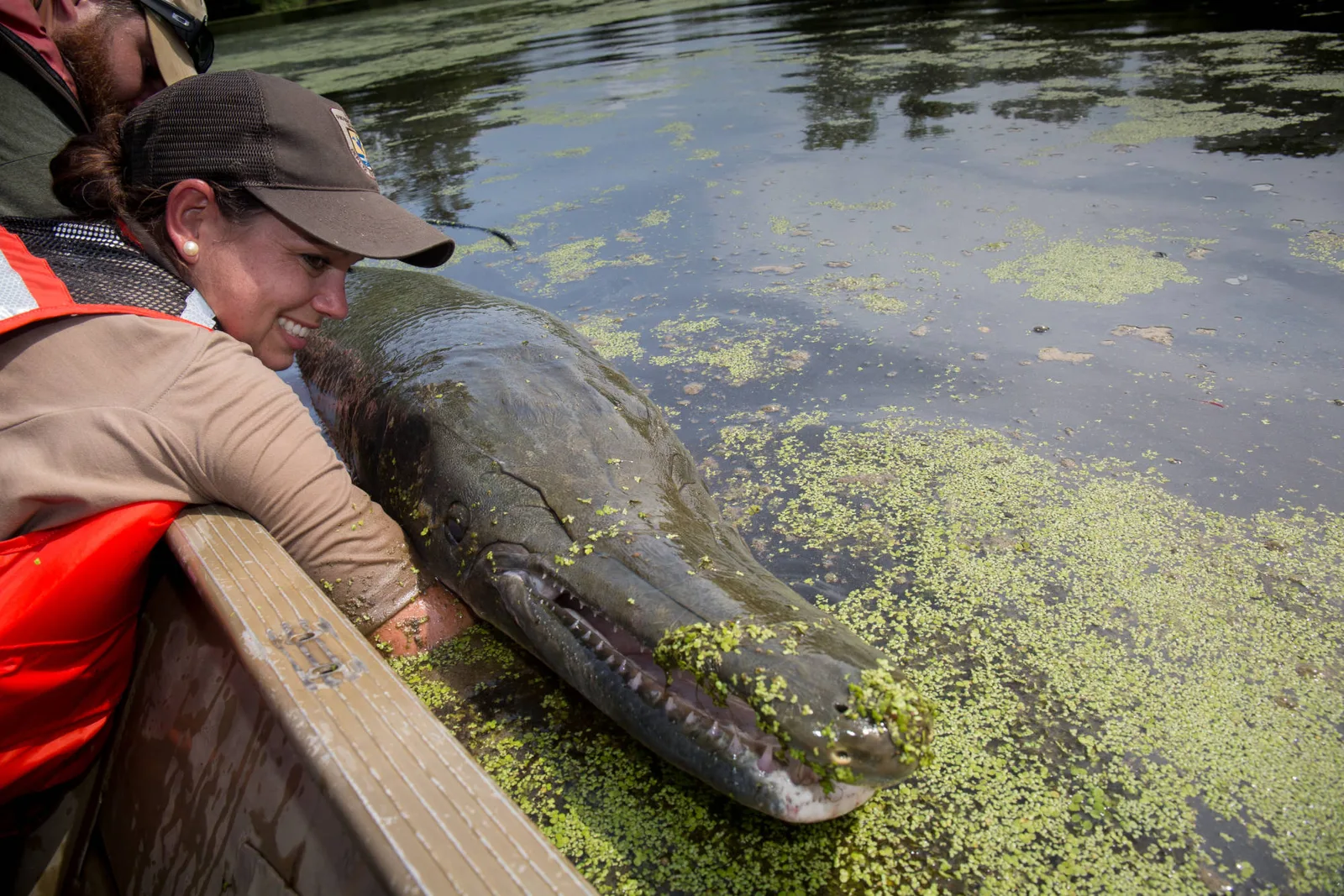
Freshwater Fish Species Outside the Big Families: Sturgeon, Gar, Bowfin, BurbotThe freshwater fish species outside the bass, trout, catfish and pike families: sturgeon, gar, bowfin, burbot, drum, eel and paddlefish, with records.
 Creek Chub: How to Identify, Catch and Use Them as Bait
A creek chub is a 5 to 7 in minnow with a black spot on its back fin. How to identify one, catch it on light tackle, and rig it as live bait.
 Gizzard Shad: How to Identify, Catch and Use Them for Bait
Gizzard shad commonly run 9 to 14 in. How to tell one from a threadfin, net it, keep it alive, and which states ban it as live bait.
 Smelt Fishing: Net a Spring Run or Jig Them Through the Ice
Smelt fishing two ways: dip a spring run at night or jig them through the ice. When the run hits, the gear, and each state's rule.
 Beluga Sturgeon: How Big It Gets, Where It Lives and the Caviar Ban
The beluga sturgeon reaches 26 ft on the books and lives only in the Caspian and Black Sea basins. Its size, record, status and the US caviar rules.
 Goliath Tigerfish: How Big They Get, Teeth, and the Crocodile Stories
Goliath tigerfish facts that hold up: the 97 lb IGFA record, real size, the teeth, the attack and crocodile stories, and where anglers go.
 Nile Perch: How Big They Get, the Record, and Where to Catch One
Nile perch grow to about 2 m and 200 kg, and the record is 230 lb from Lake Nasser. Where to catch one, why the US bans it, and the Lake Victoria story.
Sources (30)
- Virginia DWR, Get Ready for Shad! (Gerald Almy)
- Virginia DWR, Try These Tactics for Shad Fishing (Mark Fike)
- Virginia DWR, 'Tis the Anadromous Fish Season
- North Carolina Wildlife Resources Commission, American Shad
- North Carolina Wildlife Resources Commission, Hickory Shad
Show all 30 sourcesShow fewer sources
- North Carolina Wildlife Resources Commission, Coastal Rivers Fisheries Reports
- North Carolina Inland Fishing, Hunting & Trapping Regulations 2026-27
- North Carolina Division of Marine Fisheries, Recreational Size and Bag Limits
- Connecticut DEEP, Species Regulations (freshwater guide)
- Connecticut DEEP, American Shad
- Massachusetts Division of Marine Fisheries, Recreational saltwater fishing regulations
- New York DEC, American Shad
- Pennsylvania Fish and Boat Commission, Shad
- New Jersey Fish & Wildlife, Size, Season & Creel Limits (2026)
- Maryland DNR, Freshwater Seasons, Sizes & Limits
- Georgia Comp. R. & Regs. 391-2-4-.02, Shad Fishing
- Washington Department of Fish and Wildlife, American shad
- Oregon Department of Fish and Wildlife, Shad Fishers Delight (Jay Remy)
- Northwest Power and Conservation Council, American Shad in the Columbia River
- U.S. Fish & Wildlife Service, Sturgeon Snoots and Scutes
- California Code of Regulations, Title 14, Section 5.65, Shad, American
- California Fly Fisher, Shad: A Primer (Lance Gray)
- Outdoor Life, How to Catch Shad, a Beginner's Guide (Joe Cermele)
- MeatEater, How to Catch Spring Shad
- On The Water, American Shad On The Delaware River (Jimmy Fee)
- FishTalk, Spring Shad Fishing
- Holyoke Gas & Electric, Robert E. Barrett Fishway, 2026 Upstream Fish Passage Counts
- Virginia Administrative Code, 4VAC20-530, Pertaining to American Shad
- Virginia Administrative Code, 4VAC15-320-25, Creel and length limits
- Virginia Regulatory Town Hall, Marine Resources Commission, May 28, 2024 Regulatory Changes