 By
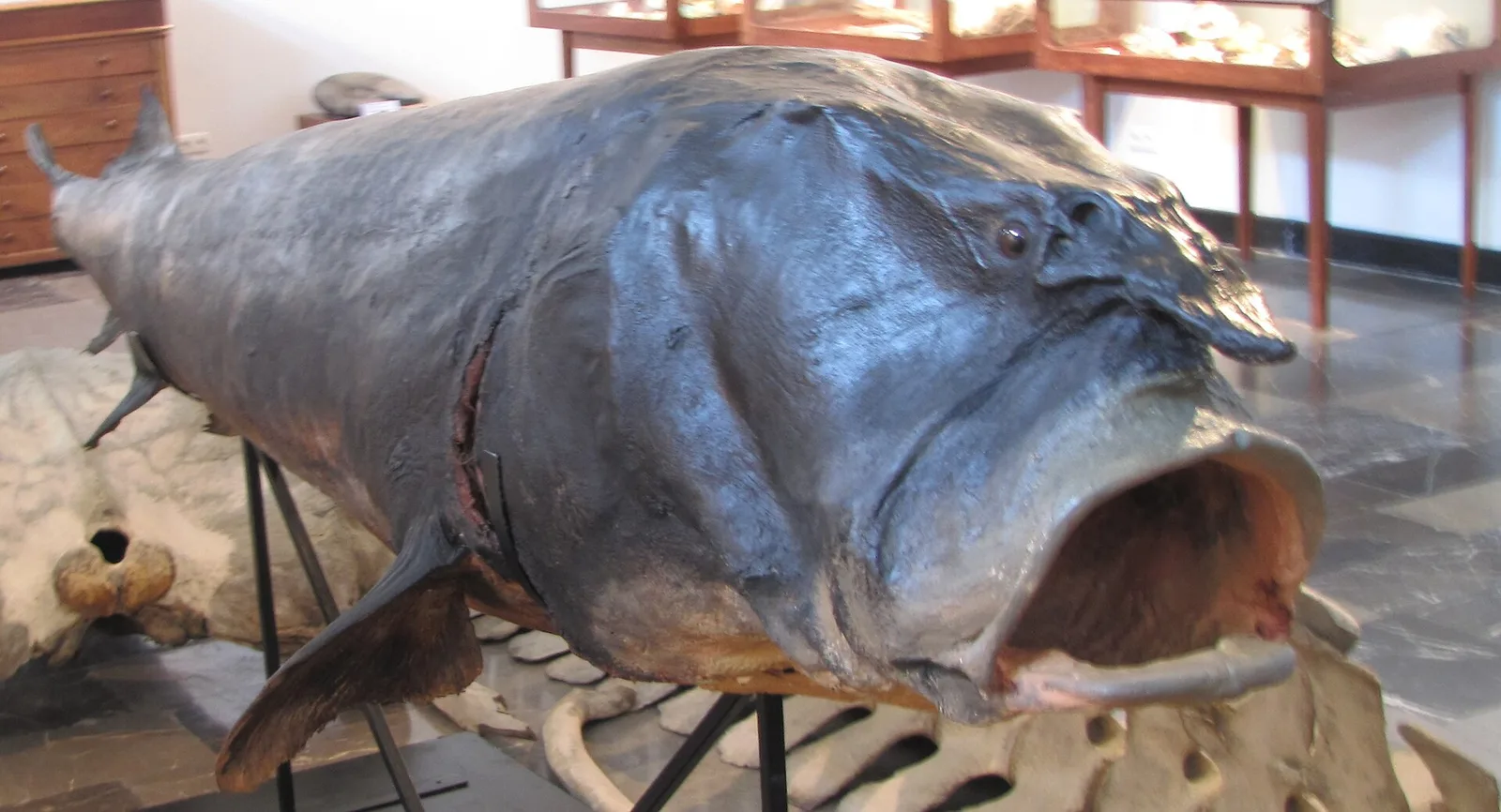
A beluga sturgeon is the biggest sturgeon on earth, listed at up to 26 ft (8 m) and 3.2 metric tons. It lives only in the Caspian and Black Sea basins, so you won’t hook one in the US. It’s a fish, no relation to the beluga whale, and most people know it for its eggs. Caviar, poaching and dams have left the wild fish critically endangered.
The biggest sturgeon on earth holds a smaller rod record than California’s white sturgeon: 224 lb 13 oz against 468 lb.
How big do beluga sturgeon get?
FishBase lists the beluga at up to 8 m (26 ft) and a top weight of 3.2 metric tons, over 7,000 lb of fish. The U.S. Fish and Wildlife Service is more careful. Its 2004 listing says historic reports show fish that “can reach 6 meters in length and more than one ton in weight.”
So call it 20 ft and a ton on the federal number, and 26 ft at the very top of the listed range. Don’t expect either one now. By 2004 the oldest beluga being caught were 50 to 55 years old, and the average was under 35.
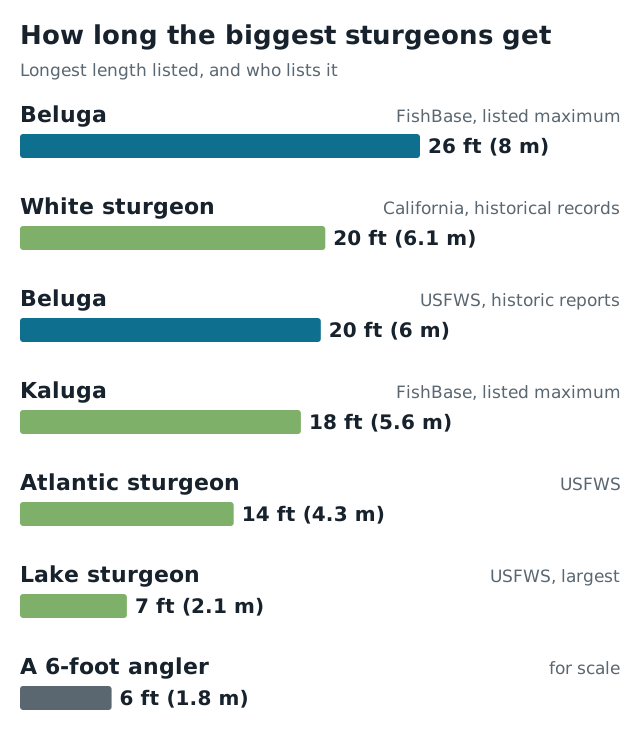
Listed maximums, not fish on a scale. Chart: fishing.info, from FishBase, the U.S. Fish and Wildlife Service and the California Department of Fish and Wildlife.
Is it the largest freshwater fish in the world? The USGS says so, in those words. The argument is over the salt water. A beluga is anadromous: it grows up in the sea and runs up rivers to spawn. Count only fish that never leave fresh water and the title goes to a giant freshwater stingray. One from the Mekong weighed 661 lb in 2022, the largest freshwater fish on record.
Where do beluga sturgeon live?
In the Caspian and Black Sea basins, and nowhere else in the wild. The federal listing limits the current range to those two. The fish used to live in the Adriatic and the Sea of Azov as well. The Adriatic population is gone, and in 2004 the last wild-caught fish on record from Azov dated from the mid-1980s.
There are no wild beluga in North America. The US beluga you’ll read about are on fish farms in Florida.
Two rivers matter most now. The Ural is the one major Caspian river “that has not been dammed or otherwise modified,” in the federal wording. The Danube is the other: “Within the EU the only river with naturally reproducing sturgeon populations remains the Danube,” WWF says.
Free PDF · Water temperature chart Which fish are biting at today's water temperature?
One reading, and the 16-page chart shows which of 26 fish are spawning, feeding hard or slowing down; for bass, crappie, bluegill and walleye, where they sit and what to throw. Every number sourced.
No card, nothing to buy, and the PDF is yours to keep. Confirm with one click and it's on its way. Then a few short emails and one a week on what's biting. Unsubscribe anytime. Privacy.
Can you catch a beluga sturgeon?
Not in the US, because there are none to catch. Along the Danube the door is shut too. Romania made its ban on fishing and selling wild sturgeon indefinite in 2021. Bulgaria brought in an indefinite ban on sturgeon fishing from January 1, 2026. Its order names the beluga.
Those are the two countries I can give you the rule for. Anywhere else on the Caspian or Black Sea, get the current rule from that country before you plan around it.
Want a giant you can actually fish for? Start with the big freshwater species closer to home. The white sturgeon is the one on the Pacific coast. The lake sturgeon is the other, in the few seasons that allow one.
What is the beluga sturgeon world record?
The IGFA all-tackle record is 224 lb 13 oz (102 kg), caught by Merete Lehne at Guryev, Kazakhstan, on May 3, 1993.
That’s small for this fish, and it’s less than half the white sturgeon record of 468 lb from Benicia, California, in 1983. The 3.2 tons in FishBase is a listed maximum, not a rod record. They’re two different numbers, so don’t let anyone trade one for the other.
| Fish | Heaviest listed by FishBase | IGFA rod record |
|---|---|---|
| Beluga | 3.2 metric tons (over 7,000 lb) | 224 lb 13 oz (102 kg) |
| White sturgeon | 816 kg (1,799 lb) | 468 lb (212.28 kg) |
| Lake sturgeon | 125 kg (276 lb) | 168 lb (76.2 kg) |
Look at the gap. The beluga’s rod record is about 3 percent of its listed top weight. The white sturgeon’s is about 26 percent, and the lake sturgeon’s about 61 percent. Nobody has landed anything near a giant beluga on a rod and had it weighed for the IGFA.
How long do beluga sturgeon live?
FishBase’s oldest reported fish is 118 years. In the early 1900s, 100-year-old beluga were commonly taken in the northern Caspian, the federal listing says. If you’ve seen a sturgeon credited with 400 years, that’s not a beluga. It’s a 2026 estimate for lake sturgeon, worked out from growth rates, and its authors caution that it isn’t an exact age.
The start is what hurts. Males mature at 10 to 16 and females at 14 to 20. After that, “Male beluga sturgeon spawn only once every 4-7 years, whereas females reproduce once every 4-8 years.” A female killed at 13 hasn’t reached the youngest age the listing gives for a mature female.
To spawn they run up rivers to shallow gravel, with runs in spring and in fall.
What do beluga sturgeon eat?
Other fish. The sturgeon you know from US rivers mostly vacuum the bottom. An adult beluga hunts in the middle of the water column, mostly on open-water fish, and it has the mouth for it: wide and crescent-shaped. Like every sturgeon, it has no teeth, so it swallows what it catches.
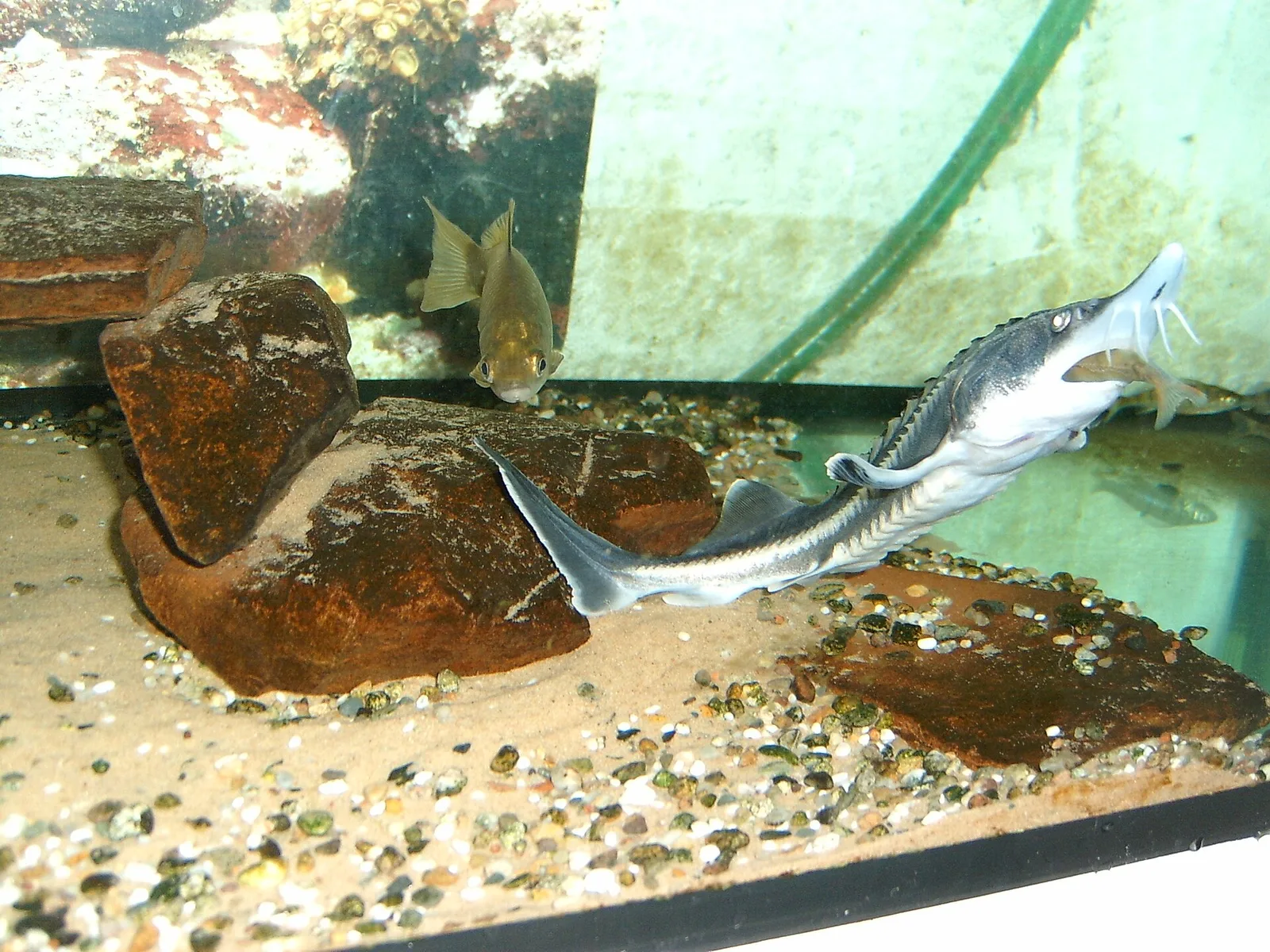
A young beluga in an aquarium. Photo: Daniel Döhne, via Wikimedia Commons (CC BY-SA 3.0)
Beluga or kaluga?
The kaluga is the beluga’s closest big relative, from the Amur River basin on the far side of Asia. It’s the other sturgeon people mix up with the beluga, and US law treats it harder.
| Beluga | Kaluga | |
|---|---|---|
| Where | Caspian and Black Sea basins | Amur basin |
| Longest listed | 26 ft (8 m) | 18 ft (5.6 m) |
| Heaviest listed | 3.2 metric tons | 1 metric ton |
| Oldest reported | 118 years | 80 years |
| US status | Threatened (2004) | Endangered (2014) |
| IUCN Red List, as FishBase carries it | Critically Endangered (2019) | Critically Endangered (2019) |
Why is the beluga sturgeon endangered?
It carries two labels, and they don’t match. FishBase carries its IUCN Red List status as Critically Endangered, assessed on September 14, 2019. The US Endangered Species Act has it as Threatened, listed in 2004. The agency wrote then that “we do not believe the species is on the brink of extinction at this time.” The beluga has also been on CITES Appendix II, the treaty list that monitors international trade, since April 1, 1998.
Here’s what drove it down, in the federal listing’s numbers:
- Dams. Natural spawning “occurs in less than 15 percent” of the fish’s historic spawning habitat. About 85 to 90 percent of the old spawning grounds are damaged or cut off.
- Poaching. The illegal catch may be “some 11 times greater than the legal market.”
- The Danube catch. It averaged 23 metric tons a year in the mid-1970s. By 1994, after the Djerdap dams went in, it was 12.7 tons.
Hatcheries have propped up the count. In 2004, more than 90 percent of the Caspian’s beluga were estimated to be of hatchery origin. A 2010 analysis built on Ural River data put a number on that trade. It takes ten hatchery fish to match the benefit of keeping one wild beluga from being killed. The same analysis found the Caspian harvest running at four to five times what the population could sustain.
How many are left? Nobody knows. In 2025 Florida’s WUFT put the question to Thomas Friedrich, who works on sturgeon at a university in Austria. Counting them is “a bit like looking into a crystal ball,” the station reports him saying. His guess for the Black and Caspian seas: likely not more than a couple thousand. The same report carries an estimate that the species could be extinct in the wild by 2050.
Is beluga caviar illegal in the US?
Imports of beluga caviar and meat from the Caspian and Black Sea states were suspended in 2005. The special rule behind that suspension is still in the federal code. Here’s what it says, line by line, in the agency’s words.
| What | What the federal text says | Where it’s written |
|---|---|---|
| Caviar or meat from Azerbaijan, Iran, Kazakhstan, Russia or Turkmenistan | “suspending import of and foreign commerce” | Caspian notice, Sept. 30, 2005 |
| Caviar or meat from Bulgaria, Georgia, Romania, Russia, Serbia and Montenegro, Turkey or Ukraine | “suspending import of and foreign commerce” | Black Sea notice, Oct. 28, 2005 |
| Caviar in your luggage | The suspension covers shipments “transported as personal or household effects” | Both notices |
| Caviar legally in the US before the suspension | Interstate sale for “no more than 18 months” after the original CITES export permit | Both notices |
| Live fish and viable eggs | “Live beluga sturgeon remain subject to all the prohibitions and provisions” of the threatened species rules | 50 CFR 17.44(y) |
| Any beluga caviar sold in the US | “must be labeled in accordance with the CITES labeling requirements” | 50 CFR 17.44(y)(3) |
| Farmed meat from Bascom, Florida | “applies to aquacultured beluga meat only” and “does not apply to trade in beluga caviar or live beluga sturgeon” | Notice, June 26, 2017 |
So the 18-month window for old stock closed long ago. A tin in your suitcase from one of those countries is covered like any other shipment. The one way around a suspension is a threatened species permit. To get one, the notices say, applicants “must demonstrate that their proposed activities would provide for the conservation of the species.”
For the agency even to consider lifting a suspension, every country on that basin has to agree a basin-wide management plan.
Has either suspension been lifted since? Not that the Federal Register shows. I searched it on November 9, 2026, for every document that names the beluga sturgeon. None lifts one. WUFT was still calling imports illegal in May 2025.
The rule does let a farm outside those countries apply for an exemption, if it “does not rely on wild beluga sturgeon for broodstock.” WUFT reports that Marky’s, the parent company of the Bascom farm, got one for purebred beluga caviar in 2019. It calls that farm “the only U.S. fish farm authorized to sell the species’ high-value eggs.” I found no Federal Register notice for a caviar exemption. The one notice on file, from 2017, covers meat only, so the caviar approval rests on press reports. By WUFT’s account, that farm’s owner is the one place in the US where you can buy approved beluga caviar.
Other caviar is outside all this. The suspension “does not apply to caviar and meat from other sturgeon species such as osetra and sevruga,” the agency said at the time.
Is beluga sturgeon good to eat?
Hardly anyone in the US gets the chance. The Florida farm’s meat is the legal source named in federal text, and I can’t vouch for how beluga itself tastes. Sturgeon in general has a good name: Missouri’s conservation department says “the flesh of sturgeons has an excellent flavor, especially when smoked.”
The eggs are the money. Modern Farmer put a half-ounce tin of the Florida beluga caviar at $420 and up in 2020. That’s what a poacher is after.
For the US fish you may actually meet, the sturgeon fishing guide has the seasons and the release rules.

Free PDF · 16 pages
Stop guessing. Know what's biting before your first cast
A whole Saturday on the water with nothing to show for it. One reading tells you who's feeding.
The Water Temperature Fishing Chart. Take one water temperature reading, find it on the chart, and see which of 26 freshwater fish are spawning, feeding hard or slowing down.
- Where bass, crappie, bluegill and walleye sit, and what to throw. Trout: the reading where you stop.
- Why a 3 ft drop beats a cold front, and what to throw each day of the front
- The three thermometer mistakes that make a reading lie
The chart's numbers come from state fish and wildlife agencies and fisheries research: 61 sources, each listed on the site.
No card, nothing to buy. Confirm with one click and the PDF is on its way, one version for your phone and one to print, yours to keep. Then a few short emails and one a week on what's biting, with an unsubscribe link in every one. Privacy.
Related
Section guide
Freshwater Fish Species Outside the Big Families: Sturgeon, Gar, Bowfin, BurbotThe freshwater fish species outside the bass, trout, catfish and pike families: sturgeon, gar, bowfin, burbot, drum, eel and paddlefish, with records.
 Goliath Tigerfish: How Big They Get, Teeth, and the Crocodile Stories
Goliath tigerfish facts that hold up: the 97 lb IGFA record, real size, the teeth, the attack and crocodile stories, and where anglers go.
 Nile Perch: How Big They Get, the Record, and Where to Catch One
Nile perch grow to about 2 m and 200 kg, and the record is 230 lb from Lake Nasser. Where to catch one, why the US bans it, and the Lake Victoria story.
 Buffalo Fish: Not a Carp, and How to Catch and Eat One
Buffalo fish are native suckers, not carp. How to tell bigmouth from smallmouth buffalo, the bait that catches them, and how to cook around the bones.
 Lamprey: What It Is, and What to Do If You Catch One
A lamprey is a jawless, eel-like fish that feeds on blood. How to tell a sea lamprey from a native one, what to do if you catch one, and the rules.
 Piranha: Are They Dangerous, and Are They Illegal in the US?
Piranhas bite swimmers, but it's unclear one has ever killed a living person. Their real size, the pacu look-alike, how to catch one, and US state law.
 Arapaima: How Big They Really Get, and Where You Can Catch One
The arapaima breathes air, tops out near 10 ft and 440 lb, and is legal to catch in only a few places. Its real size, the record, and where to fish.
Sources (29)
- FishBase, Huso huso
- FishBase, Huso dauricus
- FishBase, Acipenser transmontanus
- FishBase, Acipenser fulvescens
- Federal Register, April 21, 2004: final rule listing the beluga sturgeon as threatened
Show all 29 sourcesShow fewer sources
- U.S. Fish & Wildlife Service ECOS, species listing status (Huso)
- Endangered and Threatened Wildlife and Plants; Notice of Suspension of Trade in Threatened Beluga Sturgeon (Huso huso) From the Caspian Sea Basin (September 30, 2005)
- Endangered and Threatened Wildlife and Plants; Notice of Suspension of Trade in Threatened Beluga Sturgeon (Huso huso) From the Black Sea Basin (October 28, 2005)
- Endangered and Threatened Wildlife and Plants; Special Rule To Control the Trade of Threatened Beluga Sturgeon (Huso huso) (March 4, 2005)
- 50 CFR § 17.44, Species-specific rules: fishes (LII)
- eCFR, 50 CFR 17.44(y), Beluga sturgeon (text current as of November 5, 2026)
- Federal Register, every document that names the beluga sturgeon, newest first (searched November 9, 2026)
- Threatened Species; Exemption From Threatened Species Permits for a Qualifying Beluga Sturgeon Aquaculture Facility (June 26, 2017)
- U.S. Fish & Wildlife Service, Service Suspends Trade in Threatened Beluga Sturgeon
- U.S. Fish & Wildlife Service, Sturgeon Snoots and Scutes
- USGS, What is the largest freshwater fish?
- IGFA World Record Search: Sturgeon, beluga; Sturgeon, white
- Animal Diversity Web, Huso huso
- California Department of Fish and Wildlife, White Sturgeon
- U.S. Fish & Wildlife Service, Atlantic sturgeon (Acipenser oxyrinchus oxyrinchus)
- U.S. Fish & Wildlife Service, Lake Sturgeon (Acipenser fulvescens)
- Missouri Department of Conservation, Shovelnose Sturgeon
- New research shows fishery management practices for beluga sturgeon must change (Phys.org)
- WUFT, Beluga sturgeon are vanishing from their home seas. So why are they on North Florida caviar farms? (May 27, 2025)
- Modern Farmer, A 17-Year Journey to Homegrown Beluga Caviar
- WWF Central and Eastern Europe, Conservation Success! Fishing for Wild Sturgeon and Selling Wild Sturgeon Products Banned Indefinitely in Romania
- BTA, Bulgaria Bans Sturgeon Fishing in Danube and Black Sea
- National Geographic (Stefan Lovgren), What's the world's biggest freshwater fish—and will we ever know for sure? (April 7, 2023)
- Bridge Michigan, Think you're getting old? New study says Michigan sturgeon may live to 400 (August 11, 2026)