 By
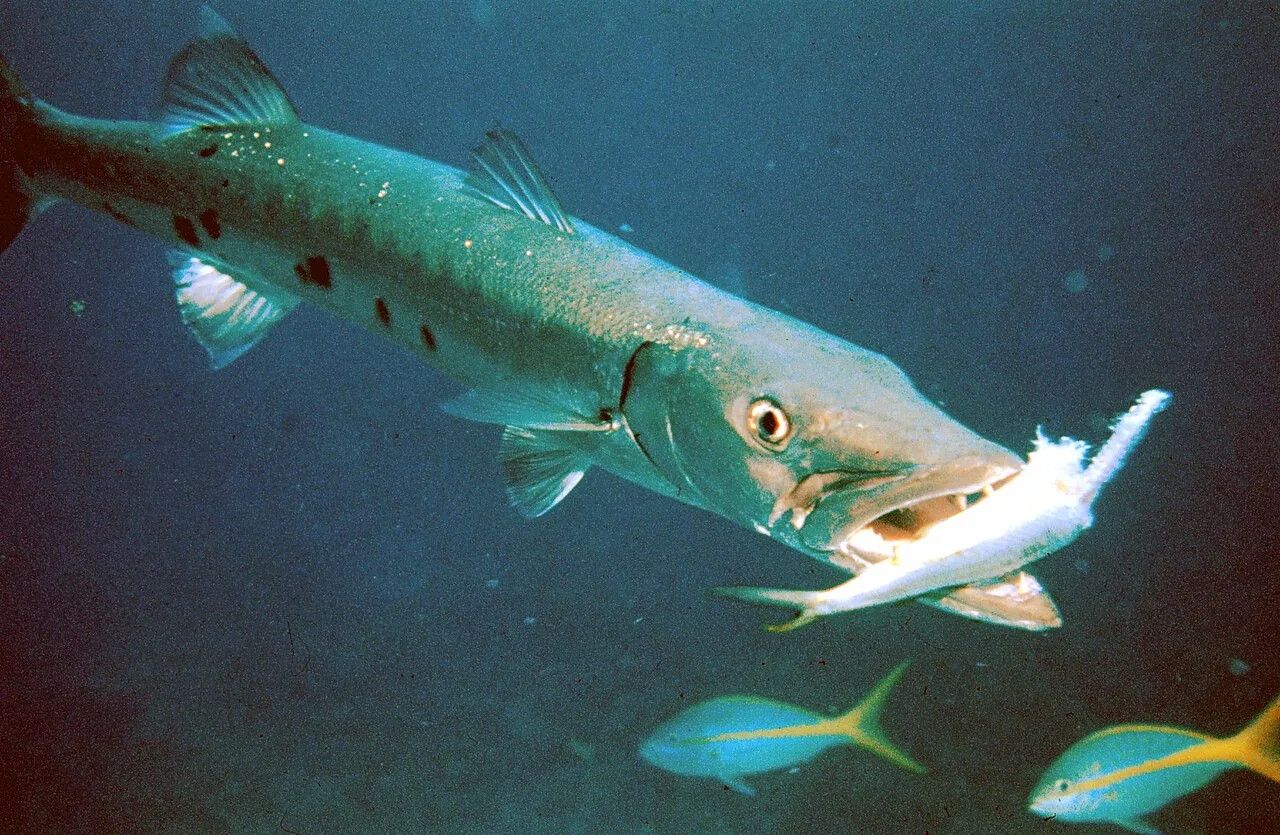
Fish eat other living things in the water: insects, smaller fish, crayfish, snails, worms, tiny floating plants and animals called plankton, and water plants. Which of those a fish eats comes down to its mouth and its size. A bass eats fish and crayfish. A bluegill eats mostly insects. A catfish eats nearly anything it can find on the bottom. Know what your fish eats, and you know what to put on the hook.
A grass carp can eat more than its own body weight in a day. About half of it comes out the other end undigested.
What do fish eat in the wild?
Out in a lake or river, the menu runs from food you need a microscope to see up to food as big as a bluegill. The FAO, the United Nations’ food and farming agency, lists the natural foods in a pond: detritus, plankton, worms, insects, snails, water plants and fish. Missouri’s field guides fill in the rest:
- Plankton: tiny plants and animals that float in the water. Some fish, like the paddlefish, strain it from the water.
- Insects and their larvae: mayflies from the water, and land bugs that fall in from the bank.
- Worms and snails on and in the bottom.
- Crayfish and other small crustaceans, the shelled animals related to shrimp.
- Other fish: minnows, young shad, small sunfish.
- Plants and algae, and detritus, which is the rotting plant matter on the bottom.
- Whatever falls in: a frog, a mouse, a snake. Missouri’s field guide lists all three for the largemouth bass.
Most fish are not picky. They eat what is common and what fits in their mouth, which is good news when you pick a bait. Channel catfish from the Des Moines River had insects from 50 different families in their stomachs.
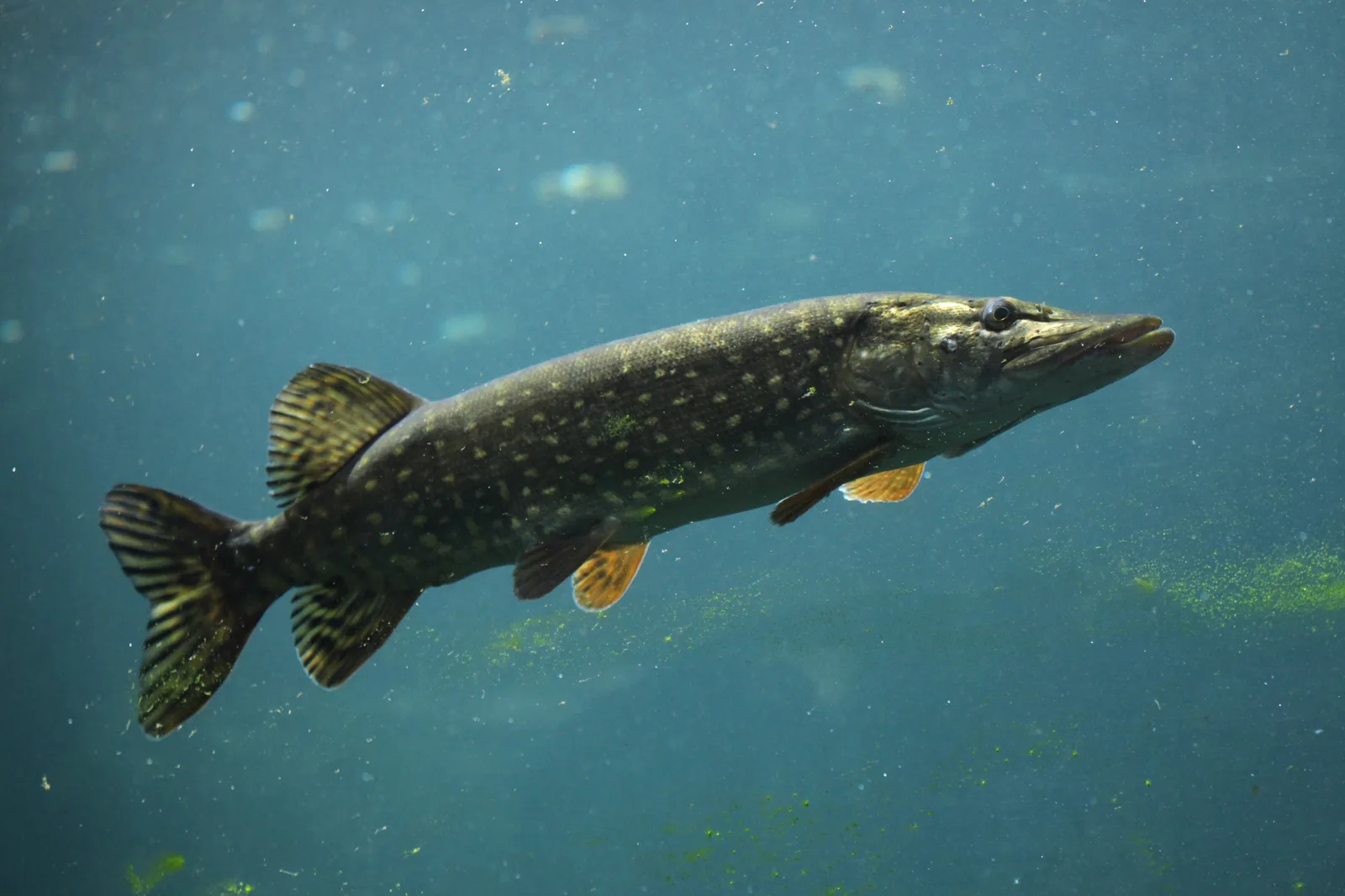
A northern pike. Photo: wrangel / Depositphotos.
Are fish carnivores, herbivores or omnivores?
All three, plus a fourth group: the filter feeders. Here is each one with the fish you are likely to meet:
- Carnivores eat animals. Smaller fish, insects, crayfish, frogs. Northern pike, bass, walleye and trout are carnivores. A pike hides and darts out to grab passing fish.
- Herbivores eat plants. The grass carp is the one you will find in US ponds. In this country it is mainly used to control water weeds in lakes and ponds. Young grass carp eat small animals first and switch to plants at about 8 in (20 cm).
- Omnivores eat both. Missouri calls the common carp and the channel catfish omnivores. The catfish eats fish, insects, crayfish, mollusks such as snails, and plants. Water insects are a carp’s main food.
- Filter feeders strain plankton. The paddlefish swims with its mouth wide open. It catches tiny crustaceans and insects on its gill rakers, comb-like bristles inside the gills. Gizzard shad do much the same, mostly along the bottom.
Why it matters at the water: you can’t count on a filter feeder to take your bait. Paddlefish are filter feeders, so Missouri calls snagging the most dependable way to catch them. It sets a snagging season for that. A carnivore wants something that moves or smells like an animal. An omnivore takes almost anything, which is why carp and catfish bite corn, dough and shrimp.
Free PDF · 7-day beginner fishing pack Starting fishing? What do you buy, what does it cost, and what do you do at the water?
The 16-page beginner pack: the $85–100 kit with the spec to ask for in the store, the license rules, the first knot, the rig drawn, the cast, the bite and the release. A free seven-day email course comes with it, one step a day.
No card, nothing to buy, and the PDF is yours to keep. Confirm with one click and it's on its way. Then a few short emails and one a week on what's biting. Unsubscribe anytime. Privacy.
What do common fish eat, and what bait matches?
This is the short answer for the fish most people catch first. Each diet comes from the Missouri Department of Conservation’s field guide.
| Fish | What it eats | Where it feeds | Bait that matches |
|---|---|---|---|
| Bluegill | Mostly insects, plus small fish, crayfish, snails | At every depth, by sight; at the top when mayflies hatch | A piece of worm or a cricket under a small bobber |
| Largemouth bass | Fish, crayfish, big insects, the odd frog or mouse | At any depth; it sucks prey in | A live minnow, or a lure that looks like a fish or crayfish |
| Channel catfish | Fish, insects, crayfish, mollusks, plants | On the bottom at night, by taste, smell and touch | Cut bait, nightcrawlers, liver or shrimp on the bottom |
| Common carp | Mostly aquatic insects, plus plants | Mostly the bottom, in the late evening and early morning | Corn or a dough bait on the bottom |
| Grass carp | Water plants and algae | In the weeds | Plant bait, like a cherry tomato or lettuce |
| Rainbow trout | Water and land insects, snails, small fish | At any depth, in front of it | A small spinner, a worm, or a fly |
| Northern pike | Mostly other fish | From hiding, in ambush | A big live baitfish, or a spoon, a metal lure that flashes |
| Walleye | Fish as adults; mayflies all their life | Deep by day, shallower at night | A minnow in the cold months, a nightcrawler or leech in the warm ones |
| White crappie | Mostly small fish like minnows and young shad, plus insects | Where the minnows and shad are | A small minnow under a bobber |
| Paddlefish | Plankton, strained from the water | Open water | None: they are snagged, where legal |
Smallmouth bass lean harder on crayfish than largemouth do. What bass eat has a Virginia lake where crayfish were about three-quarters of the smallmouth diet, and the full menu by size and season. For catfish it is what catfish eat, with each species and the bait to use.
The baits come from anglers, not the field guides. Cherry tomatoes and lettuce are on Connecticut’s list of grass carp baits, and carp bait has the corn and dough recipes.
How can you tell what a fish eats from its mouth?
Look at where the mouth sits on the head. It often tells you where the fish feeds, and so where your bait should be. Biologist Jenna O’Del laid out the three positions in Northern Woodlands magazine.
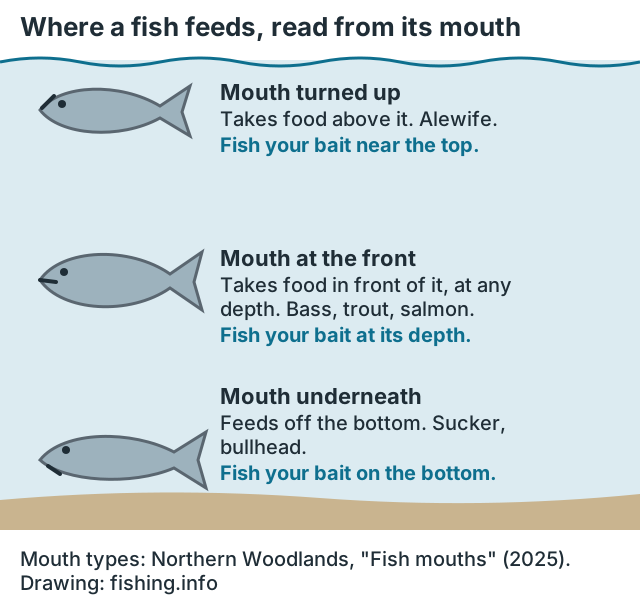
- Mouth turned up: the fish often takes food above it, at the surface or from below. The alewife, a herring, is one.
- Mouth at the front: the fish takes food in front of it, at whatever depth it swims, so you can catch it at any level. Bass, trout and salmon have this mouth (see what salmon eat). Bass also suck prey in: they open the mouth fast and the water rushes in with the food.
- Mouth underneath: the fish feeds along the bottom as it swims. O’Del’s examples are the longnose sucker and the brown bullhead, a catfish.
The size of the mouth sets the size of the meal. A bluegill’s small mouth limits what it can eat, so a big worm gets nibbled, not swallowed. Use a small hook and a pinch of worm. A largemouth can swallow a bluegill about 40 percent of its own length and a shad about half its length. A 15 in (38 cm) bass tops out near a 7.5 in shad. That is why big baits catch big bass.
Does a fish eat the same thing all its life?
No. A fish starts tiny and works its way up the menu as its mouth grows.
- Bluegill fry, the newly hatched young, eat mainly small crustaceans. Adults eat mostly insects.
- Channel catfish under 4 in (10 cm) eat almost nothing but small insects. Bigger ones eat bigger food and more kinds of it.
- Walleye fry eat crustaceans and insects. Adults eat mostly fish.
- Grass carp eat small animals until they reach about 8 in (20 cm), then turn to plants.
For you, this means a small bait catches every size of fish, and a big bait sorts out the big ones. If you’re catching only small bluegill or small bass, go up a size.
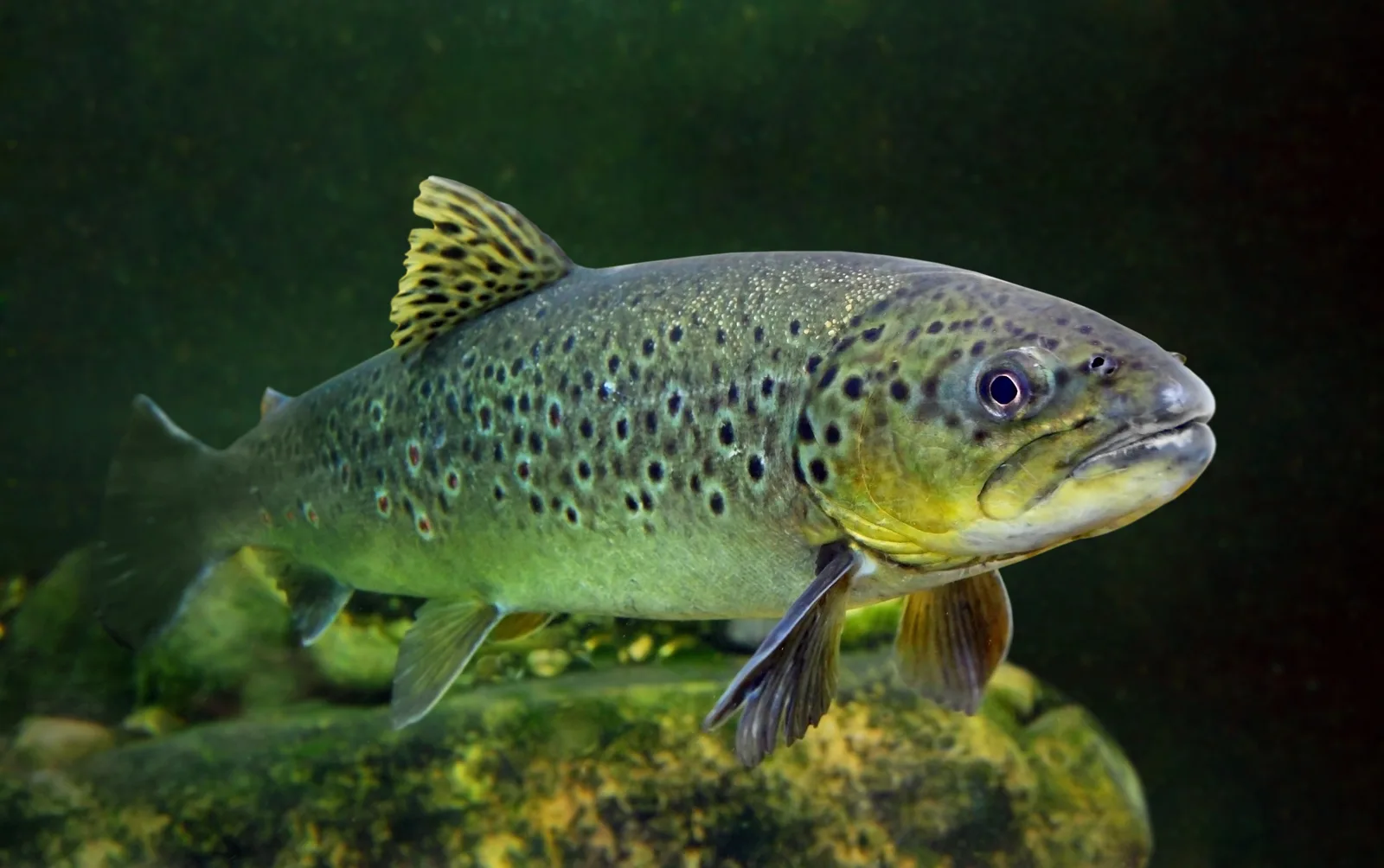
A brown trout. Photo: vladvitek / Depositphotos.
When do fish eat?
Each fish has its hours. Carp feed most in the late evening and early morning, sometimes in very shallow water. Channel catfish feed at night in the shallow parts of pools. Walleye stay deep by day and move shallower at night. Their eyes are made for low light. Bluegill hunt by sight, at every depth.
Water temperature matters too. Most fish are as warm as the water around them. (Do fish get cold explains the few that aren’t.) In cold water they digest slowly and eat less, so you get fewer bites. In warmer water they eat more often, up to a point: Clemson University’s pond guide notes that fish slow down again in the heat of August and September. The water temperature guide has the bands for each species. The bass page shows what that does to a bass’s meals from summer to winter.
What do fish eat in the ocean?
The same chain as in a lake, only bigger. It starts with plankton. Small schooling fish eat the plankton. Off the Northeast coast those are herring, menhaden, mackerel, butterfish and sand lance. NOAA, the federal ocean agency, calls them the link between the plankton and everything above them. Cod, striped bass, tuna, seabirds, seals and whales all eat them.
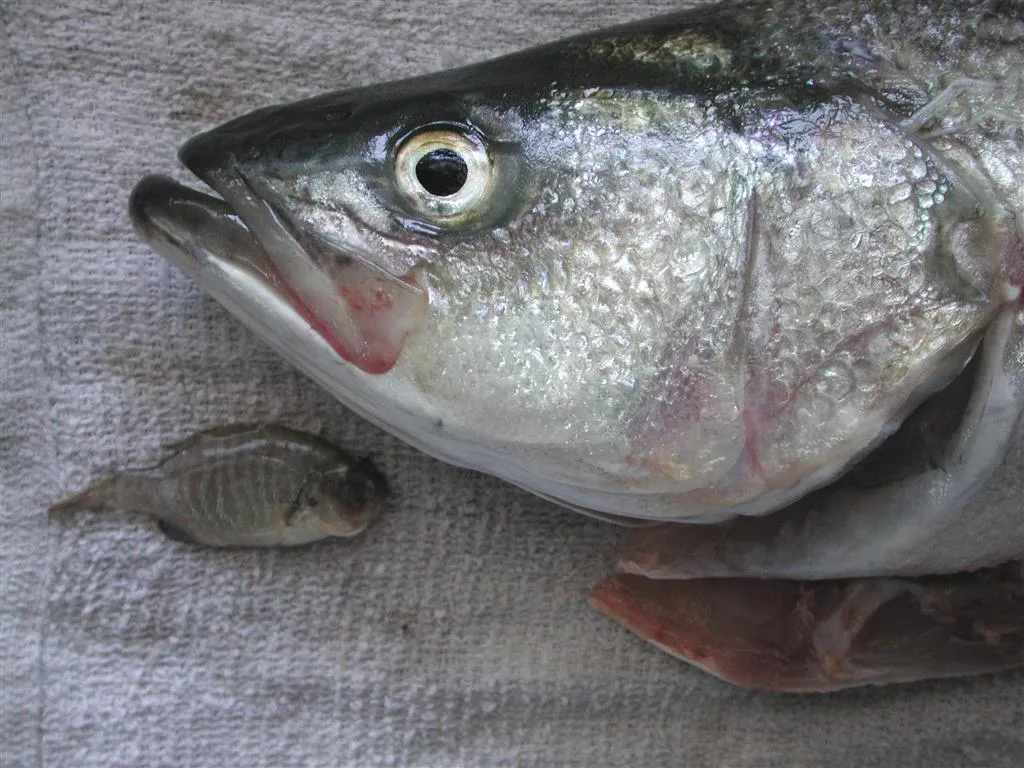 A striped bass and the perch found in its stomach. Photo: Robert Hsiao, Wikimedia Commons (CC BY 3.0)
That’s why so much saltwater bait is a small fish, live or cut. From Cape Cod to Virginia anglers call menhaden bunker, and Sport Fishing magazine’s captains fish them live for stripers. The bait guide has a section on saltwater bait.
What do fish eat in a pond?
A pond feeds its fish the same way a lake does: plankton, insects, worms, snails and small fish. You don’t have to feed a fishing pond. If you do want to feed bluegill and catfish, Clemson’s extension service gives a clear plan:
- Feed bluegill and catfish, not bass. Bluegill and catfish eat pellets readily. Bass rarely do, but they grow on the well-fed bluegill.
- Use a fish pellet with 25 to 30 percent protein and 5 to 8 percent fat.
- Give only what they clear in 5 to 10 minutes. Food left over means you fed too much: cut back.
- Stay within 10 lb per acre a day (about 11 kg per hectare), split into two feedings. That is the ceiling for fish used to a feeder, at the peak of the growing season.
- Start when the water passes 65 °F (18 °C) in March or April. Stop when feeding slows in the heat of late summer, and for the year when the water cools into the low 60s in fall.
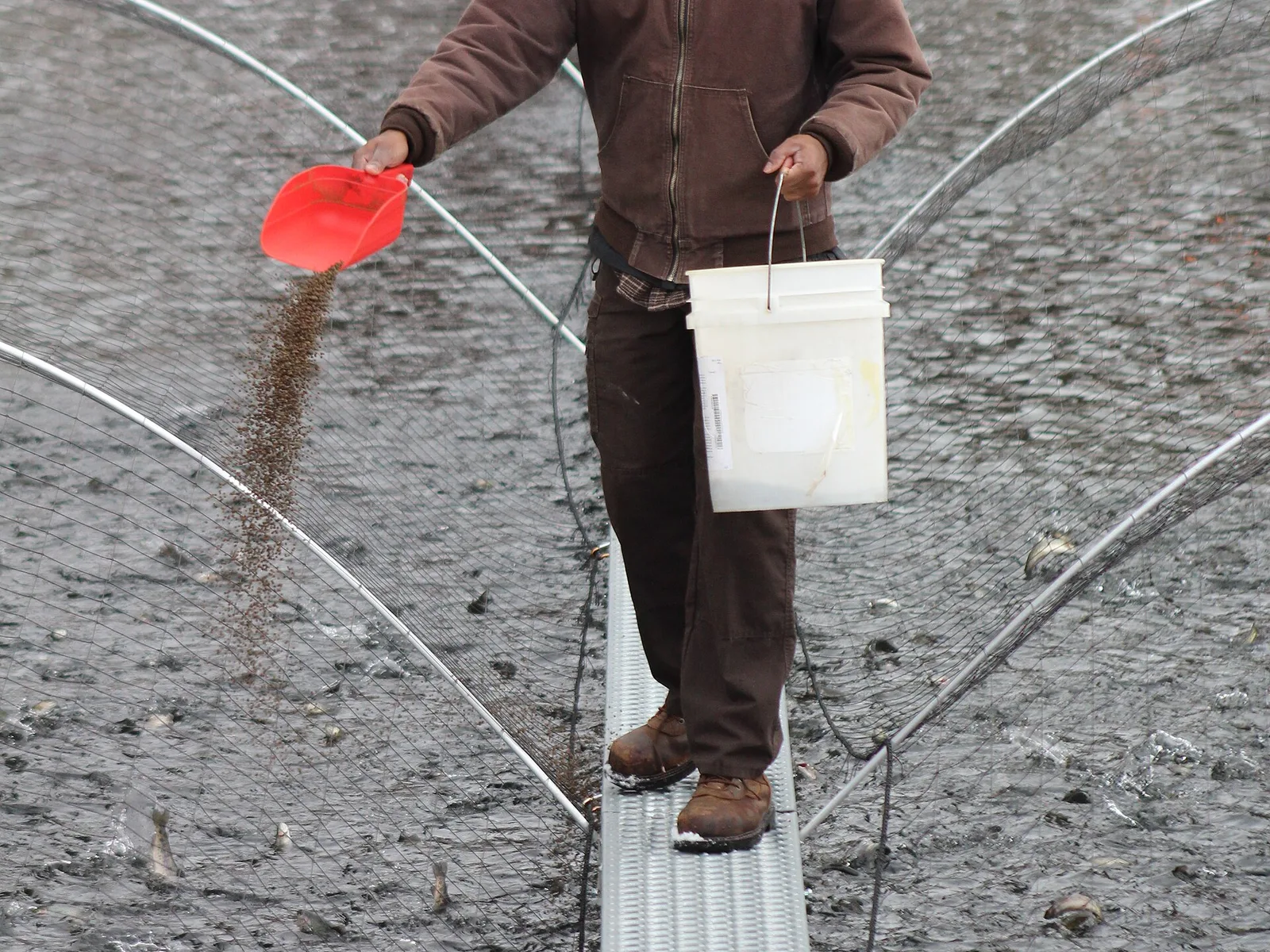 Photo: April Gregory, U.S. Fish and Wildlife Service (public domain)
Don’t overfeed. Clemson warns that leftover feed and fish waste rot and use up the oxygen in your pond. In water already green with algae, that can kill fish. Its advice is written for South Carolina, so your dates may differ.
What do pet fish eat?
Pet fish eat food made for them, mostly flakes and pellets. Buy the food made for your kind of fish. PetMD’s vet guide says:
- Feed what they eat in two to five minutes, once or twice a day, and take out what’s left.
- Flakes float on top before they sink. Pellets come floating or sinking.
- Overfeeding is the common mistake. It can harm the fish and foul the water.
- Treats are extras. PetMD lists freeze-dried bloodworms, brine shrimp, de-shelled peas, lettuce and squash, and says treats should not be the main food.
If a fish’s mouth is big enough for a pellet, PetMD says to feed pellets: they hold their vitamins longer in water than flakes do.
Can fish eat worms?
Yes, and most freshwater fish will. Worms are on the FAO’s list of natural fish foods, and they live in and on the bottom where fish look. That’s why a worm under a bobber, the float that holds a bait at one depth, is the classic first bait. Bluegill, perch, trout, walleye and bass all take one. The bait guide shows how to hook a worm so it stays on.
How do you match your bait to what fish eat?
Use what you now know about the fish. Run through these five checks before you pick a bait:
- Know what it eats. A fish eater wants a minnow or a lure that looks like one. An insect eater wants a worm, a cricket or a small fly. An omnivore takes almost anything that smells like food.
- Look at the mouth. Underneath means bottom. Turned up means near the top. At the front means its own depth.
- Size the bait to the mouth. A small bait for bluegill and crappie, a big one for pike and big bass.
- Check what’s in the water now. When mayflies hatch, bluegill feed on top. Crappie eat minnows and young shad, so fish where those are.
- Mind the clock. Catfish and walleye feed at night, carp in the late evening and early morning.
Do that and the bait picks itself. Minnows cover most fish eaters. The live bait guide covers worms, crickets and the rest. A bobber keeps any of them at the depth you pick.
More of the questions kids ask at the water, from how fish breathe to whether they sleep, are in fish facts.

Free PDF · 16 pages
Your first fishing trip, from the store aisle to the first fish
Lost in the tackle aisle, the wrong gear in the cart, and home with nothing. Skip all of that.
The 7-Day Beginner Fishing Pack. A 16-page PDF plus a free seven-day email course, one step a day: the whole first trip in order, from the store to the release.
- Walk out of the store with the right rod and nothing extra: the $85–100 kit, item by item
- Know if you need a license, in 13 states, and the places where nobody needs one
- What to do when the bobber goes under, and the ten-second rule for letting the fish go
Every line from the beginner pages on fishing.info and the 247 sources behind them, the U.S. Fish and Wildlife Service and the Missouri Department of Conservation among them.
No card, nothing to buy. Confirm with one click and the PDF is on its way, one version for your phone and one to print, yours to keep. Then a few short emails and one a week on what's biting, with an unsubscribe link in every one. Privacy.
Related
Section guide
Fish Facts: The Questions Kids Ask About Fish, Answered With the ScienceFish facts with a number and a source for each: how fish sleep, breathe, hear and feel, and what every answer means when you hook and release one.
 Scariest Fish: Which Ones Really Hurt People, and Which Only Look It
The scariest fish in the world, sorted by what each can really do to you: sharks that bite, the most venomous fish, fish that poison and harmless monsters.
 Smallest Fish in the World: Three Fish Under a Third of an Inch
The smallest fish in the world is a swamp fish grown at 7.9 mm, shorter than a #8 hook. Its two rivals, how each was measured, and tiny fish in US water.
 Are Fish Animals? Yes: Vertebrates, Not Mammals, Mostly Cold-Blooded
Are fish animals? Yes: animals with a backbone and gills. Why fish aren't mammals, which fish run warm, and why California law calls a bee a fish.
 Biggest Fish Ever Caught: A 2,664 lb Great White on Rod and Reel
The biggest fish ever caught on rod and reel is a 2,664 lb great white from 1959. The IGFA top 10, the bigger fish that don't count, and the US giants.
 Is Fish Meat? Biology Says Yes, Lent Says No, Here's Why
Is fish meat? Biology says yes, Lent rules and US food law say no. See what vegetarian, kosher, halal and Hindu rules each say about fish.
 Do Fish Drink Water? Freshwater Fish, Saltwater Fish and Sharks
Do fish drink water? Freshwater fish barely do, saltwater fish drink all day, sharks use urea. Do fish get thirsty? Why bait dies in the wrong water.
Sources (19)
- FAO Training Series, 10. Fish feed and feeding
- Missouri Department of Conservation, Field Guide: Bluegill
- Missouri Department of Conservation, Field Guide: Largemouth Bass
- Missouri Department of Conservation, Field Guide: Channel Catfish
- Missouri Department of Conservation, Field Guide: Common Carp
Show all 19 sourcesShow fewer sources
- Missouri Department of Conservation, Field Guide: Grass Carp
- Missouri Department of Conservation, Field Guide: Northern Pike
- Missouri Department of Conservation, Field Guide: Rainbow Trout
- Missouri Department of Conservation, Field Guide: Walleye
- Missouri Department of Conservation, Field Guide: White Crappie
- Missouri Department of Conservation, Field Guide: Paddlefish
- Missouri Department of Conservation, Field Guide: Gizzard Shad
- Jenna O'Del (2025), Fish Mouths: How Anatomy Suggests Ecology, The Outside Story, Northern Woodlands
- Timmons, T. J. and Pawaputanon, O. (1980), Relative size relationship in prey selection by largemouth bass in West Point Lake, Alabama-Georgia, Proc. SEAFWA 34:248–252
- Missouri Department of Conservation, Paddlefish: Tips for Fishing
- NOAA Integrated Ecosystem Assessment, Northeast Small Pelagics (Forage Fish)
- Capt. Vincent Daniello, A Guide to Saltwater Live Baits, Sport Fishing
- W. Cory Heaton (2018), Supplemental Feeding for Recreational Ponds, Clemson Cooperative Extension Home & Garden Information Center
- Melissa Witherell, DVM (2026), What Do Fish Eat? Your Guide To Feeding Pet Fish, PetMD