Fish do sleep: four species have passed every test science uses to prove it, the zebrafish, the Mexican cavefish, the banded knifefish and the sand wrasse. The rest, from the bluegill under your dock to the walleye off the point, show most of the signs. They keep a daily quiet spell and a fixed resting spot, breathe slower, and take a moment to wake. For an angler, that decides which fish to chase after dark and which to leave until dawn.
A zebrafish spends about 58% of the night asleep and 5% of the day. A draughtsboard shark asleep on the seabed burns about a third of the oxygen of one that is swimming.
How do scientists know a fish is asleep?
A fish has no eyelids to close and no neocortex to record a sleep brain wave, so the yardsticks used on mammals fail. A 2024 review of 126 papers put five questions to each species instead. Is there a daily quiet period? Does the fish need a stronger nudge to react? Does it use a species-typical resting site and posture? Does it wake quickly, and does it sleep more after being kept awake? Only the four species above pass all five, a measure of how few fish have been studied.
The zebrafish has been studied deepest. In 2019 researchers recorded two sleep states in its brain. One is slow-bursting, like our slow-wave sleep. The other is a propagating wave, like our REM, with relaxed muscles and a slowed heart. Those signatures are at least 450 million years old.
How does a fish sleep with no eyelids?
It does not close its eyes; it changes what it does with the rest of the body. A resting fish stops swimming or slows to a hover and settles on or near a fixed spot. Fin and tail movement drop to a minimum, and it breathes slower. Some sharks have a third eyelid, the nictitating membrane, but it guards the eye while feeding, not for sleep. A great white simply rolls the eye back.
One sense stays on. In the Mexican cavefish the lateral line, the row of pressure sensors along the flank, keeps the cave populations awake. Cut its input and they sleep as much as their river-dwelling cousins. A fish at rest is still listening for vibration.
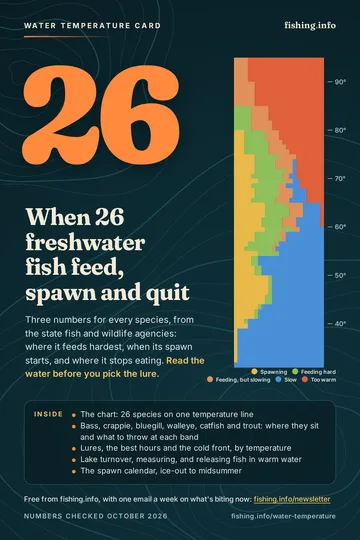
Free card: what 26 species do at your water temperature
Plus one email a week on what's biting now. No sales pitches. Privacy.
How can you tell a fish is sleeping?
The handling reports collected in Reebs’s review of fish sleep are the best guide. A brown bullhead at rest lies with its tail flat on the bottom and its body tilted 10 to 30 degrees, heart and breathing slowed. Tilapia sit on the bottom and let food drift past. Wrasses and hogfish have been lifted by hand. A diver once grabbed a resting walleye by the tail.
One trap: a flashlight makes some fish, bluegill first, sink and freeze. That looks like sleep and is a startle response. To see the real thing:
- Pick clear, shallow water with something to rest against. A dock, a weed edge or a rock pile in 3–6 ft (1–2 m). Fish rest where they hide.
- Return an hour after full dark, and approach slowly. Footfalls on a dock carry into the water.
- Use a dim red light from above, never a white beam in the face. The sink-and-freeze response comes from a sudden bright light.
- Read the posture. Tail on the bottom, body tilted, pectoral fins slow, gill covers beating slower than by day. A school broken into single fish sitting apart is the perch signature.
- Look for the arousal gap without touching the fish. A resting fish ignores a leaf drifting past; by day the same fish chased everything. That gap, not stillness alone, is sleep.
- Come back at first gray light. Fish that rested all night feed first at dawn. In an aquarium, the same drill works with the room light off, watching from a dark corner.
How long do fish sleep?
Less than we do, and in pieces. Adult zebrafish sleep about 5% of the day and 58% of the night. Kept awake for six hours, they lost about 30% of their sleep and paid it back the next night. The Mexican cavefish’s river-dwelling form sleeps more than 800 minutes a day; the blind cave populations get by on 110 to 250 minutes.
For a bass, a bluegill or a catfish there is no field number at all. Michael Heithaus of Florida International University puts aquarium fish at roughly 7 to 12 hours. That is expert opinion, not a measurement.
What do fish do at night?
Some rest. A 1979 study of yellow perch found that their schools break up at dusk in a fixed sequence, each fish drifting down to sit alone on the bottom. Bluegill and non-spawning smallmouth do the same.
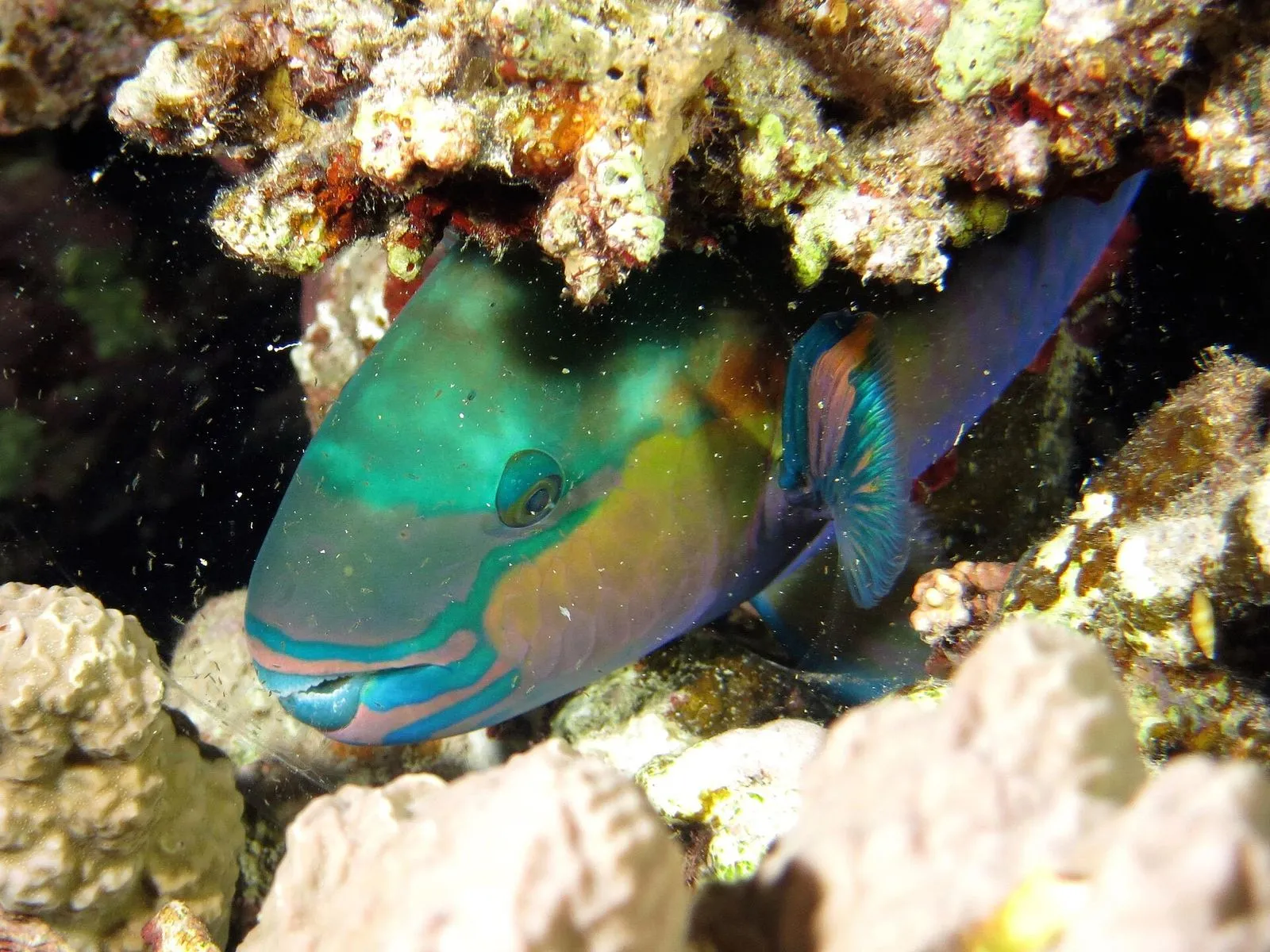
Parrotfish go further. Every night one spins a mucus cocoon around itself in under an hour, for about 2.5% of its daily energy. Of cocooned fish, 10% were attacked by blood-feeding isopods; of uncocooned ones, nearly all. A sleeping fish is a meal, and the cocoon is a mosquito net.
Some hunt: channel and flathead catfish by smell and touch, walleye by a reflective layer behind the retina, the tapetum, that turns dusk into daylight. And by one 1998 account some may never sleep: bluefish, mackerel, tuna and bonito swim and respond around the clock.
Sleep also bends to life. Spawning largemouth, pumpkinseed, perch and bullhead go 24 hours without a quiet period. A smallmouth guarding a nest defends it day and night.
Do sharks sleep?
The ones that can stop swimming do. A draughtsboard shark on the bottom uses about a third of the oxygen of a swimming shark, and half that of one merely resting. Its eyes are often open. Recordings published in 2024 added the first muscle-tone evidence of shark sleep.
About 20 of the 500-plus shark species, among them the great white, mako and whale shark, are obligate ram ventilators: they must swim to breathe. How they sleep, or whether they do, is unknown. The claim that they sleep one brain half at a time, like dolphins, has no primary source.
Which game fish rest at night, and which feed?
Where nobody has watched a species after dark, the table says so. The fish facts section answers the other questions about how fish live.
| Species | When it rests | Where | For night fishing |
|---|---|---|---|
| Yellow perch | Night; schools break up at dusk in a fixed order | On the bottom, single fish sitting apart | Fish the last hour of light and the first; skip the middle of the night |
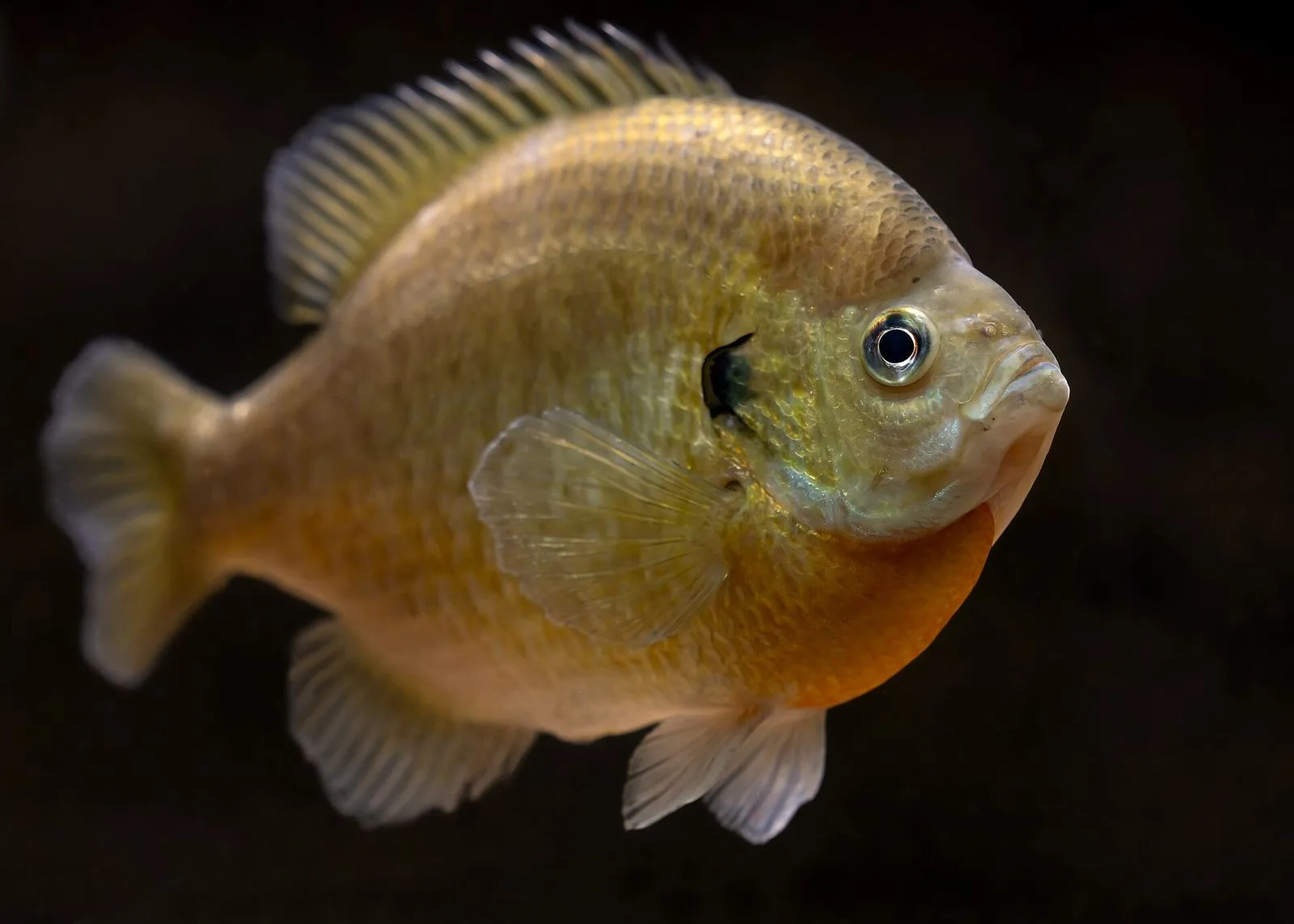
| Bluegill | Night | Tight to docks, weeds and the bottom; a bright light makes it sink and freeze | Dusk and dawn; casts in full dark rarely pay |
| Smallmouth bass | Night, except a nest-guarding male, which defends day and night | Rock and hard bottom | Dawn and dusk; the spring nest guarder is the exception and is best left alone |
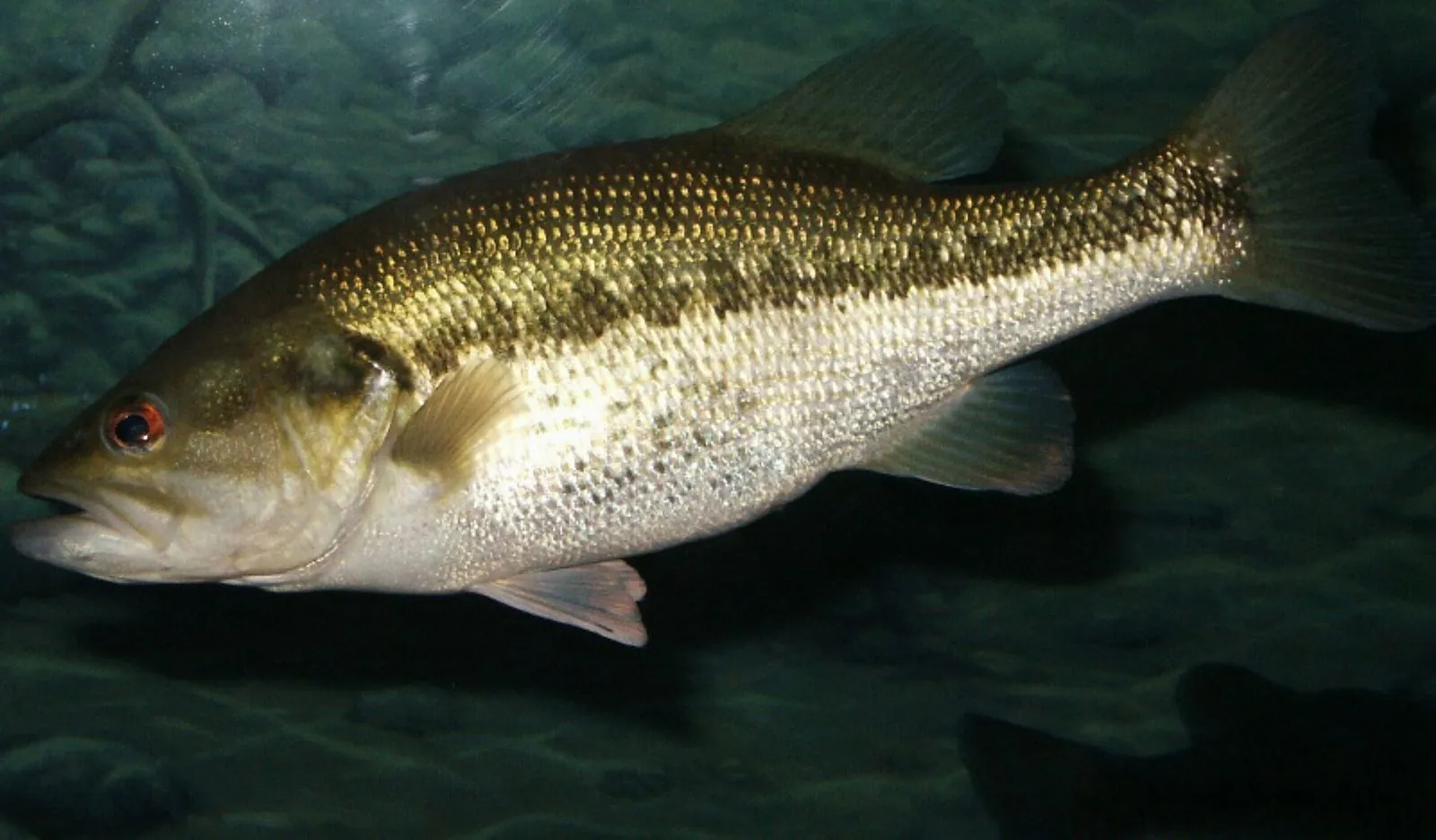
| Largemouth bass | By day in summer, offshore; most mobile at dawn | Deeper water or thick cover | The swing species: dusk into night in summer, dawn in every season |
| Walleye | Rests at times, and deeply (a diver grabbed one by the tail); hunts in low light | On the bottom near structure | A night feeder; the tapetum makes dusk its daylight |
| Channel catfish | No quiet period recorded; feeds by smell and touch | Bottom, holes, current edges | Night is the main shift |
| Brown trout | No sleep study; feeds at night in winter, and big browns hunt after dark | Undercut banks, deep pools | Night for the biggest fish; in winter, night is the bite |
| Northern pike | No sleep study | Weed edges | Daylight is the proven bite; treat night as an experiment |
Why do dawn and dusk fish so well?
The perch study explains why the first and last hour of light fish so well. Dusk is not one event but a sequence. Schools break, resting fish settle, and night hunters come up from deeper water, each species on its own timing. In one tracking study, largemouth were most mobile at dawn, resting offshore by day and feeding at dusk and into summer nights. The best time of day to fish puts hours on that window by season.
Are winter fish asleep?
No. What looks like sleep in a January bass is metabolic depression. A 2025 study tracked wild largemouth through fall and winter. Heart rate and metabolism fell with the water temperature and stayed low, yet the fish kept slow-swimming and probably fed a little. That is a fish on a low idle, not one that is unconscious. It will still take a bait dropped in front of it; it will not chase one.
The water temperature chart shows how far the idle drops per species, with trout and catfish each on their own bands.
Will a resting fish take a lure?
Nobody has put a lure in front of a fish confirmed asleep and published the result, so what follows is inference. A resting fish has a raised arousal threshold, so a crankbait passing 6 ft (2 m) away is background. But its lateral line stays on. A fish tilted against a rock still registers the pressure wave of something landing within a body length. That fits the handling reports: a hand can approach, and the fish reacts only at contact.
So on a night when the bluegill and perch are down, a lure moving through open water fishes for the hunters. The fish holding tight to cover gets a bait dropped on its nose, or nothing. No field study has measured sleep in bass, bluegill or catfish, so any number you hear for them is a guess.
Free download
The water temperature card
Read your water temperature and the card tells you who is spawning, who is feeding and what to throw. 26 species, 16 pages, for your phone and the tackle box.
Plus one email a week on what's biting now. No sales pitches. Privacy.
Related
Section guide
Fish Facts: The Questions Kids Ask About Fish, Answered With the ScienceFish facts with a number and a source for each: how fish sleep, breathe, hear and feel, and what every answer means when you hook and release one.
 Do Fish Drink Water? Freshwater Fish, Saltwater Fish and Sharks
Do fish drink water? Freshwater fish barely do, saltwater fish drink all day, sharks cheat with urea. The numbers, and what it means for bait and livewells.
 Do Fish Drown? How Fish Suffocate, and How to Revive a Tired One
Do fish drown? Not by the dictionary, but they suffocate three ways: low oxygen, damaged gills, no water flow. How long a fish lasts in air, how to revive one.
 Do Fish Fart? Yes, Herring Do It on Purpose, and a Bloated Bass Needs Help
Do fish fart? Herring do, on purpose, and scientists won a prize for proving it. Which fish pass gas, where it goes, and what to do with a bloated bass.
 Do Fish Feel Pain? What the Studies Found, and What Decides Whether a Released Fish Lives
Do fish feel pain? They sense damage and react; whether they suffer is contested. The trout study, both camps, and what decides if a released fish lives.
 Do Fish Get Cold? What Winter Does to a Fish, and the Ones With Antifreeze in Their Blood
Do fish get cold? Yes: a fish is as cold as its water and feels it as slowness. What fish do in winter, who carries antifreeze, and how to fish cold water.
 Do Fish Have Bones, Hearts and Blood? What Is Inside a Fish
Do fish have bones? Most do; sharks run on cartilage and 16 icefish have clear blood. How skeleton, heart and blood work, and what it means for your fillets.
Sources
- Norman et al. (2024), Sleep and ecophysiology in fish, Journal of Experimental Biology
- Leung et al. (2019), Neural signatures of sleep in zebrafish, Nature
- Yokogawa et al. (2007), Characterization of sleep in zebrafish and insomnia in hypocretin receptor mutants, PLOS Biology
- Duboué, Keene and Borowsky (2011), Evolutionary convergence on sleep loss in cavefish populations, Current Biology
- Jaggard et al. (2017), The lateral line confers evolutionarily derived sleep loss in the Mexican cavefish, Journal of Experimental Biology
- Kelly et al. (2022), Energy conservation characterizes sleep in sharks, Biology Letters
- Lesku et al. (2024), An electrophysiological correlate of sleep in a shark, Journal of Experimental Zoology A
- Grutter et al. (2011), Fish mucous cocoons: the 'mosquito nets' of the sea, Biology Letters
- Reebs, S. G., Sleep in fishes (review with the handling reports: Ryder 1977, Davis 1962, Helfman 1981, Hinch and Collins 1991, Cooke et al. 2002)
- Helfman, G. S. (1979), Twilight activities of yellow perch, Canadian Journal of Fisheries and Aquatic Sciences
- Sammons and Maceina (2005), Activity patterns of largemouth bass in a subtropical US reservoir, Fisheries Management and Ecology
- Brownscombe et al. (2025), Winter behaviour and energetics of largemouth bass, Canadian Journal of Fisheries and Aquatic Sciences
- Sleep in fish (overview, with the Kavanau 1998 reference)
- NOAA Ocean Service, Do fish sleep?
- Heithaus, M. (2022), Sleeping fish: from sharks to salmon, guppies to groupers, The Conversation