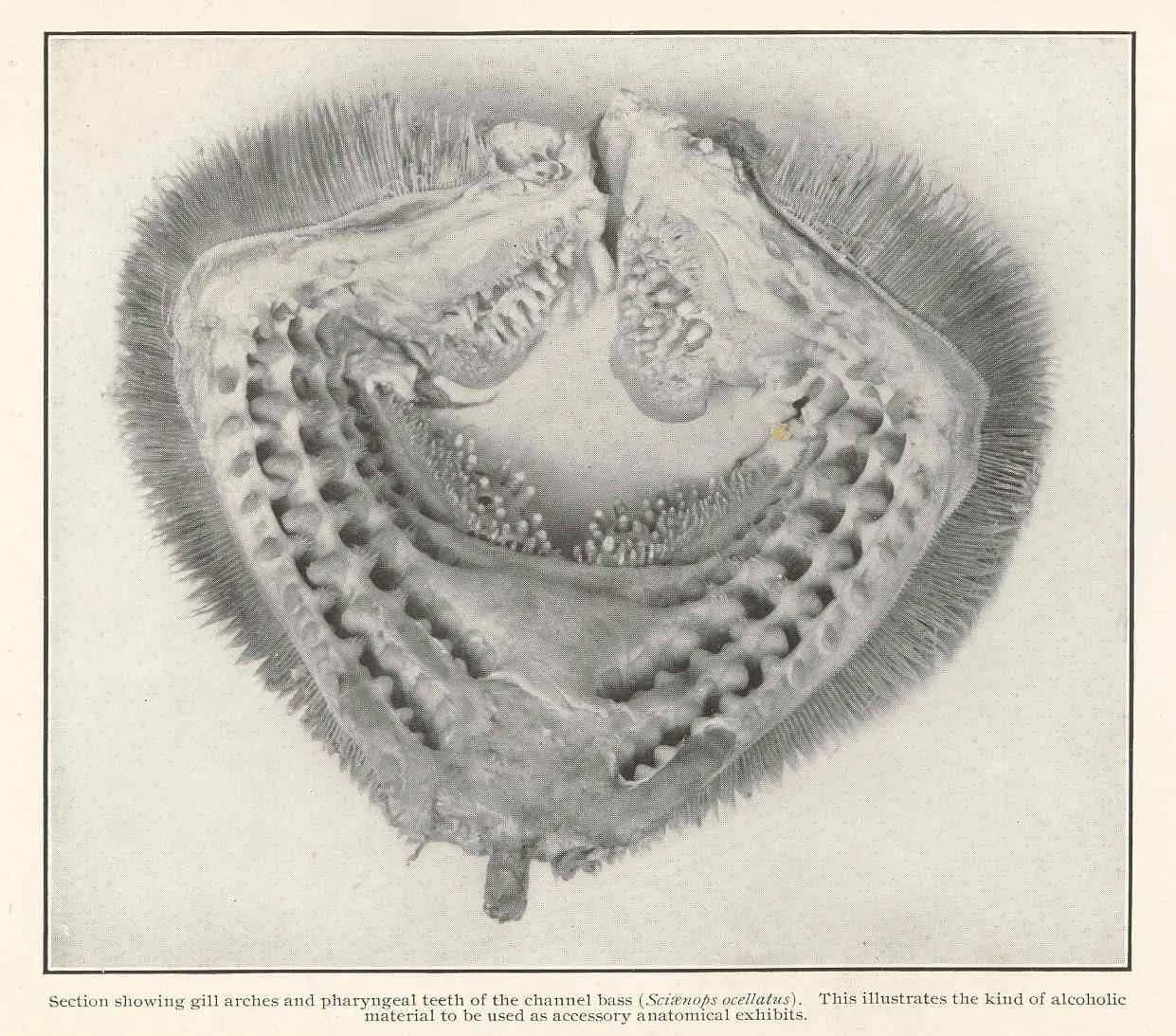
Fish breathe with gills: water goes in through the mouth, passes over thin red folds packed with blood, and leaves under the gill covers, and on the way the oxygen crosses into the blood. That is the whole trick, and it runs on very little: a liter of water holds one twenty-sixth of the oxygen in a liter of air. How much it holds depends on the water temperature, and that decides how a bass fares in a livewell in August.
A liter of water holds about 8 cm³ of oxygen; a liter of air holds 210. A fish lives on one twenty-sixth of what you breathe, and its gills still pull more than 80% of it out of the water.
How do gills work?
Lift the gill cover on a bass and you see four red, feathery arches. Each arch carries rows of filaments, and each filament carries hundreds of tiny folds called lamellae. They are red because they are full of blood, flowing a hair’s width from the water. Oxygen crosses that thin wall into the blood; carbon dioxide crosses the other way. The blood then carries the oxygen around the body, the job your lungs do with every breath.
The clever part is direction. Water flows across each lamella one way, and blood flows through it the other way. Scientists call this countercurrent exchange. Because the blood keeps meeting water that holds more oxygen than it does, it keeps loading up along the whole fold. The result: more than 80% of the oxygen is removed from the water passing through. It has to be that good: water carries about 8 cm³ of oxygen per liter against 210 in air, so a fish moves a lot of water for a little oxygen. That is why the gill covers of a resting bass never stop.
How do fish move water over their gills?
Most fish pump it. The mouth opens and the throat widens, drawing water in; the mouth closes and the gill covers flare, pushing it out over the gills. Biologists call it buccal pumping, and it is why a bass can hover motionless under a dock and keep breathing. You can watch the same rhythm in a goldfish bowl.
Fast swimmers found a shortcut: swim with the mouth open and the water rams itself through the gills. Tunas are described as obligate ram ventilators: they cannot pump, so they never stop. Most sharks ram ventilate while cruising, and some can switch to pumping and rest on the bottom, like the draughtsboard shark in Do fish sleep?. About 20 of the 500-plus shark species cannot, the great white and mako among them. For those few, “a shark must keep swimming or die” is true.
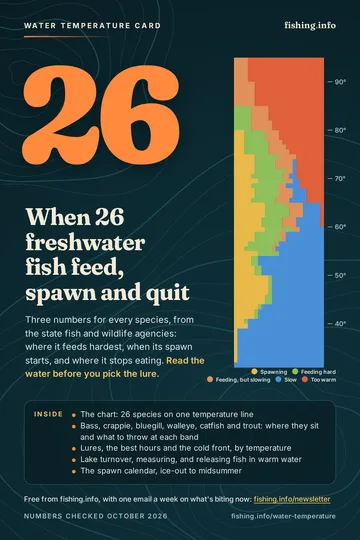
Free card: what 26 species do at your water temperature
Plus one email a week on what's biting now. No sales pitches. Privacy.
Do fish have lungs? Can fish breathe air?
No lungs, with one famous exception. The lungfish of Africa, South America and Australia carry true lungs alongside their gills. When its pond dries, an African lungfish digs into the mud, seals itself in a cocoon and breathes air for up to two years. A few others cheat without lungs. Mudskippers hold water in their gill chambers and take oxygen through their skin for about three and a half days on land. The mangrove rivulus, a small killifish, lasts about two months in damp leaf litter.
A bass, a bluegill, a trout or a catfish can do none of that. Out of water the lamellae collapse and stick together like wet tissue paper, and oxygen uptake stops within seconds. That fact sits behind the 10-second rule further down, and behind Do fish drown?. Gills have a second job as well, letting water in and salt through, which is the story of Do fish drink water?.
How much oxygen does water hold?
The unit is milligrams per liter (mg/L), which in fresh water equals parts per million (ppm). Cold water holds more, warm water holds less. The saturation figures in the table are for fresh water at sea level: the most oxygen water at that temperature can hold when fully aerated. A real lake usually runs below that line, and lowest of all just before dawn, when plants have spent the night using oxygen instead of making it.
The fish thresholds come from EPA and state water-quality criteria. Warmwater fish, meaning bass, bluegill, crappie and catfish, want more than 5 mg/L, avoid water below 3 and die below 2. Trout and salmon want 6.5 and need at least 4; the USGS calls anything under 2 hypoxic. Carp survive below 1, and northern pike have been reported alive for days at 0.1.
| Water temperature | Oxygen at saturation | What fish do | What you do |
|---|---|---|---|
| 32 °F (0 °C) | 14.6 mg/L | Oxygen everywhere; fish slow, eating little | Fish small and slow; oxygen is not the limit under ice |
| 50 °F (10 °C) | 11.3 mg/L | Trout in comfort; bass and catfish waking up | Fish the warmest hours; a livewell needs no ice |
| 60 °F (16 °C) | 10.0 mg/L | Prime for nearly every species; bass spawn | Any depth works; release fish where you caught them |
| 70 °F (21 °C) | 8.9 mg/L | Bass, bluegill and catfish feed hardest; trout start to feel the squeeze | Aerator on whenever a fish is in the well |
| 80 °F (27 °C) | 8.0 mg/L | Only 3 mg/L above the warmwater floor; a weedy bay can dip under 5 by dawn | Aerator on constantly; fish weedy shallows at dusk, not first light |
| 90 °F (32 °C) | 7.3 mg/L | Trout’s 6.5 floor is 0.8 below saturation; bass go deep, to inflows or shade | Above 84 °F (29 °C): ice the well, keep fights short, or release at once |
| 100 °F (38 °C) | 6.6 mg/L | Shallow ponds and dead-end coves run out; fish kills follow | Keep no fish; work deep water, moving water and the night |
Why do fish go deep, or to the creek mouth, in a heat wave?
Heat squeezes a fish from both sides. Warm water holds less oxygen, and a warm fish burns more of it, because its body runs faster. The University of Miami said it plainly in August 2023, when the Gulf of Mexico hit 88 °F (31 °C): a fish can, in effect, drown. Summer fish kills work the same way, often on a still morning after a hot spell, when the plants that made oxygen by day have used it up overnight.
So fish go where the oxygen is: a creek mouth or spring bringing in cooler water, a wind-blown bank where oxygen is mixed in from above, or deeper, cooler water. Up to a point: in a stratified lake the bottom layer can run out of oxygen by late summer, so fish stack just above it. The water temperature charts show where each species sits in that stack through the year.
How do you keep a fish alive in a livewell?
Tournament research funded by B.A.S.S. gives three numbers. Keep the livewell at or below 84 °F (29 °C). Never change its temperature by more than 7 °F (4 °C) at once. Keep dissolved oxygen at or above 5.5 ppm. And the finding Bassmaster keeps repeating: a bass that fought for one minute survives the day in the well far better than one that fought for three.
- Fill the well before your first cast and start the aerator, so the first fish lands in water that is already moving.
- Run the aerator constantly, not on a timer. At 80 °F (27 °C) saturation is only 8.0 mg/L, and a bass in a closed box pulls that down fast.
- Check the temperature. If the lake is above 84 °F (29 °C), add ice in bags or frozen bottles, and drop the well no more than 7 °F (4 °C). A fish dumped from 90 °F into 75 °F is shocked, not saved.
- Land the fish fast. Heavier line, a firmer rod and a net save a minute of fight, the minute the research measured.
- Keep air time under 10 seconds. A 2015 review of the studies found harm rising with every second out of water. Lift the fish only when the camera is ready.
- Do not overcrowd. Five bass share the oxygen of one. If the well is warm and full, release the smallest fish where you caught them.
- Release into oxygen. Let a tired fish go in moving or shaded water, facing into the current, and never drag it backward: water flowing the wrong way over the gills does nothing. The full routine is in catch and release.
Which numbers are worth remembering?
- A liter of water holds about 8 cm³ of oxygen; a liter of air holds 210. One twenty-sixth.
- A gill removes more than 80% of the oxygen from the water, because blood and water flow in opposite directions.
- 32 °F water holds 14.6 mg/L of oxygen; 80 °F water holds 8.0; 100 °F water holds 6.6. Bass want more than 5, trout 6.5; below 2, fish die.
- Livewell: at or below 84 °F, no jump over 7 °F, oxygen at or above 5.5 ppm, one-minute fights.
More answers, from whether fish sleep to whether they feel pain, are in fish facts.
Free download
The water temperature card
Read your water temperature and the card tells you who is spawning, who is feeding and what to throw. 26 species, 16 pages, for your phone and the tackle box.
Plus one email a week on what's biting now. No sales pitches. Privacy.
Related
Section guide
Fish Facts: The Questions Kids Ask About Fish, Answered With the ScienceFish facts with a number and a source for each: how fish sleep, breathe, hear and feel, and what every answer means when you hook and release one.
 Do Fish Drink Water? Freshwater Fish, Saltwater Fish and Sharks
Do fish drink water? Freshwater fish barely do, saltwater fish drink all day, sharks cheat with urea. The numbers, and what it means for bait and livewells.
 Do Fish Drown? How Fish Suffocate, and How to Revive a Tired One
Do fish drown? Not by the dictionary, but they suffocate three ways: low oxygen, damaged gills, no water flow. How long a fish lasts in air, how to revive one.
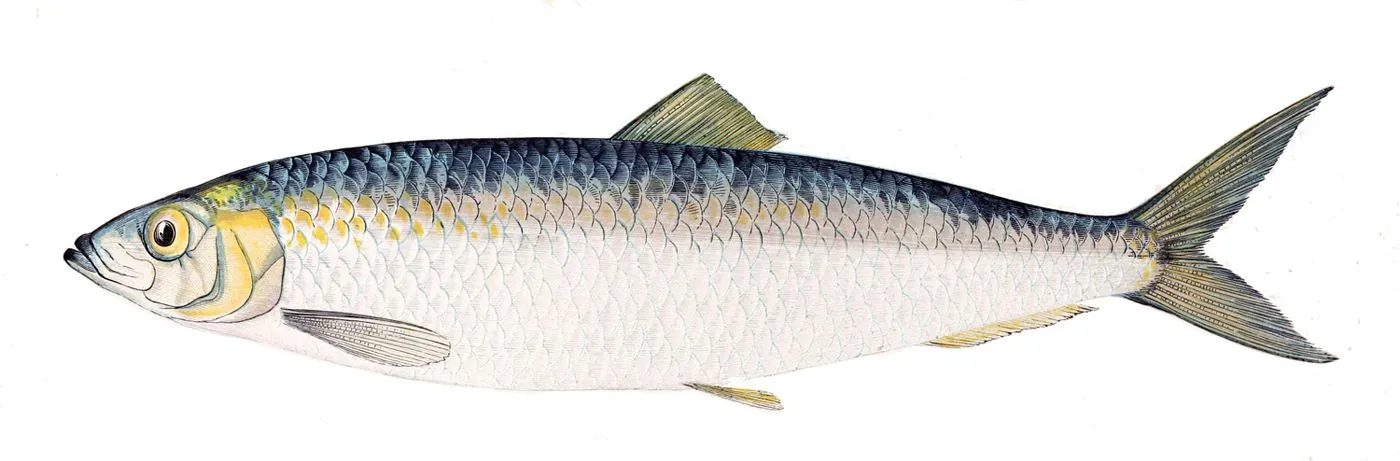 Do Fish Fart? Yes, Herring Do It on Purpose, and a Bloated Bass Needs Help
Do fish fart? Herring do, on purpose, and scientists won a prize for proving it. Which fish pass gas, where it goes, and what to do with a bloated bass.
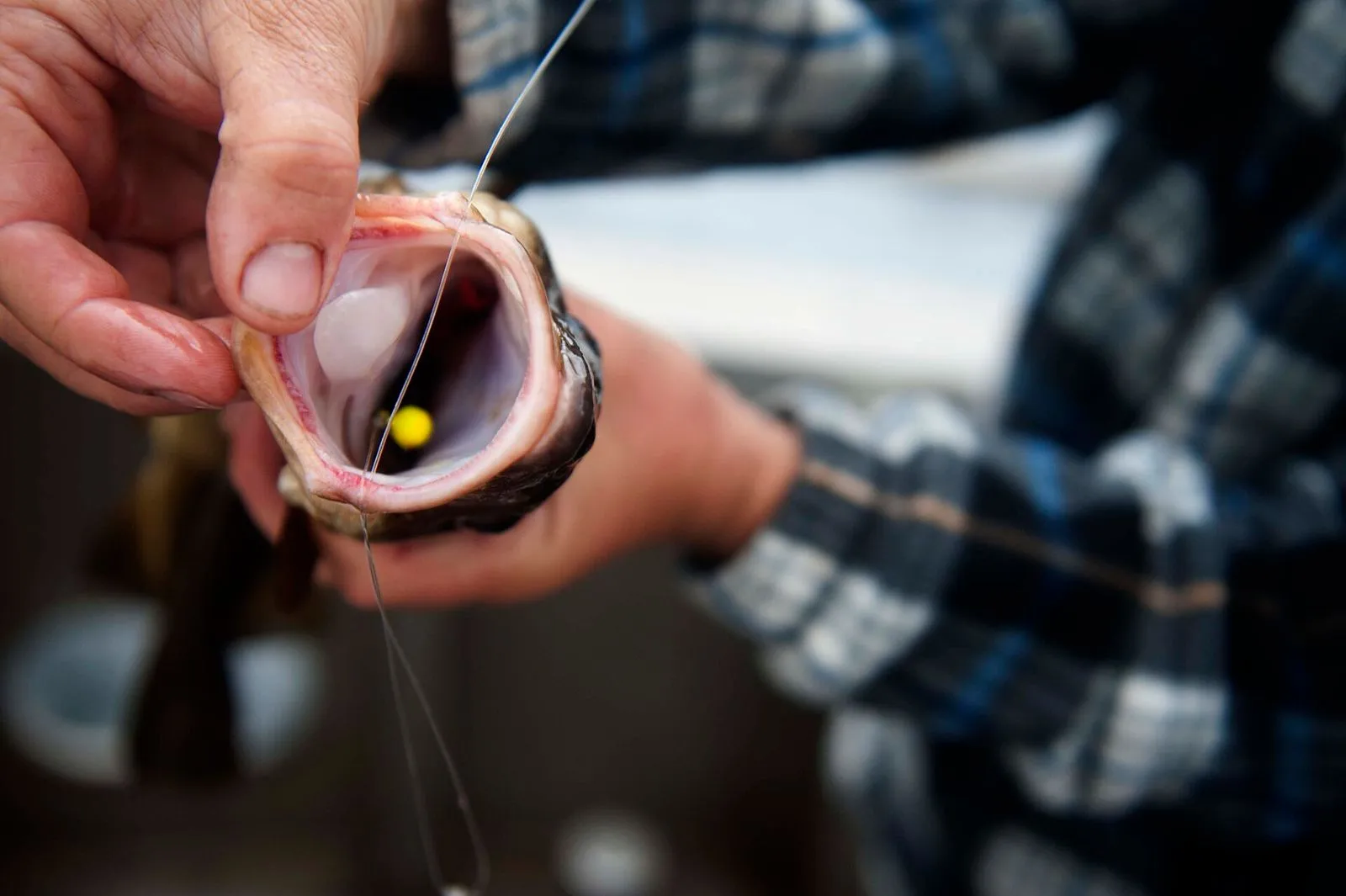 Do Fish Feel Pain? What the Studies Found, and What Decides Whether a Released Fish Lives
Do fish feel pain? They sense damage and react; whether they suffer is contested. The trout study, both camps, and what decides if a released fish lives.
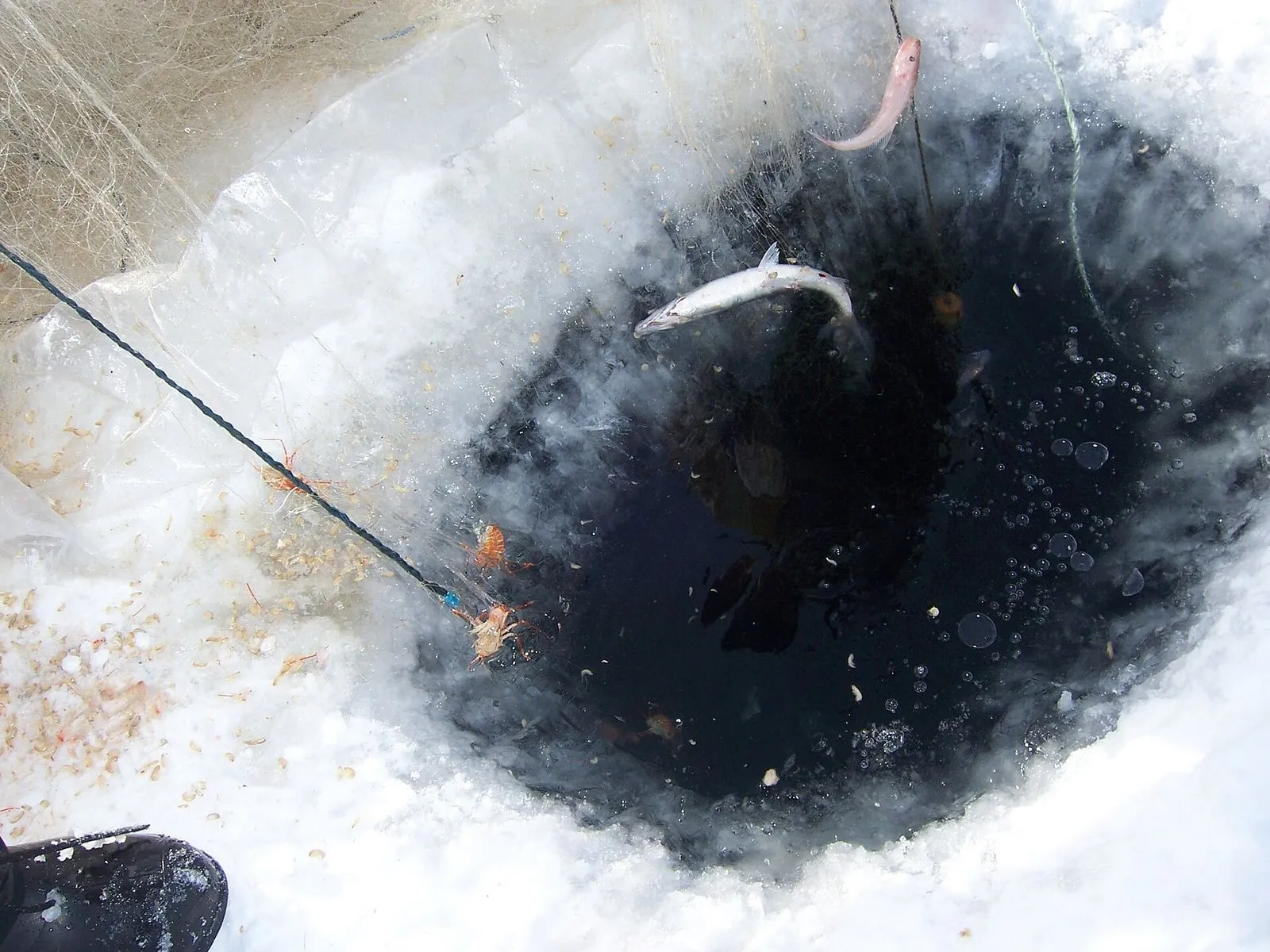 Do Fish Get Cold? What Winter Does to a Fish, and the Ones With Antifreeze in Their Blood
Do fish get cold? Yes: a fish is as cold as its water and feels it as slowness. What fish do in winter, who carries antifreeze, and how to fish cold water.
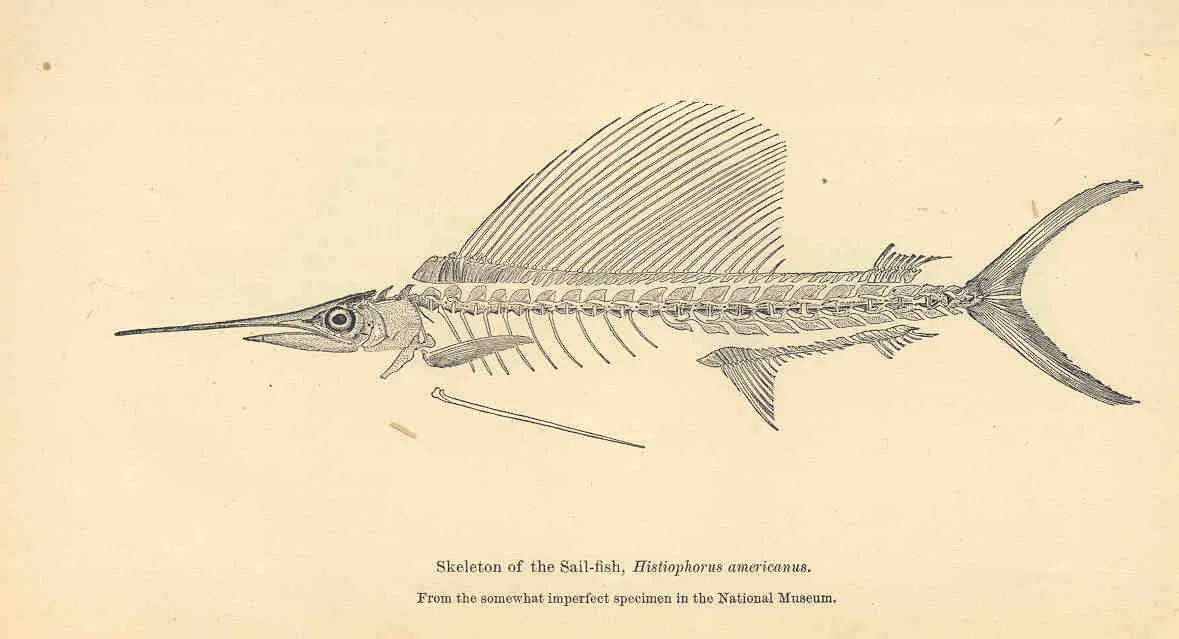 Do Fish Have Bones, Hearts and Blood? What Is Inside a Fish
Do fish have bones? Most do; sharks run on cartilage and 16 icefish have clear blood. How skeleton, heart and blood work, and what it means for your fillets.
Sources
- USGS Water Science School, Dissolved oxygen and water (with the DOTABLES saturation equation)
- Fondriest Environmental, Dissolved oxygen: fish thresholds from EPA and state criteria
- Water on the Web (University of Minnesota Duluth), Dissolved oxygen in lakes
- FISHBIO (2016), An efficient exchange: countercurrent flow in fish gills
- Fish gill (structure, oxygen content of water versus air, ram ventilation)
- WSU Ask Dr. Universe (2018), How do fish breathe?
- Amphibious fish (mudskippers, mangrove rivulus, lungfish out of water)
- University of Miami (2023), It's hard to imagine, but a fish can drown
- AFTCO, Bass Care 101 (the B.A.S.S. livewell numbers)
- Bassmaster (2022), Keeping bass alive
- Cook, Lennox, Hinch and Cooke (2015), Fish out of water: how much air is too much?, Fisheries