 By
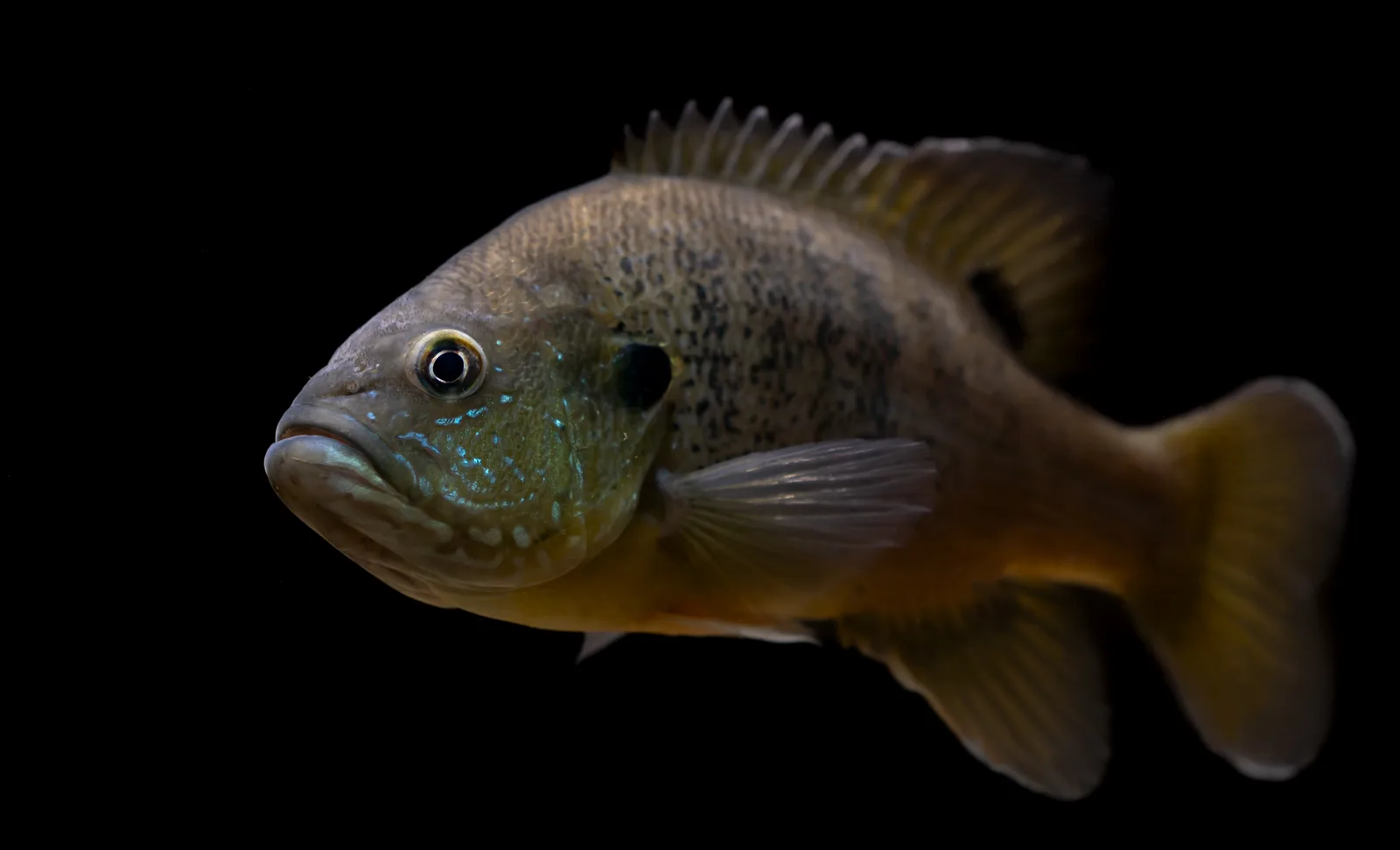
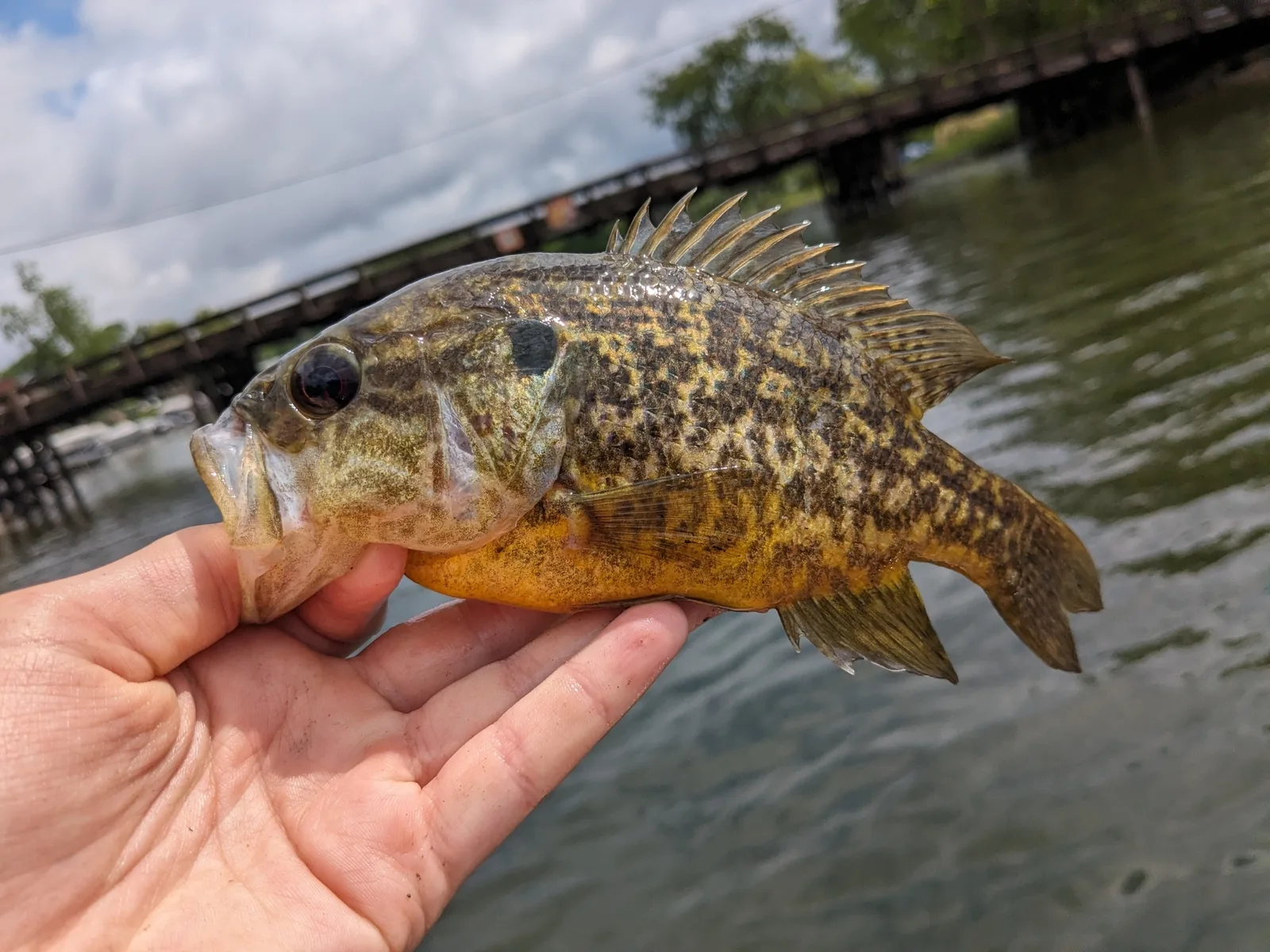
A green sunfish is the big-mouthed, thick-bodied sunfish that lives in almost any water that holds fish, and it seldom grows past 8 in (20 cm). It is greenish blue with turquoise streaks on the cheek and a pale edge on its black ear flap. It takes almost any bait, fights hard for its size and is easy to catch from the bank. In a small pond it can also crowd out everything else.
Nobody has to stock a green sunfish. Iowa’s DNR calls it a pioneering species: often the first fish to turn up in a newly dug farm pond, and the first back into a creek after a drought.
How do you tell a green sunfish from a bluegill?
Look at the mouth first. A green sunfish’s upper jaw reaches about the middle of the eye; a bluegill’s stops short of the front of it. Then fold the pectoral fin forward, the paired fin just behind the gill cover. On a green sunfish it is short and rounded. On a bluegill it is long and pointed, and the tip reaches past the eye.
The ear flap settles what is left. A bluegill’s is solid black to the edge. A green sunfish’s is black with a pale margin, white to yellowish. Both fish carry a dark spot at the rear of the dorsal fin, so that mark does not separate them.
The warmouth is the other look-alike, with the same big mouth and thick body. It has a red eye with four or five red-brown streaks fanning back over the cheek, and a patch of teeth on the tongue you can feel with a fingertip.
| Mark | Green sunfish | Bluegill | Warmouth |
|---|---|---|---|
| Mouth | Large; jaw to about the middle of the eye | Small; jaw stops short of the eye | Large; jaw to or past the middle of the eye |
| Pectoral fin | Short, rounded | Long, pointed, past the eye | Short, rounded |
| Ear flap | Black with a pale white-to-yellow margin | Solid black, no colored edge | Often red-tipped on breeding males |
| Cheek and eye | Blue-green streaks on the cheek | Blue wash on the chin and gill cover | Red eye; 4–5 red-brown streaks from it |
| Fins | Dorsal, anal and tail tipped white, yellow or salmon | Black blotch at the rear of the soft dorsal | Spotted and banded dark brown |
| Body | Thick, longer than most sunfish, built like a small bass | Deep, round and flat | Thick, mottled olive-brown |
| Typical size | 6–8 in (15–20 cm) | 6–10 in (15–25 cm) | To 8 in (20 cm) |
Every row comes from the agency descriptions in the sources. Green sunfish also cross with other sunfish; Texas Parks and Wildlife calls the hybridizing “very common”. A fish with a bluegill’s flap and a green sunfish’s mouth is a hybrid, not a mistake in the table. The full nine-species key is on the panfish hub, and the rock bass page covers the red-eyed fish with six anal spines that gets mixed up with both.
Where do green sunfish live?
Missouri’s field guide puts it plainly: green sunfish live in “any pond, lake, or stream that is capable of supporting fish life”. That includes the pools of creeks that dry up into stagnant puddles in summer. Iowa adds muddy creeks, weedy backwaters, shallow lakes and the riprap along the Missouri River. It credits the fish with a tolerance for silt, low oxygen, heat and murky water that lets it thrive where other sunfish cannot.
The native range is the middle of the continent, between the Appalachians and the Rockies and into northeastern Mexico. Stocking and stray introductions did the rest. Texas Parks and Wildlife now calls it nearly ubiquitous in the United States, except Florida and parts of the Northwest. North Carolina finds it scarce on its Coastal Plain, because it cannot tolerate acidic or salty water.
In a small creek a green sunfish may be the largest fish there, the top predator of the pool. Missouri notes that it provides fishing in small, intermittent creeks “where other hook-and-line fish cannot live”.
Free PDF · Water temperature chart When do panfish bite?
One water temperature reading, and the 16-page chart tells you who's spawning, who's feeding hard, where they sit and what to throw. 26 fish, every number sourced.
Enter your email, confirm it with one click, and the PDF is in your inbox. Plus one email a week on what's biting. Unsubscribe anytime. Privacy.
Why don’t you want green sunfish in your pond?
Because they breed faster than the pond can feed them. Texas Parks and Wildlife says their “enormous reproductive potential” lets them overpopulate small lakes and ponds and become stunted. Then they “rarely reach a desirable size for angling”. Virginia’s biologists add that the big mouth and faster growth let them outcompete other sunfish. Virginia treats the fish as invasive in some waters, and stocking any public water there without authorization is illegal.
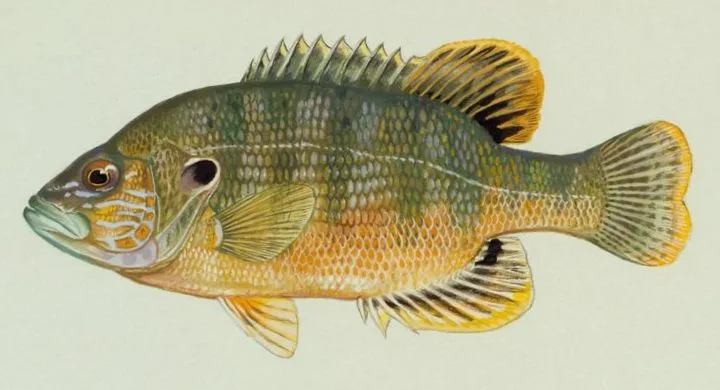
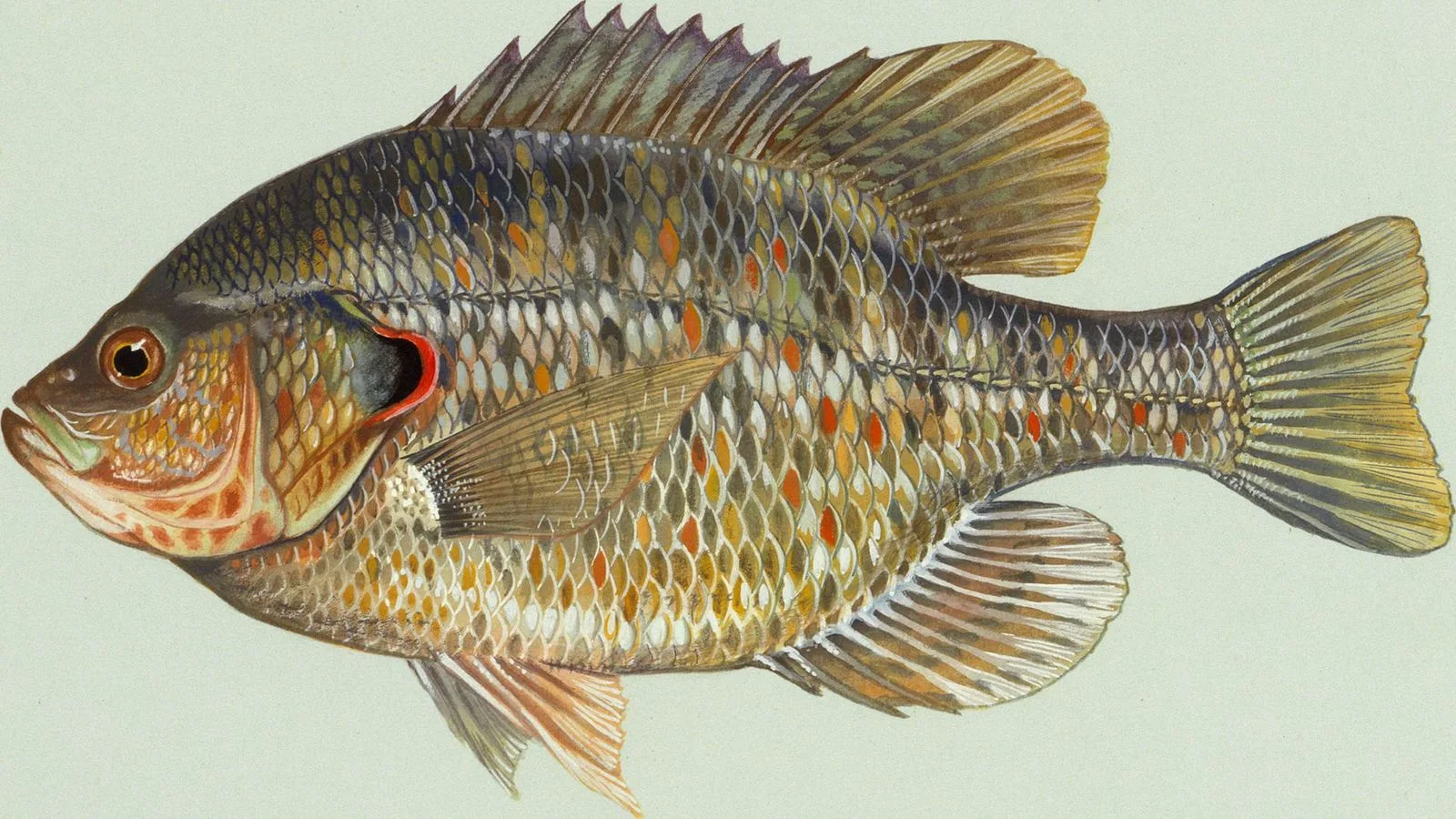
The big mouth and thick, bass-like body that let a green sunfish outeat the other sunfish in a pond. Illustration: Duane Raver, U.S. Fish and Wildlife Service (public domain).
A pond owner who wants the green sunfish’s fight without the crowding buys the hybrid instead. The hybrid bluegill sold by hatcheries is usually a male bluegill crossed with a female green sunfish. Missouri’s pond guidance spells out why it works. Virtually all hybrids are male, so they barely reproduce and have to be restocked when the catch rate drops. They do best in small ponds with good habitat and no other fish, or only catfish. A bass pond still needs the bluegill itself, the forage fish that breeds.
How aggressive are green sunfish?
Aggressive by sunfish standards: on the nest, on the hook and in the hybrid bred from them. The males guard their nests hard: Texas Parks and Wildlife says they “aggressively defend” them until the fry swim free. On a hook they are, in North Carolina’s words, “aggressive fighters”, even though they rarely grow large. The trait carries into the hybrid, which Missouri finds more aggressive than either parent. That makes it a faster-growing, more competitive feeder and easier to catch.
How do you catch green sunfish?
Simply. Missouri’s guide says a cane pole and bobber with worms, grubs or grasshoppers is “about as effective as any method”, and Iowa calls them unselective feeders that take most live bait. The one condition is that the hook fits the mouth. That mouth is bigger than a bluegill’s, so a green sunfish will take a bigger bait and a bigger hook.
Where to put it matters more. North Carolina’s anglers fish close against the shore, under overhanging banks and in small dugouts in shallow water. Rock piles and dense weeds hold them too. A cane pole reaches all of those spots without a cast.
Lures work as well. North Carolina lists small crankbaits, spinners such as a light inline spinner, and wet or dry flies among what green sunfish strike.
Green sunfish feed through the daylight hours, in Missouri’s description, so there is no need to wait for dusk. They are also a classic live bait for flathead catfish. Bait rules differ by state, and in Missouri a green sunfish over 5 in (13 cm) taken as live bait must be released at once. The rules by state are on the catfish bait page.
How big do green sunfish get?
Not big. Missouri gives 6–8 in (15–20 cm) as typical and about 10 in (25 cm) and a pound as the maximum. Iowa’s fish reach about 7 in (18 cm) by their fourth year and rarely pass 6 or 7 in. They mature at two; Missouri gives them about six years, Virginia up to ten.
The heavy ones come from private ponds with few other fish. Texas’s largest reported wild fish was 1.3 lb (0.6 kg), while specimens over 2 lb (0.9 kg) have been recorded in private ponds.
Biologists measure condition against a standard weight, the weight of a well-fed fish of that length. For green sunfish the equation is Bister and colleagues’ from 2000; the weights below are computed from it.
| Length | Standard weight | What it means |
|---|---|---|
| 6 in (15 cm) | 2.5 oz (72 g) | A typical adult |
| 7 in (18 cm) | 4.1 oz (115 g) | An Iowa fish in its fourth year |
| 8 in (20 cm) | 6.2 oz (175 g) | The top of the typical range |
| 9 in (23 cm) | 8.9 oz (250 g) | Michigan’s Master Angler minimum |
| 10 in (25 cm) | 12.3 oz (350 g) | About the largest in the wild |
The all-tackle world record is 2 lb 2 oz (0.96 kg). Paul Dilley caught it at Stockton Lake, Missouri, on June 18, 1971, on a river worm and 12 lb line. Outdoor Life gives its length as 14.75 in (37.5 cm) and its girth as 14 in (36 cm). A 14-in girth on a 14.75-in fish would normally mean a fish of over 3 lb, so treat the measurements as reported, not verified. The record has stood for more than fifty years.
When do green sunfish spawn?
Once the water passes 70 °F (21 °C). In Missouri that is mid to late May, with a peak in June and spawning that carries on into August. Virginia’s biologists describe the green sunfish as a cyclic spawner, able to spawn every two weeks from May to September.
The nests are colonies in shallow water near the shore. Iowa finds them in a foot (30 cm) of water or less, over gravel or sand. Where the bottom is poor, the males fan nests in waterlogged leaves, twigs and muck. Where space is short, as many as 25 nests fit in 50 sq ft (4.6 m²). The male guards the eggs for six or seven days, until the fry swim free. The bluegill spawn temperature page has the month-by-region timing for the colonies they share.
Are green sunfish good to eat?
Yes, if you catch them big enough to fillet. Outdoor Life calls the green sunfish a “tasty panfish”. The catch is size: most are under 8 in (20 cm), which makes for small fillets. Working from mercury, PFOS and PCB readings, Minnesota’s Department of Health allows most adults up to four servings of sunfish a week, or two in Cook, Lake and St. Louis counties. Statewide, children under 15 and anyone who is or may become pregnant or is breastfeeding should keep to one a week.
Missouri classes the green sunfish as a nongame fish, and North Carolina says it is “not highly regarded” as a gamefish. Where a state sets a limit, it is in that state’s fishing regulations, so check the booklet before you fill a bucket.
What else is a green sunfish called?
Missouri lists black perch. Outdoor Life adds green perch, sand bass, blue-spotted sunfish and rubbertail, and in Arkansas it is a “slick” from a pond and a “goggle-eye” from a creek. In Texas it is also called rock bass and branch perch, which is why the red-eyed real rock bass is worth a spine count.
The scientific name is Lepomis cyanellus. Lepomis is Greek for “scaled gill cover” and cyanellus for “blue”. It belongs with the bluegill and the redear sunfish in the true sunfish genus, and the rest of the family is on the panfish hub.
Free PDF · 16 pages
Know what's biting before your first cast
The Water Temperature Fishing Chart. Take one water temperature reading, find it on the chart, and you know which of 26 freshwater fish are feeding today, where they are and what to throw. For your phone and the tackle box.
- Where they sit and what to throw at every band: bass, crappie, bluegill and walleye; catfish by species; trout: when to stop and where they hide
- The best hours at your reading, the cold front day by day, and the spawn calendar from ice-out to midsummer
- The three thermometer mistakes that make a reading lie (the first one is the surface)
- The 26-fish chart: who's spawning, feeding hard or shut down at your reading
Every number from state fish and wildlife agencies and fisheries research: 61 sources, all on the site.
Enter your email, confirm it with one click, and the PDF is in your inbox. Plus one email a week on what's biting. Unsubscribe anytime. Privacy.
Related
Section guide
Panfish: Which Fish Count and How to Tell Them ApartPanfish are bluegill, the sunfish, crappie and yellow perch. Tell 9 sunfish apart by the ear flap, plus records and limits from 50 a day to none in Texas.
 Warmouth: How to Identify It, Where It Lives and How to Catch It
Warmouth: a red-eyed sunfish with 3 anal spines and teeth on its tongue. How to tell it from a rock bass, catch one, and the 2 lb 7 oz record.
 Bream Fish: What Southern Anglers Mean, and Which Bream You Have
In the South a bream is any sunfish, the bluegill first. In Europe it is a carp relative, on a menu a sea bream. How to tell which bream you have.
 Perch Fish: What a True Perch Is, and Which Perch Are Not
A true perch is one of three Perca species. White perch, ocean perch, Nile perch and surfperch borrow the name: what each really is, and the records.
 Perch Fishing: Where to Find Them, the Rigs That Work, and When They Bite
How to catch yellow perch: where the schools sit each season, the spreader and jig rigs, how far off the bottom to fish, the bait, and the ice.
 Rock Bass: How to Identify, Find and Catch the Goggle-Eye
How to tell a rock bass from a warmouth or a smallmouth, where it lives, what it bites, how big it gets and the 3 lb world record that is a tie.
 Bluegill: How to Identify It, How Big It Gets and How It Spawns
How to identify a bluegill, how old an 8- or 10-inch fish is, why a pound is a trophy, the 4 lb 12 oz record and the sneaker males on the beds.
Sources
- Missouri Department of Conservation, green sunfish (description, size, habitat, spawning, fishing)
- Iowa DNR, green sunfish (identification, diet, nesting, growth, pioneering)
- Texas Parks and Wildlife, green sunfish (range, overpopulation, Texas size)
- Virginia DWR, green sunfish (spawning cycle, competition, stocking rule)
- NC Wildlife Resources Commission, green sunfish (identification, habitat, lures)
- Missouri Department of Conservation, bluegill
- Missouri Department of Conservation, warmouth
- Missouri Department of Conservation, hybrid sunfish in ponds
- Connecticut DEEP, warmouth (identification: pectoral fins short and rounded)
- Missouri Code of State Regulations 3 CSR 10-6.605, live bait
- IGFA world record search, green sunfish
- Outdoor Life, the biggest panfish of all time (IGFA all-tackle records with lengths and tackle)
- Minnesota Department of Health, fish consumption guidelines
- Michigan DNR, Master Angler minimum entry lengths and state records
- FSA WSlit standard-weight table (Bister et al. 2000 green sunfish equation)