 By
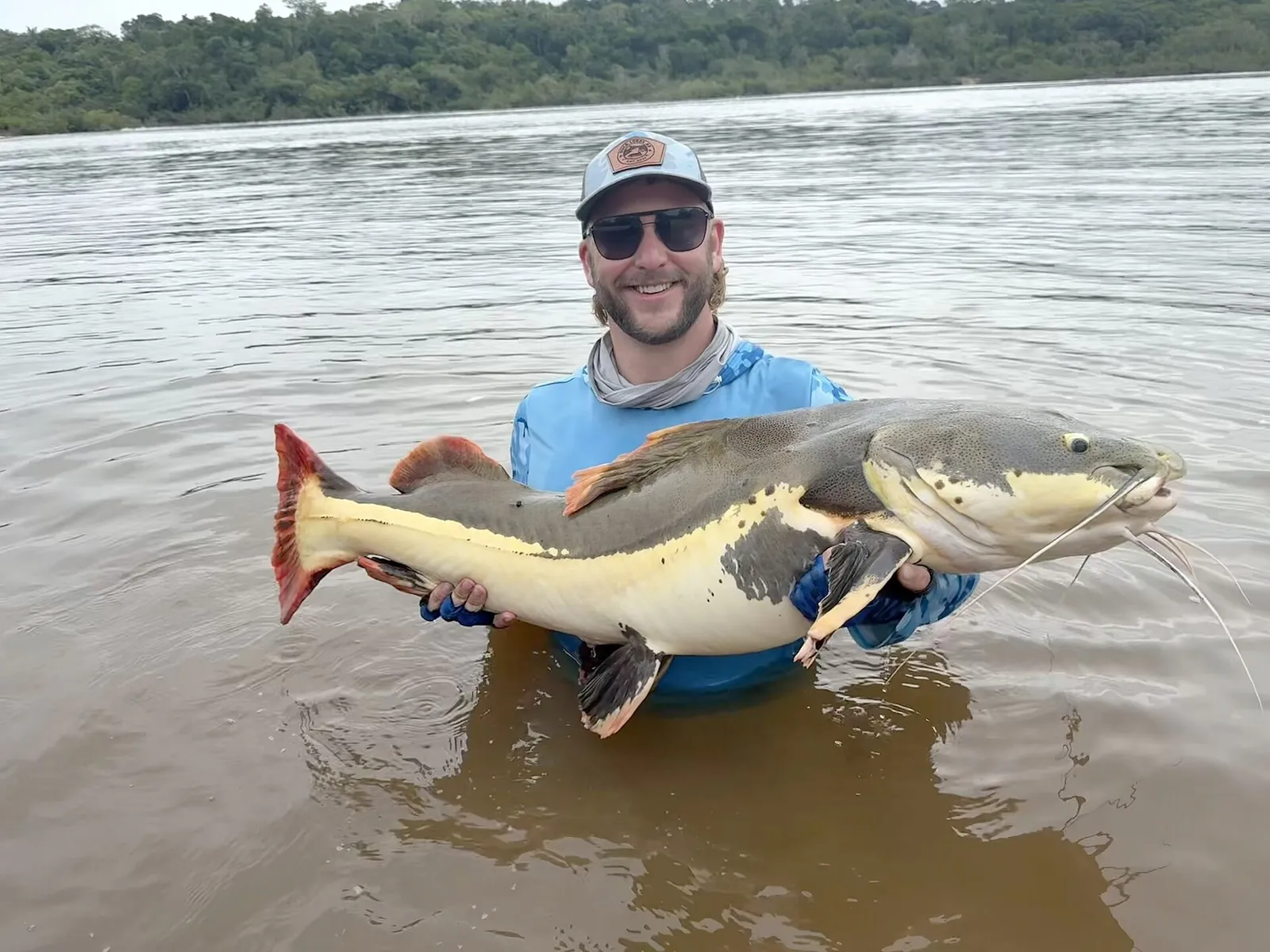
The redtail catfish is a big South American catfish from the Amazon and Orinoco, and it grows to well over 100 pounds. The IGFA world record weighs 123 lb 7 oz (56 kg). You catch one in an Amazon river or in a stocked lake in Thailand. In the US it’s a pet-store fish, and USGS has found loose ones in 12 states.
The heaviest redtail catfish ever caught on a rod weighed 123 lb 7 oz and came out of the Amazon in 2010. The one pulled from Minnesota’s St. Croix River in 2015 was most likely somebody’s pet.
How do you identify a redtail catfish?
Look at the tail first. It’s red or orange, and no native catfish has one like it. Then the side. USGS describes a dark gray to black back and a wide white stripe from the mouth to the tail. The dorsal, pelvic and anal fins are sometimes red or orange too.
The IGFA’s words: a brownish back, yellow sides and red-orange dorsal and tail fins. It carries three pairs of long barbels, the whiskers it finds food with.
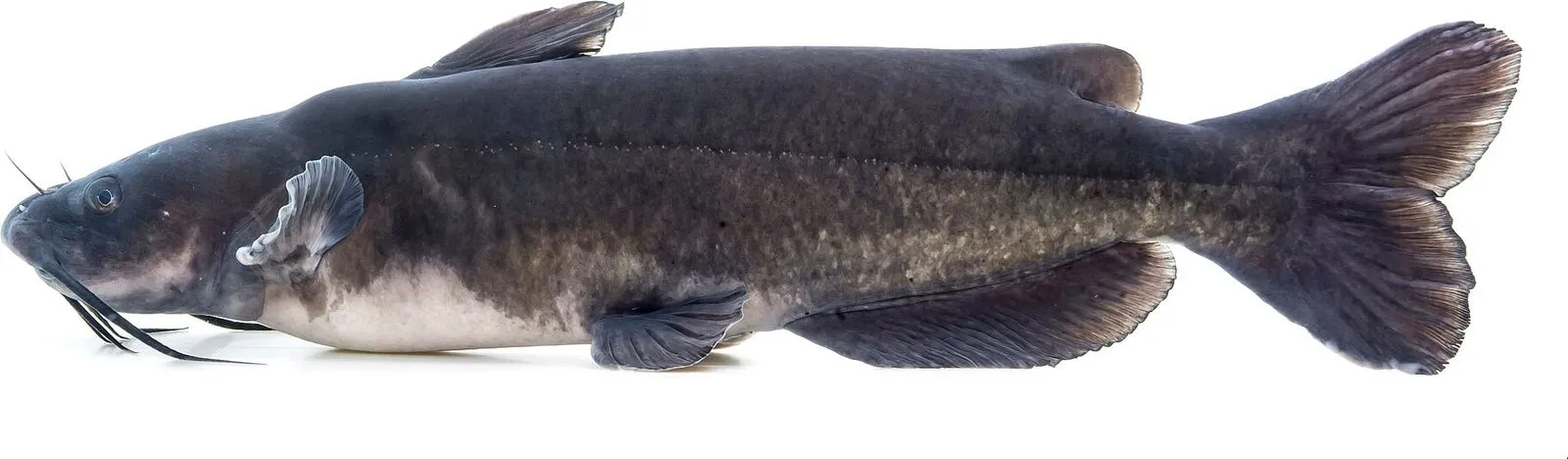
You won’t mix it up with a native cat. A channel catfish is olive-brown to slate-blue with a deeply forked tail. A blue catfish is pale bluish silver on the back. A flathead catfish is pale yellow to light brown and heavily mottled, with a squared-off tail. None of them has a red tail or a white stripe down its side.
In South America it goes by other names. Pirarara is the common one, USGS says, above all in South American writing. The IGFA also lists bigoril, guacamayo, pez torre and peixe-arara, and USGS adds cajaro.
How big do red tail catfish get?
Over 4 ft long and more than 100 lb. The exact top depends on who you ask, because each source counts a different fish:
| Source | Longest | Heaviest | What it counts |
|---|---|---|---|
| IGFA records | 139 cm (4 ft 7 in), Xingu River, 2022 | 123 lb 7 oz (56 kg), Rio Amazonas, 2010 | Fish caught on rod and reel |
| USGS | 130 cm (4 ft 3 in) | 80 kg (176 lb) | The size it can grow to |
| FishBase | 135 cm (4 ft 5 in) | 44.2 kg (97 lb) | Largest published, measured to the tail tip |
| FishBase | 60 cm (2 ft) | — | Common length |
The IGFA fish are the ones you can check: weighed or measured, with a name and a date. The 80 kg in the USGS profile is about 176 lb, close to the 180 lb figure you see in posts online. No weighed fish that big is on the IGFA list. The heaviest on it is 123 lb 7 oz. That fish was 55.43 in (141 cm) long, Outdoor Life reports. That’s a touch longer than the length record you see above, which is a category of its own.
For most fish you’d see, think about 2 feet. FishBase lists maturity from 85 cm (about 33 in), so a breeding adult is a big fish, close to 3 ft long.
Free PDF · 5-rig catfish cheat sheet When do catfish bite, and what do they want on the hook?
One reading, and the 16-page cheat sheet tells you which catfish is feeding, where it sits and what to put on the hook. Five rigs drawn, a trip step by step.
No card, nothing to buy, and the PDF is yours to keep. Confirm with one click and it's on its way. Then a few short emails and one a week on what's biting. Unsubscribe anytime. Privacy.
Why does a pet redtail outgrow every tank?
Because a full-grown one needs a tank the size of a room. USGS calls this “large predacious catfish” somewhat common in the aquarium trade. Fishkeeping guide Seriously Fish puts a full-grown one in a tank of about 12 by 8 by 4 ft, or roughly 10,000 liters (2,700 gallons).
It also reports that many public aquariums already show donated adults and turn more away. So an owner with a 3 ft fish and nowhere to put it faces a choice. Some pick the nearest lake.
That’s how redtails got into the wild far from home. USGS lists the way they arrived in the US as “probable aquarium release.” In Malaysia, a scientist believed hobbyists set them free in rivers once they outgrew their tanks, the U.S. Fish and Wildlife Service screening reports. In Singapore, one about 1,200 mm (47 in) long, not counting the tail, came out of the Pandan Reservoir.
Where do redtail catfish live?
In the Amazon and Orinoco river systems of South America, across a wide area of both. The IGFA says they live in larger rivers, streams and lakes, and swim out into the flooded forest when the water is high. USGS calls them habitat generalists: big rivers, sloughs, streams, lagoons and river mouths.
They are bottom fish of warm water. FishBase gives 20–26 °C (68–79 °F) as their range. That number explains most of what happens to the ones dumped in the US.
Why are redtail catfish turning up in US lakes?
People dump them, and the fish turn up as far north as Minnesota’s St. Croix River. These are the US records in the USGS database as of November 15, 2026:
| State | Years | Where |
|---|---|---|
| Alabama | 2016 | Bon Secour Bay, north of Gulf Shores |
| Florida | 1984–2025 | Six areas, among them a Panama City marina (found dead, 2007), Miami-Dade lakes, Saddle Creek Park and Gemini Springs |
| Indiana | 2013–2018 | Lake Michigan at Portage, and a slough of Crooked Creek |
| Iowa | 2015 | Lower Centerville Reservoir |
| Massachusetts | 2014 | Chaffin Pond |
| Minnesota | 2015 | St. Croix River at the Stillwater lift bridge |
| Mississippi | 2024 | Tennessee-Tombigbee Waterway |
| Missouri | 2000 | Missouri River near Columbia |
| Nebraska | 1985–1998 | A private lake and water near Lincoln |
| North Carolina | 2018 | Albemarle Sound |
| Tennessee | 2010 | Lake Barkley and the Cumberland River, three fish |
| Texas | 2004–2012 | Clear Creek off Galveston Bay (an angler’s catch) and a pond near Mont Belvieu |
That’s 12 states, and the reports haven’t stopped. The two newest came from the Tennessee-Tombigbee Waterway in Mississippi in 2024 and from Pinellas County, Florida, in 2025. The USGS profile calls no state’s fish established. It rates them “failed” in Florida, Nebraska, Missouri and Texas, and unknown in Tennessee. You’ll find one 2005 record from Clear Creek, Texas, tagged “established” in the record list, but the profile still says failed for Texas. The likely reason is winter. FishBase gives the fish a range of 68–79 °F, and a Minnesota river in January is a long way below that. USGS does note that a redtail “may be able to survive winters in a warm-water refugia.” That’s a spot that stays warm when the rest of the water cools.
The U.S. Fish and Wildlife Service rates the risk as uncertain. The climate match is medium to high in peninsular Florida, medium on the Texas coast, and low everywhere else. What a loose redtail does to native fish is unknown, because no one has studied it.
Red tail catfish in Florida and Texas: what do the rules say?
Don’t release one, ever. Florida law is plain. It makes it unlawful “to release within this state, any species of the animal kingdom not native to Florida,” unless FWC allows it. Importing one for sale or use falls under the same rule. If you own a redtail you can’t keep, Florida’s Exotic Pet Amnesty Program rehomes nonnative pets for free, year-round, for any reason.
Texas law says no one may put “any species of fish” into public water without a permit from Texas Parks and Wildlife. A fish that escapes from your pond into public water counts against you too. The redtail isn’t on the Texas list of prohibited exotic fish. The walking catfish and the wels catfish are. So for a redtail, the rule that bites is the one on releasing.
Other states have their own rules on nonnative fish, so check with your state agency before you keep or move one.
Watch out: Caught a redtail in US water? Don’t put it back. Report it on the USGS Nonindigenous Aquatic Species site, and call your state fish agency to ask what to do with it.
The report matters more than it looks. Reports like that feed the database behind the table above. That’s how anyone knows a dumped fish turned up in Iowa or Massachusetts at all.
How do you catch a redtail catfish?
On the bottom, with cut fish, in the Amazon. That’s the short version from How To Catch Any Fish, written by an angler who has fished for them in Brazil and Bolivia. He says redtails only rarely hit a lure, and that most are caught on bait soaked on the bottom.
What the page recommends:
- Bait: chunks of fish that live in the same water, such as piranha, small wolf fish (trairão) or other baitfish. Fresh seems to work better than old.
- Hook: a circle hook, which works well and prevents gut-hooking.
- Line and leader: braid for the hookset, and a wire leader, because the fish can chew through line and runs for sunken logs.
- Depth: if piranha keep stealing your bait, you’re probably fishing too shallow.
- The fight: a hard hit and a long run toward cover. Keep it out of the logs or it breaks you off.
The same writer notes that a redtail out of the water makes a “croaking/wheezing” sound. Like most catfish, they rarely jump.
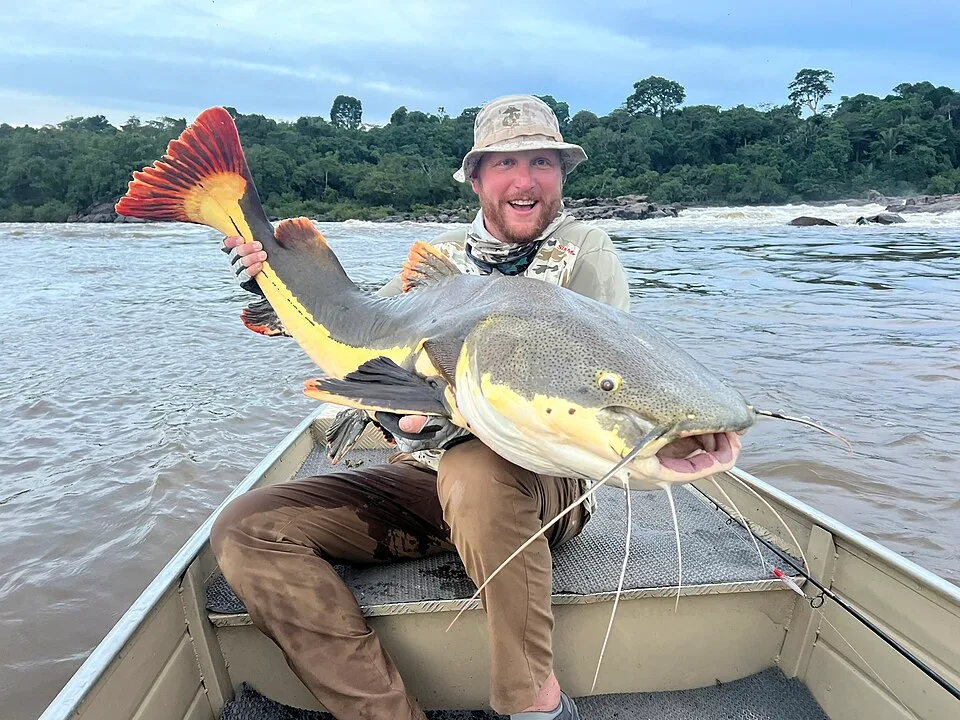 A big redtail, held up in a boat. Photo: Waltman30, Wikimedia Commons (CC BY-SA 4.0).
Where anglers actually catch them
The IGFA records map the water. Every line-class and length record comes from Brazil: most from the Rio Amazonas, others from the Rio Negro, the Xingu and the Jatapu. The boys’ junior and smallfry records come from the Kabalebo River in Suriname and Brazil’s Araguaia. It’s arapaima country, and peacock bass water too. How To Catch Any Fish tells of a 45 lb redtail on Brazil’s Tapera River. It came up and tried to swallow a 15 lb peacock bass at the boat.
The other place is Thailand. A Thai fishing site, quoted in the federal screening, says redtails are “stocked in many lakes in Thailand.” It calls them a very popular sport fish. Every IGFA fly record held for the species comes from Thailand, from Theerasart and Ratchaburi Lake. So do the girls’ junior and smallfry records. The redtail isn’t native to Asia, so every Thai fish was brought in.
What is the redtail catfish world record?
The all-tackle record is 123 lb 7 oz (56 kg), caught by Gilberto Fernandes in the Rio Amazonas, Amazonas, Brazil, on April 3, 2010. It was on 20 lb class line, so the same fish also holds that line class.
Fernandes owns this species in the record book. Of the 11 men’s line-class records, from 2 lb to 130 lb, he holds 10. The odd one out is the 80 lb class, Jorge Masullo de Aguiar’s 113 lb 9 oz fish from 2007.
| Record | Fish | Where and when | Angler |
|---|---|---|---|
| All-tackle | 123 lb 7 oz (56 kg) | Rio Amazonas, Brazil, April 3, 2010 | Gilberto Fernandes |
| All-tackle length | 139 cm (4 ft 7 in) | Xingu River, Brazil, August 12, 2022 | Antonio Pedro Servulo Molinari |
| 2 lb line, men | 13 lb 3 oz (6 kg) | Rio Amazonas, Brazil, November 7, 2009 | Gilberto Fernandes |
| Heaviest women’s line class | 25 lb 15 oz (11.77 kg), 12 lb line | Rio Jatapu, Brazil, November 20, 2017 | Vicki D. Martin |
| Heaviest fly | 52 lb 5 oz (23.74 kg), 8 lb tippet | Ratchaburi Lake, Thailand, November 9, 2011 | Jean-Francois Helias |
| Smallfry, boys | 67 lb 2 oz (30.45 kg) | Araguaia River, Brazil, May 9, 2024 | Nathan “Bibil” Barreto |
Look at the 2 lb line record: a 13 lb redtail on line rated to break at 2 pounds. Eight of the 11 women’s line classes and every women’s fly class are still vacant, and so is the fly length record. A boy set the two newest records on one day. One is Nathan Barreto’s 107 cm (42 in) junior length fish from Mato Grosso, Brazil, on June 16, 2026. The world record catfish page puts the redtail next to the records for the blue, the flathead and the wels.
How do you handle a redtail catfish?
With two hands and the belly held up. How To Catch Any Fish says redtails are very hardy and take more handling than most fish. It says a redtail can be lifted by the pectoral fins, the pair just behind the head, but that bigger ones need the belly supported.
The mouth is rough, not toothy. The same writer says redtails “don’t have teeth” the way most Amazon fish do. He still uses a wire leader against “chafing from their sandpaper-like teeth.” FishBase lists the fish as harmless to people.
Get the photo fast and get it back in, unless you’re in US water, where it shouldn’t go back at all. For the grip on a big native cat, see how to hold a catfish.
Can you eat a redtail catfish?
Yes, and in South America people do. USGS calls the species “an important component of the Amazonian fishery.” FishBase rates it a minor commercial fish. The photo below shows redtails for sale in the market at Leticia, Colombia.
The meat is dark and “is said to be excellent,” Outdoor Life reports. A loose redtail caught in US water is a different question. Check your state’s fish consumption advisory for that water, and check the state’s rules on nonnative fish before you keep it.
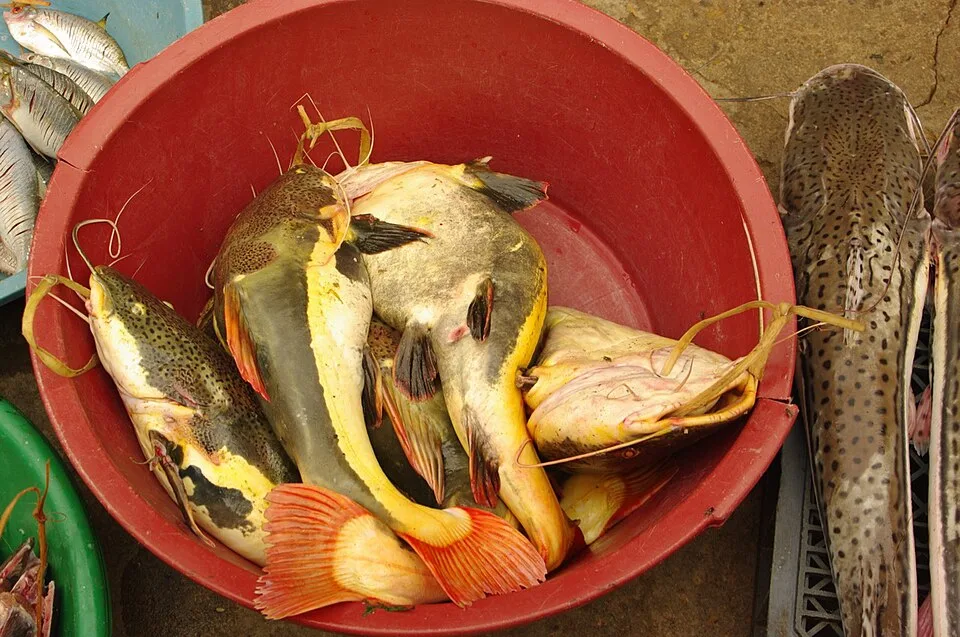 Redtail catfish for sale in the market at Leticia, Colombia. Photo: Kenspuss, Wikimedia Commons (CC BY-SA 4.0).
The biology behind the fishing
It hunts by touch and taste. USGS says the redtail uses its well-developed senses of taste and touch to find prey, and is thought to attack by probing and ambush. It’s a slow-moving bottom fish, which is why a bait sitting still on the bottom works.
It eats mostly other fish, mainly characins (the piranha and tetra group) and catfish. It may also eat fruit, seeds and crustaceans, most of all in the flooded forest, and FishBase lists crabs too. That’s why cut fish is the bait, not a dough ball.
It isn’t in trouble at home. The IUCN assessed it as Least Concern in December 2020. In the Amazon it’s both a food fish and a game fish. The rest of the family’s giants, from the Mekong giant catfish to the blue cat, are on the catfish hub.
Gear for catfish
Gear guide
Best Catfish Bait: What Channel, Blue and Flathead Catfish EatThe best catfish bait by species: cut shad for blues, punch and dip baits for channels, live bluegill for flatheads, and which prepared baits to buy.
Gear guide
Catfish Rods: Length, Power, the Soft Tip, and the Reviewers' PicksCatfish rods explained: 7–10 ft, medium-heavy, a soft glass tip on a strong butt, sinker ratings by species, and the reviewers' picks with maker specs.

Free PDF · 16 pages
Know what the catfish want tonight before you leave the house
A whole night next to a rod that never moves. One reading tells you which catfish is feeding, and where.
The 5-Rig Catfish Cheat Sheet. Take one water temperature, find your season on the two-page sheet, and it tells you which catfish is feeding, where it sits and what goes on the hook.
- The temperature that shuts channel cats down while blue cats keep biting all winter
- Five rigs drawn, three tied step by step, and why you never strike with a circle hook
- The bait and hook for each catfish, from punch bait to a live bluegill
Every line from the catfish pages on fishing.info and the 152 sources behind them, Missouri and Texas wildlife agencies among them.
No card, nothing to buy. Confirm with one click and the PDF is on its way, one version for your phone and one to print, yours to keep. Then a few short emails and one a week on what's biting, with an unsubscribe link in every one. Privacy.
Related
Section guide
Catfish: Species Identification, Baits, Seasons and RecordsThe catfish species anglers catch most, channel, blue and flathead first: how to tell them apart by the anal fin, when they spawn, what bait each wants.
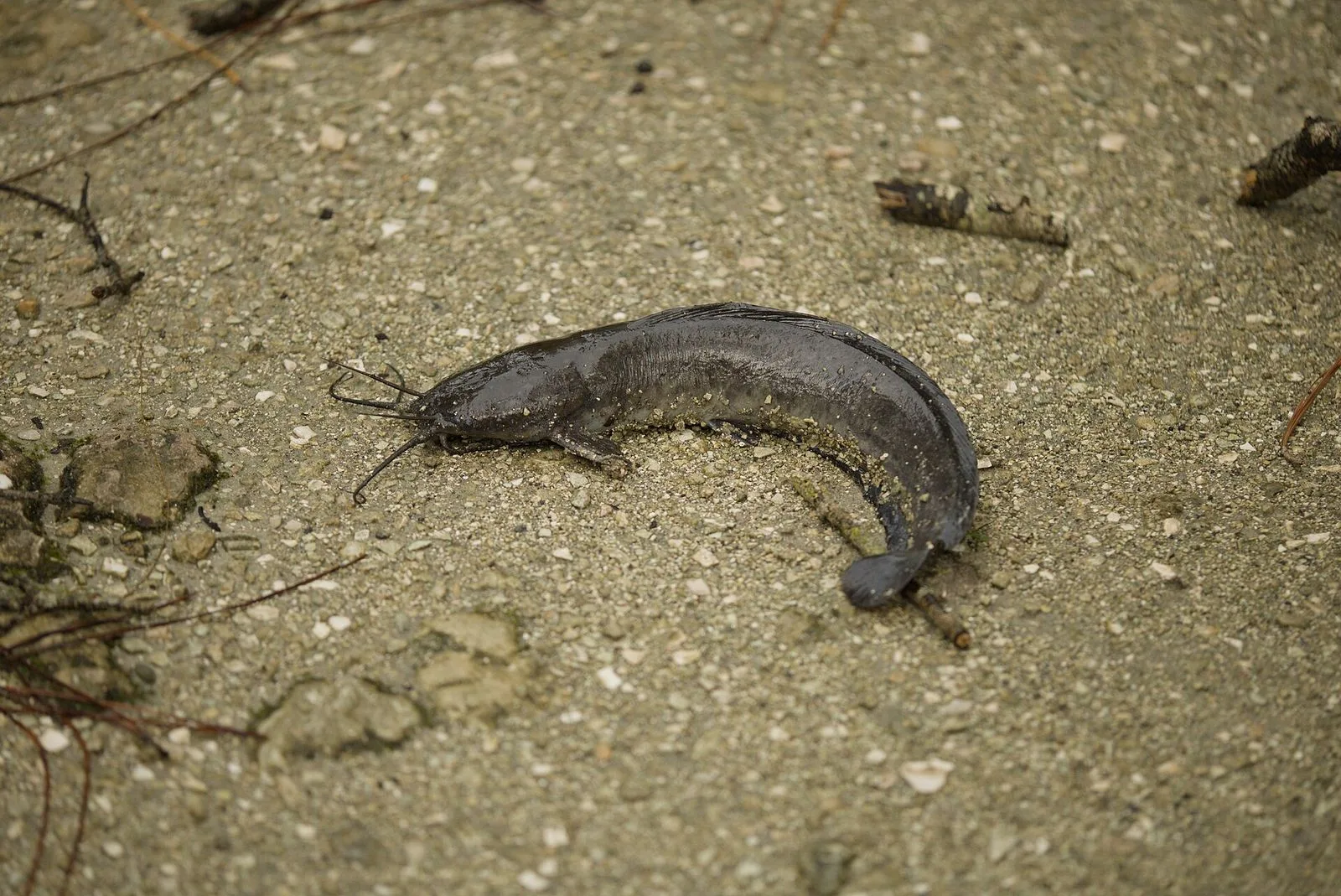 Walking Catfish: The Florida Invader That Crosses Land, and the Law on It
Walking catfish: an air-breathing Asian catfish loose in Florida since the 1960s. How it crosses land, its 2 lb 10 oz record, and why live ones are banned.
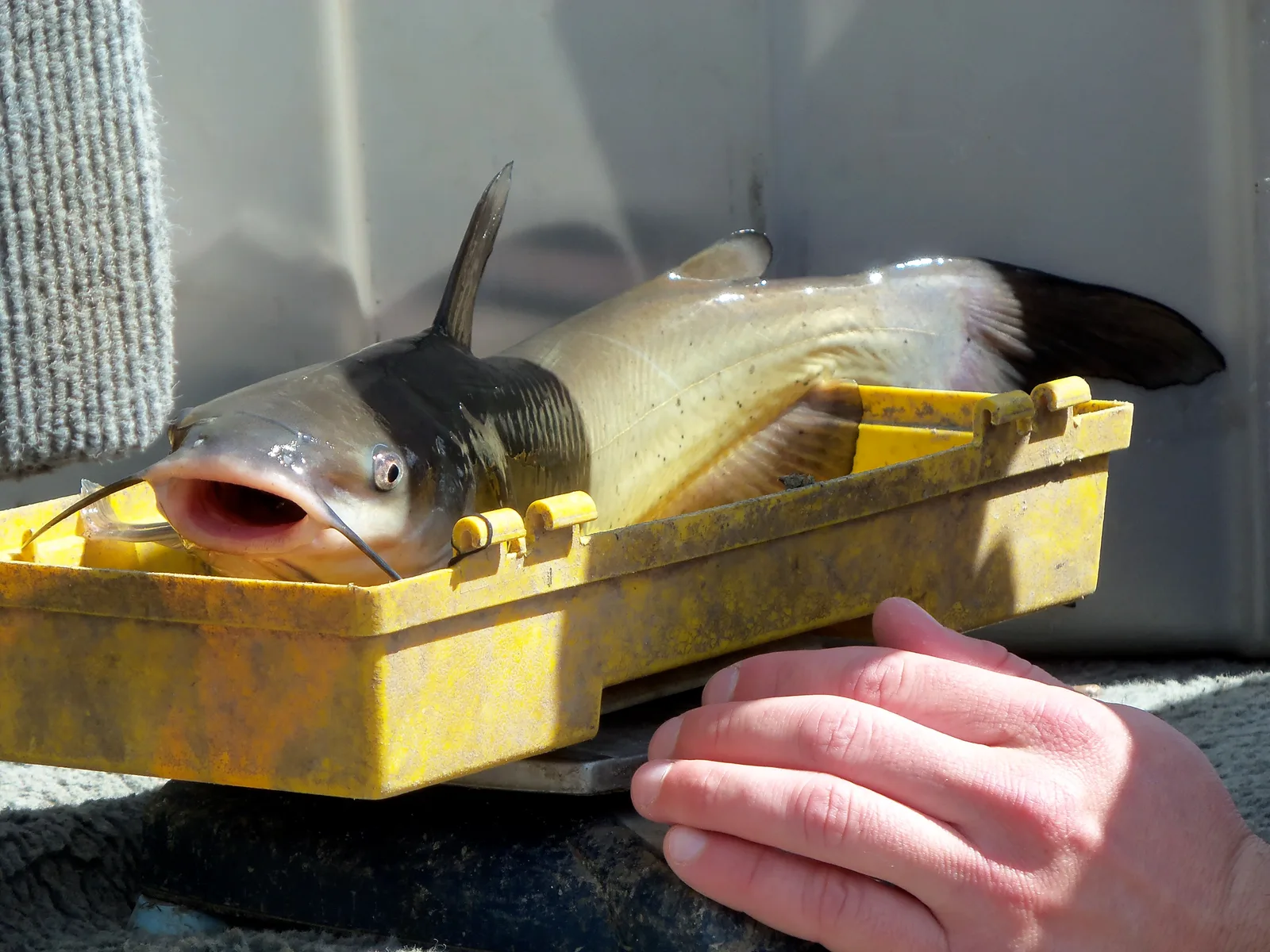 What Do Catfish Like? What They Eat, Smell and Avoid, by Species
What catfish like, by species: anything for channels, cut fish for blues, live fish for flatheads. The diet data, the senses and the baits.
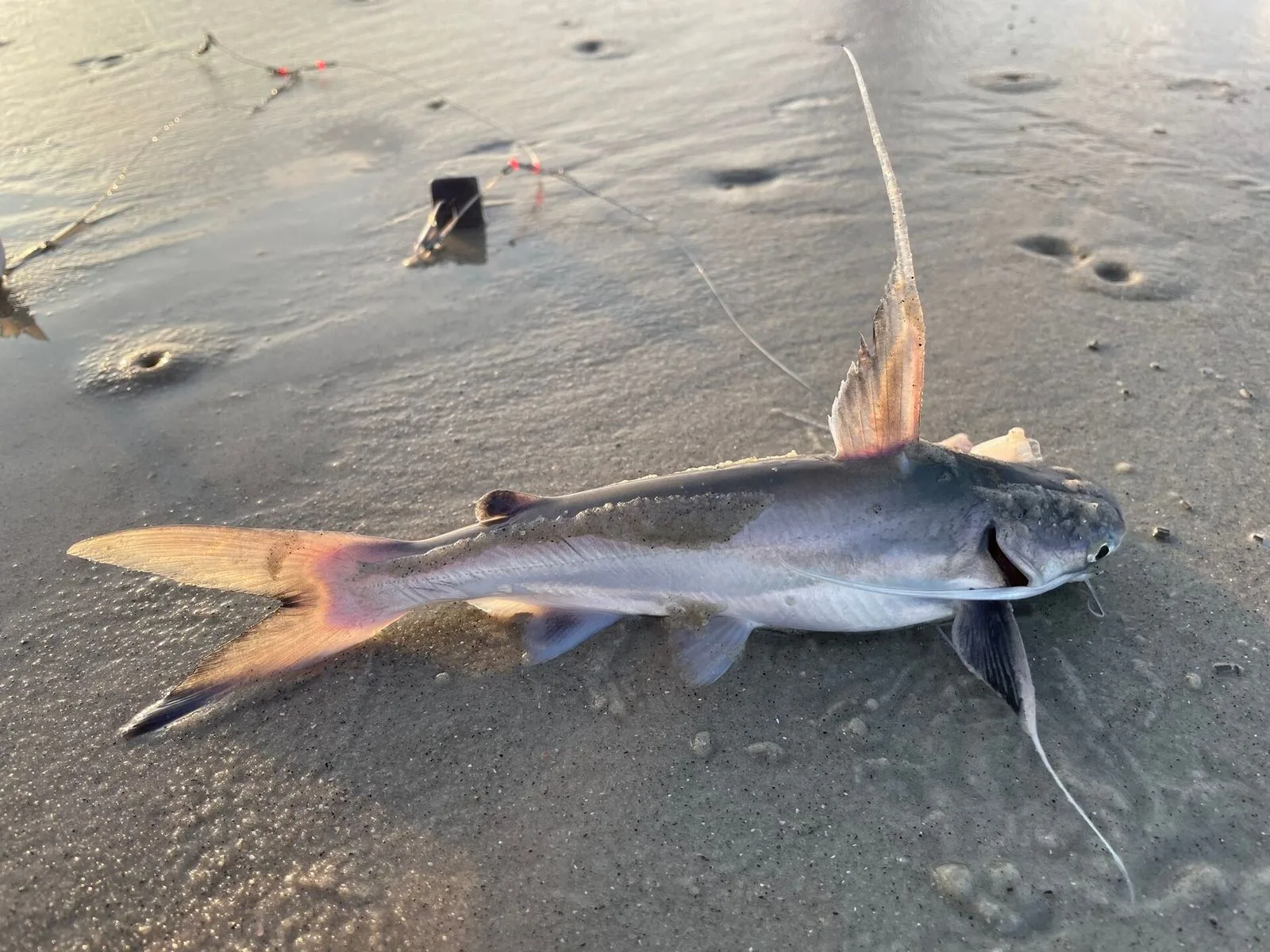 Saltwater Catfish: Hardhead vs Gafftopsail, the Sting, the Eating
The two saltwater catfish: how to tell a hardhead from a gafftopsail, sizes and records, the sting and its first aid, and which one to eat.
- How to Catch Catfish: Bait, Rigs, Where and When, by Species
How to catch catfish: the bait, rig, hook and water for channel, blue and flathead catfish, where they are by day and night, and a trip step by step.
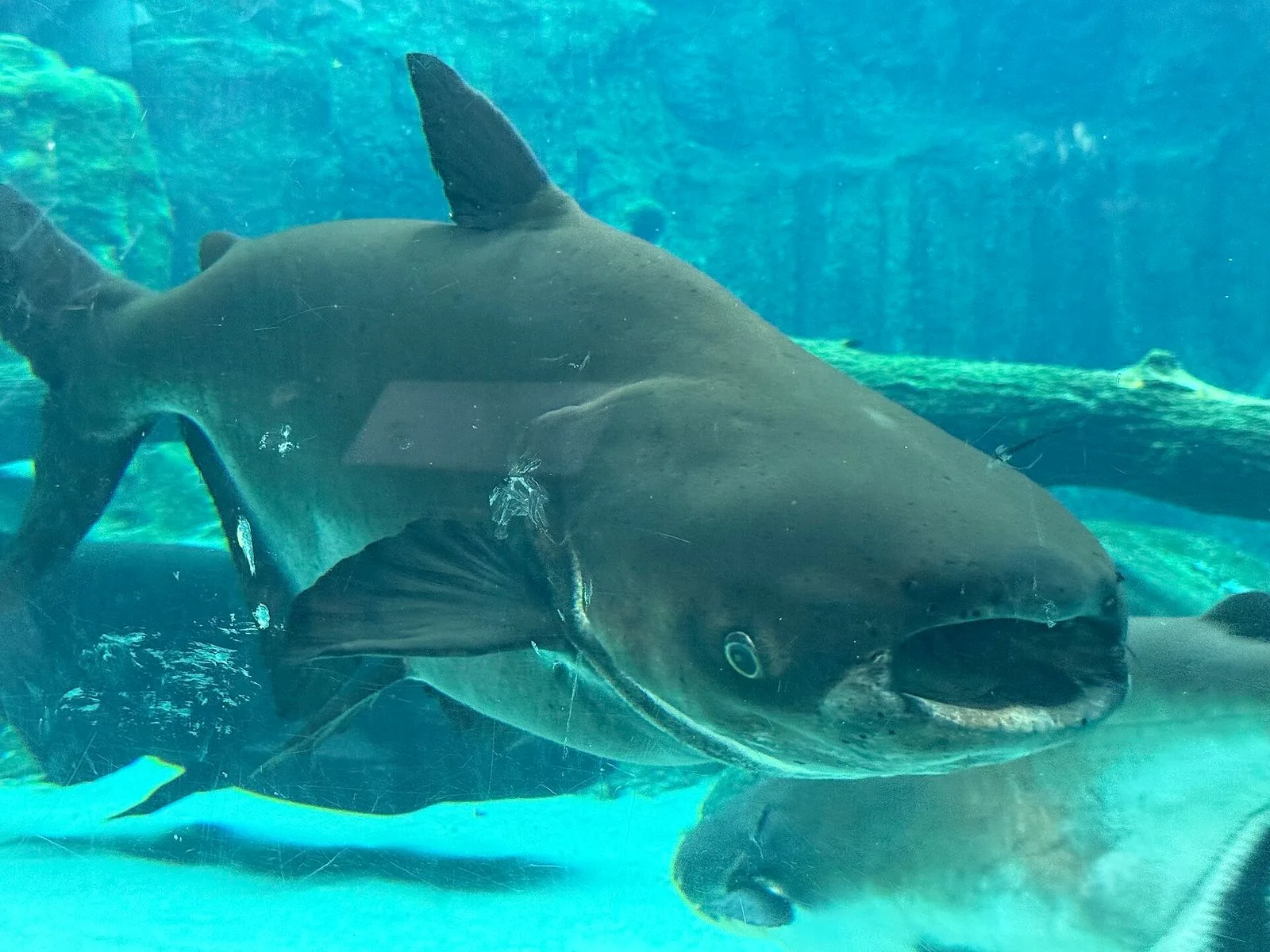 Mekong Giant Catfish: The 646 lb Record, and Where You Can Legally Catch One
The Mekong giant catfish: how to recognize the toothless giant, the 646 lb fish of 2005, how many are left, and the one legal way an angler catches one.
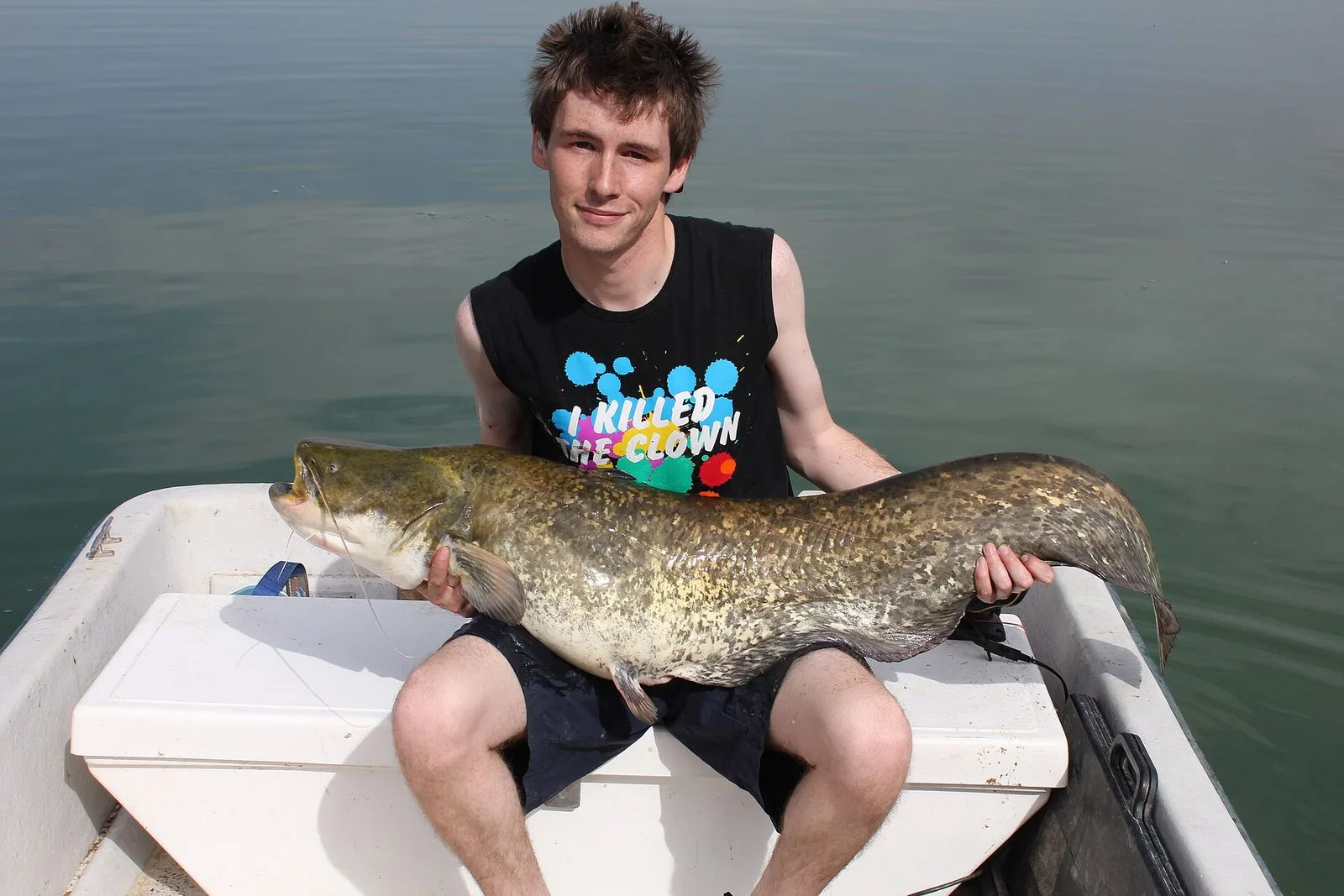 Wels Catfish: Europe's Giant, Its Records, and Why It Is Banned in the US
Wels catfish: Europe's giant, 297 lb 9 oz on record and banned from US import since 2016. How to recognize it, the Ebro record book, how anglers catch it.
Sources (12)
- IGFA World Record Search, Catfish, redtail (pirarara), all records (member-portal API, read November 15, 2026)
- USGS Nonindigenous Aquatic Species, Phractocephalus hemioliopterus (redtail catfish) species profile (table updated November 15, 2026)
- USGS Nonindigenous Aquatic Species, redtail catfish collection records
- U.S. Fish and Wildlife Service, Redtail catfish (Phractocephalus hemioliopterus) Ecological Risk Screening Summary (February 2011, revised August 2017)
- FishBase, Phractocephalus hemioliopterus summary
Show all 12 sourcesShow fewer sources
- The Florida Statutes, 379.231 Regulation of nonnative animals
- Florida Fish and Wildlife Conservation Commission, Exotic Pet Amnesty Program
- Texas Parks and Wildlife Code, Section 66.015, Introduction of fish, shellfish, and aquatic plants
- Texas Parks and Wildlife Department, Prohibited exotic aquatic species
- Seriously Fish, Phractocephalus hemioliopterus species profile
- How To Catch Any Fish, Redtail Catfish
- Outdoor Life, the biggest record catfish from around the world (IGFA all-tackle list)