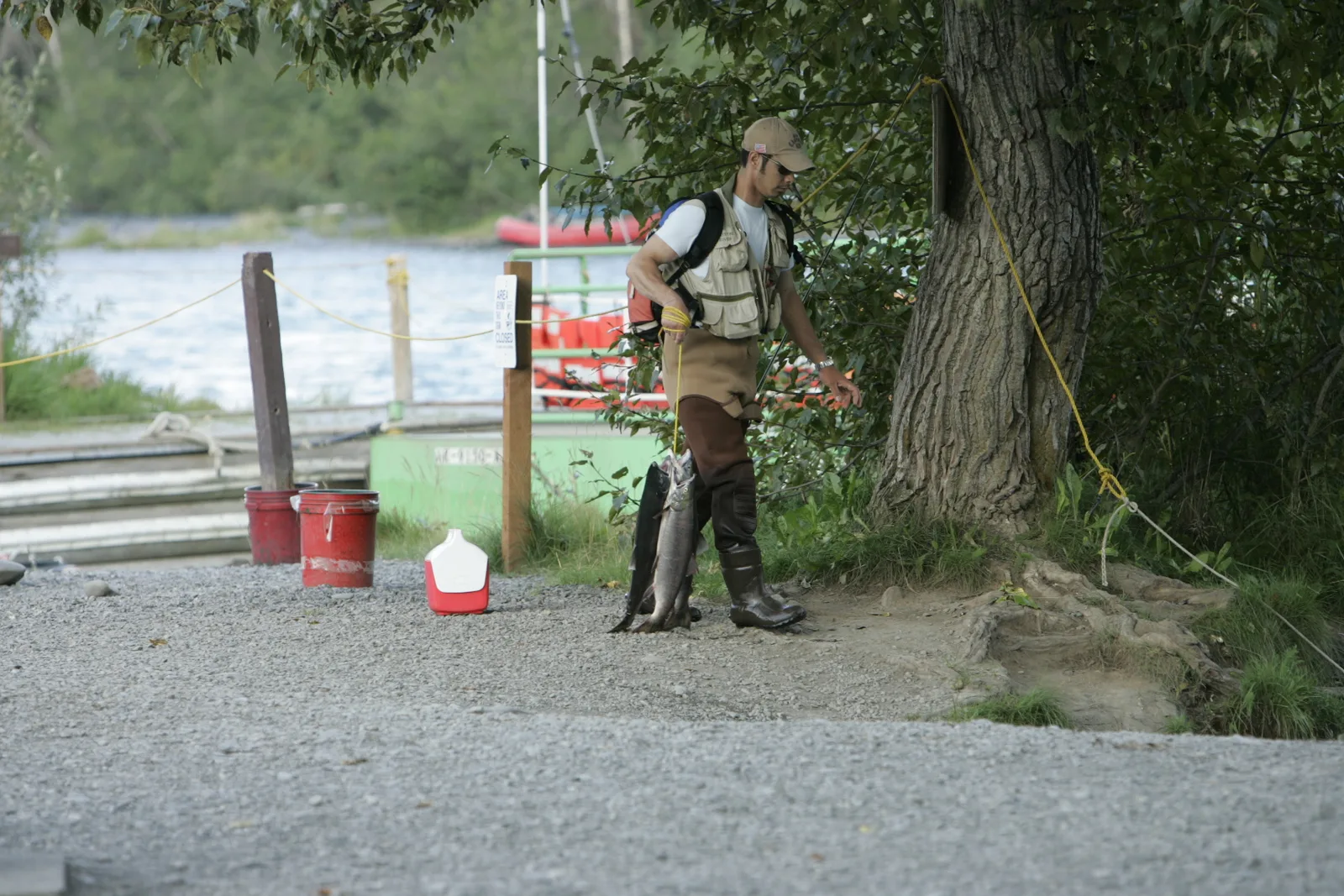
A $3 chain stringer through the lower jaw is the fishing stringer most anglers need: nine snaps, one fish on each, every fish free to come off alone. Spend more for a heavier chain on pike, a vinyl-coated cable for a boat or salt water, or a 15 ft float stringer for wading. Panfish off a dock are better in a wire fish basket. The picks come from the makers’ specifications and the owner ratings on retailer pages; none was tested by this site.
In a 2023 Ontario study, no pike died during two hours on a stringer, but more than one in four died within two days. With a cord through the gill cover, more than half did.
Which stringer for your fishing?
- Bank or dock, bass, walleye or catfish for supper: the Eagle Claw 46 in 9 Snap Chain Stringer, $3.09.
- Pike and big walleye: the Lindy Easy-String, $11.99, 60 in of heavier chain.
- A boat that stays put, fresh or salt: the Luhr-Jensen Pro-Class Cable, $30.99, vinyl-coated with stainless hooks.
- Wading the flats: the ForEverlast G2 Pro, $29.99, 15 ft of cable with a quick-release cork.
- Panfish off a dock or an anchored boat: the Eagle Claw Floating Wire Fish Basket, $11.99.
- Cheapest that works: the Eagle Claw Braided Polycord, from $1.99.
- A kayak: a stringer only while you sit still; fish go in an insulated bag on ice before you paddle.
How long will fish live on a stringer?
The one measured answer is two hours, for northern pike. Carleton University researchers held 168 pike from Lake Opinicon, Ontario, on cord and metal stringers for two hours. No fish died on the stringer. Within 48 hours of release, 27% of the stringer fish were dead, against 7% of fish held in an aerated tank.
Blood lactate, a stress marker, ran 42% higher than in the tank fish. Every stringer fish had impaired reflexes, and 68% of the survivors still carried wounds after two days. A pike that looks lively on the cord may still die after release.
Warm water makes it worse, and the study linked higher water temperature with more deaths. Water at 50 °F (10 °C) holds 11.3 mg/L of oxygen; at 86 °F (30 °C) it holds 7.7. Keeping Bass Alive puts a bass’s oxygen demand at almost twice as high at 85 °F as at 50 °F. The fish breathing page explains why that squeeze kills. Read the water where the stringer hangs with a fishing thermometer, and check your species on the water temperature chart.
Our reading of those numbers: in cool spring water a fish strung through the jaw keeps for hours; in a hot August shallow, put it on ice.
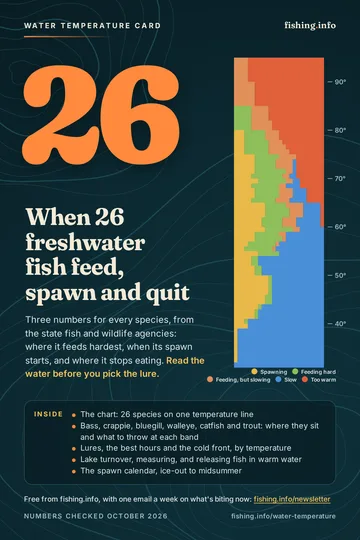
Free card: what 26 species do at your water temperature
Plus one email a week on what's biting now. No sales pitches. Privacy.
How do you use a fish stringer?
A stringer is a cord, chain or cable that holds caught fish alive in the water by the jaw.
- Through the lower jaw or both lips, never the gills. New York DEC: “Fish will die more rapidly if the stringer is placed through the gills.” Take Me Fishing says to push the point “through the soft tissue behind the fish’s lower jawbone”; Wikipedia’s entry threads it through the upper and lower lips. In the pike study, a stringer through the gill cover killed 37% of the fish, through the jaw 17%.
- One fish per snap (the snaps, or clips). “Each clip will hold one fish—sometimes two if the fish are small,” in Take Me Fishing’s words. On a rope stringer the fish stack, so the last one on is the first one off.
- Hang it deep and tie it off. Take Me Fishing wants “a solid tie-off point” and fish that stay immersed. Penn State Extension adds that fish on stringers need “enough water and mobility to breathe.” Anglers on the forums hang it in shade and deeper, cooler water.
- Lift it before the boat moves. Boat and kayak anglers on the forums bring the fish aboard first rather than tow them.
- When a fish dies, start the clock. The FDA’s limit is 2 hours out of the cold, 1 hour above 90 °F, and 40 °F or below after that. NDSU Extension: “Bleed the fish,” then remove the gills and entrails. Ikejime is the Japanese way to kill and bleed a fish you keep; for a pike, the boneless five-fillet cut comes next.
Rope, chain or cable?
Rope is a cord with a metal needle at one end and a ring at the other, and the fish on it slide into a bunch. Freeing the bottom one means unthreading the rest. Rope comes long enough for wading, and Eagle Claw’s cost $1.09 to $8.79. Through the gill cover, a cord was the worst stringer in the pike study: 56% died within two days, most of them in the first eight hours.
Chain holds each fish on its own snap, and each comes off alone. A stringer through the lower jaw had the fewest deaths in the pike study: 15% on cord, 19% on chain. Owner complaints are about thin metal and a big fish that got loose. Plated chain also rusts: one owner of a 46 in Danielson chain found it “severely rusty after just a few uses” without ever taking it into salt water.
Cable is the chain’s coated cousin: coated steel cable with sliding snaps, $23.99 and $30.99 for the two here. For salt water it is our pick: Eagle Claw sells its plain chain for “freshwater or light saltwater” and its coated cable for both.
Do you need a float stringer for wading?
On a shark coast, yes, and a long one. Joe Doggett put it plainly in Texas Saltwater Fishing Magazine: a wader “dragging a stringer or fighting/landing a fish is, literally, trolling for sharks.” He calls it “a rookie mistake to firmly knot a flimsy little six-foot perch stringer to your belt.” His setup is “a 10- to 12-foot cord stringer with a big cork on the end” and a quick-release knot. A blacktip once took two of his eight trout off the cord “in two bites.”
Bink Grimes, in the same magazine, goes further for West Bay: “if you must use a stringer, make sure it is at least 25 feet away from you.” KRIS-TV reported the Texas State Aquarium’s advice after the South Padre bites: do not go into the water with your catch on a stringer. Doggett also notes that inshore Gulf sharks “almost never knowingly attack humans.” The quick release lets you drop the stringer when one takes it.
Can you use a stringer from a kayak?
Only while you sit still. Kayak anglers on the forums say a stringer over the side drags hard, so the fish come aboard before you paddle, most into an insulated fish bag with ice in the hatch. The sure costs of towing are drag, thrashing and predators.
Predators find bank stringers too. On Lake Taneycomo, Missouri, otters pulled trout off anglers’ stringers. The Missouri Department of Conservation’s advice: “either put them in a secure basket or don’t put them in the water.” On a Florida kayak forum, anglers warn that a stringer “could be a serious problem with a gator” and tie it to the boat with a knot they can release quickly.
Does a fish on a stringer count toward your limit?
In several states, yes, from the moment it goes on. The pike study’s authors say that once on a stringer, a fish “should be regarded as part of the daily harvest limit.” Swapping it later for a bigger one is culling.
| State | The rule | Exception |
|---|---|---|
| Minnesota | A fish “not immediately released” is in possession; once a limit is in possession, “no culling or live well sorting” | None in the rule |
| Iowa | Fish held “in a live well, on a stringer, or in other fish holding devices” count; “You cannot sort, cull, high-grade or replace” them | DNR-permitted black bass and catfish tournaments |
| California | Culling only in permitted black bass contests, once the limit is reached | Those contests only |
Other states differ, so check your regulations; fishing for beginners covers licenses and limits. If you might let a fish go, release it at once, as the catch and release guide shows, never from the stringer at the end of the day.
In salt water the fish on the stringer must also stay whole. Florida snook “must remain in whole condition until landed ashore,” and Florida sharks are landed whole. Louisiana, with a few exceptions such as tuna, keeps the head and tail fin on saltwater recreational finfish “until set or put on shore.” The fillet knife waits for the dock.
How do the stringer types compare?
| Type | Build and length | Holds | What kills fish on it | Price |
|---|---|---|---|---|
| Twisted rope | Poly cord, needle and ring; 6–12 ft (1.8–3.7 m) | As many as fit, stacked | Gill-cover cord: 56% of pike died | $1.09–$2.19 |
| Braided rope | Braided poly or nylon; 7 ft 6 in–25 ft (2.3–7.6 m) | Same, stacked | Same as twisted rope | $1.99–$8.79 |
| Chain | Steel chain, 7–11 snaps; 40–60 in (1.0–1.5 m) | One fish per snap | Chain through the jaw: 19% of pike died | $2.69–$11.99 |
| Cable | Coated steel cable, sliding snaps; 5 ft 6 in–70 in (1.7–1.8 m) | One fish per snap | Same hold as chain; no study | $23.99–$30.99 |
| Float stringer | Cable or cord with a cork; 10–15 ft (3–4.6 m) | Fish under the cork | Sharks, on a coast that has them | $29.99 |
| Wire fish basket | Wire mesh, lid; 14 × 25 in (36 × 64 cm) | Panfish, loose inside | Nothing pierced; bluegill: 34% died | $11.99 |
The picks in detail
Eagle Claw 46 in 9 Snap Chain Stringer: best overall
Nine nickel-plated snaps on 46 in (1.2 m) of chain, $3.09 on Eagle Claw’s page. The maker sells it for shore and boat, in fresh or “light saltwater.” Walmart’s 25 or so owner reviews average 4.9 of 5; Dick’s 14 average 3.5, with complaints of thin metal and a big fish that got away. Buy it for bass, walleye and catfish you plan to eat; for pike, step up to the Lindy.
Eagle Claw Braided Polycord Stringer: best rope stringer
A braided cord with a needle and a ring, $1.99 to $4.39, in 7 ft 6 in, 9, 12 and 25 ft. Eagle Claw states the braid resists fraying and suits wading, shore or boat. Walmart’s own Ozark Trail 15 ft braided stringer, $2.74, is rated 4.8 of 5 over 48 reviews. Rope is for a few fish going home the same day, not for fish you might release.
Lindy Easy-String Chain Stringer: best for pike and walleye
Sixty inches (1.5 m) of heavy steel chain with 10 hooks, 9 of them on swivels, $11.99. Lindy calls it “ideal for toothy fish.” Discount Tackle shows two owner reviews; one dislikes how the hooks slide.
Luhr-Jensen Stringer Pro-Class Cable: best for the boat
Vinyl-coated cable, 5 ft 6 in (1.7 m), with 10 sliding brass-sleeve clasps and stainless hooks, $30.99 from Rapala. The maker states the length lets fish “move around and live longer”; no study has tested that. Buy it for an anchored boat in fresh or salt water; skip it if your fish go on ice anyway.
ForEverlast G2 Pro Stringer: best for wading
Fifteen feet (4.6 m) of cable with “a quick-release system on the cork end,” $29.99 at Academy. It is the long cork stringer Doggett describes, in cable.
Eagle Claw Floating Wire Fish Basket: best fish basket
A 14 × 25 in (36 × 64 cm) wire basket with a metal lid, 1.54 lb (0.7 kg), that collapses for storage; $11.99 on sale at Overton’s, rated 4.8 of 5 there. Nothing pierces the fish. New York DEC suggests baskets “for smaller fish like sunfish and perch,” and NDSU Extension calls a metal link basket or live box best. It is no live well, though: in a 2009 Illinois study, 34% of bluegill kept in wire fish baskets died, against 7.6% in live wells.
How we chose
The specifications and prices are the makers’ and retailers’ own, from the pages under Sources in October 2026. Owner ratings come from Walmart, Dick’s, Overton’s and Discount Tackle; where a review count is shown, it is small. No stringer was tested for this page. What the stringer does to the fish comes from the 2023 pike study and the agencies’ handling guides.
Nets, pliers and the rest of the small gear are in the accessories hub.
Free download
The water temperature card
Read your water temperature and the card tells you who is spawning, who is feeding and what to throw. 26 species, 16 pages, for your phone and the tackle box.
Plus one email a week on what's biting now. No sales pitches. Privacy.
Related
Section guide
Fishing Accessories: The Small Gear That Decides the DayThe fishing accessories worth carrying: net, pliers, scale, thermometer, tackle box and the rest, with the one spec that matters on each and what it is for.
 Best Fishing Thermometers: From a $14 Stream Tube to the Fish Hawk TD
A $14 encased stream thermometer serves most anglers; only a depth probe reads where summer bass and walleye sit. Five types compared, with picks.
Sources
- Madden, LaRochelle, Burton, Danylchuk, Landsman and Cooke (2023), Condition and post-release mortality of angled Northern Pike temporarily retained on stringers, NAJFM 43:1395–1406 (study summary, Queen's University Biological Station)
- Madden et al. (2023), article page, North American Journal of Fisheries Management (water temperature and mortality)
- New York State DEC, Beginners' Guide to Freshwater Fishing, Keep it Alive (lower jaw, not the gills; fish baskets)
- Take Me Fishing (RBFF), How to keep fish fresh (rope and chain stringers, one fish per clip, tie-off)
- Wikipedia, Fish stringer (through the upper and lower lips)
- eBay, Danielson Fishing Chain Stringer 46" Inch 9 Snaps 9320, owner review "Rust Attack" (2016)
- Penn State Extension, Proper care and handling of fish from stream to table (stringers and live wells)
- NDSU Extension FN535, A Pocket Guide to Care and Handling of Fish from Stream to Table (stringer damage, bleeding, two hours)
- FDA, Selecting and serving fresh and frozen seafood safely (40 °F, 2 hours, 1 hour above 90 °F)
- West Virginia DEP, Save Our Streams, percent saturation of dissolved oxygen (solubility table)
- Gilliland and Schramm (2002), Keeping Bass Alive, B.A.S.S. (oxygen demand at 85 °F and 50 °F)
- Joe Doggett, Danger afoot, over-rated and otherwise, part one, Texas Saltwater Fishing Magazine, August 2012 (wading stringers and sharks)
- Bink Grimes, The View: July 2020, Texas Saltwater Fishing Magazine (25 ft from the wader)
- KRIS-TV, Texas State Aquarium weighs in on South Padre Island shark attacks
- KY3, Otters swipe anglers' fish from stringers on Lake Taneycomo, August 8, 2018 (Missouri Department of Conservation)
- BassResource forum, Keeping fish when kayak fishing (stringer drag, fish aboard, fish bags)
- Minnesota Rules 6262.0100, subpart 5 (possession, culling and live well sorting)
- Iowa DNR General Fishing Regulations (stringers and holding devices, no culling, tournament exemption)
- California Department of Fish and Wildlife, Fish culling at black bass tournaments (14 CCR §230)
- Florida FWC, Snook recreational regulations (whole condition until landed ashore)
- Fla. Admin. Code R. 68B-44.003, Sharks: landing in whole condition
- Louisiana RS 56:325.2 (head and caudal fin intact until on shore)
- Eagle Claw, Stringers (specifications and prices of the poly, braided, chain and cable stringers)
- Luhr-Jensen (Rapala), Stringer Pro-Class Cable 6904
- Lurenet, Lindy Easy-String Chain Stringer ST115
- Discount Tackle, Lindy Easy-String Chain Stringer (owner reviews)
- Academy, ForEverlast G2 Pro Stringer
- Overton's, Eagle Claw Floating Wire Fish Basket
- Walmart, fishing stringers category (owner ratings and prices, October 2026)
- Dick's Sporting Goods, Eagle Claw 9-Snap Chain Fish Stringer (owner reviews)
- Hoxmeier and Wahl (2009), Factors influencing short-term hooking mortality of bluegills, NAJFM 29:1372–1378 (wire fish baskets 34.0%, live wells 7.6%)
- BigBendFishing.Net forum, Storing fish after you catch them? (kayak stringers, gators, quick-release knot)