 By
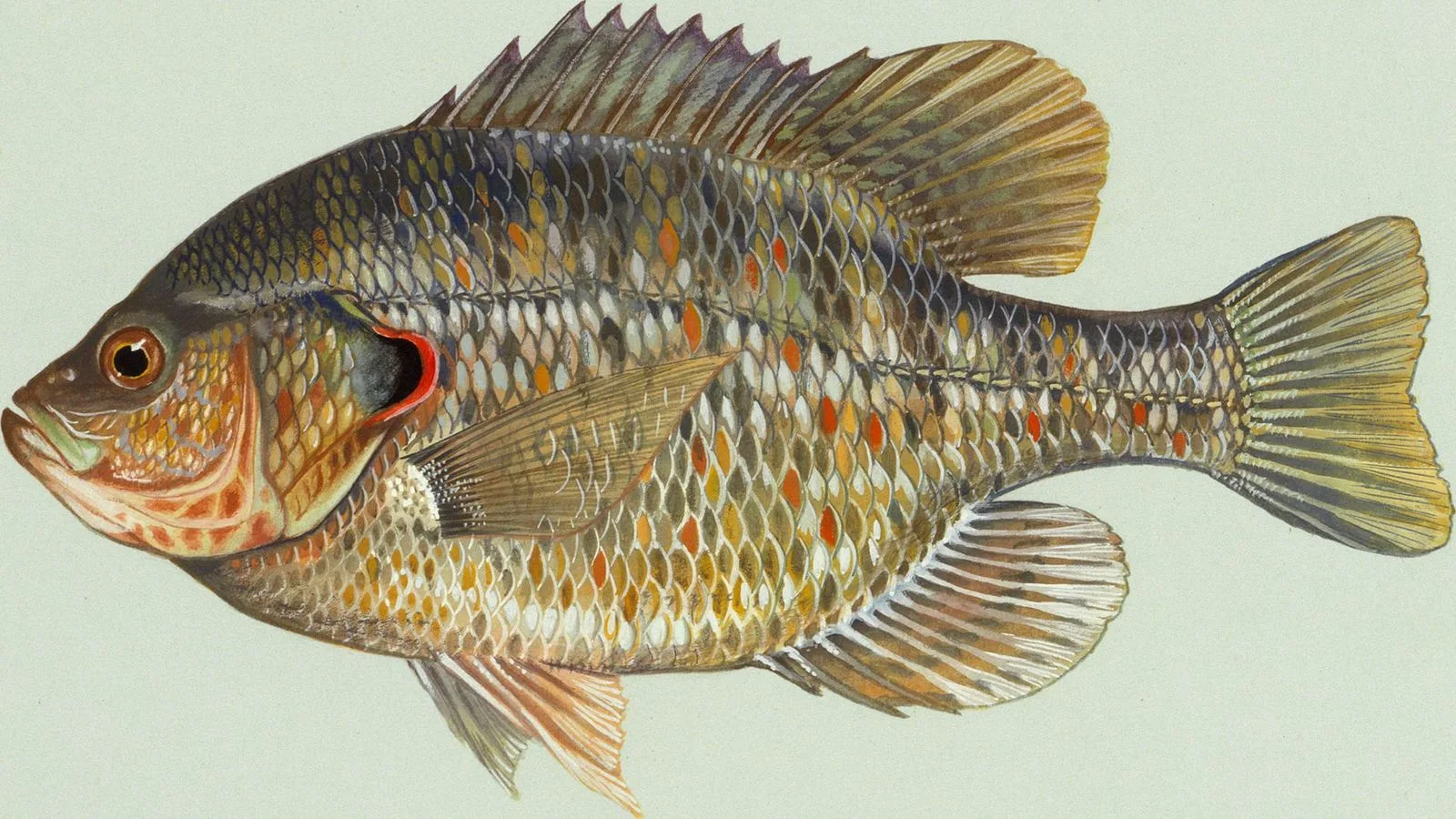
A redear sunfish is the South’s shellcracker: shaped like a bluegill, with a red or orange spot on its ear flap. It lives near the bottom of warm, weedy lakes and ponds and eats snails, so you catch it with a worm on or just above the bottom, rarely anything on top. It also grows bigger than a bluegill: 8–10.5 in (20–27 cm) is typical.
Lake Havasu’s record was about 3 lb when quagga mussels showed up in 2007, says tackle-shop owner John Galbraith. Since then the lake has turned out three world records in a row, the last at 6 lb 4 oz.
How do you tell a redear from a bluegill?
Look at the ear flap, the dark tab at the back of the gill cover. A redear’s is black with a whitish border and a red spot at the tip. On a female that spot is orange. A bluegill’s is solid black right to the edge, with no color at all. You’ll never see a long flap on a redear, the way you do on a longear or a redbreast. A redear is its own species, not a bluegill, though the two can cross.
Then check the body. You’re looking for a deep, slab-sided fish, golden to light olive, with red flecks and often dark bars down the sides. A bluegill often carries a black blotch at the rear of its soft dorsal fin, and you won’t find that on a redear. Both fish have a small mouth and long, pointed pectoral fins, so those won’t help you.
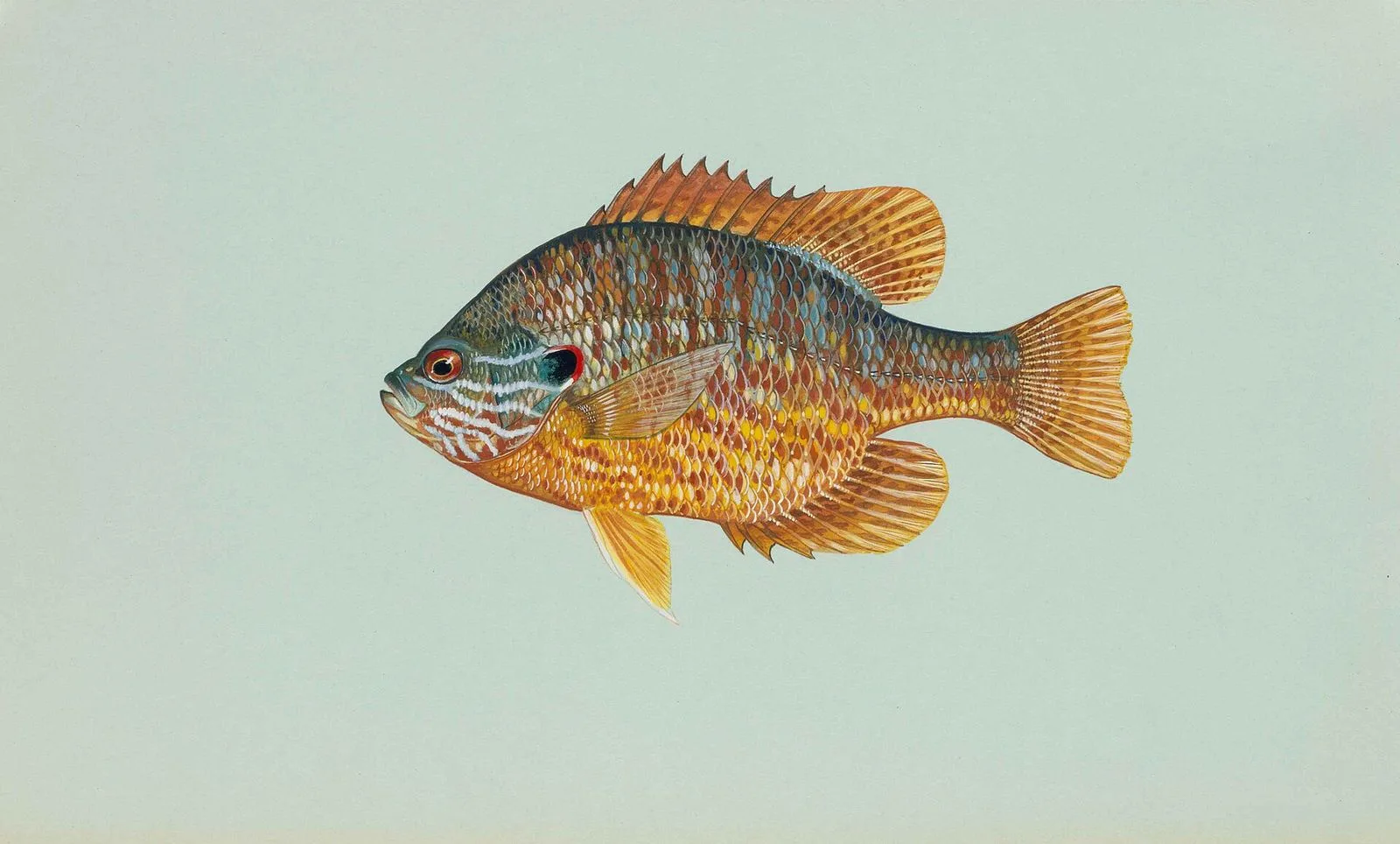
The pumpkinseed can fool you. It’s the other fish with red on its flap, and it lives in many of the same lakes. Look for a bright red-orange half-moon at the end of its flap and wavy blue-green lines across its cheek.
| Mark | Redear | Bluegill | Pumpkinseed |
|---|---|---|---|
| Ear flap | Black, whitish border, red (male) or orange (female) spot at the tip | Solid black, no colored edge | Black, bright red-orange half-moon at the tip, pale edge |
| Body | Golden to light olive, red flecks, often dark bars | Dark vertical bars; blue chin and gill cover | Orange belly; wavy blue-green lines on the cheek |
| Soft dorsal fin | No dark blotch | Black blotch at the rear | May carry orange spots |
| Mouth | Small; jaw not past the front of the eye | Small; jaw not past the front of the eye | Very small; jaw short of the eye |
| Typical size | 8–10.5 in (20–27 cm) | Commonly 7.5 in (19 cm), to about 9.5 in (24 cm) | 6–10 in (15–25 cm) |
An odd fish with marks of both may be a hybrid: a female redear and a male bluegill make the hybrid sunfish Texas A&M describes. For the rest, the panfish hub has the full nine-species key, and the green sunfish page covers the big-mouthed fish of the same genus.
What do redear eat, and why does it matter?
Snails and other mollusks, which is where “shellcracker” comes from. Its throat teeth are broad and flat, built for crushing shells, Missouri’s field guide says. That’s why you fish low: redear feed on the bottom. Insect larvae and water fleas may turn up in the diet, and redear rarely come up to take a fly, Texas Parks and Wildlife says.
Those shells decide where a redear goes and what it does to a lake. Michigan lakes stocked with redear have 56 percent fewer native pumpkinseed than lakes without them, and 69 percent less weight of snails, the USGS reports. Redear crush harder than pumpkinseed and eat more of the snails, it notes.

Free PDF · Water temperature chart When do panfish bite?
One reading, and the 16-page chart shows which of 26 fish are spawning, feeding hard or slowing down; for bass, crappie, bluegill and walleye, where they sit and what to throw. Every number sourced.
No card, nothing to buy, and the PDF is yours to keep. Confirm with one click and it's on its way. Then a few short emails and one a week on what's biting. Unsubscribe anytime. Privacy.
Are redear good for ponds?
Yes, and the snail diet is the reason. Snails are a link in the life cycle of certain parasites, so many small ponds and fish hatcheries stock redear to keep those parasites from spreading, Missouri’s field guide says. In your own pond, put in 250 redear fingerlings of 1–3 in (2.5–7.5 cm) per acre, in late summer or early fall, alongside the bluegill. That’s what Texas A&M recommends. Just know they feed on the bottom, so they’re less likely to take commercial fish feed, it notes.
Where do redear live?
Look for warm water with little current and plenty of weeds. A redear sits nearer the bottom and deeper than a bluegill, so fish below where your bluegill are. Try stumps, logs and roots, where Oklahoma finds it. On a river, fish the protected bays and overflow pools, because it stays out of the main channel.
The native range runs along the Atlantic and Gulf slopes, from about the Savannah River in South Carolina to the Nueces River in Texas. It reaches north up the Mississippi valley to southern Illinois and Indiana. Live outside that? You may still have them, because stocking carried the fish much farther. The USGS records redear from 13 watersheds in Arizona since 1945. California has 42 going back to 1948, and Texas Parks and Wildlife lists Michigan, Ohio and Pennsylvania.
How do you catch redear?
On the bottom, with a worm. Earthworms and grubs beat lures, Missouri says, and you’ll catch most redear off their spawning beds in early summer. They’re harder to catch than bluegill, Oklahoma says, so go to the deeper water around wood.
Tie on a drop-shot rig first, with the weight on the bottom and the hook above it. That’s what Lake Havasu’s anglers use. Set the bait 12 to 15 in (30–38 cm) off the bottom so it hangs above the grass, tackle-shop owner John Galbraith told Wired2Fish. Nightcrawlers and cut anchovies are the baits there. The 2021 world record took a drop-shot nightcrawler in about 25 ft (7.6 m) on 6 lb line. If they’re hanging over low weeds, a slip bobber set just above them works too, Wired2Fish’s Havasu anglers say.
Don’t want to fuss with a drop shot? The old way still works. T. J. Lashley Sr. took his 1962 world record on two red worms dug from the family’s yard. He used a No. 6 hook and a cane pole with 10 lb line. His son remembered the sinker about a foot above the hook, “so the worm would float above the bottom”. You can go smaller on the hook. A No. 6 sits at the large end of the panfish sizes on the hook size chart. A redear’s mouth is no bigger than a bluegill’s, so a No. 8 or 10 is no mistake.
| Lake Havasu, 2021 record | Alabama, 1962 record | |
|---|---|---|
| Rig | Drop shot; Galbraith sets the bait 12–15 in (30–38 cm) off the bottom | Cane pole, sinker about a foot above the hook |
| Bait | Nightcrawler | Two red worms |
| Line | 6 lb | 10 lb |
| Hook | Not reported | No. 6 |
| Depth | About 25 ft (7.6 m) | Not reported |
Go in the low light if you can. Sunfish are most active early in the morning and later in the evening, Oklahoma says, though they feed through the day.
How big do redear get?
Bigger than a bluegill. Expect 8–10.5 in (20–27 cm) and 6.5–12 oz (185–340 g), Missouri says, while a bluegill tops out at 9.5 in (24 cm) in most waters. A redear “can be more than 12 inches and more than 4 pounds”, in Missouri’s words. Texas A&M and Oklahoma give 12 in (30 cm) and 2 lb (0.9 kg) as the size a redear can reach.
Inch for inch, though, a redear is the lighter fish. On the fisheries standard-weight scale, a 10-in redear should weigh 0.75 lb against 0.88 lb for a 10-in bluegill. Measure yours and check it against this table, which gives that standard weight for each length.
| Length | Standard weight | What it means |
|---|---|---|
| 8 in (20 cm) | 6.0 oz (170 g) | The small end of a typical redear |
| 10 in (25 cm) | 12 oz (340 g) | Missouri’s typical top weight |
| 12 in (30 cm) | 1.33 lb (600 g) | The top size Texas A&M and Oklahoma give |
| 14 in (36 cm) | 2.15 lb (975 g) | Texas’s record, 2.99 lb at 14 in, was 139 percent of this |
| 17 in (43 cm) | 3.93 lb (1.78 kg) | The world record, at 6 lb 4 oz, was 159 percent of this |
A redear is mature by the end of its second year, and it dies young. Few live past six summers, Texas Parks and Wildlife says, and Missouri gives about six years.
Where do the world records come from?
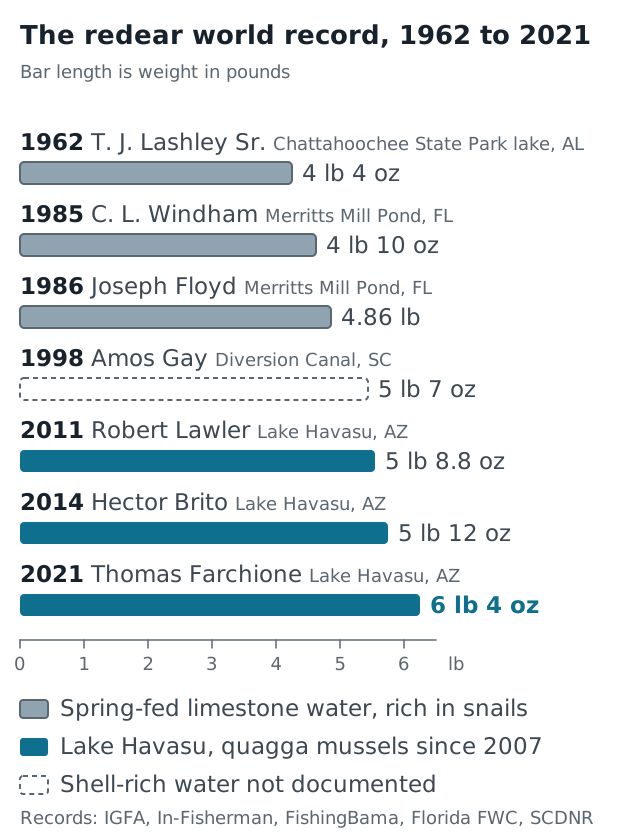
Mostly from water full of shells. Seven fish have held the record since 1962, and you can see the pattern in where they were caught.
| Year | Weight | Angler | Water | The shells |
|---|---|---|---|---|
| 1962 | 4 lb 4 oz (1.93 kg) | T. J. Lashley Sr. | Chattahoochee State Park lake, Alabama | Spring-fed limestone water, rich in snails |
| 1985 | 4 lb 10 oz (2.1 kg) | C. L. Windham | Merritts Mill Pond, Florida | The same aquifer, 16 miles away |
| 1986 | 4.86 lb (2.20 kg) | Joseph Floyd | Merritts Mill Pond, Florida | The same spring water |
| 1998 | 5 lb 7 oz (2.47 kg), 5 lb 7.5 oz on South Carolina’s list | Amos Gay | Diversion Canal, South Carolina | – |
| 2011 | 5 lb 8.8 oz (2.52 kg), listed beside Gay’s | Robert Lawler | Lake Havasu, Arizona | Quagga mussels since 2007 |
| 2014 | 5 lb 12 oz (2.61 kg) | Hector Brito | Lake Havasu | Quagga mussels |
| 2021 | 6 lb 4 oz (2.83 kg) | Thomas Farchione | Lake Havasu | Quagga mussels |
Lawler’s fish didn’t knock out Gay’s. The IGFA wants a fish under 25 lb to beat the record by 2 oz, so the two shared the listing until Brito’s fish beat both.
Springs from the Floridan Aquifer, in limestone, feed both the Alabama park lake and the Florida mill pond. That mineral-rich water grows snails, and the snails grew shellcrackers. Lashley’s fish weighed over 5 lb on the park’s uncertified scale that afternoon, but the record books list 4 lb 4 oz.
Lake Havasu, a 19,300-acre reservoir on the Colorado River, did it with an invader: quagga mussels, first identified there in 2007. “The lake record was a three-pounder when the quaggas first showed up,” Galbraith told the Dallas Morning News, “and it’s gotten bigger ever since.” Ty Hardymon, a biologist with Arizona Game and Fish, calls the mussels “part of a perfect storm”. The rest, he says, is a long growing season, good habitat and a lack of predators on big redear.
Headed to Havasu? Galbraith weighed all three records there, and he noticed a pattern. All three came in the pre-spawn, February to early May, when egg-laden females move shallow and before the weeds choke the lake. All three came within two to three miles of each other, either side of the main island. That water sits over a cottonwood forest, flooded when the lake was built. Farchione’s fish measured 17 in (43 cm) with a 20 in (51 cm) girth.
When do redear spawn?
Late spring into early summer. Watch your thermometer for 66–70 °F (19–21 °C), the figure Oklahoma gives. In Missouri that means May or June, and sometimes again in August. Texas sees one or two peaks a season, so count on once or twice a year, fewer than a bluegill.
Redear bed deeper than other sunfish, so you’ll have to look deeper too. Texas A&M puts the nests in water over 3 ft (0.9 m). Look for the saucers the males fan in gravel, or in silt where there’s no gravel, packed so close that the rims almost touch. Bluegill colonies follow in warmer water, and the bluegill spawn temperature page has the regional timing.
Are redear good to eat?
Yes. Missouri calls the redear “an excellent panfish”, and in the lakes where it was stocked it adds a large share of the catch. It falls under the sunfish or bream limit in most states, such as Alabama’s 50 bream a day, so check your state’s booklet. Minnesota’s Department of Health allows most adults up to four servings of sunfish a week, or two in Cook, Lake and St. Louis counties, based on mercury, PFOS and PCB levels. Statewide, children under 15 and anyone who is or may become pregnant or is breastfeeding should keep to one.
What else is a redear called?
Shellcracker first, for the diet. You may also hear bream and stumpknocker, Missouri says. Texas Parks and Wildlife lists Georgia bream, cherry gill, sunny and sun perch, and the IGFA adds yellow bream. The scientific name is Lepomis microlophus, Greek for “small nape”.
The USGS recognizes two unnamed subspecies, one in Florida, Georgia and southern Alabama and one everywhere else. Stocking has mixed them so much that they may no longer be told apart. You’ll find the rest of the sunfish family on the panfish hub.

Free PDF · 16 pages
Stop guessing. Know what's biting before your first cast
A whole Saturday on the water with nothing to show for it. One reading tells you who's feeding.
The Water Temperature Fishing Chart. Take one water temperature reading, find it on the chart, and see which of 26 freshwater fish are spawning, feeding hard or slowing down.
- Where bass, crappie, bluegill and walleye sit, and what to throw. Trout: the reading where you stop.
- Why a 3 ft drop beats a cold front, and what to throw each day of the front
- The three thermometer mistakes that make a reading lie
The chart's numbers come from state fish and wildlife agencies and fisheries research: 61 sources, each listed on the site.
No card, nothing to buy. Confirm with one click and the PDF is on its way, one version for your phone and one to print, yours to keep. Then a few short emails and one a week on what's biting, with an unsubscribe link in every one. Privacy.
Related
Section guide
Panfish: Which Fish Count and How to Tell Them ApartPanfish are bluegill, the sunfish, crappie and yellow perch. Tell 9 sunfish apart by the ear flap, plus records and limits from 50 a day to none in Texas.
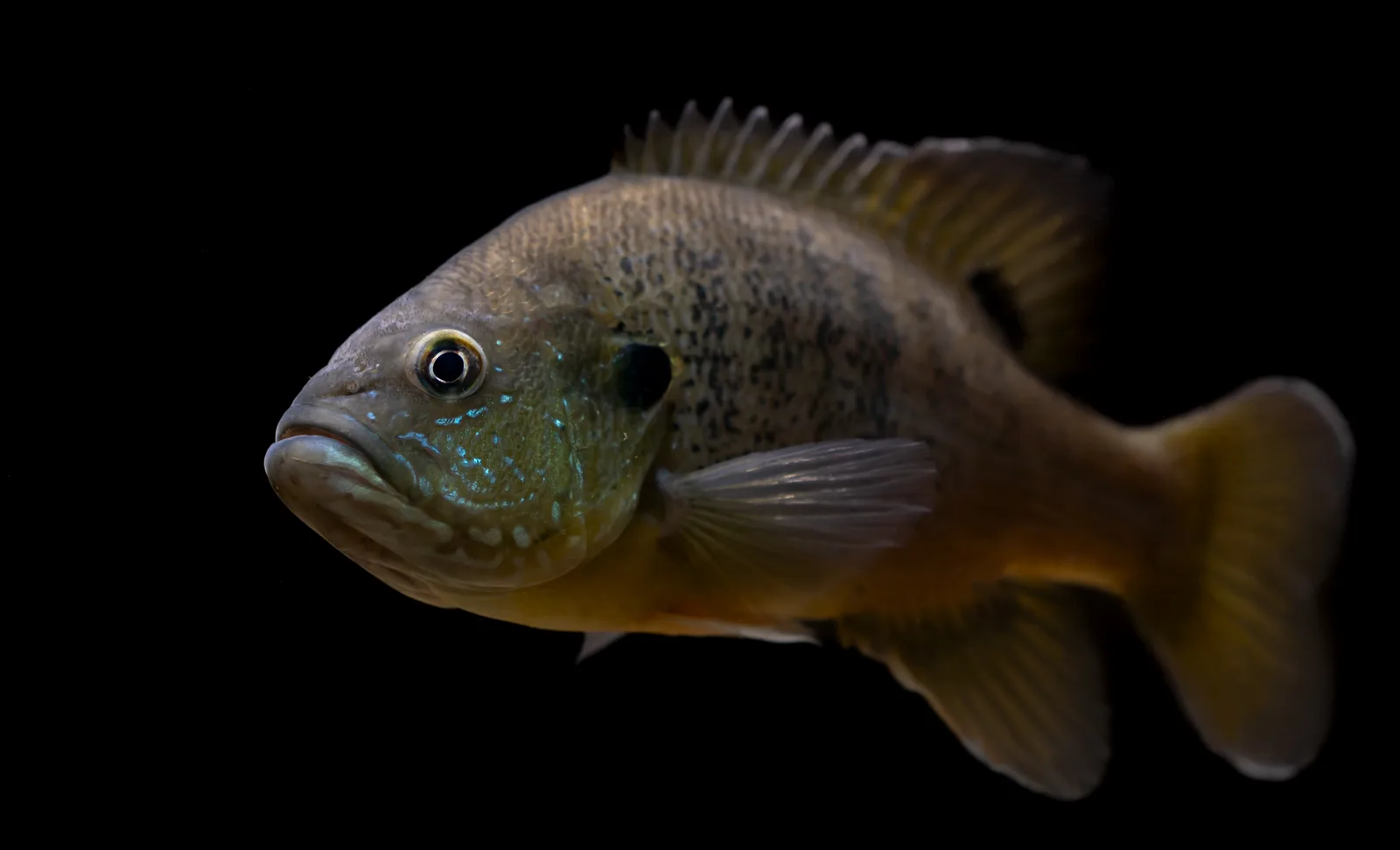 Green Sunfish: How to Identify It, and Why Ponds Fill With It
How to tell a green sunfish from a bluegill or a warmouth, why it takes over small ponds, how to catch one, how big it gets and the 1971 record.
 Warmouth: How to Identify It, Where It Lives and How to Catch It
Warmouth: a red-eyed sunfish with 3 anal spines and teeth on its tongue. How to tell it from a rock bass, catch one, and the 2 lb 7 oz record.
- Bream Fish: What Southern Anglers Mean, and Which Bream You Have
In the South a bream is any sunfish, the bluegill first. In Europe it is a carp relative, on a menu a sea bream. How to tell which bream you have.
 Perch Fish: What a True Perch Is, and Which Perch Are Not
A true perch is one of three Perca species. White perch, ocean perch, Nile perch and surfperch borrow the name: what each really is, and the records.
 Perch Fishing: Where to Find Them, the Rigs That Work, and When They Bite
How to catch yellow perch: where the schools sit each season, the spreader and jig rigs, how far off the bottom to fish, the bait, and the ice.
 Rock Bass: How to Identify, Find and Catch the Goggle-Eye
How to tell a rock bass from a warmouth or a smallmouth, where it lives, what it bites, how big it gets and the 3 lb world record that is a tie.
Sources (25)
- Missouri Department of Conservation, redear sunfish (description, size, food, nesting, fishing)
- Texas Parks and Wildlife, redear sunfish (ear flap, deeper beds, peaks, lifespan, names)
- USGS Nonindigenous Aquatic Species, redear sunfish (identification, native range, introductions, Huckins et al. 2000)
- Texas A&M AgriLife, redear sunfish (spawning depth, maturity, pond stocking)
- Oklahoma Department of Wildlife Conservation, redear sunfish (spawning temperature, habitat, fishing)
Show all 25 sourcesShow fewer sources
- Texas Parks and Wildlife, longear sunfish (the elongated, white-trimmed ear flap)
- Texas A&M AgriLife, hybrid sunfish (female redear crossed with male bluegill)
- Missouri Department of Conservation, bluegill
- Texas Parks and Wildlife, bluegill (dark spot on the dorsal fin, vertical bars)
- U.S. Fish and Wildlife Service, bluegill (common length 7.5 in)
- Iowa DNR, pumpkinseed (ear flap, cheek lines, mouth, adult size)
- Maine Inland Fisheries and Wildlife, pumpkinseed sunfish (half-moon, belly, size)
- Wikipedia, pumpkinseed (orange spots on the fins; secondary)
- IGFA world record search, redear sunfish
- IGFA, world records for July 2021 (the 2.83 kg redear)
- Dallas Morning News, where records flourish: Lake Havasu is the place for giant redear sunfish (Matt Williams, May 22, 2021)
- Wired2Fish, welcome to Lake Havasu, where redear break world records (Brent Frazee)
- FishingBama, Alabama's record bluegill and shellcracker (Eileen Davis; the 1962 world record)
- Florida Fish and Wildlife Conservation Commission, freshwater state records (Joseph Floyd, 4.86 lb, Merritts Mill Pond, 1986)
- South Carolina DNR, freshwater state records (shellcracker, Amos Gay, Diversion Canal, 1998)
- Outdoor Alabama, freshwater creel and size limits (bream, 50 a day)
- In-Fisherman, world record sunfish (the redear record line)
- Outdoor Life, the biggest panfish of all time (IGFA all-tackle records)
- Minnesota Department of Health, fish consumption guidelines
- FSA WSlit standard-weight table (Pope et al. 1995 redear equation)