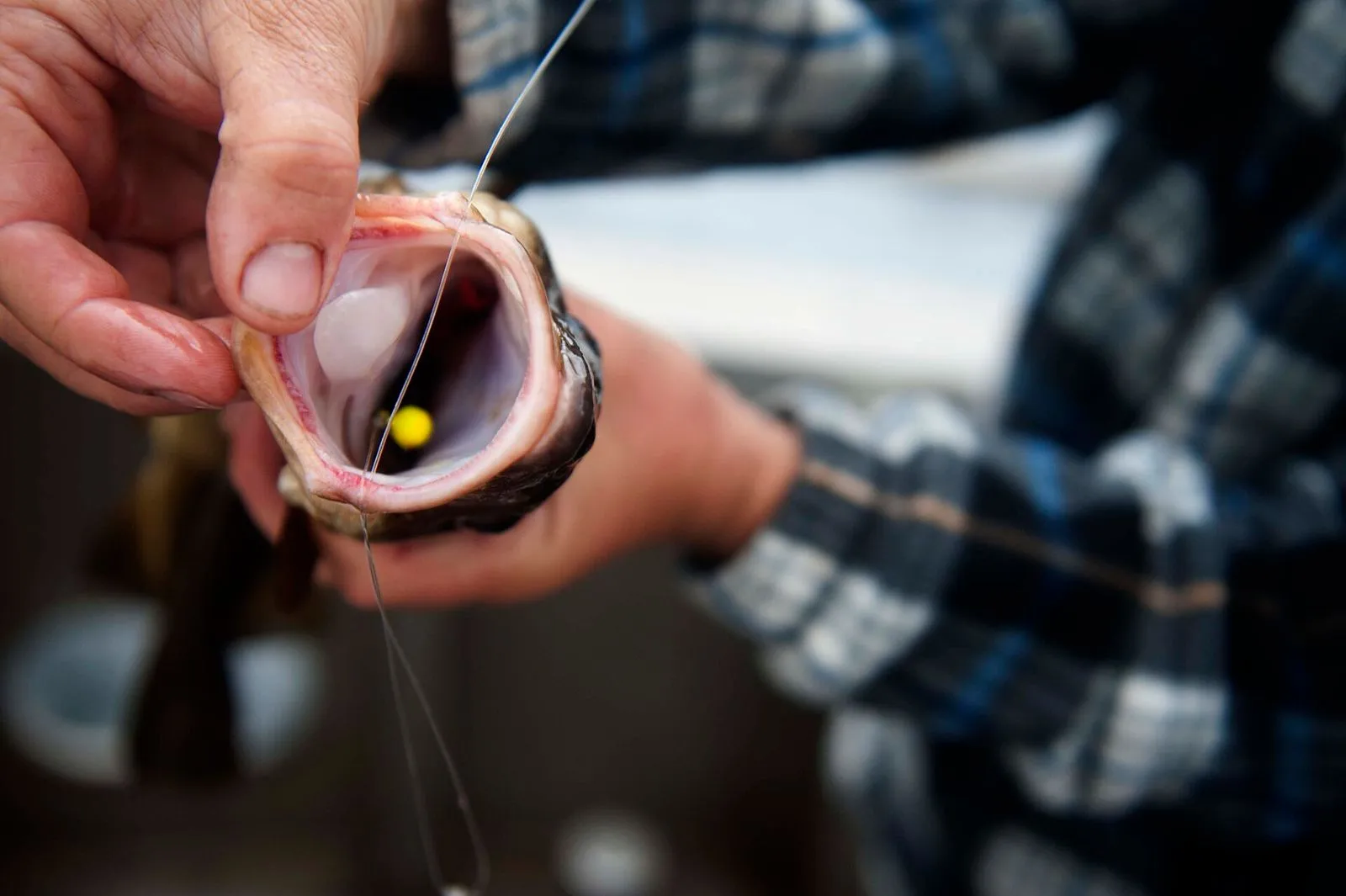
Fish sense damage: a rainbow trout carries 22 pain receptors on its head and lips, and it reacts when they fire. A caught fish also shows a stress response you can measure in its blood; whether fish suffer the way we do is where scientists still disagree. None of that settles what matters most at the water: whether the fish you let go swims off and lives. That question has clear numbers, and most of them are in your hands.
Exhausted rainbow trout survived at 88% when they were never lifted from the water, 62% after 30 seconds in the air and 28% after 60 seconds.
Alarm or pain: what is the argument about?
Two words carry the whole argument. Nociception is the body’s alarm system: nerve endings that fire when something is cut, crushed or burned. Pain is what a mind makes of that alarm. Fish have nociception, and nobody serious disputes it anymore. Lynne Sneddon, then at the University of Edinburgh and later at Liverpool, led the work that proved it. James Rose of the University of Wyoming led the case against: the alarm rings, but there is no one home to hear it.
Think of a smoke detector. A fish has one, and it works. The argument is about whether anything in the fish notices the noise.
How do we know? The trout study
In 2003 Sneddon, Victoria Braithwaite and Michael Gentle mapped the nerves on the face of the rainbow trout. They found 58 receptors on the head and lips. Twenty-two were polymodal nociceptors: fibers that fire at hard pressure, at heat above 104 °F (40 °C) and at a 1% acetic acid solution, roughly vinegar strength.
Then some trout got bee venom or acid injected into the lips, and others got plain saline. The venom and acid fish rocked from side to side on the tank floor, rubbed their lips on the gravel and the glass, breathed faster and refused food for about 170 minutes. The saline fish were feeding again in a third of that time. In a second paper the same year, Sneddon gave injured fish morphine. The rocking and rubbing stopped. Fish have working detectors, and a painkiller changes what they do about it.
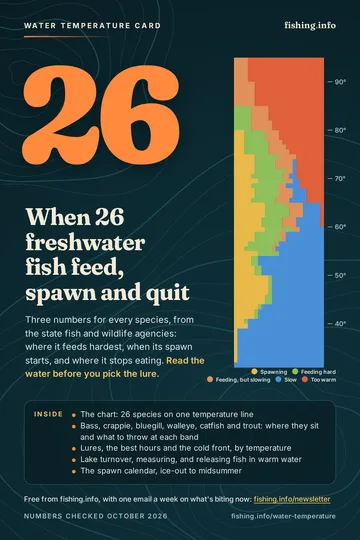
Free card: what 26 species do at your water temperature
Plus one email a week on what's biting now. No sales pitches. Privacy.
What the doubters say
Rose and six colleagues answered in 2014 with “Can fish really feel pain?” Their case rests on the brain. In humans, the felt part of pain happens in the neocortex, the folded outer layer. Fish have no neocortex. Nociception on its own, they argue, is a reflex, the way your hand leaves a hot stove before you feel the burn.
They also point at the wiring. In mammals about 50% of nociceptor fibers are C-fibers, the slow ones tied to the dull, lasting ache. In fish about 4–5% are. Their conclusion: claims that fish feel pain “remain unsubstantiated.” Brian Key of the University of Queensland made the same case in 2016 under the title “Why fish do not feel pain.” It drew more than 40 published replies, most of them rejecting it.
On the other side, Braithwaite’s 2010 book Do Fish Feel Pain? and Culum Brown’s 2015 review argue that fish pain is comparable to that of other vertebrates. The trout did not just flinch; they changed what they did for hours, and a painkiller changed it back.
So here is where the science stands. Nociception is a fact. Stress is a fact. Suffering is inferred, in both directions, and no experiment yet can settle it.
Do fish feel pain when hooked?
A hook goes through the lip or jaw, exactly where Sneddon mapped the receptors. So the detectors fire. You may have heard that fish lips have no nerve endings. No study says that, and the 2003 map says the opposite. The defensible version is narrower: lips carry nociceptors, but very few of the slow C-fibers. What the fish makes of that is the contested part above.
What is known is that the hook wound itself rarely kills. Fernholz and colleagues followed hooked largemouth bass in 2018. Every wound was visible on day 0, and 91% still were on day 7. Healing depended on the season: 27% of wounds had closed by day 6 in May, against 12% in July. A 2023 study of sea trout in Fisheries Research found wounds healed in 26 to 29 days with no deaths and no lost growth, though 6% of lure-caught fish still carried an open or infected wound.
Do fish feel pain when caught? The stress response
Whatever a fish feels, its body reacts like any body under threat. Suski and colleagues sampled tournament largemouth bass within five minutes of weigh-in in 2003. Cortisol, the stress hormone, and blood glucose were far above the levels in unfished bass. Lactate, the burn you feel at the end of a sprint, kept rising for up to 8 hours and was back to normal by about 24 hours.
Put simply, the fish’s body does what yours does at the finish line of a race. Heart hammering, muscles burning, sugar dumped into the blood. A fish fights the way a rabbit runs, to get away. It spends most of the next day recovering, resting much as it does at night (do fish sleep?). Whether that alarm comes with anything like fear is the next question: do fish have feelings?
What decides whether a released fish lives
Bartholomew and Bohnsack pooled 274 published estimates of catch-and-release mortality in 2005. The average was 18%, and the range ran from near 0% to 95%. That spread is the point. The same fish caught two different ways lives or dies, and one factor towered over the rest: where the hook sits. A fish hooked in the lip mostly lives. A fish hooked deep in the throat or the gills often does not. Bait deep-hooks far more often than lures. Treble against single hook made little difference.
The barb matters less than most anglers believe. Schill and Scarpella pooled the trout studies in 1997: 4.5% mortality on barbed hooks against 4.2% on barbless, and only 1 of 11 comparisons was significant. Schaeffer and Hoffman found barbless hooks came out faster, and barbed hooks landed 22% more fish.
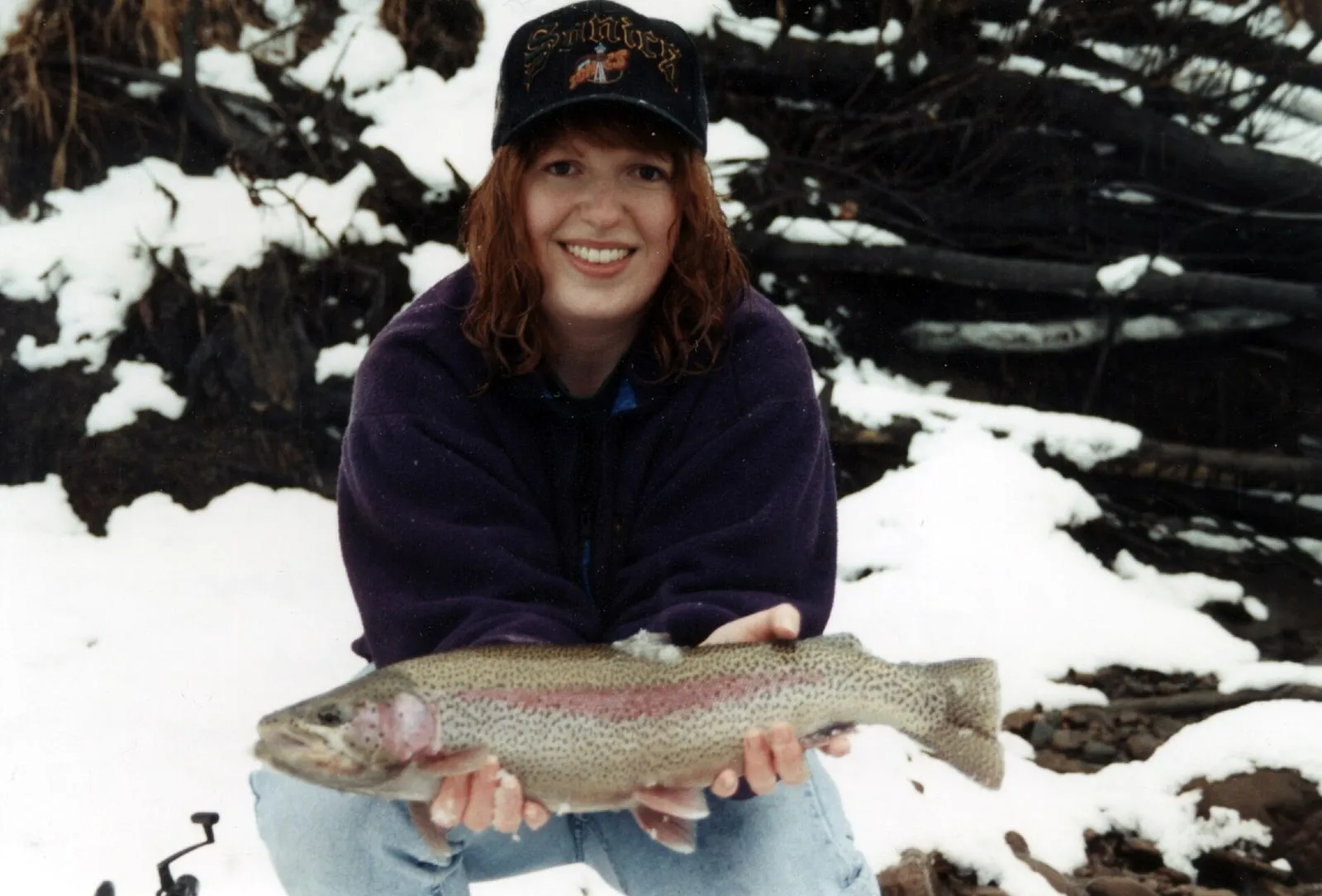
Air is the lever. Ferguson and Tufts exercised rainbow trout to exhaustion, then held them out of the water: 88% survived with no air time, 62% after 30 seconds, 28% after 60. Cook, Lennox, Hinch and Cooke reviewed the air-exposure studies in 2015 and are cited for a limit of about 10 seconds. A photo takes less than that if the fish waits in the water between shots.
| Factor | The number | Source |
|---|---|---|
| Where the hook sits | 18% mean mortality across 274 estimates, range 0–95%; deep and gill hooking fill the high end, lip hooking the low | Bartholomew and Bohnsack 2005 |
| Bait or lure | Bait deep-hooks more often than lures; treble against single hook made little difference | Bartholomew and Bohnsack 2005 |
| Time in the air | 88% survival with no air, 62% after 30 s, 28% after 60 s; about 10 s is the cited limit | Ferguson and Tufts 1992; Cook et al. 2015 |
| Barbed or barbless | 4.5% against 4.2% mortality, 1 of 11 comparisons significant; barbed landed 22% more fish | Schill and Scarpella 1997; Schaeffer and Hoffman 2002 |
| Season and water temperature | 27% of bass hook wounds healed by day 6 in May, 12% in July; 91% still visible at day 7 | Fernholz et al. 2018 |
| The fight | Cortisol and glucose high within 5 minutes; lactate up for 8 hours; baseline at about 24 hours | Suski et al. 2003 |
A careful release, from hook to swim-off
- Decide before the cast. If you fish bait for bass or catfish and plan to let them go, a circle hook sets in the corner of the mouth instead of the throat. Hook location is the biggest number in the table, and this is where you set it.
- Pinch the barb if unhooking speed is your problem. Barbless hooks come out faster and cost you about one fish in five. Mortality itself barely moves, so treat this as a handling choice, not a rescue.
- Land the fish fast. Every extra minute of fight is more lactate to pay back over the next 8 hours. Use tackle that ends the fight, not tackle that prolongs it.
- Unhook in the water when you can. Wet hands, pliers ready before the fish arrives, the fish resting in the net or beside the boat while you work.
- Count the air. Ten seconds is the number. Lift for the photo, put the fish back to breathe, lift again. A fish held up for a full minute has, on the trout numbers, about one chance in four.
- Deep-hooked? Cut the line close and leave the hook. Digging in the throat or gills turns the worst hook position into a fatal one.
- Hold it upright until it kicks free. Face it into any current and let go when it swims out of your hand, not when you are ready. In July, fish early and release faster; wounds heal at half the May pace.
What does it mean when you fish?
Fish detect injury, and their bodies go into full alarm when caught. Whether they suffer is a question science has argued for twenty years and has not closed. Sneddon, Braithwaite and Brown say yes; Rose and Key say no. You do not have to settle it to fish well. Where the hook sits and how long the fish is out of the water decide, far more than anything else, whether it lives. The full routine is in catch and release, and the other questions kids ask about fish, each with a number behind it, are in fish facts.
Free download
The water temperature card
Read your water temperature and the card tells you who is spawning, who is feeding and what to throw. 26 species, 16 pages, for your phone and the tackle box.
Plus one email a week on what's biting now. No sales pitches. Privacy.
Related
Section guide
Fish Facts: The Questions Kids Ask About Fish, Answered With the ScienceFish facts with a number and a source for each: how fish sleep, breathe, hear and feel, and what every answer means when you hook and release one.
 Do Fish Drink Water? Freshwater Fish, Saltwater Fish and Sharks
Do fish drink water? Freshwater fish barely do, saltwater fish drink all day, sharks cheat with urea. The numbers, and what it means for bait and livewells.
 Do Fish Drown? How Fish Suffocate, and How to Revive a Tired One
Do fish drown? Not by the dictionary, but they suffocate three ways: low oxygen, damaged gills, no water flow. How long a fish lasts in air, how to revive one.
 Do Fish Fart? Yes, Herring Do It on Purpose, and a Bloated Bass Needs Help
Do fish fart? Herring do, on purpose, and scientists won a prize for proving it. Which fish pass gas, where it goes, and what to do with a bloated bass.
 Do Fish Get Cold? What Winter Does to a Fish, and the Ones With Antifreeze in Their Blood
Do fish get cold? Yes: a fish is as cold as its water and feels it as slowness. What fish do in winter, who carries antifreeze, and how to fish cold water.
 Do Fish Have Bones, Hearts and Blood? What Is Inside a Fish
Do fish have bones? Most do; sharks run on cartilage and 16 icefish have clear blood. How skeleton, heart and blood work, and what it means for your fillets.
 Do Fish Have Brains? Memory, Learning, and Why the 3-Second Myth Is Wrong
Do fish have brains? Yes: a full brain, no neocortex, a memory that lasts months. What goldfish, carp and pike learned, and what it means at the water.
Sources
- Sneddon, Braithwaite and Gentle (2003), Do fishes have nociceptors? Evidence for the evolution of a vertebrate sensory system, Proceedings of the Royal Society B
- Sneddon (2003), The evidence for pain in fish: the use of morphine as an analgesic, Applied Animal Behaviour Science
- Rose et al. (2014), Can fish really feel pain?, Fish and Fisheries
- Key (2016), Why fish do not feel pain, Animal Sentience
- Brown (2015), Fish intelligence, sentience and ethics, Animal Cognition
- Braithwaite (2010), Do Fish Feel Pain?, Oxford University Press
- Bartholomew and Bohnsack (2005), A review of catch-and-release angling mortality with implications for no-take reserves, Reviews in Fish Biology and Fisheries
- Schill and Scarpella (1997), Barbed hook restrictions in catch-and-release trout fisheries: a social issue, North American Journal of Fisheries Management
- Schaeffer and Hoffman (2002), Performance of barbed and barbless hooks in a marine recreational fishery, North American Journal of Fisheries Management
- Ferguson and Tufts (1992), Physiological effects of brief air exposure in exhaustively exercised rainbow trout, Canadian Journal of Fisheries and Aquatic Sciences
- Cook, Lennox, Hinch and Cooke (2015), Fish out of water: how much air is too much?, Fisheries
- Fernholz et al. (2018), Hook wound longevity in largemouth bass, North American Journal of Fisheries Management
- Catch-and-release of sea trout: hook wound healing, survival and growth, Fisheries Research (2023)
- Suski et al. (2003), Physiological changes in largemouth bass caused by live-release angling tournaments, North American Journal of Fisheries Management
- Penn State News (2010), Researcher explores whether fish feel pain