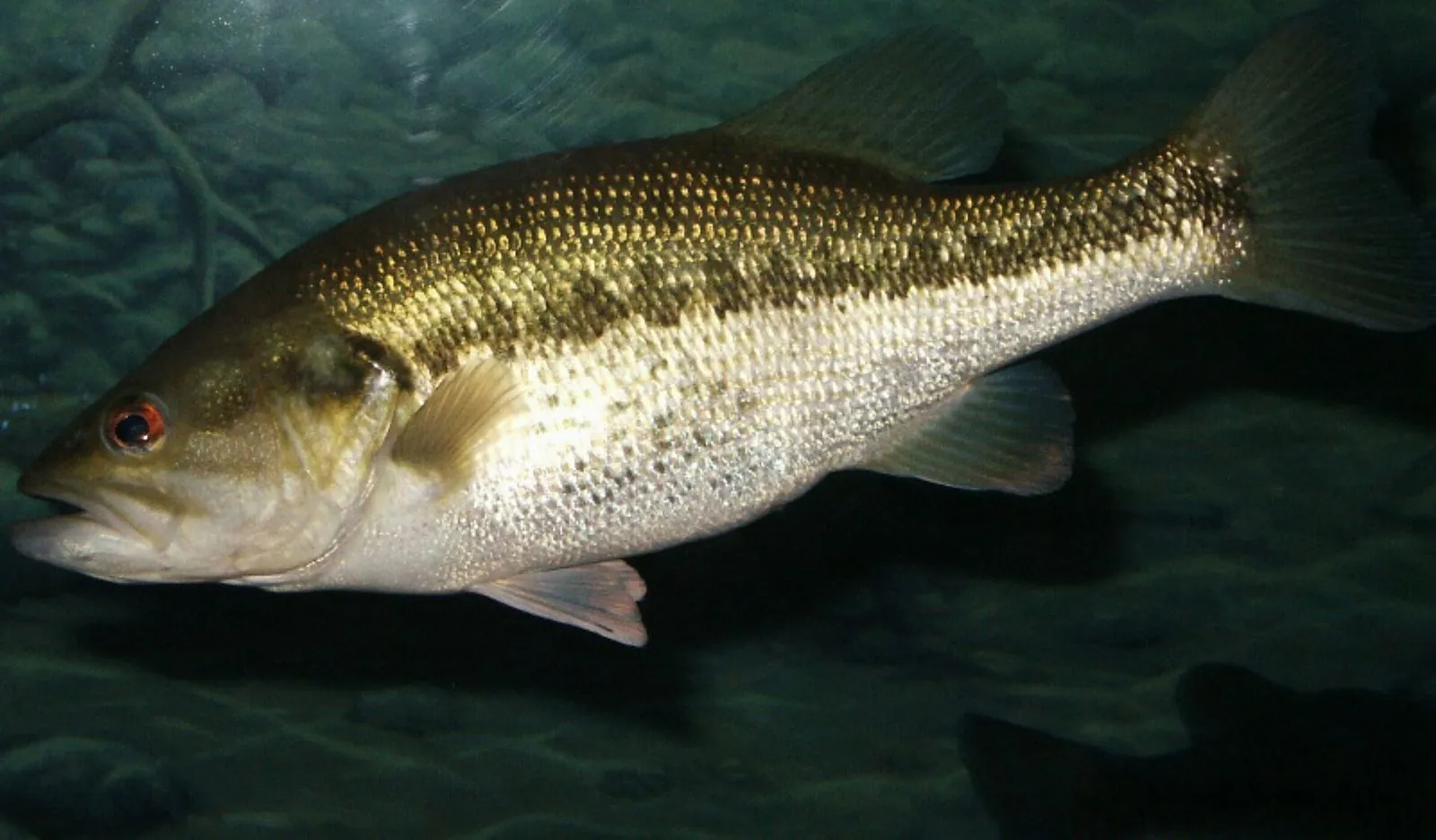
Freshwater fish barely drink at all; saltwater fish drink all day long. That sounds backward, but it follows from one rule: water always moves toward the saltier side. A bass in a lake is saltier than the lake, so water pushes into it through its gills and skin without a single sip. A cod in the ocean is less salty than the sea, so water is pulled out of it, and it has to drink to keep up.
A rainbow trout makes about 2.31 ml of urine per kg of body weight every hour. Over a day that is about 5% of its weight, roughly an ounce (25 ml) from a 1 lb (0.45 kg) trout (Journal of Experimental Biology, 1992).
Why doesn’t a freshwater fish need to drink?
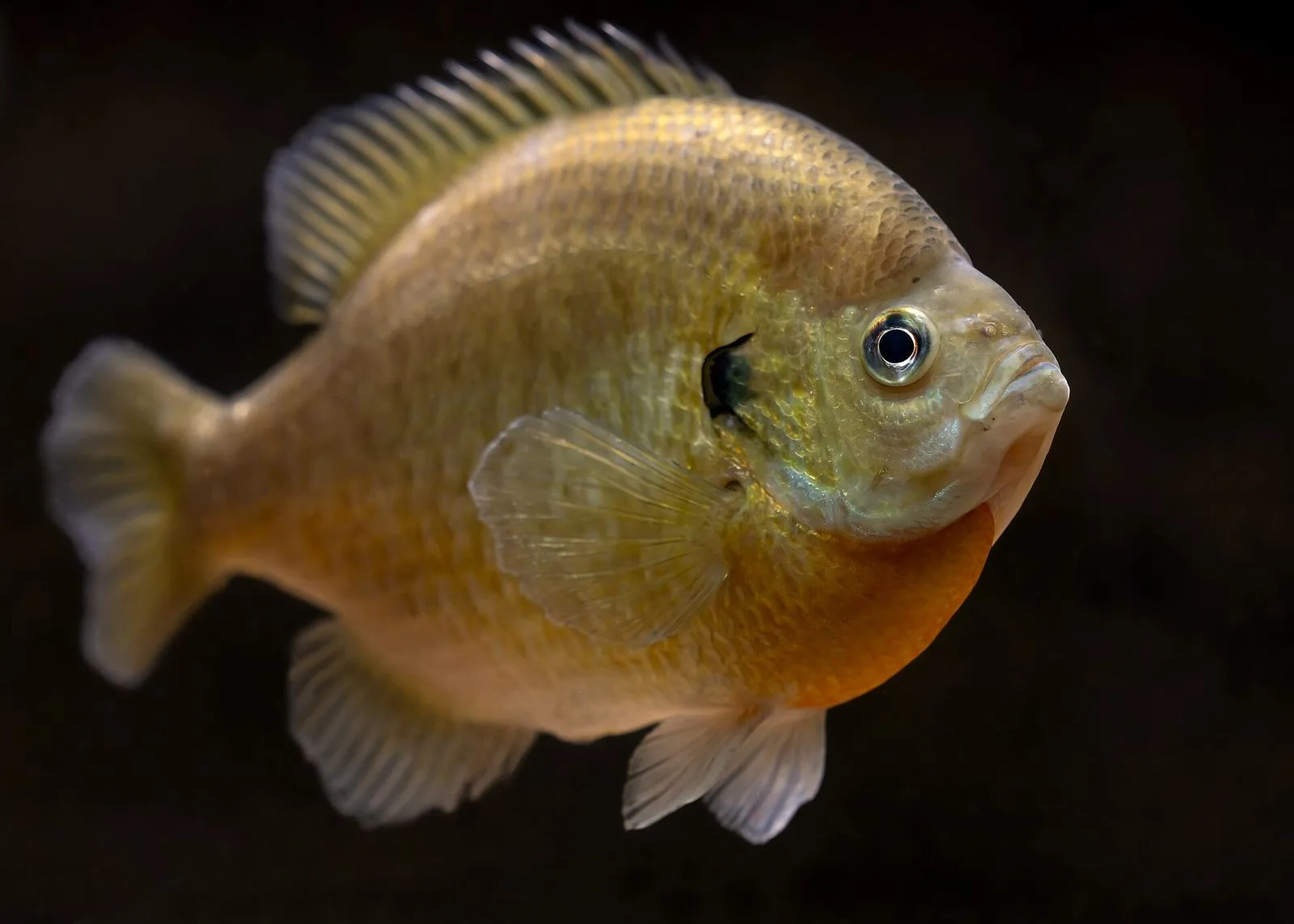
Because water gets in without it. Fish blood carries salt, more than a lake or river does. Water moves through thin skin and gill membranes toward the salty side, a process called osmosis. So a bluegill, a bass or a catfish soaks up water every second of its life, whether it wants to or not. Drinking would only make the flood worse.
The fish handles the flood two ways. Its kidneys make a lot of very watery urine, about 1 to 6 ml per kg of fish every hour. In the rainbow trout study by Curtis and Wood the rate was 2.31 ml, which is where the 5% a day comes from. At the same time, special cells in the gills grab salt from the passing water and pull it back into the blood.
A freshwater fish does swallow some water with its food. That is eating, not drinking.
Why does a saltwater fish drink all day?
Turn the rule around. Seawater is saltier than fish blood, so water flows out of the fish. A snapper or a striped bass in the ocean is always drying out from the inside. To replace what it loses, it drinks seawater constantly.
Seawater brings salt with it, and the fish has to get rid of that. Cells in the gills called chloride cells pump salt back out into the sea. The kidneys make only a small amount of concentrated urine, so little water is wasted. In short, freshwater fish fight to keep salt in and water out; saltwater fish fight to keep water in and salt out.
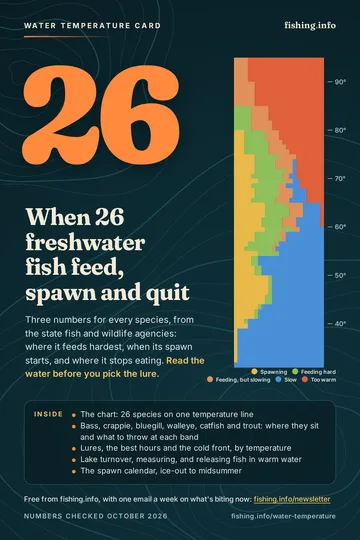
Free card: what 26 species do at your water temperature
Plus one email a week on what's biting now. No sales pitches. Privacy.
How is a shark different?
Sharks found a third way: they keep a lot of urea, a waste product most animals flush out, in their blood. That makes their blood about as salty as the sea, so water drifts in gently instead of being pulled out, and a shark does not have to drink like a bony fish. The salt that still leaks in leaves through a small organ at the end of the gut, the rectal gland. The same urea is why fresh shark meat smells faintly of ammonia.
| Freshwater fish | Saltwater fish | Shark | |
|---|---|---|---|
| Drinks? | Almost never; water floods in on its own | Yes, constantly | Little; urea in the blood lets water drift in |
| Urine | Lots, very dilute; about 1–6 ml per kg an hour | Very little, concentrated | Little; urea is kept, not flushed |
| Salt | Pulled in through the gills from the water | Pumped out through gill chloride cells | Shed through the rectal gland |
| Example | Largemouth bass, channel catfish, rainbow trout | Red snapper, cod, striped bass in the sea | Blacktip shark, bull shark |
Do fish get thirsty?
Nobody knows, because nobody has measured it. There is no published study of thirst as a feeling in any fish. In people, thirst is the brain’s alarm that the blood is getting too concentrated. A saltwater fish never stops drinking and a freshwater fish never needs to start, so neither has much use for an on-off switch. That is a guess, not a finding. The same gap turns up in whether fish sleep: plenty of behavior, few measurements.
Do fish pee?
Yes, and a freshwater fish pees far more than you would expect for its size. At the trout rate, a 1 lb (0.45 kg) fish passes about an ounce (25 ml) a day. A 5 lb (2.3 kg) bass at the same rate would pass about 4 oz (125 ml), though nobody has measured a bass the way Curtis and Wood measured trout. A saltwater fish makes only a trickle.
Can a freshwater fish live in the sea?
No. Drop a bluegill in seawater and osmosis works against it at once. Water leaves through its gills and skin, salt pours in, and its gill cells are wired to pull salt in, not push it out. The fish dehydrates while its blood gets saltier, and it dies. A saltwater fish in fresh water has the opposite problem: it swells with water it cannot pump out fast enough.
A few fish can switch worlds. Salmon, striped bass and eels move between rivers and the sea by rebuilding their gill cells, and that takes days to weeks. A sudden swap kills an ordinary fish.
What does it mean at the water?
Bait fish die in the wrong water. Freshwater shiners in a saltwater livewell, or saltwater pilchards in lake water, are dying from the moment they hit it. Their kidneys and gills are built for one world. Ask what water bought bait lived in and keep it there. For catfish, the best catfish bait guide covers which live baits are worth the trouble.
A fish out of water dries from the gills first. Gills are hundreds of paper-thin folds that only work spread apart in water. In air those folds collapse and stick together, and oxygen uptake stops; do fish drown has the survival numbers. A 2015 review of air exposure puts the safe limit at about 10 seconds. The catch and release page has the rest of a clean release. A gasping fish is not thirsty; it is suffocating with its gills glued shut.
Saltwater catches often feel drier in the hand. A freshwater fish leaks dilute water outward all the time, so its skin stays slick. A saltwater fish holds its water in and makes almost no urine. That is the likely reason many saltwater anglers describe their catches as firmer and drier.
Keeping bait fish alive
- Match the water. Fill the bucket from the water the bait came from. Never freshwater bait in saltwater or the reverse.
- Skip the hose. Tap water is a different world again. Use lake, river or sea water only.
- Keep it cool and steady. The AFTCO Bass Care 101 targets, from B.A.S.S. research, work for bait too: 84 °F (29 °C) or less, no jump of more than 7 °F (4 °C) at once.
- Put air in it. A battery aerator keeps dissolved oxygen at the 5.5 ppm AFTCO asks for. Bait hanging at the surface with its mouth open is short of oxygen, not thirsty.
- Do not crowd. A dozen shiners in a 5 gal (19 L) bucket use up oxygen and foul the water fast. Fewer fish live longer.
- Change a third of the water at a time, from the same source, so nothing changes suddenly.
For more questions like this one, start at the fish facts hub.
Free download
The water temperature card
Read your water temperature and the card tells you who is spawning, who is feeding and what to throw. 26 species, 16 pages, for your phone and the tackle box.
Plus one email a week on what's biting now. No sales pitches. Privacy.
Related
Section guide
Fish Facts: The Questions Kids Ask About Fish, Answered With the ScienceFish facts with a number and a source for each: how fish sleep, breathe, hear and feel, and what every answer means when you hook and release one.
 Do Fish Drown? How Fish Suffocate, and How to Revive a Tired One
Do fish drown? Not by the dictionary, but they suffocate three ways: low oxygen, damaged gills, no water flow. How long a fish lasts in air, how to revive one.
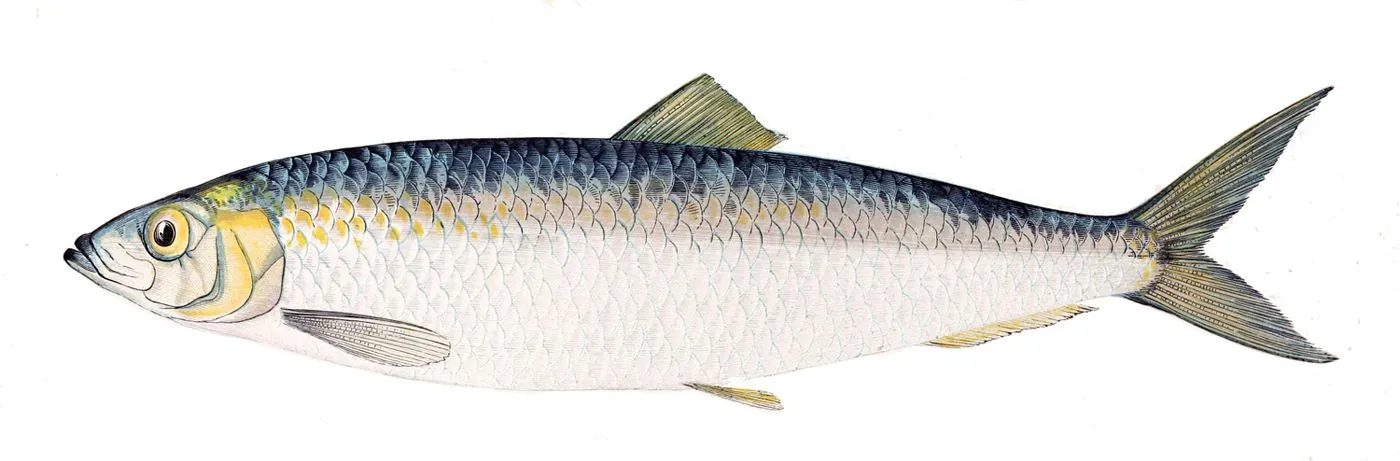 Do Fish Fart? Yes, Herring Do It on Purpose, and a Bloated Bass Needs Help
Do fish fart? Herring do, on purpose, and scientists won a prize for proving it. Which fish pass gas, where it goes, and what to do with a bloated bass.
 Do Fish Feel Pain? What the Studies Found, and What Decides Whether a Released Fish Lives
Do fish feel pain? They sense damage and react; whether they suffer is contested. The trout study, both camps, and what decides if a released fish lives.
 Do Fish Get Cold? What Winter Does to a Fish, and the Ones With Antifreeze in Their Blood
Do fish get cold? Yes: a fish is as cold as its water and feels it as slowness. What fish do in winter, who carries antifreeze, and how to fish cold water.
 Do Fish Have Bones, Hearts and Blood? What Is Inside a Fish
Do fish have bones? Most do; sharks run on cartilage and 16 icefish have clear blood. How skeleton, heart and blood work, and what it means for your fillets.
 Do Fish Have Brains? Memory, Learning, and Why the 3-Second Myth Is Wrong
Do fish have brains? Yes: a full brain, no neocortex, a memory that lasts months. What goldfish, carp and pike learned, and what it means at the water.
Sources
- Curtis and Wood (1992), Kidney and urinary bladder responses of freshwater rainbow trout to isosmotic NaCl and NaHCO3 infusion, Journal of Experimental Biology
- FISHBIO, Osmoregulation: how fish balance salt and water
- McGill Office for Science and Society (2018), Do fish drink?
- Osmoregulation in fish (overview)
- Discover Wildlife (2024), Can fish drown?
- Cook, Lennox, Hinch and Cooke (2015), Fish out of water: how much air is too much?, Fisheries
- AFTCO, Bass Care 101 (livewell temperature and oxygen from B.A.S.S. research)