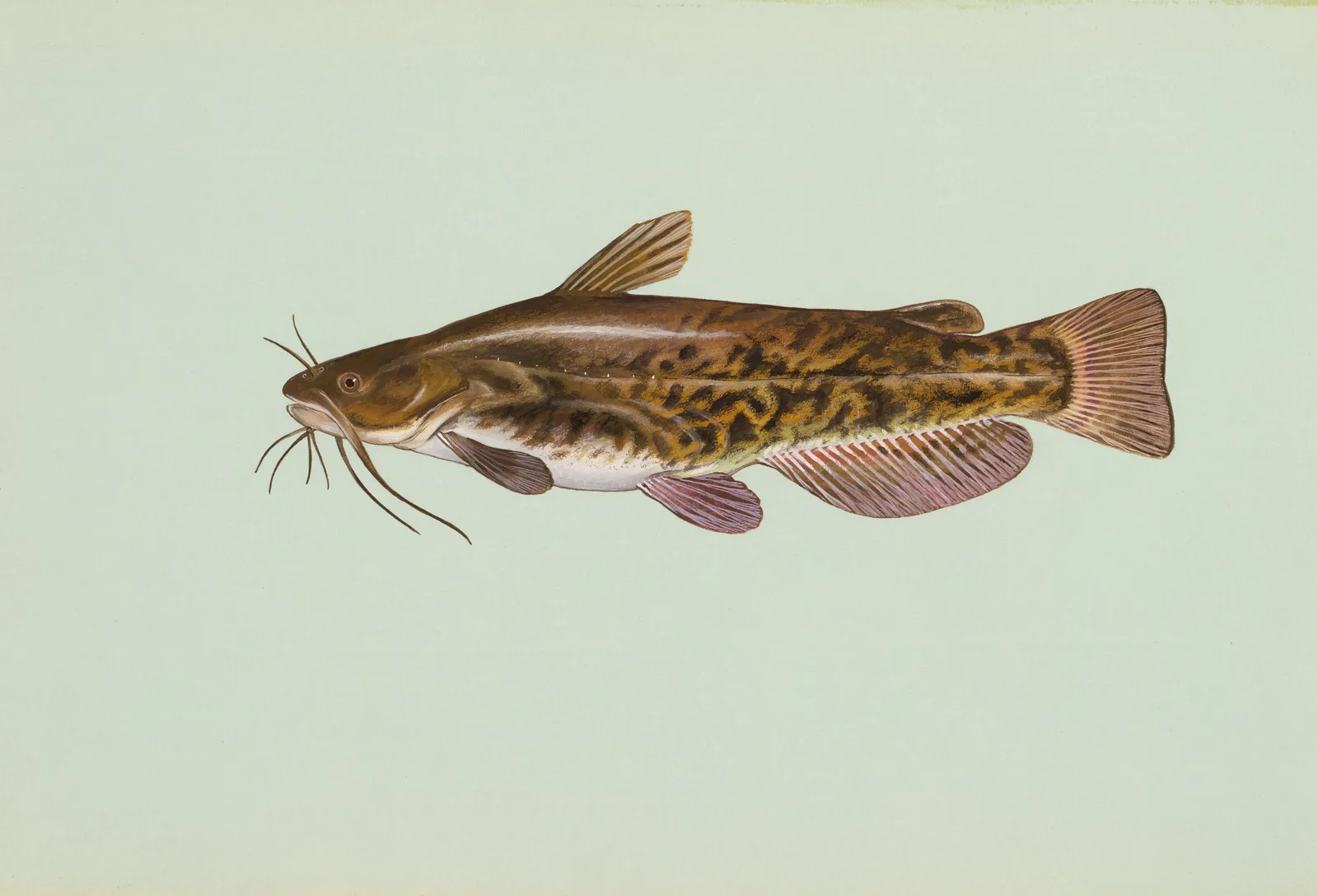
Bullhead catfish are the small, square-tailed catfish of ponds, creeks and quiet backwaters across the eastern two thirds of North America. There are three: black, brown and yellow. Most anglers meet them before any other catfish, and many never learn to tell them apart. They look alike, live in overlapping water and bite the same nightcrawler. What separates them is on the chin and the pectoral spines, not in the color the names promise.
The all-tackle world record black bullhead, 8 lb 2 oz, was caught on bread in a Long Island lake in 2015. New York’s own record book still lists a 7 lb 7 oz fish from 1993, caught on Wonder Bread.
Black, brown or yellow: how do you tell them apart?
The tail settles the genus, Ameiurus. A bullhead’s tail is squared or only slightly notched; channel and blue catfish have deeply forked tails. The flathead has a square tail too, but a projecting lower jaw, and it grows fifty times bigger.
Within the genus, color is the least reliable mark: a black bullhead can be yellowish and a yellow bullhead can be dark. Missouri’s field guides use three marks instead. They are the color of the chin barbels, the anal-fin ray count, and whether the rear edge of the pectoral spine carries sawlike teeth.
| Mark | Black bullhead | Brown bullhead | Yellow bullhead |
|---|---|---|---|
| Chin barbels | “Dusky or black (never uniformly white)” | Dusky or black | “Uniformly whitish” |
| Anal-fin rays | Usually 17–21 (Florida Museum: 19–23) | Usually 22–23 (Florida Museum: 19–23) | Usually 24–27, “not fewer than 24” |
| Pectoral spine | No sawlike teeth on the rear edge | “Sawlike teeth are well developed”, 5–8 large teeth | Sawlike teeth present |
| Tail | Slightly notched; often a pale bar across its base | Slightly notched | Rear edge “nearly straight” |
| Color | Dark greenish or yellowish brown, plain; yellow or white belly | Dark yellowish brown, “strongly mottled with darker brown or black” | Uniformly yellowish brown |
| Common size | Seldom over 16 in (41 cm) or 2.3 lb (1 kg); maximum about 4.75 lb (2.2 kg) | 7–15 in (18–38 cm), 0.3–2.2 lb (0.1–1 kg); maximum about 18 in and 3.7 lb (1.7 kg) | 7–13½ in (18–34 cm), 0.2–1.3 lb (0.1–0.6 kg); maximum about 17 in and 2 lb (0.9 kg) |
| Lifespan | Few pass 5 years | Typically 6–8 years | Few pass 5 years |
| Water | “Turbid, silty water with little or no current” | “Quiet, clear waters” with heavy vegetation | “Quiet, heavily vegetated backwaters” and clear ditches |
The spine test is the one to learn, because it works in the dark with a fish in your hand. Grasp the pectoral spine between thumb and forefinger and pull outward, as Missouri’s guide describes. On a brown or yellow bullhead the teeth catch the skin like a tiny saw; on a black bullhead the spine slides smooth.
The brown bullhead has one more mark of its own: a barbel at the corner of the mouth so long that in adults it reaches well behind the base of the pectoral fin. Iowa’s biologists add the pale band across the base of the tail as the black bullhead’s giveaway, a mark the other two never show.
Two cautions. The ray counts are where the field guides disagree: Missouri separates black (17–21) from brown (22–23), while the Florida Museum gives both as 19–23. So the counts reliably separate only the yellow bullhead, and the barbel color and the spine teeth do the rest. And the white catfish, Ameiurus catus, of the Atlantic and Gulf slopes is a bullhead by genus with a moderately forked tail. It is the one most often confused with a small channel catfish.
Where do bullheads live?
The black bullhead’s native range runs through the Great Lakes, Hudson Bay and Mississippi basins, from New York to Saskatchewan and Montana and south to the Gulf. It is the bullhead of prairie ponds and muddy, sluggish water. The brown bullhead is the eastern and northern fish, at home in clear, weedy lakes and ponds. It has been carried west to the Pacific Northwest and stocked across the country for food and sport. The yellow bullhead sits between them, in the vegetated backwaters, overflow pools and clear ditches of the Midwest and South. In South Carolina it holds in the pools of small and medium rivers, over soft silt or leaf litter.
In Iowa, where the black bullhead is the commonest of the three, the water is a plain list: backwaters, oxbows, sloughs, marshes, ponds, natural lakes and the pools of streams that dry to puddles in August. The biggest populations are in the slow reaches of small streams.
The fish tolerates silt, pollution, heat and low oxygen, which is why a farm pond that holds nothing else holds bullheads. The brown bullhead prefers water of 77–88 °F (25–31 °C) and tolerates 97 °F (36 °C), warmer than any bass would choose. The cost is stunting. In a crowded Iowa pond bullheads seldom pass 7–9 in (18–23 cm); the same fish in a big northern lake reaches 2 lb (0.9 kg) and more.
When do bullheads spawn and bite?
Bullheads spawn in May and June in Missouri and Iowa. South Carolina puts the yellow bullhead’s spawn at about 75–80 °F (24–27 °C); the Ontario life-history database gives the brown bullhead a wider window, 57–77 °F (14–25 °C).
The female fans out a saucer-shaped nest, often under a log or rock, in about 2–4 ft (0.6–1.2 m) of water in Iowa. She lays 2,000–6,000 eggs that hatch in a week or less. One parent stays on the nest, fanning the eggs and chasing off the minnows and sunfish that hover close for an unguarded moment. The young then move in a compact black ball near the surface, herded by the adults until they are about 1 in (2.5 cm) long. Anyone who has looked into a pond in June has seen one.
They feed at night and on the bottom. Missouri’s biologists found adults mostly inactive by day: they leave the deeper parts of a pool in the early hours of darkness to feed and return shortly before dawn. Adults eat aquatic insect larvae first, then crayfish, snails, worms, plant matter and the occasional small fish. The table runs the year by water temperature; the catfish water-temperature page does the same for the channel, blue and flathead.
| Water | When | What bullheads do | Where to fish them |
|---|---|---|---|
| Ice-out to 50 °F (10 °C) | March in the North | Gather in the first open, warming water; the year’s first bite, mostly after dark | Mouths of swamps, marshes and wetland creeks where open water shows first |
| 50–70 °F (10–21 °C) | April–May | Move shallow and school ahead of the spawn; day fishing works in small waters | Shallow, weedy or muddy bays; rocky and sandy bottoms under 15 ft (4.6 m) |
| 70–80 °F (21–27 °C) | May–June | Spawn in nests 2–4 ft (0.6–1.2 m) deep under logs and rocks; adults guard, then herd the fry | River mouths, deltas and pond shallows; around cover |
| 75–90 °F (24–32 °C) | Summer | Preferred range; feed through the night and go deeper by day; the flesh turns muddy in warm water | Pond and creek-pool shallows and weed edges, from dusk on |
| Below 50 °F (10 °C) | Late fall and winter | Feed little; sit in the mud of the deepest water | Rarely worth the hours; wait for the first open water |
The spring rows follow In-Fisherman’s Lake Champlain account, where the bullhead bite peaks in March while the trout streams are still iced; the summer rows are Missouri’s.
How to catch them
There is no simpler fishing. Bullheads are not selective: the bait lists run from nightcrawlers, crickets and minnows to corn, cheese, hot dogs, liver and bread. The nightcrawler is the standard because it stays on the hook and smells right, and Iowa’s tip is half a nightcrawler rather than a whole one. The best catfish bait page ranks the options for the whole family.
The rig is a bait hook with a weight above it, nothing more. A #4 to #2 hook covers a half nightcrawler, the sizes the hook size chart gives for small catfish baits. In-Fisherman goes to No. 2 through 1/0 and asks for a long shank: bullheads are notorious hook swallowers, and a long shank gives the pliers something to grip. A split shot or two pinched above the hook holds the bait on the bottom in still water. A light slip sinker does the same where a creek moves; both are drawn on the catfish rigs page.
Any light rod and 6–10 lb line will do; the world-record brown bullhead came in on 6 lb line and the black on 10 lb. Carry needle-nose pliers for the deep hooks, or fish a small circle hook. It takes the fish in the corner of the mouth and saves the ones you release.
Fish from dusk into the night, in the shallows of ponds and creek pools and along weed edges. In small waters the day bite does not really stop, as Take Me Fishing puts it. Still-fishing from the bank with a cane pole or a rod and reel is how Missouri describes the sport; In-Fisherman’s kit list is a five-gallon pail and a folding chair. When the first bullhead bites, stay put: the next one is beside it.
For a child with a bobber and a worm, a bullhead pond on a summer evening is the best first fishing there is. A push-button kids fishing pole rigged with a #8 hook, a split shot and a bobber catches them as surely as it catches bluegill.
Do bullheads sting?
Not with their whiskers. The three spines, one in the dorsal fin and one in each pectoral fin, lock upright when the fish is stressed. That defense makes a bullhead hard for a heron or a bass to swallow, and it works on hands too. The spines are needle-sharp and carry a mild venom that causes swelling and a burning ache. The sawtoothed pectoral spines of brown and yellow bullheads tear as well as puncture.
Hold a bullhead the way Wisconsin’s fish technician holds one for the knife: thumb up, the fish belly down between the first two fingers, each finger slipped under a pectoral spine, the dorsal spine behind the web of the thumb. The how to hold a catfish page shows the grip and the first aid: clean the puncture, and hot water eases the pain more than ice.
Are bullheads good to eat?
Yes, with a condition. The meat is firm and mild, reddish to pink on a brown bullhead, and bullheads from clean, cool water are as good as any small catfish. From a warm, muddy, overcrowded pond they taste like the pond. In-Fisherman’s rule is that the flesh turns muddy as summer warms the water, so the fish of early spring are the ones to keep, and any dark yellow or red streak in a fillet is cut out. South Carolina calls the yellow bullhead edible but the least prized catfish, which says more about its usual water than about the fish.
Wisconsin DNR’s method skins one without a board or a nail, in less than a minute each with a little practice:
- Hold the fish thumb up, belly down between the first two fingers, a finger under each pectoral spine. With a sharp knife, cut into the back at an angle toward the head from directly behind the dorsal spine, down to the backbone, without cutting through it.
- Bend the body sharply down, breaking the spine and exposing the air bladder and entrails. Reverse the knife and slit the skin down the middle of the back from the edge of the first cut to the tail.
- Grasp the body between thumb and forefinger and pull in opposite directions. The head, skin and entrails come away in one piece, leaving the flesh on the backbone. Roll it in cornmeal and fry.
State health advisories for mercury apply by waterbody, as they do for every fish. Bullheads are short-lived and small, which keeps them near the bottom of the list.
How big is a record bullhead?
| Species | All-tackle world record | Where and when |
|---|---|---|
| Black bullhead | 8 lb 2 oz (3.7 kg), 26.5 in (67 cm), on bread | Massapequa Lake, New York, August 8, 2015 |
| Brown bullhead | 7 lb 6 oz (3.3 kg), 22 in (56 cm), on a sawbelly (alewife) | Mahopac Lake, New York, August 1, 2009 |
| Yellow bullhead | 6 lb 6 oz (2.9 kg), 21 in (53 cm) | Drexel, Missouri, May 27, 2007 |
Those are extraordinary fish. The state record books show what a big bullhead really is, and 3 lb (1.4 kg) is a trophy anywhere. New York’s list is the odd one: it carries the 2009 brown bullhead that is also the world record, but its black bullhead record is still Kevin Kelly’s 7 lb 7 oz from Mill Pond in 1993. The heavier 2015 fish the IGFA certified is not on it.
| State | Black bullhead | Brown bullhead | Yellow bullhead |
|---|---|---|---|
| New York | 7 lb 7 oz (3.4 kg), 26 in, Mill Pond, 1993 | 7 lb 6 oz (3.3 kg), 22.2 in, Lake Mahopac, 2009 | No record kept |
| Wisconsin | 5 lb 8 oz (2.5 kg), 21.5 in, Big Falls Flowage, 1989 | 4 lb 2 oz (1.9 kg), 17.5 in, Little Green Lake, 2006 | 4 lb 5 oz (2.0 kg), 19.5 in, White Mound Park Lake, 2021 |
| Iowa | 5.50 lb (2.5 kg), 22 in, farm pond, 1986 | 1.25 lb (0.57 kg), Mississippi River Pool 9, 2015 | 2.60 lb (1.2 kg), private pond, 2024 |
| North Carolina | No record kept | 4 lb (1.8 kg), Greenfield Lake, 2016 | No record kept |
| South Carolina | — | — | 6 lb 6.3 oz (2.9 kg), 2009 |
Iowa’s rules for a record explain why the lists move so slowly. The fish is weighed on a scale certified for trade, preferably alive and never frozen, and must beat the old record by an ounce or 5 percent, whichever is less. The everyday bullhead weighs under a pound. Most states set no limit or a generous one, and some still class bullheads as rough fish; the state pages carry the current rules.
Related
Section guide
Catfish: Species Identification, Baits, Seasons and RecordsThe catfish species anglers catch most, channel, blue and flathead first: how to tell them apart by the anal fin, when they spawn, what bait each wants.
 World Record Catfish: Blue, Flathead, Channel, Wels, Mekong Giant
Every world record catfish: the 143 lb blue, 123 lb flathead, 58 lb channel of 1964, 297 lb wels and 646 lb Mekong giant, and how a record is certified.
 How to Hold a Catfish Without Getting Stung, Small to Big
How to hold a catfish safely: where the three spines are, the grip behind the pectoral fins for small fish, the lip grip for big ones, and first aid for stings.
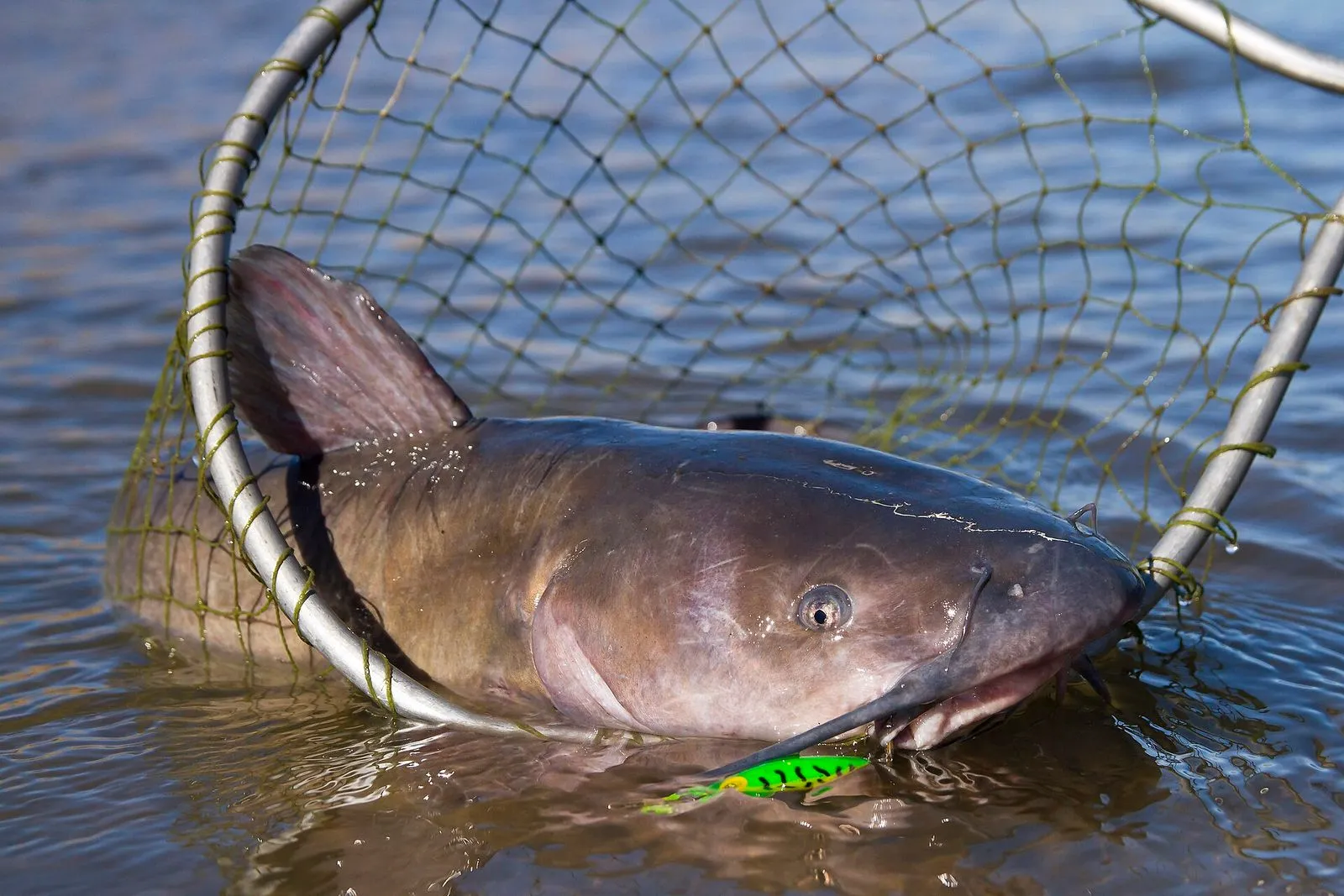 Catfish Rigs: The Five That Matter and When to Use Each
The five catfish rigs the guides use, slip sinker, Santee Cooper, three-way, slip float and bottom rig, with sinker weights, hook sizes and when to use each.
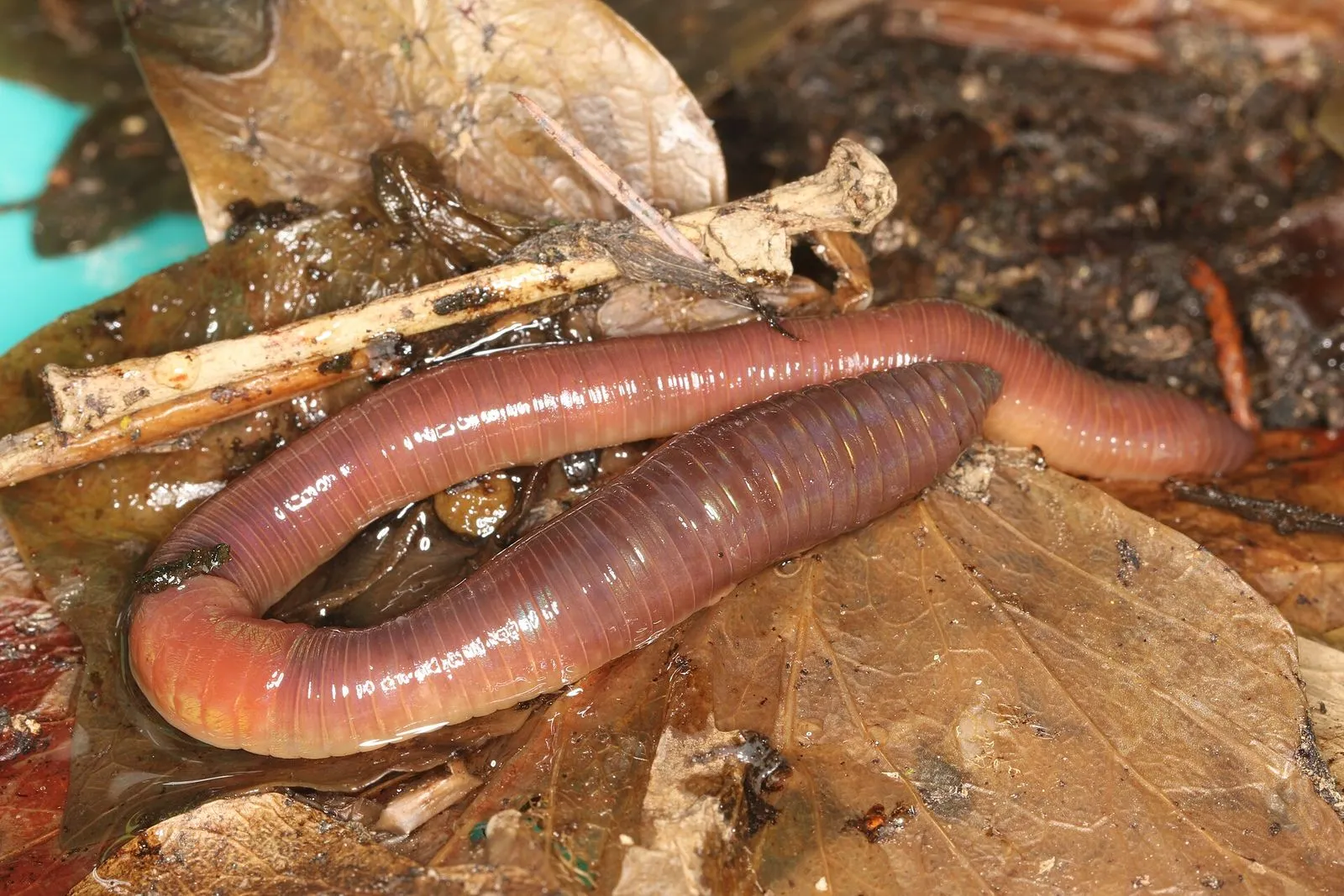 Best Catfish Bait: What Channel, Blue and Flathead Catfish Eat
The best catfish bait by species: cut shad for blues, punch and dip baits for channels, live bluegill for flatheads, and which prepared baits to buy.
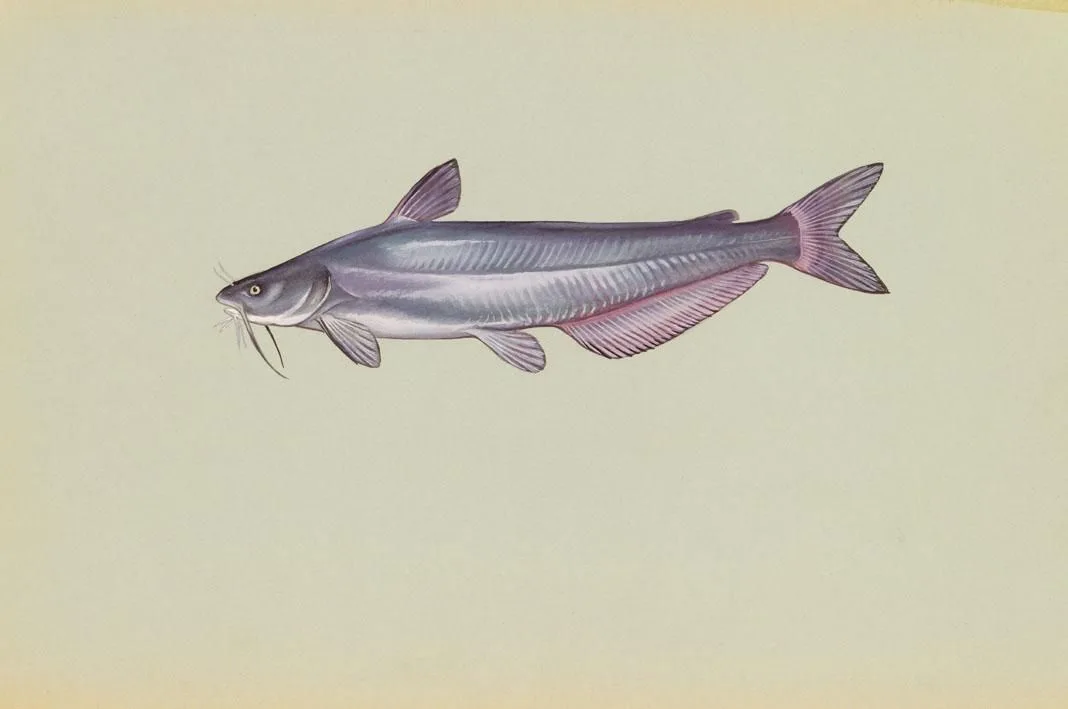 Blue Catfish: Identification, Size, Season and the Chesapeake Invasion
Blue catfish from the agency data: the 30-ray anal fin, how big and old they get, a month-by-month season from a river guide, and the Chesapeake invasion.
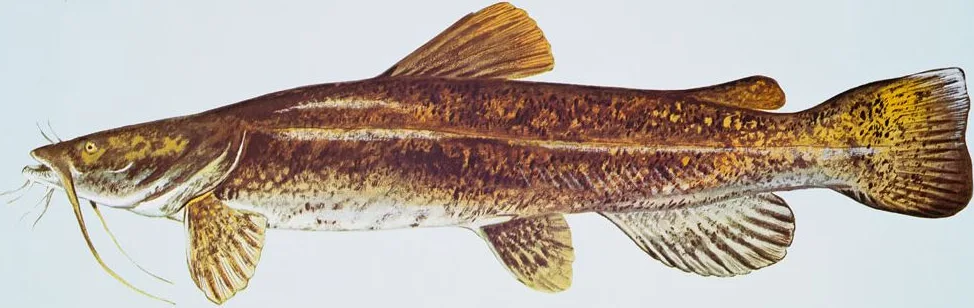 Flathead Catfish: Identification, Size, Live Bait and Where They Live
Flathead catfish from the agency data: square tail and jutting jaw, deep-pool habitat, spawning at 75–80 °F, why only live bait works, and the 123 lb record.
Sources
- Missouri Department of Conservation, yellow bullhead
- Missouri Department of Conservation, black bullhead
- Missouri Department of Conservation, brown bullhead
- Florida Museum, black bullhead (Ameiurus melas)
- Iowa DNR, Fish Iowa: black bullhead
- South Carolina DNR, yellow bullhead
- Ontario Freshwater Fishes Life History Database, brown bullhead
- Wisconsin DNR, How to skin bullheads (Jerry Perkins, fish technician)
- In-Fisherman, Catfish Week: bullhead are worthy targets (Matt Crawford, 2024)
- Outdoor Life, the biggest North American catfish of all time (IGFA records)
- New York DEC, freshwater fishing records (as of December 10, 2025)
- Wisconsin DNR, hook and line record fish
- Iowa DNR, state record fish
- North Carolina Wildlife Resources Commission, freshwater fishing state records
- Take Me Fishing, How to catch bullheads
- Catfish Edge, how to hold a catfish