 By
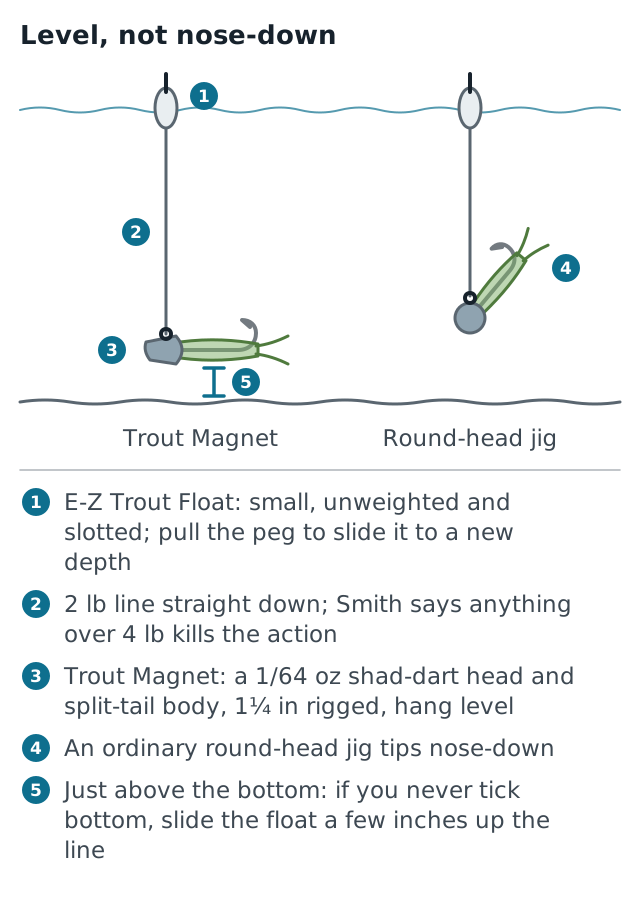
The Trout Magnet is a 1/64 oz jig fished on 2 lb line under a small float, drifting through a run just above the bottom. The jighead is a shad-dart on an extra-long size 8 hook, threaded with a soft split-tail body so the rigged lure is 1¼ inches long. Set the float depth before you think about color. Jeff Smith and Todd Gainer kept it to themselves for years, then started Leland’s Lures in Searcy, Arkansas, in 1997 with this one lure.
Most jigs tip nose-down. The Trout Magnet’s head and hook are balanced so the body hangs level in the water, and Jeff Smith’s whole explanation for the lure’s success is six words: “The flat look drives them crazy.”
Why does it catch so many trout?
The jighead has a shad-dart shape, flattened and angled, that gives any body a darting action. A small barb on the back of the hook holds the plastic in place. The hook is an extra-long size 8 in what the maker calls “extra strong wire,” so a big fish does not straighten it. It is also the only hook size the lure comes in, and Outdoor Life lists that as one of its drawbacks.
The body is a grub with a ribbed, split tail. On The Water counted 33 body colors and 12 head colors in 2021. Outdoor Life’s reviewers named it the best trout jig. They credit it with imitating “everything on a trout’s menu, from a nymph to a crayfish to a small baitfish.”
The design point is balance. A normal jig hangs from the line at its head and falls nose-down. The Trout Magnet’s head and body are matched so the lure sits horizontal, suspended under a float or falling through a pool. In stocked water it is the first lure Leland’s guide David Taylor ties on, and the maker ties its color rule to rainbow trout.
What do you need?
The maker sells it as a system, and it fishes best as one:
- Rod: a light or ultralight spinning rod with a fast tip, 6 to 9 ft (1.8 to 2.7 m). Leland’s starter rod is a 6 ft 6 in light rod rated for 2–6 lb line and 1/64–1/8 oz lures. For drifting water 7 to 9 ft deep, Leland’s advice is “long 8 and 9 foot spinning rods,” and some anglers fish it on a fly rod.
- Reel: a 500 or 1000-size spinning reel.
- Line: 2 lb test, with a 2 lb fluorocarbon leader. Smith told On The Water that anything over 4 lb test will not give the lure its action, and both he and Taylor say they have landed fish over 10 lb on 2 lb line.
- Float: the E-Z Trout Float, which Smith and Gainer designed for this lure. It is small and unweighted, so it “detects the smallest hit unlike weighted floats.” It is slotted, so it goes on and comes off without cutting the line and slides to a new depth without retying.
The line hub explains why 2 lb line behaves so differently from 6 lb in current, and the fluorocarbon page covers the leader. For where to find stocked fish and the rest of the day’s tackle, read trout fishing.

Free PDF · Water temperature chart When do trout bite?
One reading, and the 16-page chart shows which of 26 fish are spawning, feeding hard or slowing down; for bass, crappie, bluegill and walleye, where they sit and what to throw. Every number sourced.
Enter your email, confirm it with one click, and the PDF is in your inbox. Plus one email a week on what's biting. Unsubscribe anytime. Privacy.
How do you rig it and set the depth?
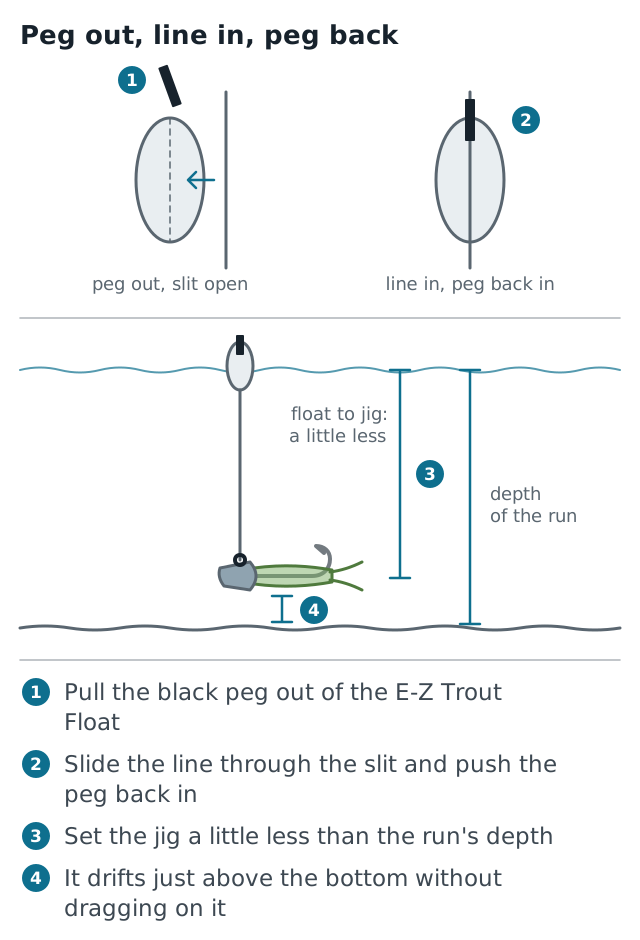
Drawing: fishing.info, after steps 3 and 4 below
- Thread the body onto the jighead. Slide the split-tail body up the hook until it seats against the head and the small barb holds it. Keep it straight; a crooked body spins instead of hanging level.
- Tie the jig to the line with an improved clinch knot, or to a short 2 lb fluorocarbon leader tied to the main line.
- Put the float on. Pull the black peg out of the E-Z Trout Float, slide the line through the slit, and push the peg back in. Pull the peg again each time you change depth, so the float slides freely.
- Set the depth first. Guess the depth of the run and set the float so the jig hangs a little less than that. The goal is a jig that drifts just above the bottom without dragging on it.
- Cast upstream of the fish and let it drift at the speed of the current. Take up slack as the float comes back toward you, but do not pull the float; it must move no faster than the foam beside it.
- Adjust. If you get no bite and never touch bottom, slide the float up the line a few inches and drift again. Keep going until you either tick bottom or catch fish. Smith’s advice in On The Water is to give the rod tip constant short twitches as the float travels, so the jig lifts and settles as it drifts.
- Set the hook the moment the float goes under, with a smooth lift. A trout spits a jig fast.
- Extend the drift. At the end of the run, open the bail and let the float carry a few more feet downstream before you retrieve.
The rule under all eight steps is Taylor’s: “Go deep or go home—if you aren’t fishing at the right depth, you might as well go home.” Depth is the first thing to change and color the last.
Kit or parts: what does it cost?
A Trout Magnet is one of the cheapest lures in a trout box, and buying parts beats buying a kit. On The Water’s 2021 sum was 40 or 50 rigged lures with floats for around $30. At the maker’s prices in October 2026 it looks like this:
| Item | Pack | Price (Oct. 2026) | Per rigged lure |
|---|---|---|---|
| Original 9-pc pack | 2 heads, 7 bodies | $2.49 | $1.25 |
| Big Kit | 20 heads, 120 bodies, 2 floats | $22.99 | $1.15 |
| Jig heads, 1/64 oz | 5 or 25 | $2.29 or $8.99 | 46¢ or 36¢ a head |
| Bodies | 50 | $5.99 | 12¢ a body |
| E-Z floats | 4 or 36 | $1.99 or $10.99 | 50¢ or 31¢ a float |
| Tungsten heads, 1/32 oz | 3 | $3.99 | $1.33 a head |
| Parts build | 25 heads, 50 bodies, 8 floats | $18.96 | about 76¢ |
The parts build gives you 25 rigged lures with a spare body for each, plus eight floats, for under $20. The Big Kit costs more per lure but carries six bodies for every head, which matters once trout start tearing the tails. Count the contents when it arrives: the maker’s description calls it a 142-piece kit (20 + 120 + 2), though its web address says 152. The heads are what you lose to snags, so buy them by the 25.
How do you fish it in different water?
| Situation | Rig | Line | What to change |
|---|---|---|---|
| Stocked run or riffle-to-pool drift | Trout Magnet under the E-Z Trout Float | 2 lb (0.9 kg) | Float depth, a few inches at a time |
| Deep run, 7–9 ft (2.1–2.7 m) | Same, on an 8–9 ft rod or a fly rod; or a 1/32 oz tungsten head | 2 lb | A longer rod to mend line; the heavier head instead of split shot |
| Pool, eddy or slack water | No float: cast, let it fall, twitch it back | 2 lb | Let it sink closer to the bottom before twitching |
| Trout you can see in clear water | No float: cast across, small rhythmic twitches | 2 lb fluorocarbon leader | Color, if they follow but don’t bite |
| Deeper, faster water or wild fish | A 1/16–1/8 oz D2 Jig, jigged | 2 lb fluorocarbon leader | Save the Trout Magnet for slower water |
| Lake or pond | Trout Magnet Spin, steady slow retrieve | 2 lb | Depth: a split shot 12 in (30 cm) above the lure |
When do you twitch it, and when use tungsten?
The twitch. When you can see trout that are not feeding, Taylor fishes the jig without a float on a 2 lb fluorocarbon leader, and he names the tungsten version for it. His method in his own words: “Cast across the current, then make small, rhythmic twitches with your rod tip.” The jig should quiver like a struggling bug rather than jump. Polarized glasses let you watch the fish, and his rule for what you see is short: “If they follow but don’t bite, change colors.”
The tungsten head. Leland’s also sells a 1/32 oz tungsten head, lead-free, on a Mustad Ultrapoint hook. The maker says tungsten is “nearly twice the weight” of a lead head the same size. The densities put it at about 1.7 times: tungsten weighs 19.3 grams per cubic centimeter, lead 11.35. Either way the small head gets down faster and deeper without a split shot on the line. That keeps the rig sensitive, and the head is lead-free for waters where lead tackle is banned.
Which colors?
Leland’s recommends four colors for a first kit: pink, chartreuse, mealworm and white. Their rule for rainbows is “unnatural colors presented naturally”: loud, bright bodies drifted exactly at current speed. Outdoor Life’s advice runs the other way for clear water, where black, white and subtle shades work best and pink and orange are for muddy water.
The two agree more than they seem to. Fresh stockers in any water, and any trout in stained water, take bright colors; wild fish in gin-clear water want quiet ones. White and chartreuse have one more advantage, Taylor points out: “you can easily track them,” so you can watch a fish react to the jig.
Does it work on wild trout and other fish?
It works on wild trout, in the right water. The Trout Magnet is at its best in slow to moderate current, clear water and stocked streams. Leland’s own guides change lures when the water changes. Smith fishes deeper, faster water more aggressively with a D2 Jig, and Taylor starts with a D2 Jig “in a more wild environment.” That is a heavier jig, 1/16 or 1/8 oz, in white, peaches or Toad-O, which Taylor jigs on an 8 ft rod.
The combination works on both kinds of fish. Search with the heavier jig, and when you find trout, sit down with the Trout Magnet and feed them. Another of Outdoor Life’s drawbacks is the same point from the other side: a jig under a float covers little water.
Trout are not the only fish that eat it; the maker says it “catches anything that swims.” The float itself is sold as the E-Z Trout and Panfish Float, and the panfish hub covers crappie, bluegill and where they hold.
What else does Leland’s make?
The same shop sells close relatives of the original, each for its own job. For the smallest one, the maker’s advice is to try the Trout Magnet first.
| Use | Lure | What it is | Price (Oct. 2026) |
|---|---|---|---|
| Spooked fish, a fly rod, or a dropper behind the original | Mini Magnet | A much smaller version, “the smallest jig on the market” | $2.29 for 2 heads, 8 bodies |
| A reaction bite in streams and lakes, on a steady, slow retrieve | Trout Magnet Spin | The same lure with a very small inline spinner, size 1 gold willow blade | $2.99 |
| Searching deeper, faster water | D2 Jig | Dudley’s marabou jig from Northeast Arkansas, 1/32, 1/16 or 1/8 oz | $7.99 for 3 |
| Crappie and panfish | Crappie Magnet | The crappie line: its own bodies, jig heads and E-Z Crappie Floats | Packs and kits |
When does something else win?
A Trout Magnet is a slow, close lure for fish that are already there. When you need to find fish, or the current is too fast for a float, a spinner or a spoon covers more water. Each type of trout lure works in its own conditions, and the best trout lures name the specific models.
If stocked trout refuse every jig, a PowerBait nugget under the same float is the next thing to drift. Every other species is on the trout hub.
Free PDF · 16 pages
Know what's biting before your first cast
The Water Temperature Fishing Chart. Take one water temperature reading, find it on the chart, and see which of 26 freshwater fish are spawning, feeding hard or slowing down. Six pages go deeper: bass, crappie, bluegill, walleye, catfish and trout. For your phone and the tackle box.
- Where they sit and what to throw at every band: bass, crappie, bluegill and walleye; catfish by species; trout: the 68 °F line where you stop, and where they hide
- A bass that drops 3 ft feels more pressure change than the biggest cold front: the front day by day, and what to throw on each
- The three thermometer mistakes that make a reading lie (the first one is the surface)
- The 26-fish chart: who's spawning, feeding hard or slowing down at your reading
The chart's numbers come from state fish and wildlife agencies and fisheries research: 61 sources, each listed on the site.
Enter your email, confirm it with one click, and the PDF is in your inbox. Plus one email a week on what's biting. Unsubscribe anytime. Privacy.
Related
Section guide
Trout: The Fish, Where They Live, When They Bite and How to Catch ThemTrout are cold-water fish of the salmon family. The five you'll catch, the 68 °F line, when each spawns and how to catch them; every type on its own page.
 Arctic Char: How to Identify, Where to Catch and Is It Good to Eat
Arctic char, the most northerly freshwater fish: how to tell it from a Dolly Varden, where US anglers catch it, the record, and how it eats.
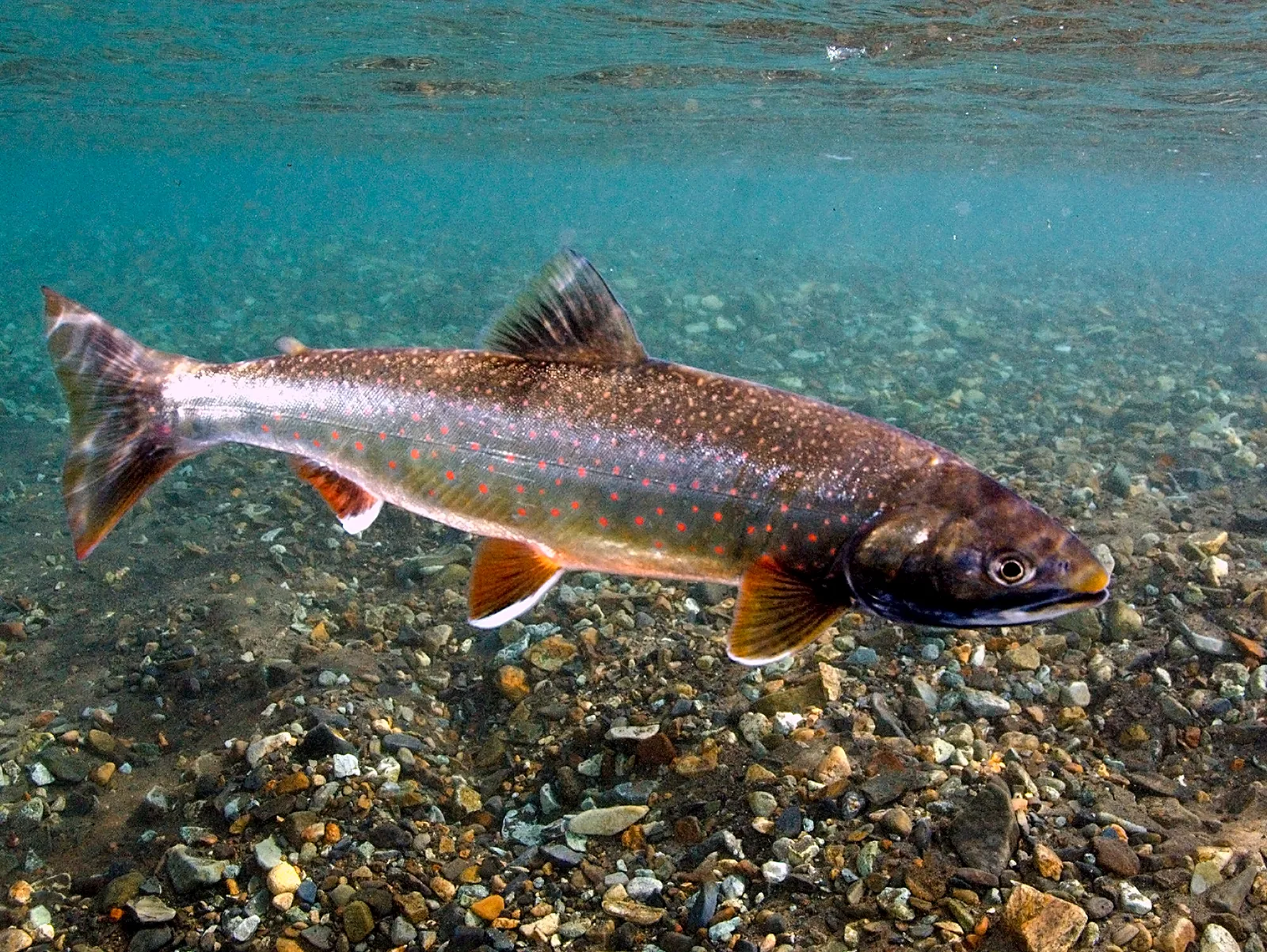 Dolly Varden: Alaska's Sea-Run Char and How to Catch One
The Dolly Varden is a char, not a trout: how to tell it from Arctic char and bull trout, where it runs, when to fish for it and the 20 lb record.
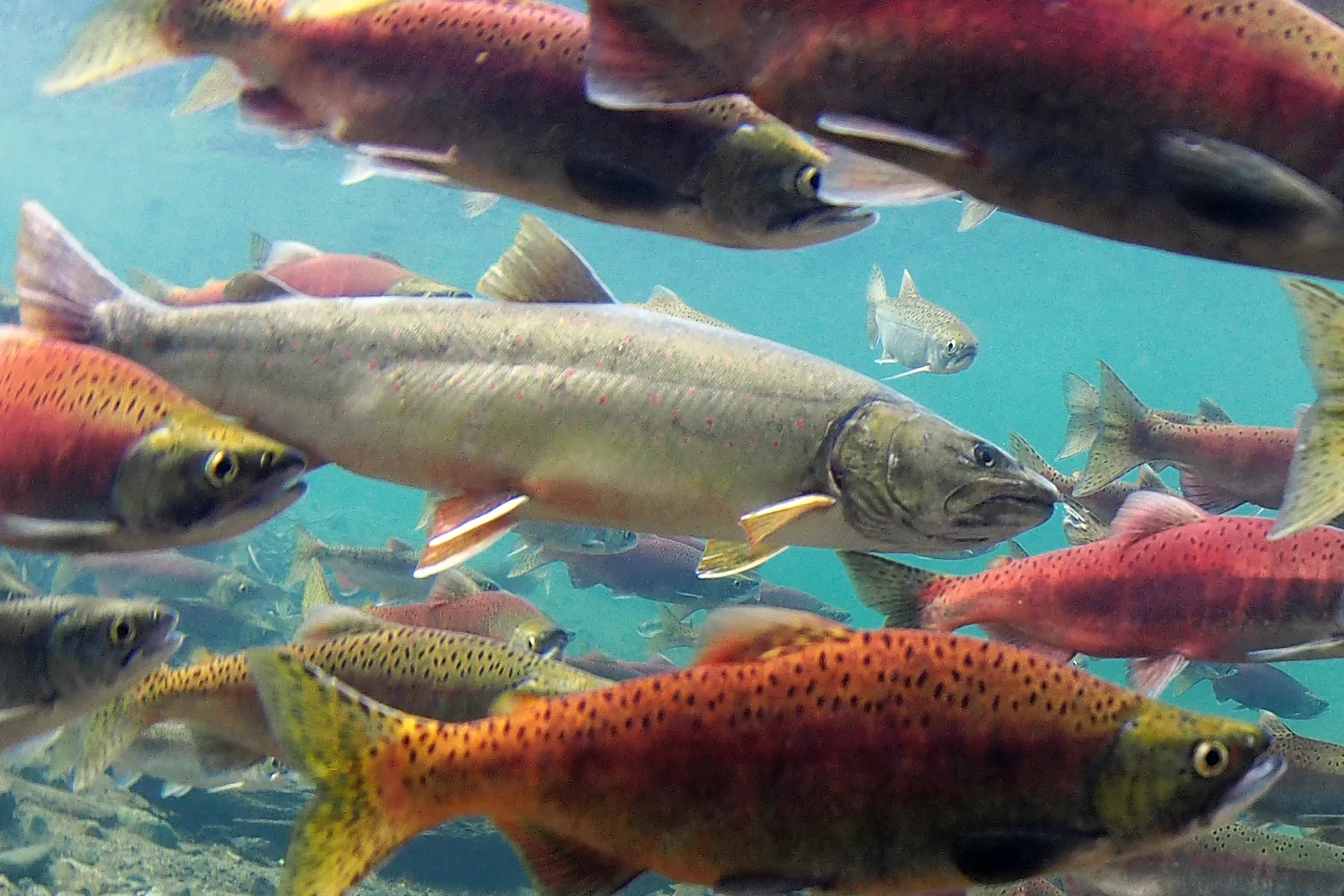 Bull Trout: How to ID the Threatened Char, and Where to Fish
Bull trout are a threatened char: how to tell one from a brook trout, lake trout or Dolly Varden, the few waters where you may fish, and the 32 lb record.
 Golden Trout: California's State Fish and Where to Catch One
The California golden trout: native to two Kern Plateau creeks, stocked in high lakes from Wyoming to Washington, and the 1948 record Wyoming now doubts.
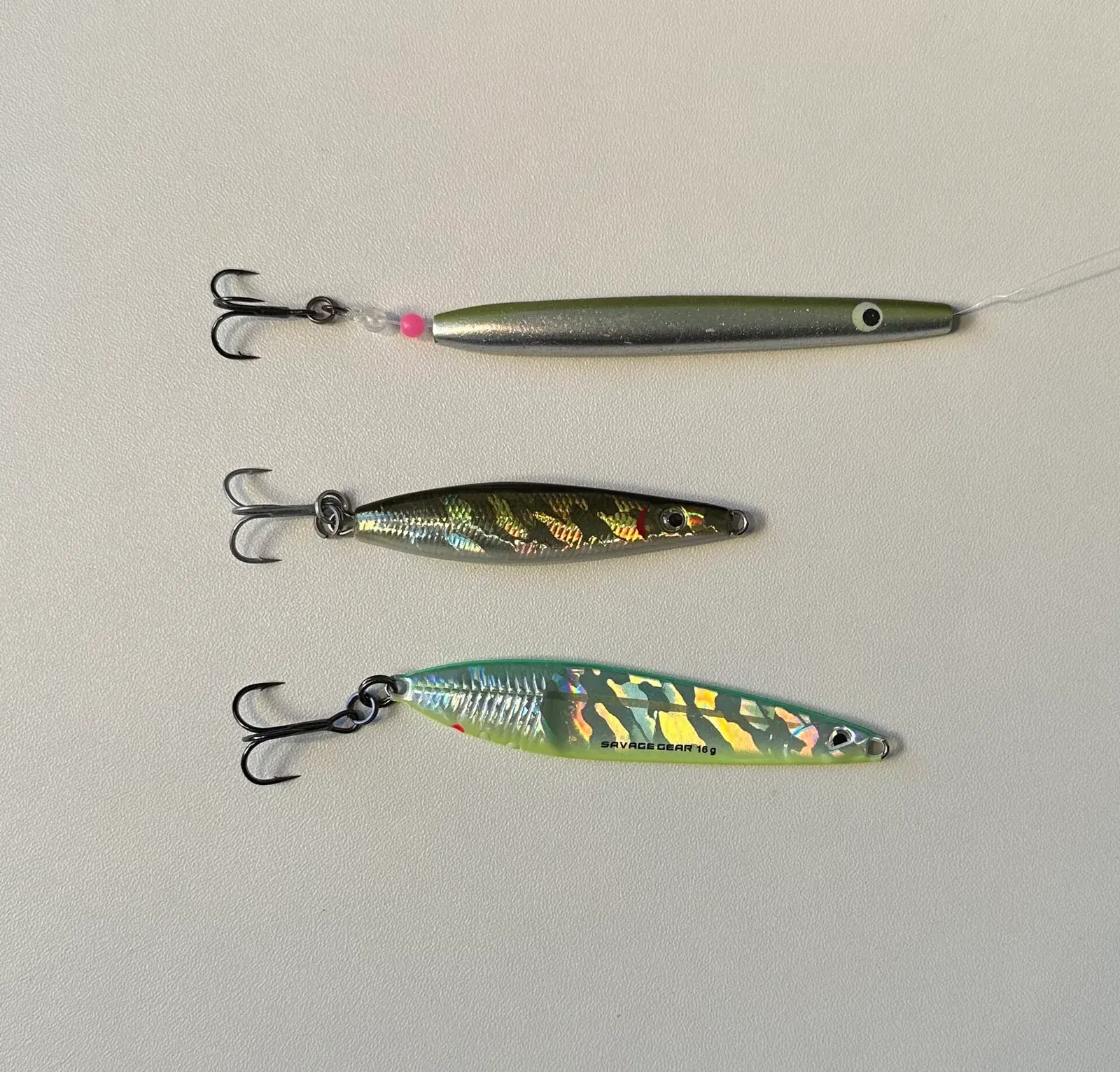 Trout Lures: Spinners, Spoons, Jigs and Minnows, and How to Fish Each
Trout lures come in five types: inline spinners, spoons, micro jigs, sinking minnows and jerkbaits, mostly 1/64–1/4 oz. Sizes by trout, colors by water.
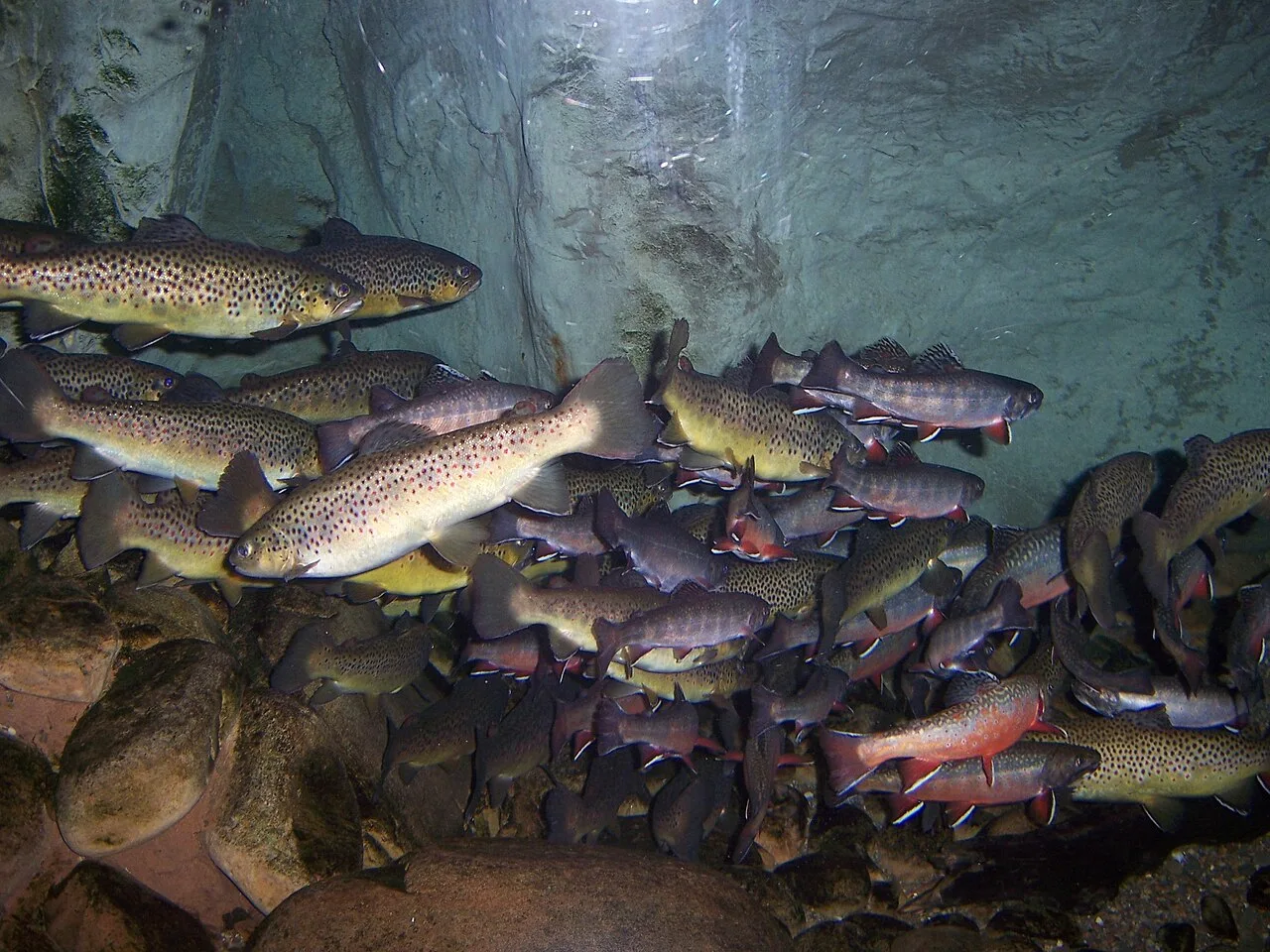 Types of Trout: Every US Trout and Char and How to Tell Them Apart
The types of trout in the US, rainbow and brown to bull trout and Arctic char: the group each belongs to, where it is native, and the one mark that IDs it.
Sources
- Leland's Lures (Trout Magnet), Trout fishing: the system, rods and reels, float fishing
- Leland's Lures, Trout Magnet jig heads
- Leland's Lures, The Original Trout Magnet (9 pc. packs)
- Leland's Lures, E-Z Trout and Panfish Floats
- Leland's Lures, Tungsten jig heads
- Leland's Lures, Trout Magnet Big Kit (20 heads, 120 bodies, 2 floats)
- Leland's Lures, Mini Magnet
- Leland's Lures, Trout Magnet Spin
- Leland's Lures, D2 Jigs
- Leland's Lures, Crappie Magnet
- Leland's Lures, About us (history)
- Leland's Lures (David Taylor), 3 best ways to fish a jig for trout
- Trout Magnet, Trout Fishing 101 (Jason Sealock, quoting Jeff Smith and David Taylor)
- On The Water, Is this the most effective trout lure ever?
- Outdoor Life, The best trout lures (Trout Magnet as best jig)
- NIST ESTAR, composition of tungsten (density 19.3 g/cm³)
- NIST ESTAR, composition of lead (density 11.35 g/cm³)