 By
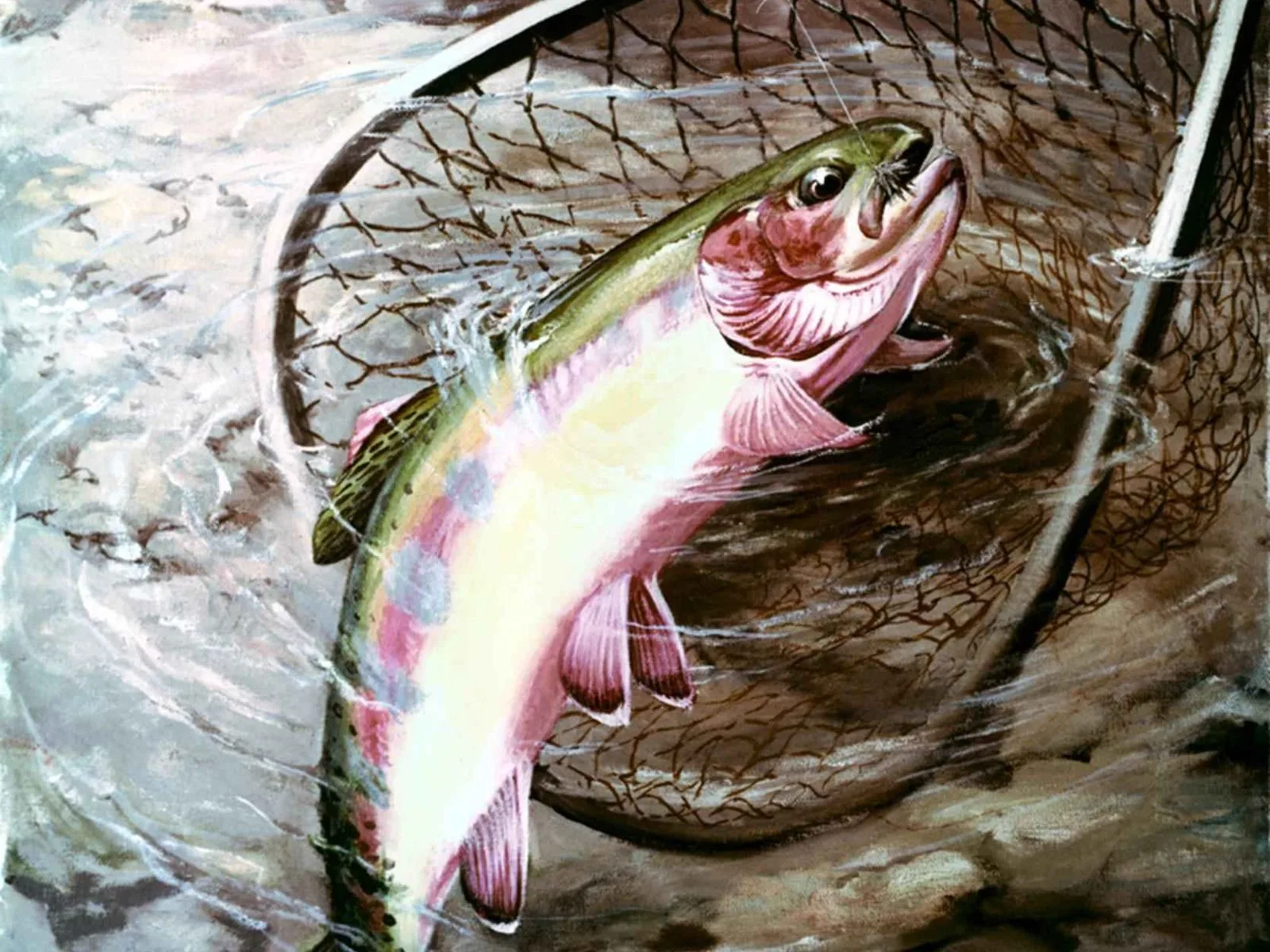
The golden trout is California’s state fish, a wild trout native to just two drainages on the Kern Plateau in the southern Sierra Nevada: Golden Trout Creek, with its tributary Volcano Creek, and the South Fork Kern River. Every other golden in the West, in more than 300 high lakes from Wyoming to Washington, descends from fish carried out of those creeks. To catch one you walk: the native creeks and most of the lakes are reached only by trail.
Wyoming’s first golden trout went into Cook Lake in 1920. Twenty-eight years later the same lake gave up the 11 lb world record, a fish with no photo that a Wyoming biologist says might never have existed.
How do you tell a real golden trout?
A California golden is brassy to olive on the back, deepening to gold and yellow on the sides and belly, with a crimson stripe along the lateral line. The mark that settles it is the parr marks: about ten dark oval blotches centered on the lateral line. They are juvenile marks, and a golden keeps them into adulthood. The lower fins have white edges. Black spots are few and mostly on the back and tail.
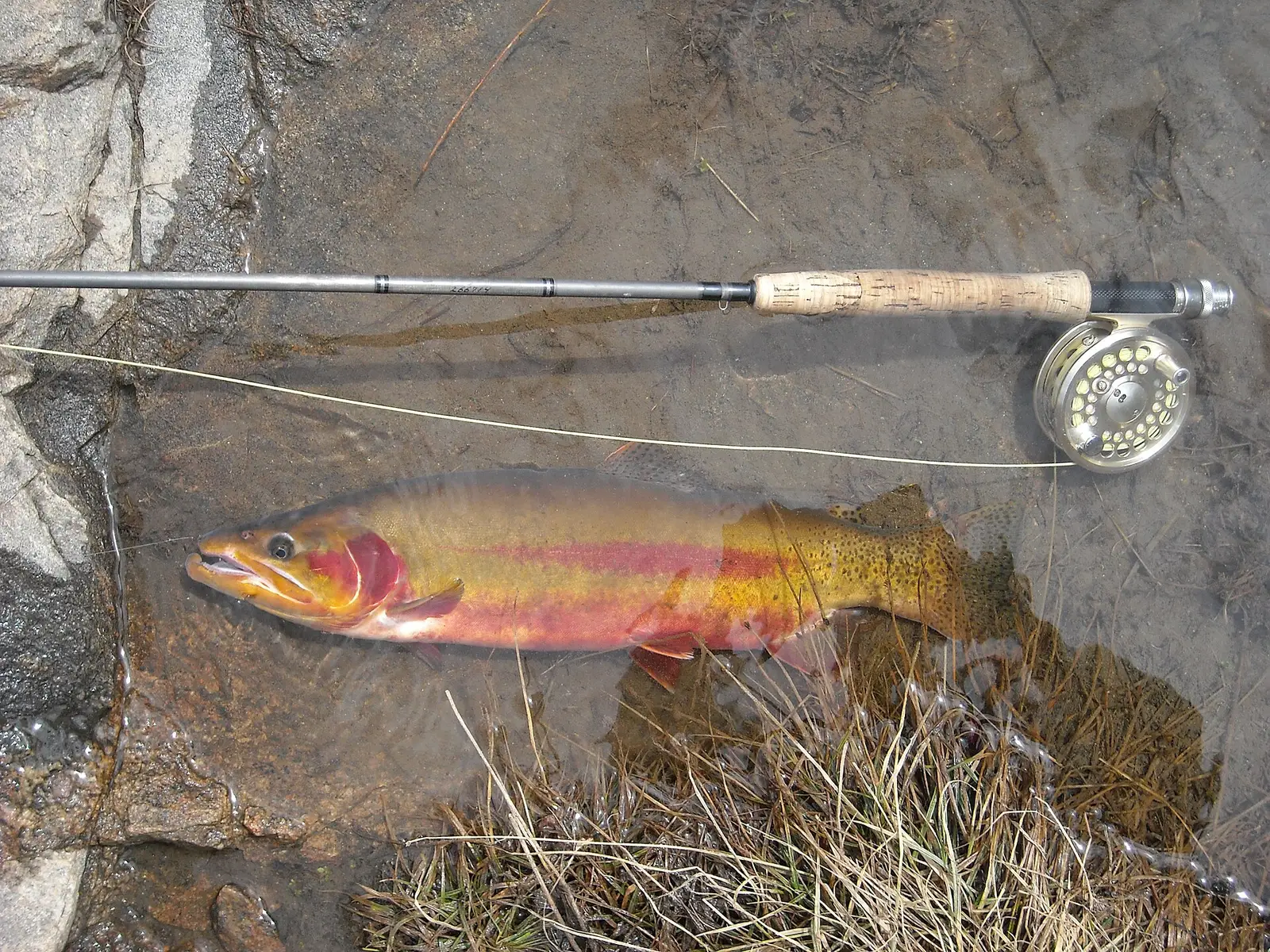 A golden trout on a fly rod, most likely from stocked water outside the native range, by the photographer’s own note. Photo: John C. Sneddon, Wikimedia Commons (public domain)
The fish it gets confused with is the palomino, also sold as the golden rainbow. That is a hatchery color strain of ordinary rainbow trout, bred from one yellow fingerling found in a West Virginia hatchery in 1955. It is solid gold with no parr marks, and it is stocked in put-and-take water across the East.
So a golden from a stocked lake in Pennsylvania is a palomino trout, a rainbow in gold, and a golden from a Sierra creek at 9,000 ft is the real thing.
Where do golden trout live?
The native range is a watershed of about 593 square miles. It runs from 10,800 ft at Rocky Basin Lakes down to below 7,000 ft, where Golden Trout Creek meets the Kern. Outside it, CalTrout counts goldens in more than 300 high mountain lakes and about 680 miles (1,100 km) of streams. They reached Wyoming in 1920, and Wyoming now runs its own golden trout broodstock.
| State | Where the goldens are | How they got there, how you get there |
|---|---|---|
| California, native | Golden Trout Creek, Volcano Creek, South Fork Kern River | Inside the Golden Trout Wilderness; trail access, with an overnight quota on the Cottonwood Pass trail from late June to mid-September |
| California, stocked | High Sierra lakes outside the native range | Transplanted; hike-in |
| Wyoming | 133 alpine lakes, most in the Wind River Range, also the Absaroka, Snowy and Bighorn ranges | First stocked at Cook Lake in 1920; 90 percent stocked by helicopter on two- or four-year rotations |
| Montana, Utah, Washington | High-country lakes | Established, self-sustaining populations |
| Colorado, Idaho | High-country lakes | Stocked; Wyoming’s Story hatchery ships them eggs |
Wyoming’s broodstock story is its own small epic. Story Hatchery, the state’s oldest, took golden eggs from Sylvan Lake, Montana, in 2007 and spawned captive goldens for the first time in 2009. It went from about 40,000 eggs a year to about 300,000 by 2022. It now fills Wyoming’s own orders and ships the surplus to Colorado, Utah, Idaho, Montana, Washington and California. Most of the fish go into lakes as 2 to 4 in fingerlings, dropped from a helicopter, and mature at three years.
Before Story, Wyoming took its eggs from the wild. Cook Lake was the brood water from 1936 through 1954, and Surprise Lake from 1955 through 1993. Crews packed in on foot, by horse or by helicopter, penned the fish and camped for days or weeks until they were ready to spawn. A big fire burned the Surprise Lake drainage in 1988, and the sediment that followed ended the egg take there. For a named lake to aim at, Wyoming’s Sheridan region lists four on the east side of the Cloud Peak Wilderness in the Bighorns: Elephanthead, Myrtle, Firehole #2 and Frozen #1. The west side holds eleven more.
In California, the native fish live in the Golden Trout Wilderness, over 300,000 acres split between the Inyo and Sequoia national forests. Golden Trout Creek is a designated Heritage and Wild Trout Water, and the South Fork Kern a Wild Trout Water. Some of the lower South Fork runs beside forest roads near Kennedy, Troy and Monache meadows, and CDFW warns that fish there are more likely hybrids, without the bright color of the upper watershed. Many lake goldens elsewhere in the Sierra come from the Cottonwood Lakes broodstock, which genetic tests in the 1990s showed was hybridized with rainbows; Trout Unlimited places most of them between Yosemite and Sequoia-Kings Canyon.
Free PDF · Water temperature chart When do trout bite?
One water temperature reading, and the 16-page chart tells you who's spawning, who's feeding hard, where they sit and what to throw. 26 fish, every number sourced.
Enter your email, confirm it with one click, and the PDF is in your inbox. Plus one email a week on what's biting. Unsubscribe anytime. Privacy.
How do you catch golden trout?
The work is getting there. Goldens live high, the season is short, and the best of it comes right after ice-out. For the Golden Trout Wilderness, the Ecological Angler’s guide puts peak fishing in July, August and September. In its view the ice-out weeks of late June and early July are the best for actively feeding fish, and for fewer people.
Plan ahead, and plan on a long walk to reach the water. For the native creeks, the paperwork and the numbers fit in one table:
| Planning a Golden Trout Wilderness trip | What applies |
|---|---|
| Best weeks | Ice-out, late June to early July; peak fishing July to September |
| Overnight permit | Needed for every overnight trip into the wilderness |
| Trail quota | Cottonwood Pass trail, all overnight visitors, last Friday in June through September 15 |
| Food | Inyo National Forest order: in a bear-proof container or otherwise kept from bears |
| Water temperature | Goldens prefer 58 to 62 °F; on degraded Kern Plateau streams they tolerate 70 °F if the water cools at night |
| Rules on the water | Open all year, artificial lures only, 2 trout a day (details below) |
That walk and the short season are most of why goldens count as hard to catch. The fish add some of their own: a Wyoming Game and Fish biologist calls goldens one of the more timid trout. Fly Fisherman finds alpine trout will take a fly in their view as long as the line does not splash down. In the native creeks the fish are less fussy: CDFW says most creeks in the wilderness abound with goldens that readily take flies of all types, particularly dries and terrestrials. Small lures work as well, though casting is hard on the smaller tributaries, which are lined with meadow grass and streamside brush.
Those temperature numbers sit beside every other trout on the trout water temperature chart.
Once there, the tackle is light: a 5-weight fly rod, or an ultralight spinning rod with 2 to 4 lb line. That is the small-water gear the trout fishing guide sets out.
For flies, Fly Fisherman’s report from the Wind River Range names the standards for alpine trout: Parachute Adams, Elk Hair Caddis and foam beetles. For goldens specifically it names bright orange scuds, egg patterns and a dark Woolly Bugger with a small bright bead. In the lake that report fished, the goldens held deep and rose from 30 ft down, so a sinking line and a wet fly found the bigger fish. Those patterns, in small sizes, are the trout flies to carry up there.
What is California’s Heritage Trout Challenge?
California offers a reason to go beyond the fish itself. The California Department of Fish and Wildlife started the Heritage Trout Challenge in 2004. It awards a certificate for photographing six of the state’s native trout forms, each caught in its native range.
The California golden and the Little Kern golden both count, and the master level asks for all eleven. A golden from a lake outside the native range does not qualify.
Are golden trout endangered?
The California golden is not federally listed. It was petitioned for listing in 2000, and in 2011 the Fish and Wildlife Service found listing not warranted. California lists it as a Species of Special Concern, and the Forest Service as a Sensitive Species.
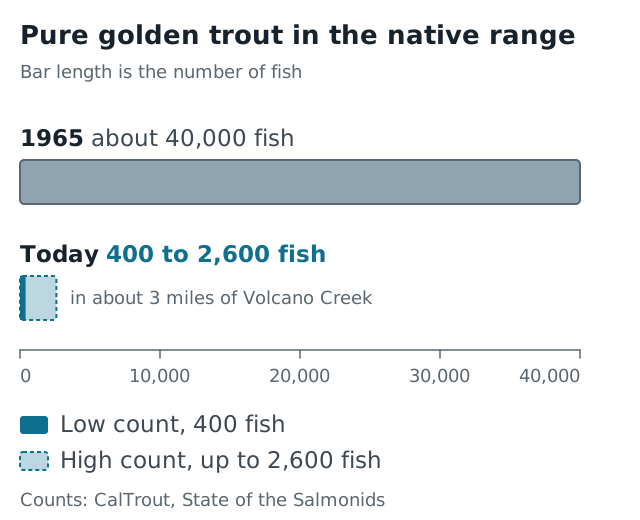
CalTrout rates its status critical. By its count, the number of genetically pure fish in the native range has fallen from about 40,000 in 1965 to between 400 and 2,600, in about 3 miles of Volcano Creek.
Drought squeezes what is left. In September 2016, after three dry years had shrunk Volcanic Creek, CDFW staff rescued 52 pure goldens that averaged four inches. Motor vehicles are barred from wilderness, so it took four days on horseback above 10,000 ft and more than 32 miles round trip. The fish went out by mule and then more than 300 miles by truck to the American River Hatchery, to be reared and put back once the water returned.
The threats are hybridization with stocked rainbows, brown trout that eat and outcompete goldens, brook trout that compete with them for food, and cattle grazing that damaged meadow and streamside habitat. The Inyo National Forest rested two of four grazing allotments for ten years from 2000.
Can you keep one? Yes. CDFW says all waters on the Kern Plateau are open to angling, and both native watersheds lie largely inside the Golden Trout Wilderness. There the 2026 rule is open all year, artificial lures only, 2 trout a day (14 CCR §7.50(b)(51)); the main-stem Kern has its own entry. Check the current booklet for the water you fish. A stream golden is about 8 in long and can be up to nine years old.
How big is the record golden trout, and is it real?
The IGFA all-tackle record is 11 lb (5 kg) and 28 in (71 cm). Chas Reed caught it at Cooks Lake, Wyoming, on August 5, 1948, on a minnow behind a spinner; Wyoming’s books list it at 11 lb 4 oz.
In 2023 Mark Smith, Wyoming Game and Fish’s assistant fisheries management coordinator, told Cowboy State Daily that there is no photograph and no written account of the catch. The fish, he said, “might have never existed”. By the paper’s account of his view, 3 to 4 lb is already a mighty impressive golden, and the biggest he has heard of ran about 5 lb. He also allowed that it might have been a hybrid with a rainbow or a cutthroat. Until someone lands a bigger one on camera, the record keeps its asterisk.
The IGFA also keeps an all-tackle length record for golden trout: 21 in (53 cm), from Golden Lake, Wyoming, in 2012.
Is a golden trout just a rainbow?
Close to it. Most agencies, California’s included, name it Oncorhynchus mykiss aguabonita, a subspecies of the rainbow trout isolated on the high Kern Plateau. The U.S. Fish and Wildlife Service and some authors list it as a full species, O. aguabonita.
Wyoming Game and Fish tells how a rainbow became a golden. Some 20,000 to 30,000 years ago, volcanoes, glaciers and erosion built the Kern Plateau and left waterfalls and hanging valleys that cut the sea-run rainbows above them off from the ocean. Isolated, they evolved into the golden. David Starr Jordan, Stanford’s first president, described the fish in 1892 and named it agua-bonita after the Agua Bonita falls at the mouth of Volcano Creek. The only other fish native to its range is the Sacramento sucker.
The kinship is the problem. Goldens and rainbows interbreed freely, and hybridization with stocked rainbows is the main threat to the native fish. Two close relatives share the Kern: the Little Kern golden trout and the Kern River rainbow. The cutthroat trout is the other native trout of the high West, and the trout hub sets the golden beside every other American trout.
Free PDF · 16 pages
Know what's biting before your first cast
The Water Temperature Fishing Chart. Take one water temperature reading, find it on the chart, and you know which of 26 freshwater fish are feeding today, where they are and what to throw. For your phone and the tackle box.
- The 26-fish chart: who's spawning, feeding hard or shut down at your reading
- Where they sit and what to throw at every band: bass, crappie, bluegill, walleye, catfish and trout
- The best hours at your reading, the cold front day by day, and the spawn calendar from ice-out to midsummer
- The three thermometer mistakes that make a reading lie (the first one is the surface)
Every number from state fish and wildlife agencies and fisheries research: 61 sources, all on the site.
Enter your email, confirm it with one click, and the PDF is in your inbox. Plus one email a week on what's biting. Unsubscribe anytime. Privacy.
Related
Section guide
Trout: The Fish, Where They Live, When They Bite and How to Catch ThemTrout are cold-water fish of the salmon family. The five you'll catch, the 68 °F line, when each spawns and how to catch them; every type on its own page.
 Trout Lures: Spinners, Spoons, Jigs and Minnows, and How to Fish Each
Trout lures come in five types: inline spinners, spoons, micro jigs, sinking minnows and jerkbaits, mostly 1/64–1/4 oz. Sizes by trout, colors by water.
 Types of Trout: Every US Trout and Char and How to Tell Them Apart
The types of trout in the US, rainbow and brown to bull trout and Arctic char: the group each belongs to, where it is native, and the one mark that IDs it.
 Cutthroat Trout: Subspecies, Identification and How to Fish
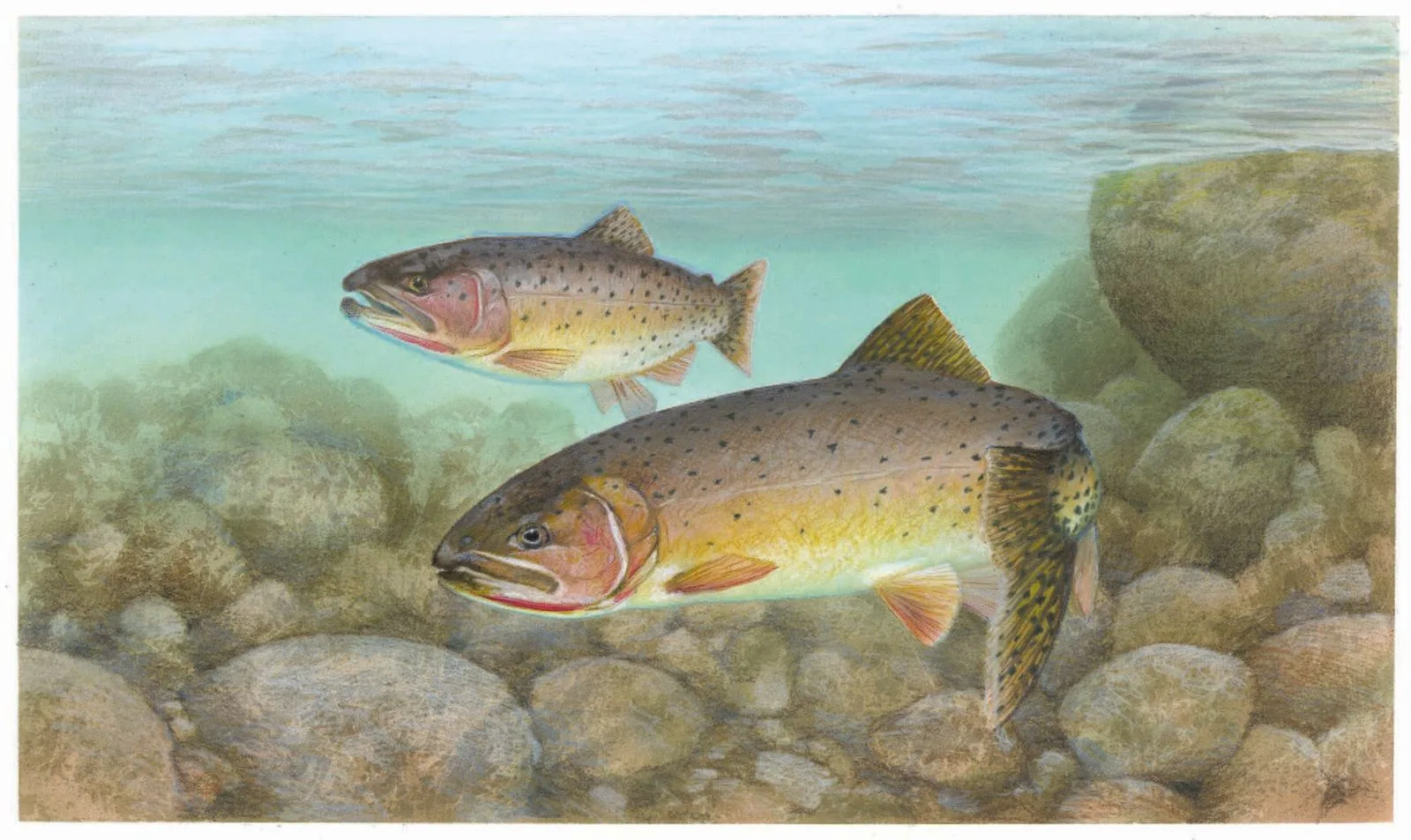
Cutthroat trout: how to tell one from a rainbow or cutbow, each subspecies with its range, size, spots and status, how to fish them, the 41 lb record.
 Lake Trout: The Deep-Water Char That Lives 60 Years
Lake trout are deep-water chars that live 60 years: how to tell one apart, where they hold by season, the 72 lb record and the Great Lakes comeback.
 Tiger Trout: The Sterile Brown x Brook Hybrid Explained
Tiger trout are sterile brown x brook hybrids from hatcheries: how they are made, why states from Oregon to Virginia stock them, and the 27 lb 6 oz record.
 Trout Fishing for Beginners: Where, When and What to Use
Trout fishing peaks at 55–65 °F, and most beginners catch stocked fish first. Where trout hold in streams and lakes, the one outfit to buy, and when to go.
Sources
- Western Native Trout Initiative, California golden trout
- CalTrout, State of the Salmonids: California golden trout
- Trout Unlimited, everything you wanted to know: California golden trout
- USGS Nonindigenous Aquatic Species, golden trout profile
- U.S. Fish & Wildlife Service, golden trout (Oncorhynchus aguabonita)
- Wikipedia, Golden trout
- Wyoming Game and Fish Department, A golden era
- Wyoming Game and Fish Department, learn more about golden trout
- Cowboy State Daily, why Wyoming's golden trout record seems sketchy (2023)
- Outdoor Life, the biggest trout ever caught (IGFA records)
- California Fly Fisher, the California Heritage Trout Challenge
- The Ecological Angler, fly fishing the Golden Trout Wilderness
- Fly Fisherman, fly fishing for golden trout in Wyoming's Wind River Range
- West Virginia DNR, West Virginia gold rush: a history of the golden rainbow trout
- California Department of Fish and Wildlife, fishing for California golden trout
- California Department of Fish and Wildlife, 2026 freshwater sport fishing regulations
- Wikimedia Commons, golden trout (Oncorhynchus mykiss aguabonita) photo by John C. Sneddon (public domain)