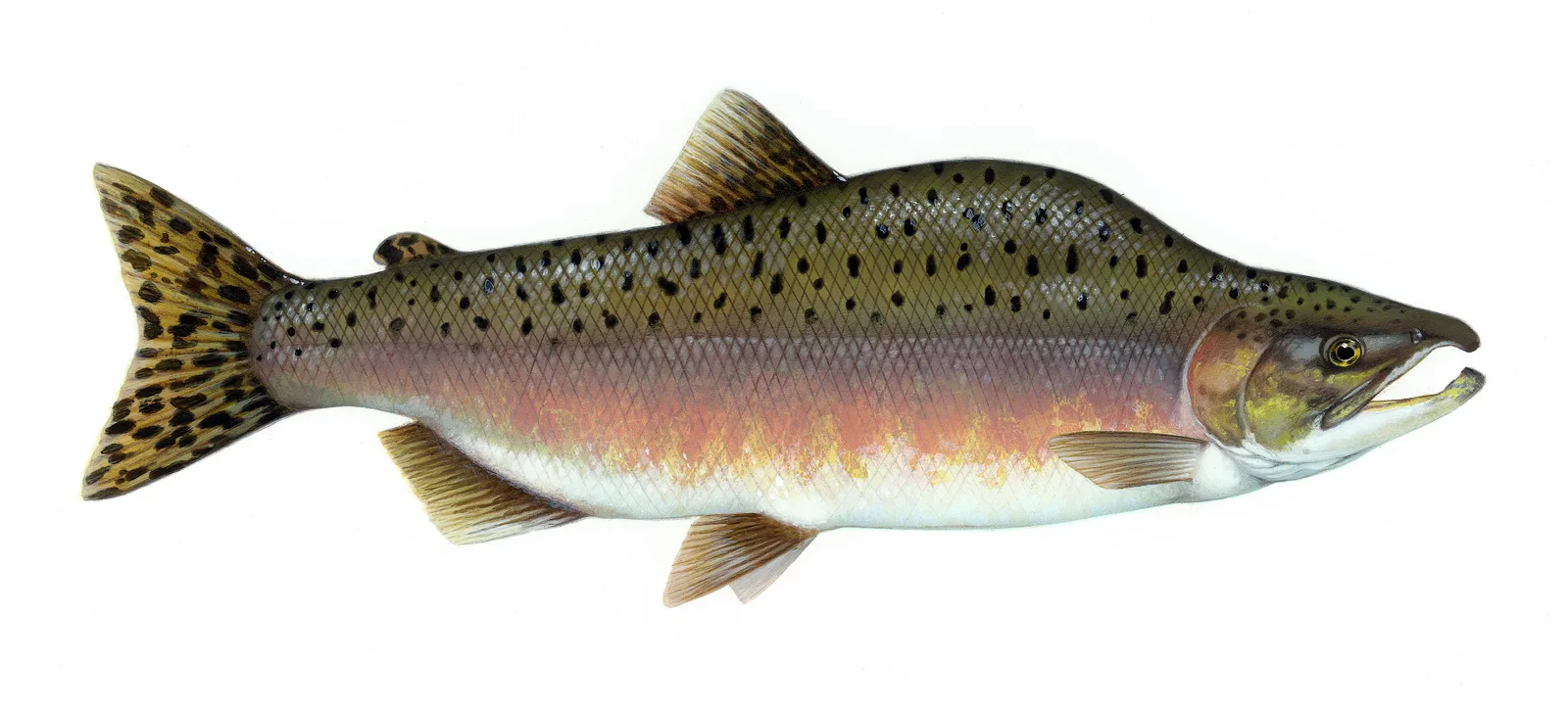
The pink salmon, the humpy, is the smallest Pacific salmon in North America and the most abundant: 20 to 25 in (51–64 cm) and 3.5 to 5 lb (1.6–2.3 kg). On the Pacific coast every one lives exactly two years, which is why Washington sees pinks only in odd years and the Kenai has its big runs in even ones. When they come, they come by the million, close to shore, and they bite.
The world-record pink salmon was caught by a nine-year-old. Alex Minerich’s 14 lb 13 oz fish came out of the Skykomish River at Monroe, Washington, on September 30, 2001, on a Dick Nite spoon and 10-pound line.
Pink or chinook: check the mouth and the tail
The mistake that costs anglers is calling a young chinook a pink. Pinks are often open for harvest while chinook rules are stricter, and Washington’s fish and wildlife department warns that the mix-up leads to violations. The mouth, the teeth and the tail settle it.
| Mark | Pink | Chinook (king) | Coho (silver) |
|---|---|---|---|
| Mouth and gums | White mouth, black gums and tongue | Dark mouth, black gums | Light to dark mouth, white gum line |
| Teeth | Almost none in salt water | Large and sharp | Medium, sharp |
| Tail | Large oval spots on both halves; no silver | Spots on both halves; silver prominent | A few spots, upper half only |
| Scales | Very small for the fish’s size | Larger | Larger |
Black gums alone will not do it, because a chinook has them too. Look at the teeth and the tail. A pink’s lower jaw is pointed, and its spots are big ovals. In the Great Lakes a pink trolled from open water is mostly silver, may show no hump and is often taken for a coho; the coho salmon page covers that fish’s white gum line.
On the spawning run the male earns the name. He grows a tall hump in front of the dorsal fin and a hooked jaw, the kype, and turns dark on the back with a white belly. Females go olive green with dusky bars. Neither loses the black spots. The salmon hub sets all five Pacific salmon and the Atlantic side by side.
Odd or even: when pinks run where you fish
A pink hatches, goes to sea, and comes back to spawn and die at two. Alaska’s fish and game department says odd-year and even-year fish do not interbreed, even on the same gravel. So each river has two separate runs, and often one is much bigger.
| Water | Big year | When | Next big year |
|---|---|---|---|
| Puget Sound and the Strait | Odd only | Peak mid-August; south Sound late August | 2027 |
| Puget Sound rivers | Odd only | Enter in August; peak in September | 2027 |
| Kenai River, Alaska | Even | August to October (NOAA, all pinks) | 2028 |
| Northwest Alaska | Even | August to October (NOAA, all pinks) | 2028 |
| Rest of Alaska | No dominant year | Late June to mid-October | Every year |
| Lake Superior, North Shore | Both | Late August to mid-September, after rain | Every year |
| Northern Norway (invasive) | Odd | From the second half of June | 2027 |
NOAA notes small even-year spawning in a few Puget Sound rivers, but the runs anglers fish come in odd years. Run size swings widely from one odd year to the next. The 2023 Puget Sound return was 7.22 million fish, and the 2025 forecast was nearly 7.8 million. In 2017 only about 511,000 came back, after drought, floods and a warm ocean hit the brood.
The Great Lakes broke the clock. Langan and colleagues, writing in Fish and Fisheries in 2026, report Great Lakes pinks maturing at anywhere from one to four years. Fish that mature at three put pinks into Lake Superior’s streams in even years as well as odd ones.
Free card: what 26 species do at your water temperature
Plus one email a week on what's biting now. No sales pitches. Privacy.
Where pink salmon live
Pinks live on both sides of the North Pacific, from Puget Sound and North Korea north into the Arctic. NOAA records them as far south as central California, but they do not reproduce in significant numbers south of Puget Sound. Canada’s fisheries department reports them colonizing the western Arctic as far east as the Mackenzie River.
They are the salmon of short rivers. NOAA puts most spawning within about 30 miles of a river mouth, and some pinks spawn right where the tide reaches. A 1969 federal leaflet on Alaska’s pinks found that 50 to 75% of Prince William Sound’s fry came from intertidal zones.
The Great Lakes fish began as an accident. In 1956 Ontario was raising British Columbia pink eggs at a hatchery in Thunder Bay for Hudson Bay. About 21,000 leftover fingerlings ended up in the Current River, which runs into Lake Superior. They took, and by Kwain’s 1982 study pinks had spread into every Great Lake. Michigan’s DNR calls the St. Marys rapids “the most outstanding pink salmon fishery this side of Alaska.”
Across the Atlantic the same fish is a pest. Russian stocking spread pinks to Norway. In 2023, the Norwegian Environment Agency counted 481,463 pink salmon caught or observed in its rivers. A year later only about 323,000 wild Atlantic salmon spawned there.
How to catch pink salmon
Pinks fresh from the sea strike hard, and Alaska calls them an excellent salmon for children because they are easy to hook and easy to land. The rule of pink salmon fishing fits in two words: think pink.
- Troll a dodger and a pink squid. Mark Yuasa of WDFW names a small hot pink plastic mini squid 13 to 16 in (33–41 cm) behind a 1/0 white or silver dodger as the best setup. Troll slowly, 1.3 to 1.8 mph at most. Without a downrigger, a 6 to 8 oz banana weight a few feet ahead of the dodger gets it down.
- Find the depth. Pinks can hold anywhere from just under the surface to 80 to 125 ft (24–38 m), deeper on bright days. Everett charter owner Gary Krein told the Everett Herald in 2009 that the best depth is often 30 to 50 ft early, then 50 to 70 ft.
- Cast a jig from the beach. Buzz Bombs, Point Wilson Darts and similar jigs take pinks from shore. Let the jig sink about a foot a second, keep it twitching, and do not set hard: a pink has a soft mouth. In Washington’s marine areas 1 to 13, swap the barbed treble for single barbless hooks.
- Fish the tide. Pinks tend to hug the shoreline. WDFW names the hour before and after a flood tide, and slack tide, as the times to be there.
- In rivers, go small and slow. WDFW suggests a 1/16 oz pink spoon or a 1/8 to 1/4 oz pink jig under a float. Fly anglers throw a size 4 pink Comet or marabou on a 6- or 7-weight.
Line can stay light: Yuasa suggests 8 to 12 lb test on an 8 to 9 ft salmon or trout rod with a spinning reel or level wind. Keep every other line in the water when one fish is hooked, because pinks travel in schools and double hookups are common.
How big do pink salmon get?
NOAA and Alaska both give 20 to 25 in and 3.5 to 5 lb as the average. Great Lakes pinks are far smaller: the Great Lakes spawners in Kwain’s 1982 study averaged 0.68 kg, about 1.5 lb. A few Pacific fish grow huge, and the record book shows how unevenly.
| Record | Weight | Angler, water, date |
|---|---|---|
| World (IGFA) | 14 lb 13 oz (6.74 kg) | Alexander Minerich, Skykomish River, Monroe, Washington, September 30, 2001 |
| Washington, fresh water | 15.40 lb (6.99 kg) | Adam Stewart, Stillaguamish River, October 11, 2007 |
| Washington, salt water | 11.56 lb (5.24 kg) | Jeff Bergman, Possession Point, August 25, 2001 |
| Alaska | 13 lb 10.6 oz (6.2 kg) at the weigh-in | Robert Dubar, Kenai River near Sterling, August 23, 2016 |
| Michigan | 8.56 lb (3.88 kg) | Carp River, Mackinac County, 1987 |
Stewart’s fish is heavier than the world record, but the IGFA book still lists Minerich’s. Alaska’s record fell twice in two days in 2016: Thomas Salas’s 12 lb 13 oz Kenai fish broke a 42-year-old mark, and Dubar’s came in about three hours later. ADF&G’s own record table lists the fish as 13 lb 7 oz.
Are pink salmon good to eat?
Yes, when they are bright. NOAA describes the meat as lean and mild, softer than most salmon, with a small flake and pale pink color. The color comes from the small crustaceans pinks eat at sea. Pinks have the lowest oil content of the Pacific salmon, and Yuasa notes the fillets run a little leaner than a sockeye, coho or chinook. NOAA lists U.S. pinks as wild-caught, from Alaska, Washington and Oregon: fresh from late summer to fall, frozen and canned all year. Alaska has canned them since the late 1800s.
Is it good for you? NOAA calls pink salmon a good source of omega-3 fatty acids, protein, niacin, vitamin B12 and selenium, at 116 calories and about 20 g of protein per 100 g raw.
The catch is soft flesh in warm weather. Yuasa’s advice is to bleed the fish at once by cutting the gills, gut it and get it on ice. Once a pink shows its spawning colors in a river, the flesh is poor eating; a lake or ocean fish that is still silver is the one to keep.
Why there are so many pinks
From 1990 to 2015, pinks made up 67% of the adult pink, chum and sockeye salmon in the North Pacific, by Ruggerone and Irvine’s count. About 15% of them started life in a hatchery. Alaska’s commercial fleet has taken around 100 million a year since about 1990, and no pink population is listed under the Endangered Species Act.
How long do pink salmon live?
Two years on the Pacific coast; Washington’s fish and wildlife department says there are no one- or three-year-old fish to start runs in the other years. A female digs her nest, the redd, in clean gravel, and lays 1,200 to 1,900 eggs, by Alaska’s figures. In Alaska spawning usually starts when streams are near 50 °F (10 °C). She guards the nest until she dies, usually within two weeks. The eggs incubate over winter.
In spring the fry swim straight to salt water without feeding, bright silver and unspotted. After about 18 months at sea they come home to spawn once and die. Unlike a coho or a steelhead, a young pink spends almost no time in fresh water. On Lake Superior’s North Shore that lets it use short streams too poor to rear steelhead, coho or chinook. For every other fish, start at the species guides.
Free download
The water temperature card
Read your water temperature and the card tells you who is spawning, who is feeding and what to throw. 26 species, 16 pages, for your phone and the tackle box.
Plus one email a week on what's biting now. No sales pitches. Privacy.
Related
Section guide
Types of Salmon: The Five Pacific Species and the Atlantic, Told ApartThe six types of salmon a North American angler meets: chinook, coho, sockeye, pink, chum and Atlantic, by gum line, tail spots, size and record.
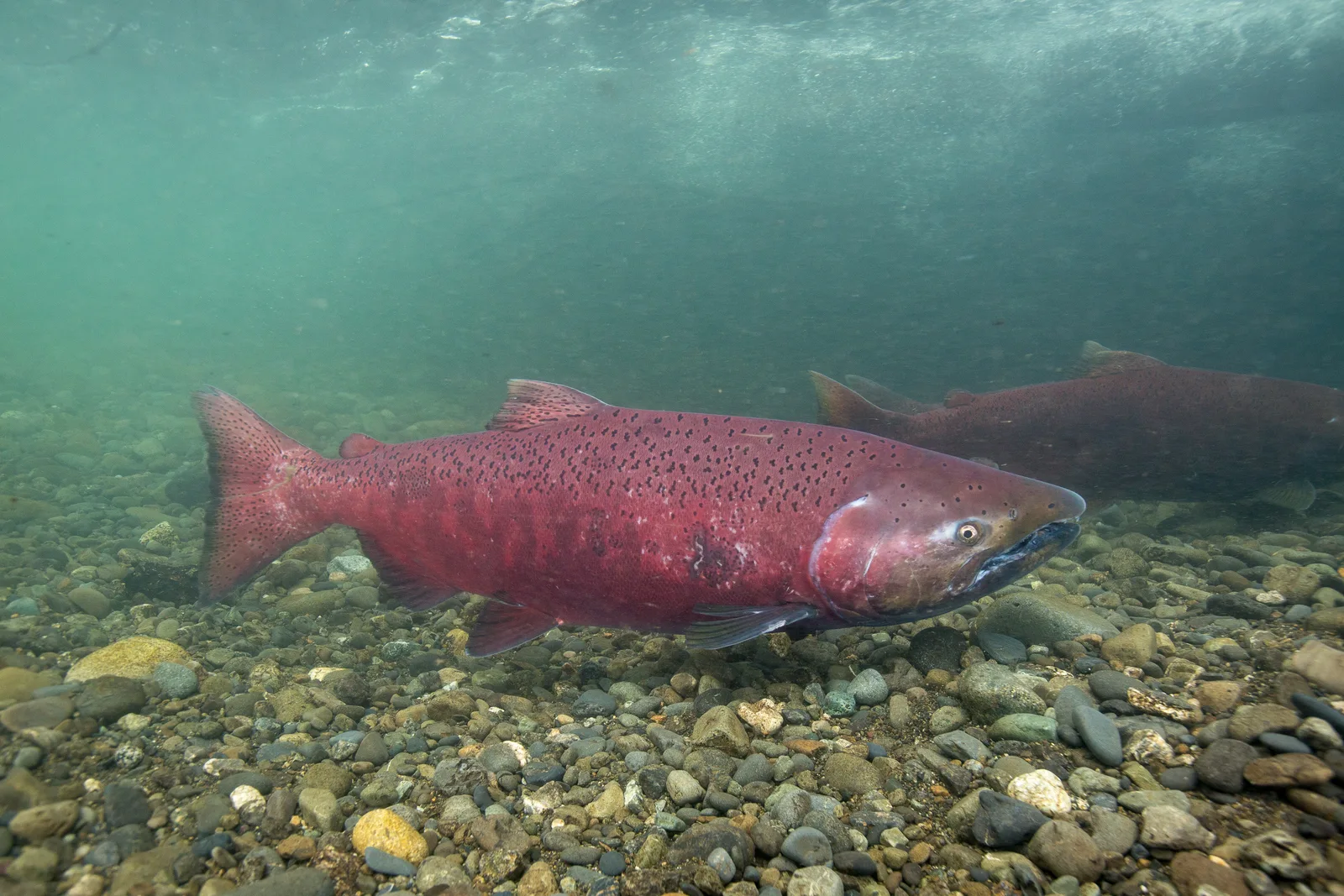 King Salmon (Chinook): Black Gums, Size, Runs and the 97-Pound Record
King salmon, or chinook: the black gums that mark a king, how big they get from Alaska to the Great Lakes, when each run starts, and the 97 lb 4 oz record.
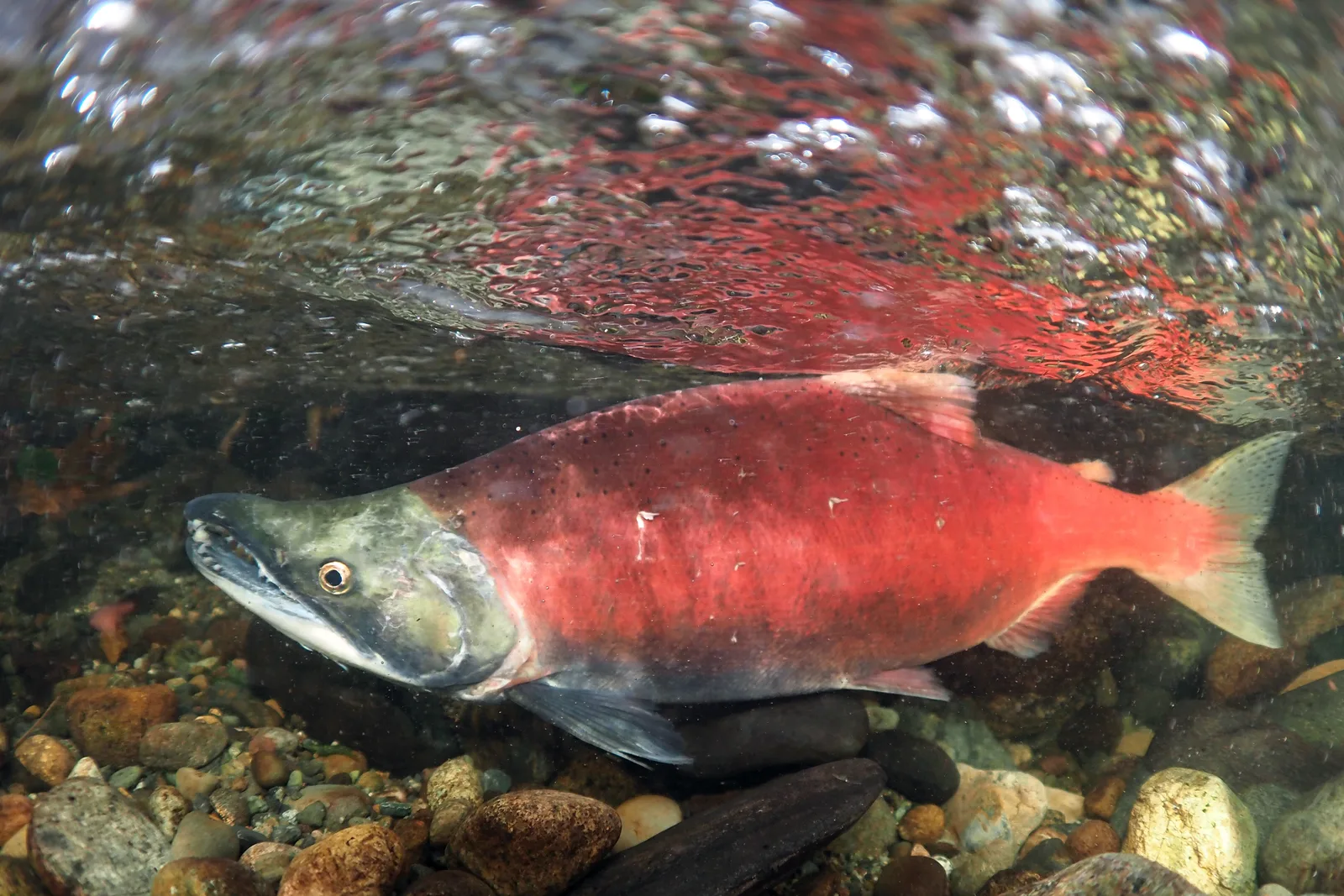 Kokanee Salmon: The Landlocked Sockeye, Season by Season
Kokanee salmon are sockeye that never reach the sea. How to tell one, the 50 °F depth they hold at each season, how to troll for them, and the record.
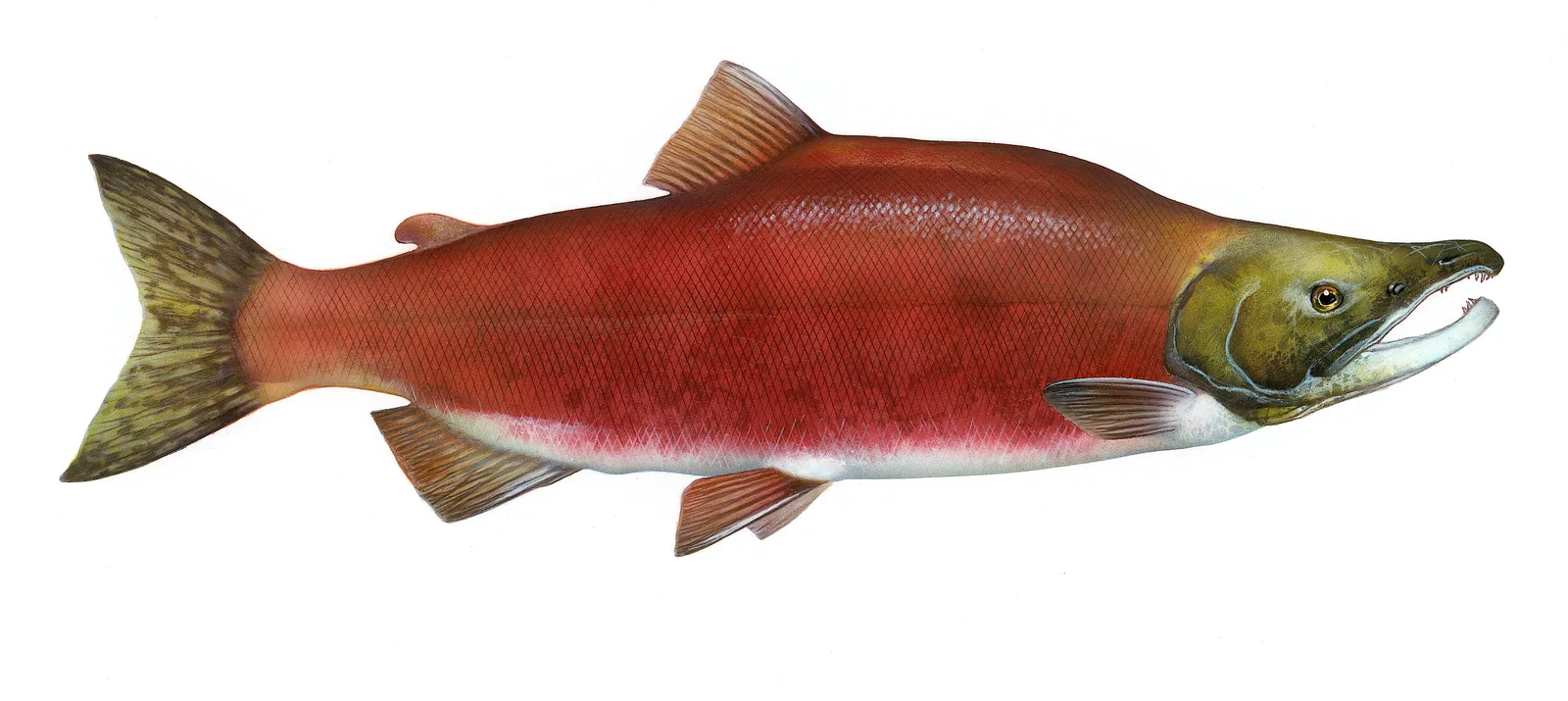 Sockeye Salmon: How to Tell a Red, Where They Run, and the Record
Sockeye salmon: a 4–15 lb red salmon that needs a lake. Tell it from a chum, find the runs from Bristol Bay to Lake Washington, hook one, and the record.
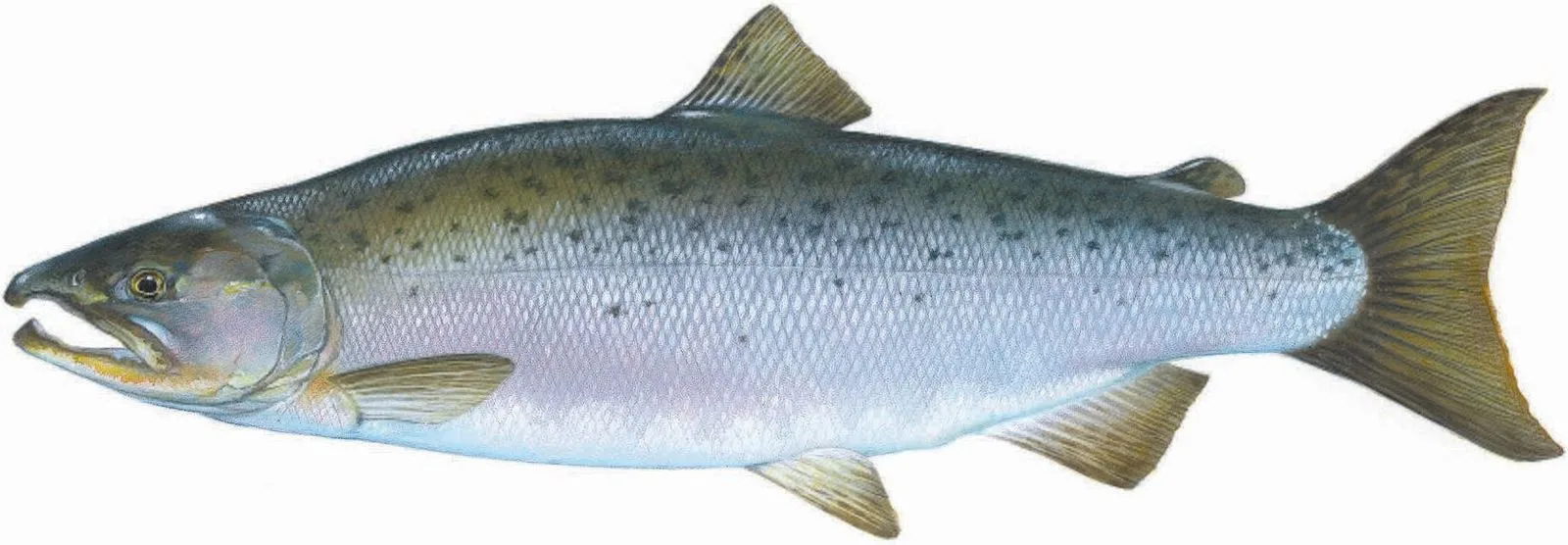 Coho Salmon: How to Tell a Silver From a King, Size, Runs and Records
Coho salmon: the white gum line that separates a silver from a king, how big they get, when they run from Alaska to the Great Lakes, and the record.
Sources
- IGFA world record database, Salmon, pink (all-tackle and length records)
- Alaska Department of Fish and Game, Pink salmon species profile
- Alaska Department of Fish and Game, Alaska salmon fishing guide
- Alaska Department of Fish and Game, Pacific salmon marine and spawning phase identification (2018)
- NOAA Fisheries, Pink salmon
- Washington Department of Fish and Wildlife, Pink salmon (Oncorhynchus gorbuscha): odd-year runs and state records
- Washington Department of Fish and Wildlife, Pacific salmon ID card (2024)
- WDFW news release (archived), Arlington angler reels in record-breaking pink salmon (2007)
- Mark Yuasa, It's time to think pink salmon!, WDFW (2025)
- MyWDFW, Fishing highlights: Think Pink Salmon, Chapter 2
- Michigan DNR, Pink salmon
- Michigan DNR, State record fish
- Great Lakes Sea Grant Network, Salmon and Trout of the Great Lakes: a visual identification guide
- Fisheries and Oceans Canada, Pink salmon
- Norwegian Environment Agency, Pink salmon (Oncorhynchus gorbuscha)
- Bailey (1969), Alaska's fishery resources: the pink salmon, U.S. Fish and Wildlife Service Fishery Leaflet 619
- Kwain (1982), Spawning Behavior and Early Life History of Pink Salmon (Oncorhynchus gorbuscha) in the Great Lakes, Canadian Journal of Fisheries and Aquatic Sciences 39
- Ruggerone and Irvine (2018), Numbers and Biomass of Natural- and Hatchery-Origin Pink Salmon, Chum Salmon, and Sockeye Salmon in the North Pacific Ocean, 1925–2015, Marine and Coastal Fisheries 10
- Langan et al. (2026), The Forgotten Pink Salmon in the Laurentian Great Lakes: An Unexpected Invasion With Insights for Three Oceans, Fish and Fisheries 27
- Millane, Kelly and Gallagher, Introduction to pink salmon in the North Atlantic and Arctic (NASCO)
- Pacific Salmon Foundation, Pink
- Wild Salmon Center, Pink salmon
- The Seattle Times (2001), Giant pink lands 9-year-old angler in record books
- Alaska Department of Fish and Game, Trophy Fish Program: Alaska State Trophy Fish Recordholders (archived 2023)
- Anchorage Daily News (2016), Alaska's pink salmon record broken twice in 2-day span on Kenai River
- Northern Wilds, Pink salmon: an improbable tale in Lake Superior
- Minnesota Steelheader, Pink salmon
- Wayne Kruse, Everett Herald (2009), pink salmon trolling with Gary Krein
- John Kruse, Proven methods to get your limits of pinks, Northwest Fishing Reports (2007)