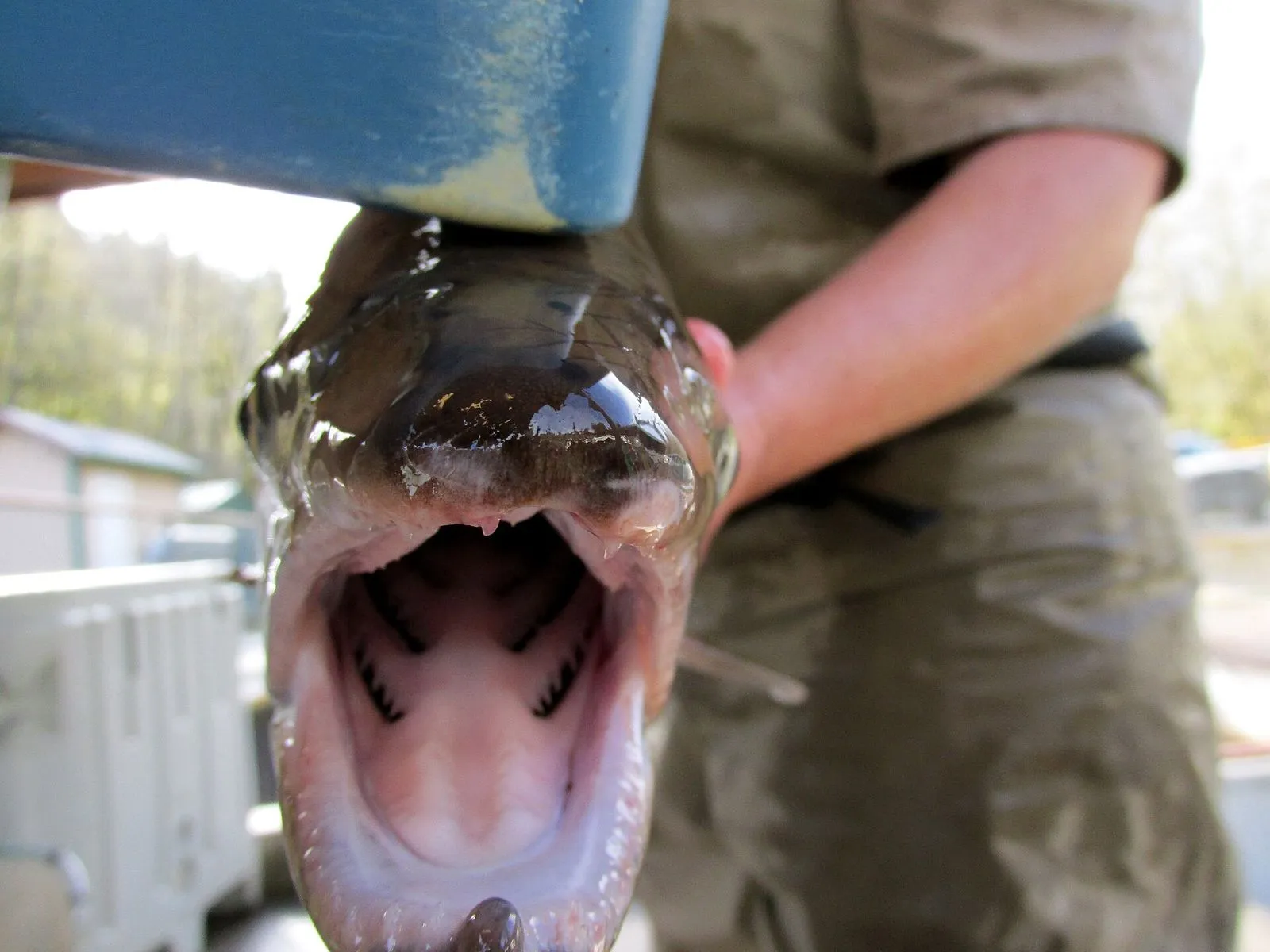
Fish have tongues, but a fish’s tongue is a fold of bone called the basihyal, with no muscles, no taste buds and almost no movement. It sits on the floor of the mouth and cannot lick or tell sweet from sour. Fish taste with their lips, their whiskers and, in catfish, their whole skin. That is how a catfish finds a chunk of cut bait in muddy water at night.
In 1983, Brusca and Gilligan examined 37 spotted rose snapper. Two had a female isopod sitting where more than 90% of the tongue had been. It is the only known case of a parasite functionally replacing a host organ.
What is a fish tongue made of?
Your tongue is a bundle of muscle covered in taste buds. A fish’s tongue is a bone. The basihyal is the front end of the hyoid, the set of bones that works the floor of the mouth and the gill covers. It sits under the skin as a small, stiff pad with no muscle of its own, so it cannot move by itself. It carries no taste buds, so it tastes nothing.
So why have one at all? BBC Science Focus gives the best guess. Right beneath the floor of the mouth runs the ventral aorta, the vessel that carries blood from the heart to the gills. A fish swallows its prey alive and whole, and a struggling minnow or crayfish could tear that vessel. The bony basihyal probably began as a shield for the artery, not as a tool for eating.
Can fish taste?
Yes, very well. Fish simply keep their taste buds somewhere else: on the lips, inside the mouth, on the barbels (the whiskers of a catfish or a carp) and on the skin. Water carries flavor straight to them, so a fish can taste a bait before it opens its mouth.
Catfish are the champions. A channel catfish carries taste buds over its whole body, whiskers to tail. It swims through a cloud of scent the way you walk into a kitchen where dinner is cooking. That is why it finds a chunk of cut shad in muddy water at night, and why what catfish eat is mostly a list of things that smell.
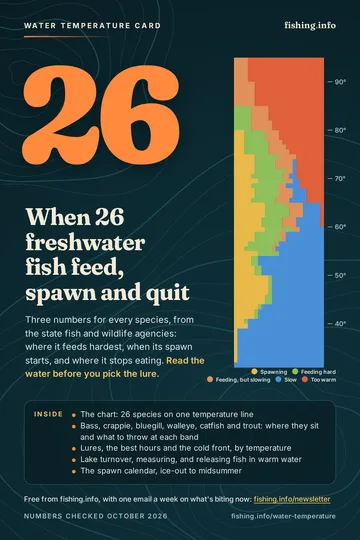
Free card: what 26 species do at your water temperature
Plus one email a week on what's biting now. No sales pitches. Privacy.
Do fish have teeth on their tongues?
Some do. Several fish carry small teeth on the basihyal, pointing backward to hold prey while the fish swallows. Salmon and trout are among them: their teeth line the jaws, the roof of the mouth and the tongue. A sea lamprey goes further. Its tongue sticks out and works as a rasp that files a hole in the side of another fish.
Do goldfish have tongues? A goldfish has the same bony floor of the mouth as every other bony fish, and no teeth on it, because it has no jaw teeth at all. It chews in its throat instead, where rows of pharyngeal teeth grind food against a bony plate. Watch one take a flake: the throat works, the tongue does nothing.
Do sharks have tongues? Yes, and theirs is cartilage instead of bone: a small, thick slab on the floor of the mouth, also called the basihyal. In most sharks it does nothing you could see. The exception is the cookiecutter shark, which uses it to tear round plugs of flesh out of tuna, dolphins and whales. A shark does not taste with it either; its taste buds sit on small bumps lining the mouth and throat.
What is the tongue-eating louse?
The isopod Cymothoa exigua is a sea-going relative of the roly-poly in your yard. It settles in a fish’s mouth and clamps onto the tongue, which withers to a stump. The louse stays, gripping the stump, and the fish goes on eating with a parasite where its tongue used to be.
The numbers come from Brusca and Gilligan, who examined 37 spotted rose snapper in 1983. Two carried a female isopod in place of more than 90% of the tongue. Whether the fish uses the louse as a working tongue for life has not been shown, as the Ethogram’s review of the study points out. The Australian Museum records other tongue-biting isopods; this one is the only parasite known to take an organ’s place.
Which fish has what tongue?
| Fish | Tongue | Teeth on it | Tastes with |
|---|---|---|---|
| Atlantic salmon | Narrow, bony basihyal | Yes; above it the vomer carries a single small row | Lips and the inside of the mouth |
| Brown trout | Broad, square basihyal | Yes; the vomer carries a well-developed zig-zag row | Lips and the inside of the mouth |
| Channel catfish | Bony basihyal, no taste buds | No | Barbels, lips and the whole skin |
| Goldfish and common carp | Bony basihyal | No; grinding teeth sit in the throat | Lips; a carp also with its barbels |
| Sharks | Small, thick slab of cartilage that does not move | No; the cookiecutter shark tears flesh with it | Taste buds lining the mouth and throat |
| Sea lamprey | Sticks out; a rasp | Yes, a rasping surface | Mouth, not the tongue |
| Spotted rose snapper with the louse | Gone; the isopod sits in its place | No | Lips and the inside of the mouth |
Salmon or brown trout? Check the mouth
An Atlantic salmon and a brown trout look alike in the hand, and the rules for keeping them are rarely the same. Maine Inland Fisheries and Wildlife separates them by the mouth. The check takes ten seconds.
- Keep the fish in the water or a wet net, and wet your hands. The fish should not pay for the check with its slime coat.
- Open the mouth gently and look at the roof. Down the center runs a narrow bone, the vomer.
- Count the teeth on the vomer. A single small row, a few teeth toward the front: Atlantic salmon. A well-developed row that zig-zags down the bone: brown trout.
- Look at the tongue. Narrow and tapering: salmon. Broad and square at the end: brown trout.
- Check that the two clues agree. If not, trust the vomer; the tongue shape is the confirmation.
- Decide before the fish goes in the cooler. The two fish are often under different limits on the same water, so check the rules for each.
What does this mean for catfish bait?
A channel catfish does not need to see your bait. The taste buds on its flank pick up the scent trail, and the barbels find the bait in the dark. So the bait’s job is to leak flavor, and yours is to leave it there long enough. The best catfish baits do exactly that: cut shad, chicken liver, dip bait. A bait moved every two minutes never builds a trail.
Does scent on a soft plastic matter?
A bass has taste buds on its lips and inside its mouth, so it tastes a worm the instant it closes on it. Salt, scent and flavor built into a soft plastic give the fish a reason to hold on a moment instead of spitting, and that moment is when the hook goes in. Nobody has measured how much longer a bass holds a scented worm, so treat the gain as a small edge, not a guarantee.
That tasting never switches off. A fish resting on the bottom at night still reads the water with its lips and skin, one reason a bait dropped on the nose of a quiet fish can work (do fish sleep?). More questions like this one, each with its number and its source: fish facts.
Free download
The water temperature card
Read your water temperature and the card tells you who is spawning, who is feeding and what to throw. 26 species, 16 pages, for your phone and the tackle box.
Plus one email a week on what's biting now. No sales pitches. Privacy.
Related
Section guide
Fish Facts: The Questions Kids Ask About Fish, Answered With the ScienceFish facts with a number and a source for each: how fish sleep, breathe, hear and feel, and what every answer means when you hook and release one.
 Do Fish Drink Water? Freshwater Fish, Saltwater Fish and Sharks
Do fish drink water? Freshwater fish barely do, saltwater fish drink all day, sharks cheat with urea. The numbers, and what it means for bait and livewells.
 Do Fish Drown? How Fish Suffocate, and How to Revive a Tired One
Do fish drown? Not by the dictionary, but they suffocate three ways: low oxygen, damaged gills, no water flow. How long a fish lasts in air, how to revive one.
 Do Fish Fart? Yes, Herring Do It on Purpose, and a Bloated Bass Needs Help
Do fish fart? Herring do, on purpose, and scientists won a prize for proving it. Which fish pass gas, where it goes, and what to do with a bloated bass.
 Do Fish Feel Pain? What the Studies Found, and What Decides Whether a Released Fish Lives
Do fish feel pain? They sense damage and react; whether they suffer is contested. The trout study, both camps, and what decides if a released fish lives.
 Do Fish Get Cold? What Winter Does to a Fish, and the Ones With Antifreeze in Their Blood
Do fish get cold? Yes: a fish is as cold as its water and feels it as slowness. What fish do in winter, who carries antifreeze, and how to fish cold water.
 Do Fish Have Bones, Hearts and Blood? What Is Inside a Fish
Do fish have bones? Most do; sharks run on cartilage and 16 icefish have clear blood. How skeleton, heart and blood work, and what it means for your fillets.
Sources
- Australian Museum, Do fishes have tongues? (FAQ)
- Australian Museum, Fish tongue biters: more than just one of a kind
- BBC Science Focus, Do fish have tongues?
- Maine Department of Inland Fisheries and Wildlife, The difference between salmon and brown trout
- The Ethogram (2020), Creature feature: the tongue-eating louse, on Brusca and Gilligan (1983)
- Burke Museum, Key to the Cyprinidae (carp and minnows): pharyngeal teeth
- Florida Museum of Natural History, Shark biology
- Basihyal (the fish tongue bone), overview