 By
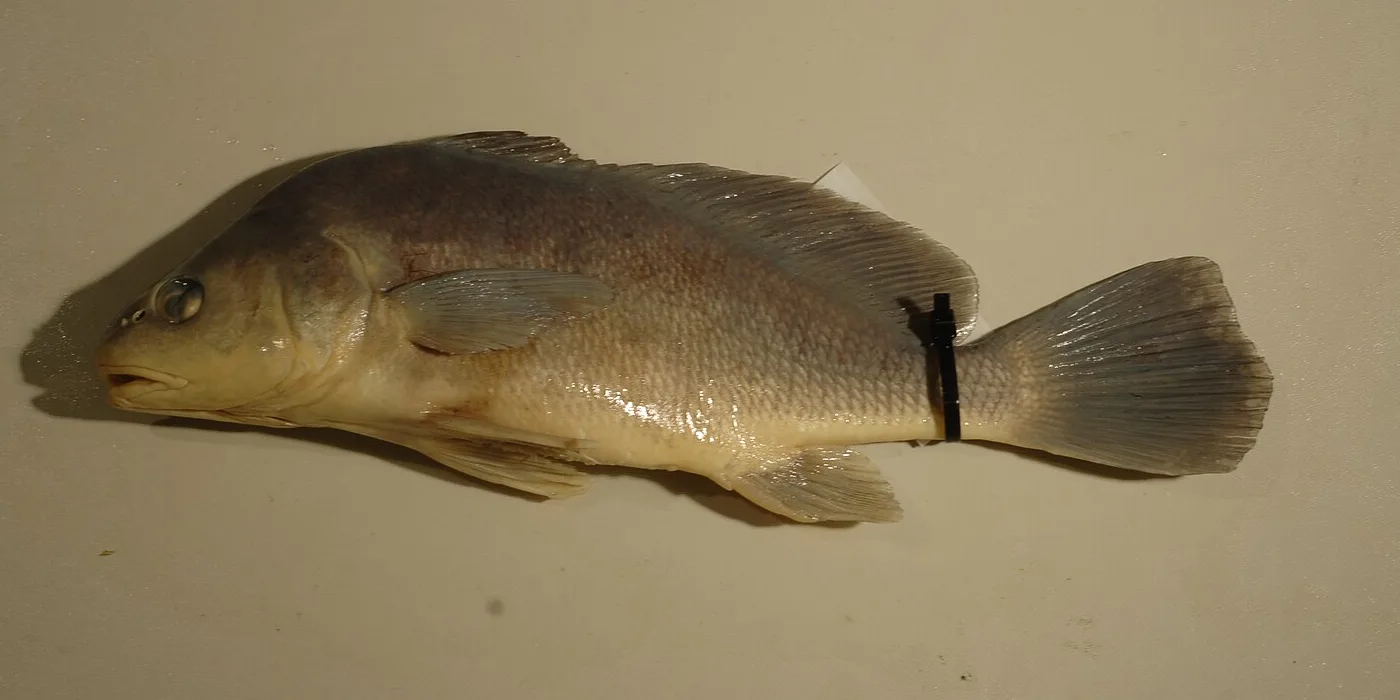
The freshwater drum is the only drum in North America that lives its whole life in fresh water: a silver, humpbacked bottom feeder of big rivers, lakes and reservoirs. Most weigh 12 oz to 5 lb, and the world record is 54 lb 8 oz. Northern anglers call it sheepshead, Louisiana calls it gaspergou, and Iowa’s advice for catching one fits on a line: a nightcrawler on the bottom, from the bank.
The “lucky stones” that beachcombers pick up on Lake Erie are drum ear bones. Rings on those stones aged one Lake Winnebago drum at 58 years.
What is a freshwater drum, and what else is it called?
It is the only North American freshwater member of the drum and croaker family, whose closest relatives are the red drum and black drum of the coast. Its range is the longest north to south of any North American freshwater fish, by the IGFA’s account: from Manitoba and Hudson Bay through the Mississippi basin and eastern Mexico to Guatemala.
The names change with the river. Missouri and Minnesota anglers say sheepshead or sheephead. Texas lists gaspergou and gou, which the National Park Service traces to the French casse-burgeau, “to break a clam.” Purdue’s Fishes of Indiana adds “white perch,” “rock perch,” “grinder” and “silver bass,” and Ohio adds “grunter,” “gray bass” and “silver perch.” The Ohio DNR writes that Native Americans called it the buffalo fish, because its grunt sounds like a bison.
One name causes most of the mix-ups: the sheepshead of the Atlantic and Gulf coasts is a different fish, a saltwater porgy with dark bars. The table below shows how to tell them apart.
How do you tell a freshwater drum apart?
Look at the back and the mouth. The drum’s head and body slope steeply up from a blunt snout to the dorsal fin, which gives it a hump. The mouth sits low, the lips are milky white, and the dorsal fin is long and split into two parts. The Minnesota DNR adds a mark no other freshwater fish has: the lateral line runs right through the tail.
| Fish | Water | Body and mouth | The mark to check |
|---|---|---|---|
| Freshwater drum | Fresh | Silver, humped, mouth low, white lips | Long two-part dorsal fin; lateral line into the tail |
| Common carp | Fresh | Large scales, gold to brown | Barbels at the mouth |
| Red drum (redfish) | Salt | Silver-gray with a copper cast | One or more dark spots toward the base of the tail; the freshwater drum has none |
| Black drum | Salt | Florida lists it as a sheepshead look-alike | Barbels on the chin; no incisor-like teeth |
| Sheepshead (saltwater) | Salt | Gray, oval, 5–6 dark vertical bars | Broad front teeth like incisors |
Feeding in the shallows, a drum can pass for a carp or a buffalo, the West Virginia DNR notes, and a small one for a shad. On a bigger fish the humpback settles it. And a drum is not a carp at all: it belongs to the drum family, while the common carp belongs to the carp family, Cyprinidae.
Free PDF · Water temperature chart Which fish are biting at today's water temperature?
One water temperature reading, and the 16-page chart tells you who's spawning, who's feeding hard, where they sit and what to throw. 26 fish, every number sourced.
Enter your email, confirm it with one click, and the PDF is in your inbox. Plus one email a week on what's biting. Unsubscribe anytime. Privacy.
Where do freshwater drum live, and when do they bite?
Drum live in the big water of the middle of the continent: from the western slopes of the Appalachians to the eastern slopes of the Rockies, by Texas Parks and Wildlife’s description. They are native to Lakes Michigan, Huron, Erie and Ontario. USGS also records stockings outside the native waters: Illinois lakes in the late 1800s and Colorado in the 1950s.
Look for them over sand, gravel or mixed mud and sand in large rivers, lakes and reservoirs. Iowa finds them in reservoirs at 30 ft or more, and Oklahoma at 20 to 60 ft, shallower in warm spells. They tolerate muddy water better than many fish. The Ohio DNR says they are mostly active at night, “when large schools of them feed in shallow water.”
| Season | Where the drum are | What to fish | Source |
|---|---|---|---|
| Spring (spawn) | Shallow gravel and sand shores, spawning at 65–72 °F (18–22 °C); schools drumming | Nightcrawlers on the bottom near the spawning shallows | Iowa DNR, West Virginia DNR, Keith Sutton |
| Summer | Deep holes, channel edges and ledges in big, dense schools; shallow at night | Nightcrawlers on the bottom; a 1 oz jig for deep fish | Keith Sutton, Ohio DNR |
| Fall | Feeding actively but scattered; young gizzard shad are over half the diet in some waters | Shad or minnows; cover water to find the fish | Keith Sutton, USFWS |
| Winter | Deep holes and channel edges in dense schools | A 1 oz jig lifted with a few upward flips | Keith Sutton |
The spawn temperatures come from the Iowa DNR (66–72 °F on the Mississippi in May and June) and the West Virginia DNR (65–70 °F in April and May). Texas drum may spawn in April or May. The deep schools of summer and winter, and the scattered fall fish, are the pattern Arkansas writer Keith Sutton describes from years of fishing for drum. In his experience they bite from January through December, if you can find them.
How do you catch freshwater drum?
Fish a bait on the bottom where the current breaks. The Arkansas Game and Fish Commission gives the simplest rig:
- Slide an egg sinker of about 1/2 oz onto the main line, heavier in strong current.
- Tie on a barrel swivel so the sinker can slide.
- Add a monofilament leader of about 12 in.
- Finish with a No. 2 or 4 baitholder hook, or a light-wire No. 1 circle hook.
- Bait it with worms, a crawdad tail or a piece of cooked shrimp.
It is built like a Carolina rig, a sliding sinker, a swivel and a leader, with bait in place of a plastic. Drum have small mouths, so a small hook works better. They also bite lightly and swallow the bait, which is why the commission likes the circle hook: tighten the line instead of setting the hook hard.
For line, the commission suggests 15 to 20 lb mono or 20 to 30 lb braid. Braid is thinner, so the current pulls less on it while you wait. Anchor above a current break, an eddy or a drop-off. Cast several rods to different depths, and stay put once one fish bites, because drum travel in schools.
Worms have probably caught more drum than any other bait, the commission writes. Sutton threads as many nightcrawlers as fit on a No. 1 or 2 baitholder hook, and he likes small-hook jigs for deep fish in summer and winter. The guests on a U.S. Fish and Wildlife Service podcast agree: “Worms on bottom. You can’t go wrong with that.” They also use small jigs, crayfish mimics and shrimp, “like you’re fishing for catfish.” Drum often take a bass angler’s grub, swimbait or jig fished near the bottom, and Sutton lists spinners, spoons, crankbaits, blade baits and jerkbaits among the lures that have caught him drum.
A hooked drum pulls hard but does not jump. Sutton reports more than 50 drum in two hours on a nightcrawler, eight of them over 10 lb, on a hot August day when the bass and catfish would not bite.
How big do freshwater drum get?
Most are 12 to 20 in long. Missouri gives 12 oz to 5 lb as the usual weight, with a state maximum of about 40 lb. The big ones are big, though, and the top records are decades old.
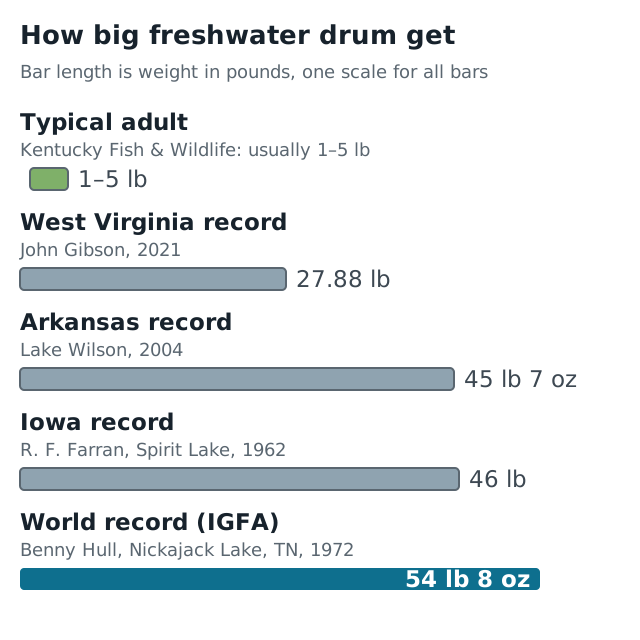
The IGFA all-tackle record is 54 lb 8 oz (24.72 kg), caught by Benny Hull at Nickajack Lake, Tennessee, on April 20, 1972. Iowa’s record of 46 lb, 38.5 in long, came from Spirit Lake in 1962. Texas lists a rod-and-reel record over 30 lb and a trotline record of 55 lb.
Drum rules vary by state. Missouri counts them in its combined daily limit of nongame fish. Check your state’s rules before you keep a big catch or try bowfishing for them.
Are freshwater drum good to eat?
Yes. Many anglers call the drum a rough fish, but the West Virginia DNR calls it “excellent to eat,” and Texas says it is “prized as a food fish in some areas.” The Arkansas Game and Fish Commission says the fillets have no intermuscular bones and the meat is firm.
How you treat the fish decides most of it. Ice it as soon as you can; Sutton warns that a drum on a stringer or in a wire basket dies fast and the flesh soon spoils. Fillet it like a bass and trim the dark red meat along the lateral line. Then fry it in seasoned cornmeal, blacken it like redfish, or make poor man’s lobster: cubes boiled for 5 to 7 minutes in crab boil and served with a butter dipping sauce. Arkansas adds one condition: drum are best “when caught out of cool water.”
In an Ohio Sea Grant taste test, MeatEater reports, 75% of tasters said their attitude toward drum improved after trying it. Check your state’s fish advisory for the water you fish before you keep drum to eat. The EPA says most people are not at risk from fish caught in U.S. waters, but pregnant women, children, older adults and people who eat a lot of fish should follow the local advice.
Why do drum grunt, and what are the lucky stones?
The drum gets its name from its sound. Special muscles vibrate against the swim bladder, and Oklahoma notes the grunt comes from mature males in the spawning season. When schools spawn in the shallows, the U.S. Fish and Wildlife Service says the drumming can be loud enough to hear from shore. The National Park Service adds that anglers can feel a hooked drum vibrate “like a cell phone.” How fish hear such sounds is the subject of our page on whether fish can hear.
The lucky stones are the drum’s otoliths, the ear stones a fish uses for balance. The Minnesota DNR says a drum’s can be more than 1 in across, and they have been used as currency, jewelry and good luck charms. West Virginia describes a distinct “L” shape carved into each one. Biologists count their yearly rings like a tree’s.
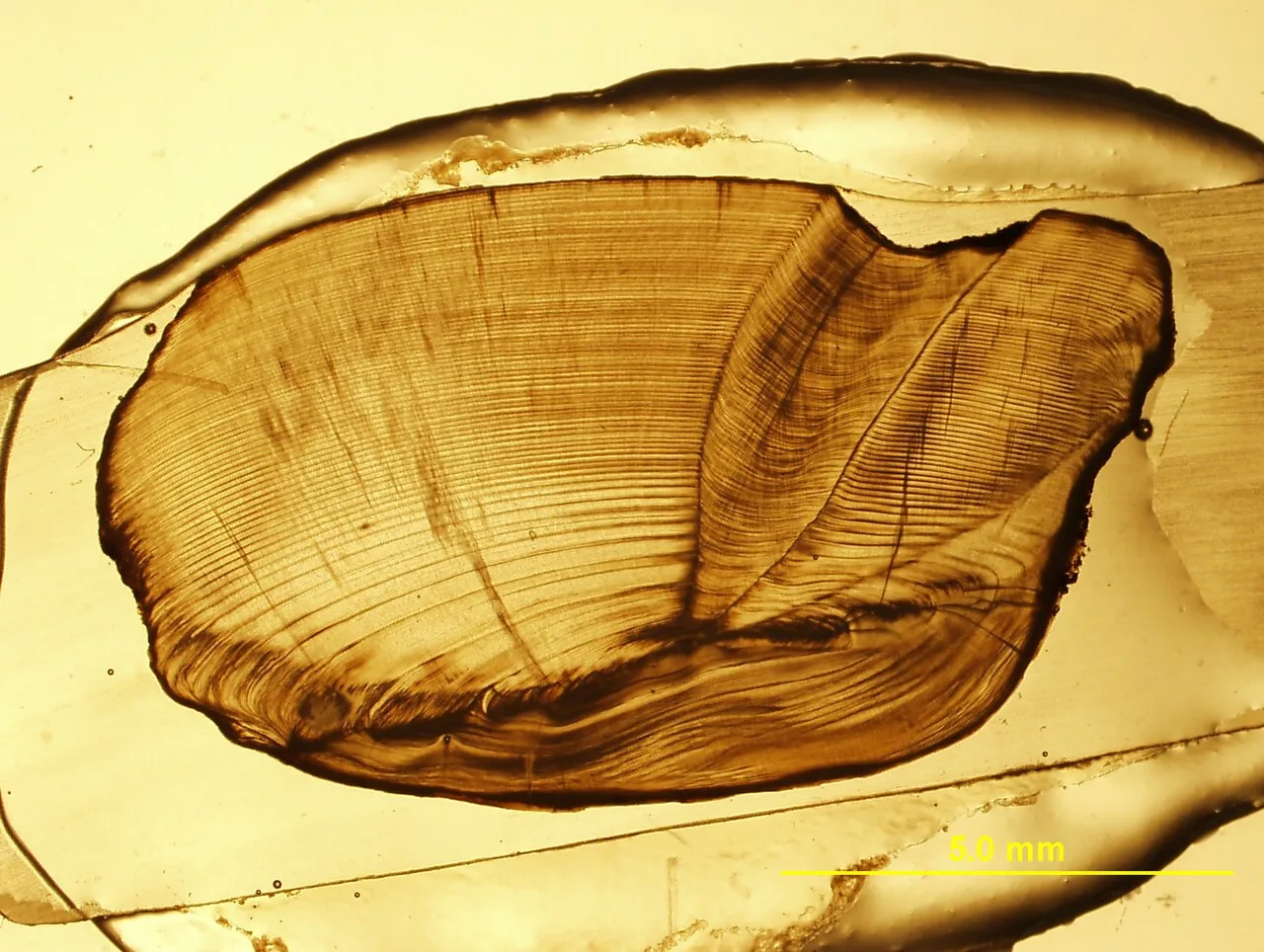
A sectioned freshwater drum otolith from an archaeological site on Doty Island, Lake Winnebago, Wisconsin, with its growth rings; the uploader aged this fish at 74 years. Photo: Hockeypoc, Wikimedia Commons (CC BY-SA 3.0).
For Lake Winnebago drum, bomb radiocarbon dating confirmed the ring counts to at least 52 years, give or take two, and the oldest fish in that study was 58. The average drum lives 6 to 13 years.
The throat holds the other tool: heavy, molar-like throat teeth that crush crayfish and shells. Drum eat zebra mussels in Lake Erie, Texas notes, though not nearly enough to control them. Missouri calls the old idea that drum live on mussels a myth: they eat mainly fish, crayfish and insect larvae.
Drum spawn in open water, and their eggs float to the surface, which West Virginia calls unique among North American freshwater fish. The young feed walleye, bass and perch, and in Texas freshwater drum are among the most common foods of the alligator gar. For the rest of the fish outside the bass, trout and catfish families, start at the freshwater fish species hub.
Free PDF · 16 pages
Know what's biting before your first cast
The Water Temperature Fishing Chart. Take one water temperature reading, find it on the chart, and you know which of 26 freshwater fish are feeding today, where they are and what to throw. For your phone and the tackle box.
- Where they sit and what to throw at every band: bass, crappie, bluegill and walleye; catfish by species; trout: when to stop and where they hide
- The best hours at your reading, the cold front day by day, and the spawn calendar from ice-out to midsummer
- The three thermometer mistakes that make a reading lie (the first one is the surface)
- The 26-fish chart: who's spawning, feeding hard or shut down at your reading
Every number from state fish and wildlife agencies and fisheries research: 61 sources, all on the site.
Enter your email, confirm it with one click, and the PDF is in your inbox. Plus one email a week on what's biting. Unsubscribe anytime. Privacy.
Related
Section guide
Freshwater Fish Species Outside the Big Families: Sturgeon, Gar, Bowfin, BurbotThe freshwater fish species outside the bass, trout, catfish and pike families: sturgeon, gar, bowfin, burbot, drum, eel and paddlefish, with records.
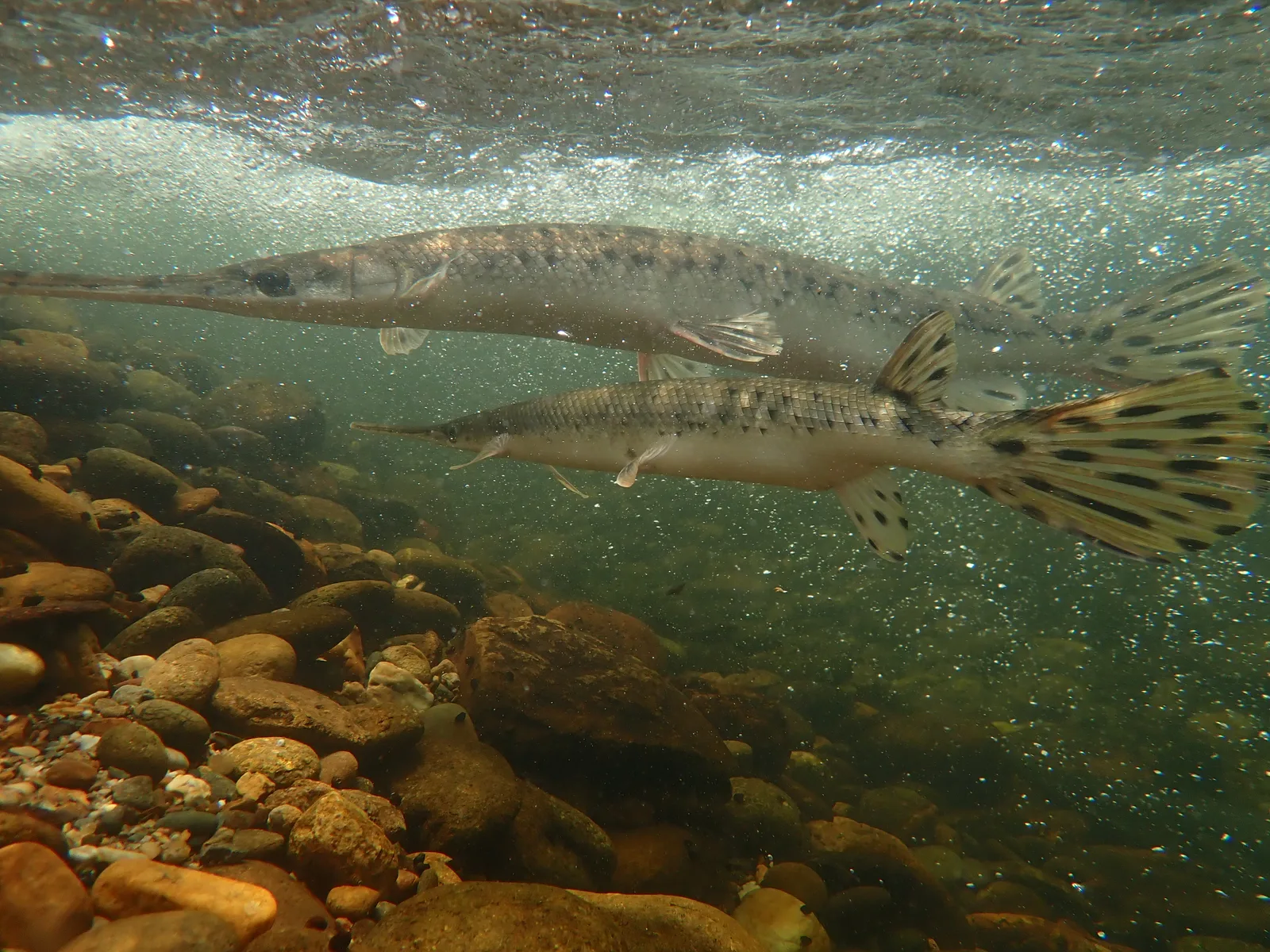 Longnose Gar: Identification, Size, Records, and How to Catch One
Longnose gar commonly reach 3 ft and 5 to 6 lb; the IGFA record is 43 lb, yet four states certify bigger fish. How to ID, find and catch one.
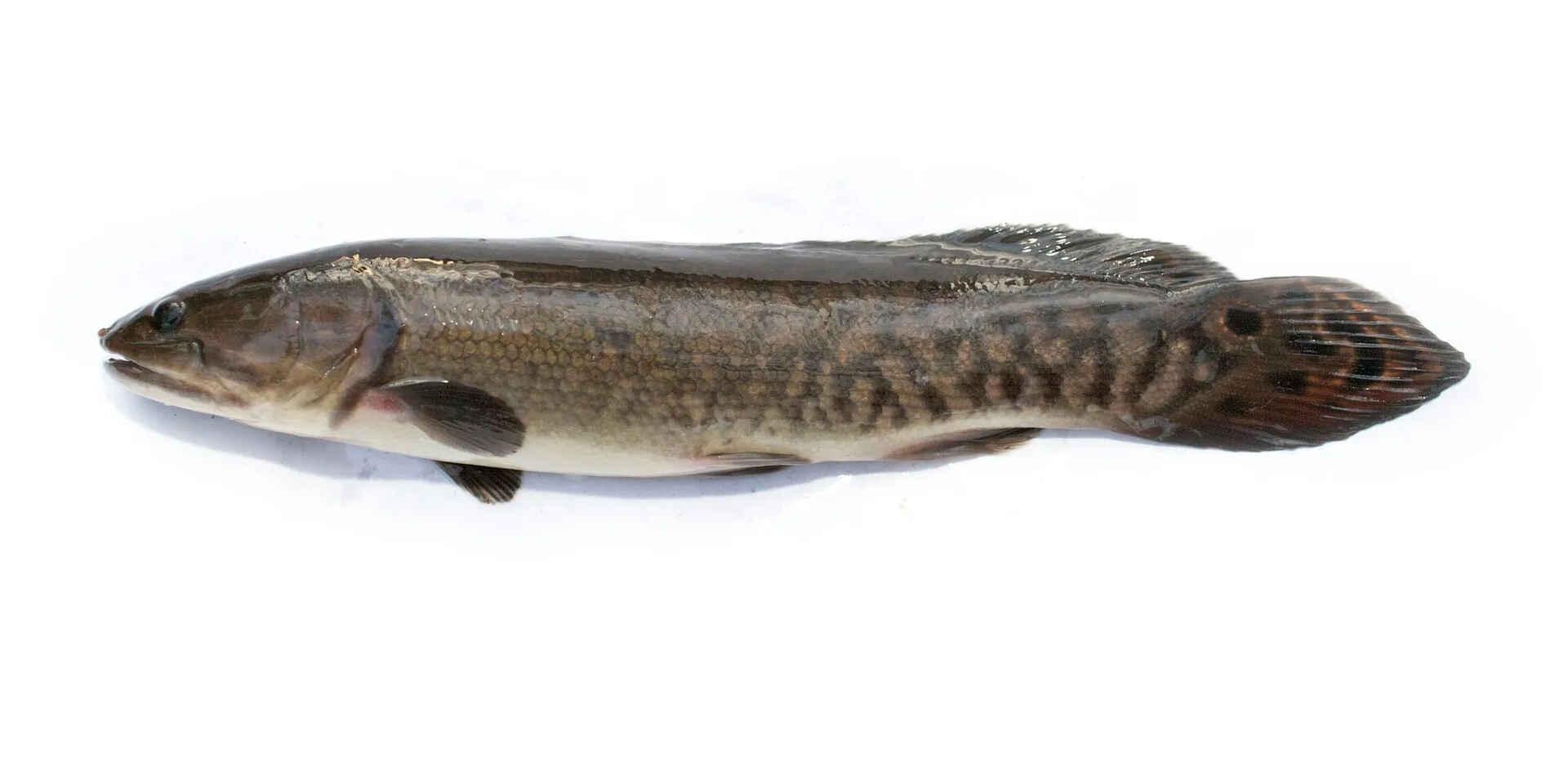 Bowfin: Identification, Bowfin Fishing, and the Snakehead Look-Alike
The bowfin is a native, air-breathing predator with a 21 lb 8 oz world record. How to identify one, tell it from a snakehead, and catch one.
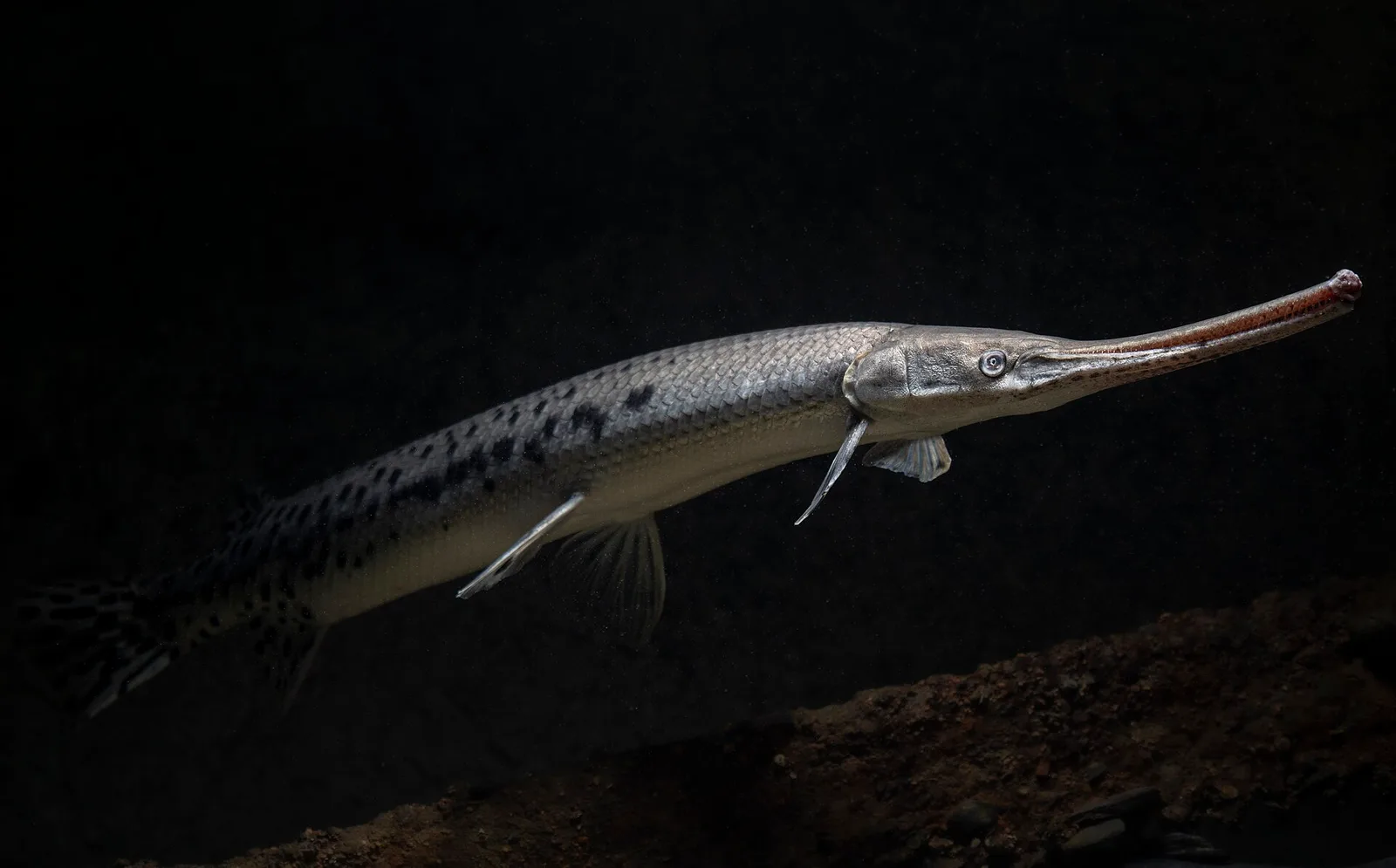 Gar Fishing: Rope Lures, Live Bait and Bowfishing for Every Gar
Gar fishing for all five US gars: hookless rope lures, live bait, fly and bow, the alligator gar rig, and how to handle a mouth full of teeth.
 Sturgeon: The Nine US Sturgeons, How Big and Old They Get, and the Rules
Nine sturgeons live in US waters and six may never be kept. How to tell them apart, how big and old they get, the records and where you can fish.
- Alligator Gar: Size, Teeth, Records, and How to Catch One
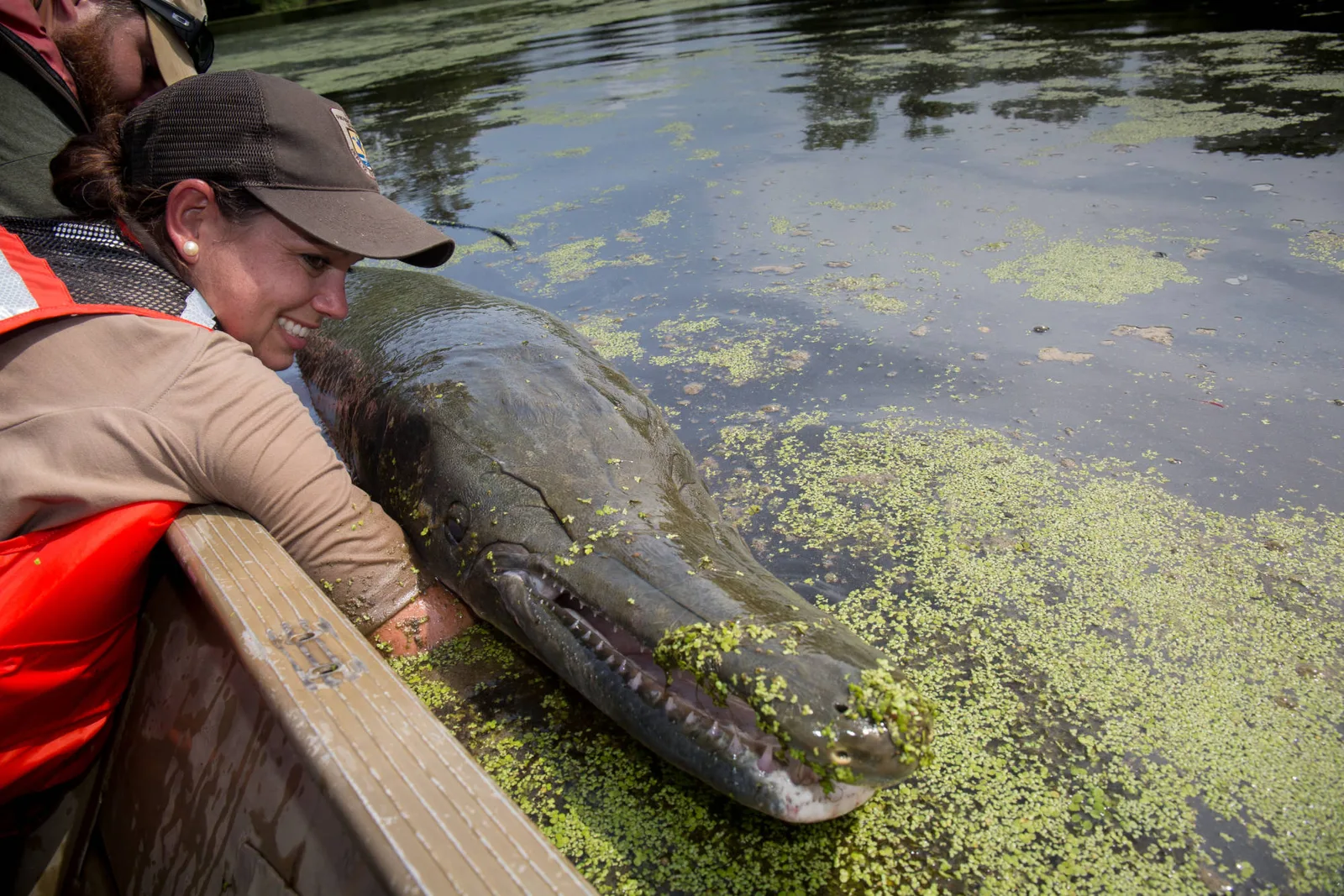
Alligator gar reach 8 ft and 300 lb and can live past 90 years. How to tell them from other gars, how to catch one, the records and the rules by state.
 Burbot: The Freshwater Cod That Spawns Under the Ice
Burbot, the only freshwater cod: one chin barbel, 15–28 in, 1.5–5 lb. When and where they bite through the ice, the glow jig that works, and the rules.
Sources
- International Game Fish Association, World record search: drum, freshwater, all-tackle (member-portal API, read 2026-11-01)
- Missouri Department of Conservation, Freshwater drum (field guide)
- Texas Parks and Wildlife, Freshwater drum (Aplodinotus grunniens)
- Iowa DNR, Fish Iowa: freshwater drum
- Minnesota DNR, Freshwater drum (sheepshead)
- Ohio DNR, Freshwater drum
- Kentucky Department of Fish & Wildlife Resources, Freshwater drum
- West Virginia DNR, Freshwater drum
- Oklahoma Department of Wildlife Conservation, Freshwater drum (field guide)
- Arkansas Game and Fish Commission, Chuck Long (2020), Drumming up spring fishing excitement
- U.S. Fish and Wildlife Service, Daniel Kemp (2023), Freshwater Drum: The Great Grunting Gaspergoo
- National Park Service, Mississippi National River and Recreation Area: Freshwater drum/sheepshead
- USGS Nonindigenous Aquatic Species, Aplodinotus grunniens fact sheet
- Purdue University, Fishes of Indiana: freshwater drum (other common names)
- CALS Encyclopedia of Arkansas, Freshwater drum
- Davis-Foust, S. L., R. M. Bruch, S. E. Campana, R. P. Olynyk and J. Janssen (2009), Age Validation of Freshwater Drum using Bomb Radiocarbon, Transactions of the American Fisheries Society 138(2):385–396
- Keith Sutton, Six Reasons to Fish for Freshwater Drum (Bass Pro Shops 1Source)
- MeatEater, Trash Fish Tuesday: Freshwater Drum (2019)
- South Carolina DNR, Sheepshead (Archosargus probatocephalus)
- Florida Fish and Wildlife Conservation Commission, Sheepshead
- USGS Nonindigenous Aquatic Species, common carp fact sheet
- Missouri Department of Conservation, Freshwater drum: fishing regulations (nongame fish limits)
- Texas Parks and Wildlife, Alligator gar fast facts (diet)
- South Carolina DNR, Red drum (Sciaenops ocellatus): identification
- Missouri Department of Conservation, Common carp (field guide): family Cyprinidae
- U.S. EPA, Should I be concerned about eating fish and shellfish?