 By
Fish is meat in the plain sense, because a fillet is an animal’s muscle. But Catholic Lent rules and US food law both count it as something else. Neither side is wrong. They’re using one word for two different things. So your answer depends on who’s asking.
US food law says meat comes from “cattle, sheep, swine, or goats” and leaves fish out. Then the Federal Meat Inspection Act covers one group of fish anyway: catfish.
Is fish considered meat? Here’s who says what
Find the row that fits you. That’s your answer, and you can skip the rest.
| Who’s asking | Is fish meat? | What that rests on |
|---|---|---|
| A biologist | Yes | A fillet is the muscle of an animal with a backbone |
| A dictionary | Yes, with a catch | Wiktionary: the “flesh” of an animal used as food, “often understood to exclude fish and other seafood” |
| US food law | No | 9 CFR 301.2 names cattle, sheep, swine and goats, and treats horses the same way |
| World Health Organization | Not red meat | Red meat is “all mammalian muscle meat” |
| Catholic Church in Lent | No | US bishops: “Fish are a different category of animal” |
| Orthodox Church in Great Lent | Off the menu, like meat, most days | One parish’s rule: fish “only on the feasts of Annunciation & Palm Sunday” |
| Jewish kosher law | No | My Jewish Learning: fish is “pareve, neither meat nor dairy” |
| Islam | Its own rule | Quran 5:96 makes seafood lawful, and fish skip ritual slaughter |
| Hindu practice | No single answer | Varies by region and caste |
| Vegetarian Society | Off the plate either way | “simply stop eating meat and fish” |
| Pescatarian | Yes, the only one eaten | Seafood is “the only source of meat in a diet” |
| Vegan | Off the plate | Excludes “meat, fish and other animal seafood” |
And yes, a fish is an animal. It has muscle, blood and a skeleton, as do fish have bones shows from the inside. The argument is only ever about the word.
Why is fish not considered meat?
Blame the word. From the 700s on, “meat” meant food in general, especially solid food. The sense we use now, the flesh of a killed animal, turned up in the 1300s. Even today Wiktionary notes that sense is “often understood to exclude fish and other seafood.” Webster’s leans the same way: “the flesh of an animal (especially a mammal) as food.” The American Meat Science Association goes the other way and counts “fish/seafood” as meat.
Fish also eats differently, and that keeps the two apart in the kitchen. A fish has less of the tough connective tissue that holds a steak together. The FAO, the UN’s food agency, gives that as one reason fish is generally less tough than meat.
A fillet is a stack of muscle blocks with thin sheets of connective tissue between them, a few millimeters thick. The collagen in those sheets doesn’t hold its shape in the pan the way a mammal’s does.
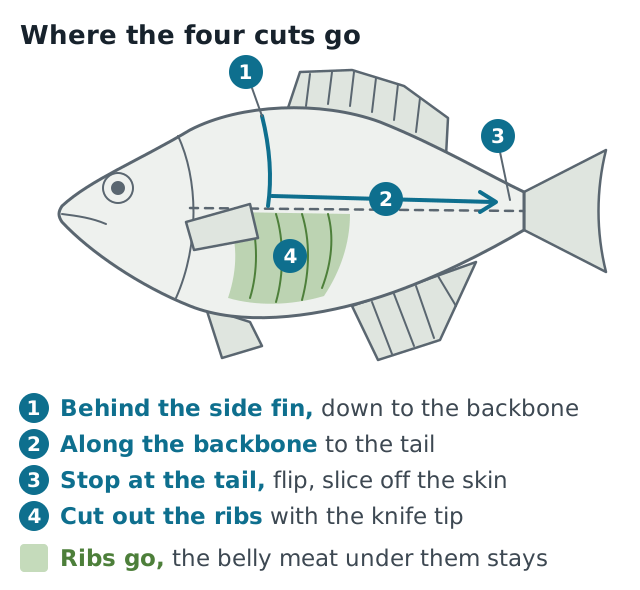
The fillet is the muscle along the fish’s side. Drawing: fishing.info
Free PDF · 7-day beginner fishing pack Starting fishing? What do you buy, what does it cost, and what do you do at the water?
The 16-page beginner pack: the $85–100 kit with the spec to ask for in the store, the license rules, the first knot, the rig drawn, the cast, the bite and the release. A free seven-day email course comes with it, one step a day.
No card, nothing to buy, and the PDF is yours to keep. Confirm with one click and it's on its way. Then a few short emails and one a week on what's biting. Unsubscribe anytime. Privacy.
Is fish meat during Lent?
Not for Catholics. On Ash Wednesday and the Fridays of Lent, Catholics 14 and over skip meat, and fish is allowed. The US bishops spell it out: meat “comes only from animals such as chickens, cows, sheep or pigs,” all of which live on land. Birds count as meat too.
“Salt and freshwater species of fish, amphibians, reptiles, (cold-blooded animals) and shellfish are permitted,” the bishops say. So a Friday plate of walleye is fine, and so are frog legs. They do add that a “lavish buffet at your favorite seafood place sort of misses the point.”
Church law names every Friday of the year. It also lets each country’s bishops set the details or swap in another penance. So ask your own diocese about Fridays outside Lent.
Why fish and not beef? Thomas Aquinas gave a reason in the 1200s. Land animals are “more like man in body,” he wrote, so “they afford greater pleasure as food.” That’s why the Church forbade fasters “to eat flesh meat, rather than to eat fish.”
Orthodox Christians draw the line in a different place. In Great Lent, the strict rule takes fish off the table too. The Church of the Nativity in Erie, Pennsylvania, puts it plainly: “Fish is allowed only on the feasts of Annunciation & Palm Sunday.” Parishes differ, so ask yours.
Two American stories show how far this goes. Catholics Downriver from Detroit have eaten muskrat on Lenten Fridays since the 1780s. A 2002 archdiocesan document calls it “a long-standing permission.” The bishop of Lansing wrote in 1987 that the archdiocese had told him “no dispensation was ever given.” He put it down to immemorial custom instead, even though a muskrat is a warm-blooded mammal.
Then there’s the Filet-O-Fish. Lou Groen ran a McDonald’s on the west side of Cincinnati. On Lenten Fridays his Catholic customers went to a nearby Frisch’s Big Boy for a fish sandwich. So he built his own. On Good Friday 1962, he sold 350 of them at 25 cents each.
Is fish red meat, white meat or poultry?
Fish isn’t red meat and it isn’t poultry, so you can cross both off. The World Health Organization defines red meat as “all mammalian muscle meat,” and a fish isn’t a mammal. US rules define poultry as “any domesticated bird.”
White meat is the loose one. “White fish” is a real term for lean fish, such as cod and haddock. They carry only “a small strip of dark, or red, muscle just under the skin,” the FAO says. Fatty fish have much more of that dark muscle.
Fish muscle usually runs 15 to 20 percent protein, per the FAO. Fat is the big difference. It’s usually under 1 percent in the cod family. In fatty fish it swings with the season. A starved herring may have as little as 0.5 percent. One that’s been feeding heavily can top 20.
Why does the US inspect catfish under its meat law?
This is the odd one, and it comes straight from Congress. The legal definition of meat doesn’t mention fish. But the Federal Meat Inspection Act lists “all fish of the order Siluriformes” among the species it covers, and that order is the catfish.
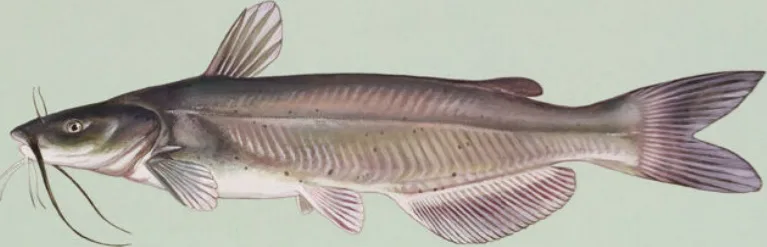
Channel catfish. Illustration: Duane Raver, U.S. Fish and Wildlife Service (public domain)
Farm bills in 2008 and 2014 made that change, and the inspection rule took effect March 1, 2016. Catfish moved to the USDA, while the FDA kept every other fish. So a channel catfish on a processing line is handled under a meat law, even though the law’s own definition of meat leaves it out.
Does the Bible say fish is meat?
It treats fish as flesh, but as its own kind. The line is 1 Corinthians 15:39 in the King James Version. “All flesh is not the same flesh: but there is one kind of flesh of men, another flesh of beasts, another of fishes, and another of birds.” Leviticus 11:9–12 is where the fins-and-scales rule below comes from.
Is fish kosher?
Only if it has fins and scales. That’s the Torah’s own test, and it means the scales must be visible and easy to remove. Fish is pareve, meaning neither meat nor dairy, so it needs no separate dishes. It needs no ritual slaughter either. Chabad says that “as soon as a fish is removed from the water it is considered slaughtered.”
Orthodox practice keeps fish and meat apart in cooking and serving. Conservative sources have dropped that rule, per My Jewish Learning.
Here’s how the fish you’re likely to catch stack up on two well-known lists.
| Fish | Kosher? | Who lists it |
|---|---|---|
| Bass | Yes | Chabad, My Jewish Learning |
| Trout | Yes | Chabad, My Jewish Learning |
| Salmon | Yes | Chabad, My Jewish Learning |
| Walleye | Yes | My Jewish Learning, in the perch group |
| Perch | Yes | Chabad, My Jewish Learning |
| Bluegill | Yes | My Jewish Learning |
| Pike | Yes | Chabad, My Jewish Learning |
| Carp | Yes | Chabad |
| Crappie | Not on either list | Ask before you serve it |
| Catfish | No | Chabad |
| Eel | No | Chabad |
| Sturgeon | Disputed | Chabad says no, the Conservative movement says yes |
| Swordfish | Disputed | Chabad says no, the Conservative movement says yes |
| Shrimp, crab, lobster | No | Chabad |
Is fish halal?
Yes. Islam treats it under its own rule, so the question there isn’t whether fish is meat. It’s whether it’s lawful. Quran 5:96 says, in Mustafa Khattab’s translation: “It is lawful for you to hunt and eat seafood.” Fish also skips the slaughter that land animals need. “The jurists mention that fish can be eaten without slaughtering,” writes Abdullah James Clarke in The Halal Life.
The schools of Islamic law differ on the rest of the sea. The Hanafi school reads the verse as “fish only,” so its rulings leave out lobster and oysters. Its scholars don’t agree on whether prawns and shrimp count as fish. The Shafi’i and Hanbali schools allow everything that lives in the sea, and the Maliki school does too, except eel. Cooking for a Muslim friend? Ask what they follow.
Do Hindus eat fish?
Many do. Hinduism has no single food rule, and practice shifts with region and caste. In Pew’s 2021 survey of India, 44 percent of Hindus called themselves vegetarian, and Pew left the word’s meaning up to each person. That figure runs from 71 percent in the North to 18 percent in the East. Pew’s report on it doesn’t mention fish.
Fish and seafood are a staple across eastern and coastal southwestern India. Many Brahmins avoid fish, with “significant exceptions, especially in Bengal, Kashmir, and some other parts of north India.”
Do vegetarians eat fish?
No. The Vegetarian Society’s definition is one line: “simply stop eating meat and fish.” Vegans skip fish too, along with eggs, dairy and honey. Someone who eats fish but no other meat is a pescatarian, a diet where seafood is “the only source of meat.”
Whether that counts as vegetarian is still argued. The Pescetarian Society calls it “a form of vegetarianism.” The Vegetarian Society’s definition rules it out. For some people the question is whether a fish suffers, which is what do fish feel pain gets into.
Is seafood meat? What about shrimp?
Shrimp splits the rule books harder than fish does. Catholic Lent allows shellfish. Kosher law doesn’t. Islamic schools are divided. Vegetarians skip it. Cut one open and you’ll find animal muscle, same as a fillet.
What does this mean for the fish in your cooler?
A keeper, a fish that’s legal to keep, is fine on a Friday in Lent. Check the size and limit rules first, same as any other day.
Cooking for friends? Ask before you serve. Don’t assume fish is safe for a vegetarian, and don’t guess at kosher or halal. For fish from a store without kosher supervision, Chabad says you need to see “the scales on the fish, or at least the indentations in the skin.” So keep the fish whole until you’ve asked, and put the fillet knife away for now.
Then there’s the part that matters for your health. The Dietary Guidelines for Americans recommend “At least 8 ounces of seafood (less for children) per week based on a 2,000 calorie diet.” Fish that family or friends caught gets its own FDA rule. “Check for fish and shellfish advisories to tell you how often you can safely eat those fish.” And the line worth repeating at the water: “If there is no advisory, eat only one serving and no other fish that week.”
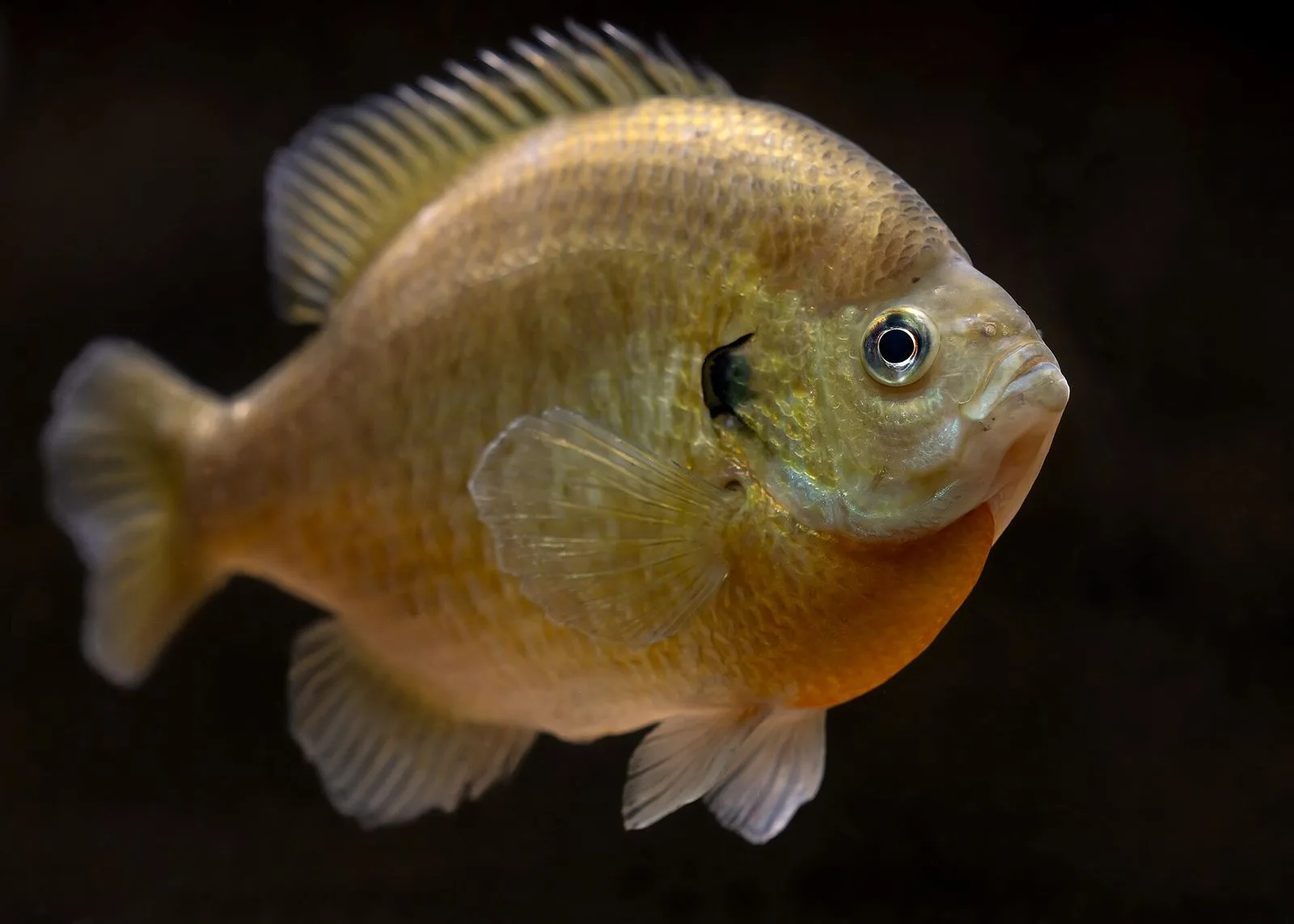
Which fish are worth keeping is its own question. Is bass good to eat? and are northern pike good to eat? start there, and more odd questions like this one are in fish facts.

Free PDF · 16 pages
Your first fishing trip, from the store aisle to the first fish
Lost in the tackle aisle, the wrong gear in the cart, and home with nothing. Skip all of that.
The 7-Day Beginner Fishing Pack. A 16-page PDF plus a free seven-day email course, one step a day: the whole first trip in order, from the store to the release.
- Walk out of the store with the right rod and nothing extra: the $85–100 kit, item by item
- Know if you need a license, in 13 states, and the places where nobody needs one
- What to do when the bobber goes under, and the ten-second rule for letting the fish go
Every line from the beginner pages on fishing.info and the 247 sources behind them, the U.S. Fish and Wildlife Service and the Missouri Department of Conservation among them.
No card, nothing to buy. Confirm with one click and the PDF is on its way, one version for your phone and one to print, yours to keep. Then a few short emails and one a week on what's biting, with an unsubscribe link in every one. Privacy.
Related
Section guide
Fish Facts: The Questions Kids Ask About Fish, Answered With the ScienceFish facts with a number and a source for each: how fish sleep, breathe, hear and feel, and what every answer means when you hook and release one.
 Biggest Fish Ever Caught: A 2,664 lb Great White on Rod and Reel
The biggest fish ever caught on rod and reel is a 2,664 lb great white from 1959. The IGFA top 10, the bigger fish that don't count, and the US giants.
 Do Fish Drink Water? Freshwater Fish, Saltwater Fish and Sharks
Do fish drink water? Freshwater fish barely do, saltwater fish drink all day, sharks use urea. Do fish get thirsty? Why bait dies in the wrong water.
 Do Fish Drown? How Fish Suffocate, and How to Revive a Tired One
Can fish drown? No, they suffocate. Exhausted trout survived 62% after 30 seconds in air, 28% after 60, so the rule is 10 seconds. Never pull one backward.
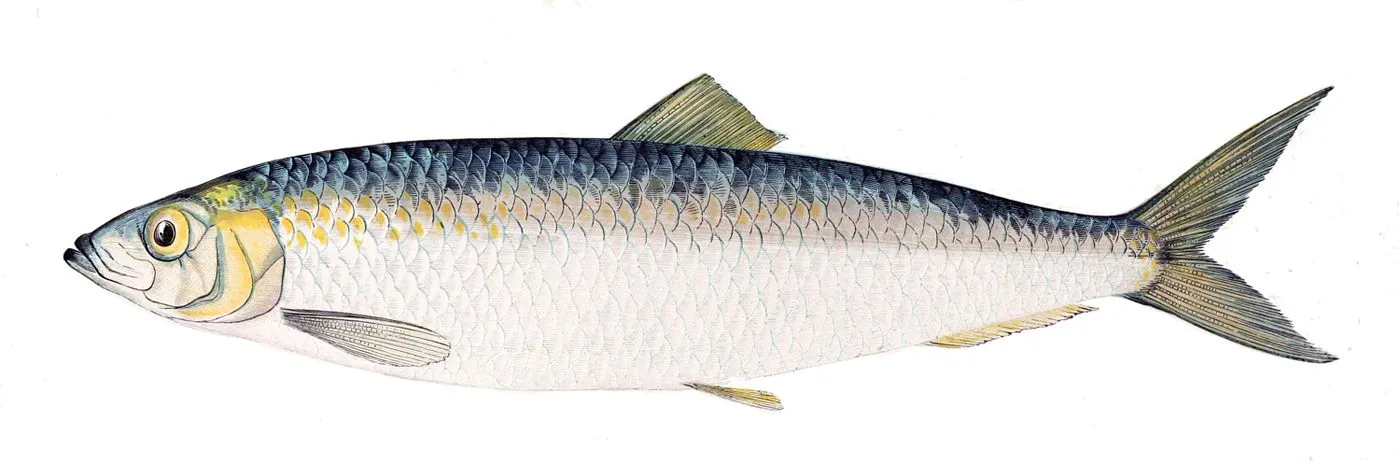 Do Fish Fart? Yes, Herring Do It on Purpose, and a Bloated Bass Needs Help
Do fish fart? Herring do, on purpose, and won scientists a prize. Which fish fart, which only burp, where the bubbles go, and how to help a bloated bass.
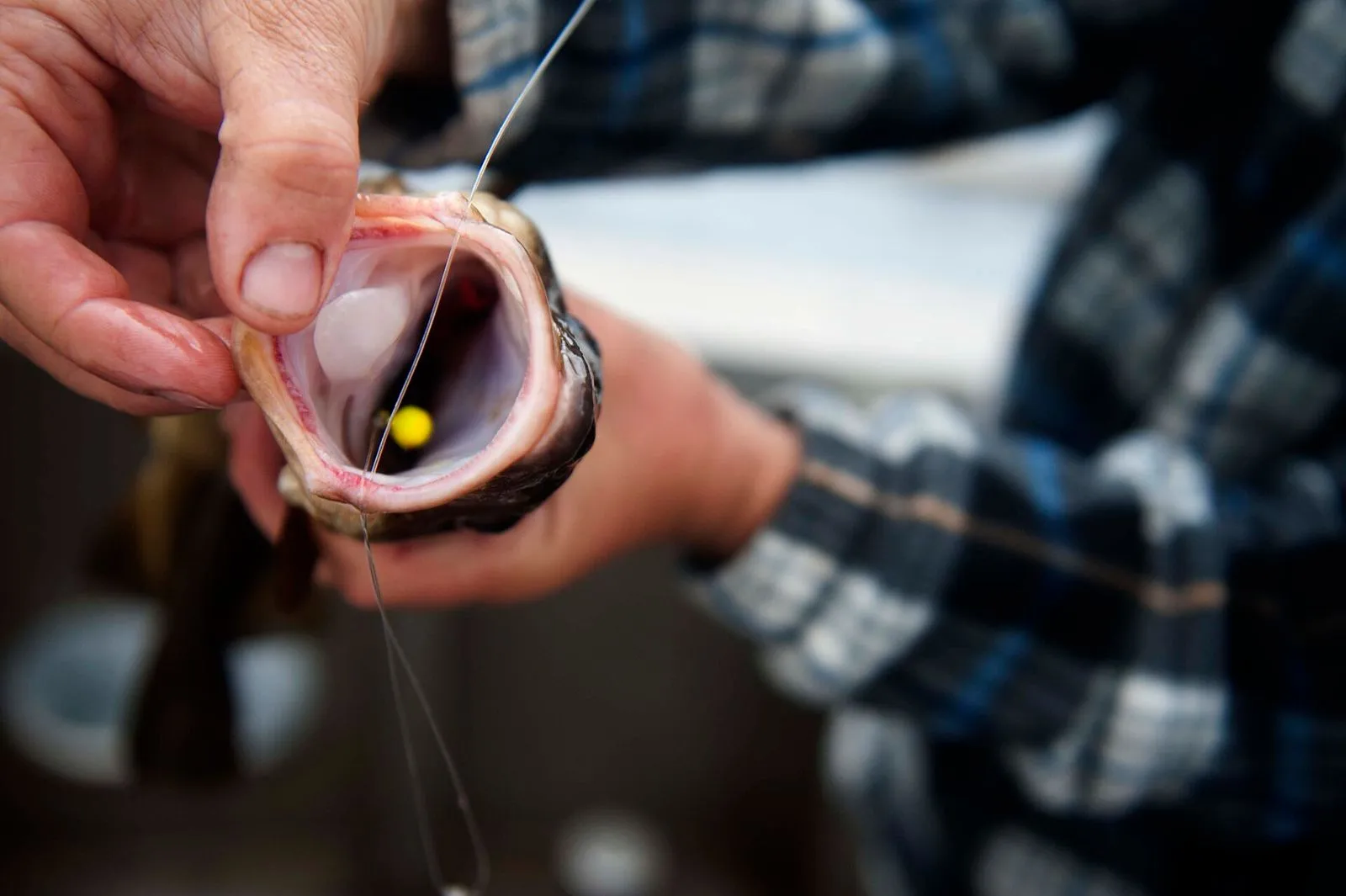 Do Fish Feel Pain? What the Studies Found, and What Decides Whether a Released Fish Lives
Do fish feel pain? They sense damage and react; whether they suffer is contested. The trout study, both camps, and what decides if a released fish lives.
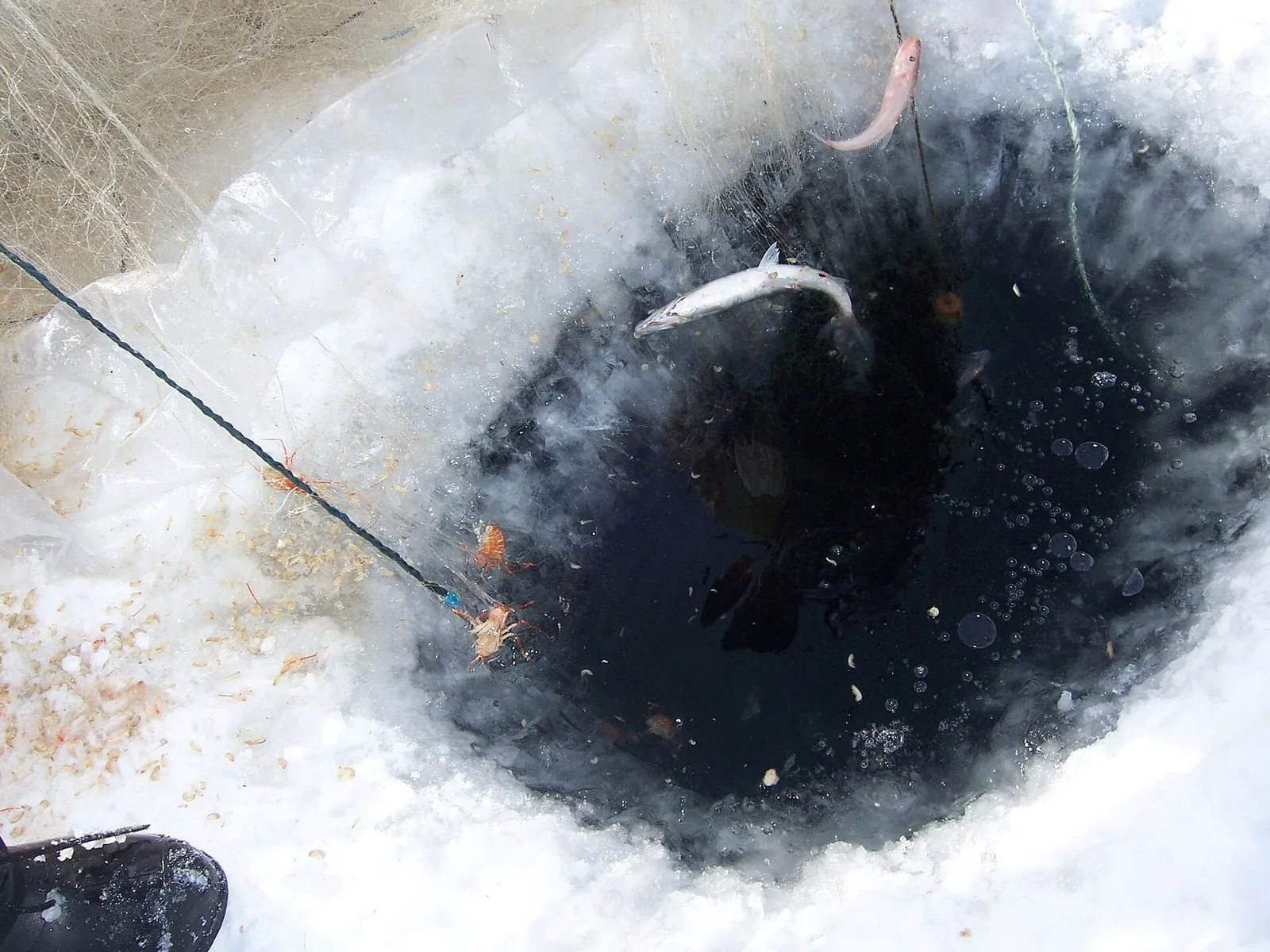 Do Fish Get Cold? What Winter Does to a Fish, and the Ones With Antifreeze in Their Blood
Do fish get cold? Yes: a fish is as cold as its water and feels it as slowness. What fish do in winter, who carries antifreeze, and how to fish cold water.
Sources (30)
- Wiktionary, meat (senses, dates and the usage note on fish)
- Zhang, Owens and Schilling (2017), Meat: the edible flesh from mammals only or does it include poultry, fish, and seafood?, Animal Frontiers 7(4)
- 9 CFR 301.2, Definitions (meat), Cornell Legal Information Institute
- 9 CFR 381.1, Definitions (poultry), Cornell Legal Information Institute
- 21 U.S. Code 601, Definitions (amenable species), Cornell Legal Information Institute
Show all 30 sourcesShow fewer sources
- Riette van Laack, FSIS Finally Nets "Catfish", FDA Law Blog (December 10, 2015)
- World Health Organization, Cancer: Carcinogenicity of the consumption of red meat and processed meat (definition of red meat)
- FAO, The Composition of Fish
- Listrat et al. (2016), How Muscle Structure and Composition Influence Meat and Flesh Quality, The Scientific World Journal
- United States Conference of Catholic Bishops, Questions and Answers about Lent and Lenten Practices
- Code of Canon Law, canons 1250 to 1253 (days of penance), Vatican
- Thomas Aquinas, Summa Theologiae II-II, Question 147, Article 8, New Advent
- Church of the Nativity, Erie, Pennsylvania, Guidelines for Fasting
- Detroit Catholic, The history of Detroit Catholics' muskrat-eating tradition
- Crux, Origins of the Filet-O-Fish, created to serve a local Catholic community (March 2025)
- 1 Corinthians 15:39, King James Version, Bible Gateway
- Chabad.org, All About Kosher Fish
- My Jewish Learning, What Makes a Fish Kosher?
- OU Kosher, Kosher Fish Production: Getting Into the Stream of Things
- Quran 5:96, The Clear Quran, translated by Dr. Mustafa Khattab, Quran.com
- Abdullah James Clarke, The fiqh ruling of Seafood in Islam, The Halal Life (July 1, 2020)
- Shaykh Mohammed Tosir Miah, Darul Ifta Birmingham, Seafood in the four madhab, IslamQA.org
- Mufti Ebrahim Desai, Sea Food in the Four Madhahib, Albalagh (April 13, 2003)
- Pew Research Center, Religion and food, Religion in India (June 29, 2021)
- Pew Research Center, Eight-in-ten Indians limit meat in their diets, and four-in-ten consider themselves vegetarian (July 8, 2021)
- Wikipedia, Diet in Hinduism
- The Vegetarian Society, Definition of a vegetarian
- Wikipedia, Pescetarianism
- Wikipedia, Veganism
- U.S. Food and Drug Administration, Advice about Eating Fish