 By
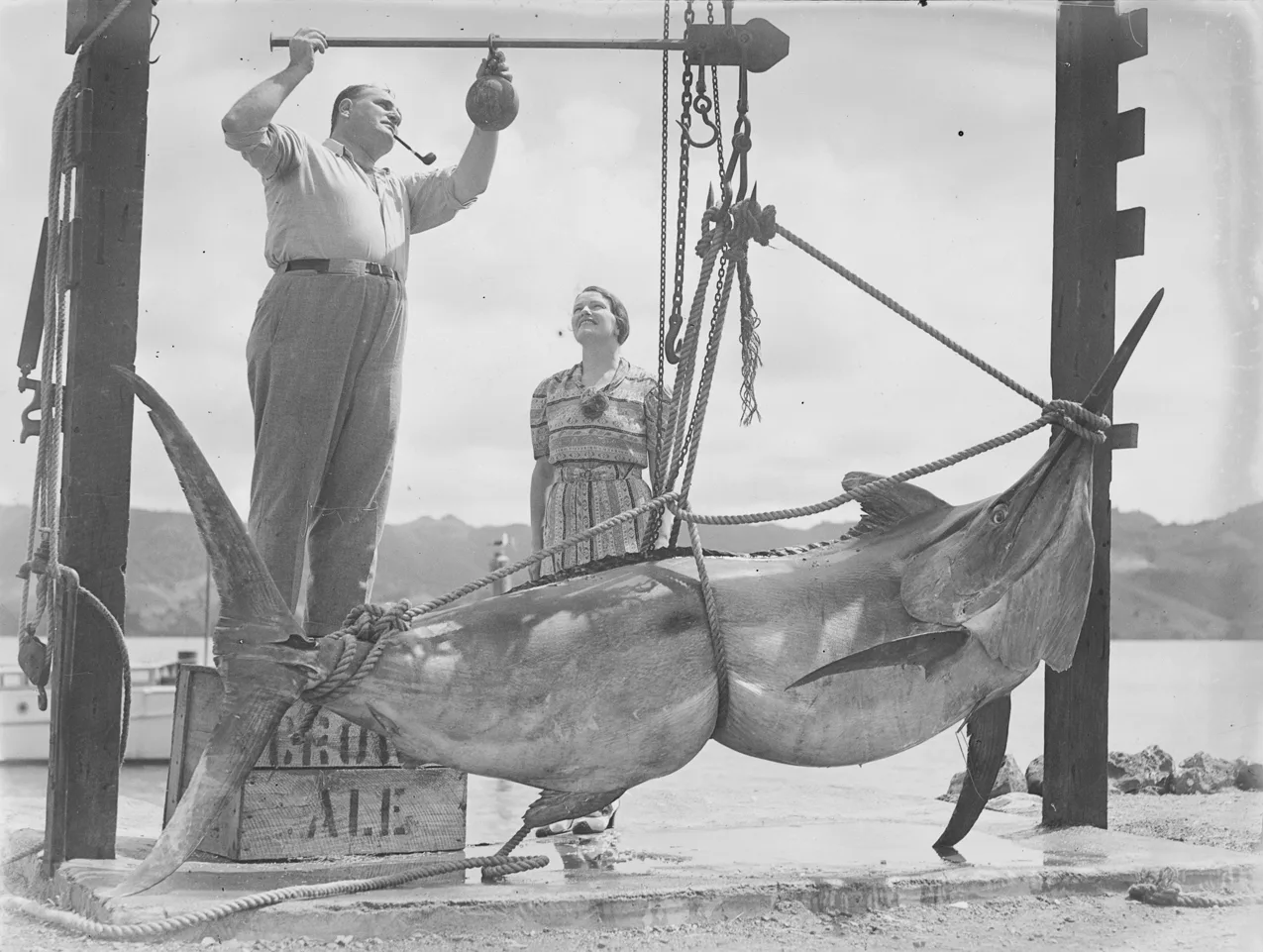
A fish scale for most anglers is a 50 lb digital with a tare button, and the Bass Pro Shops Digital does that for $26.99. Pay $88.99 for a Rapala 15 lb Touch Screen only when you cull in a tournament, swapping a small fish for a bigger one. Weigh the fish in a wet net you’ve already zeroed, not hanging from its jaw. Specs come from the makers and sellers, and accuracy numbers from Field & Stream’s plate test. None of these scales was tested by this site.
Your hand under the belly takes weight off the reading. For a true number and a safe fish, zero a wet net and weigh the fish inside it.
Which fish scale should you buy?
Pick by what you’re keeping score on. Most anglers want a number to tell a buddy, and a $27 digital gives you that. The money only starts to matter when two fish are close and a check is riding on it.
| Your fishing | Buy | Why |
|---|---|---|
| Bass, walleye and fish for the cooler | Bass Pro Shops Digital, 50 lb, $26.99 | Plenty of range, and a known result on a test plate |
| Bass tournaments | Rapala 15 lb Touch Screen, $88.99 | Eight bins total your bag, and cull tags mark the fish to let go |
| Catfish and carp | A 50 lb digital, or a 110 lb scale on trophy water | Buy more range than your biggest fish |
| Pike and muskie | A big net and a tape, or a BogaGrip for the teeth | Keep your fingers out of the mouth |
| Trout and panfish | A tape, and skip the scale | Length tells you what you need on small fish |
| A record chase | A scale you can get certified | IGFA wants the paperwork |
Buy more capacity than your biggest likely fish, so the scale doesn’t bottom out. A 15 lb tournament scale tops out under the 22 lb 4 oz largemouth record, and that’s a problem you’d like to have. On blue catfish water, where the record is 143 lb, a 50 lb scale runs out fast. For fish that big, buy a 110 lb scale. Field & Stream’s saltwater pick is the Bass Pro Shops CatMaxx.
Field & Stream says good scales usually run $80 to $100, and that reliable ones sell for $50 or less. Start there. You’ll know soon enough if you need more.
What matters when you buy one?
Four things come before the price: a tare button, how fine it reads, what happens when it gets wet, and which batteries it eats.
A tare button. Tare means zero. It tells the scale to ignore whatever is already hanging on it, like a clip, a bag or a net. Field & Stream says to tare the gripper before you weigh, and to tare a bag or net the same way. Without it, you’re doing math on the dock. Field & Stream zeroed every scale in its test this way, and Rapala lists tare on its Mini and its tournament model.
How fine it reads. A BogaGrip counts in 1/2 lb steps on its 30 and 60 lb models and 1/4 lb steps on the 15 lb model. The tournament Rapala switches between pounds and ounces, decimal pounds and kilograms. The Mini reads pounds or kilograms. Outdoor Life’s advice is simple: finer steps beat 4 or 8 oz steps when precision matters. On a fish you’re comparing to another fish, it matters.
Water. Rapala’s two digitals say “water resistant” and give no rating, and Field & Stream lists its touch screen as “Not fully waterproof.” Keep those out of the rain and off the wet deck. For a scale that lives in your boat, Field & Stream wants one built to keep water out and keep the batteries from corroding.
Batteries. Field & Stream calls AA batteries a safe bet, because they’re cheap and easy to find. It says to keep a spare set handy. The Bass Pro takes 2 AAA and the tournament Rapala takes 2 AA. The Mini runs on one 9V, which is a harder find at the ramp at 5 a.m.

Free PDF · Water temperature chart Which fish are biting at today's water temperature?
One reading, and the 16-page chart shows which of 26 fish are spawning, feeding hard or slowing down; for bass, crappie, bluegill and walleye, where they sit and what to throw. Every number sourced.
No card, nothing to buy, and the PDF is yours to keep. Confirm with one click and it's on its way. Then a few short emails and one a week on what's biting. Unsubscribe anytime. Privacy.
Digital, spring or lip grip?
Go digital unless you have a reason not to. Field & Stream calls digital the more precise kind.
| Type | Power | How it reads | Suits |
|---|---|---|---|
| Digital | Batteries | The more precise kind, per Field & Stream; stores weights | Most fish, kept dry |
| Spring or mechanical | None | A spring, no screen | Larger fish like catfish, per Field & Stream |
| Lip grip with a scale | None | 1/4 or 1/2 lb steps on a BogaGrip | Toothy fish, per Outdoor Life |
Digital. Hang the fish, read the number, and it stores the weight. Eight memory slots on the Bass Pro and eight bins on the tournament Rapala will keep a day’s fish straight. You pay for that with a battery and a screen that dislikes water.
Spring or mechanical. No battery and nothing to flood. Field & Stream says spring scales suit larger fish like catfish. Outdoor Life’s spring pick is the brass Chatillon, which can be IGFA certified. The $19.99 Rapala 25 lb mechanical has a 32 in tape built in, so it gives you the length too.
Lip grip with a scale. This is a jaw clamp with a spring scale in the handle. The BogaGrip is Field & Stream’s best lip gripper. Its jaws lock on the fish and its spring reads the weight against marks on the main tube. It’s a tool for toothy fish, and Outdoor Life picks it for exactly that. It reads coarser than a digital, and anglers who want extreme accuracy may prefer one. And you have to use it right, which is the next problem.
Are fish scales accurate?
Some are and some aren’t, and the box rarely tells you which. Rapala says its Mini weighs “with precision accuracy” and prints no number. Bubba’s scale is listed at ±0.3 percent, with no word on whether that’s 0.3 percent of the fish or of the scale’s 60 lb limit. BogaGrip says each scale is calibrated with certified weights to within one step.
The one real test in reach is Field & Stream’s. It zeroed each scale, attached it to a 13.5 lb metal plate, and read it on dry land so waves couldn’t move the number.
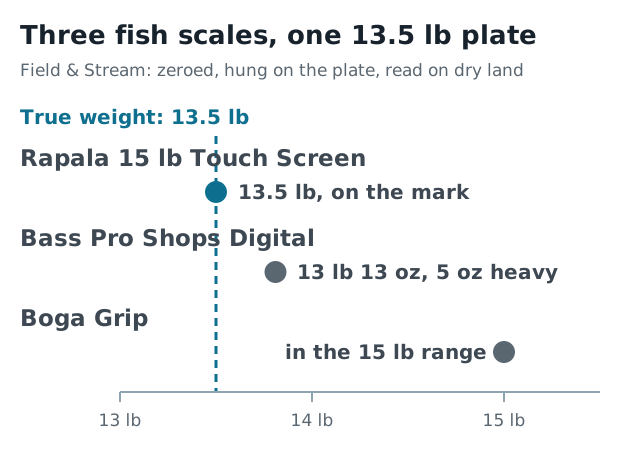
Look at the spread. The Rapala was on the mark. The Bass Pro read 5 oz heavy, and it did so again and again, which is the kind of error you can live with. The Boga Grip read “in the 15 pound range,” so roughly 1.5 lb heavy, and that’s more than the one step its maker promises. Field & Stream doesn’t say which model it hung on the plate. That’s one scale in one test, so don’t hang the whole brand on it. It’s still a good reason to check yours.
Now put those errors on real fish. The numbers below are worked out from the specs and the plate test.
| What the scale claims or did | On a 5 lb bass | On a 30 lb catfish |
|---|---|---|
| Bubba’s ±0.3 percent, if it means of the reading | under 1/4 oz | about 1 1/2 oz |
| Bubba’s ±0.3 percent, if it means of its 60 lb limit | about 3 oz | about 3 oz |
| One 1/4 lb step (BogaGrip 315) | up to 4 oz | past its 15 lb limit |
| One 1/2 lb step (BogaGrip 130 and 260) | up to 8 oz | up to 8 oz |
| Bass Pro’s 5 oz heavy on 13.5 lb, scaled up | about 2 oz | about 11 oz |
Here’s what to take from that. On a 5 lb bass, one half-pound step is 10 percent of the fish, so a grip scale won’t settle which of two fish goes back. On a 30 lb flathead it’s under 2 percent, and nobody at the cleaning table will care. A bag of five that’s close at the cull needs a digital you’ve checked. A catfish for the photo doesn’t.
How do you weigh a fish without hurting it?
Use a wet net, and have the scale ready before the fish comes up. Keep Fish Wet says to keep air exposure to 10 seconds or less. It also says “fish should never be held vertically by a lip gripping device.” So the lip grip that weighs the fish is also the hold you’re told not to use. Outdoor Life says much the same about big fish: holding them by the jaw can damage them, so weigh a muskie in a cradle or your net.
The usual fix is a hand under the belly. That protects the fish and wrecks the number, because your hand is now carrying part of the weight. You can have a level fish or a true reading on a lip grip, not both.
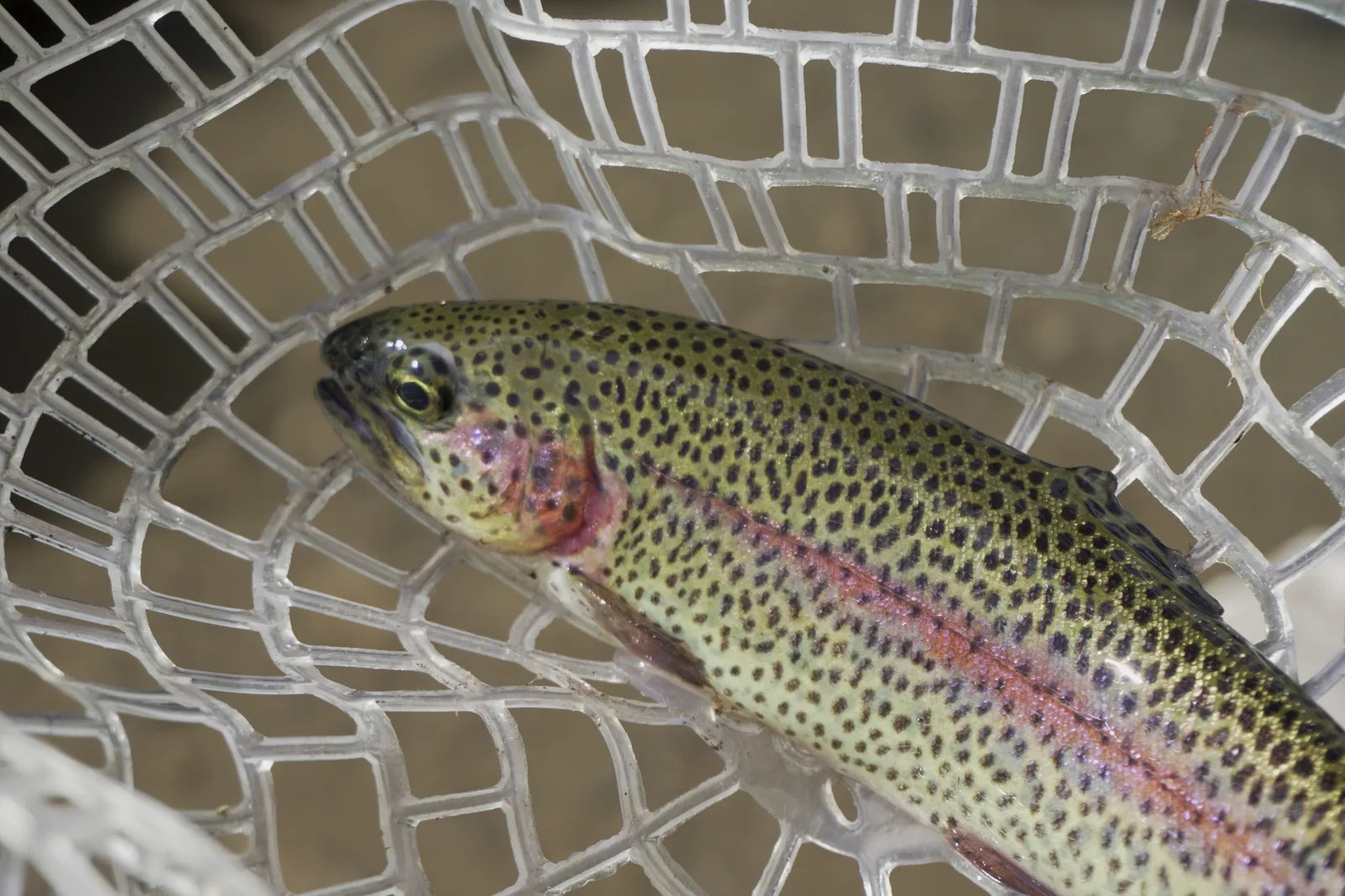 A rubber net holds the fish level and is easier on its slime. Photo: JYEXP (CC BY 4.0).
The net does both jobs. Here’s the order:
- Turn the scale on and set it where you can reach it before you land the fish.
- Wet the net, hang it on the scale empty, and press tare. A wet net weighs more than a dry one, so zero it wet.
- Net the fish and lift the net onto the hook. The fish lies level and all its weight is on the scale.
- Let the number settle, then read it. Waves move the number, which is why Field & Stream read its plate on dry land. Step off the rocking boat if you can.
- Get the fish back in the water. Keep Fish Wet’s mark is 10 seconds of air or less, so have the camera ready before you lift.
Two small things. The net’s weight counts against your scale’s limit, so a heavy net on a 15 lb scale leaves less room for fish. And a tournament bag works the same way. Field & Stream says to tare the bag first.
More on handling is on the catch and release page, and big whiskered fish get their own page on how to hold a catfish.
How do you check a scale at home?
Hang something whose weight you know. Outdoor Life says to test repeatedly against known items such as exercise weights, and to replace a scale that isn’t accurate. Field & Stream used a 13.5 lb plate.
If you don’t own a plate, use water. A US gallon of 60 °F water weighs 8.34 lb (3.78 kg), worked out from the USGS water table. Hang an empty bucket, press tare, pour in four level quarts and read it. A kitchen measure isn’t perfect, so this catches a scale that’s off by half a pound, not by an ounce. For ounces, use a weight you trust.
Do it again at the start of each season and after a hard knock. Outdoor Life notes that jarring can affect electronics, and recommends a padded case for boat rides. Then write down how far off it is. A scale that’s always 5 oz heavy is still useful, as long as you know about the 5 oz.
What does a record need?
A certified scale and a fish you haven’t let go yet. IGFA says a world-record fish must be weighed on land, with exceptions for junior and smallfry records, on a scale certified within the past 12 months. IGFA will check any digital or spring scale up to 100 lb for members, for $40. Scales above that need a certifying company or a local government body.
A scale that wasn’t certified on the day can still be checked afterward. IGFA wants that done as quickly as possible, with the inspection report in the application. But the catch won’t qualify if the accuracy can’t be verified. And as BogaGrip points out, once the fish is released it can’t be reweighed. So keep the scale. Don’t swap it for a new one before the paperwork is done. The world record catfish page walks through the rest of the checklist.
Your state record program has its own rules, so read them before you release a fish you think might count.
No scale on the boat?
Measure it. Length times girth times girth, divided by 800, gives a rough weight in pounds when you measure in inches. Girth is the distance around the fish at its fattest point. It’s an old general formula, so treat it as a rough number. The fish weight calculator has better ones for several species. Take a tape and a phone photo, and you can settle the argument at home.
How do the picks compare?
| Scale | What it reads | Price and power |
|---|---|---|
| Bass Pro Shops Digital | 50 lb (23 kg), 8 memory slots | $26.99, 2 AAA |
| Rapala Mini Digital | 50 lb (23 kg), tare | $30.99, one 9V |
| Rapala 15 lb Touch Screen | 15 lb (6.8 kg), 8 bins, cull system | $88.99, 2 AA |
| BogaGrip Model 130 | 30 lb (13.6 kg) in 1/2 lb steps | Dealers only, no battery |
| Rapala 25 lb Mechanical | 25 lb (11 kg), 32 in (81 cm) tape | $19.99, no battery |
| Bubba Smart Fish Scale | 60 lb (27 kg), listed at ±0.3 percent | $114.95, AA |
The picks in detail
Bass Pro Shops Digital Fish Scale: best for most anglers
$26.99, 50 lb, up to eight weights in memory labeled A through H, and 2 AAA batteries. Field & Stream named it the best budget scale. It wasn’t dead on: “the scale consistently weighed slightly heavy,” with several readings of 13 lb 13 oz on the 13.5 lb plate. A steady, known error beats an unknown one. Buy it for bank fishing and weekend trips. Skip it for a tournament, where 5 oz is the difference between two fish.
Rapala 50 lb. Mini Digital Scale: the pocket pick
$30.99 for a pocket-size digital with a tare button and a chrome hook. It runs on one 9V battery, 400 hours by Rapala’s count, with a 4-minute shutoff. Rapala calls it “precision accuracy” and prints no number, and we couldn’t find a test of it. So run the gallon check before you believe it. Pick it if size matters more than memory slots.
Rapala 15 lb. Touch Screen Tournament Model: best for tournaments
$88.99, with eight bins you tap to store each fish and add it to the total. An eight-piece culling system tells you which fish to let go. It reads in pounds and ounces, decimal pounds or kilograms, and runs up to 400 hours on 2 AA batteries. It takes a clamp or a stainless hook, and has a backlight for the dark ramp. Field & Stream called it one of the most precise it tried, “consistently weighing in at the 13.5-pound mark.” The limits are the 15 lb top end and a body that’s water resistant only. Buy it if you cull for money, and check your state’s culling rules first.
BogaGrip Model 130: best lip grip
30 lb in 1/2 lb steps, 10 3/4 in long, 1 lb in the hand. BogaGrip makes four. The 315 goes to 15 lb in 1/4 lb steps. The 260 goes to 60 lb in 1/2 lb steps, and it’s 15 in long and 1 1/2 lb in the hand. The 430 is a 130 with the 260’s bigger jaws. No battery, a stainless spring, and a main tube that spins inside the grip when a fish thrashes. BogaGrip sells through dealers and lists no price on its site. Buy it to control a pike or a saltwater fish with teeth. Don’t buy it to settle a cull, and don’t hang a fish from it straight down.
Rapala 25 lb. Mechanical Scale: no batteries
$19.99 for a top-view spring scale with a hook, pound and kilogram marks and a 32 in retractable tape. It’s the backup that lives in the tackle bag and never dies. Rapala gives no accuracy figure and spring scales read coarser than digitals, so treat its number as a good estimate.
Bubba Smart Fish Scale: most features
$114.95 at Tackle Warehouse, 60 lb, listed at ±0.3 percent and “completely waterproof,” on AA batteries. The Pro Series costs about twice as much. Owners aren’t sold: the 16 reviews at Tackle Warehouse average 3.0 out of 5. Field & Stream ranked the Pro Series first overall, and called it expensive. The listing says “completely waterproof” and prints no rating. For most anglers it’s more scale than the job needs.
How we chose
Rapala and BogaGrip specs and prices come from the makers’ own pages, read in November 2026. Two picks are exceptions. Bubba’s site wouldn’t open for us, so its figures come from Tackle Warehouse’s listing. Bass Pro’s page wouldn’t open either. Its specs come from Field & Stream’s review, and its $26.99 from Google’s product listing for Bass Pro Shops on November 9, 2026. Accuracy results come from Field & Stream’s 13.5 lb plate test. The ounces in the table are simple arithmetic on those numbers. We didn’t hold or test any of these scales.
Nets, pliers and the rest of the small gear sit in the accessories hub.

Free PDF · 16 pages
Stop guessing. Know what's biting before your first cast
A whole Saturday on the water with nothing to show for it. One reading tells you who's feeding.
The Water Temperature Fishing Chart. Take one water temperature reading, find it on the chart, and see which of 26 freshwater fish are spawning, feeding hard or slowing down.
- Where bass, crappie, bluegill and walleye sit, and what to throw. Trout: the reading where you stop.
- Why a 3 ft drop beats a cold front, and what to throw each day of the front
- The three thermometer mistakes that make a reading lie
The chart's numbers come from state fish and wildlife agencies and fisheries research: 61 sources, each listed on the site.
No card, nothing to buy. Confirm with one click and the PDF is on its way, one version for your phone and one to print, yours to keep. Then a few short emails and one a week on what's biting, with an unsubscribe link in every one. Privacy.
Related
Section guide
Fishing Accessories: The Small Gear That Decides the DayThe fishing accessories worth carrying: net, pliers, scale, thermometer, tackle box and the rest, with the one spec that matters on each and what it is for.
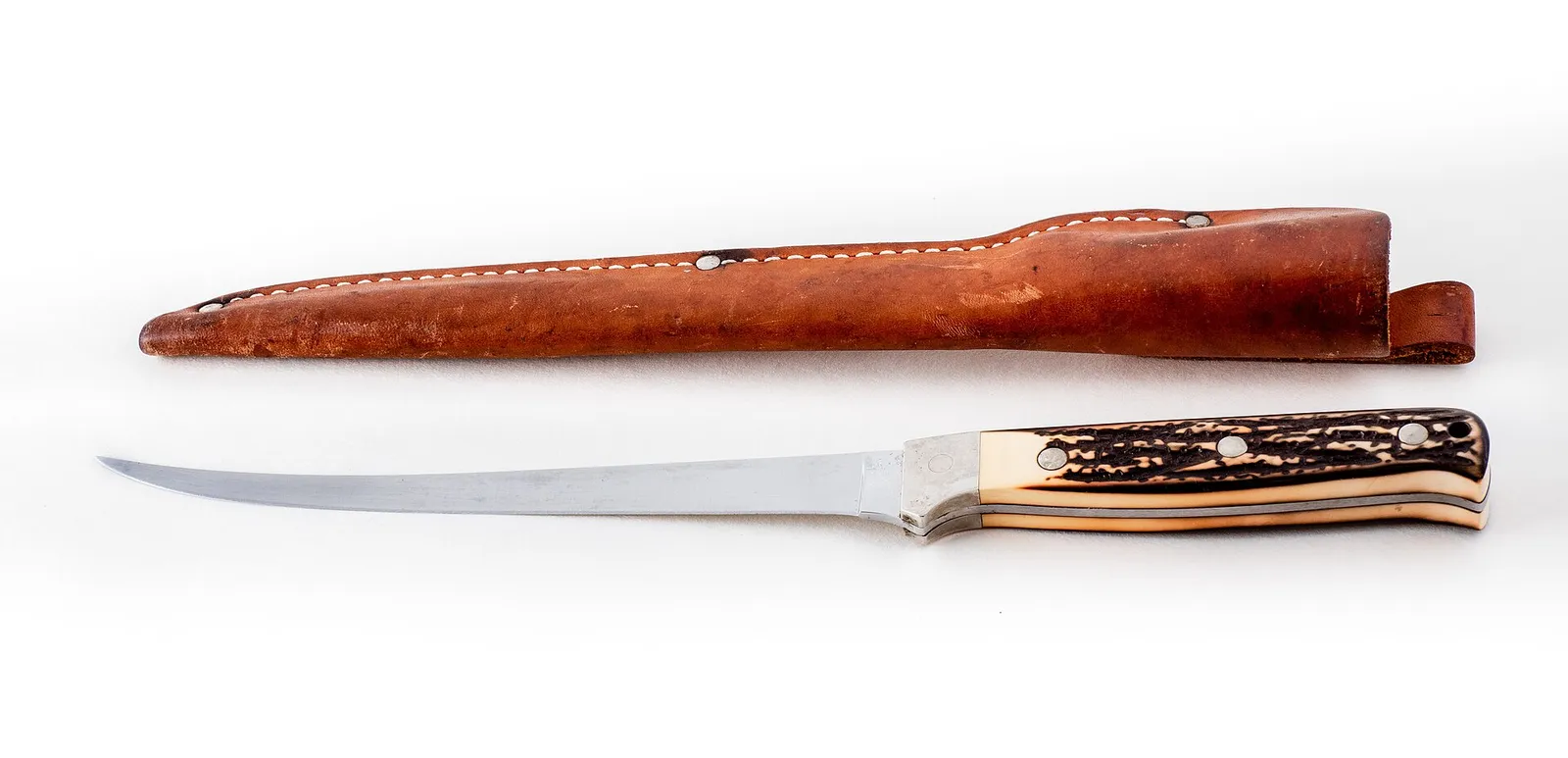 Fillet Knife: How to Pick the Best Fish Fillet Knife, Manual or Electric
A fillet knife for most anglers is a 7 in flexible blade; 4 to 6 in for panfish, 9 in for big saltwater fish. 8 picks, manual and electric, $14 to $204.
- Fishing Net: Which Landing Net to Buy, Rubber or Nylon, and What Size
The fishing net most anglers need is a rubber-mesh landing net sized to their fish. What two mesh studies found, hoop sizes by species, and 7 picks.
 Fishing Stringer: The Right One for Bank, Boat and Wading, and How to Use It
A $3 chain fishing stringer through the lower jaw suits most anglers. Pike lived two hours on one, but a quarter died later. Picks and how to use it.
 Best Fishing Thermometers: From a $14 Stream Tube to the Fish Hawk TD
A $14 encased stream thermometer serves most anglers; only a depth probe reads where summer bass and walleye sit. Five types compared, with picks.
Sources (17)
- Field & Stream, The Most Accurate Fish Scales, Tested on the Water
- Outdoor Life, Best Fish Scales of 2026
- Bass Pro Shops, Digital Fish Scale
- Rapala, 50 lb. Mini Digital Scale
- Rapala, 15 lb. Touch Screen Scale Tournament Model
Show all 17 sourcesShow fewer sources
- Rapala, 25 lb. Mechanical Scale
- BogaGrip, BogaGrip Advantages (calibration and spring)
- BogaGrip, Model 130
- BogaGrip, Model 260
- BogaGrip, Model 315
- BogaGrip, Model 430
- BogaGrip, BogaGrip Certification
- Tackle Warehouse, Bubba Smart Fish Scale (listing and owner reviews)
- IGFA, Scale Certification
- IGFA, World Record Requirements
- Keep Fish Wet, Tips
- U.S. Geological Survey, Water Density