 By
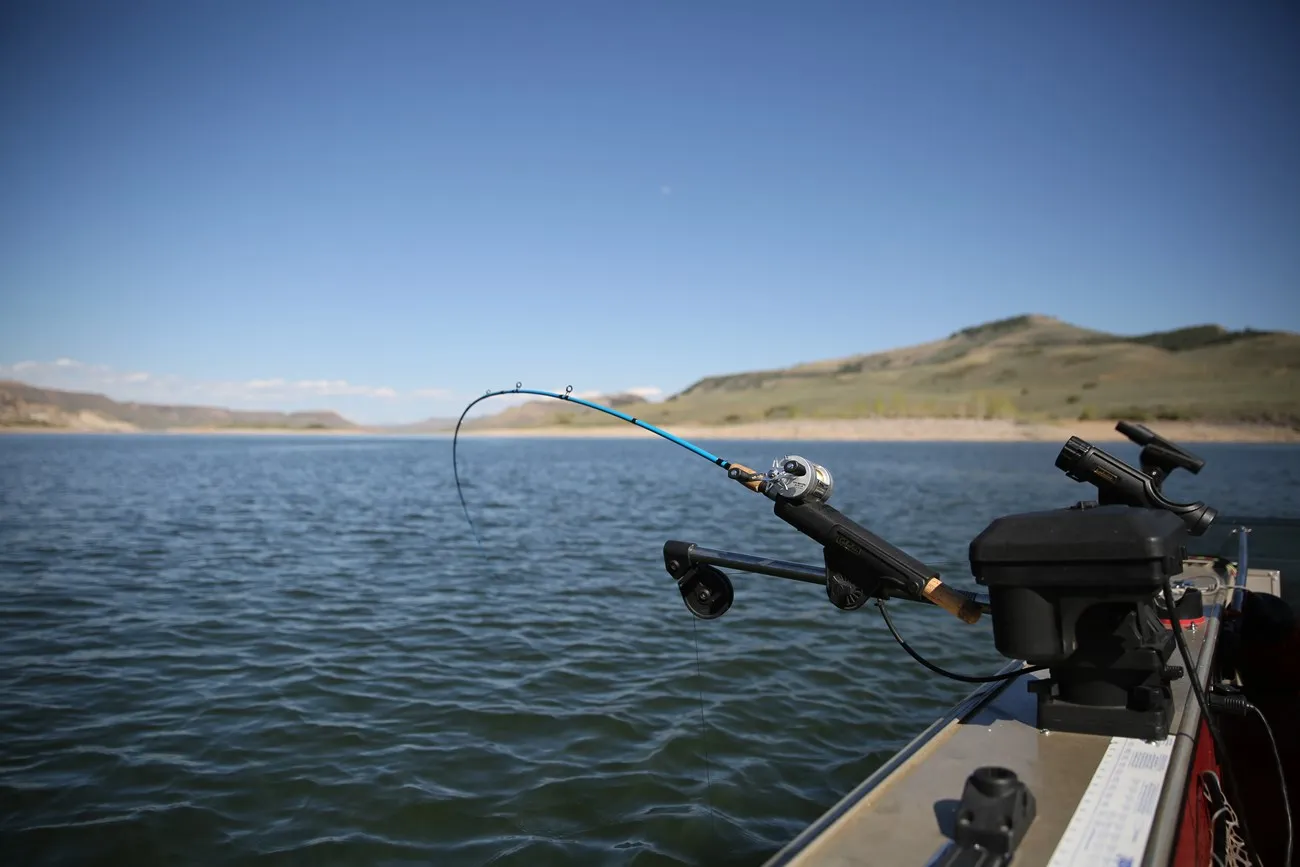
A downrigger is a small winch on your boat that lowers a 6–10 lb weight on steel cable to the depth you pick. Your line clips to a release on that weight, the ball. When a fish hits, the line pops free and you fight the fish without the lead. Oregon’s fish and wildlife agency puts it simply: when you need to go deeper than 30–40 ft (9–12 m), a downrigger is the tool. The specs below come from Scotty, Big Jon and Cannon’s own pages and manual. Nothing here was tested by this site.
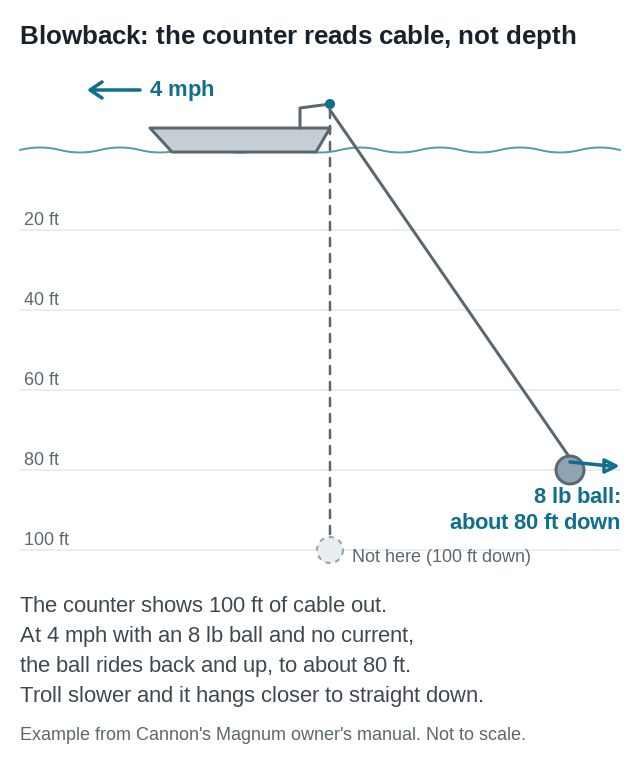
At 4 mph, an 8 lb ball on 100 ft of cable runs about 80 ft deep, Cannon’s manual says. The counter tells you how much cable is out, not how deep the ball is.
What does a downrigger do?
It puts your lure at one depth and keeps it there. A weight on your line, a diver or lead-core line gets a lure down too, but each one changes depth with speed and line length. A downrigger holds one depth as long as you hold one speed. Its counter lets you go back to the depth where you caught the last fish.
The parts are few:
- The ball: the weight, 6 to 10 lb in ODFW’s description. Cannon’s manual charts 8, 10 and 12 lb balls.
- The cable: stainless steel, 150 lb test on Cannon’s Magnum and most Scotty models, 180 lb on Scotty’s 2106.
- The boom: the arm that holds the cable out from the hull, from 23 in (58 cm) up to 60 in (1.5 m).
- The release: a clip on the ball or the cable that holds your line until a fish pulls it free. Cannon’s Uni-Release sets from 2 to 22 lb of grip.
- The counter: it counts feet of cable let out.
- The rod holder: many come with one on the downrigger itself.
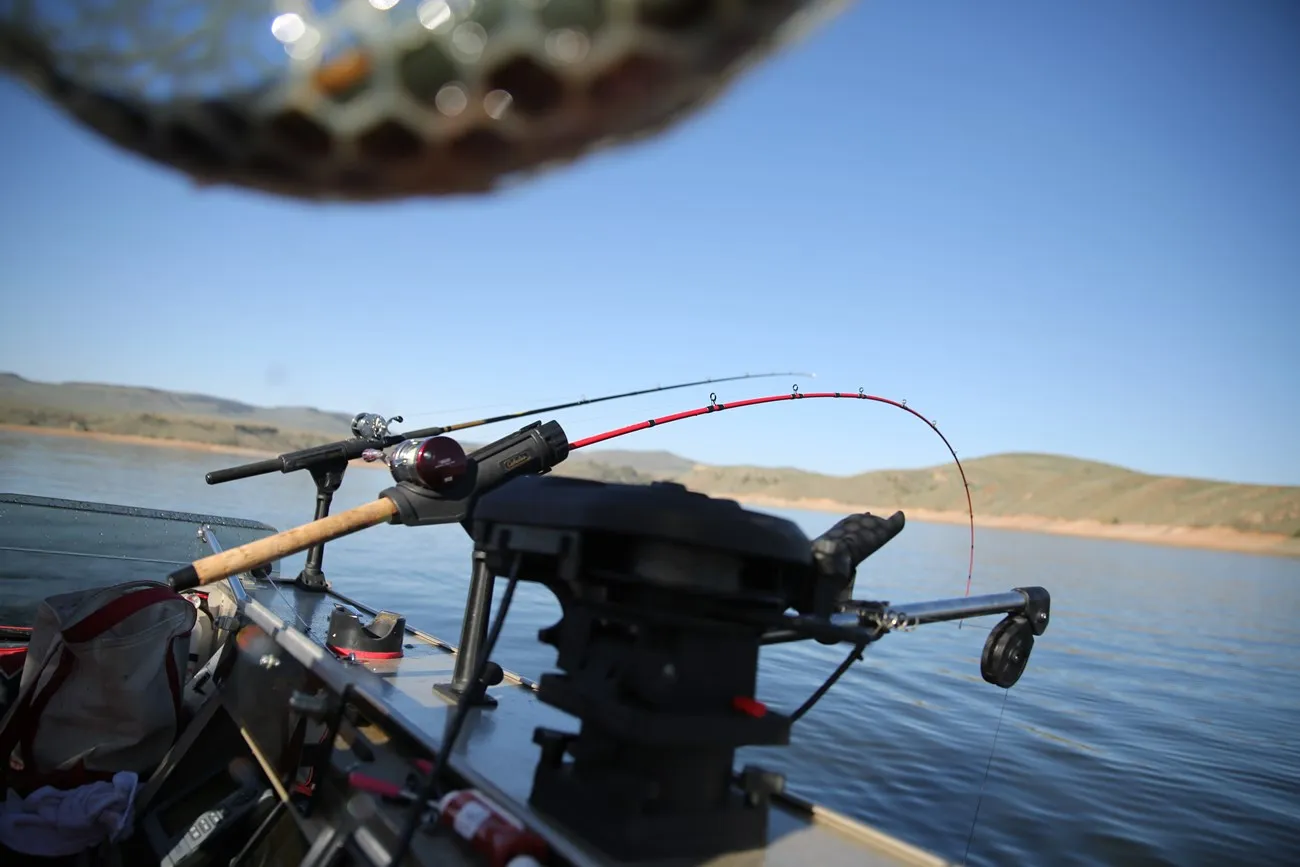
The red rod is clipped to the downrigger. The rod behind it trolls a flat line, with no weight. Curecanti National Recreation Area. Photo: Forrest Czarnecki, National Park Service (public domain).
Do you need one?
Only when the fish are deep. Take ODFW’s kokanee advice. With no weight, 100–150 ft of line behind a dodger gets a lure 10–12 ft down at most. A 1–3 oz weight on the line gets a lure as deep as 40 ft, depending on lead, line and speed. Past 6 oz of weight, ODFW says, you’re better off with a downrigger.
So if your fish sit in the top 30 ft, you don’t need one yet. Summer is different. Lake trout drop below the thermocline, and kokanee can sit hundreds of feet down. Wisconsin names downrigger trolling one of the best ways to catch Lake Michigan king salmon. That’s where one pays for itself.
How do you set up and fish a downrigger?
Scotty lays out twelve steps, and the National Park Service adds a few habits on top. Boiled down to nine:
- Mount it. Bolt or clamp the downrigger to the boat.
- Hang the ball. Clip the weight to the end of the cable, then put a release clip on the cable or the ball.
- Let your lure out. Loosen the drag on your reel and let out line behind the boat. Cannon’s manual says to start with the lure about 10 ft behind the ball. The NPS calls 10 to 20 ft common.
- Clip in. Put the line in the release clip, and set the rod in the holder.
- Lower the ball. Swing it over the side and let the brake off slowly. When it’s just under the water, stop and put on the stopper beads, small stops that clamp on the cable.
- Go to depth. Keep lowering while you watch the counter. Feed line off the reel as the ball drops, so the line stays in the clip and doesn’t tangle.
- Load the rod. Tighten the drag and reel in the slack until the rod bends in a tight arc toward the water. The NPS wants the top third of the rod bent over.
- Watch the tip. On a strike the rod jumps and the line usually pulls free. If it doesn’t, lift the rod until the clip lets go.
- Bring the ball up. On a Scotty electric, hit auto stop. The ball comes up and the beads stop it, so the cable can’t tangle your line.
Free PDF · Water temperature chart Which fish are biting at today's water temperature?
One reading, and the 16-page chart shows which of 26 fish are spawning, feeding hard or slowing down; for bass, crappie, bluegill and walleye, where they sit and what to throw. Every number sourced.
No card, nothing to buy, and the PDF is yours to keep. It's in your inbox a minute later. Then a few short emails and one a week on what's biting. Unsubscribe anytime. Privacy.
How deep is your lure, really?
Shallower than the counter says. The counter only counts cable. Pull the ball through the water and it swings back behind the boat. The faster you go, the farther back and the shallower it rides. Cannon calls this blowback.
Cannon’s manual gives one example worth remembering. Troll at 4 mph with an 8 lb ball and 100 ft of cable out, no current, and the ball sits about 80 ft down. Current, salt water and other makers’ weights change that number too, the manual adds. Cannon’s charts also show 2 mph, where the ball hangs much closer to straight down.
Keep the speed down anyway. The NPS says trolling with a downrigger is always done under 5 mph, with no wake. Test each lure next to the boat first, Cannon says, so you know it swims right before it goes down.
What to do with it:
- Fish to the fish, not the counter. Find the fish on your sonar first, then set the ball for them. ODFW calls a fish finder a big help for kokanee, which can sit anywhere from near the surface to hundreds of feet down. The guide on reading a fish finder shows how to tell fish from bait and clutter.
- Slow down to go deeper. Less speed, less blowback.
- Check the temperature where the ball is. A probe clipped to the ball reads the water your lure is in, not the surface. The fishing thermometer guide covers two that go down on a downrigger, from about $10.
Manual or electric downrigger?
Manual for a small boat and a tight budget. Electric if you troll deep for hours.
A manual downrigger is a crank, a brake and a counter. Scotty’s 1060 Depthking and 1091 Longarm bring up two feet of cable per turn of the spool. At 100 ft, that’s 50 turns for every fish, every snag and every lure check. Big Jon’s Gadabout costs $349.99 with the cable, counter, rod holder and line release in the box. That’s the cheapest downrigger Big Jon sells. Its line runs up to $1,079.99 for the Captain’s Pak electric.
An electric model does the cranking. Scotty rates its 1106 Depthpower at 235 ft a minute with a 7 lb ball. Big Jon’s $799.99 Legacy brings up a 12 lb ball at 120 ft a minute. The big win on Scotty’s electrics is auto stop: one button and the ball comes up while you play the fish. Cannon’s Magnum stops the ball at the water by itself too. Big Jon’s page names no such feature for the Legacy.
Electric comes with a battery bill. Cannon rates its Magnum at 30 amps at full load on 12 volts and warns never to run it on a 24-volt system. It wants a deep-cycle marine battery, or a starting battery only if the motor charges it while you troll. If the battery dies, the Magnum has a hand crank to get the ball up.
How do the downriggers compare?
Every figure below is from the maker’s own page or manual. Scotty lists no prices, so buy through its dealers.
| Model | Type | Cable | Boom | Worth knowing |
|---|---|---|---|---|
| Scotty 1071 Laketroller | Manual | 100 ft (30 m), 150 lb | Not listed (clamp mount) | Canoes and aluminum boats; weights under 4 lb |
| Scotty 1060 Depthking | Manual | 200 ft (61 m), 150 lb | 23 in (58 cm) | Small boat that fishes deep; 2 ft per turn |
| Big Jon Gadabout | Manual | 200 ft (61 m) | 2 ft (61 cm) | $349.99; gunwale or transom |
| Scotty 1091 Longarm | Manual | 200 ft (61 m), 150 lb | 36–60 in (0.9–1.5 m) | Big boats; long handle for leverage |
| Big Jon Legacy | Electric | 200 ft (61 m) | 2, 3 or 4 ft (0.6–1.2 m) | $799.99; 12 lb ball at 120 ft/min |
| Scotty 1106 Depthpower | Electric | 250 ft (76 m), 150 lb | 36–60 in (0.9–1.5 m) | 7 lb ball at 235 ft/min; auto stop |
| Scotty 2106 High Performance | Electric | 300 ft (91 m), 180 lb | 36–60 in (0.9–1.5 m) | Digital counter; auto stop |
| Cannon Magnum 10 STX | Electric | 150 lb | 24–53 in (0.6–1.3 m) range | 30 A at full load; ion control |
That “ion control” is Cannon’s Positive Ion Control. It puts a fixed 0.6 volts on the cable, and Cannon says the charge draws fish to the cable. It only works with a short lure-to-ball distance: Cannon’s manual calls 10 to 20 ft typical and says 50 to 100 ft cancels it out.
What weight and release do you need?
ODFW names 6 to 10 lb of weight. Cannon’s blowback charts run 8, 10 and 12 lb balls. The small clamp-on Laketroller is rated for weights under 4 lb, so match the ball to the downrigger, not just the fish. Check what yours can lift. Scotty rates the 1106 lifting a 15 lb ball, and Big Jon quotes the Legacy with a 12 lb ball.
On a Cannon with ion control, use vinyl-coated weights, which Cannon recommends, and the insulator that comes with it. The manual says the insulator also stops the ball at the waterline on the way up. Cannon also says to replace the cable at least every two years.
The release is the clip that lets go. The NPS says it should hold the line and lure, yet let go when a fish strikes, and its pressure should be adjustable. Too light, and the pull of the lure trips it. Too tight, and a striking fish can’t.
How do you fish a downrigger for salmon, lake trout and kokanee?
The setup changes by fish. Each row below names the agency or pro it comes from.
| Fish | Where they are | Speed | Downrigger setup | From |
|---|---|---|---|---|
| King salmon, Lake Michigan | Open lake, usually under 100 ft (30 m) of water | – | Plug or spoon on a downrigger | Wisconsin DNR |
| Coho, Lake Michigan, spring | Top 15 ft (4.6 m) | 1.8–3.2 mph | Spoons on downriggers, divers or short lead core | Indiana DNR |
| Lake trout | On the bottom | 1.7–2.0 mph | Dodger and Spin-N-Glo 10 ft behind; ball ticks bottom | Yakima Bait (Romanack) |
| Kokanee | Surface to hundreds of feet; downrigger past 30–40 ft (9–12 m) | 0.8–1.6 mph | A soft rod that loads up; line-counter reel | ODFW |
Spring coho salmon swim in the top 15 ft, so a downrigger is only one way to reach them. In summer, Indiana DNR says, the same fish can be anywhere from 60 to over 300 ft deep. For lake trout, Mark Romanack’s trick at Yakima Bait is to let the ball tap the bottom every few feet. It kicks up mud that looks like other lake trout feeding. Stand next to the downrigger, he says, and keep making small depth changes.
Kokanee salmon call for light gear. ODFW wants a rod that bends and “loads up” under pressure, and a line-counter reel so you know how much line is out. Cannon’s manual says downrigger trolling grew out of Michigan’s Pacific salmon plantings of the mid-1960s.
How we chose
We compared each maker’s published specs: cable length and test, boom, retrieve speed, mount and what comes in the box. The prices are the makers’ own where they list one. Scotty lists none on its pages. Cannon’s figures come from its Magnum owner’s manual, which gives no price, so none is given for either. Nothing here was tested by this site, and no owner reviews were counted.
If you’re new to trolling, the NPS suggests a trip with a licensed guide first. You’ll see a downrigger spread at work before you drill holes in your own boat. More tools for the boat are in fishing accessories.

Free PDF · 16 pages
Stop guessing. Know what's biting before your first cast
A whole Saturday on the water with nothing to show for it. One reading tells you who's feeding.
The Water Temperature Fishing Chart. Take one water temperature reading, find it on the chart, and see which of 26 freshwater fish are spawning, feeding hard or slowing down.
- Where bass, crappie, bluegill and walleye sit, and what to throw. Trout: the reading where you stop.
- Why a 3 ft drop beats a cold front, and what to throw each day of the front
- The three thermometer mistakes that make a reading lie
The chart's numbers come from state fish and wildlife agencies and fisheries research: 64 sources, each listed on the site.
No card, nothing to buy. The PDF is in your inbox a minute later, one version for your phone and one to print, yours to keep. Then a few short emails and one a week on what's biting, with an unsubscribe link in every one. Privacy.
Related
Section guide
Fishing Accessories: The Small Gear That Decides the DayThe fishing accessories worth carrying: net, pliers, scale, thermometer, tackle box and the rest, with the one spec that matters on each and what it is for.
 Best Fishing Pliers: The Right Pair for Your Fishing, $10 to $400
The best fishing pliers by job: a 7 in pair with carbide cutters for braid, aluminum for saltwater, 11 in for pike. Seven picks, $9.99 to $399.95.
 Minnow Trap: Which One Is Legal Where You Fish, and How to Use It
A galvanized minnow trap costs about $24. Check the funnel opening first: New York, South Carolina and Georgia cap it at 1 in. How to bait, set and check one.
 Fishing Hook Remover: Which Kind to Buy and How to Use It
Which fishing hook remover to buy, from a $1.59 disgorger to a 17.5 in dehooker, how each one works, and when to cut the line instead.
 Best Split Ring Pliers: What Opens Which Ring, $9.99 to $59.99
Split ring pliers have a bent tooth that pries a split ring open so you can swap a treble. Nine tools compared at the maker's price, with ring sizes.
 Fish Scale: Best Digital, Spring and Lip-Grip Picks for Every Angler
The fish scale to buy for your fishing: a $27 digital for most anglers, a cull scale for tournaments, and how to weigh a fish safely and get a true number.
 Fillet Knife: How to Pick the Best Fish Fillet Knife, Manual or Electric
A fillet knife for most anglers is a 7 in flexible blade; 4 to 6 in for panfish, 9 in for big saltwater fish. 8 picks, manual and electric, $14 to $204.
Sources (15)
- Oregon Department of Fish and Wildlife, Kokanee fishing in Oregon
- National Park Service, Trolling (Curecanti National Recreation Area)
- Cannon (Johnson Outdoors Marine Electronics), Magnum 5 ST, Magnum 10 STX and Magnum 10 STX TS owner's manual
- Scotty, Downriggers (range and the 12 steps of using a downrigger)
- Scotty, 1106 Depthpower Downrigger
Show all 15 sourcesShow fewer sources
- Scotty, 2106 High Performance Downrigger
- Scotty, 1091 Longarm Downrigger
- Scotty, 1060 Depthking Downrigger
- Scotty, 1071 Laketroller Downrigger (With Clamp Mount)
- Big Jon Sports, The Gadabout Manual Downrigger
- Big Jon Sports, The Legacy Electric Downrigger
- Big Jon Sports, Downriggers (range and prices)
- Wisconsin DNR, Chinook salmon (species sheet)
- Indiana DNR, Spring trolling for coho salmon in Indiana
- Yakima Bait, A lake trout strategy (Mark Romanack)