 By
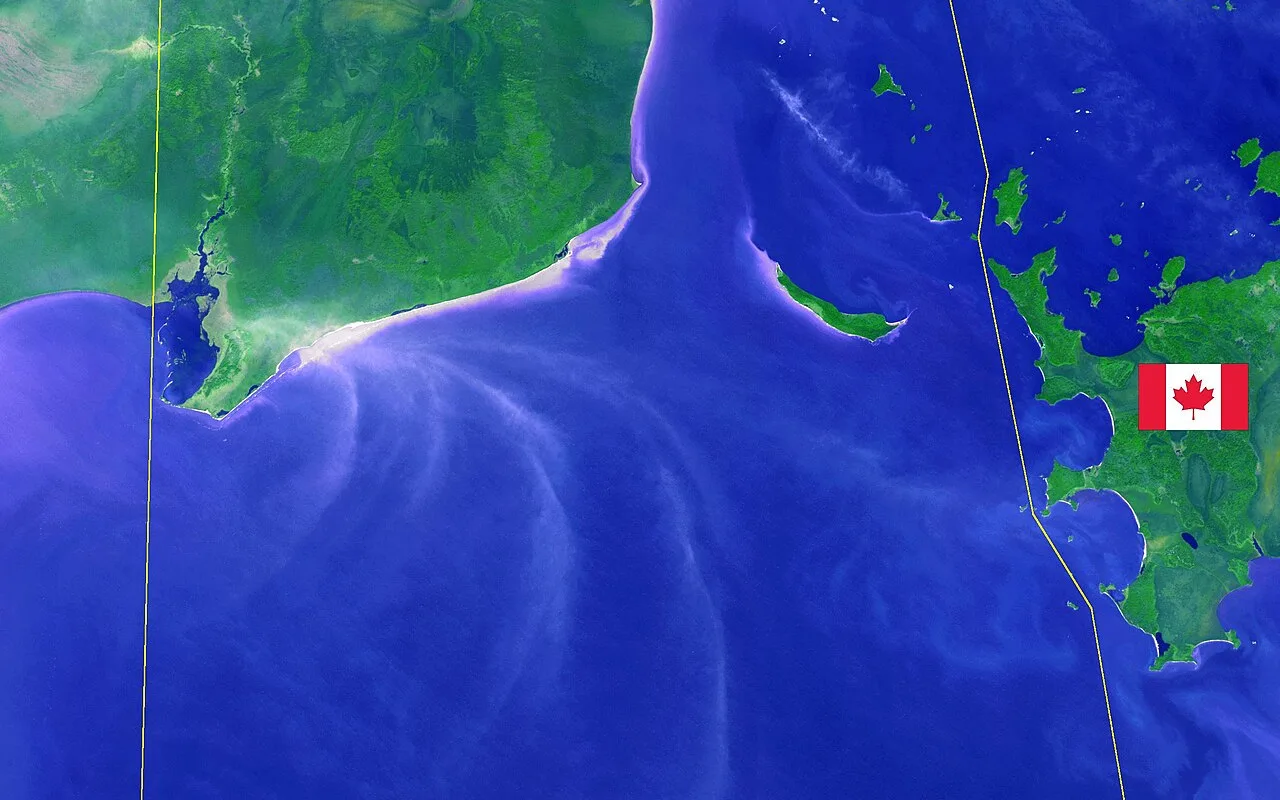
Lake of the Woods ice fishing runs from early December to late March. On the Minnesota side you keep six walleye and sauger a day, no more than four of them walleye. Every walleye from 19½ to 28 in (50–71 cm) goes back, and only one over 28 in may go home with you. The lake covers 951,337 acres and drains north to Hudson Bay. Nearly a third of it lies in Minnesota, which makes it the state’s largest lake.
A 25-inch female walleye from Lake of the Woods is about 10 years old, the Minnesota DNR says, and a 30-incher about 20. On the Minnesota side, every walleye from 19½ to 28 in goes back.
When is the ice, and what happens each month?
The DNR’s short answer is early December to late March. Inside that, the season builds in steps, and each step has its own rule. The timing below is the tourism bureau’s, the rules are the DNR’s 2026 booklet.
| When | On the ice | The rule that matters |
|---|---|---|
| Late November to early December | Back bays freeze first. Resorts set spear houses for pike in shallow water, and the first ice roads carry sleds and ATVs | Spearing pike from a dark house opens November 15, 2026 |
| Mid-December to January | Resort day houses go out around December 10, the bureau says, though that varies by year | Two lines through the ice, six walleye and sauger |
| January to February | Sleeper houses go out. Ice road weight limits step up: light trucks, then pickups, then 1-ton trucks | Medium truck: 13 in (33 cm) of new clear ice, per the DNR |
| March | Houses on northern Minnesota’s inland lakes come off by March 15, 2027. Here they stay to March 31 | Four Mile Bay and the Rainy River turn catch and release on March 1 |
| April 1 to 14 | After March 31 a house may stay out overnight only while you’re in it | The walleye and sauger season on the main lake runs to April 14, 2027 |
That long tail is the lake’s draw. Lake of the Woods is a border water, so it fishes under the Canada-Minnesota rules, not the inland ones.
Resort house or your own gear?
The bureau counts over 50 resorts on the lake, and most first trips start in a rented house. A day house is heated, the holes are drilled, and the resort hauls you out in a track vehicle with rods, bait and tackle. A sleeper house sleeps up to eight on bunks, out on the ice.
If you bring your own shelter, you can use the marked ice roads. Expect a small daily fee at the resort accesses. The bureau’s road rules are plain:
- Keep to 15 mph on resort ice roads.
- Don’t drill in a plowed road. It wrecks it for everyone.
- Stay 15–20 ft (4.6–6 m) from other fish houses. Holes closer than that can flood them with slush.
- Don’t use a resort’s road you haven’t paid for.
A hard-sided house or a wheelhouse on the ice needs a Minnesota shelter license. So does a portable one if you leave it alone between midnight and an hour before sunrise, or walk more than 200 ft (61 m) from it. Unless it’s a portable you’re sitting in, put your name and address, driver’s license number or DNR number on the outside, in letters at least 2 in tall. A house left out overnight also needs 2 square inches of reflective material on each side.
Big Traverse Bay, off the south shore around Baudette, is where most of the resorts and roads are. The bureau puts it at 30 miles north to south and 25 miles east to west. The Northwest Angle is the other way in, with 15 places to stay. You get there by bombardier (a tracked snow bus), snowmobile trail or the Angle’s guest ice road.
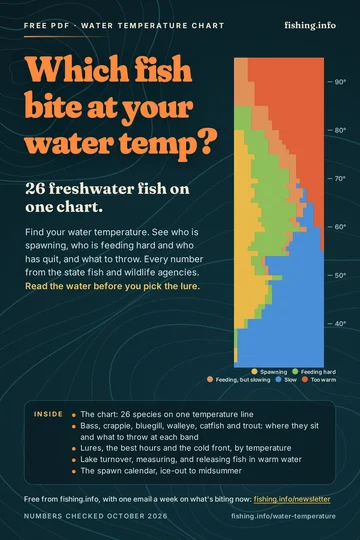
Free PDF · Water temperature chart Which fish are biting at today's water temperature?
One reading, and the 16-page chart shows which of 26 fish are spawning, feeding hard or slowing down; for bass, crappie, bluegill and walleye, where they sit and what to throw. Every number sourced.
No card, nothing to buy, and the PDF is yours to keep. It's in your inbox a minute later. Then a few short emails and one a week on what's biting. Unsubscribe anytime. Privacy.
How do you catch walleye and sauger here?
Fish near the bottom with a jig tipped with a minnow or a minnow head. That’s the core of the Minnesota DNR’s ice walleye advice, and it names Lake of the Woods with Upper Red, Mille Lacs and Leech as popular winter walleye lakes. What sets this lake apart is the sauger. The DNR says there may be no better place in Minnesota to catch them through the ice. A mixed bag is “more likely than not,” and the bite lasts all day.
The setup that works here
- Run two rods. Jig one and set the other as a deadstick: a live minnow under a bobber, 6 in (15 cm) off bottom. The tourism bureau calls it the one-two punch. The jig draws fish in, and the still minnow catches the ones that won’t take the jig. Two lines are legal through the ice in Minnesota.
- Use a jig of 3/8 to 1/2 oz. The bureau’s colors are gold, glow pink, orange and chartreuse, tipped with a minnow head.
- Try a spoon when the jig dies. The DNR’s pick for sauger in these “bog-stained depths” is a live minnow or a bright, shiny jigging spoon.
- Bang the bottom, then stop. Some anglers drop the lure onto the bottom to kick up a puff of silt, the DNR notes. The bureau adds a pause: hold still 3 to 4 seconds, because the strike often comes then.
- Use shiners. The bureau says emerald shiners are the lake’s main baitfish and the best bait, live or frozen. Buy your bait. Lake of the Woods is a designated infested water, and you generally can’t net your own there.
- Watch the screen. A flasher shows a fish rising to the jig before you feel it.
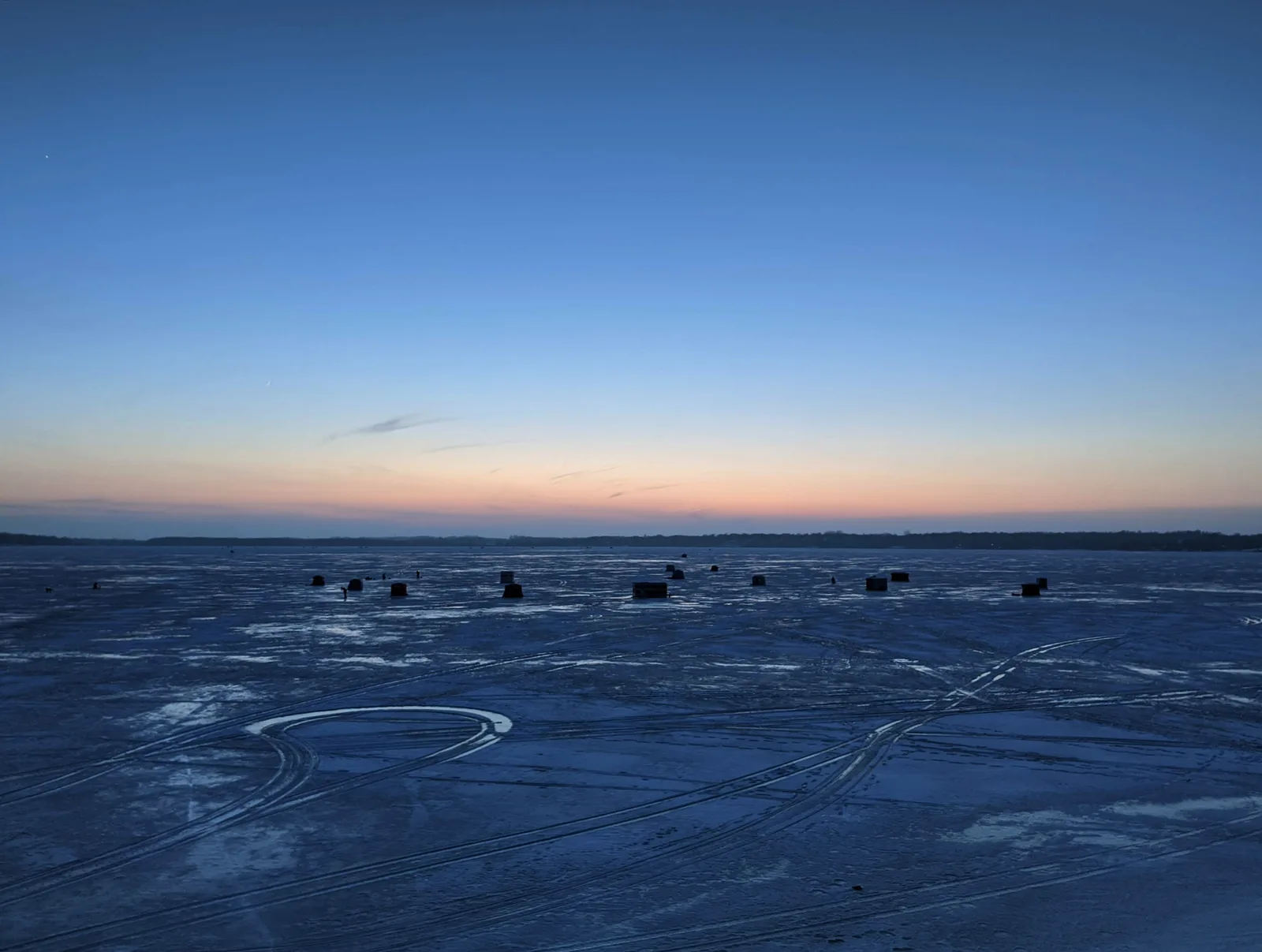
Fish houses on Buffalo Lake, in the Midwest. On Lake of the Woods, the tourism bureau says, guides track the walleye schools and move the resort houses to stay on them. Photo: Courtney Celley, U.S. Fish and Wildlife Service, public domain.
For the rest of the method, the walleye ice fishing guide covers depth, timing and lures, and the ice fishing lures page the spoons and rattle baits.
What about the pike?
Pike season never closes on the Minnesota side, and late ice is their time. The DNR says big northern pike move into shallow water before they spawn, and that’s when anglers chase them. If you set a tip-up for them, you must stay within 200 ft (61 m) of it. Minnesota now allows hook-setters through the ice too. A spring or a bent rod may set the hook, but no motor, and the device can’t reel the fish in for you. Not in Ontario, though: a spring-loaded hook-setter may not even come within 30 m (98 ft) of the water there.
The slot seems to be working. Every pike from 30 to 40 in (76–102 cm) goes back, and only one over 40 in may be kept. The DNR says the share of large pike has grown since that slot was set. Walleye aren’t their main meal, either. In fall nets from 2021 to 2024, the DNR found no walleye in a sample of stomachs from pike over 30 inches. The northern pike page covers the fish, and walleye has the lake’s main target.
What are the Minnesota and Ontario rules this winter?
The line between the two sides crosses open ice, and the rules change at it. Ontario’s numbers below are for a non-Canadian resident with a sport license.
| Rule, 2026–27 | Minnesota side | Ontario side |
|---|---|---|
| Walleye and sauger season | May 9, 2026 – April 14, 2027 | January 1 – April 14, and the third Saturday in May – December 31 |
| Walleye and sauger a day | 6 combined, no more than 4 walleye; 6 in possession | 2 combined, 4 in possession |
| Walleye size | Release 19½–28 in (50–71 cm); 1 over 28 in (71 cm) | None from 43–70 cm (17–27½ in); 1 over 70 cm |
| Northern pike | 3; release 30–40 in (76–102 cm); 1 over 40 in (102 cm) | 4; none over 75 cm (29½ in) |
| Yellow perch | 20 a day, 40 in possession | 15 |
| Lines through the ice | 2; stay within 200 ft (61 m) of a tip-up | 2; stay within 60 m (197 ft) of each line |
| Houses off the ice | By midnight, March 31 | Before the ice breaks up |
Far up the Ontario side, Whitefish Bay, Clearwater Bay and Echo Bay add their own bait and barbless-hook rules. Read Ontario’s Zone 5 page before you fish them.
Crossing into Ontario
Fishing the Ontario side takes an Ontario fishing license and an Outdoors Card. Only the one-day license comes without the card. A kid under 18 may fish beside you on yours, and the kid’s fish count as yours. Leave your minnows on the Minnesota side: Ontario doesn’t let baitfish, live or dead, into its bait zone unless they’re dead and preserved.
At the border the ice counts as land. The tourism bureau says anyone who sets foot on Canadian ice must report to both countries. Not reporting back into the U.S. can cost up to $5,000.
Minnesota rules that catch people out
A slot limit is a length range with its own rule. Here it means release. On the Minnesota side, three rules catch people out:
- Four Mile Bay and the Rainy River close early. From March 1 to April 14 it’s catch and release only there, while the main lake stays open.
- A sauger without its head and tail counts as a walleye. Keep them whole until you’re off the water.
- No harvest of lake sturgeon. From October 1 to April 23 it’s catch and release only, and no tag is needed. The lake sturgeon page covers the fish.
Six is also all you may have with you. On the Minnesota side the daily limit and the possession limit are the same, so three days in a sleeper house still means six fish.
You may cook fish on the ice. Keep each carcass with its head, back fin and tail, so it can still be measured. It counts toward your limit until you dispose of it. Leaving carcasses or trash on or under the ice is illegal.
How many fish do anglers keep here?
The DNR counted the winter catch in 2023–24 and 2024–25. The numbers say a lot about how this lake fishes. The newest count out is 2024–25: from mid-December to mid-March, anglers put in 2 million hours on the ice. Here’s what they kept.
| Fish | Kept, winter 2024–25 | Six-year average |
|---|---|---|
| Walleye | about 175,000 lb (79,000 kg) | 161,000 lb (73,000 kg) |
| Sauger | about 150,000 lb (68,000 kg) | 235,000 lb (107,000 kg) |
| Yellow perch | 39,000 lb (17,700 kg) | 18,000 lb (8,200 kg) |
Day-trip anglers took nearly 70 percent of that winter’s walleye. Overnight anglers keep fewer fish per hour, the DNR says, so a sleeper house is about the stay, not the count.
The fall 2025 nets are the newest numbers the DNR has out. Walleye ran 15.5 a net, under the long-term 16.6, but fish of 14 to 16 in, the eaters, were above average. Sauger stayed high at 16.0 a net, over their 15.3 average. Walleye here reach 13 in at about three years old, and sauger grow slower and stay smaller.
The lake grows other fish worth the trip. Minnesota’s records list a burbot of 19 lb 10 oz and a lake whitefish of 13 lb 9 oz, both from Lake of the Woods. The burbot page has the eelpout. The DNR adds one warning: a big windstorm as the ice forms can muddy the water and slow the bite.
Is the ice safe?
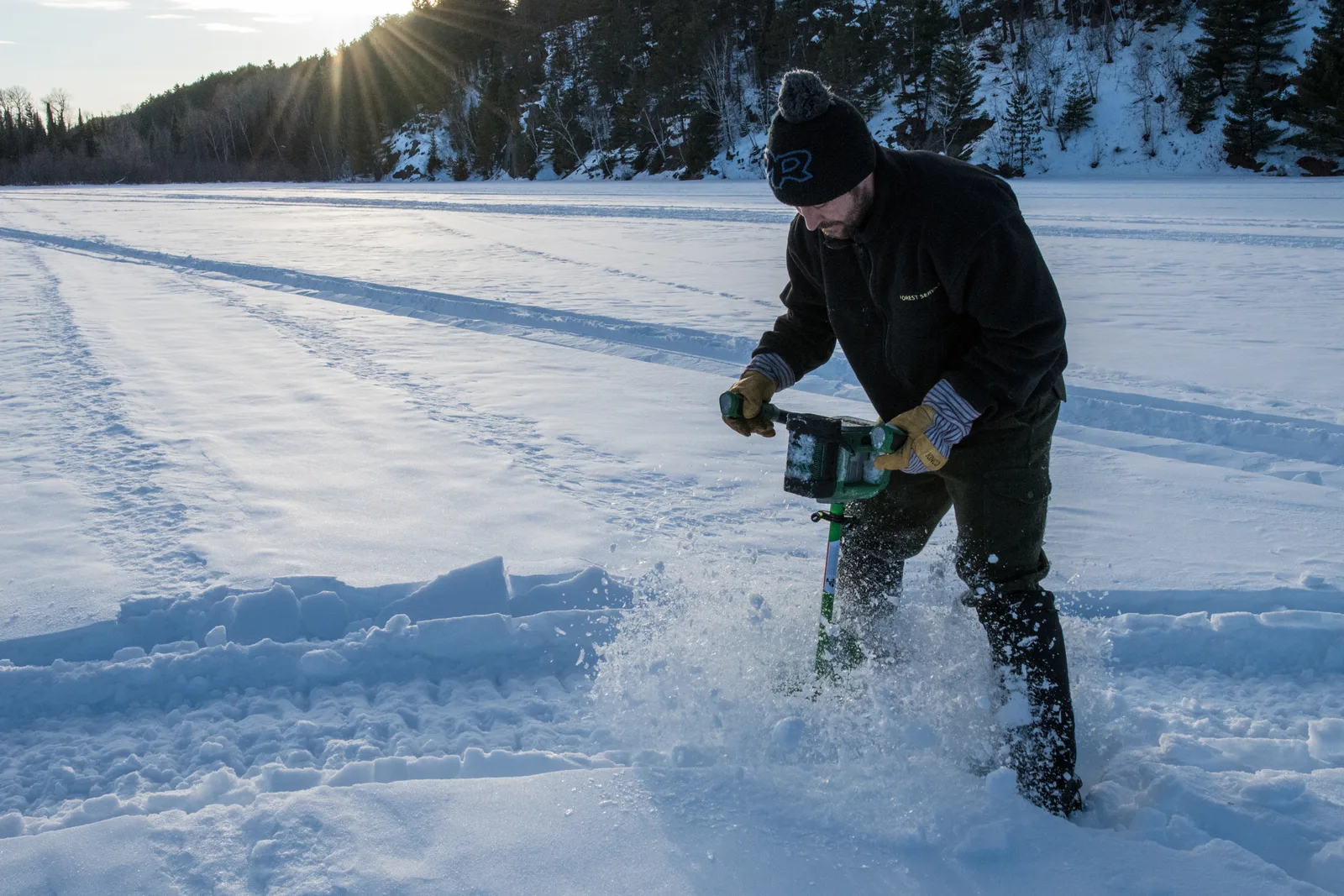
The Minnesota DNR does not measure ice on any lake. Ask the resorts that run the roads. Then check it yourself with a spud bar or an auger. The DNR’s guideline, for new clear ice:
| Clear ice | What it holds |
|---|---|
| 4 in (10 cm) | You on foot |
| 5–7 in (13–18 cm) | A snowmobile or small ATV |
| 9–10 in (23–25 cm) | A small car or SUV |
| 13 in (33 cm) | A medium truck |
| 20 in (51 cm) and up | A heavy-duty truck with a wheelhouse |
Double every figure on white ice, which is only about half as strong. Park at least 50 ft (15 m) apart and move the truck every two hours, or it can start to sink. Ontario sets its own floor: 8 in (20 cm) of clear blue ice for a snowmobile, 12 in (30 cm) for a light vehicle. The ice thickness chart puts the agencies side by side.
What does a license cost?
A Minnesota resident pays $25 for the year, $12 for 24 hours or $14 for 72 hours. A nonresident pays $51 for the year, $14 for a day, $36 for three days or $43 for a week. Each license adds a $1 issuing fee. Residents under 16 need none, and nonresident kids under 16 fish free when a parent or guardian is licensed. The Minnesota fishing page has the license fees and the four big walleye lakes side by side.
Minnesota’s Take a Kid Ice Fishing Weekend is January 16–18, 2027. Residents 16 and older may fish without a license if a child under 16 is with them. The states hub sets Minnesota’s fees beside other states, and the ice fishing guide has the gear and the basics. If sauger are new to you, the sauger page shows how to tell one from a walleye before you count your six.

Free PDF · 16 pages
Stop guessing. Know what's biting before your first cast
A whole Saturday on the water with nothing to show for it. One reading tells you who's feeding.
The Water Temperature Fishing Chart. Take one water temperature reading, find it on the chart, and see which of 26 freshwater fish are spawning, feeding hard or slowing down.
- Where bass, crappie, bluegill and walleye sit, and what to throw. Trout: the reading where you stop.
- Why a 3 ft drop beats a cold front, and what to throw each day of the front
- The three thermometer mistakes that make a reading lie
The chart's numbers come from state fish and wildlife agencies and fisheries research: 64 sources, each listed on the site.
No card, nothing to buy. The PDF is in your inbox a minute later, one version for your phone and one to print, yours to keep. Then a few short emails and one a week on what's biting, with an unsubscribe link in every one. Privacy.
Related
Section guide
Minnesota Fishing: The Big Lakes, the License and the Winter RulesMinnesota fishing in one place: the $25 license, the two-line rule on the ice, when walleye close, and the four big walleye lakes with their own rules.
 Minnesota Fishing License 2026: Cost, Who Needs One and Where to Buy
A Minnesota fishing license is $25 for residents and $51 for nonresidents. The 2026 fees, who fishes free, and how to buy one in the new DNR system.
Sources (12)
- Minnesota DNR, 2026 Minnesota Fishing Regulations (PDF; effective March 2026 through February 28, 2027), Canada-Minnesota border waters and ice shelters
- Minnesota DNR, Lake of the Woods and Rainy River winter information (PDF, 2025–26): creel survey, gill nets, carcasses on the ice
- Minnesota DNR, Lake of the Woods
- Minnesota DNR, General ice thickness guidelines
- Minnesota DNR, Ice fishing for walleye
Show all 12 sourcesShow fewer sources
- Minnesota Conservation Volunteer, sauger (May–June 2022)
- Ontario, Fishing regulations summary: Fisheries Management Zone 5 (updated August 4, 2026)
- Ontario, Fishing regulations summary: recreational fishing licences and fees (updated August 4, 2026)
- Ontario, Ice fishing: lines, ice huts and ice safety
- Lake of the Woods Tourism, Border crossing information
- Lake of the Woods Tourism, Ice fishing at Lake of the Woods (updated for 2026)
- NASA, Northwest Angle, Minnesota, ASTER image of May 19, 2002 (Wikimedia Commons)