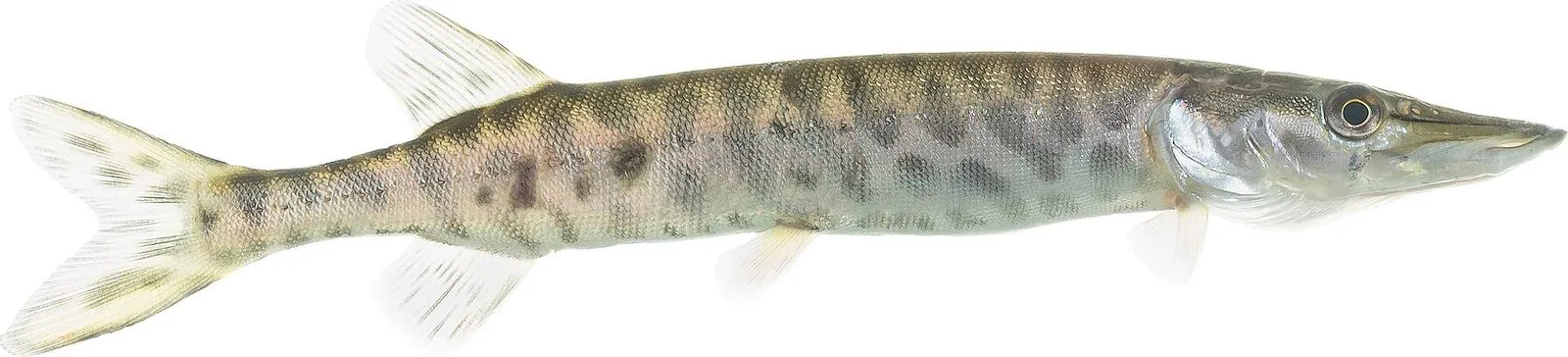
The world record muskie weighs 67 lb 8 oz (30.6 kg) if you ask the IGFA and 69 lb 11 oz (31.6 kg) if you ask the National Fresh Water Fishing Hall of Fame. Both fish were caught near Hayward, Wisconsin, in 1949, three months apart. A third fish, 69 lb 15 oz (31.7 kg), held the title for 35 years, was thrown out as a fake in 1992, and is still New York’s state record. None of the three can be measured again. What follows is each claim, the evidence against it, what the record keepers answered, and the giants since 1988 that were weighed with witnesses watching.
The heaviest muskie nobody disputes weighed 65 lb, was caught in 1988 by a man on his first day of muskie fishing, and has never been the all-tackle world record.
The list: every claimed and certified giant
| Fish | Weight | Length | Date and water | Status |
|---|---|---|---|---|
| Art Lawton | 69 lb 15 oz (31.7 kg) | 64½ in (164 cm), claimed | Sept 22, 1957, St. Lawrence River, New York | Disqualified 1992; still the New York record |
| Louis Spray | 69 lb 11 oz (31.6 kg) | 63½ in (161 cm), claimed | Oct 20, 1949, Chippewa Flowage, Wisconsin | Hall of Fame record; Wisconsin record |
| Cal Johnson | 67 lb 8 oz (30.6 kg) | 60¼ in (153 cm), claimed | July 24, 1949, Lac Courte Oreilles, Wisconsin | IGFA all-tackle record |
| Ken O’Brien | 65 lb (29.5 kg) | 58 in (147 cm) | Oct 16, 1988, Georgian Bay, Ontario | Ontario and Canadian record; witnessed weighing |
| Martin Williamson | 61 lb 4 oz (27.8 kg) | not confirmed | Nov 2000, Georgian Bay, Ontario | Reported weight; no record listing found |
| Joe Seeberger | 58 lb (26.3 kg) | 58 in (147 cm) | Oct 13, 2012, Lake Bellaire, Michigan | Michigan record; Modern Day program record |
| Nolan Sprengeler | 55 lb 14.8 oz (25.4 kg) | 57¾ in (147 cm) | Nov 22, 2021, Mille Lacs, Minnesota | Minnesota record |
| Art Weston | released | 54.33 in (138 cm), fork length | Oct 29, 2024, Mille Lacs, Minnesota | IGFA all-tackle length record |
Read the table from the bottom up and a pattern shows. Every fish weighed in front of officials since 1988 is 58 in or shorter and 65 lb or lighter. Every fish above that line dates from 1949 to 1957 and rests on paperwork and photographs.
Art Lawton, 1957: the record that was thrown out
Art Lawton reported a 69 lb 15 oz muskie, 64½ in long, from the St. Lawrence River near Clayton, New York, on September 22, 1957. Field & Stream, the record keeper of the day, accepted it. The fish itself was given away and eaten.
It stood for 35 years. Then John Dettloff of Couderay, Wisconsin, went through the photographs, and published what he found in Outdoor Life in December 1992:
- The length. Lawton stood 5 ft 8 in. Scaled against him in the photo, “the true length of the Lawton fish was between 55.1 and 55.9 inches,” Dettloff wrote, and “it could not have exceeded 57 inches.”
- The stringer photo. A picture printed with Lawton’s own 1958 magazine story showed muskies said to be caught a week before the record. The biggest carried a noted weight of 49 lb 8 oz, and its markings matched the “record” fish.
- The witness. Walter Dunn, listed as overseeing the weighing, signed a notarized statement that he “did not weigh or measure the fish and did not know who did.”
On August 6, 1992, the Hall of Fame and the IGFA both disqualified the fish “on the grounds of falsification.”
Lawton has a defender. Muskie historian Larry Ramsell argued in 2006 that the case skipped due process. He pointed to the missing chain of custody for the key photo, reviewers without photogrammetry credentials, and a 1958 affidavit in which Dunn said he did witness the weighing. New York never took the fish down. The state’s record list still shows 69 lb 15 oz.
Louis Spray, 1949: the Hall of Fame’s fish
With Lawton gone, the Hall of Fame put Louis Spray’s fish back on top: 69 lb 11 oz and 63½ in, from the Chippewa Flowage on October 20, 1949. Wisconsin lists it as the state record. Spray had already claimed record muskies of 59½ lb in 1939 and 61 lb 13 oz in 1940.
The IGFA would not take it. Spray’s companion George Quentmeyer shot the fish twice in the head before it came aboard. That was legal and common in 1949, and it has ruled a fish out under IGFA rules since. The mount burned in a fire in January 1959, so there is no fish to measure.
In October 2005 the World Record Muskie Alliance (WRMA) filed a 93-page protest. It had hired a Canadian firm to scale the fish against Spray’s known height in the 1949 photographs. The firm put the muskie at 52.1 to 55.1 in, not 63½ in. The Associated Press reported the group’s weight conclusion as “no more than about 55 pounds.” The alliance also suggested that weight had been added before the weigh-in.
The Hall voted in January 2006, with eight votes to uphold. Executive director Emmett Brown said: “The all-tackle world record will not be overturned. In many ways, it’s further validated.” The Hall cited three mathematicians it had consulted. On February 1, 2006, those three wrote back that the Hall had misread them: “None of us is willing to say, based on the limited information made available to us and the limited investigations we have made thus far, whether or not we believe the record is valid.” They asked for an independent panel of mathematicians and photogrammetry experts. Ramsell, the Hall’s own record historian, had resigned on December 30, 2005.
Spray has a defender too. Milwaukee outdoor writer Don L. Johnson dug into the story in 1992 and came away convinced Spray had caught the fish.
Cal Johnson, 1949: the IGFA’s fish
Cal Johnson’s muskie came first, on July 24, 1949, from Lac Courte Oreilles near Hayward: 67 lb 8 oz and 60¼ in, on a Pike Oreno lure. The IGFA settled on it after the Lawton ruling, having first named Ken O’Brien’s 65-pounder its “temporary” record.
The WRMA gave Johnson the same treatment as Spray. Its report, dated June 13, 2008, used the same photogrammetry firm plus a peer review by a forensic imaging company. The photographs, it said, show a fish of 53.2 in, 54 in at most. It asked that “Mr. Johnson’s records be promptly removed from record status.”
The IGFA declined in a February 2009 email. Jason Schratwieser wrote: “Your report has been vetted at the highest possible level at IGFA. We simply do not feel the photogrammetry analysis is sufficient for us to rescind this record.”
So the score stands like this. The IGFA backs Johnson. The Hall of Fame and Wisconsin back Spray. New York still lists Lawton.
What the tape says about the weights
Length is the weak point in all three claims, and length decides weight. The standard-weight chart used by fisheries biologists gives the weight of a well-fed muskie at each length. At 54 in (137 cm) it reads 51.1 lb (23.2 kg). At 58 in it reads 64.8 lb.
Real giants run under that chart. Seeberger’s 58 in fish weighed 58 lb. Sprengeler’s 57¾ in fish weighed 55 lb 14.8 oz. Only O’Brien’s fish matched it, at 58 in and 65 lb, with a girth of 30½ in (77 cm).
That is the arithmetic behind the challenges. A muskie of 53 to 55 in weighing 67 to 70 lb would be far heavier for its length than any fish on the modern list. The claimed lengths of 60 to 64½ in are several inches longer than any muskie weighed in front of officials since. To see what your own fish weighs from length and girth, use the fish weight calculator.
The giants weighed with witnesses
Ken O’Brien, 65 lb, 1988. O’Brien was fishing a friendly muskie match in the Moon River basin of Georgian Bay on October 16, 1988. It was his first time muskie fishing. The fish measured 58 in with a 30½ in girth. It was weighed on certified scales before witnesses and photographed by Toronto Star outdoor columnist John Power. It is the Ontario and Canadian record.
Joe Seeberger, 58 lb, 2012. Seeberger’s fish came from Lake Bellaire in Antrim County, Michigan, on October 13, 2012, and a Michigan DNR fisheries biologist verified it. The angler taped it at 59 in and the taxidermist at 58 in, with a 29 in girth. In February 2013 it became the first record of the Modern Day Muskellunge World Record Program. That committee of muskie scientists, anglers and outdoor media formed in 2006. Michigan DNR says it covers a “void” for verifiable fish “in the 58- to 68-pound range.”
Nolan Sprengeler, 55 lb 14.8 oz, 2021. Sprengeler hooked his fish on Mille Lacs at about 9 p.m. on November 22, 2021. “After trying to revive the fish for about an hour we realized she wasn’t going to make it,” he said, so it went to a certified scale. It measured 57¾ in by 29 in and broke a 54 lb Minnesota record that had stood since 1957.
Martin Williamson, 61 lb 4 oz, 2000. This Georgian Bay fish from November 2000 appears in In-Fisherman’s list of modern giants. No record body’s listing for it turned up, so treat the weight as reported.
Length records: the fish that swam away
Most big muskies are released now, so the tape has become the record. The IGFA’s all-tackle length record is Art Weston’s fish from Mille Lacs, caught on October 29, 2024, with Sprengeler as his guide. The IGFA lists it at 138 cm (54.33 in), measured to the fork of the tail. Outdoor Life reported a total length of 57½ in.
Wisconsin’s live-release record fell three times in 2025, all on Green Bay: 56 in, then 56½ in, then Sam Becker’s 57 in (145 cm). A Wisconsin DNR biologist, Jason Breeggemann, said in 2022: “It’s very possible that a world record muskie is swimming in Green Bay today.”
Has a 60 in muskie ever been caught? Three were claimed, by Lawton, Spray and Johnson, and none of those lengths survived a photo analysis. In-Fisherman reported a released 60 in by 29½ in fish in 2011. No muskie of 60 in has been measured by a record body.
Does a 70 lb muskie exist?
John Casselman, the biologist who started the Cleithrum Project archive of muskie age bones, told MeatEater: “For a muskie to reach 60 pounds, it needs to be in the water 32 to 35 years.” The oldest muskies on record are about 30. His verdict: “I doubt we’ll see muskies reaching weights beyond the mid- to high 60s.”
The growth data agrees. An average Wisconsin muskie needs 17 years to reach 50 in (127 cm). In Minnesota it takes 13 to 21 years. Minnesota’s females level off at an average of 54.2 in (138 cm), and the longest muskie ever taken in a Minnesota spring net survey was 57 in. Only females get there. In Minnesota’s sample of kept fish, 26% of females and 1% of males passed 47 in.
Which state has the biggest? On paper, New York and Wisconsin. On a certified scale, Michigan at 58 lb and Minnesota at 55 lb 14.8 oz. The biggest water matters more than the state line: Wisconsin DNR found that lakes of 2,000 acres and up are the ones that grow 50 in fish.
For how to tell a muskie from its cousin, and how old a 40 or 48 in fish is, see the muskie page. The pike has its own record story, with a $52.50 twist, on the world record pike page. The whole family, from pickerel to tiger muskie, is on the pike family hub, and the everyday comparison is muskie vs pike and northern pike.
Related
Section guide
Pike Fish: Northern Pike, Muskie, Tiger Muskie and Pickerel Told ApartThe pike family in North America: northern pike, muskie, tiger muskie and chain pickerel, how to tell each one apart, and the record for each.
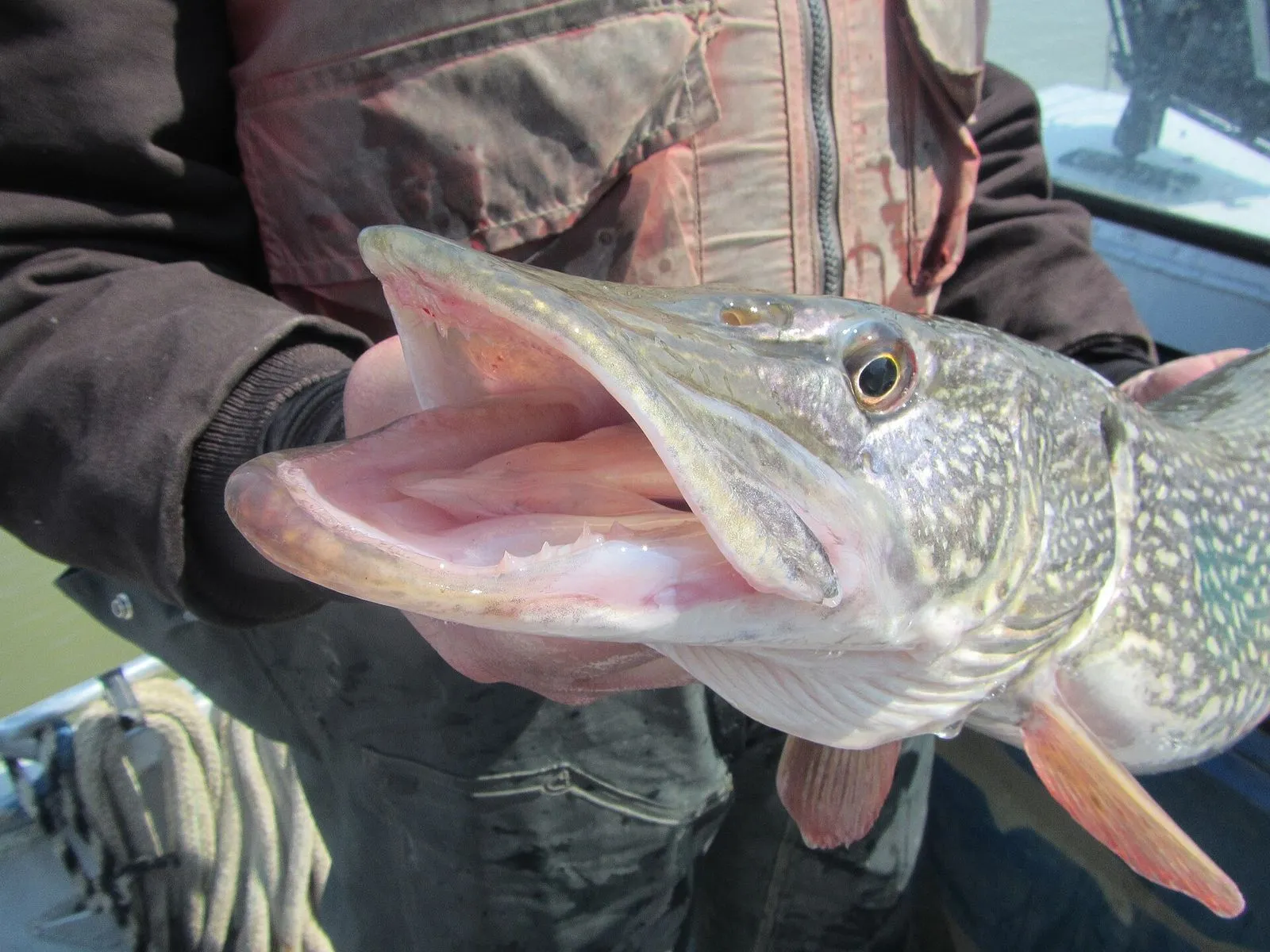 Northern Pike Teeth: How Many, How Sharp, the Summer Myth, and How to Unhook One
Northern pike teeth: about 16 knife-edged canines on each side of the lower jaw, hundreds more on the roof and tongue, and how to unhook one safely.
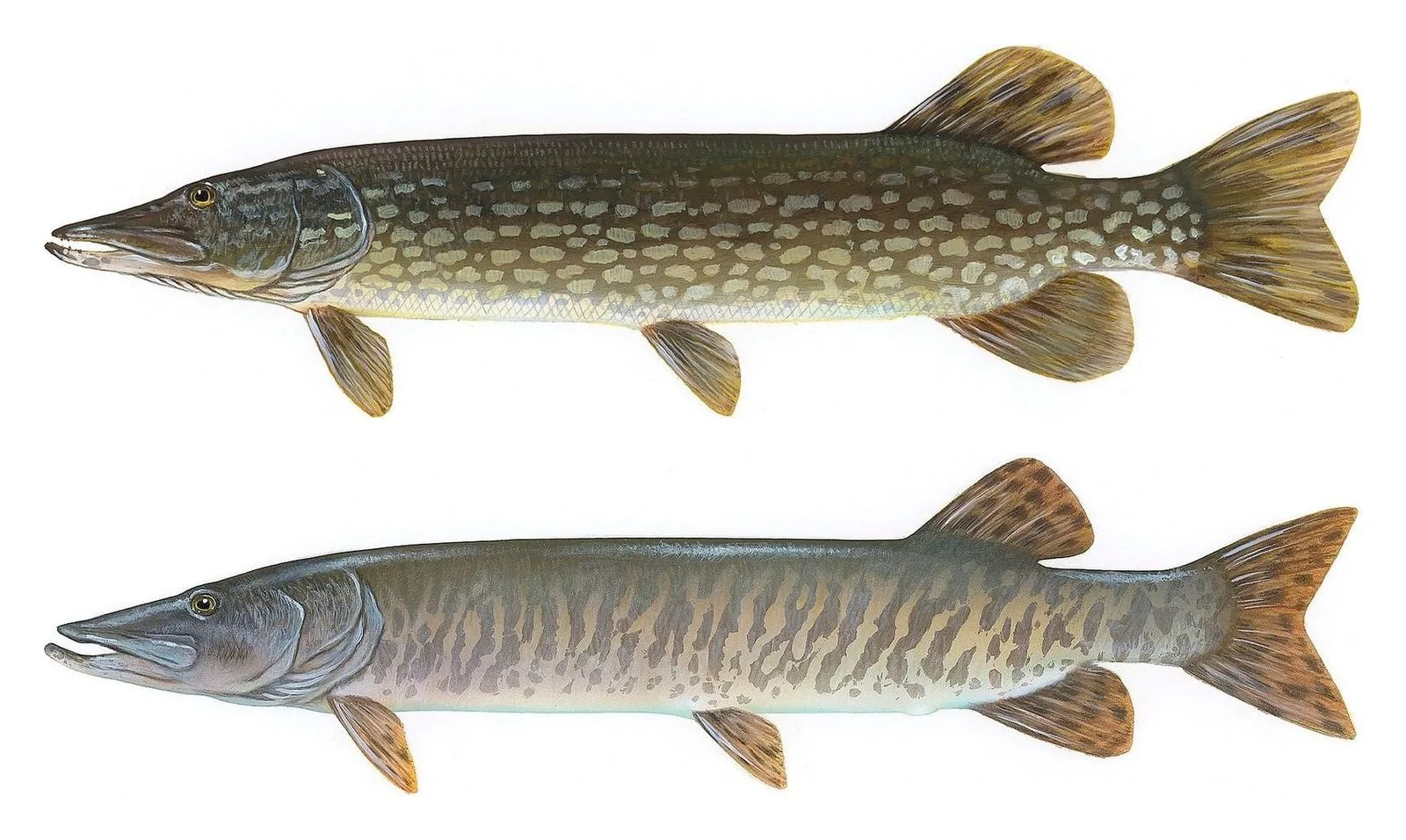 Muskie vs Pike: How to Tell Them Apart, and How the Two Fish Really Differ
Muskie vs pike: markings, tail tips, jaw pores and cheek scales side by side, plus size, age, numbers per acre, and pike against pickerel and walleye.
 Best Northern Pike Lures: Six Classics the Agencies and Guides Agree On, and When to Throw Each
The northern pike lures that state agencies, In-Fisherman guides and the magazines agree on, with sizes checked at the maker and the water each one is for.
 Best Muskie Lures: The Classic in Each Class, and the Water Temperature to Throw It
The muskie lures guides and magazines keep naming, one per class, with maker-checked sizes and the water temperature each is for, from 40 °F to 75 °F.
 Chain Pickerel: How to Identify One, How Old It Is, and How to Catch It
Chain pickerel: the tear under the eye, the three pickerels compared, age at every length, season-by-season fishing, the bones, and the 1961 record.
- Tiger Muskie: What the Hybrid Is, How Big It Gets, and Which States Stock It
Tiger muskie: the pike and muskellunge cross, how to tell it from both parents, how fast it grows, which states stock it and why, and the 1919 record.
Sources
- Wisconsin DNR, Wisconsin record fish list (July 2021): Spray, 69 lb 11 oz, 63.5 in
- New York DEC, New York State freshwater fishing records: Lawton, 69 lb 15 oz
- John Dettloff, The World-Record Muskie That Turned Out to be a Hoax, Outdoor Life (December 1992, republished 2025)
- Patrick Durkin, Mobsters, Arson, and Photogrammetry: The World Record Muskie Conspiracy Theories, MeatEater (June 27, 2022)
- World Record Muskie Alliance, Cal Johnson Summary Report (June 13, 2008)
- Chicago Sun-Times, WRMA debunks another muskie: Cal Johnson's (November 29, 2009)
- Associated Press, Is world record muskie bogus? Lawrence Journal-World (December 4, 2005)
- ESPN / Associated Press, Fishing Hall of Fame upholds record muskie (January 2006)
- Douglas N. Arnold, University of Minnesota, Fish story: the mathematicians' letter of February 1, 2006
- Larry Ramsell, Did Art Lawton Get a Fair Shake? OutdoorsFirst (February 22, 2006)
- Kathy Johnson, Who caught the world's largest muskie? Great Lakes Now (March 23, 2022)
- Gary Ball, The Sun Times, Owen Sound (December 15, 2005): the O'Brien muskie
- Michigan DNR, State-record Great Lakes muskellunge now also a world record (February 19, 2013)
- Fox 9, Minnesota DNR certifies 55-pound muskie caught on Mille Lacs Lake as new record (December 2021)
- IGFA, World records for January 2025: Weston, 138 cm all-tackle length record
- Outdoor Life, Record chaser teams up with local fishing legend to catch pending world-record muskie (Weston, October 29, 2024)
- Dac Collins, Wisconsin's Muskie Record Was Broken 3 Times in 2025, Outdoor Life (January 20, 2026)
- Bob McNally, DNR Survey: World Record Muskie Could Be Swimming in Green Bay, Outdoor Life (May 19, 2022)
- Steve Ryan, The Hunt For Giant Muskie, In-Fisherman (March 1, 2018): Williamson and the released giants
- Dr. Rob Neumann, Muskie Length To Weight Conversion Chart, In-Fisherman (January 3, 2016)
- Wisconsin DNR, Muskellunge Management Update, FH-508 (2012): age at 50 in, lake size
- Younk and Pereira, An Examination of Minnesota's Muskellunge Waters, Minnesota DNR Investigational Report 498
- Jerry Younk, Minnesota DNR, Ask the DNR: how old do muskies get (Grand Forks Herald, 2014)