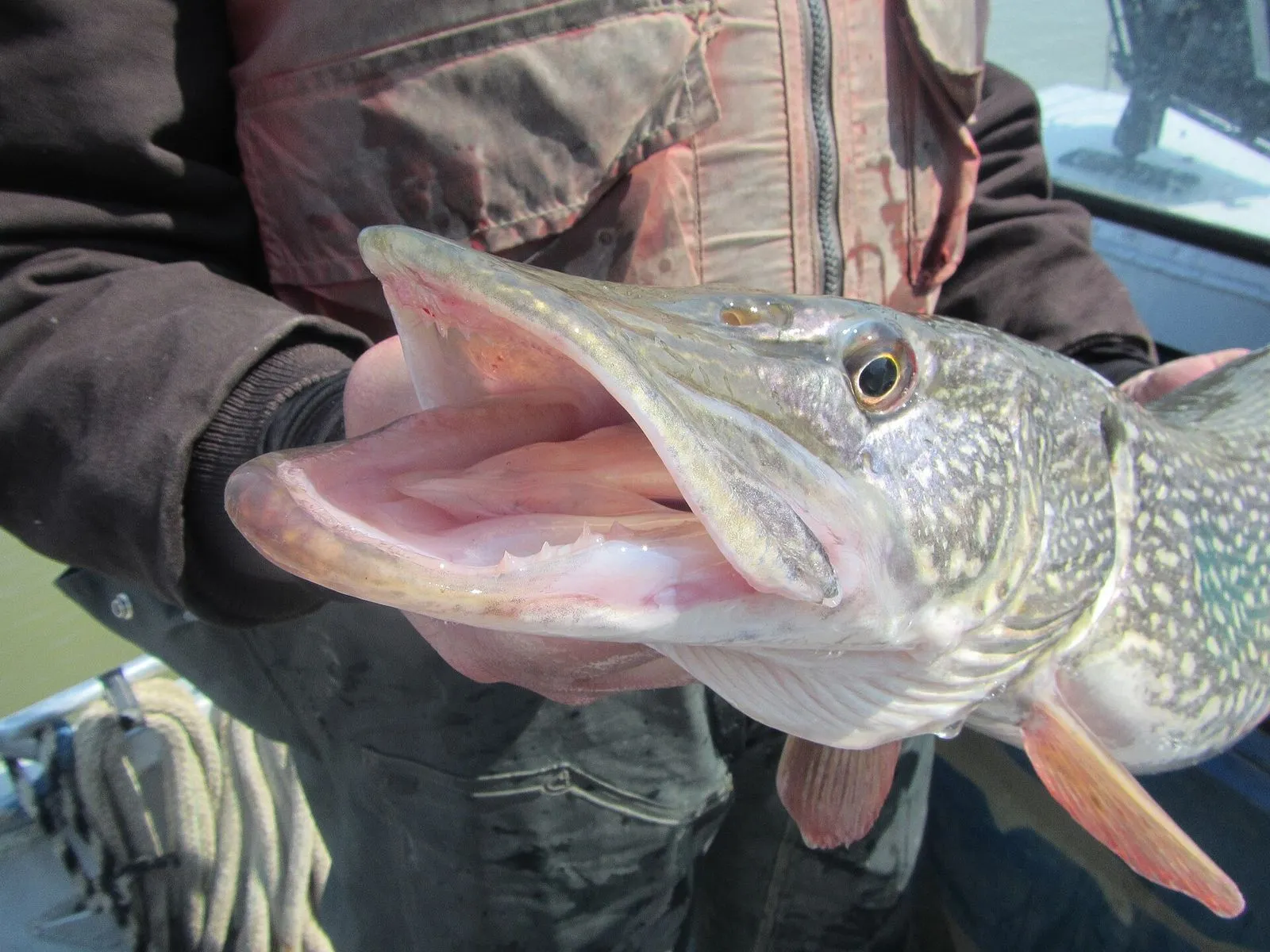
Northern pike teeth come in two sets: about 16 knife-edged canines along each side of the lower jaw, and hundreds of small, backward-slanting teeth on the roof of the mouth and the tongue. The canines pierce and the small teeth hold. Below: every kind of tooth and where it sits, what a 1935 count of 188 pike says about the summer shedding story, what is known about bites on people, and how to pick a leader and unhook the fish with your fingers intact.
“A three-foot pike has no more canine teeth than a five-inch pike.” Two Michigan biologists counted them in 1935: about 16 on each side of the lower jaw, at every size, for life.
How many teeth does a northern pike have?
Hundreds. Minnesota DNR describes a “tongue and palate lined with hundreds of backward-slanting teeth to grip, while long teeth in the lower jaw pierce”. Alaska’s Department of Fish and Game adds that the jaws, the roof of the mouth, the tongue and even the gill rakers carry sharp teeth.
You will see “700 teeth” on many fishing sites. No agency or study read for this guide gives a counted total, so treat that figure as a guess.
Only one group of teeth has been counted by dissection: the big canines of the lower jaw. Milton Trautman and Carl Hubbs of Michigan’s Institute for Fisheries Research did it in 1935 and found about 16 on each side. As the jaw grows, each tooth and its slot simply get bigger.
The kinds of teeth, and where each one sits
| Teeth | Where | What they are like |
|---|---|---|
| Canines, about 16 a side | Rear two thirds of each lower jaw | Flat-sided blades; needle tip, a keel front and back |
| Two “super-canines” | Within that row, toward the front | The longest teeth; one is almost always in service |
| Front lower teeth | Front third of the lower jaw | Round, hooked, much smaller; seldom missing |
| Upper-jaw teeth | Edge of the front third of the upper jaw | One row, tiny |
| Roof teeth | Along the roof of the mouth, largest toward the middle | Hinged; they fold down toward the throat; present in great numbers |
| Tongue teeth | Middle of the tongue | Fine as sharkskin, set among taste buds |
The table follows Trautman and Hubbs, who described the mouth tooth group by tooth group. The tongue’s taste buds come from a 2014 microscope study of five pike tongues.
The two sets do different work. The canines stab and slice. The roof teeth are a one-way gate: they fold flat as prey slides in and stand up against anything pulling out. That includes a finger.
How sharp are northern pike teeth?
Sharp enough that the 1935 report describes a new canine this way: “Its tip is sharp as a needle; its front and rear edges are expanded into knife-like keels.” A pike tooth cuts in two directions, which is why a pike cut is a slice and not a puncture.
Minnesota DNR warns that those teeth “will easily cut through your mono-filament line”. Wired2Fish puts the canines of a big pike at up to 1 in (2.5 cm) long, without naming its source.
One claim has nothing behind it. British anglers say pike slime stops blood from clotting, and that this is why a pike cut bleeds for so long. No agency page or study read for this guide mentions any such substance. Canada’s 31-page federal review of the species, which covers its parasites, viruses and toxins, is silent on it. The plain explanation is many fine, clean cuts on a wet hand.
Do pike lose their teeth in summer?
No. The story is old: pike shed their teeth in August, grow a new set, and refuse to feed while their gums are sore. Trautman and Hubbs suspected “that guides, finding it an excellent alibi to satisfy their unsuccessful customers, have been to a large degree responsible for keeping this idea alive”.
They tested it. Their report, dated August 31, 1935, tabulates the teeth of pike collected in every month except February and December.
| What they measured | What they found |
|---|---|
| Fish examined | 188 northern pike, 7 muskellunge, 6 chain pickerel |
| Canines per side, five pike of 5–12 in (13–30 cm) | 15.8 on average |
| Canines per side, ten pike of 14–42 in (36–107 cm) | 15.9 on average |
| Canines in service per side, by month | About 6 to 7, April through September |
| Canines being replaced per side, by month | About 5, with no summer rise |
| Fish with three quarters of their canines in service | None of more than 200 |
| Stomachs opened | About 100; July and August fish held as much food as the rest |
The monthly averages are read from a typed table in a 90-year-old scan, so take them as “about”. The conclusion needs no rounding: “At all times of the year there is an effective complement of teeth, and at all seasons approximately the same number of teeth are being replaced.”
How replacement works. The gum along the back of each lower jaw is divided into about 16 compartments. Each holds a file of teeth at different stages of growth, from a tiny tip to a finished blade. When a tooth in service breaks, its bony base dissolves and the next tooth moves out and fuses to the jaw. The authors compared it to a rattlesnake’s fang, 16 times over on each side. So a pike always has gaps, and always has teeth. Not one fish in the study had even three quarters of its canines working at once.
Where the sore gums come from. The biologists looked at four pike straight out of the water in late August and early September. The gums showed no swelling and no redness. Soon afterward they reddened, as small blood vessels burst in the dying fish, mostly around the teeth that were being replaced. That is what an angler sees in the bottom of the boat.
The August slump itself is real. Michigan’s creel census of the day confirmed that the catch per hour “does fall off very notably in the summer”. Trautman and Hubbs offered two causes: plenty of natural food, and warm water. Wisconsin DNR gives the same two today. A Minnesota study later showed that pike over 28 in (71 cm) move to water of 61 to 70 °F (16–21 °C) in August, which the northern pike guide covers.
Muskie teeth and tiger muskie teeth
A muskie has the same mouth, larger. USGS describes “strong canine teeth” in the jaw and “short, sharp brush-like teeth” on the tongue. The seven muskellunge and six pickerel in the 1935 study matched the pike. The authors concluded that all members of the pike genus probably share the pattern: about 16 canines a side, replaced one by one in every season.
The shedding myth was in fact stronger for muskies. The report quotes the angling writer Dixie Carroll, who wrote that the muskie loses its teeth about the middle of August. He had examined three fish caught on a September 10 and seen new teeth beside loose old ones. That is exactly what the biologists found in every month of the year.
Nothing has been published on the teeth of the tiger muskie as such. It is a cross of the two fish above, and anglers should treat its mouth the same way.
Do northern pike bite people?
Rarely, and almost never the way the stories tell it. The documented cases are few.
- Finland, June 2025. A man rinsing his hands at a lakeshore was bitten on three fingers by a pike he put at about 16 in (40 cm). He needed a tetanus shot and no stitches (Yle News).
- Britain. Outdoor Swimmer found sporadic reports: a hand bitten in a canal in 2020, a water-skier’s foot in 1999. Its verdict was that more swimmers cut their feet on broken glass in one year than pike have bitten in two decades.
- Muskies. Three cases made the news. In 2017 an 11-year-old girl on a paddleboard at Island Lake, Minnesota, was slashed on the foot and leg; the species was never confirmed. In 2020 a woman standing waist-deep in the Winnipeg River in Ontario was bitten on the calf. In 2021 a triathlete swimming in Lake St. Clair took 13 stitches in his hand.
No fatal case turned up. Joni Tiainen of the Natural Resources Institute Finland told Yle that a pike can mistake a hand or foot for prey, “a predatory reflex”. He added that most bites happen “when someone is removing a hook from a fish”. Adam Weir, a biologist with the Ontario Federation of Anglers and Hunters, said of muskies that they “are more inclined to take off and swim away than taking a bite”.
So the northern pike bite to plan for is the one at the side of the boat.
Leaders for pike: wire or fluorocarbon?
Every state agency that addresses it says wire. Minnesota DNR: “Don’t forget a steel leader for larger pikes.” Alaska: “A wire leader is a must.” Wisconsin and Michigan list a wire leader as standard pike tackle. Maine asks for “highly abrasion resistant leaders”.
Named anglers increasingly use fluorocarbon, and they are open about the trade:
- Doug Stange, In-Fisherman: 20 lb fluorocarbon on live and dead bait rigs. He reports well over 100 pike landed on it “without getting cut off”, one of them over 20 lb. That is one angler’s tally with small bait hooks, not a test with lures.
- Paul Bailey, North Dakota Game and Fish: 100 lb fluorocarbon for dead bait under tip-ups for big pike.
- Jack Ballard, MeatEater: wire is “the easiest antidote”; for flies, about a foot of 50 lb fluorocarbon.
- Mark Romanack, Northern Ontario Travel: 18 in (46 cm) of 50 to 80 lb fluorocarbon where the bite-off risk is low, titanium wire where it is higher. He rates jigs as the lure most often bitten off, because pike swallow them deep.
No controlled test of wire against fluorocarbon for bite-offs has been published; a search for one turned up only forum threads and magazine pieces. What can be said is this. Wire is the one material that no source reports a pike cutting. Fluorocarbon is a bet: perhaps more strikes, some risk. And a bitten-off lure stays in the fish, which is the argument for wire whenever you are unsure. The fishing leader guide covers lengths and knots, and how to catch northern pike puts the leader in the full rig.
How to hold and unhook a northern pike
These steps come from Minnesota DNR, Wisconsin DNR and Muskies Canada.
- Get the tools out first. Long-nosed pliers and a cutter that will go through a hook. Muskies Canada adds jaw spreaders and gloves to the list.
- Leave the fish in the water. Wisconsin DNR: do not land it; bring it alongside the boat and take the hook out there. A large net of soft or coated mesh holds the fish while you work.
- Keep your fingers out of the mouth. Minnesota DNR: “Remove hooks quickly with long-nosed pliers, not your fingers.”
- Cut what will not come out. Cut a stubborn hook with the cutter. If the hook is swallowed, both agencies say to cut the line and leave it.
- Lift it level, if you lift it at all. One hand under the belly. Minnesota DNR: “Always hold a fish horizontally. Holding vertically places stress on the vertebrae.”
- Stay out of the gills and eyes. Minnesota DNR calls lifting by the gills or eye sockets “an older method” that in most cases will kill the fish.
- Keep a fish that is bleeding heavily, if it is legal to keep. Minnesota DNR advises against releasing one that cannot right itself.
About the gill-plate hold. Guides and tackle shops teach a grip for pike: fingers flat under the gill cover, clear of the red gills, thumb outside, the other hand under the belly. No agency page read for this guide describes it. The one agency that mentions gills at all, Minnesota DNR, warns against putting fingers in them. The gill rakers carry teeth too. If you use the grip, learn it from someone who can show you. Until then, the net and the pliers do the job.
Related
- Pike, muskie and pickerel: the whole family, told apart.
- Muskie vs pike: markings, tail, pores and cheek scales side by side.
- Do fish have teeth?: which fish you can lip and which you cannot.
- Catch and release: the full drill for letting a fish go alive.
Sources
- Trautman and Hubbs (1935), When do pike shed their teeth?, Institute for Fisheries Research Report 310, Michigan Department of Conservation and University of Michigan
- Wisconsin DNR, Northern Pike (Esox lucius), PUBL-FM-707 (2008): teeth, the summer slump, wire leader, unhooking
- Minnesota DNR, MinnAqua species profile: northern pike (teeth, steel leader, handling rules)
- Minnesota DNR, Catch and release: holding and unhooking
- Alaska Department of Fish and Game, Wildlife Notebook Series: northern pike (teeth constantly replaced, wire leader)
- Alaska Department of Fish and Game, Northern Pike in Southcentral: steel leader
- Michigan DNR, Northern pike species page: wire leaders
- Maine Department of Inland Fisheries and Wildlife, Northern pike assessment: abrasion-resistant leaders
- Morphological study of the northern pike (Esox lucius) tongue (2014), DOI 10.1007/s12565-014-0254-x
- USGS Nonindigenous Aquatic Species, Esox masquinongy: the muskellunge's teeth
- Wisconsin DNR, Muskellunge (Esox masquinongy) fact sheet, PUBL FM-705 (2012): unhooking at boatside
- Muskies Canada, Muskies 101: handling and the tool list
- Yle News (2025), Fish bites Finnish man rinsing hands in lake
- Outdoor Swimmer (2023), Myth busting: can a pike bite my toes?
- Andrew Cruickshank, Rare muskie attack leaves triathlete with 13 stitches, Cottage Life (2021)
- Fox News (2017), Fish attack at Minnesota lake leaves girl, 11, with deep lacerations
- Cottage Tips (2020), Muskie attack sends woman to ER
- Doug Stange, Fluorocarbon secrets for pike, In-Fisherman (2017)
- Paul Bailey, Targeting big pike in winter, North Dakota Outdoors (2016)
- Jack Ballard, Northern pike fishing part two: hook up and hold on, MeatEater (2019)
- Mark Romanack, Understanding pike and musky leaders, Northern Ontario Travel (2025)
- Wired2Fish (2023), Northern pike: a comprehensive species guide (canine length)