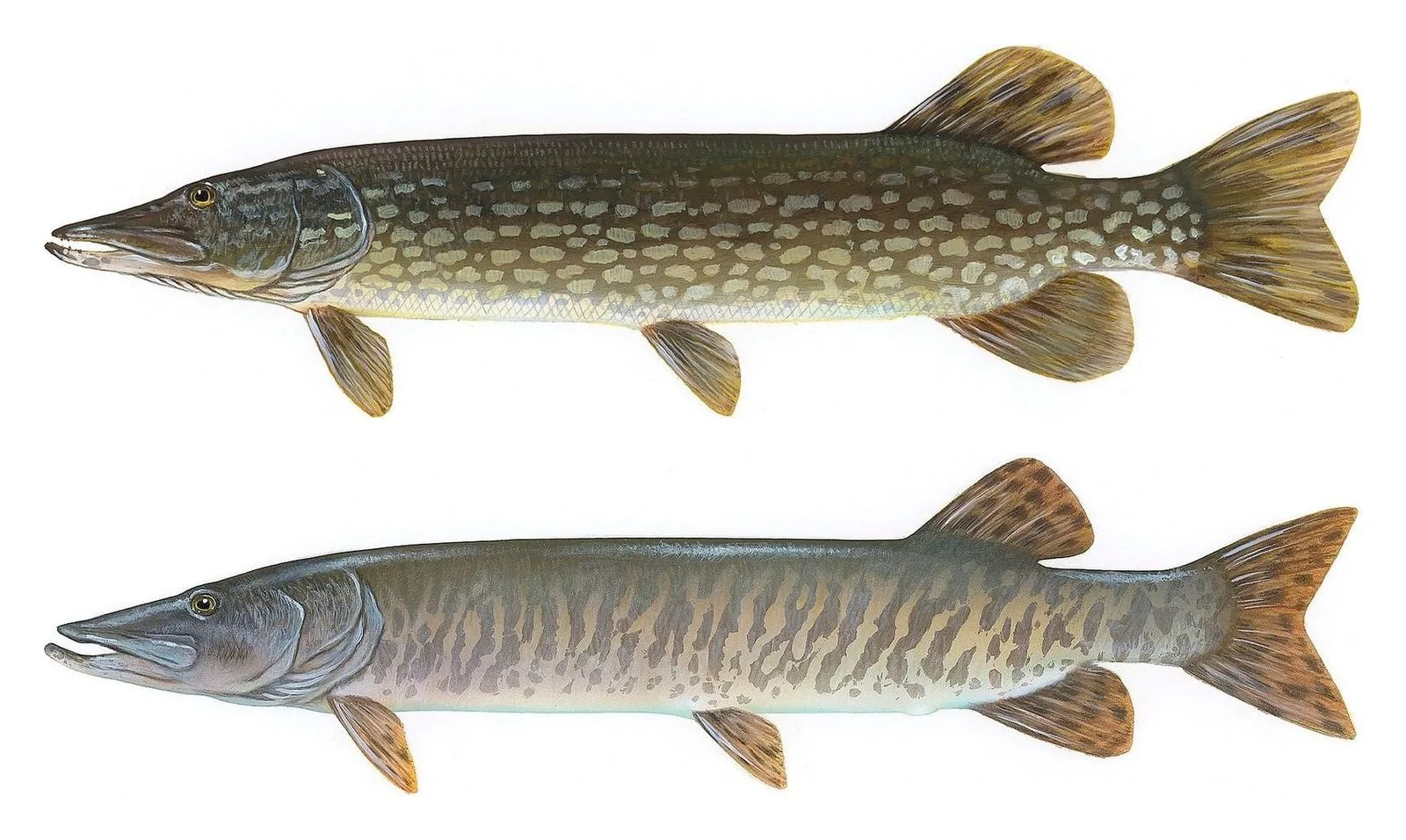
Muskie vs pike comes down to three marks. A muskie has dark bars or spots on a light body, pointed tail tips, and six or more pores under each side of its jaw. A northern pike has pale spots on a dark body, rounded tail tips, and five or fewer pores. Below: the full side-by-side, a 30-second check for the fish in your net, the two places where the agencies contradict each other, and how the fish differ in size, age and numbers.
A Wisconsin lake averages about 6.5 adult pike to the acre. A good muskie lake holds one adult muskie to every two or three acres. That is the whole difference between an eight-hour fish and a 27-hour fish.
Muskie vs pike, side by side
Every cell below comes from a state agency. The tiger muskie is the cross of the two, so it sits in its own column.
| Feature | Muskie | Northern pike | Tiger muskie |
|---|---|---|---|
| Markings | Dark bars or spots on light, or none | Pale bean-shaped spots in rows on dark green | Bold vertical bars; see the note below |
| Tail tips | Pointed | Rounded | Rounded |
| Pores under jaw, per side | 6–9 | 5 or fewer | 5–7 |
| Cheek scales | Top half only | Whole cheek | Whole cheek, or two thirds |
| Gill-cover scales | Top half only | Top half only | A third to a half |
| Fins | Pointed, often rust-colored | Rounded, with dark spots or wavy lines | Rounded; jaws usually spotted |
The markings are the fast test, and Wisconsin DNR, Iowa DNR and the National Park Service all state it the same way: dark on light is a muskie, light on dark is a pike. It fails on two kinds of fish. Some muskies carry no marks at all, the “clear” pattern common in Michigan’s inland Upper Peninsula. And Pennsylvania’s Fish and Boat Commission notes that the marks of an old muskie can fade to one even color. Those are the fish for which the tail, the cheek and the pores exist.
The 30-second field check
Do it with the fish in the net and in the water.
- Read the sides. Pale spots in rows on a dark body: pike. Dark bars or spots on a lighter body: muskie. No marks: go to step 2.
- Look at the tail. Iowa DNR says a muskie’s tail splits into two points whatever its color. A pike’s ends in two rounded lobes. A tiger muskie’s is rounded too.
- Look at the cheek, the flat panel between the eye and the gill cover. Scales all over is a pike. Scales on the top half and bare skin below is a muskie.
- Count the pores along one side of the underside of the lower jaw. Iowa DNR’s rule: five or fewer on each side is a pike, six or more on either side is a muskie.
- Bold bars with a rounded tail? That is a tiger muskie. Its cheek is scaled all over or two thirds of the way down, and it has five to seven pores.
- Chain-link marks and a dark bar under the eye? Check the gill cover. If it is scaled all over, the fish is a chain pickerel, not a pike.
- Still unsure? Treat it as a muskie. Iowa counts the hybrid as a muskie for its 40 in (102 cm) limit, and muskie size limits run far above pike limits in every state named below.
Where the agencies disagree
Two cells in that table are less solid than they look.
A pike’s pore count. Wisconsin DNR’s identification card says “5 or less”. Pennsylvania says four or five. Iowa and Minnesota say five or fewer. But Wisconsin DNR’s own 2008 pike leaflet says “five to seven”. That overlaps the muskie’s six to nine, and Michigan DNR widens the muskie to “six to 10”. So a fish with six pores on one side is not settled by the pores alone. Use the cheek and the tail with it.
Some websites give a muskie “12 to 18” pores. That is the same count added across both sides of the jaw. Minnesota DNR prints the total as 11 to 18.
A tiger muskie’s bars. Wisconsin DNR’s card describes the hybrid as “irregular vertical light markings on a dark background”. Washington, Colorado, Pennsylvania and Iowa describe dark bars on a light background. Both are honest descriptions of a fish whose bars and gaps are about equally wide. Do not try to decide which color is the background. The rounded tail and the cheek do not depend on the eye.
One mark does not separate muskie from pike at all: the gill cover. On both fish only the top half is scaled. It matters for pickerel, further down.
Size, age and how many live in a lake
| Muskie | Northern pike | |
|---|---|---|
| Typical adult | 30–42 in (76–107 cm) | 20–30 in (51–76 cm), 2–10 lb (0.9–4.5 kg) |
| Average age at 36–40 in | 40 in (102 cm) at 8–9 years | 36.6 in (93 cm) at 10 years |
| Lifespan | Into the teens; 30 documented | About 7 years in fished lakes; 29–30 at the limit |
| Adults per acre | 0.2–0.5 in good waters | About 6.5 on average in Wisconsin |
| Hours of fishing per fish | 27 in Wisconsin, 40 in Minnesota | About 8 in Wisconsin |
| Spawning | 50–60 °F (10–16 °C), a week or two after pike | At ice-out, 35–50 °F (2–10 °C) |
| Largest prey | Up to two thirds of its own length | Best at a third to a half of its length |
| Heaviest on record | 67 lb 8 oz (30.6 kg) IGFA; 69 lb 11 oz (31.6 kg) Hall of Fame | 55 lb 1 oz (25 kg), Germany; 46 lb 2 oz (20.9 kg) in North America |
| Native range | Great Lakes, St. Lawrence, upper Mississippi and Ohio basins | Right around the north: North America, Europe, Siberia |
Are northern pike bigger than muskie? No. Ohio DNR gives a pike 20 to 30 in as typical and 48 in (122 cm) and 25 lb (11.3 kg) as the top end. It gives female muskies up to 50 in (127 cm) and 40 lb (18 kg). The world-record pike is a European fish; American pike stop about 20 lb short of the best muskies. The stories behind those fish are told under world record muskie and world record pike.
Growth. The muskie grows faster and for longer. Wisconsin’s average muskie is 40 in in its ninth year, and Michigan’s passes 40 in at age eight. Michigan aged 7,726 pike from 109 lakes: the average pike is 24.6 in (62 cm) at age five and 36.6 in at age ten. Most pike never see ten. Michigan puts the average lifespan at six to eight years.
Numbers. This is the difference that shapes a day on the water. Canada’s fisheries department, citing a Wisconsin study, gives an average of 16.1 adult pike per hectare, about 6.5 an acre. Wisconsin DNR puts muskies at about one adult to every two or three acres in good waters. Minnesota’s Leech Lake strain waters average one adult to 5.6 acres.
The catch rates follow. Wisconsin creel surveys from 1990 to 2011 recorded one muskie per 27 hours; Minnesota’s average across 18 waters is 40 hours. Wisconsin DNR’s pike leaflet says a northern takes about eight hours, though it names no survey for the figure. The same leaflet puts a muskie at nearly 100 hours.
Spawning order. Pike spawn first, at ice-out. Muskies follow a week or two later in the same kind of shallows. Michigan DNR spells out what that means: young pike are already hunting when muskie fry hatch, and they eat them. Where pike are added to a muskie lake, the muskies usually decline.
Who eats more. In three Minnesota lakes, muskies were 1 to 4% of the top predators by number and ate 6 to 16% of the food. The pike ate 38 to 50%. Yellow perch come first in the diet of both fish. Pike themselves turned up in Minnesota muskie stomachs, at 3.7% of the diet by importance.
Speed. Wisconsin DNR credits a pike with 8 to 10 miles per hour (13–16 km/h). No agency read here gives a figure for a muskie.
Teeth. The same design in both: large canines along the lower jaw, and short brush-like teeth on the roof of the mouth and the tongue. The 1935 Michigan study that counted them concluded that all species of the pike genus probably carry about 16 canines on each side of the lower jaw. Both fish have bitten people in the water on rare occasions, but the cut hand at unhooking is the common injury. Northern pike teeth has the counts and the cases.
Limits and the table. A muskie is a release fish: 40 in (102 cm) on most Wisconsin waters, 42 in (107 cm) in Michigan, 54 in (137 cm) in Minnesota. Wisconsin DNR says muskies are rarely targeted for eating, and advises women of childbearing age and children under 15 not to eat them because of mercury. Pike are the fish for the pan. Michigan’s statewide minimum is 24 in (61 cm), and small pike eat best. Check the current rules for your water before you keep either.
Northern pike vs pickerel
A chain pickerel is a small cousin of the pike, and a young pike is easy to take for one. Pennsylvania’s Fish and Boat Commission gives four differences.
- Gill cover. On a pickerel the cheek and the gill cover are both scaled all over. On a pike the cheek is scaled all over but only the top half of the gill cover.
- Pattern. A pike has rows of pale spots on dark. A chain pickerel has dark chain links on yellow-green.
- The tear. A pickerel wears a dark bar under the eye, “like a clown’s painted tear”. No agency read here lists one for the pike.
- Fins. Pike fins carry dark blotches and often yellow, orange or red. Chain pickerel fins are pale and unmarked.
Size helps only with big fish. Connecticut’s fisheries agency gives chain pickerel as commonly 10 to 18 in (25–46 cm). In Pennsylvania’s survey data a pickerel levels off near 21 in (53 cm), while a pike passes 30 in (76 cm) at around age eight.
The trap is the young pike. Iowa DNR notes that a juvenile has slanting bars of light and dark, not the adult’s spots. Check the gill cover.
Pike vs walleye
These two are not related. The walleye is a perch, and the mix-up is mostly one of names: in parts of Canada a walleye is called a pickerel.
| Northern pike | Walleye | |
|---|---|---|
| Family | Pikes | Perches |
| Fin on the back | One, soft, far back by the tail | Two, the first one spiny |
| Head | Flat duckbill snout | No duckbill; big mouth, prominent teeth |
| Eye | Ordinary | Very reflective; a night feeder |
| Color | Pale spots in rows on olive green | Yellowish or olive brown, white below |
Count the fins on the back and you are done.
Related
- Pike, muskie and pickerel: the whole family, with the record for each.
- Muskie: age at every length, and what a 50 in fish weighs.
- Northern pike: length at age, weight, and where big pike go in summer.
- Fish weight calculator: weight from length and girth for either fish.
Sources
- Wisconsin DNR, Muskellunge – Northern Pike Identification, PUBL-FM-503: markings, pores, cheek and gill-cover scales, tail
- Wisconsin DNR, Northern Pike (Esox lucius), PUBL-FM-707 (2008): identification, pore count, hours per fish, speed, lifespan
- Wisconsin DNR, Muskellunge (Esox masquinongy) fact sheet, PUBL FM-705 (2012): identification, prey size, spawning, density, consumption advice
- Wisconsin DNR, Muskellunge Management Update, FH-508 (2012): length at age, 27 hours per fish, size limits
- Iowa DNR (2016), Know Your Catch: how to ID northern pike and muskies
- Pennsylvania Fish and Boat Commission (2003), The 100-Year Chain: The Pike Family: cheek and gill-cover scales, pickerel, fins
- Pennsylvania Fish and Boat Commission (2018), Chain Pickerel Management and Fishing in Pennsylvania: length at age for pickerel and pike
- Minnesota DNR, MinnAqua species profile: northern pike (pores, tail, average size)
- Minnesota DNR, Long Range Plan for Muskellunge Through 2040: diet studies, share of food eaten, 54 in limit
- Smith, Thomas and Hanchin (2016), Management Plan for Muskellunge in Michigan, Michigan DNR Fisheries Report 12: length at age, pike and muskie together, color phases
- Smith, Kovacs and others (2016), Management Plan for Northern Pike in Michigan, Michigan DNR Fisheries Report 15: length at age, lifespan, 24 in limit
- Michigan DNR, Muskellunge species page (six to 10 pores)
- Harvey (2009), A biological synopsis of northern pike, Fisheries and Oceans Canada: range, density, prey size, maximum age
- National Park Service, Muskellunge (Esox masquinongy): average size
- USGS Nonindigenous Aquatic Species, Esox masquinongy: native range, teeth
- Ohio DNR, Northern pike: typical and maximum size
- Ohio DNR, Muskellunge: sizes of males and females
- Washington Department of Fish and Wildlife, Tiger muskie: description
- Colorado Parks and Wildlife, Tiger muskie: description
- Connecticut DEEP, Chain pickerel: bar under the eye, usual size
- Missouri Department of Conservation, Walleye field guide
- The Canadian Encyclopedia, Pickerel: the name as used for walleye
- IGFA (2026), 12 of the largest northern pike in IGFA world record history
- New York DEC, New York State freshwater fishing records (northern pike, 46 lb 2 oz, 1940)
- Wisconsin DNR, Wisconsin record fish list (muskellunge, 69 lb 11 oz, 1949)
- Kathy Johnson, Who caught the world's largest muskie?, Great Lakes Now (2022): which body recognizes which fish