 By
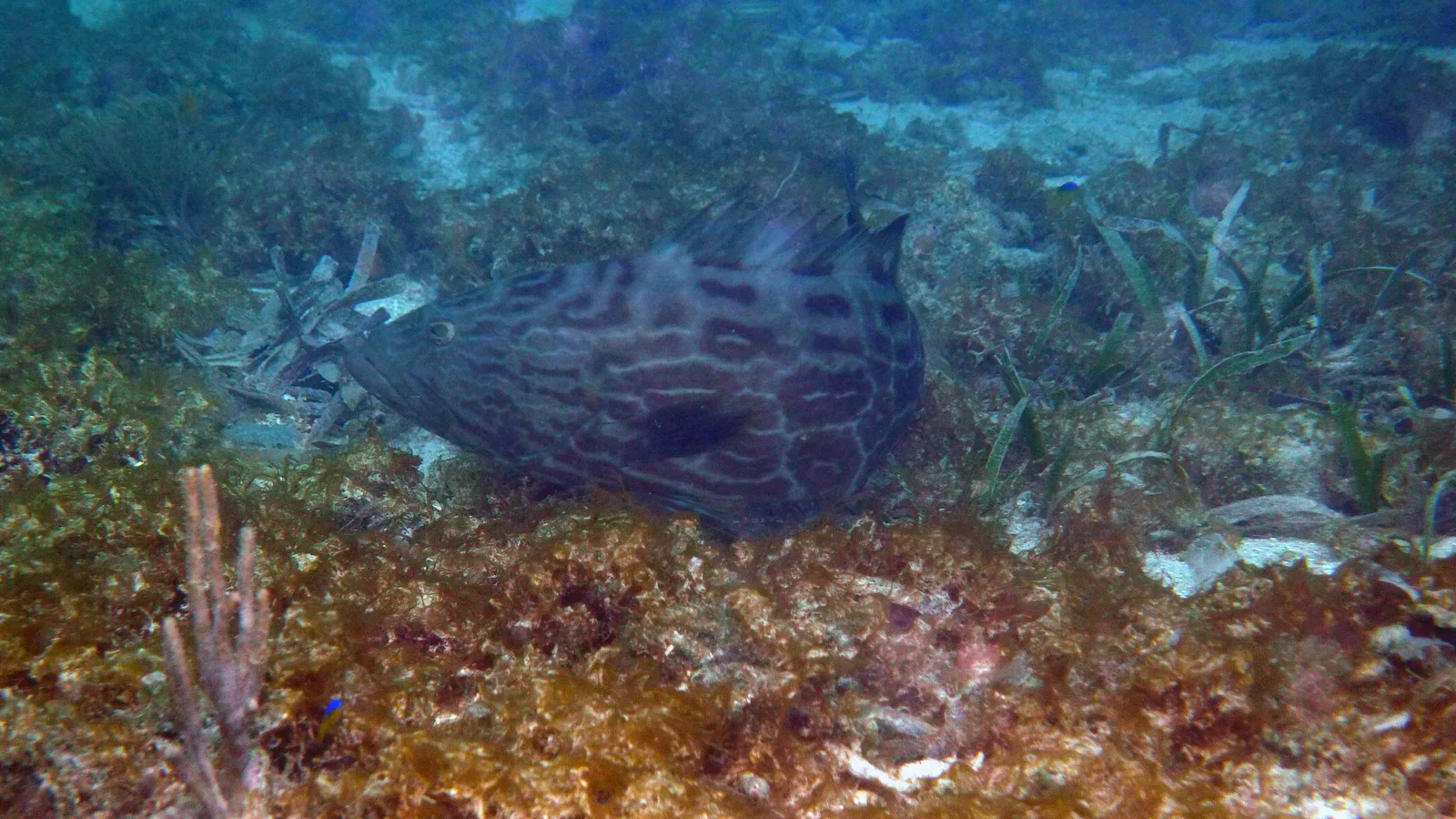
The black grouper is the big grouper of the Florida Keys: up to 180 lb, olive or gray, with rectangular black blotches. You catch it on the bottom near rock, reef and wrecks, mostly on live bait and heavy tackle. It has to be 24 in to keep in Gulf and South Atlantic federal waters, and in Florida’s. And before you measure it, make sure it isn’t a gag, because anglers mix the two up.
Federal managers put a two-fish boat limit on black grouper in the South Atlantic partly because anglers keep mistaking it for gag.
How do you tell a black grouper from a gag?
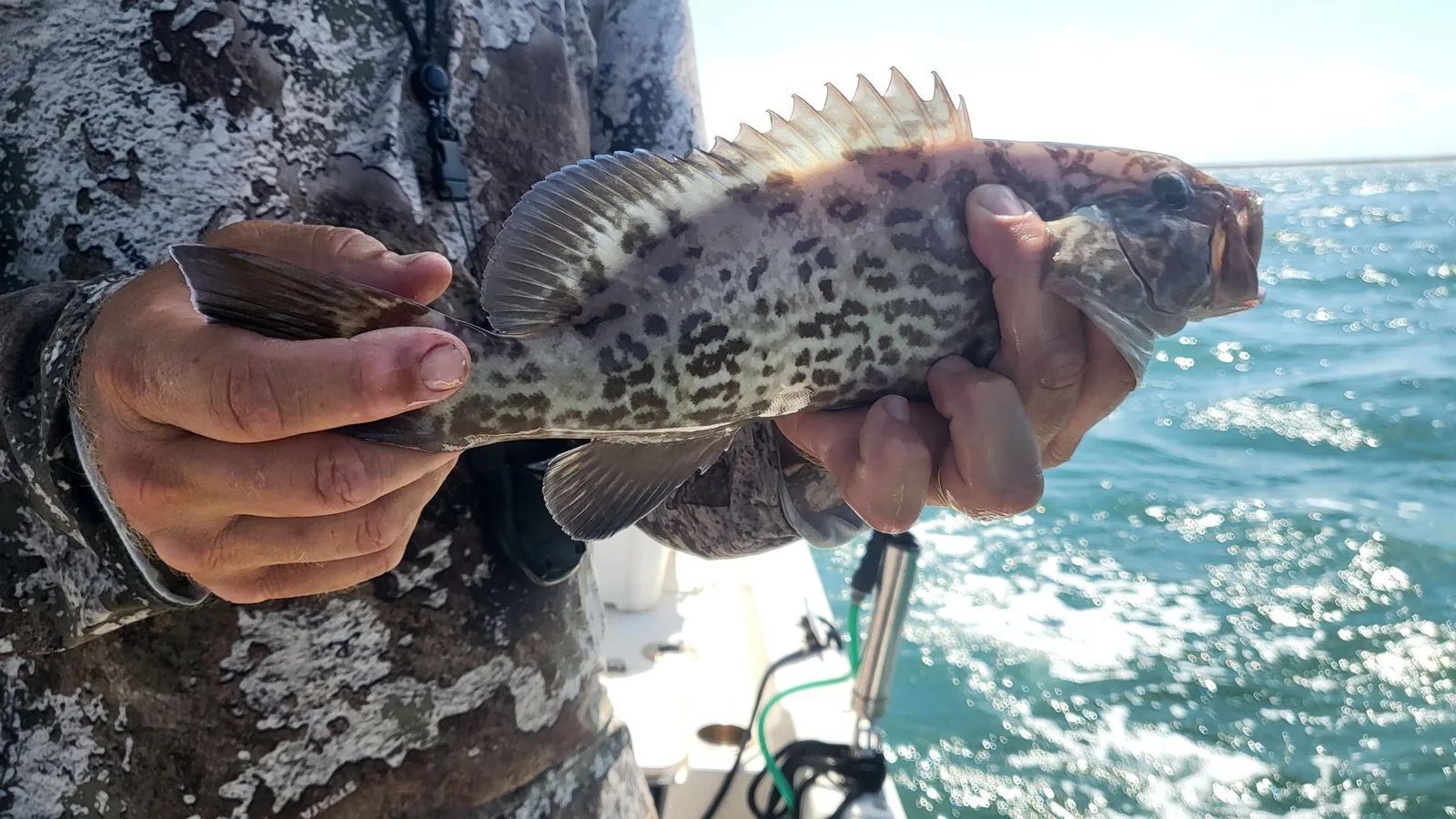
Run a finger along the bottom edge of the cheek, just in front of the gill cover. A gag has a strong serrated spur there. A black grouper’s edge is gently rounded. That’s the check FWC, Florida’s wildlife agency, gives.
The colors help you too. A black grouper is olive or gray with rectangular black blotches and brassy spots. A gag is brownish-gray with dark, worm-like marks on its sides. Look at the fins as well: on a black grouper the second dorsal fin, the anal fin and the tail are black on the outer third.
| Check | Black grouper | Gag |
|---|---|---|
| Bottom edge of the cheek | Gently rounded | Strong serrated spur |
| Body | Olive or gray, rectangular black blotches, brassy spots | Brownish-gray, dark worm-like marks |
| Fins | Second dorsal, anal fin and tail black on the outer third; pale yellow or white edge on the pectoral fins | Dark, with white edges on the anal fin and tail |
| Face | None listed by FWC | Dark lines radiating from the eyes |
| Grows to | 48 in (122 cm), 180 lb (82 kg); common to 40 lb (18 kg) | 36 in (91 cm), 50 lb (23 kg); common to 25 lb (11 kg) |
Marks and sizes from FWC’s species profiles.
The mix-up has a cost. A 2026 federal rule says gag and black grouper “are misidentified by recreational fishermen” because they look alike. That’s one reason the South Atlantic put a boat limit on black grouper at all, and since October 28, 2026, gag and black share one. Even fish markets confuse them: NOAA says gag is sometimes sold as black grouper.
One more look-alike in South Florida is the yellowfin grouper. FWC’s tell is simple: its pectoral fins are trimmed in bright yellow.
Where do black grouper live?
The US stock lives mostly in the Florida Keys, NOAA says. In the Gulf it’s more common in the southeastern part, off Florida. You’ll find the adults on rocky bottom, reef and drop-off walls in water over 60 ft (18 m), FWC says. They also use ledges, caves, crevices and artificial reefs. A black grouper tends to stay put and can sit on one spot for some time.
Size tells you depth. Black grouper move to deeper water as they age, and NOAA has them down to 656 ft (200 m). The young grow up in seagrass and oyster rubble in the Carolinas and on the reefs of the Keys.
For the boat, think reef edges. In the Keys, black grouper hold on the deep reef edges, The Tackle Room says. Reds sit on the shallower reef tract, gags on wrecks and ledges. Marathon captain Bill Giliberti fishes for black, red and gag grouper on reef in 25 to 120 ft of water. Bouncer Smith, a Miami Beach charter captain for 54 years, also works the edges of South Florida’s ship channels. In Government Cut, Sport Fishing says, the channel drops to 50 ft, and that’s where the groupers wait to ambush prey.
Free PDF · Water temperature chart Which fish are biting at today's water temperature?
One reading, and the 16-page chart shows which of 26 fish are spawning, feeding hard or slowing down; for bass, crappie, bluegill and walleye, where they sit and what to throw. Every number sourced.
No card, nothing to buy, and the PDF is yours to keep. Confirm with one click and it's on its way. Then a few short emails and one a week on what's biting. Unsubscribe anytime. Privacy.
When is the best time to catch black grouper?
In South Florida, November and December rank as prime months, Sport Fishing says. The fish are plentiful then, and the season closes for four months on January 1. Black grouper get common in the fall, Smith says, and so do the little bonito he uses for bait.
The calendar is set by the spawn. FWC says black grouper spawn in the winter. NOAA says the South Atlantic closes January through April to protect them during their peak spawning. That closure covers all of Monroe County’s state waters too, on the Gulf side as well as the Atlantic. In the Keys the season opens again on May 1.
The Gulf runs differently, for now. Through December 31, 2026, black grouper are open in Gulf federal waters. That changes on January 1, 2027. From then on, Gulf federal waters close black grouper from January 1 through June 30 every year. The rule keeps June shut because that’s when landings of these groupers have been highest.
How do you catch black grouper?
You want live bait on the bottom, near the structure. That’s how most South Florida anglers do it, anchored up-current, drifting, or trolling their baits. Pinfish are probably the most steady bait you can easily get, Smith says. Giliberti uses live bait too: pinfish, ballyhoo, blue runners and pilchards.
The best bait: a baby bonito
Smith’s top choice is a live 1 to 3 lb bonito. He calls it the No. 1 black grouper food you can drop down. Catch them by trolling a sabiki-style rig of small spoons and jigs around the wrecks. Hook the bonito through the upper lip and drop it on the up-current side of the wreck. Through December, live ballyhoo slow-trolled in 15 to 50 ft of water along any reef edge are very, very effective too, he says.
Here are his two setups side by side.
| Live bonito on a wreck | Rigged ballyhoo trolled on a planer | |
|---|---|---|
| Bait | Live 1–3 lb (0.5–1.4 kg) baby bonito, hooked through the upper lip | Rigged ballyhoo behind a Sea Witch skirt |
| Hook | 9/0 triple-strength circle hook | 7/0 triple-strength J hook |
| Leader | 20 ft (6 m) of 120 lb, to a three-way swivel | 100 ft (30 m) of 100 lb mono, to a planer |
| Weight | 3 lb (1.4 kg) on a short mono dropper | The planer, sized to the depth |
| Line | Heavy mono, 80 or 100 lb, and a lot of drag | 65 lb braid on a Penn International 50 |
| Where | Up-current side of the wreck | Coral reef in 50 ft (15 m) or less, bait about 10 ft (3 m) off the bottom |
Both from Capt. Bouncer Smith, in Sport Fishing.
Smith fishes off Miami, in the Atlantic. In Gulf federal waters you must use a non-stainless steel circle hook with natural bait. In the Atlantic south of 28° N, any hook with natural bait must be non-stainless.
Line, rig and lures
Why mono. If you’re after big grouper, Smith wants heavy monofilament and the tightest drag you can fish. “Braid doesn’t give to the pressure. Braid either holds or it breaks,” he says. Mono stretches instead of breaking, so you can put more heat on the fish. Not everyone goes that way. A Key West wreck setup in Salt Water Sportsman runs 60 lb braid with a 30 to 50 lb fluorocarbon leader and live pinfish.
The bottom rig. On the lower Keys wrecks, a popular choice is the classic Carolina rig with a 4 to 6 oz sliding sinker. It’s used for black, red and gag grouper. Keep the sinker sliding. The Tackle Room’s point: if a grouper rocks you with a fixed weight on, it’s stuck there.
Trolling lures. To learn trolling for grouper, Smith suggests a Rapala X-Rap 30 or 40, picked by depth. White seems to work best. Sand the top and paint it yellow and it works even better, he says, because black grouper eat yellowtail snapper.
Run the bait right. Smith wants a trolled bait about 10 ft off the bottom. Too deep, and the fish can take you back into the rocks more easily. Too shallow, and the grouper won’t bother. On a spot, give it 20 minutes, Giliberti says. No bite, and he moves to the next spot or shifts a little so the bait falls in front of a different part of the reef.
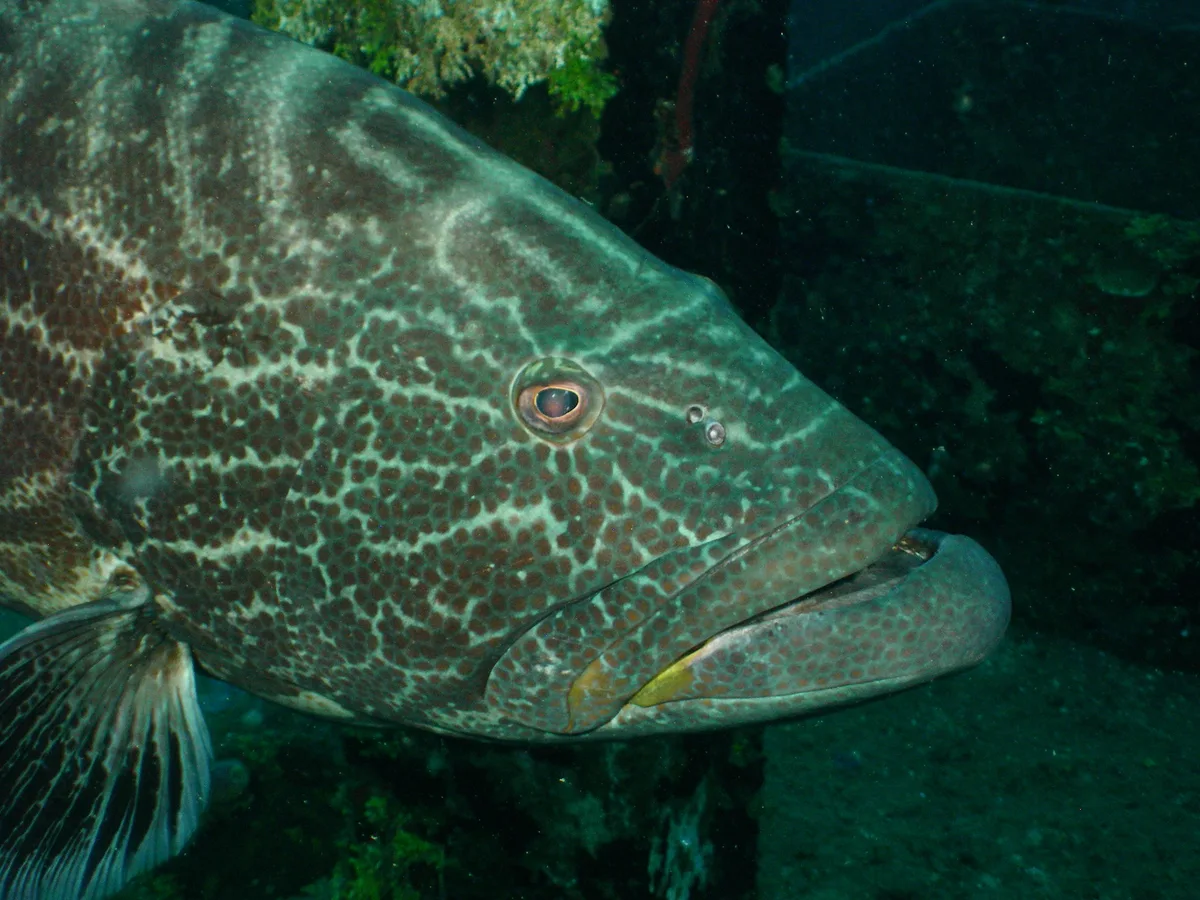
A black grouper up close: the brassy spots and the smooth cheek. Photo: TheMongrelKoi, iNaturalist observation 45276886, Bay Islands, Honduras (CC0)
What to do when a black grouper rocks you
The bottom 20 ft is the hardest part, Giliberti says. Grouper live in holes in the reef and the wrecks, and a hooked keeper usually swims right back to its hole. His advice: fresh line, a fresh leader and good knots, because a big grouper will test all three.
If it locks in, don’t break it off yet. Open the bail or put the reel in free spool and let the line go slack, so the fish thinks it’s safe and swims out. Watch the slack line for any move. When it moves, close the bail, wind tight and pull hard to get it coming your way. “Sometimes you wait 15 minutes or more in free-spool for that opportunity,” Keys light-tackle angler Daniel Delph told Salt Water Sportsman.
The story behind that quote is a black grouper. George Poveromo dropped a pinfish in 250 ft at the Dry Tortugas, on 20 lb braid, a 40 lb fluorocarbon leader and a 4/0 hook. The fish rocked up, and he got four tries at it. After about 45 minutes, the boat’s drift and the drag finally pulled it into open water, and they boated a 55 lb black grouper.
Black grouper size limit, bag limit and season (2026)
Black grouper must be at least 24 in (61 cm) total length in Gulf and South Atlantic federal waters. These are the rules as they stood on November 17, 2026.
| Water | Minimum size | Bag limit | Season |
|---|---|---|---|
| Gulf federal waters | 24 in (61 cm) | Inside the 4-grouper total per person; charter captain and crew keep zero | Open through December 31, 2026; from 2027 closed January 1 to June 30, open July 1 to December 31 |
| South Atlantic federal waters | 24 in (61 cm) | 1 gag or black per person, inside the 3 grouper and tilefish total; 2 gag or black per private boat a day | Closed January through April; open May 1 to December 31 |
| Florida Gulf state waters (not Monroe County) | 24 in (61 cm) | Up to 4, inside the 4-grouper total; charter captain and crew keep zero | Open all year |
| Florida Atlantic state waters and all Monroe County state waters | 24 in (61 cm) | 1 gag or black, inside the 3-grouper total; 2 gag or black per boat a day; charter captain and crew keep zero | Open May 1 to December 31 |
The South Atlantic boat limit changed on October 28, 2026. Before that, a private boat could keep two gag and two black. Now it’s two in any mix. On a charter or headboat it’s two per trip, and the captain and crew keep none. The boat limit only counts with two or more anglers aboard. Three anglers on a private boat still go home with two. Florida’s Atlantic and Monroe County state waters carry the same two-fish boat limit.
Gulf federal waters also had a closure from February 1 through March 31 past 20 fathoms (120 ft). That closure ended on October 2, 2026. On November 17, 2026, FWC’s grouper page and NOAA’s black grouper page both still listed it. The federal rule text is what counts.
To fish for grouper from a private boat in Florida, sign up for the State Reef Fish Survey first. The 2027 Gulf closure is a federal rule, so check FWC for state waters early in 2027. In the South Atlantic, carry a descending device rigged with at least a 16 oz weight and 60 ft of line. The grouper hub has every grouper’s rules, gag and red grouper included, in one place.
How big do black grouper get?
FWC gives a black grouper up to 48 in and 180 lb, and calls 40 lb common. NOAA says up to 5 ft and up to 180 lb. The IGFA calls it perhaps the largest grouper of its branch of the family in the Atlantic.
The IGFA all-tackle record weighed 124 lb. Tim Oestreich II caught it in the Gulf of Mexico off Texas on January 11, 2003. Florida’s state record is 113 lb 6 oz, caught near the Dry Tortugas. A big black grouper is an old fish: NOAA gives them up to 30 years.
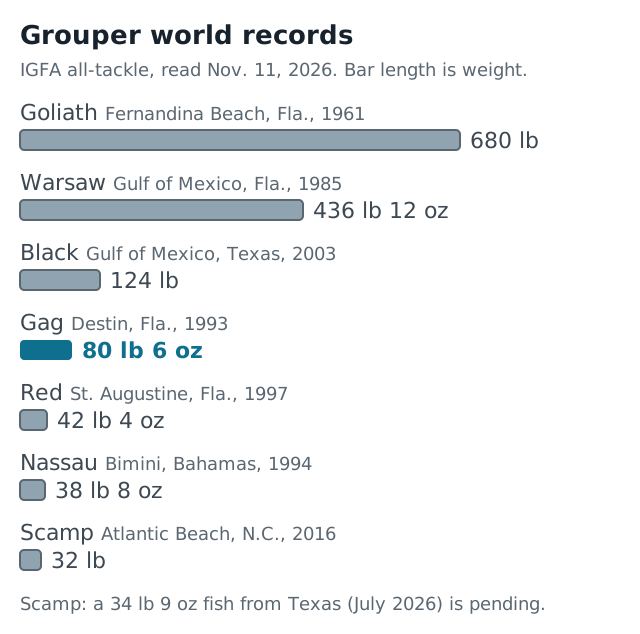
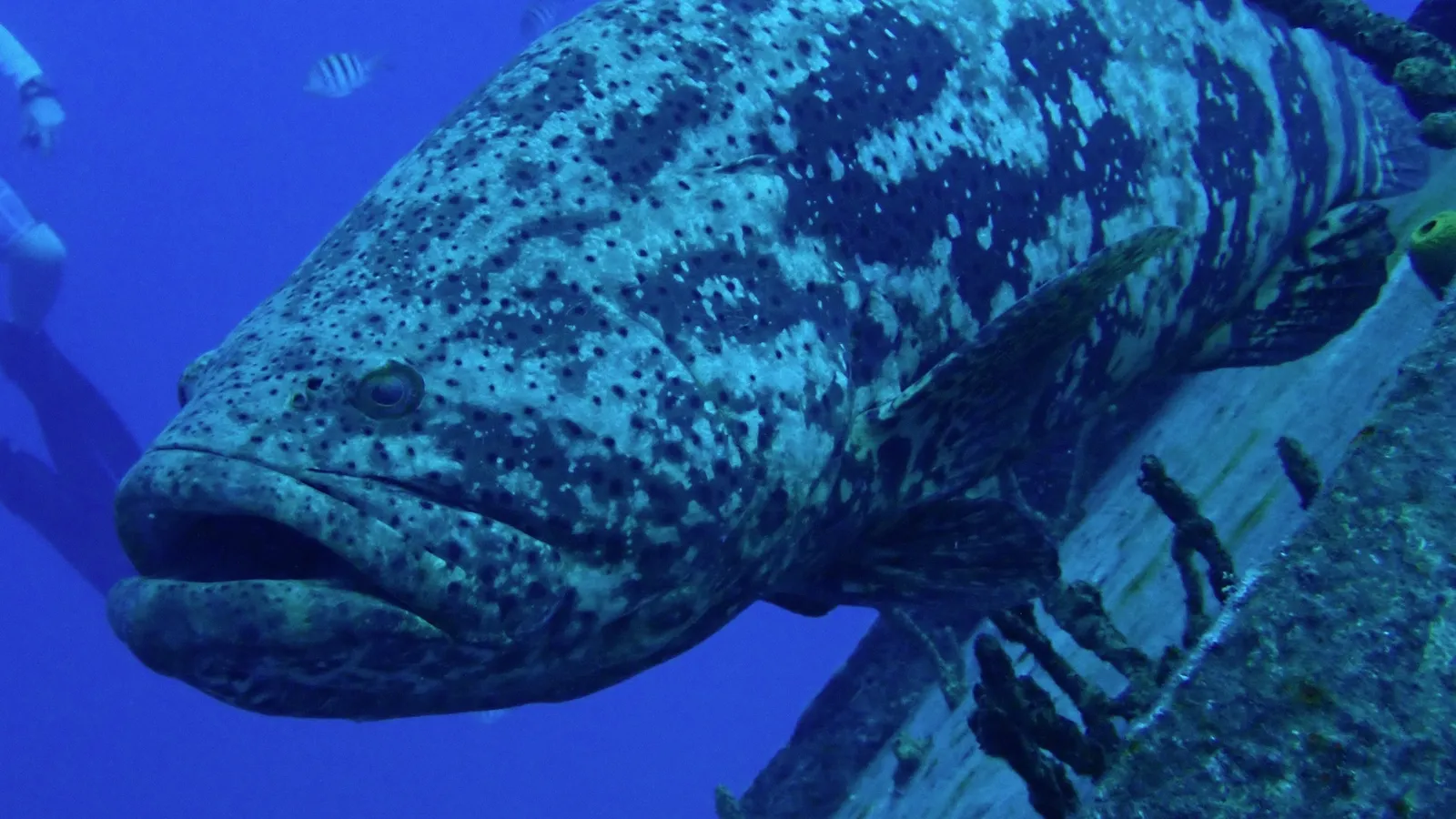
Of the seven groupers US anglers meet most, only two have a bigger IGFA record. The goliath grouper record is 680 lb and the Warsaw’s is 436 lb 12 oz. The gag record, at 80 lb 6 oz, is well short of the black.
Is black grouper good to eat?
Yes. NOAA describes grouper as mild but distinct, somewhere between bass and halibut, with firm, flaky meat. It says gag and black grouper are very similar in taste and texture. Red grouper is sweeter and milder than black, NOAA adds, and many people like red best.
One warning belongs to the fish. The CDC names grouper among the reef fish you may want to avoid because of ciguatera, a poison from tiny algae around coral reefs. You can’t see, smell or taste it, and “cooking does not destroy the toxins,” the CDC says. Don’t eat the liver, guts, eggs or head, where the toxin is strongest. Check your state’s fish advisory for the water you fish.
The biology behind the fishing
Black grouper start life as females, and some turn male as they grow. That usually happens at 2 to 4 ft long, around 11 to 14 years old. There’s about one male for every four females. Most of the year they live alone. In the spawning season they gather and spawn in huge numbers, and the South Atlantic’s January–April closure is there to protect the peak of it.
Good to know: A black grouper usually turns male at 2 to 4 ft long, around 11 to 14 years old.
The young eat mostly shrimp. Adults eat fish and squid, and the bigger fish sit deeper. Black grouper also show up to feed when other fish gather to spawn, NOAA says. Sharks eat the big ones. Other groupers and moray eels eat the small ones.
NOAA lists the Gulf and South Atlantic stock as not overfished, but that rests on a 2010 assessment. On 2023 catch numbers, it wasn’t being fished too hard either. A 2026 federal rule adds that black grouper in the Gulf couldn’t be assessed, for lack of data. Anglers landed 100,000 lb of black grouper in 2024, NOAA counts, against 2.8 million lb of red grouper. Every fish counts, so when you catch a short one, let it go in good shape.

Free PDF · 16 pages
Stop guessing. Know what's biting before your first cast
A whole Saturday on the water with nothing to show for it. One reading tells you who's feeding.
The Water Temperature Fishing Chart. Take one water temperature reading, find it on the chart, and see which of 26 freshwater fish are spawning, feeding hard or slowing down.
- Where bass, crappie, bluegill and walleye sit, and what to throw. Trout: the reading where you stop.
- Why a 3 ft drop beats a cold front, and what to throw each day of the front
- The three thermometer mistakes that make a reading lie
The chart's numbers come from state fish and wildlife agencies and fisheries research: 61 sources, each listed on the site.
No card, nothing to buy. Confirm with one click and the PDF is on its way, one version for your phone and one to print, yours to keep. Then a few short emails and one a week on what's biting, with an unsubscribe link in every one. Privacy.
Related
Section guide
Grouper: The Seven Types, the Rules and How to Catch OneGrouper fish: gag, red, black, scamp, Warsaw, Nassau and goliath. How to tell them apart, the size, bag and season rules by coast, and how to catch one.
 Goliath Grouper: Size, Record, the Rules and How to Catch One
Goliath grouper reach 8 ft and 800 lb. The 680 lb record, how to tell one apart, Florida's harvest lottery, slot-fish tackle and how to release a giant.
Sources (21)
- NOAA Fisheries, Black Grouper
- NOAA Fisheries, Red Grouper
- FWC species profile, Black grouper
- FWC species profile, Gag grouper
- Florida Fish and Wildlife Conservation Commission, Groupers (recreational regulations)
Show all 21 sourcesShow fewer sources
- eCFR, 50 CFR 622.37 and 622.38, Gulf reef fish size and bag limits
- eCFR, 50 CFR 622.30, required gear for Gulf reef fish
- eCFR, 50 CFR 622.185 and 622.187, South Atlantic snapper-grouper size and bag limits
- eCFR, 50 CFR 622.183, South Atlantic area and seasonal closures (shallow-water grouper closed January through April)
- eCFR, 50 CFR 622.188, required gear for South Atlantic snapper-grouper
- Federal Register 91 FR 36545 (June 17, 2026), Reef Fish Fishery of the Gulf of America, Shallow-Water Grouper Management Measures
- Federal Register 91 FR 63502 (October 6, 2026), Reef Fish Fishery of the Gulf of America, Amendment 62
- Federal Register 91 FR 61160 (September 28, 2026), Snapper-Grouper Fishery of the South Atlantic, Regulatory Amendment 36
- IGFA World Record Search: Grouper, black
- Sport Fishing (Steve Waters), Fish South Florida's Prime Grouper Season (2020)
- Keys Weekly (Capt. Bill Giliberti), 'Tis the season: grouper season (2023)
- Salt Water Sportsman (George Poveromo), Bottomfish Tactics (2019)
- Salt Water Sportsman (David Conway), Florida Keys Wreck Fishing Tactics (2020)
- The Tackle Room, Grouper Fishing Guide: How to Catch Gag, Red and Black Grouper
- CDC Travelers' Health, Food Poisoning from Seafood (ciguatera and scombroid)
- Wikipedia, Mycteroperca bonaci