 By
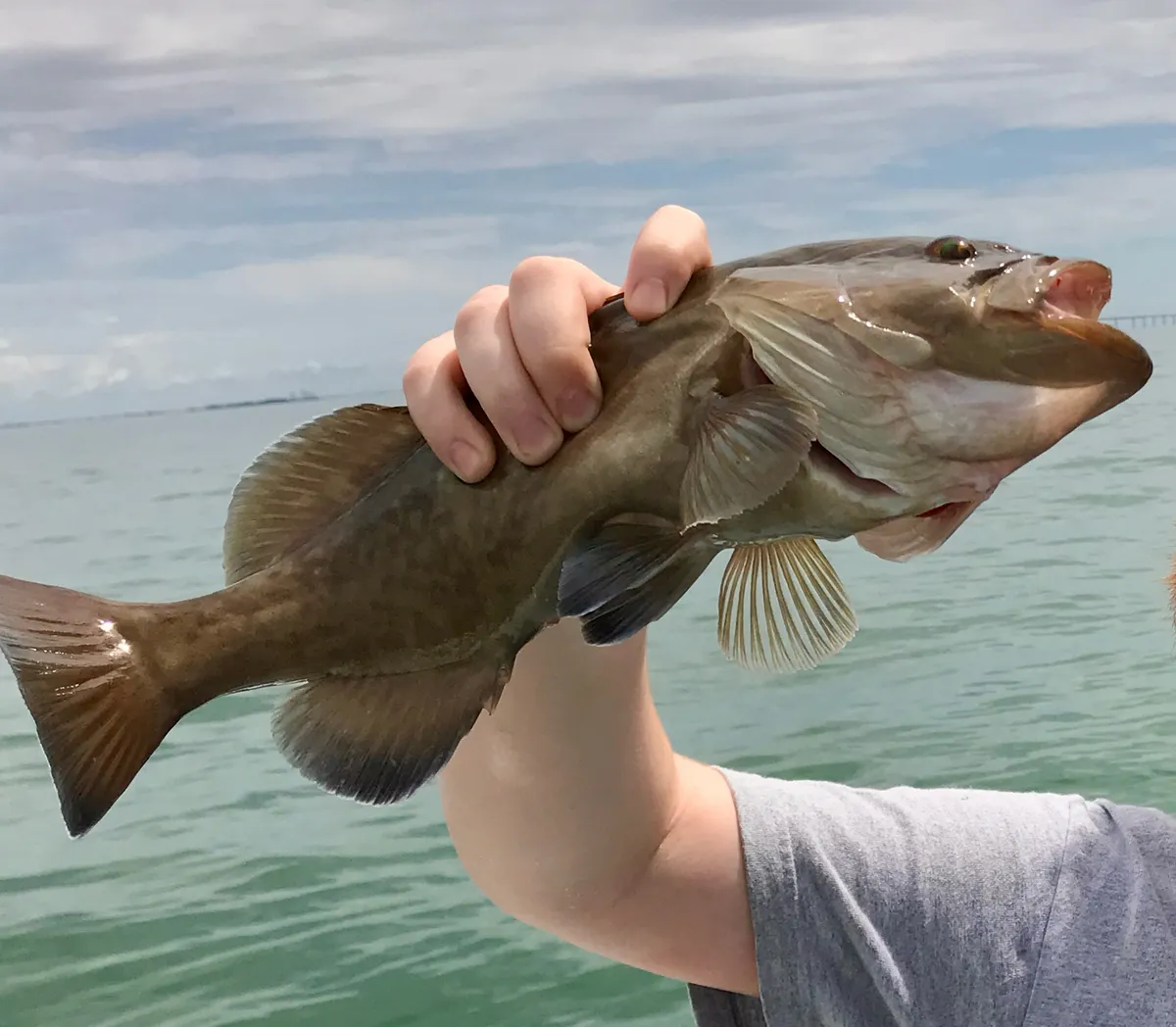
Anglers landed 2.8 million lb of red grouper in 2024, NOAA says, more than twice their 1.2 million lb of gag. Red grouper live on hard bottom from the Carolinas around Florida into the Gulf, and they’re common in 10 to 60 ft (3–18 m) of water. Drop a live pinfish to the bottom, and when it eats, reel it up before it gets back into the rocks. In federal waters you can keep one at 20 inches or longer, in season.
Red grouper build their own spots. NOAA calls them “marine engineers”: they dig out flat bottom, and spiny lobster, black grouper and vermilion snapper move into what they make.
How do you identify a red grouper?
Check the mouth. FWC says a red grouper’s mouth is lined in scarlet-orange. The body is brownish-red, with irregular white blotches on the sides. NOAA adds black spots on the cheeks and a belly that shades pink or reddish.
One look-alike matters most, because you can’t keep it.
| Mark | Red grouper | Nassau grouper |
|---|---|---|
| Body | Brownish-red, white blotches, pinkish below | Light beige with five dark brown bars |
| Top of the tail base | No big black spot | Large black saddle blotch |
| Mouth | Lined in scarlet-orange | Don’t go by the mouth. Check the tail base |
| Can you keep it? | Yes, 20 in and up, in season | No. Possession is prohibited in US waters |
Red or Nassau? FWC names the Nassau as the red grouper’s look-alike. Check the top of the tail base. A large black spot there means Nassau, and NOAA says possession is prohibited in the United States. Let it go at once.
Red or gag? A big gag is dark brownish-gray above with traces of dark wavy marks on the sides, NOAA says. The grouper guide has the ID table for all seven US grouper, plus the cheek check that tells a gag from a black.
How big do red grouper get?
Most of the reds you catch will be close to keeper size. FWC calls them common to 20 inches and 15 pounds. At the top end, NOAA says they reach almost 50 inches and more than 50 pounds. They grow slowly, and UF/IFAS says one can take many years to reach the minimum size.
The biggest one on record weighed 42 lb 4 oz (19.16 kg). Del Wiseman Jr. caught it off St. Augustine, Florida, on March 9, 1997. It’s the IGFA all-tackle world record, and FWC lists the same 42 lb 4 oz as Florida’s state record.
That fish stands well above the rest. On the IGFA line-class list, no red heavier than 28 lb holds a record. Here are the heaviest ones.
| Line class | Record | Year, place |
|---|---|---|
| Women’s 30 lb | 28 lb (12.7 kg) | 2012, Naples, Florida |
| Men’s 50 lb | 27 lb (12.25 kg) | 2025, Gulf, Florida |
| Men’s 30 lb | 26 lb 1 oz (11.83 kg) | 2005, Tarpon Springs, Florida |
| Women’s 16 lb | 26 lb (11.79 kg) | 2005, Key West, Florida |
| Women’s 20 lb | 26 lb (11.79 kg) | 2005, Key West, Florida |
| Men’s 12 lb | 25 lb 8 oz (11.56 kg) | 2007, Port Canaveral, Florida |
| Men’s 80 lb | Vacant | — |
IGFA World Record Search, Grouper, red, read November 17, 2026.
So a 30 lb red is heavier than any line-class record on that list. And the men’s 80 lb class has no record at all yet.

Free PDF · Water temperature chart Which fish are biting at today's water temperature?
One reading, and the 16-page chart shows which of 26 fish are spawning, feeding hard or slowing down; for bass, crappie, bluegill and walleye, where they sit and what to throw. Every number sourced.
No card, nothing to buy, and the PDF is yours to keep. Confirm with one click and it's on its way. Then a few short emails and one a week on what's biting. Unsubscribe anytime. Privacy.
Where do red grouper live, and how deep?
On hard bottom. The IGFA gives the range as North Carolina to southern Brazil, the Gulf included, with strays as far north as Massachusetts. NOAA calls them shallow-water grouper because they’re common in 10 to 60 ft.
- Depth: UF/IFAS Extension puts the common range wider, 10 to 300 ft, with some as deep as 1,000 ft.
- Bottom: ledges, crevices and caves in limestone reef, and lower live bottom with sponges and corals, NOAA says. UF/IFAS adds rocks and artificial wrecks.
- Holes in flat ground: reds dig out flat bottom, NOAA says. The IGFA says adults rest in potholes on rocky, flat bottom and rarely live around coral reefs. A hole on otherwise flat ground is worth a drop.
- Young fish live on grass beds, rocks and reefs close to shore, then move offshore as they grow. UF/IFAS says they head out to hard bottom around age 5.
Water temperature moves them. FWC says they prefer 66 to 77 °F (19–25 °C). UF/IFAS says red grouper go deeper when the water is warm and come shallower as it cools. That’s why the Pasco County extension calls January the perfect time to target them on Florida’s Gulf coast: cold water brings them shallow, and the season is open.
How do you catch red grouper?
Live bait on the bottom, right on the hard stuff. UF/IFAS says a small pinfish or a grunt will usually be eaten quickly, and frozen bait or lures work too. Its list of good baits: pinfish, grunt, squid, octopus, shrimp, crab, and a jig head tipped with squid. That matches the menu. NOAA lists fish, octopus, shrimp, lobsters and mantis shrimp, and says a red will eat any convenient prey.
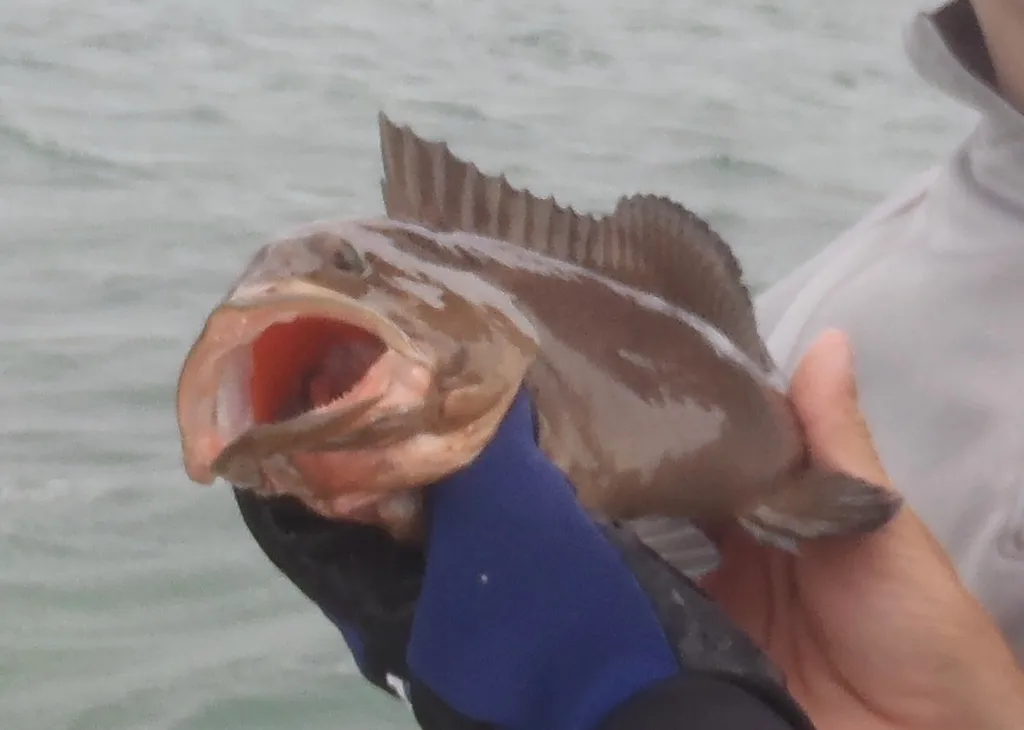
A red’s big mouth, lined in scarlet-orange, takes a bait in whole. Photo: Rose Zappa, iNaturalist observation 79542469, Monroe County, Florida (CC BY 4.0)
Where to fish. Off Sarasota, Capt. Mike Adams ran past the wrecks and reefs closer to port to natural hard bottom in 50 to 60 ft, Salt Water Sportsman reported. “These fish don’t get hammered like those that hang around the more accessible wrecks and reefs,” he said. Anchoring produces the most consistent results, the story says. Drifting with an eye on the fish finder lets you scout a spot and mark where the fish hold.
Lures. Salt Water Sportsman says red grouper can’t resist a bouncing bucktail jig or a swimbait. When the wind made it hard to stay on the spot, the crew cast bucktail jigs, let them fall to the bottom and worked them back with erratic retrieves. Both anglers caught red grouper. A big swimbait yo-yoed straight off the transom took a pair more.
The first seconds. This is where you win or lose a red. UF/IFAS says a hooked grouper rushes back into the rocks, so reel it up as soon as it hits, before it breaks your line on the structure. A stiff rod and a heavy conventional reel get it off the bottom fast.
What rig and tackle for red grouper?
Salt Water Sportsman’s crew caught keeper grouper on knocker rigs and chunks of sardine. The Carolina-style sliding-sinker rig in our grouper guide works too. Here’s the grouper tackle from that Gulf trip:
| Part | Small grouper | Big grouper |
|---|---|---|
| Rod | 20 to 30 lb spinning | 50 to 80 lb conventional (30 to 50 lb for medium fish) |
| Line | 20 to 30 lb braid | 50 to 100 lb braid |
| Leader | 30 lb | 50 to 100 lb |
| Hook | In-line circle hook, 4/0 to 8/0 | In-line circle hook, 4/0 to 8/0 |
| Bait | Chunks of sardine, herring, ballyhoo or squid | The same chunks, or live pilchards or pinfish |
The circle hook isn’t optional. With natural bait in the Gulf, federal rules require non-stainless steel circle hooks. Florida’s Gulf state waters add non-offset, with the point in line with the shank. Our hook size chart shows what 4/0 to 8/0 looks like.
Red grouper rules in 2026: size, bag limit and season
The short version: 20 inches in all federal waters, 2 a day in the Gulf, and no red grouper in the South Atlantic from January through April. Lengths are total length. These are the federal recreational rules as they stood on November 17, 2026.
| Water | Minimum size | Bag limit | 2026 season |
|---|---|---|---|
| Gulf, federal | 20 in (51 cm) | 2 red per person, inside the 4-grouper total | Open, with no closed months since October 2, 2026. Can close early if the catch limit is reached |
| South Atlantic, federal | 20 in (51 cm) | Inside the 3-fish grouper and tilefish total | May 1 to December 31. Closed in May off North and South Carolina |
On a charter or headboat in the Gulf, the captain and crew keep no grouper. In Florida’s Gulf state waters, FWC lists red grouper as open all year, except in Monroe County. On the Atlantic side it lists May 1 through December 31, and the Keys follow that on the Gulf side too. Fishing from your own boat in Florida? Sign up for the State Reef Fish Survey first.
The Gulf deep-water closure is gone
Since 2013 the Gulf closed red grouper from February 1 through March 31 past 20 fathoms (120 ft). Amendment 62 removed that closure, effective October 2, 2026. NOAA’s red grouper page still lists it, and so does FWC’s grouper page. Don’t let an old table keep you home in February. From January 1, 2027, red will be the only shallow-water grouper the change opens up. Gag, black and scamp have closures of their own in those months.
Why it went: the closure may have pushed anglers inshore, the rule says. Reds there are generally smaller, so more may get thrown back under the 20-inch limit. The Gulf stock was not overfished on the 2025 assessment.
The Gulf can close early. The federal rule closes the recreational season when anglers reach, or are projected to reach, the yearly catch limit. That happened every year from 2021 through 2024. The 2026 limit went up, to 2.11 million lb gutted weight. Before a late-year trip, check that the season is still open.
South Atlantic and the gear you must carry
In the South Atlantic all shallow-water grouper close January through April, every year. Off North and South Carolina, red grouper stay closed through May. That stock is overfished (2017). Inside the 3-fish grouper and tilefish bag, only one fish may be a gag or black.
Here’s the gear the rules call for when you bottom fish for grouper. The hook rules apply when you fish natural bait.
| Water | Hooks | You must carry |
|---|---|---|
| Gulf, federal | Non-stainless steel circle hooks | A dehooking tool |
| South Atlantic, federal | North of 28° N: non-offset, non-stainless steel circle hooks | A dehooking tool and a descending device with at least a 16 oz weight and 60 ft of line |
| Florida state waters | Gulf side: non-stainless, non-offset circle hooks | A dehooking tool, and a descending device or venting tool rigged and ready |
Other states set rules for their own waters, so check yours before you go.
How do you release a red grouper caught deep?
Send it back down. Bring a red up fast from deep water and the gas in its swim bladder expands. That’s barotrauma, and NOAA asks you to use a venting tool or a descender on any fish that shows it. UF/IFAS says to use a descending device in water deeper than 50 ft.
You have two tools for it. A descending device is a weighted hook, lip clamp or box that holds the fish while you lower it back to depth, then lets it go. A venting tool lets the gas out of the swollen belly, which makes it easier for the fish to get back down to deep water, NOAA says. In the South Atlantic you have to carry the descending device anyway, so learn to use it. No descender yet? UF/IFAS points you to Return ’Em Right, which sends free release gear to eligible anglers.
A red grows slowly and can take many years to reach 20 inches, so you’ll put some back. Get each one down fast. Our catch and release guide covers the handling.
Tip: Fishing deeper than 50 ft? Rig the descending device before the first drop, not after the first short fish comes up.
Is red grouper good to eat?
Yes. NOAA describes red grouper as mild but distinct, somewhere between bass and halibut. It calls red sweeter and milder than black grouper, and says many people find red the tastier of the two. It’s low in saturated fat and a good source of protein, selenium and vitamins B6 and B12, NOAA adds.
One warning comes with any grouper. The CDC lists grouper among the fish that can carry ciguatera, a reef-fish toxin, and says cooking does not destroy it. The grouper guide has the full ciguatera note. Check your state’s fish consumption advice too.
The biology behind the fishing
They start as females. Red grouper mature at 4 to 6 years as females, NOAA says. Some turn male later, most often between ages 7 and 15, so the share of males climbs with age. The minimum size limits are there to protect immature red grouper, NOAA says.
They spawn often, in shallow water. Close to 26 times a year, from February through June, NOAA says. Off Florida’s central Gulf coast, Salt Water Sportsman says reds gather to spawn in April and May.
They live long. The oldest red on record was 29, from the Gulf. In the South Atlantic it was 26.
They eat by suction. A red opens its big mouth, flares its gill covers and pulls in a rush of water with the prey in it. NOAA calls them unspecialized and opportunistic: they eat whatever is handy.
For the other six grouper and how their rules compare, start at the grouper guide. The giant of the family has its own page: goliath grouper.

Free PDF · 16 pages
Stop guessing. Know what's biting before your first cast
A whole Saturday on the water with nothing to show for it. One reading tells you who's feeding.
The Water Temperature Fishing Chart. Take one water temperature reading, find it on the chart, and see which of 26 freshwater fish are spawning, feeding hard or slowing down.
- Where bass, crappie, bluegill and walleye sit, and what to throw. Trout: the reading where you stop.
- Why a 3 ft drop beats a cold front, and what to throw each day of the front
- The three thermometer mistakes that make a reading lie
The chart's numbers come from state fish and wildlife agencies and fisheries research: 61 sources, each listed on the site.
No card, nothing to buy. Confirm with one click and the PDF is on its way, one version for your phone and one to print, yours to keep. Then a few short emails and one a week on what's biting, with an unsubscribe link in every one. Privacy.
Related
Section guide
Grouper: The Seven Types, the Rules and How to Catch OneGrouper fish: gag, red, black, scamp, Warsaw, Nassau and goliath. How to tell them apart, the size, bag and season rules by coast, and how to catch one.
 Black Grouper: How to Tell It From Gag, the Rules and How to Catch One
Black grouper reach 180 lb and must be 24 in to keep. How to tell one from a gag, the season and bag rules by coast, and the South Florida baits and rigs.
 Goliath Grouper: Size, Record, the Rules and How to Catch One
Goliath grouper reach 8 ft and 800 lb. The 680 lb record, how to tell one apart, Florida's harvest lottery, slot-fish tackle and how to release a giant.
Sources (18)
- NOAA Fisheries, Red Grouper
- NOAA Fisheries, Gag Grouper
- NOAA Fisheries, Nassau Grouper
- eCFR, 50 CFR 622.37 and 622.38, Gulf reef fish size and bag limits
- eCFR, 50 CFR 622.34, seasonal and area closures for Gulf reef fish
Show all 18 sourcesShow fewer sources
- eCFR, 50 CFR 622.30, required gear for Gulf reef fish
- eCFR, 50 CFR 622.185 and 622.187, South Atlantic snapper-grouper size and bag limits
- eCFR, 50 CFR 622.183, South Atlantic area and seasonal closures
- eCFR, 50 CFR 622.188, required gear for South Atlantic snapper-grouper
- Federal Register 91 FR 63502 (October 6, 2026), Reef Fish Fishery of the Gulf of America, Amendment 62
- Florida Fish and Wildlife Conservation Commission, Groupers (recreational regulations)
- Florida Fish and Wildlife Conservation Commission, Reef Fish Gear Rules
- Florida Fish and Wildlife Conservation Commission, State Reef Fish Survey
- FWC species profile, Red grouper
- IGFA World Record Search: Grouper, red
- UF/IFAS Extension Pasco County, Gulf Coast Catch and Cook January: Red Grouper
- Salt Water Sportsman (Alex Suescun), Florida Gulf of Mexico Snapper and Grouper Bottomfishing
- CDC Travelers' Health, Food Poisoning from Seafood (ciguatera and scombroid)