 By
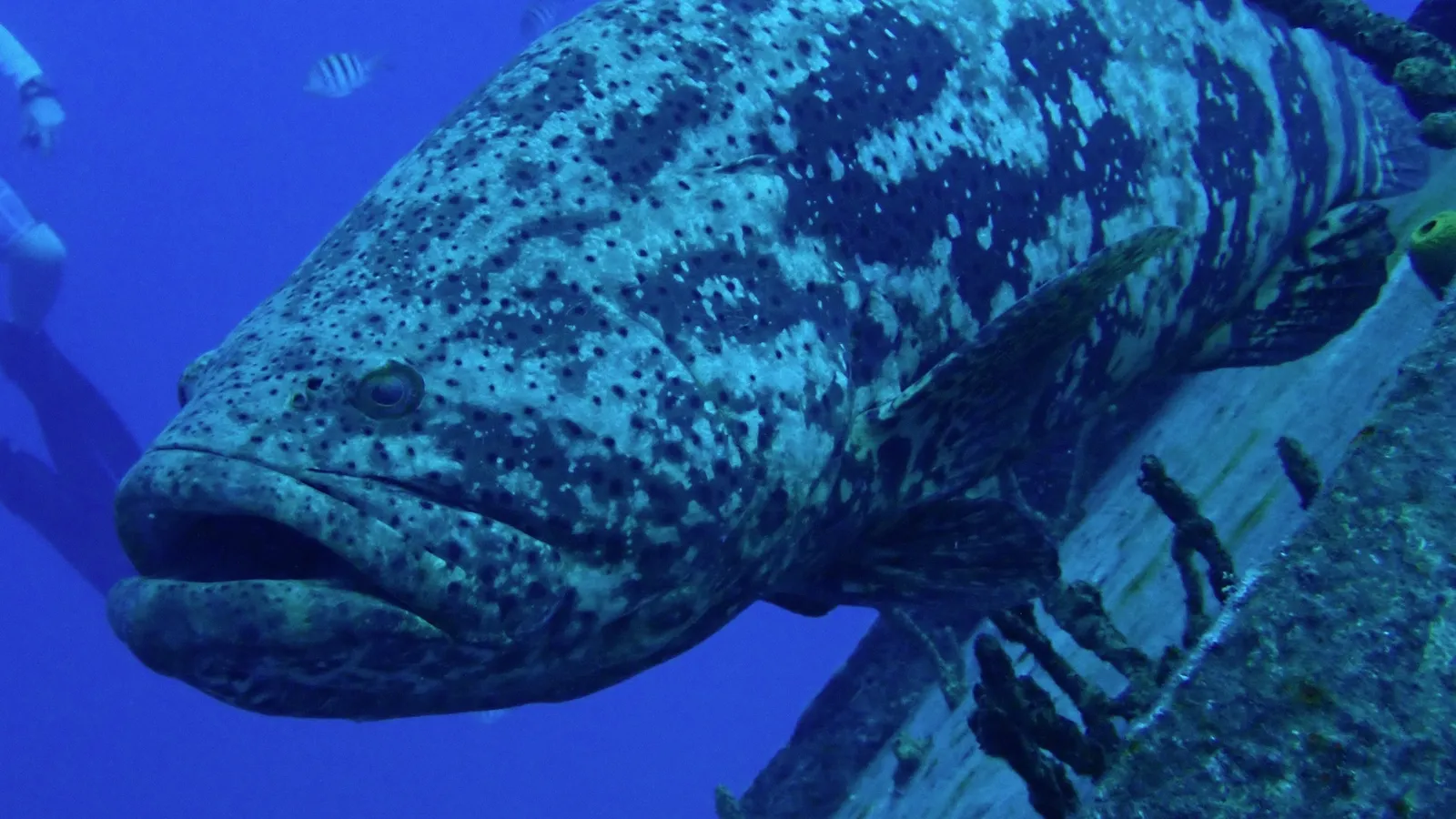
The goliath grouper is the biggest grouper in the Atlantic: up to 8 ft (2.4 m) and 800 lb (363 kg). In Florida you’ll find them around bridges, docks, wrecks and reefs, mostly in the south of the state. You can hook one almost anywhere they live. You can keep one only with a lottery permit, and only a young fish of 24 to 36 inches.
In 2023, the first year, Florida handed out 200 permits to keep a goliath grouper. Only 26 of the winners kept one.
How big do goliath grouper get?
Big. FWC puts the top end at 8 ft and 800 lb, and NOAA gives the same weight. That’s the largest grouper in the western Atlantic.
The biggest one ever caught on rod and reel weighed 680 lb (308.44 kg). Lynn Joyner landed it off Fernandina Beach, Florida, on May 20, 1961. It’s still the IGFA all-tackle world record and Florida’s state record, and it sits on our list of the biggest fish ever caught. It came on 80 lb line, so it holds that line-class record too.
That record won’t fall soon. Look at the rest of the IGFA list and every goliath record over 300 lb is old. They were all set between 1956 and 1981, before the harvest closed in 1990.
| Line class | Record | Year | Where |
|---|---|---|---|
| 6 lb | 309 lb 8 oz (140.38 kg) | 1977 | Flamingo, Florida |
| 12 lb | 365 lb 8 oz (165.78 kg) | 1975 | Flamingo, Florida |
| 20 lb | 344 lb 12 oz (156.37 kg) | 1976 | Flamingo, Florida |
| 30 lb | 430 lb (195.04 kg) | 1967 | Ft. Lauderdale, Florida |
| 50 lb | 369 lb (167.37 kg) | 1956 | Marathon, Florida |
| 80 lb | 680 lb (308.44 kg) | 1961 | Fernandina Beach, Florida |
| 130 lb | 455 lb 8 oz (206.61 kg) | 1981 | Marco Island, Florida |
Men’s line-class records over 300 lb for goliath grouper, IGFA World Record Search, read November 14, 2026.
Yes, that first record is a 309 lb fish on 6 lb line. Kenny Bittner caught it at Flamingo, Florida, in 1977.
How do you tell a goliath from other grouper?
Check the size first, then the spots and the tail. A goliath has tiny dark spots on the head and fins, irregular dark bars down the sides, small eyes set forward, and a rounded tail. FWC calls out one more mark: the dorsal spines are low and all nearly the same height.
The young ones are the easiest to spot. FWC says a goliath has five dark bands, and they show best on small fish.
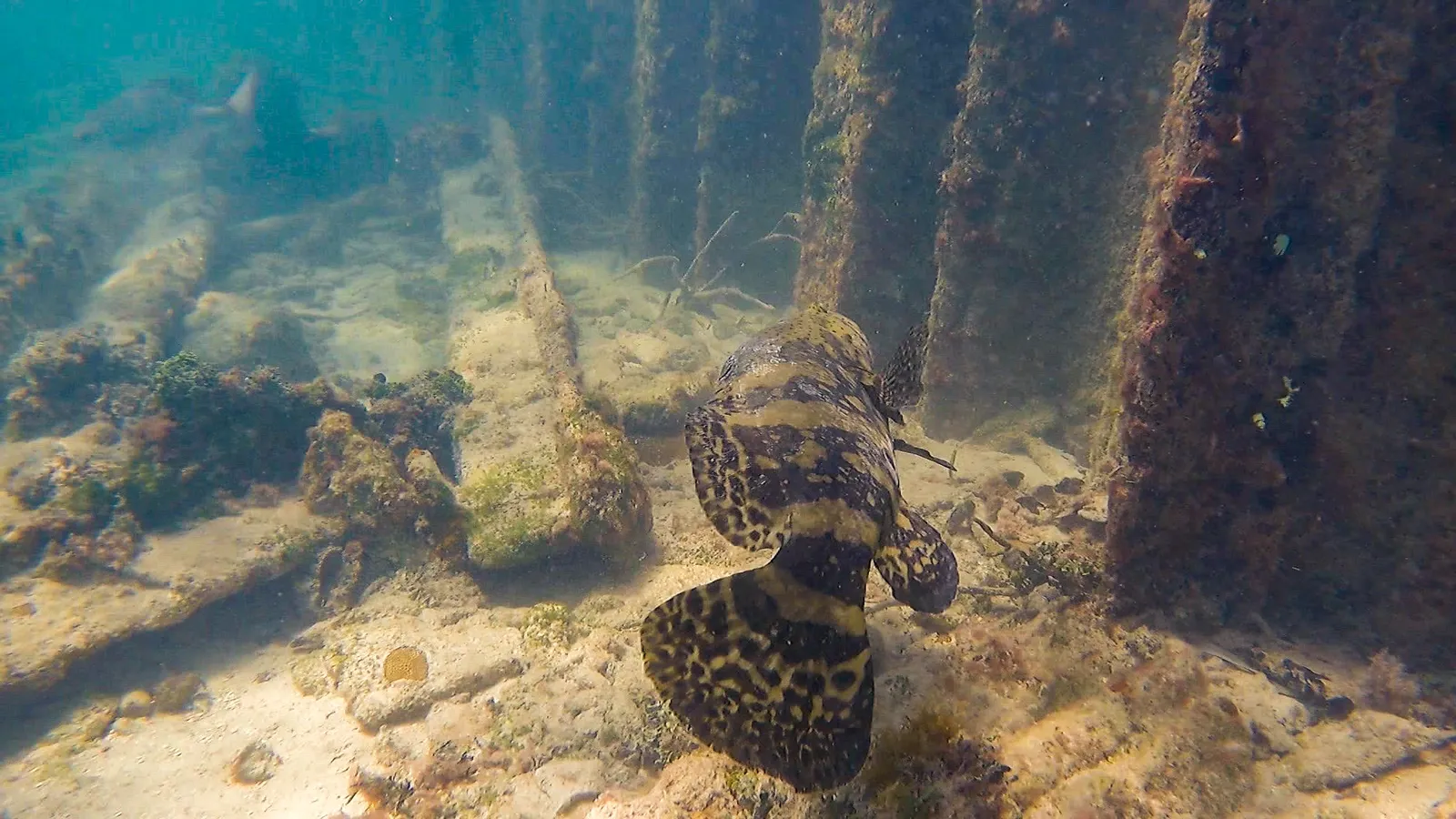
A young goliath between dock pilings, its dark bands plain to see. Photo: Marissa Balfour, iNaturalist observation 87945603 (CC0)
The fish people mix it up with is the Warsaw grouper, the other giant. Here’s how to call it.
| Mark | Goliath | Warsaw |
|---|---|---|
| Dorsal spines | Low, all nearly the same height | Second spine very high, taller than the third |
| Tail | Rounded | Squared off |
| Color | Spots on head and fins, dark bars on the sides | One even color, no real markings |
| Where | Shallow structure, bridges, docks, wrecks | Rocky bottom in water over 200 ft (61 m) |
Against the grouper you’d keep, size settles it fast. Gag, red and black grouper max out far smaller. Our grouper guide has the ID table for all seven US species, with their size and bag rules.
Free PDF · Water temperature chart Which fish are biting at today's water temperature?
One reading, and the 16-page chart shows which of 26 fish are spawning, feeding hard or slowing down; for bass, crappie, bluegill and walleye, where they sit and what to throw. Every number sourced.
No card, nothing to buy, and the PDF is yours to keep. Confirm with one click and it's on its way. Then a few short emails and one a week on what's biting. Unsubscribe anytime. Privacy.
Where do goliath grouper live?
Florida is the place. FWC says they’re more common in the south of the state than in the north. NOAA lists the Gulf, the Florida Keys, the Bahamas, most of the Caribbean and most of Brazil’s coast. Now and then one turns up as far north as Massachusetts or Maine.
Where in the water depends on age.
- Young fish live in estuaries and mangroves for up to 5 or 6 years. FWC names the Ten Thousand Islands in southwest Florida as a center for them. They also sit under bridges and docks and on artificial reefs.
- Adults move out to shallow reefs, then to reefs and wrecks offshore. FWC says they like high relief: overhangs, ledges, bridges, piers and shipwrecks.
- Depth: the IGFA says they’re usually inside the 12-fathom line, about 72 ft (22 m), though they can go deeper.
Out of the spawning season an adult keeps to itself. FWC calls them solitary, sedentary and territorial. That’s why the same big fish lives on the same wreck, and why it’s right there when you hook a snapper.
In summer that changes. In the eastern Gulf, goliath gather to spawn in groups of 100 or more on wrecks, rock ledges and patch reefs, July through September. They may swim up to 62 miles (100 km) from inshore reefs to get there. Spawning runs June to October overall, FWC says, with the peak in July, August and September.
Can you keep a goliath grouper?
Only in Florida state waters, only with a permit, and only a young one. Federal waters are closed. Goliath “may not be harvested or possessed” in the Gulf or the South Atlantic federal zone, and that’s been the rule since 1990. In Florida, harvest is prohibited without a permit.
Florida’s Goliath Harvest Program opened in 2023. Here’s how it works in 2026.
| Rule | What it says |
|---|---|
| Permits | 200 a year, by random-draw lottery. Up to 50 fish from Everglades National Park |
| Apply | October 1–15 each year, at GoOutdoorsFlorida.com or a license agent. $10 to apply |
| If you win | $150 for a Florida resident, $500 for a nonresident. Permit and tag can’t be transferred |
| The fish | 1 per person per season, 24–36 in (61–91 cm) total length |
| Season | March 1 to May 31 |
| Gear | Hook and line only. Non-offset, non-stainless circle hooks with natural bait. A dehooking device for any goliath you release |
| Closed | State waters of Martin County, St. Lucie River included, south through the Atlantic coast of the Keys. Dry Tortugas National Park. All federal waters |
| After | Tag the lower jaw at once. Report within 24 hours and send in a fin clip if your permit asks for one. No fish? Report “no harvest” within 24 hours after the season ends |
Miss the October window and you wait a year. The draw is for the season the next spring.
In 2023, the first season, only 26 of 200 permit holders kept a fish, Florida Sportsman reported. The average one was 31 in. Most came from two counties: 11 from Collier and 10 from Monroe. St. Lucie, Manatee, Volusia and Indian River had one each. That’s the only season we’ve found a count for.
There are two permit types. Category I lets you fish all open areas, Everglades National Park included. Category II covers the same areas minus the park. You can apply for both but win only one.
No one is exempt. FWC says you need the goliath permit even if you’re under 16, over 65 or hold a lifetime license. You need a saltwater fishing license too, unless you’re exempt from that. A fishing or hunting violation on your record in the past five years keeps you out of the draw. So does a harvest report you never filed on an earlier permit.
Why the slot is so small: those are kids. FWC numbers quoted by Florida Sportsman put a 24-inch goliath at 2 to 4 years old and a 36-inch fish at about 4 to 5. The slot stops right where FWC says goliath first mature: about 36 inches, at 5 or 6 years. Males mature at about 42 inches, females at 47 to 53 inches and 6 to 7 years.
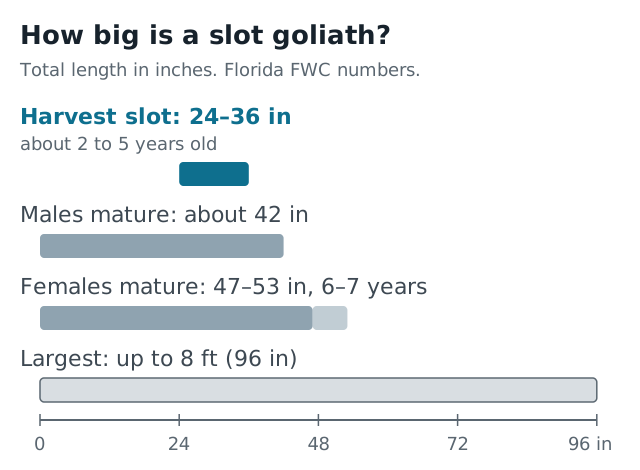
FWC says plainly what the lottery is for and what it isn’t. Adults stay off-limits statewide, and so do goliath in the busy dive areas. The harvest “is not intended to address fishing depredation concerns.” It won’t stop a big goliath from eating your snapper.
How do you catch a goliath grouper?
Fish a natural bait on the bottom, tight to structure. They eat what’s slow and easy. FWC says calico crabs make up most of the diet, plus other shellfish and fish. A goliath sucks prey in whole with a fast open of that huge mouth. Now and then one will grab a fish struggling on a line. FWC says they haven’t been shown to chase down fast fish like snapper.
For a slot fish, go inshore. Captain Tim Simos of Fort Pierce told Florida Sportsman he skips the ocean reefs and wrecks, because that’s where the big ones are. Fish just inside the inlet instead, he says: the edges of the channel in 15 feet or so, or the first bridges you come to. He also says clear water hurts your odds of a big goliath far more than a small one. Given the choice, he’d fish the incoming tide. He figures he could catch a slot fish on eight trips out of ten.
His tackle is heavy for a 3 ft fish, because a much bigger goliath can still take the bait.
| Part | Simos’ pick for a slot goliath |
|---|---|
| Reel | Large spinning reel, such as a PENN 6500 or 7500 |
| Line | 80 lb braid |
| Leader | 9 to 10 ft of 200 to 400 lb test |
| Hook | Eagle Claw 8/0 to 11/0 black or bronze circle hook |
| Weight | 2 or 3 oz, on a sliding knocker rig or tied 3 ft above the bait with waxed nylon. No swivels |
| Bait | Downsize: a pinfish or a mullet |
On a knocker rig the weight slides right down to the bait. The program requires circle hooks that are non-offset and non-stainless when you fish natural bait, so check the package for both. Our hook size chart shows how big an 8/0 to 11/0 really is.
For a big one, you’re fishing catch and release. Every goliath over the slot goes back, permit or not. The big fish are on the ocean reefs and wrecks, Simos says, and that’s where snapper and grouper anglers run into them. Anglers have a common refrain, Florida Sportsman says. You “can’t get a snapper or grouper to the surface before a goliath grouper helps itself to the catch.”
How do you release a goliath grouper?
Leave it in the water. That’s FWC’s first rule, and it’s not about manners. “The skeletal structure of a large goliath grouper cannot support its weight out of the water,” FWC says. Pull one onto the boat and it may die from the injuries.
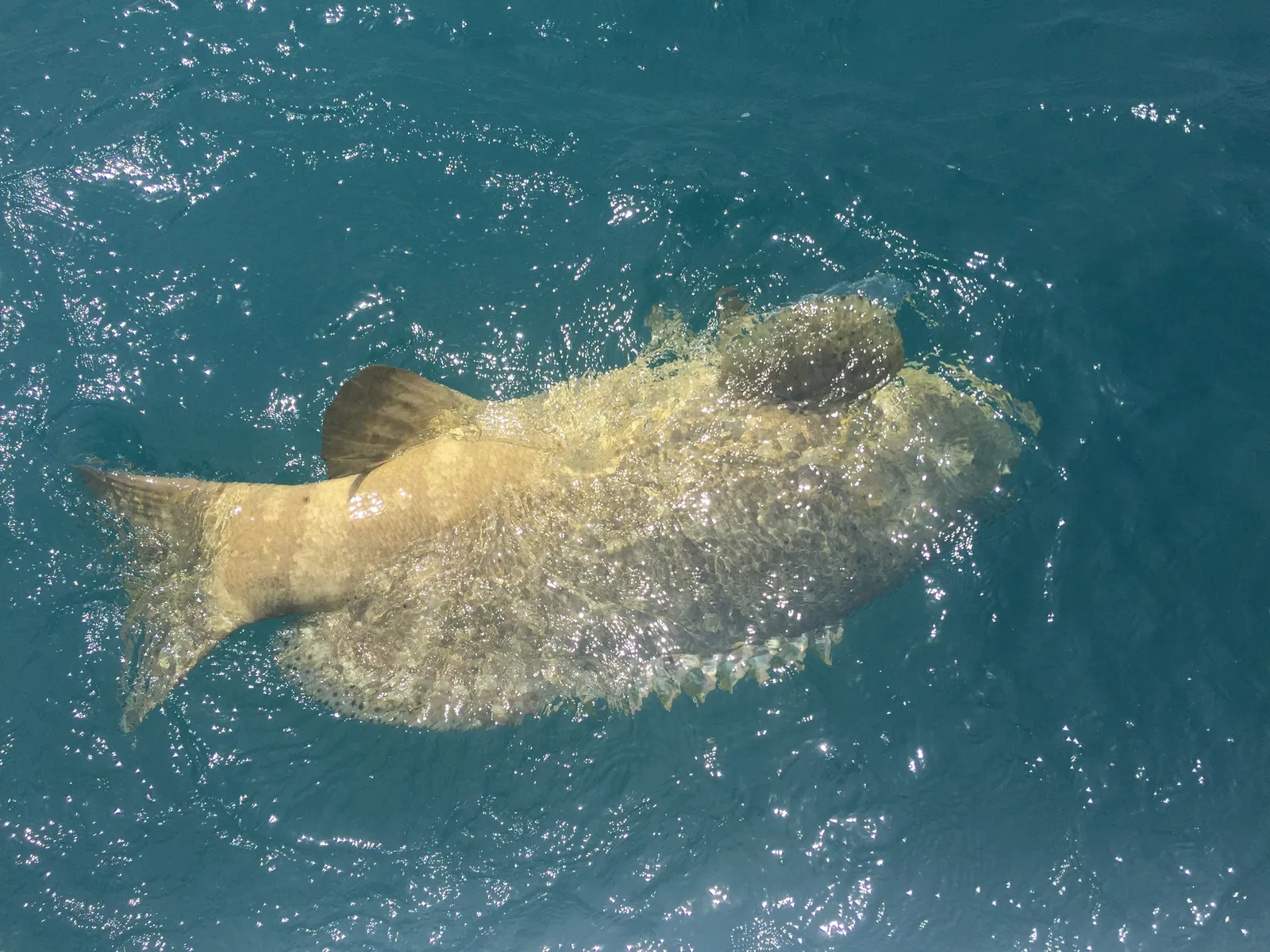
A goliath at the surface, still in the water. Photo: Dominic Alianelli, iNaturalist observation 24794052 (CC0)
What to do, by FWC:
- Release it right away, alive and unharmed. Only a permit holder with a legal slot fish can keep one.
- Keep it in the water, big or small. FWC asks you to unhook small goliath in the water too.
- In South Atlantic federal waters, the law goes further. Cut the line and release it without taking it out of the water.
- If it’s bloated from the depth, the sign of barotrauma, send it back down with a descending device or venting tool.
- Take a photo only if it doesn’t slow the release in any way.
Our catch and release guide covers the rest of handling a fish you’re putting back.
Is goliath grouper good to eat?
Hardly anyone gets the chance: harvest has been closed since 1990, and the lottery allows 200 fish a year. If you win a permit, think about mercury first.
FSU’s Coastal and Marine Laboratory tested young and adult goliath off both Florida coasts. They had “extraordinarily high” mercury, higher than any other grouper in the western Atlantic and the Gulf. That’s a fish you’d want to check against Florida’s fish consumption advice before it goes on the grill.
Why are goliath grouper protected?
Because they were nearly fished out. Anglers and commercial boats chased them from at least the late 1800s. By 1990 the population in the Southeast had fallen almost to extinction, FSU says, mostly from overfishing and habitat loss.
FWC lists what makes them easy to overfish. They gather in big numbers at the same spots every year to spawn. They live long. Their nursery mangroves keep shrinking. And they die in big events: cold snaps and red tide.
FSU says water below 51 °F (11 °C) has killed off every young fish born in a year. Red tide in Lee and Collier counties in 2003 and 2005 left large goliath dead on southwest Florida beaches. NOAA notes a few were mistaken for baby manatees.
Here’s how the protection played out:
- 1990: harvest closed in federal waters of the Southeast and in Florida.
- 1991: NOAA named the goliath, then still called jewfish, a candidate for the Endangered Species Act.
- 2006: NOAA took it off its species of concern list, crediting the success of the harvest ban.
- 2011: a petition to list it as threatened or endangered failed. NOAA found it didn’t warrant listing.
- 2023: Florida opened its small harvest lottery.
FWC doesn’t run a normal stock assessment on goliath. Since 2018 it has tracked five measures instead, from adult numbers on natural reefs to how many older fish are in the population.
The biology behind the fishing
A goliath lives a long time. FWC thinks the average is 30 to 50 years. The oldest one aged so far was at least 37. Once it’s full grown, only large sharks prey on it. Before that, barracuda, king mackerel, moray eels and sandbar and hammerhead sharks can take one, FWC says.
The young settle in mangrove leaf litter and stay in the mangroves for 5 or 6 years. Then they move to shallow reefs and on to the adults offshore. On those reefs a goliath digs out sand around the base. FSU says that adds to the structure and brings more kinds of fish to the spot.
For the other six groupers and the rules on each, start at our grouper guide.

Free PDF · 16 pages
Stop guessing. Know what's biting before your first cast
A whole Saturday on the water with nothing to show for it. One reading tells you who's feeding.
The Water Temperature Fishing Chart. Take one water temperature reading, find it on the chart, and see which of 26 freshwater fish are spawning, feeding hard or slowing down.
- Where bass, crappie, bluegill and walleye sit, and what to throw. Trout: the reading where you stop.
- Why a 3 ft drop beats a cold front, and what to throw each day of the front
- The three thermometer mistakes that make a reading lie
The chart's numbers come from state fish and wildlife agencies and fisheries research: 61 sources, each listed on the site.
No card, nothing to buy. Confirm with one click and the PDF is on its way, one version for your phone and one to print, yours to keep. Then a few short emails and one a week on what's biting, with an unsubscribe link in every one. Privacy.
Related
Section guide
Grouper: The Seven Types, the Rules and How to Catch OneGrouper fish: gag, red, black, scamp, Warsaw, Nassau and goliath. How to tell them apart, the size, bag and season rules by coast, and how to catch one.
Sources (12)
- Florida Fish and Wildlife Conservation Commission, Goliath Grouper (regulations, catch and release, Goliath Harvest Program, life history)
- Florida Fish and Wildlife Conservation Commission, Goliath Grouper Harvest Permit
- Florida Fish and Wildlife Conservation Commission, Reminder: Applications for the limited recreational harvest of goliath grouper in state waters close Oct. 15
- FWC species profile, Goliath grouper
- FWC species profile, Warsaw grouper
Show all 12 sourcesShow fewer sources
- NOAA Fisheries, Atlantic Goliath Grouper
- eCFR, 50 CFR 622.33, Gulf reef fish prohibited species (goliath grouper)
- eCFR, 50 CFR 622.181, South Atlantic prohibited species (goliath grouper)
- IGFA World Record Search: Grouper, goliath
- Florida State University Coastal and Marine Laboratory, Goliath Grouper-About
- Florida State University Coastal and Marine Laboratory, Mercury on the Rise in Goliath Grouper
- Florida Sportsman, Catch (and Keep) a Slot Goliath (April 30, 2024)