 By
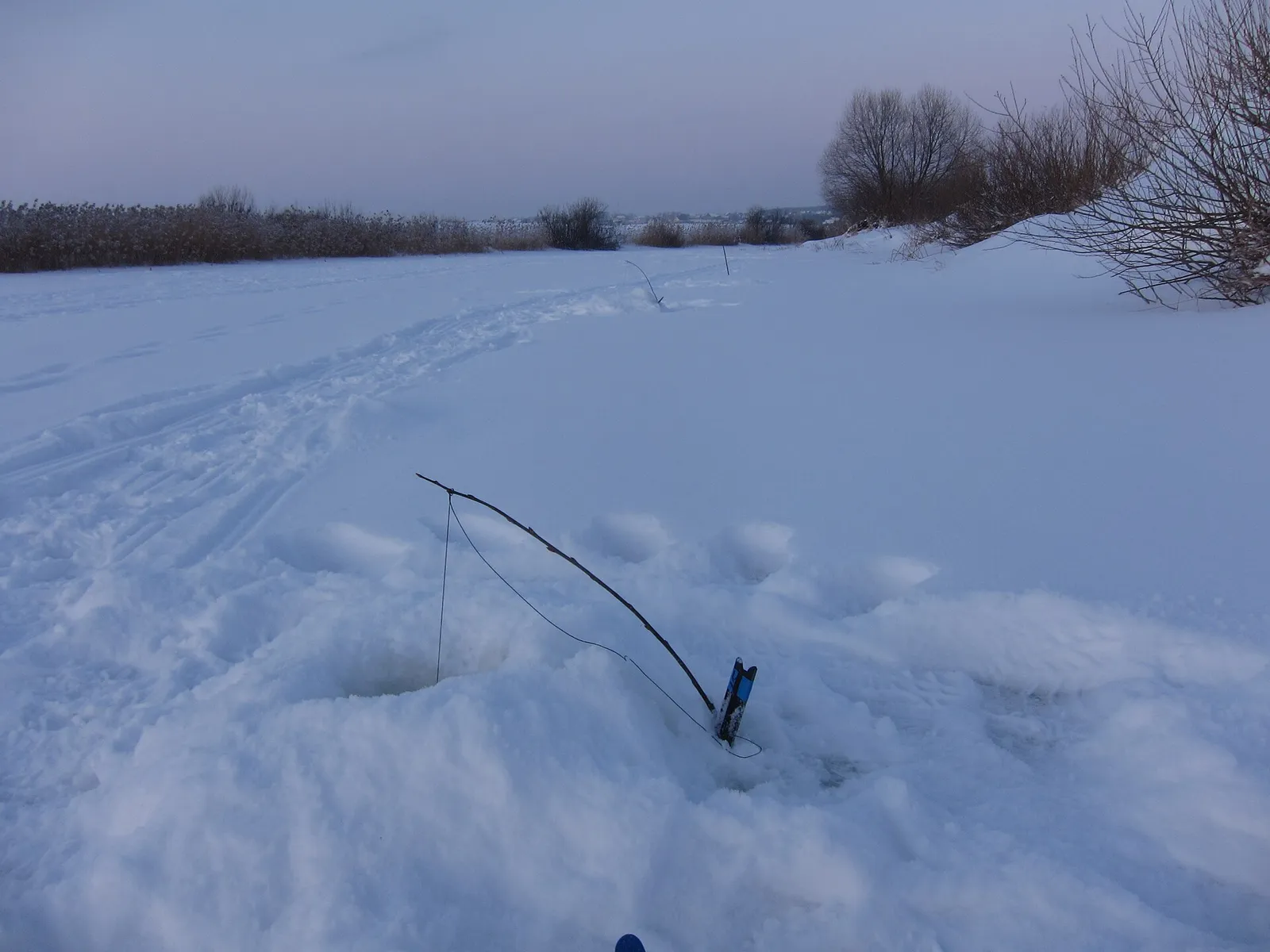
An ice fishing rod holder keeps a second rod still over its own hole while you jig the first. A good one costs under $10. For most anglers the first one should clip to the 5-gallon bucket you already carry. Want to see a bite from a few holes away? Then get a tip-down, a holder that lets the rod dip toward the hole when a fish pulls. Our picks come from the makers’ own pages and prices, read November 22, 2026, and nobody fished these holders for this page.
If the rod you’re not jigging catches most of the fish, you may be jigging too hard. That’s Minnesota DNR’s tip for perch, and it’s the whole case for a second rod in a holder.
What does a rod holder do on the ice?
It holds your dead stick: a second rod with a live minnow, left alone beside the hole you jig. Minnesota DNR says perch anglers commonly jig one rod and leave the other one alone. On crappie, the agency calls the jigging rod a “calling rod”. It pulls fish to your hole, and they bite the still minnow on the second line.
Walleye work the same way. Outdoor Life’s Jason Halfen puts it plainly. Call them in with a jigging spoon, then get them to bite a minnow set nearby at the same or similar depth. So set the dead stick’s minnow at the depth you’re jigging.
The holder’s job is to keep that rod steady and let the fish take the bait without feeling the rod. Halfen’s point about walleye is that the fish shouldn’t feel any pressure until it’s too late. That’s why deadstick rods are softer than jigging rods. More on the rod itself is on our ice fishing rod page.
A holder also keeps the reel out of the snow. Even HT’s $3.79 combo holder is sold on that: it keeps rod and reel combos above the ice and slush.
Which kind of ice fishing rod holder do you need?
Six kinds cover the shelf. Pick by where you sit and how you want to see the bite. Holders for the bank, the boat and the kayak are on our fishing rod holders page.
| Kind | How you see a bite | Where it sits | One example (maker’s price) |
|---|---|---|---|
| Bucket clip | Watch the rod tip | On the rim of a 5 or 6 gal bucket | HT Clamp-On Bucket Rod Holder, $8.99 |
| Folding stand | Watch the rod tip | On the ice by the hole | HT Lift N’ Hook, $9.99 |
| Tip-down | The rod tips toward the hole, some pop a flag | On the ice by the hole | HT Ice Master tip-down, $20.99. Clam Arctic Warrior, $39.99 |
| Shelter or sled mount | Watch the rod tip | Bolted to a shelter tub, hub or sled | Otter Adjustable, $20.00, for a dead stick. ClamLock 4 Position, $49.99, parks rods upright |
| Rattle reel (no rod) | A rattle sounds as line pulls off | On a fish house or ClamLock wall | ClamLock Horizontal Rattle Reel, $59.99 |
| Hook-setter | It sets the hook itself | On the ice over the hole | Jaw Jacker, Clam Predator ($79.99) |
Bucket clips and folding stands: start here
A bucket clip is the cheapest way in. HT’s wire version is $2.99 and “attaches to the rim of almost any kind of pail.” Its $8.99 clamp-on model sets at any angle. Clam’s $14.99 single holder clips on a bucket lip. Later it bolts to a shelter tub, so it moves with you when you buy a flip-over.
A folding stand does the same job on the ice. HT’s Lift N’ Hook folds flat to carry. The maker’s whole instruction fits on one line: when a fish strikes, grab your rod and set the hook.
Tip-downs: see the bite from a few holes away
A tip-down is a balanced holder. The rod rests on a pivot, and a fish pulling line tips the rod toward the hole. Clam’s Arctic Warrior adds a flag that pops up as the rod tips down. You fight the fish on your own rod, not hand over hand like a tip-up. Clam sells it for walleye, pike, lake trout and jumbo perch.
HT’s Ice Master is the cheap one at $20.99. It unfolds next to the hole, takes your jig pole and stands high off the ice. Its Rock-It combo, $39.99, comes rigged with a 28 in medium-power rod and reel. The upright extends from 16 to 27 inches (41–69 cm), and red reflective tape helps you see it in low light.
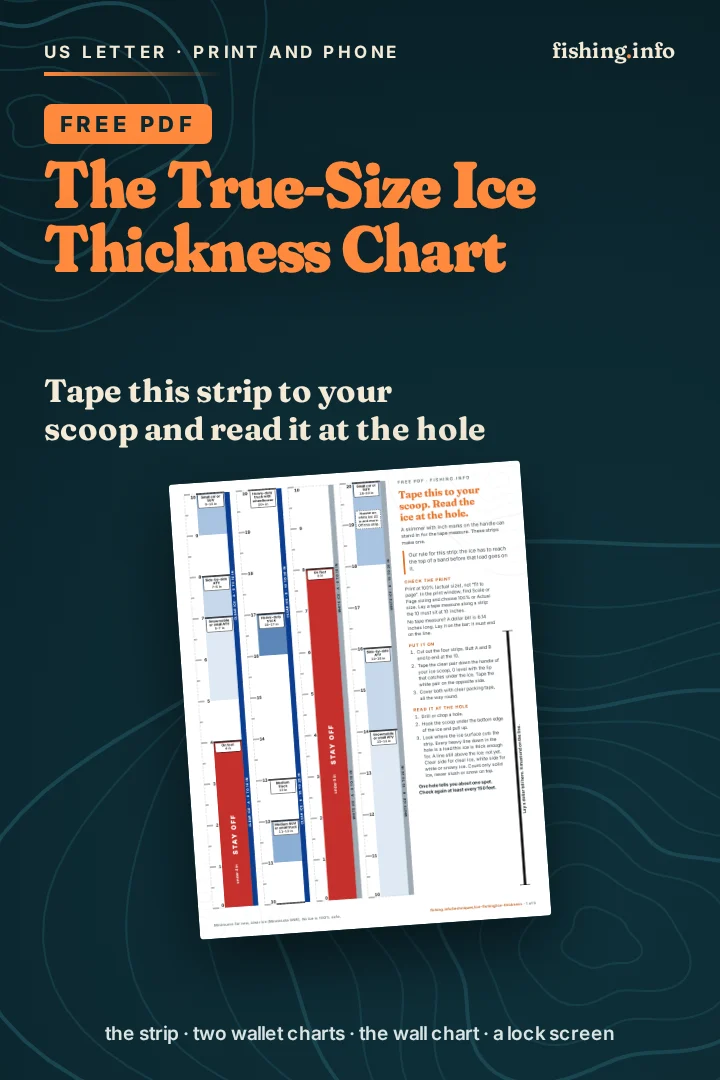
Free PDF · Ice thickness chart How thick is the ice? Read it at the hole.
Print the free chart, tape the strip to your scoop and hook it under the ice. It shows what that ice is thick enough for, clear or white. Two wallet charts and a wall chart come with it.
No card, nothing to buy, and the PDF is yours to keep. It's in your inbox a minute later. Then a few short emails and one a week on what's biting. Unsubscribe anytime. Privacy.
How do you set a dead stick in a holder?
Here’s the setup, from the agencies and Outdoor Life’s ice rod writers.
- Drill two holes close together. You jig one and the dead stick sits in the other. Keep them close, because the jig calls the fish to the minnow.
- Use a soft rod. Halfen says deadstick rods are often 36 in or longer, medium-light, moderate action. Pair it with a 1000 reel and limp 4–6 lb fluorocarbon.
- Hang a live minnow at the jig’s depth. Halfen’s walleye setup puts it at the same or similar depth as the spoon.
- Set the reel so a fish can run. Here’s Jim Edlund’s old-school way. Lay the rod on a 5-gallon bucket, with a rubber band around the top of the handle. Loop the line loosely under the band with the bail open. A fish pulls the loop free and runs, and you set the hook when it’s time.
- Watch it. Most holders give you nothing but the rod tip. Keep it where you can see it from the hole you’re jigging.
- Read what it tells you. If the still rod out-fishes your jig, slow your jigging down. That’s Minnesota DNR’s perch tip again.
Which holder for a shelter or a sled?
In a hub shelter, go with a mount. Clam built its ClamLock holders to mount over the hub of a hub shelter. The base plate also fits a flip-over tub or the wall of a fish house. Clam sells them as a place to park rods, not to fish them. For a dead stick, use the Otter or a bucket clip. You buy the $14.99 base plate once. Single, two-rod and four-rod holders mount on it, from the two-rod horizontal (on sale at $9.99 on November 25, list $34.99) to $49.99 for the four-position.
On a sled, look at Otter’s $20.00 steel holder with a pivoting arm. Otter says it mounts in its own sleds and wheel houses, and in most other sleds and shelters. It’s built for “fishing a dead stick and multiple lines.” For more ways to rig a sled, see our ice fishing sled guide.
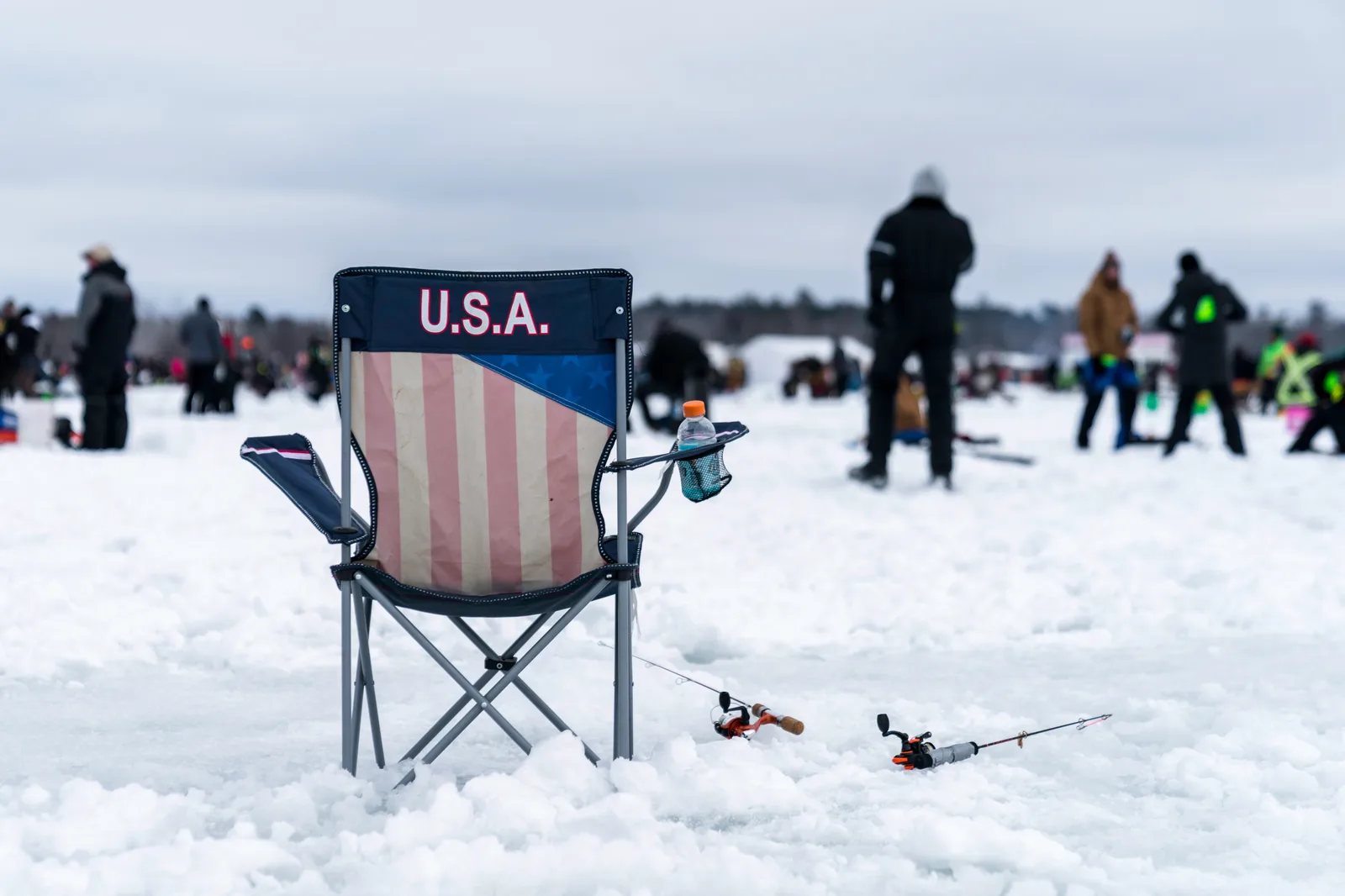 Two ice rods laid in the snow at the Brainerd Jaycees Ice Fishing Extravaganza on Gull Lake, Minnesota. Photo: Lorie Shaull, Wikimedia Commons (CC BY-SA 4.0)
Can you make your own ice rod holder?
Yes, and cheaply. MeatEater’s Sam Lungren built a rod rack for his sled. He cut a 6 ft PVC pipe into 1 ft pieces and bolted them across the back. On a bucket, all you need is a rubber band, the old-school setup in step 4 above.
Rattle reels: a holder with no rod
In a fish house you can skip the rod. Minnesota DNR describes rattle reels as reels on the wall of the shack, with no rods. They make a sound when a fish takes line. Clam’s $59.99 ClamLock rattle reel “goes off as your line is pulled.” Its tension adjusts to your bait size, so light bites still sound off. Minnesota DNR’s tip: jig one rod and let the rattle reel be your second line. More in our walleye through the ice guide.
Hook-setters: check your state first
A hook-setter holds a bent rod and lets it spring up when a fish bites. On a Jaw Jacker, the trigger lets go of the bent rod “so it can snap up and set the hook,” the maker says. Minnesota’s rules allow spring and bent-rod hook-setters through the ice (Minnesota Rules 6262.0100, announced by the DNR on November 17, 2025). The device can’t reel in line or bring the fish in. The DNR’s printed summary still lists spring hook-setters as unlawful, so carry the rule number. Jaw Jacker notes that some states count its device as a tip-up and others as a line. Our tip-ups page has the details.
Does a rod in a holder count as a line?
Yes. Every rod in a holder is a line, and so is every tip-up. Minnesota’s law allows two lines through the ice, and only one on designated trout lakes and streams. So in Minnesota, one jig rod plus one dead stick is your limit. Add a tip-up and you’re over.
Other states give you more room. Here’s what that means with one jig rod in your hand:
| State | Lines through the ice | Holders or tip-ups next to one jig rod |
|---|---|---|
| Minnesota | 2, and 1 on designated trout lakes and streams | 1, and none on designated trout waters |
| Iowa | 2, tip-ups count. A third-line permit adds one | 1, a rod in a holder or a tip-up. A third-line permit adds one more |
| Michigan | 3, tip-ups included | 2 |
| Wisconsin | 3 hooks, baits or lures | 2, if every line, your jig rod too, carries one hook or bait |
| North Dakota | 4 poles, each tip-up counts as one | 3 |
| New York | 7, in any mix of devices | 6 |
Then there’s how close you have to be. In Minnesota, an unattended line is legal only if you can see it. With a tip-up, you can be up to 200 ft (61 m) away. A phone alert doesn’t count. North Dakota wants poles easily visible and within 150 ft (46 m). A pole not checked for over an hour is an illegal set line. Wisconsin says failing to respond at once to a bite is evidence the line is unattended. So keep the holder where you’d see the rod tip move.
Our ice fishing guide has all twelve states in one table. Rules change by season, so check yours before the first trip.
The picks in detail
HT Clamp-On Bucket Rod Holder: the first one to buy
At $8.99 it’s the cheapest way to fish a dead stick without the rod lying in the snow. HT says the clamp fits any 5 or 6 gallon bucket and sets at any angle. If you fish from a flip-over, look at a holder that bolts to the tub instead.
Clam Single Rod Holder: if you’ll buy a shelter later
It clips on a bucket today and hard-mounts to a shelter tub tomorrow, $14.99. The four-position version, $29.99, bolts to the tub only, and holds the rods you aren’t fishing.
HT Ice Master tip-down: to see the bite from another hole
For $20.99 you can watch a dead stick from a hole or two away, because the rod tips toward the hole on a bite. If you want a flag too, Clam’s Arctic Warrior is $39.99. In a cramped shelter, a plain holder takes less room.
Otter Adjustable Rod Holder: for the sled
Steel, $20.00, with an arm that pivots. Pick it if you fish out of a sled or a flip-over and want a rod held the same way every trip.
Tip: Whatever holder you buy, the rod in it counts as one of your lines. In Minnesota that’s a jig rod and one dead stick, and nothing more.
ClamLock 4 Position Rod Holder: for a hub
Pick it if you fish from a hub shelter with two or three friends and the rods need a home off the floor. It’s $49.99 plus the $14.99 base plate, and the same plate takes Clam’s rattle reel. If you fish alone from a bucket, you don’t need it.
How we chose
We read the makers’ own product pages on November 22, 2026, for each holder’s mounts, features and price, and Clam’s prices again on November 25. How a dead stick is fished comes from the agencies and Outdoor Life’s ice rod writers. The line rules come from each state’s own regulations, the same ones behind our ice fishing guide. For the rest of the kit, our ice fishing gear checklist prices it at three levels. Nobody handled these holders for this page, and we didn’t count owner reviews.
If you only buy one thing for a second line, make it the bucket clip. Then put a minnow on the dead stick at the depth you’re jigging, and watch which rod gets bit.

Free PDF · 5 pages
Stop guessing the ice. Tape this strip to your scoop and read it at the hole
Ice that is 6 or 7 inches thick in one spot can be 2 inches close by. You can't tell by looking.
The True-Size Ice Thickness Chart. Print it, tape the strip to your ice scoop, hook it under the ice and read the band at the surface: on foot, sled or truck. One side for clear ice, one for white.
- A true-size strip for your scoop handle, marked from "stay off" to a truck with a wheelhouse
- Two wallet charts, one for your buddy, with five moves that get you out if you go through
- Why 8 inches of white ice counts as 4, and the ice to stay off at any thickness
Every clear-ice number is the Minnesota DNR's, set beside the 29 sources on the page, the Army Corps of Engineers among them.
No card, nothing to buy. The PDF is in your inbox a minute later, one version for your phone and one to print, yours to keep. Then a few short emails and one a week on what's biting, with an unsubscribe link in every one. Privacy.
Related
Section guide
Ice Fishing Gear: The Checklist and What a Starter Kit CostsThe ice fishing gear and equipment checklist, safety first, priced from makers' stores: a bare kit for about $320, a comfortable one for about $2,010.
 Ice Fishing Rod Case: Hard or Soft, What Size, and 7 Picks
An ice fishing rod case sized to your longest rod: 6 to 8 combos up to about 40 in for $58 to $240. Hard or soft, sled fit, and 7 cases compared.
 Ice Fishing Shanty: What a Fish House Costs, Build or Buy
A new ice fishing shanty starts at $9,735 at Ambush, the one maker that posts prices. Skid house or wheelhouse, build or buy, and the Minnesota rules.
 Ice Auger: What Size, Which Type, and How Many Holes per Charge
Most anglers need an 8 in battery ice auger. Hole sizes, electric vs. drill vs. hand, holes per charge in 12 and 24 in of ice, and 7 augers compared.
 What to Wear Ice Fishing: Layers, Bibs, Float Suits and Boots
What to wear ice fishing: three layers and no cotton, ice fishing bibs or a float suit, boots by their rating and gloves, with makers' prices.
 Ice Fishing Rod and Reel: The Length for Each Fish, and the Picks
Which ice fishing rod length and power for panfish, walleye and pike, inline or spinning reel, which line, and seven picks with the makers' prices.
 Ice Fishing Shelter: Hub or Flip-Over, and 7 Picks by Floor per Pound
Ice fishing shelter or tent: a flip-over to fish alone and move, a hub for two or three. Square feet per pound from maker specs, 7 picks, safe heat.
Sources (32)
- Minnesota DNR, Ice fishing for perch
- Minnesota DNR, Ice fishing for crappie
- Minnesota DNR, Ice fishing for walleye
- Outdoor Life (Dr. Jason Halfen), How To Rig Your Ice Fishing Rods And Reels For Any Fish
- Outdoor Life (Jim Edlund), The Best Ice Fishing Rods
Show all 32 sourcesShow fewer sources
- MeatEater (Sam Lungren), Video: How to Trick Out Your Ice Fishing Sled
- Minnesota Statutes 97C.315, Angling lines and hooks
- Minnesota Statutes 97C.321, Restrictions on unattended lines
- Minnesota DNR fishing regulations, General Regulations (eRegulations)
- Minnesota Rules 6262.0100, subp. 8, Hook-setting devices
- Michigan DNR Fishing Guide, Lawful Fishing Methods (eRegulations)
- Wisconsin DNR, Guide to Wisconsin Hook and Line Fishing Regulations 2026-2027
- North Dakota Game and Fish, 2026-28 Fishing Regulations
- Iowa DNR, General Fishing Regulations (eRegulations)
- New York State DEC, General Freshwater Fishing Regulations
- HT Enterprises, Clamp-On Bucket Rod Holder Adjustable
- HT Enterprises, Lift N' Hook Rod Holder
- HT Enterprises, Premium Rod Combo Holder
- HT Enterprises, Pail Wire Rod Holder
- HT Enterprises, Ice Master 2 in 1 Deluxe Tip Down System
- HT Enterprises, Rock-It Premium Telescopic Tip-Down Combo
- Clam Outdoors, Single Rod Holder
- Clam Outdoors, Four Position Rod Holder
- Clam Outdoors, ClamLock Base Plate
- Clam Outdoors, ClamLock 4 Position Rod Holder
- Clam Outdoors, ClamLock 2 Position Rod Holder Horizontal
- Clam Outdoors, ClamLock Horizontal Rattle Reel
- Clam Outdoors, Arctic Warrior Tip Up
- Clam Outdoors, Predator Tip Up
- Otter Outdoors, Adjustable Rod Holder
- Jaw Jacker Fishing
- Jaw Jacker Fishing, Things To Remember